Article
Printed in Brazil - ©2011 Sociedade Brasileira de Química0103 - 5053 $6.00+0.00A
*e-mail: [email protected]
Dual Bifunctional Catalysis and the
α
-Effect in the Reaction of Hydroxylamine with
Phenylacetate
Deise J. Mazera,a Josefredo R. Pliego Jr.,*,b Gizelle I. Almerindoc and José C. Gesserc
aInstituto Federal de Educação, Ciência e Tecnologia de Santa Catarina,
88103-310 São José-SC, Brazil
bDepartamento de Ciências Naturais, Universidade Federal de São João del-Rei,
36301-160 São João del Rei-MG, Brazil
cDepartamento de Química, Universidade Federal de Santa Catarina,
88040-900 Florianopolis-SC, Brazil
A reação da hidroxilamina com acetato de fenila foi investigada teoricamente para se obter uma melhor compreensão do efeito alfa nas reações de nucleófilos neutros. Os cálculos foram feitos em nível B3LYP/6-311+G(2df,2p)//HF/6-31G(d) incluindo o solvente (água) em nível PCM/HF/6-31G(d). Os resultados mostram que um ataque direto da hidroxilamina leva a uma barreira de energia livre de ativação ∆G‡ muito alta, em torno de 50 kcal mol-1. Uma segunda
molécula de hidroxilamina pode catalisar o processo através de catálise bifuncional usando ambos os grupos NH2 e OH simultaneamente. Esta catálise bifuncional reduz o ∆G
‡para 19 kcal mol-1 e é
capaz de explicar a relação de produtos cinético e termodinâmico observada experimentalmente.
The reaction of hydroxylamine with phenyl acetate was theoretically investigated to shed light on the role of catalysis and the origin of the α-effect in this system. Calculations at the B3LYP/6-311+G(2df,2p)//HF/6-31G(d) level and the solvent effect included at the PCM/HF/6-31G(d) level predict that the direct attack of hydroxylamine to the carbonyl centre has a high ∆G‡ barrier, close
to 50 kcal mol-1. A second hydroxylamine molecule can catalyse the process through bifunctional
catalysis using both the NH2 and OH groups simultaneously. This dual bifunctional catalysis decreases
the ∆G‡ to 19 kcal mol-1 and is able to explain the experimentally observed kinetics and product ratio.
Keywords: acid-base catalysis, organocatalysis, alpha-effect, zwitterionic intermediate, solvent effect
Introduction
Nucleophilicity is a fundamental concept in organic chemistry.1,2 This property is related to the ability of chemical species, having atoms with lone electron pairs, to react with electron-deficient atoms of other molecules. Because basicity is related to reactivity, it is expected that the pKa of a protonated nucleophile is correlated to its nucleophilicity through the Brønsted equation:
log (k) = βpKa + C (1)
However, this simple correlation may not work in many cases. An interesting example where the breakdown of these
simple correlations can take place occurs in species where the nucleophilic atom has a neighbouring atom with lone electron pairs, such as hydrogen peroxide, hydroxylamine, hydrazine and their respective anions. The high and unexpected reactivity of these species is called the α-effect, and the origin of this effect has attracted the attention of many researchers.3-11 In fact, it remains controversial whether the α-effect is intrinsic to the nucleophile or has its origin in the solvent effect for anionic nucleophiles. Although recent high-level theoretical calculations have provided evidence that the α-effect is intrinsic to these nucleophiles,6-8 the solvent effect is very important for these reactions and also contributes for the α-effect.9
simple correlations. In fact, a recent report by Buncel and co-workers3 has shown that the reaction of substituted
phenyl methanesulphonates with OH− and HOO− takes
place through mechanisms leading to different products, and any analysis of the α-effect in this situation may not be meaningful. On the other hand, if the reaction mechanism is different for normal and α-nucleophiles due to special features of the latter and leads to the same kind of product, analysis of the α-effect becomes meaningful. In this paper, we explored hydroxylamine reactivity to show that this species is able to promote its reaction with carboxylic esters through a singular mechanism. We would like to call the attention of the reader to the fact that the α-effect has been widely studied for anionic nucleophiles. In the present case, the α-nucleophile is a neutral species.
Hydroxylamine reactivity with carboxylic esters
Hydroxylamine is an interesting α-nucleophile and
its reactivity has received attention in recent years.12-14 Pioneering studies on the mechanism of the hydroxylamine reaction with carboxylic esters have been reported by Jencks.15,16 This author observed that the reaction of
hydroxylamine with p-nitrophenyl acetate in aqueous
solution leads to O-acylhydroxylamine as the main product with a second order overall kinetics and first order for hydroxylamine. In addition, Jencks reported the hydroxylamine, combined with its protonated species, catalysed the reaction of O-acylhydroxylamine to form hydroxamic acid. Almost forty years after these studies, Hess et al.17 investigated the isotope effects of this reaction. They concluded that the reaction proceeds through the formation of a tetrahedral intermediate and proton transfer is involved in the rate determining step.
In a previous paper,14 we reported an experimental investigation of the reaction of hydroxylamine with five different phenyl acetates. It was observed that for 2,4-dinitrophenylacetate and 2,4,6-trinitrophenylacetate, the kinetics were second order. However, for phenylacetate,
p-chlorophenylacetate and p-nitrophenylacetate, the
kinetics had second and third order terms, the latter being the most important contribution. The third order kinetics were first order for the ester and second order for the hydroxylamine, indicating that the second hydroxylamine molecule acts as a catalyst. Preliminary computations14 suggested the hydroxylamine works as a bifunctional catalyst. The multiple steps of the reaction of hydoxylamine with carboxylic esters are presented in Scheme 1.
The aim of this paper was to use theoretical calculations
to show that the α-effect for reactions involving
hydroxylamine may have its origin in the special features
of hydroxylamine which has unique catalytic properties. The model system used in this report is the reaction of hydroxylamine with phenylacetate.
Calculations
The potential energy surface for the reaction of hydroxylamine with phenyl acetate was investigated by ab initio Hartree-Fock and density functional theory methods. A second hydroxylamine molecule was included in order to evaluate the role of catalysis in this reaction system. Since this study required the investigation of a number of structures, full geometry optimisation and harmonic frequency calculations were done at the HF/6-31G(d) level of theory. For obtaining reliable activation energies, single point energy calculations were done using density functional theory with the B3LYP functional18-20 and the extended 6-311+G(2df,2p) basis set. Previous studies on similar reactions have indicated that this level of theory is reliable.21 Therefore, our gas phase calculations correspond to the B3LYP/6-311+G(2df,2p)//HF/6-31G(d) level. Because the reaction takes place in an aqueous solution, the solvent effect was included through the polarizable continuum model (PCM)22-25 with atomic radii of 1.70 (C), 1.20 (H), 1.50 (O), 1.60 (N) and a scale factor of 1.20 for all atoms, as well as the dielectric constant of water. Only the electrostatic contribution for the solvating free energy was included, and the HF/6-31G(d) wavefunction was used for the PCM computations. The gas phase calculations were done with the Gaussian 98 program system26 and the PCM computations (IEF implementation) were done with the GAMESS program.27 All the reported free energy values correspond to 1 mol L-1 standard state.
Results and Discussion
We investigated many reaction pathways for the reaction with NH2OH and phenylacetate leading to the formation of neutral tetrahedral intermediates. In order to evaluate the importance of catalysis, the pathway for the direct attack of hydroxylamine to phenylacetate was also included. For each mechanism, both the formation of O-acylated and N-acylated products were considered.
Direct hydroxylamine attack leading to a neutral tetrahedral intermediate
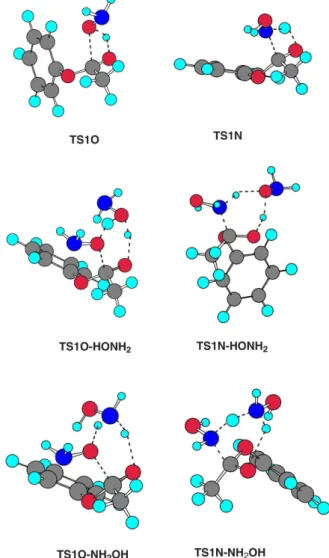
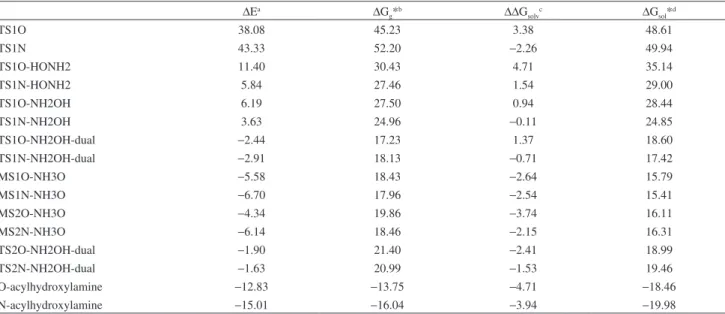
The direct attack of a nucleophile to the carbonyl centre is the most simple possibility for these reactions. Nevertheless, many previous studies have indicated that this process has a very high activation barrier for neutral nucleophiles and is viable only for ionic nucleophiles.21,28-34 In the case of neutral nucleophiles, water molecules or a second nucleophile molecule can act as a catalyst. In the reaction of hydroxylamine with phenylacetate, we found a similar situation. The transition state structures for the direct attack of hydroxylamine are presented in Figure 1 (TS1O and TS1N) and the calculated barriers are given in Table 1. The transition states lead to the corresponding tetrahedral intermediates; the ∆G‡ values are 48.6 kcal mol-1 for O attack and 49.9 kcal mol-1 for N attack. These are very high barriers and they cannot explain the observed experimental kinetics, which present overall barriers around 20 kcal mol-1.
Catalysis by the OH group of a second hydroxylamine molecule
A second hydroxylamine molecule can also act as a catalyst. One possibility is that the OH group works through bifunctional catalysis. In this case, the attacking nucleophilic atom donates a proton to the OH group of hydroxylamine, while this group donates a proton to the carbonyl oxygen. The respective transition states (TS1O-HONH2 and TS1N-HONH2) are shown in Figure 1 and the barriers are presented in Table 1. The barriers decreased to 35.1 kcal mol-1 and 29.0 kcal mol-1 for the O and N-acylation processes, respectively. This decrease in ∆G‡ indicates an important catalytic effect, but it is not enough to explain the experimental kinetics.
Catalysis by the NH2 group of a second hydroxylamine
molecule
Another possibility is bifunctional catalysis through the NH2 group of hydroxylamine. In this case, the catalytic effect is more important than for OH group catalysis. The
transition states (TS1O-NH2OH and TS1N-NH2OH) are
shown in Figure 1 and the corresponding ∆G‡ barriers (Table 1) are 28.4 kcal mol-1 and 24.9 kcal mol-1 for the O- and N-acylation processes, respectively. Catalysis through the NH2 group is selective, indicating that we would have almost 100% N-acylated product if the first step is rate determining. However, this is not the case. The barriers remain higher than the experimental values and the real reaction pathways are competitive. Therefore, another mechanism is needed to explain the experimentally observed third order kinetics. Further investigation led to the discovery of a new mechanism, related to the singular structure of hydroxylamine.
Dual bifunctional catalysis by a second hydroxylamine molecule
overall ∆G‡ barriers of 20.3 and 18.9 kcal mol-1 for second and third order kinetics, respectively. In addition, all the investigated catalysed mechanisms predict that the N-acylated isomer is the main product, contradicting experimental observations. Therefore, another mechanism must take place. One possibility is that hydroxylamine promotes bifunctional catalysis using both the oxygen and nitrogen atoms, and we have searched for such transition states. Figure 2 and Table 1 present our investigation into
this pathway. The structures TS1O-NH2OH-DUAL and
TS1N-NH2OH-DUAL correspond to this mechanism for
both O and N acylation. In this pathway, the oxygen of the second hydroxylamine (catalyst) donates a proton to the carbonyl oxygen while the nitrogen atom takes the proton from the attacking hydroxylamine. The calculated ∆G‡ barriers are 18.6 and 17.4 kcal mol-1 for O- and N-acylation, respectively. These values are very meaningful because they are close to the experimental data and indicate competition between O- and N-acylation.
The initial catalysed steps lead to the formation of
the MS1O-NH3O and MS1N-NH3O minimum energy
structures. They correspond to neutral tetrahedral
intermediates complexed with the NH3O isomeric form
of hydroxylamine. In these structures, the −NH3 group of NH3O interacts with the hydroxylamine added to the carbonyl centre. These structures can rearrange to MS2O-NH3O and MS2N-NH3O isomeric forms, where the −NH3 group of NH3O interacts with the oxygen of the phenolate group. The relative free energy of these four intermediate species is around 16 kcal mol-1.
In the next step, the NH3O isomeric form of
hydroxylamine assists in the dissociation of phenol from the tetrahedral intermediates in the MS2 complexes. The
corresponding transition states are TS2O-NH2OH-DUAL
and TS2N-NH2OH-DUAL, with relative free energy values of 19.0 and 19.5 kcal mol-1, respectively. It is worth noting that these barriers determine the reaction kinetics as can be seen by the free energy profile shown in Figure 3. In addition, these values are very close to the experimental data and also indicate that the O-acylated product is the main species formed in the reaction.
Discussion
The reaction of hydroxylamine with phenyl acetate presents different reaction pathways, but only mechanisms with low free energy barriers can take place. The reported experimental data for the phenylacetate reaction with hydroxylamine indicate that both second and third order kinetics are important. Therefore, a bimolecular mechanism also takes place. On the other hand, theoretical calculations suggest direct hydroxylamine attack is not feasible due to very high ∆G‡ barriers. How can these discrepancies in the theoretical and experimental data be reconciled? One possibility is catalysis by one water molecule. This pathway was also investigated, and although a lower ∆G‡ was observed (around 30 kcal mol-1), this decrease was not enough. A solution to this problem may be in the
isomeric form of hydroxylamine, the NH3O species. In
fact, over many years, the neutral form of hydroxylamine, Table 1. Thermodynamics data for the hydroxylamine reaction with phenylacetate in aqueous solution
∆Ea ∆G
g*b ∆∆Gsolvc ∆Gsol*d
TS1O 38.08 45.23 3.38 48.61
TS1N 43.33 52.20 −2.26 49.94
TS1O-HONH2 11.40 30.43 4.71 35.14
TS1N-HONH2 5.84 27.46 1.54 29.00
TS1O-NH2OH 6.19 27.50 0.94 28.44
TS1N-NH2OH 3.63 24.96 −0.11 24.85
TS1O-NH2OH-dual −2.44 17.23 1.37 18.60
TS1N-NH2OH-dual −2.91 18.13 −0.71 17.42
MS1O-NH3O −5.58 18.43 −2.64 15.79
MS1N-NH3O −6.70 17.96 −2.54 15.41
MS2O-NH3O −4.34 19.86 −3.74 16.11
MS2N-NH3O −6.14 18.46 −2.15 16.31
TS2O-NH2OH-dual −1.90 21.40 −2.41 18.99
TS2N-NH2OH-dual −1.63 20.99 −1.53 19.46
O-acylhydroxylamine −12.83 −13.75 −4.71 −18.46
N-acylhydroxylamine −15.01 −16.04 −3.94 −19.98
aEnergies relative to free reactants obtained at the B3LYP/6-311+G(2df,2p)//HF/6-31G(d) level. Units are kcal mol-1. bGas-phase free energies at 1 mol L-1
i.e. NH2OH, was considered to be the only neutral species present in solution. However, recent reports have suggested the zwitterionic form, NH3O, is present in aqueous solution in significant proportions.13,35,36 Therefore, it is possible that this interesting species plays an important role in the uncatalysed pathway. A full theoretical investigation of the mechanism involving the NH3O species requires a reliable
evaluation of its stability by direct theoretical methods, which is beyond the scope of the present report.
The main result of this paper is the catalysed reaction pathway, shown in Figure 3. We found low free energy reaction pathways with ∆G‡ of 19.0 kcal mol-1 and 19.5 kcal mol-1, leading to O- and N-acylated products, respectively. These values are very close to the experimental data,14 with ∆G‡ of 19.0 and 20.9 kcal mol-1, respectively. The error in the relative ∆G‡ can be attributed to the limitation of the B3LYP method to predict accurate relative barriers.37 Although the level of theory could be improved by including liquid-phase optimisation with the PCM/B3LYP method and using modern functionals, we believe the present level is reasonable for this first report.
Based on our results, we can claim that we have found a mechanism able to explain the experimental observations related to the catalysed process. This mechanism occurs due to the special structure of hydroxylamine and provides, in part, an explanation for the α-effect. Indeed, the catalysed mechanisms presented in Figure 1 could take place for normal nucleophile reactions, but those presented in Figure 2 are particular for α-nucleophiles with OH, NH
or NH2 groups bonded to the nucleophilic atom. As a
consequence, other neutral α-nucleophiles could react through this dual bifunctional catalysis mechanism; we can even think about the possibility of designing organocatalysts with these features.
Conclusions
The origin of the α-effect has been attributed to the intrinsic reactivity of α-nucleophiles and to the solvent effect. This report shows that dual bifunctional catalysis plays an important role in the α-effect for the reaction of hydroxylamine with carboxylic esters, and that catalysis Figure 2. Transition states and intermediates for the dual bifunctional
catalysis mechanism.
∆
G*
CH3COOPh +
2 NH2OH
TS1O-NH2OH-DUAL
(18.6)
TS1N-NH2OH-DUAL
(17.4)
TS2O-NH2OH-DUAL
(19.0)
TS2N-NH2OH-DUAL
(19.5)
MS1N-NH3O
(15.4)
MS1O-NH3O
(15.8)
MS2N-NH3O
(16.3)
MS2O-NH3O
(16.1)
CH3COONH2 +
PhOH + NH2OH
(-18.5)
CH3CONHOH +
PhOH + NH2OH
(-20.0)
Reaction coordinate
can play an important role in the α-effect for neutral nucleophiles.
Acknowledgments
The authors thank the Brazilian Research Council (CNPq) for support.
References
1. Anslyn, E. V.; Dougherty, D. A.; Modern Physical Organic Chemistry, University Science Books: Sausalito, CA, 2006. 2. Smith, M. B.; March, J.; March´s Advanced Organic Chemistry,
John Wiley & Sons: New York, 2001.
3. Um, I.; Im, L.; Buncel, E.; J. Org. Chem.2010, 75, 8571. 4. Villano, S. M.; Eyet, N.; Lineberger, W. C.; Bierbaum, V. M.;
J. Am. Chem. Soc.2009, 131, 8227.
5. McAnoy, A. M.; Paine, M. R. L.; Blanksby, S. J.; Org. Biomol. Chem.2008, 6, 2316.
6. Ren, Y.; Yamataka, H.; J. Org. Chem.2007, 72, 5660. 7. Ren, Y.; Yamataka, H.; Chem. Eur. J.2007, 13, 677. 8. Ren, Y.; Yamataka, H.; Org. Lett.2006, 8, 119. 9. Buncel, E.; Um, I.; Tetrahedron2004, 60, 7801. 10. Um, I.; Buncel, E.; J. Am. Chem. Soc.2001, 123, 11111. 11. Um, I.; Buncel, E.; J. Org. Chem.2000, 65, 577.
12. Kirby, A. J.; Tondo, D. W.; Medeiros, M.; Souza, B. S.; Priebe, J. P.; Lima, M. F.; Nome, F.; J. Am. Chem. Soc.2009, 131, 2023. 13. Kirby, A. J.; Davies, J. E.; Brandão, T. A. S.; Silva, P. F.; Rocha,
W. R.; Nome, F.; J. Am. Chem. Soc.2006, 128, 12374. 14. Mazera, D. J.; Gesser, J. C.; Pliego Jr., J. R.; Arkivoc2007, 199. 15. Jencks, W. P.; J. Am. Chem. Soc.1958, 80, 4581.
16. Jencks, W. P.; J. Am. Chem. Soc.1958, 80, 4585.
17. Hess, R. A.; Hengge, A. C.; Cleland, W. W.; J. Am. Chem. Soc.
1997, 119, 6980.
18. Stephens, P. J.; Devlin, F. J.; Chabalowski, C. F.; Frisch, M. J.; J. Phys. Chem.1994, 98, 11623.
19. Becke, A. D.; Phys. Rev. A: At., Mol., Opt. Phys.1988, 38, 3098. 20. Lee, C.; Yang, W.; Parr, R. G.; Phys. Rev. B: Condens. Matter
Mater. Phys.1988, 37, 785.
21. Almerindo, G. I.; Pliego Jr., J. R.; J. Braz. Chem. Soc.2007, 18, 696.
22. Cances, E.; Mennucci, B.; Tomasi, J.; J. Chem. Phys.1997, 107, 3032.
23. Cossi, M.; Barone, V.; Cammi, R.; Tomasi, J.; Chem. Phys. Lett.
1996, 255, 327.
24. Miertus, S.; Tomasi, J.; Chem. Phys.1982, 65, 239.
25. Miertus, S.; Scrocco, E.; Tomasi, J.; Chem. Phys.1981, 55, 117. 26. Frisch, M. J.; Trucks, G. W.; Schlegel, H. B.; Scuseria,
G. E.; Robb, M. A.; Cheeseman, J. R.; Zakrzewski, V. G.; Montgomery Jr., J. A.; Stratmann, R. E.; Burant, J. C.; Dapprich, S.; Millam, J. M.; Daniels, A. D.; Kudin, K. N.; Strain, M. C.; Farkas, O.; Tomasi, J.; Barone, V.; Cossi, M.; Cammi, R.; Mennucci, B.; Pomelli, C.; Adamo, C.; Clifford, S.; Ochterski, J.; Petersson, G. A.; Ayala, P. Y.; Cui, Q.; Morokuma, K.; Malick, D. K.; Rabuck, A. D.; Raghavachari, K.; Foresman, J. B.; Cioslowski, J.; Ortiz, J. V.; Baboul, A. G.; Stefanov, B. B.; Liu, G.; Liashenko, A.; Piskorz, P.; Komaromi, I.; Gomperts, R.; Martin, R. L.; Fox, D. J.; Keith, T.; Al-Laham, M. A.; Peng, C. Y.; Nanayakkara, A.; Challacombe, M.; Gill, P. M. W.; Johnson, B.; Chen, W.; Wong, M. W.; Andres, J. L.; Gonzalez, C.; Head-Gordon, M.; Replogle, E. S.; Pople, J. A.; Gaussian 98, Gaussian, Inc.: Pittsburgh PA, 1998.
27. Schmidt, M. W.; Baldridge, K. K.; Boatz, J. A.; Elbert, S. T.; Gordon, M. S.; Jensen, J. H.; Koseki, S.; Matsunaga, N.; Nguyen, K. A.; Su, S.; Windus, T. L.; Dupuis, M.; Montgomery Jr., J. A.; J. Comput. Chem.1993, 14, 1347.
28. Blumberger, J.; Klein, M. L.; Chem. Phys. Lett.2006, 422, 210. 29. Blumberger, J.; Ensing, B.; Klein, M. L.; Angew. Chem., Int.
Ed.2006, 45, 2893.
30. Cascella, M.; Raugei, S.; Carloni, P.; J. Phys. Chem. B2004, 108, 369.
31. Zahn, D.; Eur. J. Org. Chem.2004, 4020.
32. Kallies, B.; Mitzner, R.; J. Mol. Model.1998, 4, 183. 33. Pliego Jr., J. R.; Chem. Phys.2004, 306, 273.
34. Pliego Jr., J. R.; Riveros, J. M.; Chem. Eur. J.2002, 8, 1945. 35. Fernandez, M. I.; Canle, M.; Garcia, M. V.; Santaballa, J. A.;
Chem. Phys. Lett.2010, 490, 159.
36. Kirby, A. J.; Davies, J. E.; Fox, D. J.; Hodgson, D. R. W.; Goeta, A. E.; Lima, M. F.; Priebe, J. P.; Santaballa, J. A.; Nome, F.; Chem. Commun.2010, 46, 1302.
37. Westphal, E.; Pliego Jr., J. R.; J. Phys. Chem. A2007, 111, 10068.
Submitted: June 7, 2011