Ar
ti
cle
*e-mail: [email protected]
Electrosynthesis and Catalytic Activity of Polymer-Nickel
Particles Composite Electrode Materials
Tahar Melki,a Ahmed Zouaoui,a Barkahoum Bendemagh,a Ione M. F. de Oliveira,b
Gilver F. de Oliveira,b Jean-Claude Leprêtre,c Christophe Bucherd and Jean-Claude Moutet*,d
aDépartement du Tronc Commun, Faculté des Sciences de l’Ingénieur, Université Ferhat Abbas, Sétif, Algeria
bDepartamento de Química, Universidade Federal de Minas Gerais, 31270-901 Belo Horizonte-MG, Brazil
cLaboratoire d’Electrochimie et de Physicochimie des Matériaux et Interfaces, UMR-5631 CNRS-INPG-UJF,
BP 75, 38402 St Martin d’Hères Cédex, France
dUniversité Joseph Fourier Grenoble 1, Département de Chimie Moléculaire, UMR CNRS-5250,
Institut de Chimie Moléculaire de Grenoble, FR CNRS-2607, BP 53, 38041, Grenoble Cedex 9, France
Materiais de eletrodo de compostos poliméricos de níquel foram sintetizados a partir da redução eletroquímica de cátions ou complexos de níquel(II), incorporados por troca iônica ou por complexação, em vários tipos de ilmes inos de polipirróis carboxilatos que recobriam eletrodos de carbono preparados por eletropolimerização oxidativa. A atividade eletrocatalítica e a estabilidade desses diferentes compostos foram avaliadas pela hidrogenação eletrocatalítica de cetonas e enonas em eletrólitos aquosos. Os melhores resultados foram obtidos usando-se compostos poliméricos de níquel sintetizados pela eletrorredução dos íons níquel(II) complexados em ilmes de policarboxilatos, que são caracterizados por uma alta atividade catalítica e uma boa estabilidade operacional.
Nickel-polymer composite electrode materials have been synthesized using various strategies, all comprising the electrochemical reduction of nickel(II) cations or complexes, incorporated by either ion-exchange or complexation into various poly(pyrrole-carboxylate) thin ilms coated by oxidative electropolymerization onto carbon electrodes. The electrocatalytic activity and the stability of the different composites have been then evaluated in the course of the electrocatalytic hydrogenation of ketones and enones in aqueous electrolytes. The best results were obtained using nickel-polymer composites synthesized by electroreduction of nickel(II) ions complexed into polycarboxylate ilms, which are characterized by a high catalytic activity and a good operational stability.
Keywords: functionalized polypyrrole, electrodeposition, polymer-metal nanocomposite, nickel, electrocatalytic hydrogenation
Introduction
New properties are now readily accessible with nanosized metal particles, because of their unique electronic structure and their extremely large surface areas.1 These materials have
emerged as an area of great current interest motivated by potential applications in chemical catalysis, energy technology, electronics, optics and magnetics.2-6 Their properties may
be tuned via control of the metal particles shape, size and organization.7 They also depend on the chemical nature of
the microenvironment surrounding the particle.8 In many
instances, to fully exploit their great potential in technological applications, it is very important to assemble the metal particles in two- and three dimensions and to endow them with good processability. This can be readily accomplished by their encapsulation in different polymers.9-11 The use of functional
polymers as support for metal nanoparticles offer some exciting features via the generation of composites containing metal particles with controlled size and size distribution, thus providing a mean to inluence the properties of the nanocomposite through the interaction of the metal surface with the functional groups of the polymer.
materials for catalytic applications.11-14 Electrochemical
procedures for the synthesis of metal nanoparticles, although less common than chemical routes, have proven to be powerful and versatile means of preparing nanoparticles in a wide range of noble and transition metals.15 Electrochemical methods have also proved to
be effective in incorporating metal particles in either pre-deposited polymers or in growing ilms.12-14 This is especially
true in the case of electron-conducting polymers containing metal nanoparticles for electrocatalytic applications.16,17 It
should be emphasized that electrochemical syntheses of metal-polymer composites have essentially been reported with noble metal-based materials.3,14,16,17
In contrast, examples of electrodeposition in conducting polymers of transition metals such as copper,18-23 nickel,24-27
or zinc28 are more scarce, in spite of the potential
interest of transition metal-based electrode materials in electrosynthesis.26,29,30 As demonstrated in the case of
the deposition of copper20,31 and cadmium31 by direct
electroreduction of metal salts onto conducting polymer film-modified electrodes, the main problems for the electrosynthesis of transition metals-polymer composites concern the poor polymer conductibility in the potential domain usually required for the reduction of metal species, and the morphology of the metal deposit obtained, i.e. at the outer polymer surface or in open pores of the polymer ilm coated onto a substrate material. In addition, the interaction between deposited metal and the polymer substrate is relatively weak.20
We have already demonstrated that the electrochemical reduction of anionic copper and nickel-oxalate complexes onto cationic poly(pyrrole-alkylammonium) ilms allows to synthesize copper32 and nickel33 based metal-polymer
composites, which have been successfully used for the electrocatalytic reduction of organic substrates in aqueous electrolytes. More recently we reported the electrosynthesis of a complexing poly(pyrrole-malonic acid) electrode material allowing large amounts of transition metal ions to be accumulated.34-36 Metal particles could be dispersed in
the polymer modiied electrode through a ligand mediated metal ions accumulation, followed by the electrochemical reduction of the complexed cations into zerovalent metallic species.34 The electroreduction of metal complexes covalently
bound to the polymer chains is expected to lead to a better dispersion of metal particles throughout the polymer matrix. Furthermore, a polymeric complexing material can work as stabilizer to prevent metal microparticles from aggregation, and could even promote speciic catalytic properties.37
The present study describes the electrosynthesis and the electrocatalytic properties of nickel-polycarboxylic acid composites synthesized following two different strategies: (i) incorporation of cationic nickel(II)-ethylenediamine
complexes in a functionalized polypyrrole material through a cation-exchange process, followed by an electrochemical reduction; (ii) accumulation of nickel(II) cations in complexing polypyrrole ilms, followed by an electrochemical reduction. The catalytic activity and the stability of the different electrode materials have been then evaluated in the course of the electrocatalytic hydrogenation of ketones and enones in aqueous media.
Experimental
Reagents and materials
4-(Pyrrol-1-yl)methyl)benzoic acid 338 and
(3-pyrrol-1-ylpropyl)malonic acid 134 were prepared according to
previously reported procedures.
(3-pyrrol-1-ylpropyl)succinic acid 2 was synthesized as follows: a solution of n-BuLi (5 mL, 2.5 mol L-1 in hexanes, 12.5 mmol) was added to i-Pr2NH (1.8 mL, 12.5 mmol) dissolved in 40 mL of THF at –78 °C. The mixture was stirred at –78 °C for 30 min, then mono-tert-butylsuccinate39 (1 g, 5.7 mmol) dissolved in 10 mL of THF
was added dropwise. The reaction vessel was warmed to 0 °C, stirred at this temperature for two hours, and cooled again to –78 °C before N-(3-bromopropane-1-yl)pyrrole (1.49 g, 7.9 mmol)40 was added dropwise. The reaction
vessel was then allowed to warm to room temperature and stirred for 24 h, after which the reaction was quenched by adding 5 mL of water and the resulting reaction mixture concentrated. The solid residue was partitioned between ethylacetate (50 mL) and water (20 mL). The organic layer was then dried with anhydrous sodium sulfate, iltered and concentrated under reduced pressure. The crude mixture was puriied by chromatography on silica gel to afford 2-[(3-pyrrol-1-yl)propyl]tert-butylsuccinate as an oily
residue (yield 70%). 1H NMR (400 MHz, CDCl
3, 298 K)
d 1.45 (s, 9H); 1.48-1.56 (m, 1H); 1.58-1.67 (m, 1H);
1.76-1.87 (m, 2H); 2.37-2.46 (m, 1H); 2.68-2.75 (m, 1H); 3.91 (t, J 7Hz, 2H), 6.15 (m, 2H, pyr); 6.65 (m, 2H, pyr).
13C NMR (62 MHz, CDCl
3, 298 K) d 27.9; 28.8; 35.9;
41.3; 49.0; 81.1; 108.0; 120.3; 173.5; 178.0. DCI+ (NH 3/
Isobutane) -MS, m/z 282.26 [M+1]+.
A solution of 2-[(pyrrole-1-yl)propyl]tert-butylsuccinate (0.3 g, 1.06 mmol) and KOH (2 g, 35.7 mmol) in absolute ethanol was reluxed for two days at 75 °C. After cooling the mixture to room temperature the solvent was removed under
CO2H
1
N N
CO2H CO2H
2 3
N
CO2H CO2H
reduced pressure and the residue was partitioned between dichloromethane (100 mL) and water (50 mL). The biphasic mixture was protected from light, cooled at 0 °C with an ice bath and stirred vigorously. Aqueous 1 mol L-1 HCl was
then added dropwise until the pH reached a value between 2-3. The organic phase was then collected and the aqueous phase was extracted with dichloromethane (2 × 50 mL) and diethylether (2 × 50 mL). The organic fractions were collected, dried over anhydrous sodium sulfate, iltered and the solvent was evaporated under reduced pressure to afford 2 as a light brown solid material. (yield 59%). 1H NMR
(250 MHz, CD3CN, 298 K) d 1.34-1.60 (m, 2H), 1.68-1.80 (m, 2H), 2.35-2.73 (m, 3H), 3.85 (t, J 7Hz, 2H), 6.01 (m, 2H, pyr), 6.64 (m, 2H, pyr). 13C NMR (62 MHz, CD
3CN,
298 K) d 29.4; 29.6; 35.8; 41.1; 49.6; 108.6; 121.3; 173.9; 176.6. EI+-MS, m/z 225 [M]+.
The tris(ethylenediamine)nickel(II) complex was prepared by the reaction of 2.06 g (7.8 mmol) of NiSO4•6H2O dissolved in 15 mL of water, with 2 mL
(30 mmol) 1,2-diaminoethane. The resulting solution was iltered and concentrated. The precipitate was collected by suction iltration, washed with EtOH, and dried under vacuum. The yield was 40%.
Acetonitrile (Rathburn, HPLC grade S) and tetra-n -butylammonium perchlorate (TBAP, Fluka puriss) for the electrochemical experiments were used as received. Nickel sulfate, succinic acid and boric acid were of reagent grade and used as received. Distilled water was obtained from an Elgastat water puriication system (5 MΩ cm).
Electrodes, electrochemical cell and instrumentation
All electrochemical experiments were carried out using an EGG PAR model 273 potentiostat equipped with an x-y recorder. A standard three-electrode cell was used for analytical experiments. Potentials are referred to the Ag|AgCl in 3 mol L-1 KCl reference electrode in
aqueous electrolytes, and to the Ag|Ag+10–2mol L-1 in CH3CN + 0.1 mol L-1 TBAP in acetonitrile electrolyte.
Glassy carbon disc electrodes (3 mm diameter, from CH Instruments) were polished with 1-µm diamond paste. For FT-IR measurements, ilms were grown on a 0.5 cm2
Pt foil. Spectra were recorded using a Perkin-Elmer GX spectrophotometer equipped with a variable angle specular relectance accessory. All experiments were run at room temperature under an argon atmosphere.
Preparation of the modiied electrodes
The polymer films were grown from unstirred solutions of monomers 1-3 (4 × 10⁻³mol L-1) in CH
3CN
containing 0.1 mol L-1 TBAP as supporting electrolyte, by potentiostatic oxidative electropolymerization at 0.85-0.90 V vs Ag|Ag+ 0.01 mol L-1.34,41 Polymerization
experiments were controlled through the anodic charge recorded during the electrolysis. The amount of pyrrole units in the ilms and thus, the apparent surface coverage in complexing units (ΓL, mol cm–2) were determined after transfer of the modiied electrodes into monomer-free CH3CN electrolyte from the integration of the polypyrrole
oxidation wave recorded at low scan rate (10 m V s–1). For
electrocatalytic hydrogenations, polymer ilms were grown on carbon felt (RVC 2000, 65 mg cm–3, from Le Carbone
Lorraine) electrodes (20 × 25 × 4 mm). Procedures used for the incorporation of nickel metal into the different polymeric matrices will be described in the results and discussion section.
Determination of nickel loading into polycarboxylate materials
The amount of nickel dispersed into polycarboxylate ilms was determined using poly3-Ni(0) materials coated on carbon felt discs (11 mm diameter, 4 mm thick, 0.38 cm3),
or on indium tin oxide (ITO) coated glass slides (1 cm2).
Samples were digested at 100-130 °C in a mixture of concentrated H2SO4 + HNO3. Nickel concentrations were determined by Induction Coupled Plasma measurements performed using a Thermo Jarell Ash (IRIS) spectrometer set up with argon plasma low at 10 L h–1, withauxiliary
gas low of 2 L h–1, and at a power of 1.55 kW. Samples
were aspired at a low of 2.2 mL min–1 through a cyclonic
nebulizer (Meinhart). Atomic emissions for Ni were determined at 221.64 nm and 231.60 nm. Fresh working calibration solutions were prepared by properly diluting commercial standards with double distilled water. Calibrations within the expected range (0-50 ppm) were obtained with six equally spaced concentrations.
Electrocatalytic hydrogenation procedure
Electrocatalytic hydrogenations were carried out in a H-shaped three-compartment cell. The carbon felt electrodes modiied with nickel-polymer composite ilms were placed in the cathodic compartment illed with 50 mL of a deaerated equivolumic water-methanol solution containing 0.1 mol L-1NaCl + 0.1 mol L-1H
3BO3 (initial
withdrawals. Samples were extracted with diethylether and analyzed by GC. The identiication of products was based on GC comparison with authentic samples.
Results and Discussion
Deposition of nickel in polypyrrole-malonic acid (poly1) ilms
It is well established that the dianions of malonic acid and its 2-substituted derivatives form various complexes with nickel(II) cations. In particular the malonate anion forms rather stable monometallic NiL (logβ1 = 3.2) and [Ni(L)2]2– (logβ
2 = 4.9)
species (L = malonate).42 The complexation ability of poly1
towards transition metal cations such as Cu(II), Pb(II), Cd(II) and Hg(II) has already been demonstrated, as the precipitation of zerovalent metal particles in the polymer upon electroreduction of metal ions complexed into poly1 ilms.34-36
A typical cyclic voltammetry (CV) curve recorded at a carbon disc electrode in aqueous boric acid (0.1 mol L-1,
pH 5.5) containing NiSO4 (1 mmol L-1) and malonic acid
(5 mmol L-1) is shown in Figure 1A. The sharp increase in the
cathodic current below –1.4 V is attributed to the reduction of nickel-malonate complexes leading to the precipitation of nickel on the electrode surface, concomitant with hydrogen evolution on the nickel-coated carbon electrode. It has been recently shown that malonate buffer allows eficient electrodeposition of nickel.43 Boric acid has been used as
electrolyte, since it is known to improve nickel deposition.44
On the reverse scan, the large anodic wave observed at 1.6 V is due to nickel dissolution in the transpassivity region.45
These observations are in agreement with similar indings obtained upon studying the electroreduction of nickel(II) in the presence of oxalate anions.33
The effective coordination of nickel(II) into poly1 ilms soaked for a few minutes in 0.1 mol L-1 NiSO
4 (pH 5.5)
was proved by CV experiments carried out in clean Na2SO4 electrolyte containing boric acid. The poly1 ilm has been over-oxidized by potentiostating the modiied electrode at 1.1 V for 15 min in acetonitrile electrolyte, in order to obtain a voltammogram without the electroactivity of the polypyrrole backbone. A representative voltammogram is shown in Figure 1B. The C|poly1-Ni(II) modiied electrode displays a wave corresponding to the reduction of the complexed nickel ions associated, in the reverse scan, with an anodic nickel metal dissolution peak (Figure 1B, curve a). The dissolution of the entrapped nickel particles is achieved entirely in one CV cycle and the second CV curve does not present any anodic peak (Figure 1B, curve b). To conirm the successful deposition of nickel metal in poly1 ilms, C|poly1 modiied electrodes have been soaked for 15 min in aqueous NiSO4 (pH 5.5), thoroughly rinsed
and reduced at –1.4 V in 0.1 mol L-1 Na
2SO4 containing
0.1 mol L-1 H
3BO3. Then the anodic nickel metal dissolution
was studied by CV experiments carried out in clean Na2SO4 electrolyte. Typical curves are shown in Figure 1C. Under these experimental conditions (ΓL = 9.5 × 10⁻⁷ mol cm–2,
scan rate 0.1 V s–1) the total dissolution of the metal requires
two CV scans (Figure 1C, curves a-c).
The coordination of nickel(II) into poly1 ilms has been conirmed by FT-IR experiments, using ilms grown on a Pt foil (see the experimental section). The infrared spectrum of poly1 is characterized by two bands at 1733 and 1718 cm–1
(Figure 2A, curve a) assigned to the C=O stretching vibration of the malonic acid moieties. After immersion or the poly1 ilm for a few minutes in 10–2 mol L-1 NiSO
4 (pH 5.5) a new broad
band appears around 1585 cm–1 attributed to the OCO vibrations
modes in nickel-malonate complexes (Figure 2A, curve b). A similar band was observed at 1578 cm–1 in the spectrum of a
poly[Ni(II)-dicarboxylate] ilm.46 Full complexation of poly1
was readily obtained when the concentration of by Ni2+ cations
in the accumulation solution was increased up to 10–1 mol L-1.
The absorption bands corresponding to the free malonic acid groups are no longer observed and the spectrum present an intense band at 1570 cm–1 attributed to nickel-malonate
complexes (Figure 2A, curve c). These results show that the eficient complexation of nickel in poly1 ilms requires the use of a rather high concentration of nickel cations (10–1 mol L-1)
and a weakly acidic media (pH 5.5).
Deposition of nickel in polypyrrole-succinic acid (poly2) ilms
Polysuccinic acid-nickel composite electrode materials have been synthesized following the same procedure, as described above for polymalonic acid-based composites. The electrochemical behavior of the pyrrole-succinic acid (monomer 2; scheme 1) in CH3CN + 0.1 mol L-1
TBAP is very similar to that found for monomer 1. CV curves exhibit the regular irreversible oxidation peak
(Epaca. 1 V vsAg|Ag+ 0.01 mol L-1) systematically observed with N-substituted pyrroles, and an irreversible reduction peak (Epcca. –1.2 V on Pt) attributed to the reduction of the protons of the carboxylic acid groups. Poly2 ilms can be grown on platinum and carbon electrodes by cycling over the –0.4 V to 0.9 V potential range, or by controlled-potential oxidation at 0.85 V (Ag|Ag+ 0.01 mol L-1). Films with apparent surface coverage (ΓL) around 10–7 mol cm–2 could be obtained with polymerization yields above 50%.
nickel-malonic acid complex (logβ1 = 3.2).42 However,
just as for C|poly1 ilm modiied electrodes, the effective complexation of nickel(II) cations and the electroreductive deposition of nickel metal in poly2 films has been demonstrated following the same basic procedure. C|poly2 modiied electrodes have been soaked in aqueous NiSO4 (0.1 mol L-1, pH 5.5), thoroughly rinsed and reduced at
–1.4 V in 0.1 mol L-1 Na
2SO4 containing 0.1 mol L -1 H
3BO3.
Then the anodic nickel metal dissolution was studied by CV in clean Na2SO4 + H3BO3 electrolyte. A typical curve, characterized by a strong nickel anodic stripping peak at 1.5 V is shown in Figure 1D. It conirms the successful deposition of nickel metal in poly2 films using the complexation-electroreduction procedure.
Deposition of nickel in polypyrrole-benzoic acid (poly3) ilms
The electrosynthesis of polypyrrole-benzoic acid (poly3) thin ilms, along with its cation-exchange properties,
have already been reported.41 The pK
a of poly3 has been
found at 5.2. Its exchange capacity has been estimated at 4.5 molar equiv.kg–1,41 which is comparable to common
cation-exchange resins. The effective complexation of nickel(II) into poly3 ilms has been evidenced by FT-IR experiments. The infrared spectrum of a poly3 ilm is characterized by a band at 1713 cm–1 (Figure 2B, curve a)
assigned to the C=O stretching vibration of the benzoic acid moieties. After immersion or the poly3 ilm in 0.1 mol L-1 NiSO4, pH 7, this band is no longer observed and the spectrum present two new bands at 1592 and 1540 cm–1
attributed to nickel-carboxylate complexes (Figure 2B, curve b).
Firstly, nickel metal was dispersed in thin poly3
ilms by complexation and/or ion-exchange of nickel(II) cations, followed by an electrochemical reduction. The electroreductive deposition of Ni(0) in poly3 ilms was proved as follows. C|poly3 modiied electrodes have been soaked for 30 min in aqueous NiSO4 (0.1 mol L-1, pH 5.7), Figure 1. (A) Cyclic voltammetry curve recorded at a carbon disc electrode (3 mm diameter) in 0.1 mol L-1H
3BO3 (pH 5.5) containing 1 mmol L-1
NiSO4 and 5 mmol L-1 malonic acid; scan rate = 0.1 V s–1. (B) Cyclic voltammograms in 0.1 mol L-1Na2SO4 (pH 5.5) at a C|poly1 modiied electrode
(3 mm in diameter,(ΓL = 2.5 × 10⁻⁷ mol cm–2) that has been immersed for 15 min in 0.1 mol L-1NiSO
4, pH 5.5; curve a: irstscan 0 V → –1.6 V → +1.8 V;
curve b (dashed line): second scan restricted to the range 0 to +1.8 V; scan rate = 0.1 V s–1. (C) Anodic stripping wave in 0.1 mol L-1Na
2SO4 + 0.1 mol L-1
H3BO3 for nickel deposited in a poly1 ilm (ΓL = 9.5 × 10⁻⁷ mol cm–2) soaked for 15 min in 0.1 mol L-1NiSO4 (pH 5.5), then reduced at –1.4 V in clean
0.1 mol L-1Na
2SO4 + 0.1 mol L-1H3BO3 (pH 5.3); curve a: 1st scan; curve b: 2nd scan; curve c: 3rd scan; scan rate = 0.1 V s–1. (D) Anodic stripping wave
in 0.1 mol L-1Na
2SO4 + 0.1 mol L-1H3BO3 for nickel deposited in a poly2 ilm (ΓL = 10–7 mol cm–2) soaked for 30 min in 0.1 mol L-1NiSO4 (pH 5.5),
then reduced at –1.4 V in clean 0.1 mol L-1Na
2SO4 + 0.1 mol L-1H3BO3, pH 5.2; scan rate = 0.01 V s–1. (E) Anodic stripping wave in 0.1 mol L-1Na2SO4
for nickel metal deposited in a poly3 ilm (ΓL = 1.5 × 10⁻⁸ mol cm–2) soaked for 30 min in 0.1 mol L-1NiSO
4 (pH 5.7), then reduced at –1.4 V in clean
0.1 mol L-1Na
thoroughly rinsed and reduced at –1.4 V in 0.1 mol L-1 Na2SO4. Then the anodic nickel metal dissolution was studied by CV in clean Na2SO4 electrolyte. A typical CV
curve, characterized by an intense nickel anodic stripping peak at 1.5 V, is shown in igure 1E (curve a). The total dissolution of the metal is achieved in one CV scan (scan rate 10 mV s–1), and the second CV curve does not show
any anodic peaks (Figure 1E, curve b). As judged by the intensity of the stripping peaks in different experiments, we found that the incorporation of nickel in poly3 reached a maximum when the pH of the accumulation solution containing nickel(II) cations is around 6.
A nickel-polymer composite electrode material has also been synthesized by incorporation, by ion-exchange, of cationic nickel-ethylenediamine complexes in deprotonated poly3 ilms, followed by the electrochemical reduction of these complexes to nickel metal. The literature data concerning the electroreduction of nickel(II) ethylenediamine complexes are scarce and controversial.47
However, it has been shown that ethylenediamine can dramatically increase nickel electrodeposition.48
Ethylenediamine (denoted en) and nickel(II) form rather stable species as Ni(en)2+ (logβ
1 = 7.4), Ni(en)2 2+
(logβ2 = 13.5), and Ni(en)32+ (logβ
3 = 17.7) complexes. 42
The eficiency of the complexation process depends on the pH, since protonation of ethylenediamine and precipitation of nickel hydroxide (logβOH = 4.6) can compete with the formation of Ni-en complexes. With the help of these stability constants determined with a method similar to that already used for other chelate complexes of nickel(II),33
one can calculate the distribution diagram for the nickel-ethylenediamine system which shows that the Ni(en)32+
complex predominate in solution for pH values around 7. A typical voltammogram obtained with tris(ethylene-diamine)nickel(II) (1 mmol L-1) in Na
2SO4 electrolyte
containing boric acid (pH 7) is shown in Figure 3A. The reduction of the complex is characterized by a sharp
increase in the cathodic current below –1.4 V, which can be attributed to nickel deposition concomitant with hydrogen evolution on nickel. On the reverse scan, the strong anodic peak at 1.6 V is attributed to nickel dissolution in the transpassivity region.45 Larger stripping currents were
observed when boric acid is present in the electrolyte. The electrodeposition of nickel onto the carbon electrode surface was performed by reduction at –1.5 V in a solution of Ni(en)32+ (1 mmol L-1) in 0.1 mol L-1 Na
2SO4 + 0.1 mol L -1
H3BO3 (pH 7). The amount of electroprecipitated metal was estimated from the charge recorded under the anodic stripping wave. A typical result is presented in Figure 3B. Comparison with the charge consumed during the reduction at –1.5 V of the nickel-ethylenediamine complex to nickel
Figure 2. (A) FT-IR spectra of a poly1 ilm coated on Pt, before (curve a) and after soaking for 10 min in 10 mmol L-1 (curve b) and 0.1 mol L-1 (curve c) NiSO4 (pH 5.5). (B) FT-IR spectra of a poly3 ilm before (curve a) and after (curve b) soaking in 0.1 mol L-1 NiSO
4 (pH 7).
Figure 3. (A) Cyclic voltammetry curve for 1 mmol L-1 Ni(en)
32+ recorded
at a carbon disc electrode (3 mm diameter) in 0.1 mol L-1Na
2SO4 +
0.1 mol L-1H
3BO3 (pH 7); scan rate = 0.1 V s–1. (B) Nickel anodic stripping
wave in clean 0.1 mol L-1Na
2SO4 electrolyte, following metal deposition
by reduction at –1.5 V (charge passed 6 mC) in the same solution as in 3A; scan rate = 0.01 V s–1. (C) Nickel metal anodic stripping wave in
clean 0.1 mol L-1Na
2SO4 for nickel deposited in a poly3 ilm (ΓL = 1.3 ×
10–7 mol cm–2) soaked for 30 min in 10 mmol L-1 Ni(en)
32+, then rinsed
and reduced at –1.4 V in clean Na2SO4 + H3BO3 electrolyte; curve a:
metal suggests that this process is not quantitative. For example, stripping charges of 5.1 mC (Figure 3B) and 6.0 mC were measured when the deposition charges were 6 mC and 12 mC, respectively. The difference may be explained as a result of the cathodic charge being partly consumed for hydrogen evolution.
Nickel metal was precipitated into poly3 films
via incorporation, by ion-exchange, of cationic Ni-en complexes, followed by their electrochemical reduction. Typically, a C|poly3 electrode was soaked for 30 min in a 10 mmol L-1 Ni(en)
3
2+ solution, thoroughly rinsed with
water, then reduced at –1.4 V in 0.1 mol L-1 Na 2SO4 +
0.1 mol L-1 H
3BO3. The effective precipitation of nickel
metal into the polymer was demonstrated from anodic stripping experiments. Figure 3C (curve a) shows a representative nickel stripping wave recorded in clean Na2SO4 electrolyte. In these experimental conditions, total dissolution of the metal is achieved in a single CV scan (scan rate 10 mV s–1), and the second CV curve does not
show any anodic peaks (Figure 3C, curve b).
Estimation of nickel concentration into polymer ilms
Attempts have been made to estimate the amount of nickel electrodeposited in polymer ilms from the charge involved in the nickel anodic stripping. We found however that the incorporation ratios (deined as the amount of incorporated nickel on the amount of carboxylic acid sites in the ilm) measured this way were well over 100% (up to 1000%). Such over-estimation of the metal loading is not surprising since the charge consumed at the high potential value required to achieve metal stripping, most likely includes other contributions such as from the irreversible oxidation of the carboxylate groups grafted on the polymer, and the over-oxidation of the polypyrrole matrix.
Additional experiments were conducted to obtain a better estimation of the nickel loading into the polycarboxylate ilms. For this purpose nickel was precipitated in poly3 ilms coated onto carbon felt or indium tin oxide (ITO) electrodes, by complexation of nickel(II) cations followed by their electroreduction. After digestion of the samples in boiling H2SO4 + HNO3, nickel concentrations were determined by ICP measurements (see experimental).
Firstly, three poly3 ilms were grown on ITO electrodes (area ca. 1 cm2) in a 8 × 10⁻³ mol L-1 solution of monomer 3
in CH3CN electrolyte, by oxidative electropolymerization at 0.85 V (charge passed 60 mC; polymerization yields were in the 85 to 95% range). Nickel was precipitated in the polymer ilms using the experimental conditions previously described above (0.1 mol L-1 NiSO
4, pH 5.7).
The amount of carboxylic acid groups contained in the
films, determined from the integration of the charge under the polypyrrole oxidation wave, was in the 0.22 to 0.26 µmol range. The amounts of nickel in the poly3 ilms, determined from ICP measurements, were in the 9 to 23 µg range, i.e. 0.15 to 0.39 µmol. In spite of the rather scattered values found, these results show that the nickel incorporation ratio in poly3 ilms is surprisingly high, i.e.
150 to 300%, taking into account that to the maximum one Ni2+ cation can be bound to two carboxylate moieties
in the polymer during the accumulation step. Since the polymerization yields were rather high (85-95%) in these experimental conditions, one can reasonably assume that the conductivity of the polypyrrole ilms synthesized in these experimental conditions is important. Therefore the nickel incorporation ratios found over 100% cannot be explained by an underestimation of the amount of pyrrole units, and thus of the amount of carboxylic acid groups in the ilms, due to a wrong calculation from the integration of the polypyrrole oxidation wave. The high nickel incorporation ratios could thus be due to the formation in the polymer of 1:1 Ni-carboxylate complexes. Moreover, in addition to strong ion binding with the polycarboxylate material, binding could also exist between the nickel cations and the nitrogen atoms from pyrrole groups, possibly leading to the formation of molecular complexes. Additional interactions between transition metal cations and nitrogen atoms have been assumed in the case of carboxylic acid-based copolymer containing nitrogenous functional groups.49 Finally cation-π interactions, which
are recognized to be among the strongest of noncovalent binding forces,50 could be responsible in part of additional
interactions between nickel cations and the polypyrrolic matrice, and thus to increased nickel incorporation ratios.
coated on ITO electrodes. It is well established that carbon materials, including carbon ibers, bear some reasonable population of carboxylic acid groups on their surfaces.51
These additional carboxylate sites could be responsible for an increased metal ions binding capacity of the polymer-coated on carbon felt material.
Although limited to the study of Ni-poly3 composites, these results served to roughly estimate the nickel loading (typically 20 to 40 mg) in the different large size nickel-polymer ilm modiied carbon felt electrodes, used in the course of the electrocatalytic hydrogenation experiments described in the following section.
Electrocatalytic hydrogenation at the different modiied electrodes
ECH at Ni-poly1 cathodes
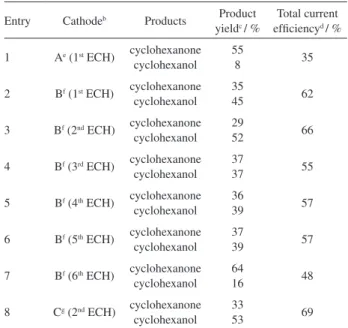
The electrocatalytic hydrogenation (ECH) of 2-cyclohexenone to cyclohexanone and cyclohexanol was chosen to estimate the catalytic activity of the poly1-nickel electrode material. The results obtained in the course of a series of experiments conducted at different C|poly1 -Ni(0) cathodes are summarized in Table 1. Electrocatalytic hydrogenations (ECH) were performed in water-methanol solutions containing 2-cyclohexenone (1 mmol), in the conditions developed by Lessard and co-workers52 for
reductions with Raney nickel-based electrodes (see experimental).
A carbon felt electrode modiied with a poly1 ilm (2.5 × 10⁻⁵ mol of malonic acid units) was irstly soaked
for 30 min in a 0.01 mol L-1 NiSO
4 aqueous solution, then
reduced at –1.4 V in clean 0.1 mol L-1 Na
2SO4 + 0.1 mol L -1
H3BO3 electrolyte. In this case, pHs of the accumulation and reduction solutions were adjusted to 3 by adding diluted sulfuric acid. The complexation-electroreduction procedure was repeated once to increase nickel loading in the polymer ilm affording electrode A, which was then used in the ECH of 2-cyclohexenone (Table 1, entry 1).
As expected with a nickel-based cathode,53 the
carbon-carbon double bond of the conjugated enone was more easily hydrogenated than the carbonyl group to give cyclohexanone, and the presence of 2-cyclohexenol was not detected in the reaction mixture. However cyclohexanone could be further reduced and a small amount of cyclohexanol (8%) was obtained after the consumption of 4 electrons per molecule of substrate (entry 1).
A signiicant improvement of the catalytic activity was observed with cathode B, prepared by increasing the amount of nickel loading in electrode A upon repeating twice the metal deposition procedure. Cathode B was then used in a series of ECH experiments (Table 1, entries 2-7). The
increase of nickel loading led to a signiicant improvement in the total current eficiency, calculated at a given charge of 4 F mol–1 and setting the electrolysis current at 20 mA, from
35% (electrode A; entry 1) to 55-66% (electrode B; entries 2-6). Furthermore, with electrode B the cyclohexanol yield was increased up to 52% (Table 1, entry 3).
An important feature of the C|poly1-Ni(0) modiied electrode is its rather good operational stability, which was tested during the hydrogenation of several samples of 2-cyclohexanone on the cathode B (Table 1, entries 2-7). The current eficiency remained almost the same (current yields ranging from 55% to 66%) during the irst ive successive ECHs (entries 2-6), but a signiicant decrease in the catalytic activity was observed from the 6th
electrolysis. In this last experiment, the total current yield remained rather good (48%), but the yield of cyclohexanol decreased down to 16% (Table 1, entry 7; measured after the consumption of 4 electrons per molecule of substrate), showing that the cathode has lost some catalytic activity after 6 electrolyses.
Table 1. ECH of 2-cyclohexenone at C|poly1-Ni(0) cathodesa
Entry Cathodeb Products Product
yieldc / %
Total current eficiencyd / %
1 Ae (1st ECH) cyclohexanone cyclohexanol
55
8 35
2 Bf (1st ECH) cyclohexanone cyclohexanol
35
45 62
3 Bf (2nd ECH) cyclohexanone cyclohexanol
29
52 66
4 Bf (3rd ECH) cyclohexanone cyclohexanol
37
37 55
5 Bf (4th ECH) cyclohexanone cyclohexanol
36
39 57
6 Bf (5th ECH) cyclohexanone cyclohexanol
37
39 57
7 Bf (6th ECH) cyclohexanone cyclohexanol
64
16 48
8 Cg (2nd ECH) cyclohexanone cyclohexanol
33
53 69
aCarried out in 50 mL of water-methanol equimolar mixtures containing 0.1 mol L-1 NaCl + 0.1 mol L-1 H
3BO3 (initial pH 5.3) and 1 mmol of cyclohexenone; electrolysis current 20 mA (–0.9 V < Eapp < –1.0 V). b20 × 25 × 4 mm modified carbon felt electrodes containing
ca. 2.5 × 10⁻⁵ mol of malonic acid units. cGC yield, measured after the consumption of 4 electrons per molecule of 2-cyclohexenone. dCalculated taking into account that reduction of 2-cyclohexenone to cyclohexanone and cyclohexanol requires 2 and 4 electrons, respectively. eNickel deposition by complexation for 30 min in 0.01 mol L-1 NiSO
4 (pH 3), then reduction at –1.4 V in clean 0.1 mol L-1 Na
2SO4 + 0.1 mol L -1 H
FT-IR experiments have shown that an optimized complexation of nickel in poly1 ilms was achieved at high nickel concentration (0.1 mol L-1) and a weakly acidic
media (pH 5.5). An ECH experiment has conirmed that these accumulation conditions allowed obtaining a more eficient incorporation of nickel metal in poly1 ilms. As a matter of fact, the catalytic eficiency of a cathode synthesized in these experimental conditions, using only two accumulation-electroreduction steps (electrode C, entry 8), turned out to be slightly better than that of electrode B prepared using a 0.01 mol L-1 NiSO
4 solution
of pH 3 and four accumulation-electroreduction procedures. Very similar current eficiency and yields were obtained with these different cathodes, as shown by the comparison of the results summarized in entry 3 (2nd ECH onto electrode
B) and entry 8 (2nd ECH onto electrode C).
Comparison with results reported in the literature for the hydrogenation in aqueous electrolytes of 2-cyclohexenone shows that the catalytic activity of poly1-Ni(0) modiied electrodes compare well with that of other nickel-based electrode materials,33,52,53 in spite of the rather small amount
of nickel contained in the polymer ilms. As a matter of fact, on the basis of the estimation made for nickel concentration into polycarboxylate ilms coated onto carbon felt (at most 0.22 mg of nickel per µmol of carboxylic acid groups in the ilms), the amount of nickel metal electrodeposited in poly1
ilms (2.5 × 10⁻⁵ mol of malonic acid units) could be roughly estimated to a few mg, i.e. at most 22 mg (electrodes A and C: two incorporations of nickel) or 44 mg (electrode B four incorporations of nickel).
Moreover, the cathodes synthesized by electroreduction of nickel ions complexed into polycarboxylate films are characterized by a signiicant improvement of the operational stability, as compared to cathodes prepared by electroreduction of anionic nickel-oxalate complexes incorporated by ion-exchange in cationic polymer ilms, which lost most of their catalytic activity after only one use.33 This behavior was attributed to the aggregation of
nickel particles to form particles of larger size, leading to a decrease of the speciic area of metal available for substrate absorption and hydrogenation. The synthesis of the poly1-Ni(0) material is performed by electroreduction of metal complexes covalently bound to the polymer matrix. This procedure can thus limit the diffusion of metal species during the electroreduction process, giving rise to a more uniform dispersion of metal throughout the polymer ilm, which, in turn, may lead to larger speciic areas of the catalyst. Moreover, the complexing polymer can work as a stabilizer to prevent metal particles from aggregation,9
which can also explain the better stability of poly1-based cathodes.
ECH at Ni-poly2 and Ni-poly3 cathodes
The electrocatalytic hydrogenation of 2-cyclohexenone was also studied at C|poly2-Ni(0) and C|poly3-Ni(0) cathodes. The main results are summarized in Table 2.
The poly(pyrrole-succinic acid)-nickel electrode material shows a catalytic activity very similar to that observed at poly(pyrrole-malonic acid)-Ni(0) ilm modiied electrodes. For example, current eficiencies and cyclohexanol yields obtained using a C|poly2-Ni(0) electrode (Table 2, entry 1) compare well with that obtained at a C|poly1-Ni(0) cathode synthesized in similar experimental conditions (see for example Table 1, entry 8). Moreover, the poly2-nickel electrode material appeared rather stable. As an example, results obtained in the course of the 5th ECH of a sample of
2-cyclohexenone at a C|poly2-Ni(0) cathode show that the current yield remained high (65%; 5th ECH: Table 2, entry
2), in spite of a signiicant decrease in the cyclohexanol yield from 57% (2nd ECH; entry 1) to 32% (5th ECH; entry
2). These results are very close to those obtained at a similar C|poly1-Ni(0) cathode (see for example Table 1, entry 6).
2-Cyclohexenone was also readily hydrogenated at C|poly3-Ni(0) cathodes synthesized by complexation in 0.01 mol L-1 NiSO
4 (pH 7), followed by reduction at –1.5 V
in clean 0.1 mol L-1 Na
2SO4 + 0.1 mol L -1 H
3BO3 (pH 5.5),
these electrodes giving even better current eficiencies (around 80%) and cyclohexanol yields (around 60%) than poly1 and poly2-based materials (see Table2, entries 3 and 4). These observations conirm that the complexing
Table 2. ECH of 2-cyclohexenone at C|poly2-Ni(0) and C|poly3-Ni(0) cathodesa
Entry Cathodeb Products Product yieldc / %
Current eficiencyd / %
1 poly2-Ni(0) e (2nd ECH)
cyclohexanone cyclohexanol
43
57 78
2 poly2-Ni(0) e
(5th ECH)
cyclohexanone cyclohexanol
66
32 65
3 poly3-Ni(0)f (1st ECH)
cyclohexanone cyclohexanol
42
55 76
4 poly3-Ni(0) f (2nd ECH)
cyclohexanone cyclohexanol
36
64 82
aCarried out in the experimental conditions described in Table 1, note a. b20 × 25 × 4 mm modiied carbon felt electrodes. cGC yield, measured after the consumption of 4 electrons per molecule of 2-cyclohexenone. dCalculated taking into account that reduction of 2-cyclohexenone to cyclohexanone and cyclohexanol requires 2 and 4 electrons, respectively. eNickel deposition by complexation (30 min in 0.1 mol L-1 NiSO
4, pH 5)-reduction (–1.4 V in 0.1 mol L-1 Na
2SO4 + 0.1 mol L -1 H
3BO3, pH 5) in a poly2 ilm containing ca.1.8 × 10–5 mol of succinic acid units; this procedure was performed twice. fNickel deposition by complexation (30 min in 0.01 mol L-1 NiSO
4, pH 7)-reduction (–1.5 V in 0.1 mol L -1 Na2SO4 + 0.1 mol L-1 H
3BO3, pH 5.5) in a poly3 film containing
properties of the polybenzoic acid matrix are high enough to allow synthesizing active nickel-polymer composite electrode materials.
The good catalytic activity of nickel-polybenzoic acid material synthesized this way was conirmed by the results obtained in the course of the ECH of cyclohexanone (Table 3) at C|poly2-Ni(0) and C|poly3-Ni(0) cathodes synthesized in similar conditions (2 incorporations of nickel, using an accumulation solution in 0.01 mol L-1 NiSO
4). Cyclohexanol
was produced with the highest yield and best current eficiency (86% and 43%, respectively, measured after the consumption of 4 electrons per molecule of cyclohexanone) at the C|poly3-Ni(0) cathode (Table 3, entry 3). In the same experimental conditions C|poly2-Ni(0) gave lower product and current yields (64% and 32%, respectively; Table 3, entry 1). However, the catalytic activity of poly2-based electrode materials was largely improved upon increasing the nickel loading. As a matter of fact, a poly2 ilm in which the incorporation of nickel was completed four times allowed hydrogenating cyclohexanone with a good current eficiency (67% measured when two electrons per molecule have been passed; Table 3, entry 2).
In contrast, modiied electrodes prepared by dispersion of nickel metal in poly3 films by ion-exchange with
of tris(ethylenediamine)nickel(II), followed by the electroreductive reduction of the incorporated complex species, are characterized by very poor catalytic activity and stability. With these cathodes, the best current yields for the hydrogenation of cyclohexanone were in the range of 10% to 15%. A typical result is presented in Table 3 (entry 4). Moreover, a large decrease of its catalytic eficiency was observed from the second ECH attempt (Table 3, entry 5).
All these observations were confirmed by results obtained in the course of the ECH of acetophenone under the same experimental conditions as those used with the other substrates. A series of experiments was performed at C|poly2-Ni(0) and C|poly3-Ni(0) cathodes synthesized with polymer ilms of similar size, containing 1.7-1.8 × 10⁻⁵ mol
of succinic or benzoic acid units, and in which increasing amounts of nickel have been incorporated by repeating the complexation-electroreduction procedure. The current and product yields for the formation of 1-phenylethanol have been measured after the consumption of 2 electrons per molecules of acetophenone The overall tendency is described as follows. The best results were obtained using C|poly2-Ni(0) and C|poly3-Ni(0) cathodes in which nickel metal was dispersed by performing four to six times the complexation-electroreduction procedure. The amounts of nickel electrodeposited in the different polymer ilms could be roughly estimated at most between 16 and 24 mg (see above). 1-Phenylethanol was produced at poly2-Ni(0) and poly3-Ni(0) cathodes in good yields and with rather good current eficiencies at freshly prepared electrodes (70-75% and 65-68%, respectively, measured after the consumption of 2 electrons per molecule of acetophenone). However with both electrode materials the yields decreased down to ca. 60% for the second use.
In addition, we found that the ECH of acetophenone at a poly3-Ni(0) ilm synthesized by ion-exchange and electroreduction of a nickel-ethylenediamine complex gave poor results. At a given charge of 2 F mol–1, the maximum
amount of 1-phenylethanol was found to be 14%. This last observation conirms the very low catalytic eficiency of nickel-based cathodes elaborated following this procedure, as compared to nickel-polymer composites synthesized by electroreduction of nickel complexes covalently bound to the polymer matrix.
Conclusions
In this work, different methods providing an effective dispersion of nickel particles into various electrogenerated functionalized polypyrrole were investigated, mainly by electroreduction of nickel(II) cations complexed into poly(pyrrole-carboxylate) films, and also by
Table 3. ECH of cyclohexanone at C|poly2-Ni(0) and C|poly3-Ni(0) cathodesa
Entry Cathodeb
Consumed current / electron per
molecule
Product yieldc / %
Current eficiency / %
1 poly2-Ni(0)d 2
4
30 64
30 32
2 poly2-Ni(0)e 2 67 67
3 poly3-Ni(0)f 2
4
56 86
56 43
4 poly3-Ni(0)g (1st ECH)
2 3
14 18
14 12
5 poly3-Ni(0)g (2nd ECH)
2 4
06 09
06 06
aCarried out in the experimental conditions described in Table 1, note a. b20 × 25 × 4 mm modiied carbon felt electrodes. cCyclohexanol GC yield. dNickel deposition by complexation (30 min in 10 mmol L-1 NiSO4, pH 5)-reduction (–1.4 V in 0.1 mol L-1 Na
2SO4 + 0.1 mol L -1 H3BO3, pH 5) in a poly2 ilm containing ca.1.8 × 10–5 mol of succinic acid units; this procedure was performed twice. eElectrode used in entry 1, in which two additional incorporations of Ni(0) have been performed in the same conditions as described in note d. f Nickel deposition by complexation (30 min in 10 mmol L-1 NiSO
4, pH 7)-reduction (–1.5 V in 0.1 mol L-1 Na
2SO4 + 0.1 mol L -1 H
3BO3, pH 5.5) in a poly3 ilm containing
ca. 3.2 × 10⁻⁵ mol of benzoic acid units; the procedure was performed twice. gNickel deposition by ion-exchange (30 min in 10 mmol L-1 tris(ethylenediamine)nickel(II) complex, pH 8.6), then reduction (–1.4 V in 0.1 mol L-1 H
electroreduction of cationic nickel(II)-ethylenediamine complexes incorporated into polymer ilms through a cation-exchange process. The electrocatalytic activity and the operational stability of various composite electrode materials have been evaluated in the course of the electrocatalytic hydrogenation of ketones and enones in aqueous media. The main result is that cathodes synthesized by the electroreduction of nickel(II) ions complexed into polycarboxylate ilms are characterized by a higher catalytic activity and a signiicant improvement of the operational stability, as compared to cathodes prepared by electroreduction of nickel(II) complexes incorporated by ion-exchange into functionalized polymer ilms. These features could be explained by the limited diffusion of metal species in the course of the electroreduction of metal complexes covalently bound to the polymer matrix, leading to a more uniform dispersion of metal throughout the polymer ilm and thus increasing the speciic area of the catalyst. Moreover, the complexing polycarboxylate matrix may act as a stabilizer to prevent metal particles from aggregation, which can also be responsible of the better operational stability observed for these cathodes.
Work is now in progress to manipulate the catalytic properties of the nanocomposites through the interaction of the nickel surface with functional groups of the polymer. One of our main objectives is to achieve enantioselective electrocatalytic hydrogenation with nickel-based cathodes synthesized using polymer ilms containing optically active polycarboxylate ligands.
Acknowledgments
Authors are thankful to CMEP (Comité Mixte d’Evaluation et de Prospective de la Coopération Interuniversitaire Franco-Algérienne; projet 03 MDU 575) for inancial support.
References
1. Bönnemann, H.; Richards, R. M.; Eur.J. Inorg. Chem. 2001, 2455.
2. Rao, C. N. R.; Cheetham, A. K.; J. Mater. Chem. 2001, 11, 2887.
3. Daniel, M.-C.; Astruc, D.; Chem. Rev. 2004, 104, 293. 4. Aiken III, J. D.; Finke, R. G.; J. Mol. Catal. A: Chem. 1999,
145, 1.
5. Raimondi, F.; Scherer, G. G.; Kötz, R.; Wokaun, A.; Angew. Chem., Int. Ed. 2005, 44, 2190.
6. Welsh, C. M.; Compton, R. A.; Anal. Bioanal. Chem. 2006,
384, 601.
7. El-Sayed, M. A.; Acc. Chem. Res. 2001, 34, 257.
8. Drechsler, U.; Erdogan, B.; Rotello, V. M.; Chem. Eur. J. 2004,
10, 5571.
9. Sergeev, G. B.; Petrukhina, M. A.; Prog. Solid State Chem.
1996, 24, 183.
10. Králik, M.; Bifis, A.; J. Mol. Catal. A: Chem.2001, 177, 113. 11. Shenar, R.; Norsten, T. B.; Rotello, M. V.; Adv. Mater.2005,
17, 657.
12. Sih, B. C.; Wolf, M. O.; Chem. Commun.2005, 3375. 13. Hepel, M.; J. Electrochem. Soc. 1998, 145, 124. 14. Gangopadhyay, R.; De, A.; Chem. Mater. 2000, 12, 608. 15. Reetz, M. T.; Helbig, W.; J. Am. Chem. Soc. 1994, 116, 7401. 16. Malinauskas, A.; Synth. Met. 1999, 107, 75.
17. Lamy, C.; Leger, J.-M.; Catalysis and Electrocatalysis at
Nanoparticles Surfaces, Wieckowski, A.; Savinova, E. R.;
Vayenas, C. G., eds.; Marcel Dekker: New York, 2003. 18. Tourillon, G.; Dartyge, E.; Dexpert, H.; Fontaine, A.; Jucha, A.;
Lagarde, P.; Sayers, D. E.; J. Electroanal. Chem. 1984, 178, 357.
19. Lee, J. Y.; Tan T.-C.; J. Electrochem. Soc. 1990, 137, 1402. 20. Nichols, R. J.; Shröer, D.; Meyer, H.; Electrochim. Acta1995,
40, 1479.
21. Abrantes, L. M.; Correira, J. P.; Electrochim. Acta1996, 41, 1747.
22. Guascito, M. R.; Boffi, P.; Malitesta, C.; Sabbatini, L.; Zambonin, P. G.; Mater. Chem. Phys. 1996, 44, 17.
23. Ciofi, N.; Torsi, L.; Losito, I.; Di Franco, C.; De Bari I.; Chiavarone, L.; Scamarcio, G.; Tsakova, V.; Sabbatini, L.; Zambonin, P. G.; J. Mater. Chem. 2001, 11, 1434.
24. Abrantes, L. M.; Correira, J. P.; Surf. Coat. Technol.1998, 107, 142.
25. Abrantes, L. M.; Correira, J. P.; Electrochim. Acta2000, 45, 4179.
26. Navarro-Flores, E.; Omanovic, S.; J. Mol. Catal. A: Chem.
2005, 242, 182.
27. Haseko, Y.; Shrestha, N. K.; Teruyama, S.; Saji, T.; Electrochim. Acta2000, 45, 4179.
28. Venkatachalam, K.; Gavalas, V. G.; Xu, S.; De Leon, A. C.; Bhattacharya, D.; Bacahas, L. G.; J. Nanosci. Nanotechnol. 2006, 6, 2408.
29. Moutet. J.-C.; Org. Prep. Proced. Int.1992, 24, 309. 30. Chapuzet, J. M.; Lasia, A.; Lessard, J.; Electrocatalysis,
Lipkowski, J.; Ross, P. N., eds.; Wiley-VCH: New York, 1998, p. 155.
31. Jović, V. D.; Trišović, T.; Jović, B. M.; Vojnović, M.;
J. Electroanal. Chem. 1996, 408, 149.
32. Zouaoui, A.; Stephan, O.; Carrier, M.; Moutet, J.-C.;
J. Electroanal. Chem. 1999, 474, 113.
33. Zouaoui, A.; Stephan, O.; Ourari, A.; Moutet, J.-C.; Electrochim. Acta2000, 46, 49.
35. Heitzmann, M.; Brovelli, F.; Basaez, L.; Bucher, C.; Limosin, D.; Pereira, E.; Rivas, B. L.; Royal, G.; Saint-Aman, E.; Moutet, J.-C.; Electroanalysis2005, 17, 1970.
36. Heitzmann, M.; Bucher, C.; Moutet, J.-C.; Pereira, E.; Rivas, B. L.; Royal, G.; Saint-Aman, E.; J. Electroanal. Chem. 2007,
610, 147.
37. Shiraishi, Y.; Nakayama, M.; Takagi, E.; Tominago, T.; Toshima, N.; Inorg. Chim. Acta2000, 300, 924, and references therein. 38. Deronzier, A.; Marques, M. J.; J. Electroanal. Chem. 1989, 265,
341.
39. Guzzo, P. R.; Miller, M. J.; J. Org. Chem.1994, 59, 4862. 40. De Oliveira, I. M. F.; Moutet, J.-C.; Hamar-Thibault, S.;
J. Mater. Chem. 1992, 2, 167.
41. Stephan, O.; Carrier, M.; Le Bail, M.; Deronzier, A.; Moutet, J.-C.; J. Chem. Soc., Faraday Trans. 1995, 91, 1241.
42. Martell, A. E.; Smith, R. M.; Critical Stability Constants, Plenum Press: New York, 1977.
43. Gamburg, Y. D.; Grosheva, M. Y.; Biallozor, S.; Hass, M.; Surf. Coat. Technol. 2002, 150, 95.
44. Hoare, J. P.; J. Electrochem. Soc. 1987, 134, 3102.
45. Melendres, C. A.; Tani, B. S.; J. Electrochem. Soc. 1990, 137, 1060.
46. Schwarzenbacher, G.; Naf, R.; Schitter, R.; Hummel, K.; Synth. Met. 1999, 101, 143.
47. Peganova, N. V.; Kravtsov, V. I.; Astakhova, R. K.; Russ. J. Electrochem. 2002, 38, 1461.
48. Harris, T. M.; Wilson, J. L.; Bleakley, M.; J. Electrochem. Soc.
1999, 146, 1461.
49. Pizarro, G. D. C.; Marambio, O. G.; Jeria-Orell, M.; Huerta, M. R.; Rodríguez, O. O.; Rivas, B. L.; Geckeler, K. E.; J. Appl. Polym. Sci. 2007, 105, 2893.
50. Ma, J. C.; Dougherty, D. A.; Chem. Rev. 1997, 97, 1303. 51. Zielke, U.; Hüttinger, K. J.; Hoffman, W. P.; Carbon 1996, 8,
983.
52. Mahdavi, B.; Chambrion, P.; Binette, J.; Martel, E.; Lessard, J.; Can. J. Chem. 1995, 73, 846.
53. Yamada, Y.; Osa, T.; Matsue, T.; Chem. Lett. 1987, 1611.
Received: December 23, 2008