Influence of surface treatment on shear bond strength
of orthodontic brackets
Ione Helena Vieira Portella Brunharo1, Daniel Jogaib Fernandes2, Mauro Sayão de Miranda3, Flavia Artese4
How to cite this article: Brunharo IHVP, Fernandes DJ, Miranda MS, Ar-tese F. Inluence of surface treatment on shear bond strength of orthodontic brackets. Dental Press J Orthod. 2013 May-June;18(3):54-62.
Submitted: September 19, 2009 - Revised and accepted: April 12, 2010
Contact address: Ione Helena Vieira Portella Brunharo
Rua Largo do Machado 54/501 – Flamengo – Rio de Janeiro/RJ – Brazil CEP: 22.221-020 – E-mail: [email protected]
1 PhD in Orthodontics, Visiting Professor, Department of Preventive and
Community Dentistry, UERJ.
2 PhD in Orthodontics, UERJ.
3 Adjunct Professor, Department of Restorative Dentistry, UERJ.
4Adjunct Professor, Department of Preventive and Community Dentistry -
Orthodontics, UERJ.
» The authors report no commercial, proprietary or financial interest in the products or companies described in this article.
Introduction: The shear bond strength of orthodontic brackets bonded to micro-hybrid and micro-particulate
resins under diferent surface treatment methods was assessed. Methods: Two hundred and eighty test samples were divided into 28 groups (n = 10), where 140 specimens were illed with Duraill micro-particulate resin and 140 with Charisma composite. In 140 samples, a coupling agent (silane) was applied. The surface treatment methods were: Phosphoric and hydroluoric acid etching, sodium bicarbonate and aluminum oxide blasting, stone and burs. A Universal Instron Machine was used to apply an occlusal shear force directly to the resin composite bracket surface at a speed of 0.5 mm/min. The means were compared using analysis of variance and multivariate regression to assess the interaction between composites and surface treatment methods. Results: Means and standard deviations for the groups were: Sodium bicarbonate jet 11.27±2.78; burs 9.26±3.01; stone 7.95±3.67; aluminum oxide blasting 7.04±3.21; phosphoric acid 5.82±1.90; hydroluoric acid 4.54±2.87, and without treatment 2.75±1.49. An increase of 1.94 MPa in shear bond strength was seen in Charisma groups. Silane agent application reduced the Charisma shear bond strength by 0.68 Mpa, but increased Duraill means for bicarbonate blasting (0.83), burs (0.98) and stone drilling (0.46). Conclusion: The sodium bicarbonate blasting, burs and stone drilling methods produced adequate shear bond strength and may be suitable for clinical use. The Charisma micro hybrid resin composite showed higher shear bond means than Duraill micro particle composite.
Keywords:Shear bond strength. Dental materials. Orthodontic brackets. Orthodontics.
INTRODUCTION
Adult patients undergoing orthodontic treatment oten have teeth restored with resin composites
com-monly used for esthetic purposes and for restorations.1,2
This type of material is also widely found in the mouths of young patients due to a high incidence of trauma
during permanent dentition (30%).3
The use of dental composites for bonding orthodon-tic brackets to enamel is convenient as it allows careful positioning of the orthodontic accessories while pro-moting bond strength capable of withstanding tooth movement during application of diferent types of forc-es. The literature is rich in methods and properties used in the direct bonding of orthodontic metal accessories
to ceramic surfaces.4,5,6 However, few studies have been
conducted to evaluate this procedure on composite res-torations. Therefore, there is great clinical demand for an efective technique capable of allowing teeth restored with resin composite to be subjected to diferent types of force application.
In order to develop an eicient method for bonding brackets onto resin composite surfaces it is necessary to learn about the factors that directly inluence the success of the procedure, such as type of resin composite (hy-brid or micro-particulate) and bond strength. Research
carried out by Schwartz, Tyas and West7 and Lai, Woods
and Tyas,8 demonstrated that metallic brackets bonded
to hybrid and micro-particulate restorative composites could withstand 7.8 MPa of shear force, which
accord-ing to Lopez9 would be suicient to ensure a successful
bond in clinical practice.
Several methods based on the repairing technique of resin composites have been reported as capable of
im-proving bond strength. These include acid etching,10,11 air
abrasion12,13 and the use of solvents and silanes.14,15
How-ever, no consensus has yet been reached regarding the re-sults obtained with diferent procedures hence, this study. The aim of this study, therefore, was to assess the bond strength resulting from the direct bonding of orthodontic brackets to surfaces composed of micro-particulate and micro-hybrid restorative materials subjected to diferent chemical and physical surface treatment methods.
MATERIAL AND METHODS
Two hundred and eighty cylinders were fabricated from acrylic (specimens) with 25 mm diameter and 5 mm in height, with an 8 mm diameter and 1.5 mm
depth hole, with grooves on the bottom for increased retention of the resin composite. Of these, 240 were used for surface treatment testing and the remaining for the control group. In order to prevent the Transbond XT adhesive (3M/Unitek, Monrovia, CA, USA) from lowing and thereby afecting the yield strength values on shearing, the bonding area was bounded with tape prior to surface preparation.
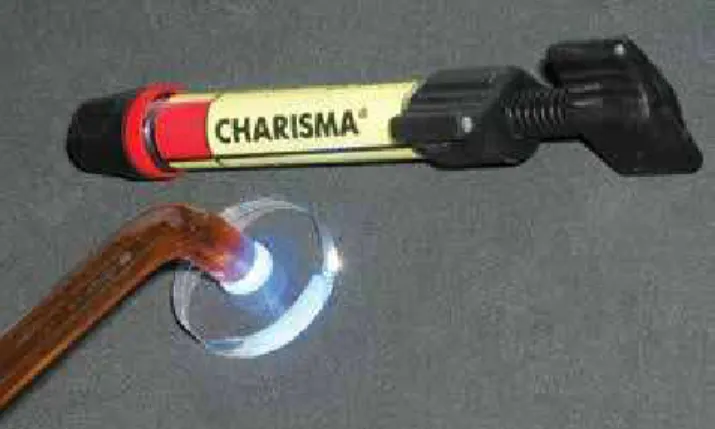
Two types of resin composites were tested: (a) Duraill resin composite (HeraeusKulzer, Hanau, Germany), and (b) Charisma micro hybrid resin composite (Her-aeusKulzer, Hanau, Germany). These materials were all placed in one go to reduce the incorporation of air bub-bles, and light cured for 40 seconds, 20 at the top and 20 at the bottom. A glass slide was used for compression and homogenization of the material (Fig 1). Ortholux XT Visible Light Curing Unit (3M Unitek, Monrovia, CA, USA) was used, and had its light intensity measured prior to curing at each stage, in all groups (Optilux Radiom-eter Model 100, SDS Care, Danbury, CT, USA). The
intensity found was 450 ± 10 mW/cm2. Additionally, the
bonding procedures were all performed in the same en-vironment and with a 1kVA voltage stabilizer connected to the curing light. The specimens were stored in plastic containers with distilled water, covered with an opaque lid and kept in an oven at 37 ± 1°C for 7 days for aging.
Sample group composition
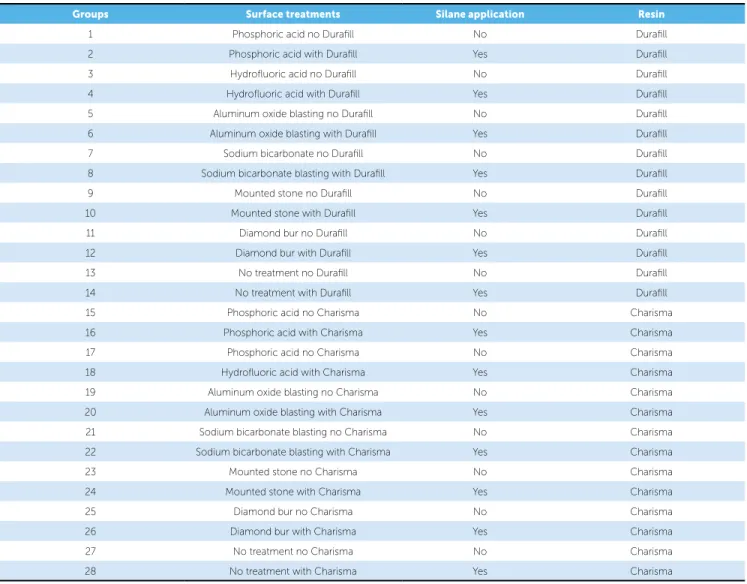
The specimens were divided into 28 groups of 10 elements, separated according to the type of sur-face treatment, type of resin composite and the use / non-use of silane (Table 1). The resinous surfaces were treated by the following agents: 37% phosphoric acid (Dental G Conditioner, Dentsply, Petrópolis, RJ) for
Table 1 - Presentation of groups, types of chemical surface treatment, use or non-use of silane, and type of resin composite used.
Groups Surface treatments Silane application Resin
1 Phosphoric acid no Duraill No Duraill
2 Phosphoric acid with Duraill Yes Duraill
3 Hydroluoric acid no Duraill No Duraill
4 Hydroluoric acid with Duraill Yes Duraill
5 Aluminum oxide blasting no Duraill No Duraill
6 Aluminum oxide blasting with Duraill Yes Duraill
7 Sodium bicarbonate no Duraill No Duraill
8 Sodium bicarbonate blasting with Duraill Yes Duraill
9 Mounted stone no Duraill No Duraill
10 Mounted stone with Duraill Yes Duraill
11 Diamond bur no Duraill No Duraill
12 Diamond bur with Duraill Yes Duraill
13 No treatment no Duraill No Duraill
14 No treatment with Duraill Yes Duraill
15 Phosphoric acid no Charisma No Charisma
16 Phosphoric acid with Charisma Yes Charisma
17 Phosphoric acid no Charisma No Charisma
18 Hydroluoric acid with Charisma Yes Charisma
19 Aluminum oxide blasting no Charisma No Charisma
20 Aluminum oxide blasting with Charisma Yes Charisma
21 Sodium bicarbonate blasting no Charisma No Charisma
22 Sodium bicarbonate blasting with Charisma Yes Charisma
23 Mounted stone no Charisma No Charisma
24 Mounted stone with Charisma Yes Charisma
25 Diamond bur no Charisma No Charisma
26 Diamond bur with Charisma Yes Charisma
27 No treatment no Charisma No Charisma
28 No treatment with Charisma Yes Charisma
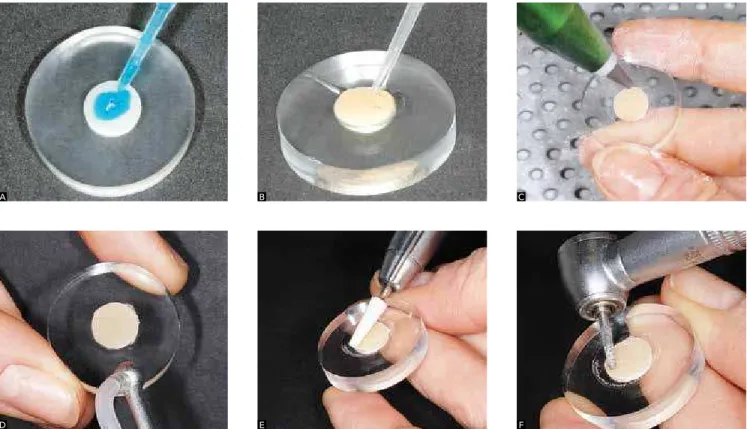
30 seconds (Fig 2A); 10% hydroluoric acid (Porcelain Conditioner, Dentsply, Petrópolis, RJ) for 2 minutes (Fig 2B); aluminum oxide blasting (blaster manufac-tured by Bio Art dental equipment Ltd, São Carlos, São Paulo, Brazil, 50-micron particles) (Fig 2C) and bicarbonate blasting (Proi II Ceramic, Dabi Atlante, Ribeirão Preto, São Paulo, Brazil, 60 pounds) (Fig 2D); mounted cylindrical stone (Jon, São Paulo, SP, Bra-zil) (Fig 2E) and high speed cylindrical diamond bur (3101, KG Sorensen, Barueri, SP, Brazil) (Fig 2F). In the two latter groups unidirectional grooves were ob-served by stereomicroscopy. The cleaning and drying procedures were similar in all other groups, and con-sisted in air/water sprays for 30 seconds followed by drying with air for another 30 seconds.
Thereater, maxillary central incisor metallic brack-ets (standard edgewise) (Dental Morelli Ltda., Sorocaba,
SP, Brazil) with 3.8 x 3.6 mm base and 0.022 x 0.030-in slot were bonded. The brackets were bonded to the composite restorative system of the specimens using Transbond XT orthodontic adhesive system according to manufacturer’s speciications (Fig 3).
In groups where silane (Angelus, Londrina, PR) was applied, a microbrush (KG Sorensen Indústria and Co-mércio Ltda., Barueri, SP, Brazil) was used, and ater a 1 minute interval, was homogenized by air jet for 3 sec-onds as well as the primer (Transbond XT Primer, 3M Unitek, Monrovia, CA, USA), which was applied with a microbrush and also homogenized by air jet.
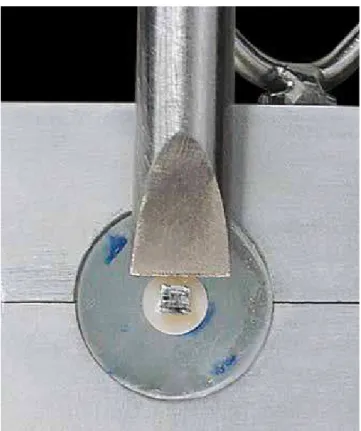
the Laboratory of Biomaterials at the Military Engineering Institute was used. The specimens are fastened to a device so that the bracket base was kept parallel to the tip of the chisel (Fig 4). Tests were performed with a load cell of 10 kg at a
speed of 0.5 mm/min,16 and data recorded by a computer
program (TESC version 3.04, Pinhais, PR, Brazil)
Adhesive remnant index (ARI)
Ater shearing the specimens, the bases of the brackets and the resin surfaces were examined in a stereomicroscope with 20x magniication. Adhesive remnant index (ARI) was categorized as follows: Score 0 (no adhesive present on the bracket bases); 1 (less than half); 2 (more than half)
and 3 (the entire adhesive remained on the bracket base).17
A descriptive analysis of the data with means, medians and standard deviations was carried out. Comparisons between shear force means were made using analysis of variance (ANOVA) with Schefe correction for multiple compari-sons. Kruskall-Wallis test was used for multiple comparisons between the scores, complemented by Mann-Whitney test.
RESULTS
The mean shear force values ranged between 2.30 MPa and 12.02 MPa, whereas the groups treated with acid etch-an explorer #5 (DUFLEX, Petrópolis, RJ, Brazil). Light
curing was performed on the whole set for 20 seconds (10 seconds on the mesial and 10 seconds on the distal surface). Ater bracket bonding, the same storage protocol described above was performed. The specimens were then once again stored in distilled water at 37° C for 7 days for aging.
Shear test
For the mechanical shear strength test a universal test-ing machine (EMIC DL 10000 MF cell Trd 21) owned by
Figure 2 - Surface treatment using: A) 37% phosphoric acid, B) hydroluoric acid, C) aluminum oxide blasting, D) sodium bicarbonate blasting, E) mounted stone, and F) diamond bur.
Figure 3 - Orthodontic Brackets bonded with Transbond XT light-cured resin onto previously treated surfaces.
A
D
B
E
C
ing attained lower values than those observed in the groups treated by blasting and bur/stone. In specimens illed with Duraill resin, silane application improved the means af-ter treatment with bicarbonate blasting, bur and stone, but higher standard deviations were observed (Fig 5). Regard-ing Charisma, the highest mean was obtained with bicar-bonate blasting without silane, although the application of silane worsened the mean yield strength values, with the exception of phosphoric acid etching (Fig 6). The stone without silane group showed the largest standard deviation followed by etching with hydroluoric acid without silane. The brackets in the control groups of both resin compos-ites had lower shear strength scores (Table 2).
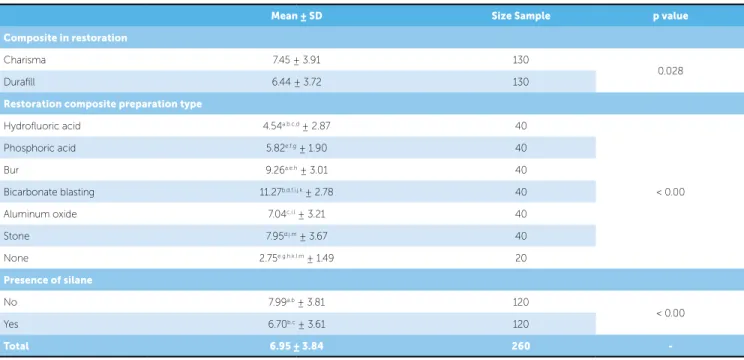
Bivariate analyses showed that there are diferences between the means of the groups, i.e., Duraill and Cha-risma, in terms of surface preparation and silane applica-tion. The Charisma group obtained higher means than the Duraill group. The resins tested exhibited their best performance with bicarbonate blasting, and the latter group with diamond burs. The efects produced — re-gardless of the type of resin composite (Duraill or Cha-risma) — types of surface preparation and use of silane were assessed by multiple linear regression. Analysis of the model showed signiicant interaction between type of composite and type of preparation (Table 2).
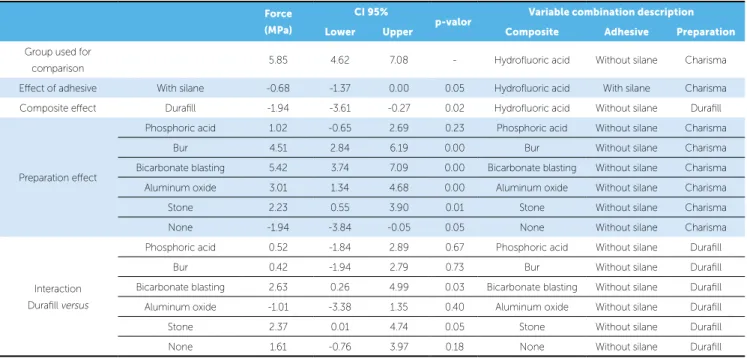
In trivariate analysis, the Charisma group treated with hydroluoric acid (Fl) without silane (5.85 MPa) was used as a basis for comparison. Compared to this group, all other surface preparations were signiicantly diferent in terms of specimen shear values, except for the use of phosphoric acid (p = 0.23). Charisma tests showed that the best surface preparation was bicarbon-ate blasting (5.42 MPa) followed by the use of burs (4.52 MPa), aluminum oxide (3.01 MPa), and stone (2.23 MPa), compared to hydroluoric acid. In the control group, the non-use of silane decreased shear strength by 1.94 MPa compared to the use of hydroluoric acid un-der the same conditions (Table 2).
In Table 3, the multivariate linear regression model highlights the interaction between the composite type and type of surface preparation variables. Charisma with hydroluoric acid was used as a basis for compari-son, where bonding performed with silane application reduced bracket adhesion, i.e., 0.68 MPa (p = 0.05). It was found that the use of Duraill with the same sur-face preparation, hydroluoric acid resin without silane, compared to Charisma, caused the shear force to worsen Figure 4 - Bracket shearing in an Emic DL 10000 MF universal testing machine.
Note the metallic support for ixation of specimens.
Figure 6 - Diagram showing shearing forces of specimens illed with Charisma resin arranged according to the use or non-use of silane.
Figure 5 - Diagram showing shearing forces of specimens illed with Duraill resin arranged according to the use or non-use of silane.
Without silane
Without silane
With silane
Group (Charisma) Group (Duraill)
MPa
MPa
With silane
0
0 2
2
1 and 2
15 and 16 17 and 18 19 and 20 21 and 22 23 and 2
4
25 and 26 27 and 28 3 and 4 5 and 6 7 and 8 9 and 10
11 and 12 13 and 1
4
4
4 6
6 8
8 10
10 12
by up to 1.94 Mpa (Table 3). Although Duraill resulted in smaller magnitudes than Charisma, the combined use of Duraill with bicarbonate blasting resulted in an additional increase in shear force (2.63 MPa) compared with the observed data (means), when the use of bi-carbonate blasting and Charisma were combined. The stone group also had a signiicant increase of 2.37 MPa (p = 0.05) relative to the comparison group, Charisma and hydroluoric acid without silane (Table 3).
Statistical diferences between specimen ARI scores in the various groups are depicted in Table 4. Analysis of specimen ARI scores ater debracketing revealed a tendency of Charisma group specimens with surfaces treated by hydroluoric acid, aluminum oxide, mount-ed stone (with application of silane) and diamond burs (without silane) to exhibit failures at the adhesive/ bracket interface. In Duraill groups, the same interface failure was observed in specimens conditioned with hydroluoric acid and aluminum oxide (without silane application). Charisma groups treated by phosphoric acid, bicarbonate blasting and use of stone (without si-lane application) and burs (with sisi-lane) tended to show failures at the adhesive/specimen interface. The same behavior was observed in the Duraill groups condi-tioned by phosphoric acid, bicarbonate blasting and ater use of stone and diamond burs (Table 4).
The use of silane did not produce ARI diferences in many groups, except for 3 specimen groups illed with
Charisma, and surfaces treated by hydroluoric acid, mounted stone and diamond burs.
DISCUSSION
The shear force of both types of resin composites tested were considered diferent, and were inluenced by the vast majority of surface preparations analyzed.
According to Swit, Valley and Boyer10 the shear force
of hybrid resin bonding was higher than that of micro-particulate resin, although their study did not test adhe-sion using orthodontic brackets.
Most studies reviewed tested the bond strength of diferent types of resin in procedures to repair esthetic
restorations. In these cases, several authors18,19,20,21
re-ported the need to etch the composite in order to en-hance its adhesiveness. In this study it was found that the efect of surface preparation on both resin composite types were similar to procedures to repair restorations.
Hydroluoric acid treatment produced a signiicant decrease in shear force compared to blasting procedures (aluminum oxide and bicarbonate) or grooved surface (bur and stone) (Tables 2 and 3). This inding
corrobo-rates works reported in the literature.16,22,23
Swit, Valley and Boyer10 stated that the efect of
hydroluoric acid is related to its percentage, size and type of inorganic composition. Therefore, depending on the type of resin composite, the efect of hydro-luoric acid may alter the efect of cohesion between
Mean ± SD Size Sample p value
Composite in restoration
Charisma 7.45 ± 3.91 130
0.028
Duraill 6.44 ± 3.72 130
Restoration composite preparation type
Hydroluoric acid 4.54a.b.c.d ± 2.87 40
< 0.00
Phosphoric acid 5.82e.f.g ± 1.90 40
Bur 9.26a.e.h ± 3.01 40
Bicarbonate blasting 11.27b.d.f.i.j.k ± 2.78 40
Aluminum oxide 7.04c.i.l ± 3.21 40
Stone 7.95d.j.m ± 3.67 40
None 2.75e.g.h.k.l.m ± 1.49 20
Presence of silane
No 7.99a.b ± 3.81 120
< 0.00
Yes 6.70b.c ± 3.61 120
Total 6.95 ± 3.84 260
-Table 2 - Description of mean and standard deviation values of shear forces comprising 4 characteristics. Analysis of Variance (ANOVA) with Schefe correction.
Table 3 - Coeicients of multivariate regression with the shear force interaction terms between composite and preparation.
Table 4 - Diferences between group scores (ARI).
Force (MPa)
CI 95%
p-valor Variable combination description Lower Upper Composite Adhesive Preparation
Group used for
comparison 5.85 4.62 7.08 - Hydroluoric acid Without silane Charisma
Efect of adhesive With silane -0.68 -1.37 0.00 0.05 Hydroluoric acid With silane Charisma
Composite efect Duraill -1.94 -3.61 -0.27 0.02 Hydroluoric acid Without silane Duraill
Preparation efect
Phosphoric acid 1.02 -0.65 2.69 0.23 Phosphoric acid Without silane Charisma
Bur 4.51 2.84 6.19 0.00 Bur Without silane Charisma
Bicarbonate blasting 5.42 3.74 7.09 0.00 Bicarbonate blasting Without silane Charisma
Aluminum oxide 3.01 1.34 4.68 0.00 Aluminum oxide Without silane Charisma
Stone 2.23 0.55 3.90 0.01 Stone Without silane Charisma
None -1.94 -3.84 -0.05 0.05 None Without silane Charisma
Interaction Duraill versus
Phosphoric acid 0.52 -1.84 2.89 0.67 Phosphoric acid Without silane Duraill
Bur 0.42 -1.94 2.79 0.73 Bur Without silane Duraill
Bicarbonate blasting 2.63 0.26 4.99 0.03 Bicarbonate blasting Without silane Duraill
Aluminum oxide -1.01 -3.38 1.35 0.40 Aluminum oxide Without silane Duraill
Stone 2.37 0.01 4.74 0.05 Stone Without silane Duraill
None 1.61 -0.76 3.97 0.18 None Without silane Duraill
Group Difered from groups
1 4, 19, 20, 24, 26
2 4, 19, 20, 24, 26
3
-4 8, 9, 12, 13, 14, 18, 23, 27, 28
5 8, 9, 12, 13, 14, 23, 27
6
-7 20
8 19, 20, 24, 26
9 19, 20, 24, 26
10
-11 20
12 19, 20, 24, 26
13 19, 20, 24, 26
14 19, 20, 24, 26
15
-16
-17 18*
18 19, 20
19 23, 27, 28
20 23, 27, 28
21
-22
-23 24*, 26
24 27
25 26*
26 27
27
-28
-the resins, reducing yield strength. Hydroluoric acid acts by dissolving glass particles, leading to increased surface porosity, which results in increased retention caused by the mechanical bonding agent. An applica-tion of this acid at 9.6% for 2 minutes may be regarded as aggressive since short duration conditioning can dis-solve the illing and compromise resin sotness. The risks involved in handling hydroluoric acid and the poor results it yielded may render it less indicated as a surface conditioning agent. This preparation proce-dure behaved similarly in this study.
Air abrasion showed better results in this study, as well as abrasive grooves. This inding is in agreement
with several studies conducted previously.10,23
Depend-ing on the type of resin composite treated, diferences were observed between preparation methods with abra-sive blasting. Duraill’s shear force performed better with silane application than without it, unlike Charis-ma, whose higher values were obtained when silane was not applied. These data corroborate the indings of
Mar-tin and Lopez16 but contrast with those of DeSchepper,
Tate and Power, who reported improved bond strength
with the use of silane ater abrasive procedures.24 Silane
application seems to improve the bond strength of the composite ater acid etching, blasting and preparation with burs and stones, when it comes to porcelain
re-pairs.25 Silane application and the use of adhesives seems
adhesive only. The same results were obtained ater subjecting both Duraill and Charisma to sodium bicar-bonate blasting and grooves with burs and stone, i.e., an increase in shear strength due to silane in areas etched
with phosphoric acid (Figs 5 and 6).26 Although
Söder-holm and Roberts27 did not ind statistically signiicant
diferences in repairing composite surfaces ater using silane, this study found an increase in shear strength of surfaces prepared with sodium bicarbonate blasting and grooves with burs and stone in specimens illed with Duraill. Silane may be responsible for the increase in shear forces observed on micro-hybrid resin surfaces.
The action of coupling agents is justiied to the extent that it facilitates iniltration of resin composite in
micro-scopic grooves produced in a prior surface preparation.16
The process of groove creation enables the detachment of inorganic particles, leaving exposed a deeper region in the composite’s resin matrix. Given that there is a struc-tural similarity between orthodontic bonding materials and the resin composites evaluated in this study, shear strength values would be expected which allow the clini-cal longevity of brackets to be bonded. This increase in shear strength ater silane application, however, was not observed in Charisma, which might indicate changes in the exposure of deeper portions of the inorganic matrix material when compared to micro-hybrid composites (Fig 6). Additional studies are needed to substantiate this laboratory inding. ARI diferences were observed which may be related to the unique features of the two types of composites and the eiciency shown by diferent types of surface treatments (Table 4). ARI diferences were not found between the use or non-use of silane in many
groups, a inding that agrees with some studies.27
In terms of the mean yield strength values of the brackets relative to the specimens, it should be noted
that according to Lopez,9 such yield strength should
withstand at least 7.8 MPa of shear force, an amount suf-icient to ensure successful bonding in clinical practice.
In this case, only the specimens illed with Duraill ater preparation with bicarbonate blasting, bur and stone, reached means that were above the means
sug-gested by Lopez.9 As for Charisma, the surface
prepa-ration that obtained values greater than 7.8 MPa were the groups that had previously been treated with alumi-num oxide blasting, sodium bicarbonate blasting, bur and stone without silane (Table 2). Thus, in Duraill micro-particulate restorations of anterior teeth,
orth-odontic brackets would be less prone to bond failures if the surfaces were irst prepared with bicarbonate blast-ing, bur or stone, without silane. However, in the case of brackets bonded to esthetic restorations in posterior teeth restored with Charisma micro-hybrid compos-ite, the best surface preparation according to the results would be aluminum oxide and bicarbonate blasting, bur and stone without silane.
There seems to have been operator inluence in surface preparation since standard deviation values relative to the mean values were not low, especially in groups prepared with bicarbonate blasting, bur and stone. This suggests that choosing a method for bond-ing orthodontic brackets onto resin composites can be inluenced by the individual orthodontist performing the procedure (Table 2).
CONCLUSIONS
1. Charisma, the micro-hybrid resin composite, dis-played higher yield strength during shear testing of the brackets than Duraill, the micro-particu-late resin composite.
2. Silane application improved surface prepara-tion of Durafill when performed in conjunc-tion with bicarbonate blasting and grooves with bur and stone.
3. When performed on Charisma, silane applica-tion worsened the means obtained for the yield strength of orthodontic brackets in all preparation surfaces, with the exception of phosphoric acid. 4. Surface preparation with bicarbonate blasting, bur
and stone experienced greater operator inluence than others.
5. Surface treatment with sodium bicarbonate blast-ing, bur and stone in both types of resin compos-ites tested showed a mean yield strength greater than 7.8 MPa, a value normally recommended and suicient to ensure successful bonding in clinical practice.
ACKNOWLEDGEMENTS
1. McKiernan EX, Jones ML. Psychological proiles and motives of adults seeking orthodontic treatment. Int J Adult Orthodon Orthognath Surg. 1992;7(3):187-98.
2. Salonen L, Mohlin B, Gotzlinger B, Helden L. Need and demand for orthodontic treatment in an adult Swedish population. Eur J Orthod. 1992;14(5):359-68.
3. Andreasen JO. Traumatic injuries of the teeth. 2nd ed. Copenhagen: Munksgaard; 1981.
4. Harari D, Shapira-Davis S, Gillis I, Roman I, Redlich M. Tensile bond strength of ceramic brackets bonded to porcelain facets. Am J Orthod Dentofacial Orthop. 2003;123(5):551-4.
5. Kao EC, Boltz KC, Johnston WM. Direct bonding of orthodontic brackets to porcelain veneer laminates. Am J Orthod Dentofacial Orthop. 1988;94(6):458-68.
6. Zachrisson YO, Zachrisson BU, Buyukyilmaz T. Surface preparation for orthodontic bonding to porcelain. Am J Orthod Dentofacial Orthop. 1996;109(4):420-30.
7. Schwartz RE, Tyas MJ, West VC. The bonding of orthodontic brackets to composite resin surfaces. Current note No. 71. Aust Dent J. 1990;35(5):472-3. 8. Lai PY, Woods MG, Tyas MJ. Bond strengths of orthodontic brackets to
restorative resin composite surfaces. Aust Orthod J. 1999;15(4):235-45. 9. Lopes JI. Retentive shear strengths of various bonding attachment bases.
Am J Orthod. 1980;77(6):669-78.
10. Swift EJ Jr, Le Valley BD, Boyer DB. Evaluation of new methods for composite repair. Dent Mater. 1992;8(6):362-5.
11. Melo MA, Moysés MR, Santos SG, Alcântara CE, Ribeiro JC. Efects of diferent surface treatments and accelerated artiicial aging on the bond strength of composite resin repairs. Braz Oral Res. 2011;25(6):485-91. 12. Boyer DB, Chan KC, Torney DL. The strength of multilayer and repaired
composite resin. J Prosthet Dent. 1978 Jan;39(1):63-7.
13. Miranda MS, Dias KRC, Correia SCS, Capanema RE. Efeito do jato de bicarbonato de sódio sobre a superfície de materiais restauradores estéticos. Rev Bras Odontol. 2003;60:240-3.
14. Söderholm KL. Flexure strength of ive one component adhesives under simulated pulpal pressure. Oper Dent. 1999;24:36-49.
REFERENCES
15. Jafarzadeh KTS, Erfan M, Rakhshan V, Aghabaigi N, Tabatabaei FS. An in vitro assessment of the efects of three surface treatments on repair bond strength of aged composites. Oper Dent. 2011;36(6):608-17.
16. Martín CL, Lopez SG. The efect of various surface treatments and bonding agents on the repaired strength of heat-treated composites. J Prosthet Dent. 2001;86(5):481-8.
17. Cal Neto J, Miguel JAM. Uma análise dos testes in vitro de força de adesão em Ortodontia. Rev Dental Press Ortod Ortop Facial. 2004;9(4):44-51. 18. Artun J, Bergland S. Clinical trial with crystal growth condiotining as
an alternative to acid etch enamel pretreatment. Am J Orthod. 1984 Apr;85(4):333-40.
19. Kupiecka KA, Bakmeier WW. Laboratory evaluation of surface treatments for composite repair. Oper Dent. 1996;21(2):59-62.
20. Puckett AD, Holder R, O’Hara JW. Strength of posterior composite repairs using diferent composite/bonding agent combinations. Oper Dent. 1991;16(4):136-40.
21. Turner CW, Meiers JC. Repair for an aged, contaminated indirect composite resin with a direct, visible light cured composite resin. Oper Dent. 1993;18(5):187-94.
22. Rinastiti M, Özcan M, Siswomihardjo W, Busscher HJ. Efects of surface conditioning on repair bond strengths of non-aged and aged microhybrid, nanohybrid, and nanoilled composite resins. Clin Oral Investig. 2011;15(5):625-33.
23. Staxrud F, Dahl JE. Role of bonding agents in the repair of composite resin restorations. Eur J Oral Sci. 2011;119(4):316-22.
24. Moncada G, Angel P, Fernandez E, Alonso P, Martin J, Gordan VV. Bond strength evaluation of nanohybrid resin-based composite repair. Gen Dent. 2012;60(3):230-4.
25. Stangel I, Nathanson D, Hsu CS. Shear strength of the composite bond to etched porcelain. J Dent Res. 1987;66(9):1460-5.
26. Kimyai S, Mohammadi N, Navimipour EJ, Rikhtegaran S. Comparison of the efect of three mechanical surface treatments on the repair bond strength of a laboratory composite. Photomed Laser Surg. 2010;28 Suppl 2:S25-30. 27 Sodërholm KL, Roberts ML. Variables inluencing the repair strength of