New Experimental Results on the Casimir Eet
V. M. Mostepanenko
Departamentode Fsia,UniversidadeFederalda Paraba,Jo~aoPessoa,
58059{970,Brazil
(on leavefromA.FriedmannLaboratoryforTheoretialPhysis,St.Petersburg,Russia)
E-mail: mostepsia.ufpb.br
Reeived7January,2000
Newexperimentsare disussedonmeasuringthe Casimirforebetweenmetallisurfaes. Oneof
themusestorsionpendulumandtheotherone|atomiforemirosope. Thelaimedagreement
ofexperimentaldatawithatheoryis analyzed. A5% levelofagreementobtained withatorsion
pendulumisshowntobeinontraditionwiththevaluesofsurfaeroughness,niteondutivity
and temperature orretions to the Casimir fore. A 1% agreement (at the losest separations)
obtainedwithanatomiforemirosopeisonrmedbytheuseofmoreexattheorytakinginto
aounthigherordersurfaeroughnessandondutivityorretions.
I. Introdution
Casimireetarisesinboundeddomainsandinspaes
with non-trivialtopologiesasaresultofthedistortion
ofthezeropointvauumutuationspetrumof
quan-tizedelds[1,2℄. Itappearsintheformofattrativeor
repulsive fores between marosopi material
bound-ariesin avauum.
An important feature of the Casimireet is that
eventhoughitisquantuminnature,itpreditsafore
between marosopi bodies. For two plane-parallel
metalli plates ofareaS =1m 2
separatedbyalarge
distane (ontheatomisale)of a=0:5m thevalue
oftheattrativeforeatingbetweenthemis:
F (0)
C (a)=
2
240 Sh
a 4
=210 6
N: (1.1)
Asisseenfrom(1.1)theCasimirforedependsonlyon
thefundamentalonstantshand,unlikeothervauum
eets whihdependontheharge,massandoupling
onstants.
There exist only afew other marosopi
manifes-tationsofquantumphenomena. Amongthemthereare
thefamousonessuhasSuperondutivity,
Superuid-ityand theQuantum Halleet. Intheabove
maro-sopi quantum eets the oherent behavior of large
numberof quantum partiles plays animportantrole.
Similarly the Casimir eet an be onsidered also as
amarosopiquantumeetasittakesplaebetween
boundariesplaedat suhlargedistanesthat the
vir-tual photon emitted by an atom of one body annot
reahtheseondbodyduringitslifetime. Nevertheless,
theorrellatorofthequantizedeletromagnetieldin
symmetrial opposite layers of dierent boundaries is
notequaltozero. Heneorrelatedosillationsariseof
thedipole momentsof atoms situated at those points
resultingin appearane oftheCasimirfore. (The
op-positelimitof attrativeforesbetweenloselyspaed
bodies isreferredto asthevander Waals fore). The
learestimpliationof theaboveisthat greater
atten-tiontraditionallygiventothemarosopiquantum
ef-fetswillalsobereeivedbytheCasimireet.
TheCasimireetplaysanimportantrolein a
va-riety of elds of physissuh as Quantum Field
The-ory,GravitationandCosmology,AtomiandMoleular
PhysisandMathematialPhysis.
In Quantum Field Theory theCasimir eet nds
three main appliations. In the bag model of
Quan-tumChromodynamistheCasimirenergyofquarkand
gluonelds ontributesupto10%ofthetotalnuleon
energy [2{4℄. In Kaluza-Klein eld theories Casimir
eet oers one of the most eetive mehanisms for
spontaneous ompatiation of extra spatial
dimen-sions[5℄. MoreovermeasurementsoftheCasimirfore
provideopportunitiestoobtainmorestrongonstraints
fortheparametersoflong-rangeinterationsandlight
elementarypartilespreditedbytheuniedgauge
the-oriesoffundamental interations[6{8℄.
In Gravitation and Cosmology the Casimir eet
arisesduetothenon-trivialtopologyofspae-time[9℄.
ThevauumpolarizationresultingfromtheCasimir
ef-fetandrivetheinationproess intheosmologial
models with non-Eulidean topology [10℄. Inthe
the-oryofstrutureformationoftheUniversedueto
topo-logial defets, the Casimir vauum polarization near
leadstoattrativeandrepulsiveforesbetweenthe
ma-terialboundarieswhihdependonthegeometryofthe
boundaries,ontemperature,andtheeletrialand
me-hanial properties of the boundary surfae [2,12{14℄.
Itisresponsibleforsomepropertiesinthin lms[15℄.
In Atomi Physis,the Casimir eet leadsto the
orretionstotheenergylevelsofRydbergstates[16℄.
A number of the Casimir-type eets arise in
Cav-ityQuantum Eletrodynamiswhentheradiative
pro-essesandassoiatedenergyshiftsaremodiedbythe
preseneofavitywalls[17℄.
In Mathematial Physis the investigation of the
Casimireethasstimulatedthedevelopmentof
pow-erfultehniqueslikeRiemannandEpsteinzeta-funtion
regularizationandalsobymeansofheat-kernel
expan-sion[18℄.
In the ve deades following Casimir's disovery
the eld hasbeendominated by enormoustheoretial
output. Given the small fores involved experimental
progresshasbeenpainfully limited. Before1997there
have been two experimental attempts. The rst by
Sparnaay based on aspring balane [19℄ qualitatively
showedtheattrativeforebut waslimitedduetothe
100%experimentalerror. In[20℄theCasimirfore
be-tweentheChromiumoveredplateandaspheriallens
wasmeasuredalsousingaspringbalane. Noestimate
fortheauraywaspresentedin[20℄. Other
measure-mentsoftheCasimirforebetween1956{1996were
per-formedwiththedieletritestbodies(seefore.g. [2℄),
whihlimitstheauraydue tostrongdependeneof
theforeonthedieletriproperties.
Here we disuss the new experiments on the
mea-suring oftheCasimir forebetween metals. In Se.II
theexperiment[21℄isbrieydisussed. InSe.IIIthe
results of the experiment [22℄ are presented. Se. IV
ontainstheritialanalysisoftherelationbetweenthe
experimentaldataof[21,22℄andtheoretialapproahes
used in these papers. More omplete theory whih is
in agreementwith theresults of [22℄ is the subjetof
Se.V.Se.VIontainsonlusionsanddisussion.
II. The experimentby S.K.
Lam-oreaux
The modern stage of theCasimir fore measurements
betweenmetals was openedby thepaper[21℄. Inthis
paper a torsion pendulum was used to measure the
fore between Cu plus Au oated quartz optial at,
and a spherial lens in a distane range from 0.6m
to 6m. The thikness of both metalli layers was
0.5m. The radius of a spherial lens was estimated
as R = 11:30:1m (later the improved value of
12:50:3m was published [23℄). The measurements
wereperformedatapressureof10 4
Torratroom
tem-perature.
pression for the Casimir fore between a plate and a
spheremadeofidealmetals
F (0)
C (a)=
3
R
360 h
a 3
: (2.1)
There is the theoretial orretion to the Casimir
foreduetoniteondutivityofthemetal. In[21℄the
Casimirforetogetherwiththerstorderondutivity
orretionwasrepresentedin theform
F (Æ0)
C
(a)=F (0)
C (a)
1 4 Æ
0
a
; (2.2)
wheretheeetivepenetrationdepthofthe
eletromag-neti zeroosillationsintothemetalis
Æ
0 =
!
p =
p
2
; (2.3)
!
p and
p
aretheeetiveplasmafrequenyand
wave-lengthoftheeletrons.
In[21℄orretion to(2.1)due to nonzero
tempera-turewasalsoonsidered. Togetherwiththisorretion
theCasimirforeis
F (T)
C
(a)=F (0)
C (a)
1+ 720
2
f()
; (2.4)
where =k
B
Ta=(h), k
B
is theBoltzmann onstant,
T istheabsolutetemperature,andf()is atabulated
funtion (see,e.g.,[24℄).
TheorretionstotheCasimirfore(2.1)duetothe
surfaeroughnesswerenotonsideredin[21℄.
The absolute error of fore measurements in [21℄
was,approximately,=10 11
N.Aordingto[21,23℄
\Agreementwiththeoryatthelevelof5%isobtained".
Byatheorytheformula(2.1)ismeant. Thestatement
of[21℄is: \dataisnotofsuÆientaurayto
demon-strate the nite temperature orretions". Also data
of[21℄doesnotsupportthepreseneoftheorretions
dueto niteondutivityoftheoveringmetal.
III. The experiment by U.
Mo-hideen and A. Roy
In [22℄ the Atomi Fore Mirosope was adapted to
measure the Casimir fore between Al plus Au=Pd
oatedsapphirediskandpolystyrenesphereforsurfae
separationsbetween0.1 to 0.9m. Thethiknesses of
Al andAu=Pdlayerwere orrespondingly 0.3m and
0.02m. Themeasurementswereperformedata
pres-sureof510 2
Torratroomtemperaturewithasphere
diameter196m.
The ideal theoretial expression for the Casimir
inrelativepenetrationdepthwereaountedforin[22℄
usingthetheoretialresultof[25℄:
F (Æ0)
C
(a)=F (0)
C (a)
1 4 Æ
0
a +
72
5 Æ
2
0
a 2
: (3.1)
The temperature orretions to the Casimir fore
are given by (2.4). In addition in [22℄ the
rough-nessof thetest bodies wasinvestigatedbytheAtomi
Fore Mirosope and Sanning Eletron Mirosope.
The average roughnessamplitudewasestimatedto be
A=35nm. ThetheoretialexpressionfortheCasimir
fore withastohastiroughnessorretion[25℄
F (R)
C
(a)=F (0)
C (a)
"
1+6
A
a
2 #
; (3.2)
wasusedin omparisonofatheorywithexperiment.
The absolute error of fore measurements in [22℄
was, approximately, = 210 12
N. In [22℄ the root
mean square average deviation (rms) between the
experimental and theoretial Casimir fore valueswas
hosenas the quantity desribing agreementof a
the-ory and experiment. For the Casimir fore (2.1)
to-getherwiththeniteondutivityorretion(3.1)and
roughnessorretion(3.2)thevalue=1:6pNwas
ob-tained in [22℄(temperatureorretionsare not
impor-tant in the measurement range under onsideration).
Thisdeviationis,approximately,1%oftheforeatthe
smallest surfae separations. This valuewastaken in
[22℄ asastatistialmeasure oftheexperimental
prei-sion. NotethattheidealCasimirforeexpression(2.1)
alongleadsto=6:3pN(5%deviationatthesmallest
separation),(2.1)togetherwithonlythenite
ondu-tivity orretion (3.1) results in a = 5:5pN, (2.1)
togetherwithonlytheroughnessorretion(3.2)leads
to a=48pN(40% deviationat thelosestspaing).
Whatthismeansisdataof[22℄supportthepreseneof
bothorretions due tonite ondutivity anddue to
surfaeroughness.
IV. Analyzing experimental
re-sults
Letusstartwiththeresultsofpaper[21℄whihusesa
torsion pendulum tomeasure theCasimir fore. As it
wasalreadynotedinSe.IIexperimentaldataof[21℄do
not support thepreseneof nite ondutivity
orre-tion to the Casimir fore. This orretion is negative
and for the losest spaing (a = 0:6m) an ahieve
20%ofF (0)
C
. Thiswasreognizedin[21℄(seealso[26℄).
The detailed analyses of the nite ondutivity
or-retion up to the fourth order in relative penetration
depth is ontainedin [7℄. There it wasonrmedthat
the value of the nite ondutivity orretion to the
Casimir foreat a=0:6mis about20%of F (0)
(the
attempt to avoid this onlusion, undertaken in [26℄,
fails \due to an invalid manipulation of optial data"
[27℄). To onlude, the atualvalue of the nite
on-dutivityorretionisinontraditionwiththelaimed
in[21℄agreementwiththetheoryatthelevelof5%.
Now let us turn to the role of nite temperature
and surfae roughness orretions in the experiment
[21℄. Aording to [23℄ \...eetsof nite temperature
andsurfaeroughness,areestimatedtobesigniantly
lessthan10%..." Thisstatement,however,isinorret.
Theroughnessorretionanahieve30%ofF (0)
C ifthe
large-saledeviationsoftheboundarysurfaesfromthe
perfetshapearepresent[28℄. Thisisatuallythease
in theexperiment[21℄beausethe lensin use was
as-pheri [23℄. As to the temperature orretion it is of
86%of F (0)
C
at a = 4m, 129% of F (0)
C
at a =5m,
and 174% of F (0)
C
at a = 6m at room temperature
[7℄. Butthedataof[21℄donotsupportthepreseneof
bothroughnessandtemperatureorretions.
>Fromtheaboveit beomeslearthat thelaimed
in [21℄ agreement with the theory at the level of 5%
doesnotstandup.
We now disuss the main onlusion of the paper
[22℄ in whih an atomi fore mirosopewas used to
measure the Casimir fore. Let us remind that here
theexperimentaldataare inagreementwiththe
pres-ene ofbothroughness and nite ondutivity
orre-tionsgivenbyEqs. (3.1)and (3.2). Thereis one
diÆ-ulty,however,in theuseof Eqs.(3.1)and(3.2). The
thing is that they are not exat but perturbative
re-sults. For example, the seond order term from (3.1)
ontributes 25% of F (0)
C
for Aluminum at the losest
spaing (a = 0:12m). Moreover, the seond order
roughness orretion in (3.2) ontributes 51% of F (0)
C
ata=0:12m. Itisevidentthathigherorder
ondu-tivity and roughness orretions should be taken into
aount to get the theoretial result whih would be
valid upto 1% auray. That is the reasonwhy the
agreementbetweenexperimentaldataandtheoryatthe
level of 1% at the smallest separation laimed in [22℄
allsforfurtheronrmation.
V. More omplete theory ts
experiment
Inthis setion we present asummary of ollaborative
experimental and theoretial results obtained in [29℄.
Theymakemoreleartheatualsituationwith anew
measurement of the Casimir fore [22℄ and its
agree-mentwithatheory.
In the ase that the harateristi lateral sizes of
distortionsoveringtheplate andthespherearesmall
omparing p
aR the following general expression for
[28,29℄
F (R)
C
(a)=F (0)
C (a)
(
1+6 " hhf 2 1 ii A 1 a 2 2hhf 1 f 2 ii A 1 a A 2 a +hhf
2 2 ii A 2 a 2 # +10 " hhf 3 1 ii A 1 a 3 3hhf 2 1 f 2 ii A 1 a 2 A 2 a +3hhf 1 f 2 2 ii A 1 a A 2 a 2 hhf 3 2 ii A 2 a 3 # +15 " hhf 4 1 ii A 1 a 4 4hhf 3 1 f 2 ii A 1 a 3 A 2 a
+6hhf 2 1 f 2 2 ii A 1 a 2 A 2 a 2 (5.1) 4hhf 1 f 3 2 ii A 1 a A 2 a 3
+hhf 4 2 ii A 2 a 4 # ) : Here f 1;2
are the funtions desribing surfae
distor-tions, A
1;2
are distortion amplitudes alulated from
themiddledistortion level. Thedoubleanglebrakets
denote twosuessiveaveragingproedures. Therst
one is the averagingoverthe surfaearea of
interat-ing bodies. The seond one is overall possible phase
shiftsbetween thedistortions situated on thesurfaes
of interating bodies against eah other. This seond
averagingis neessarybeause in the experiment [22℄
themeasuredCasimirforewasaveragedover26sans
oftheatomiforemirosope.
Theroughness ofthemetaloveringwasmeasured
withthesameatomiforemirosopeusingastandard
antileverhavingasharptip(insteadofasphere). The
major distortions are the large separate rystals
situ-atedirregularlyonthesurfaes. Theyanbemodeled
approximatelybytheparallelepipedsoftwoheights. As
the analysis of several AFMimages shows,the height
of highest distortions is about h
1
=40nmand of the
intermediateones|abouth
2
=20nm. Almostall
sur-fae betweenthedistortions isoveredbythe
stohas-tiroughness ofheighth
0
=10nmonsistingof small
rystals. Alltogethertheyformthehomogeneous
bak-groundof the averagedheighth
0
=2. Theharater of
roughnessontheplateandonthelensisquitesimilar.
NowitispossibletodeterminetheheightHrelative
to whih the middle valueof the funtion, desribing
thetotal roughness,iszero. It anbefoundfrom the
equation (h 1 H)S 1 +(h 2 H)S 2 H h 0 2 S 0
=0; (5.2)
whereS
1;2;0
are,orrespondingly,thesurfaeareas
o-upiedbydistortionsoftheheightsh
1 ,h
2
and
stohas-tiroughness. Dividing(5.2)intotheareaofinterating
surfaeS=S
1 +S 2 +S 0 onegets (h 1 H)v 1 +(h 2 H)v 2 H h 0 2 v 0
=0; (5.3)
where v
1;2;0 = S
1;2;0
=S are the relative parts of the
surfae oupied by the dierent kinds of roughness.
The analysis of the obtained AFM pitures gives us
the values v
1
= 0:11, v
2
= 0:25, v
0
= 0:64. Solving
Eq.(5.3)wegettheheightofthezerodistortionslevel
H = 12:6nm. The value of distortion amplitude
de-ned relativelytothislevelis
A=h
1
H =27:4nm: (5.4)
Belowtwomoreparameterswillalsobeused
1 = h 2 H A 0:231; (5.5) 2 = H h 0 =2 A 0:346:
With the help of them the distortion funtion of the
plate anberepresentedas
f 1 (x 1 ;y 1 )= 8 < : 1; (x 1 ;y 1 )2 S1 ; 1 ; (x 1 ;y 1 )2 S2 ; 2 ; (x 1 ;y 1 )2 S0 ; (5.6) where S1;S2;S0
are theregionsof the rstinterating
bodysurfaeoupiedbythedierentkindsof
rough-ness. Foraspheretheanalogialrepresentationof the
distortionfuntion isvalid.
NowitisnotdiÆulttoalulatetheoeÆientsof
expansion(5.1). Oneexampleis
hhf
1 f
2 ii= v
2 1 2 1 v 1 v 2 +2 2 v 1 v 0 (5.7) 2 1 v 2 2 +2 1 2 v 2 v 0 2 2 v 2 0 =0;
whihfollowsfromEqs. (5.3){(5.5). Theresultsforthe
otheroeÆientsare
hhf 2
1 ii=hhf
2
2 ii=v
1 + 2 1 v 2 + 2 2 v 0 ; hhf 3 1
ii= hhf 3
2 ii=v
1 + 3 1 v 2 3 2 v 0 ; (5.8) hhf 1 f 2 2 ii=hhf
2
1 f
2 ii=0;
hhf 4
1 ii=hhf
4
2 ii=v
1 + 4 1 v 2 + 4 2 v 0 ; hhf 1 f 3 2 ii=hhf
3
1 f
2 ii=0;
hhf 2 1 f 2 2 ii=(v
1 + 2 1 v 2 + 2 2 v 0 ) 2 :
Substituting(5.8)into(5.1)wegetthenal
expres-sion for the Casimir fore with surfae distortions
in-ludeduptothefourthorderinrelativedistortion
am-plitude
F (R)
C
(a)=F (0)
C (a)
1+12 v
1 + 2 1 v 2 + 2 2 v 0 A 2 a 2
+20 v
Itshouldbenotedthat exatlythesameresultan
beobtainedinaverysimpleway. Todothisitisenough
to alulate the values of the Casimir fore (2.1) for
six dierent distanes whih are possible between the
distorted surfaes, multiply them by the appropriate
probabilitiesandthentosummarizetheresults
F (R)
C (a)=
6
X
i=1 w
i F
(0)
C (a
i )v
2
1 F
0
(a 2A)
+2v
1 v
2 F
0
(a A(1+
1
)) (5.10)
+2v
2 v
0 F
0
(a A(
1
2 ))
+v 2
0 F
0
(a+2A
2 )+v
2
2 F
0
(a 2A
1 )
+2v
1 v
0 F
0
(a A(1
2 )):
Nowletusdisussmorein detailtheorretionsto
theCasimirforeduetonite ondutivityofthe
ov-ering metals in the experiment [22℄. The interating
bodies used in the experiment [22℄ were oated with
300nm of Al in an evaporator. The thikness of this
metallilayerismuhlargerthanthepenetrationdepth
Æ
0
ofeletromagnetiosillationsinto Alforthe
wave-lengths (sphere-plate separations) of interest. Taking
Al
p
=100nmasthe approximative valueof the
ee-tiveplasmawavelength oftheeletronsin Alonegets
Æ
0 =
Al
p
=(2) 16nm. What this means is the
in-terating bodies an be onsideredasmadeof Alasa
whole. AlthoughAlreetsmorethan90%ofthe
ini-denteletromagneti osillationsin theomplete
mea-surementrange100nm<<950nm,someorretions
to the Casimir fore due to the niteness of its
on-dutivity exist and should be taken into aount. In
addition, to prevent the oxidation proesses, the
sur-fae of Al in [22℄ was overed with = 20nm layer
of 60%Au=40%Pd. The reetivity properties of this
alloyareworsethanofAl.
Weonsider rstly theaseof small distanes a<
500nm. Here thetransmittaneof 20nmAu=Pdlms
for the harateristi wavelengths ontributing to the
fore value is greater than 90%. This transmission
measurement was made by taking the ratio of light
transmitted through a glass slide with and without
the Au=Pd oating in an optial spetrometer. So
high transmittane givesthepossibilityto neglet the
Au=PdlayerswhenalulatingtheCasimirforeandto
enlargethedistanebetweenthebodiesby2=40nm
when omparing the theoretial and experimental
re-sults.
For pure Al the Casimir fore with nite
ondu-tivity orretions up to the 4th order in relative
pen-etrationdepth anbeobtainedfrom the interpolation
formula[8℄
F (Æ
0 )
C
(a+2)=F (0)
C
(a+2)
1 4 Æ
0
a+2
+
72 Æ
2
0
2
152 Æ 3
0
3
(5.11)
+ 532
3 Æ
4
0
(a+2) 4
:
Nowweombinebothorretions|oneduetothe
surfaeroughnessandtheseondduetothenite
on-dutivity ofthemetal. Forthis purposewesubstitute
the quantity F (Æ0)
C (a
i
) from (5.11) into Eq.(5.10)
in-steadofF (0)
C (a
i
). Theresultis
F
C (a)=
6
X
i=1 w
i F
(Æ0)
C (a
i
): (5.12)
Intherangeoflargedistanes600nm<a<900nm
there is no neessity to take into aount any
orre-tionstotheCasimirforeduetothelargesatterin
ex-perimentalpointsduetotheexperimentalunertainty.
Here the ideal expression (2.1) for the Casimir fore
anbeused (see[29℄for thedetails). It givesthe rms
deviationbetweentheoryandexperimentof1.5pN.
Now we ompare theexperimental and theoretial
results in the range of smaller values of the distane
80nma460nm(or,betweenAl,120nma+2
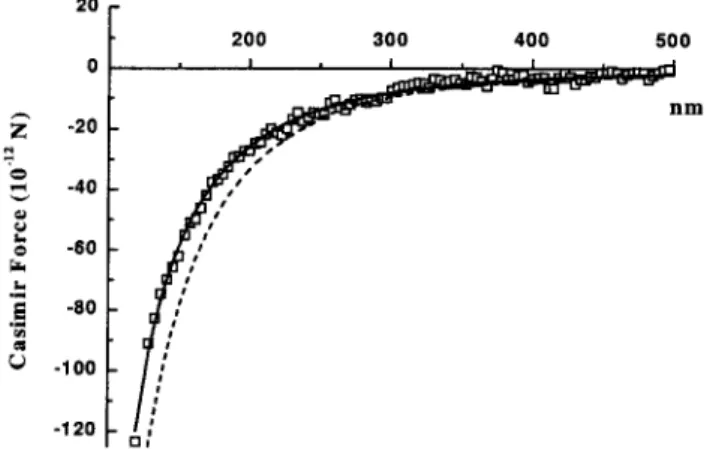
500nm). Here the Eq.(5.12) should be used for the
Casimirfore. InFig.1theCasimirforeF (0)
C
(a+2)
from (2.1) is shown by the dashed urve. The solid
urve represents the dependene alulated aording
to Eq.(5.12). The open squares are theexperimental
points[29℄.
Figure 1. The measured average Casimir fore for small
distanesas afuntionof plate-sphereseparationisshown
asopensquares. ThetheoretialCasimirforewith
orre-tionstosurfaeroughnessand niteondutivityisshown
bythesolidline,andwithoutanyorretionbythedashed
line.
Taking into aount all one hundred experimental
pointsbelongingtotherangeofsmallerdistanesweget
forthesolidurvethevalueoftherootmeansquare
de-viationbetweentheory andexperiment
100
=1:5pN.
If we onsider more narrow distane interval 80nm
a200nmwhihontainsthirty experimental points
it turns outthat
30
=1:6pN for the solidurve. In
meansquaredeviationis
223
=1:4pN(223
experimen-tal points). What this means is that the dependene
(5.12)givesequallygoodagreementwithexperimental
data in the region ofsmall distanes (forthe smallest
ones the relativeerror of fore measurement is about
1%),intheregionoflargedistanes(whereitgivesthe
sameresultas(2.1)beausetherelativeerrorisrather
large)andinthewholemeasurementrange. Ifoneuses
lesssophistiatedexpressionsfortheorretionstothe
Casimir fore due to the surfae roughness and nite
ondutivity,thevalueofalulatedforsmallawould
belargerthaninthewholerange[22℄.
It is interesting to ompare the obtained results
with those givenby Eq.(2.1), i.e. without aountof
any orretion. In this ase for the interval 80nm
a 460nm (one hundred experimental points) we
have 0
100
=8:7pN.For thewhole measurementrange
80nma910nm(223points)thereis 0
223
=5:9pN.
Itisevidentthatwithoutappropriatetreatmentofthe
orretions to the Casimir fore the value of the root
mean square deviation is not only largerbut also
de-pendssigniantlyonthemeasurementrange.
Theomparativeroleofeahorretionisalsoquite
obvious. If we take into aount only roughness
or-retion aording to Eq.(5.10), then one obtains for
the root mean square deviation in dierent intervals:
R
30
= 22:8pN, R
100
= 12:7pN and R
223
=8:5pN. At
a+2 = 120nm the orretion is 17% of F (0)
C . For
the single nite ondutivity orretion alulated by
Eq.(5.11) it follows: Æ
30
=5:2pN, Æ
100
=3:1pN and
Æ
223
= 2:3pN. At 120nm this orretion ontributes
34% of F (0)
C
. (Note, that the ontribution of both
orretions is {22% of F (0)
C
at 120nm, so that their
non-additivityisdemonstratedmostlearly.)
VI. Conlusions and disussion
Intheabove,itwasshownthattheexperimentalresults
of[22℄are in exellent agreementwiththe moreexat
theoryoftheCasimirfore takingintoaount
orre-tionsuptothe4thorderbothinsurfaeroughnessand
nite ondutivity. The1% agreementbetweena
the-oryandexperimentwasonrmedatthesmallest
sep-arations,i.e. thesameaswaslaimedoriginallyin[22℄.
Therearetworeasonswhyoneandthesamesetofdata
isinapproximatelythesameagreementwithtwo
theo-riesofdierentauray. Firstly, thehigherorder
or-retionsforthesurfaeroughnessandnite
ondutiv-ityhave dierentsigns (positive and negative,
respe-tively) and partly ompensate eah other. Seondly,
for large separations the relative error of fore
mea-surementsissolargethat boththeoretialapproahes
areequivalent. Theaountoftheregionoflarge
sepa-rationsleadstoalmostequivalentrmsdeviationsinall
measurementrange.
ene betweentwotheoretial approahes in their
rela-tion to data. With the less aurate theoretial
ap-proahusedin[22℄,thevalueofrmsdeviationdepends
signiantlyonthedistane range. Withthemore
ex-atapproahof[29℄,thevalueof is almostthesame
forsmallseparations,largeseparationsandinall
mea-surementrange. This denounesdoubts raisedin [26℄
(see also S.K. Lamoreaux omment [31℄ and U.
Mo-hideen and A. Roy reply [32℄): experimental data of
[22℄agreewithatheoryatalevelof1%atthesmallest
separations.
It is notable also that the method of atomi fore
mirosopy shows a onsiderable promise in the
mea-surementoftheCasimirfore(theresultsofnew
exper-imentwithlowerroughnessandsystematierrorshave
beenpublished reently [33℄). Thereis reasontohope
that during thenextfewyearsthedierentaspetsof
the Casimir eet will be examined experimentallyin
moredetail.
Aknowledgment
TheauthorisgratefultotheOrganizingCommittee
of the XX ENFPC for their invitation to presentthis
talk and for kind hospitality at S~ao Loureno during
theConferene.
Referenes
[1℄ H.B.G.Casimir, Pro.Kon.Nederl.Akad.Wet.51,
793(1948).
[2℄ V. M.MostepanenkoandN. N.Trunov,The Casimir
Eetand Its Appliations (ClarendonPress, Oxford,
1997).
[3℄ I. Brevik and H. Kolbenstvedt, Ann.Phys. 143, 179
(1982).
[4℄ K.A.Milton,Ann.Phys.150,432(1983).
[5℄ P.Candelasand S.Weinberg,Nul.Phys.B237,397
(1984).
[6℄ G. L. Klimhitskaya, E. R. Bezerra de Mello, and
V.M.Mostepanenko,Phys.Lett.A236,280(1997).
[7℄ M. Bordag, B. Geyer, G. L. Klimhitskaya, and
V.M.Mostepanenko, Phys.Rev.D58,075003(1998).
[8℄ M. Bordag, B. Geyer, G. L. Klimhitskaya, and
V.M.Mostepanenko, Phys.Rev.D60,055004(1999).
[9℄ L.H.Ford,Phys.Rev.D21,933(1980).
[10℄ Ya.B.Zel'dovihandA.A.Starobinsky,Sov.Astron.
Lett.(USA)10,323(1984).
[11℄ A. Vilenkin and E. P. S. Shellard, Cosmi Strings
and Other Topologial Defets (CambridgeUniversity
Press,Cambridge,1994).
[12℄ P. W. Milonni, The Quantum Vauum (Aademi
Press,SanDiego,1994).
[14℄ T.H.Boyer,Phys.Rev.174,1764(1968).
[15℄ M. Kreh and S. Dietrih, Phys. Rev. A 46, 1886
(1992).
[16℄ E.J.KelseyandL.Spruh,Phys.Rev.A18,15(1978).
[17℄ G.Barton,Pro.Roy.So.Lond.A410,141(1987).
[18℄ S.K.Blau,M.Visser,andA.Wipf,Nul.Phys.B310,
163(1988).
[19℄ M.J.Sparnaay, Physia24,751(1958).
[20℄ P. H. G. M. van Blokland and J.T.G. Overbeek, J.
Chem.So.FaradayTrans.74,2637(1978).
[21℄ S.K.Lamoreaux, Phys.Rev.Lett.78,5(1997).
[22℄ U. Mohideenand A.Roy, Phys.Rev.Lett. 81,4549
(1998).
[23℄ S.K. Lamoreaux, Phys. Rev.Lett. 81,5475 (1998),
Erratum.
[24℄ L. S.Brownand G.J.Malay, Phys.Rev.184,1272
(1969).
[25℄ V. B.Bezerra, G. L. Klimhitskaya, and C. Romero,
Mod.Phys.Lett.A12,2613(1997).
[26℄ S.K.Lamoreaux, Phys.Rev.A59,R3149(1999).
[27℄ A. Lambreht and S. Reynaud, e-print
quant-ph/9907105.
[28℄ G.L. KlimhitskayaandYu.V.Pavlov, Int.J.Mod.
Phys.A11,3723(1996).
[29℄ G. L. Klimhitskaya, A. Roy, U. Mohideen, and
V.M.Mostepanenko,Phys.Rev. A60,3487 (1999).
[30℄ M.Bordag, G.L.Klimhitskaya,andV. M.
Mostepa-nenko, Int.J.Mod.Phys.A10,2661(1995).
[31℄ S.K.Lamoreaux, Phys.Rev.Lett.83,3340(1999).
[32℄ U.Mohideenand A. Roy, Phys.Rev.Lett. 83,3341
(1999).
[33℄ A. Roy,C. Y. Lin, and U. Mohideen, Phys.Rev. D