Dirative Physis at the LHC
G. Matthiae
UniversitadiRoma IIandSezioneINFN, Roma,Italy
Reeived7January,2000
I Introdution
TOTEM[1℄;[2℄isanexperimentdediatedto the
mea-surement of the total ross setion, elasti sattering
and diration dissoiation at the Large Hadron
Col-lider(LHC)whihisnowbeingbuiltatCERN.
The total ross setion will be measured with the
luminosity independentmethod based onthe
simulta-neous measurement of low momentum transferelasti
satteringandoftherateofinelastiinterationswith
fullyinlusivetrigger.
Elasti sattering events will bedeteted with the
Romanpot tehniqueusinga suitableoptis obtained
byproperlytuningthequadrupoles intheintersetion
region. The system of dipoles foreseen in the
inter-setion region to rst ombine and then separate the
proton beamswill beused to measurethe momentum
oftheprotonswhih aredirativelysattered.
II The Physis Programme
An overallviewofthephysisprogramme ofTOTEM
isoutlinedin thisSetionwhere, togetherwitha
om-pilationofdata, alsothepreditionsofvarious models
attheLHCenergyaredisussed.
II.1 The Total Cross Setion
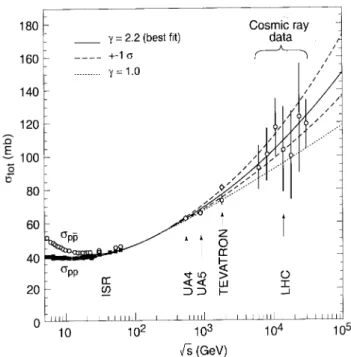
Aompilationofthetotalrosssetionsfor
proton-protonandproton-antiprotonollisions athighenergy
isshowninFig.1. Dataonbothppandpp existonlyup
to the maximumenergies of theISR ( p
s= 62 GeV).
Atthese energiesthe ppand pp ross setionstend to
approah eah other. Athigher energieswehavedata
onlyforpp (fromtheSPSandFermilabColliders)but
resultsonpp ollisions at p
s=500GeVare soon
ex-Figure 1. The total ross setionfor pp and ppsattering
is showntogetherwiththe preditionofthe dispersion
re-lationstofRef..[3℄. Thehigh-energybehaviorisdesribed
bythe term(logs)
. The bestt (solid line)orresponds
to =2.2. The region of unertainty is delimited by the
dashedlines. Theresultobtainedwith=1isshownasa
dottedline.
A question whih has been debated for a long
time is whether
tot
inreases as logs or (logs) 2
.
The solid line in Fig.1 represents the result of
a reent dispersion relation t[3℄ whih is based
on measurements of
tot
and of the parameter
(ratioof therealto theimaginarypartoftheforward
amplitude) in the .m.s. energyinterval5 p
s546
GeV.Thehigh-energydependeneofthetotalross
se-tionwasdesribedbytheterm(logs=s
0 )
withs
0 =1
GeV 2
. Thebesttgives=2:20:3.
At p
s = 1.8 TeV, the t predits a value of the
totalross setionwhih liesin betweenthe two
mea-surementsreported from Fermilab. Theresults of the
experimental group E710/E811seem to favouralogs
inreasewhiletheCDFdatafavoursthe(logs) 2
depen-Inspiteofthelargeerrorontheparameteras
de-rivedfromthebestt,thisdispersionrelationsanalysis
learlyfavoursthe(logs) 2
dependene withrespetto
thelinearriseaslogs. Thisbehaviorhasbeenoften
re-ferredtoasa\qualitative"saturationoftheF
roissart-Martin[4℄boundinthesensethatitorrespondstothe
maximum rateofrisewithenergy whih isallowedby
analytiityandunitarity,whilenumeriallyatualdata
liemuhbelowthebounditself.
AttheLHC energy, p
s=14 TeV, thet predits
tot
= 1098 mb while extrapolating as logs, one
would obtain
tot
' 95 mb, i.e. about 15 mb less
than the (logs) 2
extrapolation. The measurement of
TOTEMwillhaveaurayofabout1mb,learly
suf-ienttodisriminatebetweenthetwopossibilities.
Information in the veryhigh energy region anbe
derived from the study of the interation of primary
osmi raysin the atmosphere. Theresultsquoted by
osmirayexperiments[5℄areshowninFig.1. Itshould
bementioned,however,thattheproedureusedto
ex-trat the proton-nuleon ross setion from the
mea-suredproton-airabsorptionprobabilityisnot
straight-forward. Theatualproton-nuleonrosssetioninthe
energyregionoftheLHCouldbesubstantiallyhigher
than thosereported inFig.1. This anbewell
aom-modatedin urrentmodels[6℄.
Thetotalrosssetionsfromthehighenergyhadron
olliders areshownonanexpandedsalein Fig.2.
Figure2. Resultsonthepp totalrosssetionatthehighest
energies. Thelineisthepreditionoftheimpatpiture.
tionomplements inanobviouswaythemeasurement
ofthetotalrosssetion,whihbyvirtueoftheoptial
theorem, isjust proportionalto the imaginarypartof
theforwardamplitude. Intheenergyregionwherethe
totalrosssetionisrstdereasingandthenrising,the
parameterhasinitiallyanegativevaluebutriseswith
energybeoming positive. If asymptotially the total
ross setion saturates the Froissart-Martin bound[4℄,
i.e. if
tot
(logs) 2
, then will reaha broad
maxi-mumand thenslowlydereasetowardzeroas=logs.
Thebroadmaximumis expetedin the .m.s. energy
regionaround1TeV.
Themeasurementoftherealpartoftheamplitude
near the forward diretion requires the study of
elas-tisatteringintheregionoftheCoulombinterferene
where the Coulomb and the strong interation
ampli-tudesaresimilar in magnitude. AttheLHC this
hap-penswhen jtj10 3
GeV 2
orrespondingto anangle
offew rad. Fromthe experimental point of view, to
ndawaytodeteteventsatsuhsmallsattering
an-glesisaveryserioushallenge.
II.2 Elasti Sattering
An important quantity for understanding the
dy-namis of high-energy ollisions is the ratio
el =
tot .
The data on this ratio for pp, whih are plotted as a
funtionofenergyinFig.3,showthat
el =
tot
inreases
with energy. This observation implies that the
ee-tive \opaity" of the two olliding partiles inreases,
although slowly, with energy. Among existing models
of high-energy ollisions, this behavior is most
natu-rallyexplainedintheimpatpitureofChengandWu
[7℄. They atually preditedthat at veryhigh energy
the eetive radius of interation of the two olliding
hadronswouldinreaseaslogsandthatthe\opaity"
wouldalsoinrease. Thisleadstotheexpetationthat
asymptotially
tot
(logs) 2
and
el =
tot
!1=2.
Figure3. Theratioof theelastitothe totalrosssetion
forpp interationsas afuntionofenergy. Theline is the
preditionoftheimpatpiture.
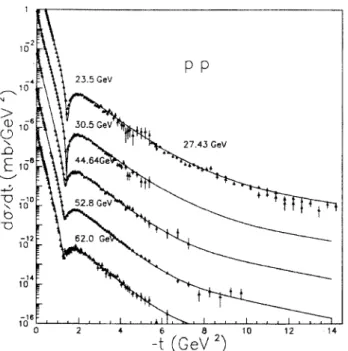
elas-quality ts obtained by a Regge model [8℄ whih
in-ludeshigherorderReggeexhangeareshowninFig.4
and5forppandpp sattering,respetively. Thepp and
pp data dier onsiderably in the region of the
stru-ture. Whilepp sattering showsapronouneddip, pp
hasnodipbut onlyashoulder.
Figure4. Proton-protonelastisattering. Thelines
repre-sentthetsofRef..[8℄.
Figure 5. Proton-antiproton elasti sattering. The lines
representthetsofRef..[8℄
Thiseet isexplainedby themodelof Donnahie
and Landsho[9℄as due to thepreseneof the
triple-gluonexhangemehanism. Theamplitudeofthis
pro-interferene with the main amplitude whih desribes
thedirationpeakisdestrutiveinppsattering,thus
produing a dip, but, on the ontrary, is onstrutive
for pp givingrise onlyto a break. We then expet at
LHC a dip and notabreak. The ross setion of the
triple-gluonexhangediagram[10℄inthelimitoflarge
tandverylarges, dereasesastheeighthpoweroft.
d
dt =C
1
t 8
Thedataonppsatteringatlargemomentumtransfer
whih arepresentlyavailable indeed follow this power
lawforjtj3GeV 2
as shownin Fig.6.
Figure6. Thedataonppelastisatteringforjtj3GeV 2
areomparedtothepreditionofthetriple-gluonexhange
model. Thestraightlinerepresentsthe1=t 8
behavior.
Aordingtothismodel,ifthetriple-gluonexhange
isthedominantmehanismat largemomentum
trans-feralsoathigherenergies,weexpetthet-distribution
to be smoothat LHC, withoutstruture. Inaddition
themodelpreditsthatd=dtforxedandlargevalues
oftisenergyindependent.
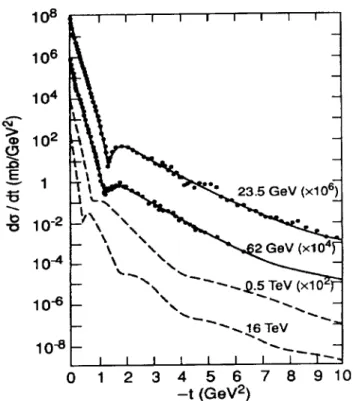
Othermodels,however,makedierentpreditions.
As anexample we showin Fig.7 thepredition of the
ReggemodelofRef..[8℄. AttheLHCenergythismodel
predits the emergene of a diration pattern with
Figure 7. Preditions ofthe modelof Ref..[8℄ at the LHC
energy
Thedierene betweenthetwopreditionsreets
a basi question on the nature of the elasti
satter-ing of hadrons. Thequestion iswhether sattering at
largemomentumtransferresultsfrom asingle
elemen-tary proess or is dominated by a ompliated
inter-playofvarious amplitudesorrespondingtohigher
or-der of multiple sattering, i.e. of multiple elementary
proessesatlowmomentum transfer.
TOTEMplanstostudythispointindetailbeause
the large design luminosity of the LHC allows elasti
satteringtobemeasureduptolargevaluesofthe
mo-mentum transfer,i.e. in therange10-15GeV 2
.
II.3 Diration Dissoiation
Theproessofdiration dissoiationislosely
re-lated to elastisattering. Single diration
dissoia-tionmayberegardedasatwo-bodyreation
p+p!p+X;
whereoneoftheollidingprotonsisexitedtoasystem
X whih then deays in anumber of stable partiles.
Tobedirativelyprodued, thesystemX musthave
the sameintrinsi quantum numbers asthe inoming
proton whilespinand paritymaybedierentbeause
someorbital angularmomentum anbetransferredto
X intheollision.
In ahigh-energy ollision, the mass M of the
sys-tem X may take quite large values with a limitation
whih is imposed bythe oherene ondition. If p
0 is
thebeammomentumandpthemomentum ofthenal
2
where x = p=p
0
. The oherene ondition implies
M 2
=s0:1High-energydataindeed providelear
ev-idenefordirativeprodutionuptoM 2
=s0:05.
The energy dependene of the ratio of the single
dirationto thetotal ross setionis shownin Fig.8
where itis ompared to the ratioof theelasti to the
totalrosssetion. Thedataindiatethatthe
probabil-ityofdirationdissoiationasomparedtotheoverall
probabilityofinterationdereaseswithenergy.
Figure8. Theratioof theelastitothe totalrosssetion
el
=tot,andtheratioofthesingledirationdissoiation
tothetotalrosssetionSD=tot,areshownasafuntion
ofenergy. The linesare linearextrapolationsto guide the
eye.
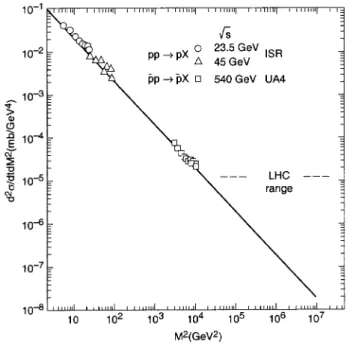
Animportantfeatureaboutdirationdissoiation
to be investigated is themass dependene ofthe
dou-bledierentialrosssetion d
2
dtdM 2
. Theompilationof
dataat-t=0.5GeV 2
showninFig.9,indiatesthatthe
massspetrumhasa1=M 2
behaviorinagreementwith
thelassialpreditionoftriplePomeronexhange.
ItislearthattheLHCwithitsverylarge.m.s.
en-ergyopensnewpossibilitiesbeausesystemswithvery
largemassanbeexitedbydiration. InfatatLHC
whenM 2
0:05s,themassM isaslargeas3TeV.
Aftertherstinlusivestudyofthediration
dis-soiation proess, it is foreseen in the TOTEM
pro-grammetoproeedtomoredetailedinvestigations
for-Figure9. Theobservedmass spetrum ofthe diratively
exitedsystem.
III The Experimental Method
III.1 The detetion of forward protons
Themeasurementofelastisatteringandof
dira-tivelyproduedprotonsatahighenergyhadronollider
requires observation of partiles at very small angles
(attheLHC,thetypialanglesareasmallfrationofa
mrad). Inpratiethisisahievedbyplaingthe
dete-torsintospeialunitsmountedonthevauumhamber
of theaelerator, whih havebeome known as
\Ro-manpots"andwererstusedattheCERNISR.
Inits retratedposition the Romanpot leavesthe
fullapertureofthevauumhamberfreeforthebeam,
as required at the injetion stage when the beam is
wide. One thenal energy isattained andthe
iru-lating beams are stable, the Roman pot is moved
to-wardthemahineaxisbyompressingthebellow,until
theinneredgeofthedetetorreahesadistaneofthe
order of one millimeter from the beam. There is no
interferenewiththemahinevauum.
Hadronollidersareusuallyoperatedathigh
lumi-nosityforthesearhof rareevents. Toobtainhigh
lu-minosity,thetransversesizeofthebeamattherossing
pointisreduedbythefousingationofquadrupoles.
Asaonsequenetheangular divergeneofthebeams
isorrespondinglyinreasedsothat alargefrationof
thesatteredpartilesremain insidetheaeptaneof
themahineitselfand arenotaessibleto detetion.
Tomeasureelastisattering,theoppositeshemeis
atuallyrequired. Thebeamsize attherossingpoint
ismaderelativelylargewhilethebeamdivergene
be-omes verysmall. Nearly parallelbeamsarenormally
used. Thisimplies that the-funtionat therossing
point hastobelarge. Theorrespondinglossof
lumi-nosity is not a problem beause the dierential ross
setionofelastisatteringislargeat smallt.
The best arrangement is obtained when the
ma-hine optis orresponds to parallel-to-point fousing
from therossingpointtothe detetors. This hasthe
very onvenient property that measuring the partile
positionat thedetetors allowsthesatteringangleto
bereonstruted inastraightforwardway.
The method is basially the same as the lassial
tehnique of measuring the diretion of light rays by
meansofanoptialsystemwithasreenplaedonthe
foal plane. The typial layout is skethed in Fig.10.
The detetors are plaed in the long straight setion
of the aelerator symmetrially on both sides of the
rossingpoint. Thebehaviorofthe funtionsforthe
atualhigh-insertiondesignedforTOTEMwith
=
1100m isshowninFig.11.
Figure10. Skethoftheelastisatteringexperiment. The
eetive distane L
eff
is determined by the optis of the
insertion.
Figure 11. The high- insertion of TOTEM for the
mea-surementoflow-tsattering.
DetailsabouttheinstallationoftheRomanpot
sta-tionsareshowninFig.12. Eahstationisomposedof
two units. The station RP2 is used for low-t elasti
sattering while the station RP1 is for large-t elasti
sattering. ThethirdstationRP3isplaedbehindthe
dipole magnet D2 whih is used to bring together the
beamsat the rossing point. The ombination of the
three stations RP1,RP2and RP3realizesamagneti
spetrometerwithmomentumresolutionatthelevelof
Figure12. TheinstallationoftheRomanpotsinthestraightsetion5oftheLHC.
III.2 The total ross setion
The best way to measure the total ross setion
is bymeans ofthesoalled \luminosityindependent"
method. Infatifthemahineluminosityisnotknown
fromothermeasurements,thiswillbetheonlymethod
of pratial use. The totalross setionand the
inte-gratedluminosityL ofthe mahine arerelated bythe
equation
N
el +N
inel =L
tot ;
whereN
el andN
inel
aretheobservednumbersofelasti
andinelasti interations,respetively.
The optial theorem whih relates the total ross
setiontotheimaginarypartoftheforwardamplitude
leadstothefollowingequation
dN
el
dt
t=0 =L
d
dt
t=0 =L
2
tot (1+
2
)
16 :
Combining the two previous equations one may
eliminate the mahine luminosity and write the total
ross setionasafuntion of measurable quantities in
thefollowingway
tot =
16
(1+ 2
) (dN
el =dt)
t=0
N
el +N
inel :
Thismethodisbasedonthesimultaneousdetetion
ofelastisatteringatlowtandoftheinelasti
intera-tions. Theparameteris smallat high-energy, about
0:1 0:2, sothat it does not haveto be known with
high preisiontogetanauratevalueof
tot .
The\luminosityindependentmethod"wasusedat
theISRbytheCERN-Pisa-Roma-StonyBrook
ollab-oration,attheSPSColliderbyUA4andatthe
Fermi-Theelastisatteringt-distributiondN
el
=dtis
mea-suredat small t using the Romanpot systemand
ex-trapolated to t = 0, i.e. to the so alled \optial
point", assuming the simple exponential dependene
e Bjtj
whihis known todesribethedatawellin the
verysmall tregion.
The total number of inelasti events N
inel
will be
measuredbytheinelastidetetorwhihfulllstwo
ba-sirequirements.
A\fullyinlusive"trigger,alsoalled\minimum
biastrigger".
Identiationofbeam-beameventsagainst
bak-ground.
At present olliderenergies, a sizeable fration of the
inelasti events (about 15 %) are of dirative type,
wherethereoilproton,satteredatverysmallangles,
remains inside the vauum pipe while a few partiles
are emitted in the opposite hemisphere in the
angu-lar region known as fragmentation region. Events of
this kindwill beobservedwith a \singlearm" trigger
using the inelasti detetor whih provides the
reon-strution of the interation vertex from the observed
hargedtraks. Inordertoreduethebakground,the
reoilprotonwill bedetetedin oinidenebymeans
oftheRomanpotsintheopposite hemisphere.
IV Conlusions
Thedisussion given by theTOTEM ollaborationin
Refs.[1,2℄ shows that measurements of the total ross
setion,elastisatteringuptoalargevalueofthe
A suitableinsertionoptiswithlarge
anbe
de-signedusing the mahine elements alreadyforeseen in
thestraightsetionoftheaelerator. TheRomanpot
tehniqueanbeimplementedattheLHCwith
dete-torshavingresolution withinreahof present
tehnol-ogy. Thesystemofollimationalreadyforeseenforthe
LHCwillprovideadequateshieldingoftheRomanpot
detetors.
The inelasti detetor for the fully inlusive
mea-surementoftheinelastiinterationsanbeintegrated
attheintersetionpoint5. Thisdetetorwillalso
pro-videabsolutealibrationofthemahineluminosity.
Implementation of three Roman pot stations with
the powerful dipole magnet D2 in between provides
twoforwardRomanpotspetrometersplaed
symmet-rially on both sides of the rossing point with good
momentum resolution for studies of singleand double
dirationdissoiationanddoublePomeronexhange.
Referenes
[1℄ The TOTEM Collaboration, \Letter of intent",
CERN/LHCC97-49,1997.
[2℄ The TOTEM Collaboration, \Tehnial proposal",
CERN/LHCC99-7,1999.
[3℄ C.Augieret al.,Phys.Lett.B315,503(1993).
[4℄ M.Froissart, Phys.Rev.123,1053(1961).
A.Martin,NuovoCimento42,930(1966).
[5℄ R.M. Baltrusaitis et al., Phys. Rev. Lett. 52, 1380
(1984).
M.Hondaetal.,Phys.Rev.Lett.70,525(1993).
[6℄ A.F.Martiniand M.J. Menon,Phys.Rev.D56 (1997)
4338.
[7℄ H. Cheng and T.T. Wu, \ExpandingProtons -
Sat-teringatHighEnergies", Cambridge1987.
C.Bourrely,J.SoerandT.T.Wu,Nul.Phys.B247,
15(1984)and
Z.Phys.C37,369(1988).
[8℄ P.Desgrolard, M.Gion andE. Predazzi, Z.Phys.C
63,241(1994).
[9℄ A.DonnahieandP.V.Landsho,Nul.Phys.B231,
189(1983)andB267,690(1986).
[10℄ A. Donnahie and P.V. Landsho, Z. Phys.C 2, 55