Neutrino Mass, Mixing and Osillations
Hiroshi Nunokawa
InstitutodeFsiaGlebWataghin,UniversidadeEstadualde Campinas{UNICAMP,
13083-970Campinas,Brazil
E-mail: nunokawai.uniamp.br
Reeived7January,2000
Present datafrom various neutrinoexperimentsare stronglysuggesting theexistene ofneutrino
mass andavor mixing. We reviewthe present status of neutrino osillation searhand various
neutrino anomalies and their possible interpretationsinterms of osillation indued by neutrino
mass andavormixing.
I Introdution
Neutrinos havebeenplaying animportant role in the
evolutionof ourunderstandingofelementarypartiles
andouldhavesomesigniantimpatontheevolution
ofthe universe. Wehavestrong motivations to searh
for non-zero neutrino mass both from theoretial and
experimentalaspets. Variousobservationaldatawhih
are indiating the existene of neutrino mass and
a-vormixing arepilingup. Infat neutrinophysisand
astrophysishavebeomeveryativeeld now. Inthe
lastdeade,manynewneutrinoexperimentshavebeen
performedandvariousimportantresultswereobtained.
Neutrinos are regarded to have spin 1/2, harge
zero,heliity-1andknowntoexistinthreeavors,i.e.,
eletron,muonandtaualthoughthediretdetetionof
tauneutrinosisstillinprogress[1℄. Fourthneutrino,if
exist,mustbe sterile (or eletroweak singlet) in order
to be onsistent with the observed Z deay width at
LEP experiment [2℄. The ombined LEP results give
thenumberoflight(not heavierthanthehalfofZ
bo-sonmass)neutrinoas,
N
=2:9930:011: (1)
Various experimental data oming from
atmo-spherineutrinoobservations[3-9℄,solarneutrinos
[10-14℄,andLSNDexperiment[15℄arestronglysuggesting
theexisteneofneutrinomassandavormixing. There
isalsosomeosmologialindiationofneutrinomasses.
It hasbeendisussed[16℄ that in order to explainthe
large sale strutures of our universe, ertain amount
of hot dark matter with mass in the few eV range is
needed. Massiveneutrinosarethemostnatural
andi-dateforsuhpartiles.
The organizations of this review is as follows. In
Se. II wereview the formulation of neutrino
osilla-tion,whihisthemostpowerfultooltosearhforvery
tinyneutrinomasses. InSe. IIIandIVwereview
at-mospheriandsolarneutrinoobservations,respetively.
In Se. V we review the presentstatus of laboratory
searhforneutrino massand osillation. In theabove
setionsIII-V,wedesribethepossibleinterpretations
aswell asonstraintsfrom thevarious observationsin
terms of neutrino osillations in the simplest two
a-vorsheme. InSe. VIwedisuss howthepiturewe
disussed in Setions III-Vould be inorporatedinto
three or four avor sheme. Se. VII is devoted for
onlusionsandoutlook.
II Neutrino Osillation F
ormal-ism
II.1 Neutrino Osillation in Vauum
Theideaofneutrinoosillationwasrstintrodued
by Ponteorvo[17℄for neutrinoand anti-neutrino
sys-tem,similartoK 0
K 0
osillation. Osillationbetween
dierentavorwasrstonsideredbyMaki,Nakagawa
and Sakata [18℄. The basiidea is asfollows. If
neu-trinosaremassive,in generalthemasseigenstatesand
avor(orweakinteration)eigenstatesdonotoinide
buttheyarerelatedbyaunitarytransformationsimilar
to the Cabibbo-Kobayashi-Maskawa(CKM)[19℄
mix-ing matrix in the quark setor. In the neutrino
se-torsuhmixingmatrixisalledMaki-Nakagawa-Sakata
(MNS)matrix[18℄.
Fortwogenerations,weandesribethisexpliitly
asfollows,
e
=
os sin
sin os
1
2
; (2)
where
e ,
and
1 ,
2
are theweakand mass
eigen-states, respetively. If mass of neutrinos are dierent
an develop and this an lead to neutrino osillation
betweendierentavors[18℄.
Theosillationprobabilityanbedesribedas
P(
e !
)=sin
2 2sin 2 h m 2 4E L i (3) =sin 2 2sin 2 h 1:27 m 2 eV 2 MeV E L m i ; (4) where m 2 m 2 2 m 2 1
is themasssquareddierene
of the twomasseigenvalues, E is theneutrino energy
and Listhedistaneneutrinotravels. Fromaboveeq.
weseethattheosillationlengthinvauumisgivenby,
L os = 1:27 E MeV eV 2 m 2 m: (5)
Forthree generation,wean desribethe neutrino
mixing as, 2 4 e 3 5 =U 2 4 1 2 3 3 5 ; (6) where
( =e;;)and
i
(i =1;2;3) arethe weak
and mass eigenstates, respetively and the MNS
ma-trixU anbeparametrizedinasamewayastheCKM
matrixinthequarksetor[2℄,
U = 2 4 12 13 s 12 13 s 13 e iÆ s 12 23 12 s 23 s 13 e iÆ 12 23 s 12 s 23 s 13 e iÆ s 23 13 s 12 s 23 12 23 s 13 e iÆ 12 s 23 s 12 23 s 13 e iÆ 23 13 3 5 ; (7) where ij =os ij ,s ij =sin ij
andÆistheCP
violat-ing phase. Wenote that ifneutrinos are ofMajorana
typetheMNSmatrixhavemoreCPphaseswhihan
not be rotated away by the redenitions of the
neu-trinoelds. See,e.g.,Ref.[20℄abouttheCPphasesfor
Majorananeutrinos.
Invauum, the osillationprobabilityan be
writ-tenas,
P(
!
)=Æ
4 X i<j Re[U i U j U i U j ℄sin 2 " m 2 ij 4E L # +2 X i<j Im[U i U j U i U j ℄sin " m 2 ij 2E L # : (8)
ThelasttermgivesrisetopossibleCPand/orT
viola-tionin theneutrinoosillation[21℄.
II.2 Neutrino Osillation in Matter
Here,forsimpliity,weonsiderneutrinoosillation
in mattermainlyfortheasewith twoavor.
Evolutionequationofneutrinosystemof
e and
x
(x=or)inmatteran bewritten as,
i d e =H e ; (9) where H = " m 2 4E
os2+ p 2G F N e m 2 4E sin2 m 2 4E sin2 m 2 4E os2 # : (10) Here,N e
istheeletronnumberdensityin matterand
G
F
istheFermi onstant.
Mixing angle in matter, whih diagonalize the
Hamiltonianineq.(10)isgivenby,
sin 2 2 m = sin 2 2 os2 p 2GFNeE m 2 2 +sin 2 2 : (11)
From above equation we see that even if the vauum
mixingangleis verysmall,themixing anglein matter
an be maximal if the following ondition (resonane
ondition),
m 2
2E
os2= p 2G F N e ; (12)
is satised. If the density is varying along the
neu-trinotrajetoryandif,atthepositionwheretheabove
onditionis met, thefollowingondition (adiabatiity
ondition), 1 N e dN e dr res m 2 sin 2 2
Eos2
; (13)
is also satised, eletron neutrino an onvert
om-pletelyintoanothertype(muortau)ofneutrino. This
phenomenaisalledthematterenhanedresonant
on-versionortheMSWeet[22℄andanprovidesolutions
tothesolarneutrinoproblem[23℄ (seeSe. IV).
For three avor, as in the ase of vauum (see
eq. (8)) in general, osillation probability depends on
sixparameters,i.e.,twoindependentm 2
ij
,three
mix-ingangles
ij
and oneCP phase Æ. However, if there
isahierarhybetweenthemass,andifonlyonem
m 2 12 (m 2 13 'm 2 23
)isrelevant fortheresonant
onversioninthesun,theprobabilityofnding
e after
theresonaneP 3
ee
anbegivenby[24℄,
P 3 ee (m 2 ; 12 ; 13 )=sin
4 13 +os 4 13 P 2 ee (m 2 ; 12 ) N e !N e os 2 13 ; (14) whereP 2 ee
istheorrespondingprobabilityforthease
III Atmospheri neutrino
anomaly
At present the most strong indiation of neutrino
os-illationisomingfrom theveryimpressiveresults
ob-tained by theSuper-Kamiokande(SK) experimenton
atmospherineutrinoobservation[7,8,9℄.
So alled atmospheri neutrinos are mainly
pro-dued by the following deay hain of harged pions
whihareproduedbyprimaryosmiray,
+
! +
+
;
+
!
+e
+
+
e
(15)
! +
; !
+e +
e
: (16)
Theavorratiooftheux,R (=e)(
+
)=(
e +
e
),whihisapproximately2forlowerenergyneutrinos
(GeV)andlargerforhigherenergyneutrinos,anbe
alulablewithanunertaintyabout5%.
In the Super-Kamiokande detetor, atmospheri
neutrinoinduedeventsarelassiedintoseveraltypes.
If neutrino interations our inside the detetor, the
events are lassied, by energy, into sub-GeV (when
visible energy E
vis
< 1:33 GeV) or multi-GeV events
(whenE
vis
>1:33GeV).Theyhavebothe-likeand
-likeevents,whih areinduedby
e (or
e )and
(or
), respetively. Insub-GeV andmulti-GeVsamples,
the observed events are further lassied into various
types, single ring events, two ring events (inlude 0
events),multi-ringevents,fullyontained(FC)events,
partiallyontained(PC)events,et.
0
200
400
600
-0.8 -0.4
0
0.4
0.8
0
200
-0.8 -0.4
0
0.4
0.8
sub-GeV e-like
sub-GeV
µ
-like
multi-GeV e-like
cos
Θ
multi-GeV
µ
-like + PC
cos
Θ
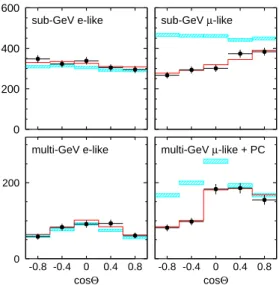
Figure 1. Angular distributionsfor e-like (left) and-like
(right)events,for sub-GeV(top)andmulti-GeV(bottom)
samples. Thebars show the MC no-osillationpredition
with statistial errors, and the line shows the osillation
predition for the best-t parameters, sin 2
2 = 1:0 and
m 2
=3:510 3
eV 2
. TakenfromRef.[8 ℄.
Ifneutrinointerationsournotinsidethedetetor
upwardgoingmuons. Thisanapplyonlyfortheevents
induedbymuonneutrinossineeletronsproduedby
eletron neutrinos would be immediately absorbed by
thematterandannotreahthedetetor.
0
0.5
1
1.5
2
2.5
3
3.5
4
4.5
5
-1
-0.9 -0.8 -0.7 -0.6 -0.5 -0.4 -0.3 -0.2 -0.1
0
cos
θ
flux (
×
10
-13
cm
-2
s
-1
sr
-1
)
Figure 2. Angular distribution of through-going upward
muons, as a funtion of os. The irles represent the
data,thesolidlinerepresentsthenormalizedno-osillation
uxpredition, and thedashedline represents thebestt
preditionfor osillations. TakenfromRef.[8℄.
For the SK sub-GeV sample, with 848days
expo-sure,
R (=e)
data
R (=e)
no os
=0:680:02(stat)0:05(syst.) (17)
FortheSKmulti-GeVsample,
R (=e)
data
R (=e)
no os
=0:680:04(stat)0:08(syst.) (18)
Theabove results are onsistent with other
atmo-spherineutrinoexperimentsIMB[3℄,Kamiokande[4℄
and Soudan2[5℄, Maro[6℄(exeptfor Frejus [25℄and
NUSEX[26℄whihhadthelargesterrors).
In addition to the signiant overall deit in the
avor ratio, Super-Kamiokande experiment is
observ-ing, learzenith angle dependentdeit ofmuon
The most plausible mehanism of suh onversion
is provided byneutrino osillation between
and
induedbymassandmixing withm 2
10 3
10 2
eV 2
andsin 2
2 >
0:8.
0
0.1
0.2
0.3
0.4
0.5
0.6
0.7
-1
-0.9 -0.8 -0.7 -0.6 -0.5 -0.4 -0.3 -0.2 -0.1
0
cos
θ
Stop/Through ratio
Figure3. SameasinFig. 2butforstoppingmuons.Taken
fromRef.[8℄.
Figure4.Allowedregionforsin 2
2andm 2
usingthe
om-bined information fromFC, PCand upward-goingmuons.
TakenfromRef.[8 ℄.
InFig.1weshowtheobservedzenithangle
depen-of sub-GeV as well as multi-GeV have strong zenith
angledependenewheretheMCpreditionsarerather
symmetri around os = 0. In the same graph, the
bestttedtheoretialpreditionswithneutrino
osilla-tionhypothesis
$
arealsoplotted. Weseethat
these urves explain the observeddata verywell. On
theother hand, e-like eventsdo not show any
signi-antzenithangledistortionwithrespettothe
predi-tionwhihimpliesthatthereisnosigniantosillation
between
e
andotherneutrinoavors.
In Fig. 4we show the region of parameters whih
anexplaintheobservedatmospheridataobtainedby
theSuper-Kamiokandeexperiment[7℄.
Wenotethatfromthepreliminarydataofthe
angu-lardependeneoftheeventswithhigherenergy
(multi-GeVand upwardgoingmuons data)andtheobserved
0
events the Super-Kamiokande ollaboration is
ex-luding
s
osillationhypothesisat99% C.L.[9℄.
IV Solar neutrino problem
Thehainofnulearfusionreationsinthesunresults
innetprodutionofone 4
Henuleusandtwoneutrinos
outoffourprotonsas,
4p!+2e +
+2
e
: (19)
The real situation in the sun is, however, a bit more
ompliated; it organizes itself as several branhes of
nulear reation network as desribed in Table 3.1 of
Ref. [23℄. In Fig. 5 we show the solar neutrino
All thesolarneutrinoexperiments, i.e.,Homestake
[10℄, SAGE [11℄, GALLEX [12℄, Kamiokande [13℄ and
Super-Kamiokande [14℄ have been observing roughly
onlyhalf orlessneutrinosompared to the predition
bythe standardsolar model (SSM)[23,27℄. InTable
1,weshowtheobservedsolarneutrinoeventratesand
inTable2,weshowtheorrespondingpreditionsfrom
theSSMbyBahallandPinsonneault[27℄.
Figure6. Contourplotofthe 2
valuesinthe8
B 7
Be
planefordierentombinationsofthesolarneutrino
exper-iments.Thesolidurvesorrespondto1to5,withstep
size1,frominsidetooutside. Wealsoindiatethe1,2 and
3theoretialrangepreditedbyBP98,bythesolid,
dot-tedanddashedlines,respetively. Alongthedashedurve,
7
Be
=( 8
B
) 10=24
,the rossesindiate, fromleft to right,
thepointwheretheentraltemperaturesare0.85,0.9,0.95,
0.98,1and1.01withrespettothepreditionbytheSSM.
TakenfromRef.[29 ℄.
Figure 7. Allowed region for sin 2
2 and m 2
whihan
explain the observed solar neutrino data. Taken from
Ref.[31 ℄.
Table1. Observedsolarneutrinoeventrates. Thequoted
errorsareat1.
Experiment Data(stat.)(syst.) Ref.
Homestake 2:560:160:15SNU [10 ℄
SAGE 69:9
+8:0
7:7 +3:9
4:1
SNU [11 ℄
GALLEX 76:46:3 +4:5
4:9
SNU [12 ℄
Kamiokande (2:800:190:33)10 6
m 2
s 1
[13 ℄
SuperK (2:440:05 +0:09
0:06 )10
6
m 2
s 1
[14 ℄
Table 2. Preditions from the referene standard solar
model[27 ℄. Thequotederrorsareat1.
Cl 7:7
+1:2
1:0 SNU
Ga 129
+8
6 SNU
8
B (5:15 +0:98
0:72 )10
6
m 2
s 1
Figure 8. Allowed regionfor sin 2
2 and m 2
whih an
explain the observed solar neutrino data. Taken from
Ref.[31 ℄.
These disrepanies between the observations and
theoryisalledthesolarneutrinoproblem[23,28℄and
it is veryunlikelythat one anmodify the SSM suh
thatalltheexperimentsareexplainedwithoutinvoking
anynon-standardneutrinoproperties[29℄. InFig.6we
plot theontours of 2
orresponding to 1, 2, ... 5
,assumingthattheuxofpp, 7
Beand 8
Baretreated
asafreeparametersbut onlyrequiredtobeonsistent
with the observedluminosity of the sun. We see that
thedataindiatevanishing 7
Beneutrinouxwithhalf
of SSM 8
B neutrinooneevenifwenegletanyone of
thethree solarneutrinoexperiments. This isvery
10
-11
10
-10
10
-9
10
-8
0
0.5
1
sin
2
θ
13
= 0.0
90
%
C.L.
99
%
C.L.
sin
2
θ
12
∆
m
12
2
(eV
2
)
(a)
0
0.5
1
sin
2
θ
12
(b)
0
0.5
1
(c)
sin
2
θ
12
Figure 9. Allowed region for sin 2
2 and m 2
whih an
explaintheobservedsolarneutrinodatabythevauum
os-illation. TakenfromRef.[32 ℄.
Themostplausiblesolutionstothisproblemis
pro-videdeitherbythematterenhanedresonantneutrino
onversion,the MSW eet [22℄ orby thevauum
os-illation [30℄.
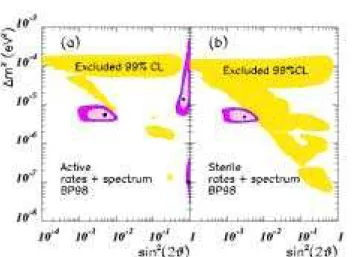
InFig.7weshowtheMSWallowedregionreently
obtainedinRef.[31℄usingtotalratesandspetrum
in-formations. In Fig. 8 we show similar plots obtained
in Ref. [31℄but usingtotalrates,spetrum,zenith
an-gle aswellasseasonalinformations. As weansee in
this gure,fortheaseof ativeonversion
e !
; ,
therearethreeseparateallowedregions. Theoneinthe
smallermixingangleregionisalledsmallmixingangle
(SMA)MSWsolution,Theoneinthelargemixing
an-gleregionwithlargerm 2
isalledlargemixingangle
(LMA) solutionandthe onein the largemixingangle
regionwithsmallerm 2
isalled largemixingangleis
oftenalledlow-m 2
(LOW)solution. Wenoteinase
ofsterile onversion,
e !
s
there isonlySMAMSW
solution.
The solar neutrino data an also be explained by
thevauum osillationbetweenthesunandtheearth.
InFig.9weshowtheallowedparameterregion
deter-mined from (a) total rates (b) SK spetrum and ()
rates +SK spetrum, assuming vauum osillationas
a solution to the solar neutrino problem. In this
se-nario,thebesttourswhentheosillationlengthfor
neutrino with energy 10 MeV is omparable to the
sun-earthdistane.
V Neutrino mass and
osilla-tion searh at laboratory
Inthissetionwereviewthestatusoflaboratorysearh
V.1 Diret mass measurements
Sofar, there isnodiret evidene ofnon-zero
neu-trinomassfromthelaboratoryexperimentsandweonly
knowthattheyhavemuhsmaller(ifnon-zero)masses
omparedtotheirhargedpartners. Upperlimitsfrom
diretkinematineutrinomassmeasurementsaregiven
asfollows[2℄,
m
e
<15eV; (20)
m
<0:17MeV; (21)
m
<18:2MeV: (22)
V.2 Double beta deay Results oming from
neutrinoless double beta deay experiment is giving
morestringentupperlimitonMajorananeutrinomass.
Theurrentbest limitis omingfrom the
Heidelberg-Mosowexperimenton2deayof 76
Ge [33℄,
hm
e i
X
U 2
ei m
i
<0:2 0:6eV; (23)
whereU
ei
istheMNSmixingmatrixandm
i
ismassof
i-thmasseigenstate.
10
-1
1
10
10
2
10
-3
10
-2
10
-1
1
sin
2
2
Θ
∆
m
2
[
eV
2
]
KARMEN2
LSND
CCFR
Bugey
NOMAD
Figure 10. LSND 90 % C. L. region in omparison with
other 90 % C. L. exlusion urves in the orresponding
(sin 2
2,m 2
)plane. TakenfromRef.[34℄.
V.3 LSND signals
LSND ollaborationhasbeenobservingsome
posi-tivesignal ofneutrino osillation of
!
e
with the
probabilityP(
!
e
)few10 3
[15℄. Thissignal
anbeaountedforbytheneutrinoosillation
hypoth-esisif m 2
>
0:1 eV
2
and sin 2
2 >
few 10 3
. In
Fig. 10 we show the LSND 90 % C.L. together with
Although the same type of experiment KARMEN
[38℄ is notobserving suh positivesignal both
experi-mentsarestill onsistentforsomeparametersofmass
andmixing.
Analysis A
10
-4
10
-3
10
-2
10
-1
1
0
0.1
0.2
0.3
0.4
0.5
0.6
0.7
0.8
0.9
1
sin
2
(2
θ
)
δ
m
2
(eV
2
)
90
%
CL Kamiokande (multi-GeV)
90
%
CL Kamiokande (sub+multi-GeV)
ν
e
→
ν
x
90
%
CL
95
%
CL
Figure 11. Exlusion plot for the osillation parameters
based on the absolute omparison of measured vs.
ex-petedpositronyieldsintheChoozexperiment. Takenfrom
Ref.[41 ℄.
V.4 Osillation searh at reators
Sofar,severalneutrinoosillationsearhhavebeen
performedbyusingnulearreators[39,40,37,41,42℄.
Amongthem, themoststringentlimits onthe
osilla-tionparameters havebeen obtainedbythe Chooz
ex-periment [41℄ whih exludedthe possibilityof having
largeosillationbetween
e and
foratmospheri
neu-trinos. InFig.11weshowtheexlusionplotofthe
os-illationparametersobtainedbytheChoozexperiment.
Similarbutsomewhatweakeronstraintsareobtained
fromPaloVerdeexperiment[42℄.
VI Multi FlavorInterpretations
Inthissetionwedisusshowthepitureswereviewed
in terms of two avor osillation in the previous
se-tionsouldbeinorporatedintothethreeorfouravor
Let us rst summarize below the required values
of mass squared dierenes and mixing angle whih
are onsistent with atmospheri, solar neutrino
prob-lem and LSND signal, when analyzed assuming only
twoavormixing,
Atm: m
2
atm
'(2 7)10 3
eV 2
sin 2
2
atm
'0:82 1:0 (24)
MSW SMA: m
2
'(4 10)10 6
eV 2
sin 2
2
'(0:1 1:0)10 2
(25)
MSW LMA: m
2
'(2 20)10 5
eV 2
sin 2
2
'0:6 0:99 (26)
MSWLOW: m
2
'(6 20)10 8
eV 2
sin 2
2
'0:9 0:99 (27)
VO: m
2
'(0:5 10)10 10
eV 2
sin 2
2
'0:6 1:0 (28)
LSND: m
2
LSND
'(0:2 2) eV 2
sin 2
2
LSND '10
3
0:04 (29)
VI.1Three FlavorShemes
It has been noted that only with three avors, it
isimpossibletoexplainatmospherineutrinoanomaly,
solarneutrinodeitandLSNDsignalsimultaneously.
The reason is simply beause we need three dierent
values of mass squared dierenes or m 2
indiated
in eqs. (24)-(29) whih an not be realized onlywith
three avors. Therefore, if we assume that there are
onlythreeneutrinoswemustgiveuptoexplainoneof
theneutrinoanomalies.
NegletingLSNDresults,ifthemixingbetweenthe
rst generation and the third generation is zero or
small, sin 2
13
1then weanassign the mixing
pa-rametersrequiredtoexplainatmospheriaswellas
so-larneutrinodataintermsofthree avorframeworkas
follows,
m 2
atm
=m
2
32
'm
2
31
sin 2
2
atm =sin
2
2
23
; (30)
m 2
=m
2
21 ;
sin 2
2
=sin
2
2
12
(31)
wherem 2
ij m
2
i m
2
j .
It an be shown that for the observations of solar
andatmospherineutrinoswiththemixingparameters
indiated in eqs. (24)-(28), the CP violating phase Æ
does not play any important role and we an simply
neglet it even if
13
is large. If
13
suf-twoavorsthesolarneutrinoandatmospherineutrino
data andthe resultsshown in theprevioussetionsin
terms of two neutrino avor are valid.
Observation-ally,osillationsofatmospheriand solarneutrinosdo
notinterfere eahother beauseof themasshierarhy
m 2 atm m 2
and the fat that
and
equally
ontributeto solar neutrino detetion at Kamiokande
andSuper-Kamiokande. Osillationbetween
and
isirrelevantforsolarneutrinoobservations.
Belowletus trytodisussthepossiblemixing
pat-terns.
(i)Onlyonelargemixing
Inorder to explaintheatmospheri neutrinodata,
undertheassignmentsoftheparametersineq.(31),we
assume that
23
and m 2
32
arein therange indiated
ineq.(24). Thenatmospherineutrinodataanbe
ex-plainedbythelargevauumosillationbetween
and
due to large
23
. If we further assumethat, under
the assignmentsoftheparametersineq.(31),
21 and
m 2
21
arein therangeindiatedin eq.(25),thensolar
neutrinoproblemanbeexplainedbythesmallmixing
angle MSW solution, withoutaeting the osillation
interpretation ofthe atmospherineutrinobetween
and
. Inthisase
1
ismostly
e
andhassmall
om-ponent of
and
and the solar
e
's are resonantly
onvertinginto
2
, whihis themixed stateof
and
, by makinguse of themassdierene of
1 and
2
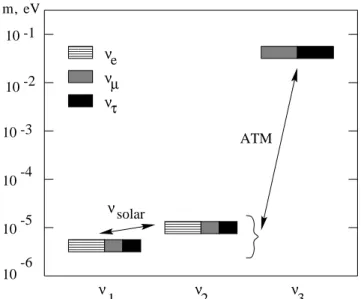
states. ThispitureisgraphiallypresentedinFig.12.
0
0
0
1
1
1
0
0
0
1
1
1
000000
000000
000000
111111
111111
111111
000
000
000
111
111
111
-3
10
-2
10
-4
10
-5
10
10 -1
ν
solar
ATM
ν
e
νµ
ντ
eV
m
100
,
ν
3
2
ν
1
ν
Figure 12. 3-avor shemes of neutrino masses and
mix-ing. SolutionsofthesolarneutrinoproblemisSMAMSW.
TakenfromRef[43 ℄.
(ii)Twolargemixing
As in the rstase in (i), weassume that
23 and
m 2
32
are in the range indiated in eq. (24) so that
atmospheri neutrino an be explained by the large
vauum osillation between
and
. If we further
assume
21
and m 2
are in the range indiated in
eq.(26)or (27),thensolarneutrinoproblemanbe
ex-plainedbythelargemixingangleMSWsolution,again
without aeting the osillation interpretation of the
atmospherineutrinoosillation. If
21
and m 2
21 are
intherangeineq.(28),thenthesolarneutrinoproblem
anbe explainedby thevauum osillations. In these
senarios,
e
is stronglymixedwith
and but the osillationbetween e
andother avorisnegligiblefor
atmospheri neutrinos beause of the small values of
m 2
21
. These two pitures are graphially shown in
Figs.13and 14.
(ii)Large
13 ?
If
13
is notso small then the simple pitures
de-sribedabovemustbemodied. Therelevantvaluesof
themassandmixing parametersin ordertot the
at-mospheriandsolarneutrinodataouldbesigniantly
dierent from the ones indiated in eqs. (24)- (28)as
were demonstrated in Ref. [44℄ for atmospheri
neu-trinoandRef. [45, 32℄ forsolar neutrinoobservations.
However,we note that
13
an notbe solargedue to
theonstraintfromChooz[41℄andSuper-Kamiokande
atmospheri neutrino data itself [7℄, and the pitures
desribedin(i)and(ii)basiallyhold.
0
0
0
1
1
1
000
000
000
111
111
111
00000
00000
00000
11111
11111
11111
0000
0000
0000
1111
1111
1111
-3
10
-2
10
-4
10
-5
10
10 -1
ν
solar
ν
e
νµ
ντ
eV
m
10
ν
ν
2
ν
3
1
0
,
ATM
Figure 13. 3-avor shemes of neutrino masses and
mix-ing. SolutionsofthesolarneutrinoproblemisLMAMSW.
TakenfromRef[43 ℄.
VI.2 Four Flavor Sheme
IfwewanttoexplainalsotheLSNDsignal,in
addi-tiontotheatmospheriandsolarneutrinoanomaly,itis
neessarytointroduefourth neutrino,whihmustbe
sterile(eletroweaksinglet)whih anonlyhavemuh
weakerinterationsthanusualneutrinos[46℄. The
ur-rently most favored piture is as follows.
and
arestrongly mixed so that atmospheri neutrino data
an beexplained by thelarge vauum osillations
be-tween them.
e
isweaklymixed with
s
(sterile)
be explained by the small angle MSW solution with
e !
s
hannel. Further
e
is weakly mixed with
with adequate mass squared dierene so that LSND
data an beexplained. This sheme an also provide
someamountof hotdarkmatter whih are mainly
and
. Thereisalsosomeastrophysialonsideration
that this sheme is also onsistent with the
hypothe-sisof heavyelementsnuleosynthesisin thesupernova
explosion [47℄. Thispitureis graphiallypresentedin
Fig.15.
0000
0000
0000
1111
1111
1111
0000
0000
0000
1111
1111
1111
000
000
000
111
111
111
-3
10
-2
10
-4
10
-5
10
-6
10
ν
1
ν
2
ν
3
solar
ν
ATM
m eV
,
10 -1
ν
ν
ντ
µ
e
Figure14. 3-avorshemesofneutrinomassesandmixing.
Solutionof the solar neutrinoproblem is VO.Takenfrom
Ref[43 ℄.
m;
eV
1
10 ;1
10 ;2
10 ;3
10 ;4
1 2 3 s; ;
ATM
LSND f
@ @
I
2HDM
Figure 15. 4-avor shemes of neutrino masses and
mix-ing. Solutions ofthesolarneutrinoproblemisSMAMSW
e !
s
onversion. TakenfromRef[48 ℄.
VII Conlusions and Outlook
As we haveseen that there are several strong
india-tions of neutrino mass and avor mixing. Although
they are suÆiently strong, neutrino mass and avor
mixing havenotyetbeenreallyestablishedand
there-This is important also to exlude the other
pos-sibilities whih are not disussed in this review. We
note that there are still anotherpossible explanations
of the neutrino anomalies whih do notuse the usual
avormixing. It has been proposed that atmospheri
neutrino observations ould be explained by neutrino
deay [49, 50℄ or avor hanging interations in
mat-ter [51℄ though senarios in Refs. [49, 51℄ have been
ritiizedanddisfavoredbythedisussionin Ref.[52℄.
SeealsoRefs.[53,54,55,56℄forthesenariowithavor
hanginginterations. Solarneutrinoproblemouldbe
explained by resonant spin-avor preession [57, 58℄,
avorhanginginterations [59, 60℄ orevenby a tiny
violationofequivalenepriniple [61℄. Theabove
pos-sibilitiesarenotyetexludedandhavetoberefutedby
the experiments, before the establishment of the
neu-trinomassand avormixing.
Forthepurposeoftheonrmation (orrefutation)
of the osillation interpretations disussed in this
re-view, several new experiments are planned. To
on-rm the atmospheri neutrino observations, the rst
long-baseline (LBL) neutrino osillation experiment
K2K[62℄with baselineL =250 km, sending neutrino
beamfromKEKtotheSuper-Kamiokandedetetor,is
already started to takedata and some resultswill be
reported verysoon. There is alsoanother LBL
exper-iment alled MINOS [63℄ with baseline L = 732 km,
fromFermilabtoSoudanmine.
For solar neutrinos, new generation experiment,
Sudbury Neutrino Observatory (SNO) solar neutrino
experiment [64℄ whih uses heavy water (deuteron) is
already taking data and will have some results soon.
Oneof thefeature ofthis experimentis that theyan
measureseparatelytheeventfrom thehargedurrent
reation,d+
e
!p+p+e andtheonefromthe
neu-tral urrentreationd+
x
!n+p+
x
(x=e;;)
sothattheyanonrmiftheativetoativeneutrino
onversion
e !
;
isourring. See,fore.g.,Ref.[65℄
forthereentdisussion onthepotentialpowerof the
SNOexperiment.
It is also very important to observe 7
Be
neutri-nos to establish neutrino osillation hypothesis. For
this purpose, several experiments suh as
BOREX-INO [66℄, KamLAND[67℄ are planned. We also note
thatKamLANDanonrm/refutetheLMAMSW
so-lutionbyobservingtheneutrinosfromnearbyreators.
Therearealsosomeexperimentswhihanidentifythe
lowerenergyneutrinosomingfromppreations,
HEL-LAZ[68℄andHERON[69℄.
Inorder to onrm/refute LSND signal,the
Mini-BOONE experiment [70℄, whih anoverompletely
the LSND allowed regionshownin Fig.10, will begin
datatakingin theyear2002.
neu-portantinformationswill beobtained.
Aknowledgments
TheauthorwassupportedbyFunda~aodeAmparo
a Pesquisa do Estado de S~ao Paulo (FAPESP). The
author would like to thank M. M. Guzzo, P. C. de
Holanda,R.Z.FunhalandothermembersofGEFAN
forusefuldisussions.
Referenes
[1℄ T. Kafka for E872 ollaboration, Nul.Phys.(Pro.
Suppl.)B70,204(1999).
[2℄ C.Casoetal.,Eur.Phys.J.C3,1(1998).
[3℄ IMBCollaboration,D.Casperetal.,Phys.Rev.Lett.
66,2561 (1991);R.Beker-Szendyetal., Phys.Rev.
D46,3720(1992).
[4℄ KamiokandeCollaboration,H.S.Hirataetal.,Phys.
Lett. B205,416(1988)and Phys.Lett. B280,146
(1992);KamiokandeCollaboration,Y.Fukudaetal.,
Phys.Lett.B335,237(1994).
[5℄ SoudanCollaboration,W.W.MAllisonetal.,Phys.
Lett.B391,491(1997);T.KafkaforSoudan
Collab-oration,hep-ex/9912060.
[6℄ MaroCollaboration,M.Ambrosioetal.,Phys.Lett.
B434,451(1998);hep-ex/0001044.
[7℄ SuperKamiokande Collaboration, Y. Fukuda et al.,
Phys.Lett.B433,9(1998);Phys.Rev.Lett.81,1562
(1998);Phys.Lett.B436,33(1998);Phys.Rev.Lett.
82,2644(1999);Phys.Lett.B467,185(1999).
[8℄ K.Sholberg,hep-ex/9905016.
[9℄ W.A.Mann,hep-ex/9912007.
[10℄ HomestakeCollaboration,K.Landeetal.,Astrophys
.J.496,505(1998);
[11℄ SageCollaboration, J.N.Abdurashitov etal.,Phys.
Rev.C60,055801(1999);
[12℄ GALLEX Collaboration, W. Hampel et al., Phys.
Lett.B447,127(1999);
[13℄ Y.Fukuda etal.(KamiokandeCollaboration), Phys.
Rev.Lett.77,1683(1996).
[14℄ SuperKamiokande Collaboration, Y. Fukuda et al.,
Phys. Rev. Lett. 81, 1158 (1998); ibid. 81, 4279
(1998);ibid.82,2430(1999);ibid.82,1810 (1999).
[15℄ C. Athanassopoulos etal. , for LSND ollaboration,
Phys. Rev.Lett. 77, 3082 (1996); Phys. Rev. C54,
2685 (1996).
[16℄ J.A.Holtzman,Astrophys.J.Suppl.71,1(1989);J.
A. Holtzmanand J.R.Primak, Astrophys.J.405,
428 (1993); J. R. Primak, J.Holtzman, A. Klypin,
andD.O.Caldwell,Phys.Rev.Lett.74,2160(1995);
K.S.Babu,R.K.Shaefer,andQ.Sha,Phys.Rev.
D53, 606 (1996); D. Pogosyan and A. Starobinsky,
astro-ph/9502019.
[18℄ Z. Maki, M. Nakagawa and S.Sakata, Prog. Theor,
Phys.28,870(1962).
[19℄ N. Cabbibo, Phys. Rev. Lett. 10, 531 (1963); M.
Kobayashi andT. Maskawa, Prog. Theor.Phys.49,
652(1973).
[20℄ M.FukugitaandT.Yanagida, inPhysisand
Astro-physis of Neutrinos edited by M. Fukugita and A.
Suzuki,SpringerVerlag,1994.
[21℄ See,e.g., M. Tanimoto, Phys.Rev.D55, 322(1997);
Prog.Theo. Phys.97,901(1997); J.Arafuneand J.
Sato, Phys. Rev.D55, 1635 (1997); J. Arafune, M.
Koikeand J.Sato,Phys.Rev.D56, 3093 (1997); H.
Minakata and H. Nunokawa, Phys. Rev.D57, 4403
(1998);Phys.Lett.B413,369(1998);M.Bilenky,C.
Giunti, W.Grimus, Phys.Rev.D58, 033001 (1998);
A.Gago,V.PleitezandR.ZukanovihFunhal,Phys.
Rev.D61,016004(2000);A.Donini, M.B.Gavela,P.
HernandezandS.Rigolin,hep-ph/9910516;M.Koike
andJ.Sato,hep-ph/9911258.
[22℄ M.Mikheyev,A.Smirnov,Sov.J.Nul.Phys.42,913
(1986);L.Wolfenstein,Phys.Rev.D17,2369 (1978);
Phys.Rev.D20,2634(1979).
[23℄ J.N.Bahall,NeutrinoAstrophysis,Cambridge
Uni-versityPress,Cambridge,England,1989;seealsoJ.N.
Bahall'swebsite, http://www.sns.ias.edu/jnb.
[24℄ C-S.Lim,Preprint,BNL-39675.
[25℄ FrejusCollaboration,Ch.Bergeretal.,Phys.Lett.B
227,489(1989).
[26℄ NUSEXCollaboration,M. Agliettaetal., Europhys.
Lett.8,611(1989).
[27℄ J.N.Bahall,S.Basuand M.H.Pinsonneault, Phys.
Lett.B433,1(1998).
[28℄ J.N.Bahall,hep-ex/0002018.
[29℄ Forareentdisussion,seefore.g.,H.Minakataand
H. Nunokawa, Phys.Rev.D 59, 073004 (1999) and
referenestherein.
[30℄ V. N. Gribov and B.M. Ponteorvo, Phys.Lett. B
28,493(1969).
[31℄ M.C. Gonzalez-Garia, P.C. de Holanda, C. Pe~
na-GarayandJ.W.F.Valle,hep-ph/9906469,Nul.Phys.
B,inpress.
[32℄ A.Gago, H.Nunokawaand R. Zukanovih Funhal,
inpreparation.
[33℄ L.Baudisetal., Phys.Rev.Lett.83,41(1999).
[34℄ K. Eitel, New Jour. Phys. 2, 1.1-1.25 (2000)
[hep-ex/9909036℄.
[35℄ A.Romosanetal.,Phys.Rev.Lett.78,2912(1997).
[36℄ M.Mezzettoet al,Nul.Phys.(Pro. Suppl.)B70,
214(1999).
[37℄ B.Ahkaretal.,Nul.Phys.B434,503(1995).
[38℄ K.EitelandB.Zeitnitz,forKARMENollaboration,
Nul.Phys.B(Pro.Suppl.)77,212(1999).
[39℄ G.Zaeketal.,Phys.Rev.D34,2621 (1986).
[41℄ CHOOZ Collaboration, M. Apollonio et al., Phys.
Lett.B420,397(1998);ibid.,B466,415(1999).
[42℄ Palo Verde Collaboration, F. Boehm et al.,
hep-ex/9912050.
[43℄ A.YuSmirnov,hep-ph/9907296.
[44℄ G.L.Fogli, E.Lisi, D. Montanino, G.Siosia, Phys.
Rev.D 55, 4385 (1997); G.L.Fogli, E.Lisi, A.
Mar-rone,G.Siosia,Phys.Rev.D59,033001(1999);O.
Yasuda,Phys.Rev.D58,091301(1998).
[45℄ G.L. Fogli, E.Lisiand D. Montanino, Physial
Re-viewD50,2048(1996);G.L.Fogli,E.Lisi, D.
Mon-taninoandA.Palazzo,hep-ph/9912231.
[46℄ J.T.Peltoniemi,D. Tommasini,andJ.W.F.Valle,
Phys.Lett.B298,383(1993);J.T.PeltoniemiandJ.
W.F.Valle,Nul.Phys.B406,409(1993);D.
Cald-well and R. N. Mohapatra, Phys. Rev. D 50, 3477
(1994); G.M.Fuller,J. R.Primakand Y.-Z.Qian,
Phys.Rev.D52,1288(1995); J.J.Gomez-Cadenas
andM.C.Gonzalez-Garia,Zeit.furPhysikC71,443
(1996); E. Ma and P. Roy,Phys.Rev.D52,R4780
(1995); E. Ma andJ. Pantaleone, Phys.Rev.D52,
R3763(1995);R.FootandR.R. Volkas,Phys.Rev.
D52,6595 (1995); Z. G.Berezhiani and R.N.
Mo-hapatra,Phys.Rev.D52, 6607 (1995); E.J. Chun,
A. S. Joshipura and A. Y. Smirnov, Phys. Lett. B
357, 608 (1995); N. Okada and O. Yasuda, Int. J.
Mod.Phys.A12,3669(1997);Q.Y.LiuandA.Yu.
Smirnov,Nul.Phys.B524,505(1998);A.Joshipura
andA. Yu.Smirnov,Phys.Lett. B439,103(1998);
S. C. Gibbons, R. N. Mohapatra, S. Nandi and A.
Rayhaudhuri,Phys.Lett.B466,115(1999).
[47℄ D. O. Caldwell, G.M. Fuller and Y-Z. Qian,
astro-ph/9910175.
[48℄ A.YuSmirnov,hep-ph/9611465.
[49℄ V.Barger,J.G.Learned,S.PakvasaandT.J.Weiler,
Phys.Rev.Lett.82,2640(1999).
[50℄ V.Bargeretal., Phys.Lett.B462,109(1999).
[51℄ M. C. Gonzalez-Garia etal., Phys.Rev.Lett. 82,
3202(1999).
[52℄ P.LipariandM.Lusignoli, Phys.Rev.D60,013003
(1999).
[53℄ N. Fornengo, M.C. Gonzalez-Garia and J. F. W.
Valle,hep-ph/9906539.
[54℄ M.M.Guzzoetal.,tobepublishedintheproeedings
ofTAUP99.
[55℄ S. Bergmann, Y. Grossman and D. M. Piere,
Phys. Rev. D 61, 053005 (2000); M. M. Guzzo,
H. Nunokawa, O. L. G. Peres, V. Pleitez and R.
ZukanovihFunhal,hep-ph/9908308.
[56℄ A. M. Gago, L. P. Freitas, O. L. G. Peres, and R.
ZukanovihFunhal,hep-ph/9911470.
[57℄ C.S. LimandW.J.Mariano,Phys.Rev.D37,1368
(1988);
E.AkhmedovandM.Y.Khlopov,Mod.Phys.Lett.A
3,451(1988);
E. Akhmedov, Sov. J. Nul. Phys. 48, 382 (1988);
Phys.Lett.B213,64(1988).
[58℄ Forareentanalysis,seefore.g.,M.M.GuzzoandH.
Nunokawa,Astropart.Phys.12,87(1999).
[59℄ M.M.Guzzo,A.MasieroandS.T.Petov,Phys.Lett.
B260,154(1991).
[60℄ S. Bergmann, M.M. Guzzo, P.C. de Holanda, H.
NunokawaandP.I.Krastev,inpreparation.
[61℄ J. Pantaleone, A. Halprin, and C. N. Leung, Phys.
Rev.D47,R4199(1993);J.N.Bahall,P.I.Krastev,
and C.N. Leung, Phys.Rev.D52, 1770 (1995); S.
W.MansourandT.K.Kuo,Phys.Rev.D60,097301
(1999);A.M.Gago,H.NunokawaandR.Zukanovih
Funhal, hep-ph/9909250, to be published in Phys.
Rev.Lett.
[62℄ K.Nishikawa, Nul.Phys.(Pro.Suppl.) B77, 198
(1999);Y.Oyama,hep-ex/9803014.
[63℄ B.C. Barish, Nul. Phys. (Pro. Suppl.) B 70, 227
(1999); S.G. Wojiki, Nul. Phys.(Pro. Suppl.) B
77,182(1999).
[64℄ A.B. MDonald, for the SNO ollaboration, Nul.
Phys.(Pro.Suppl.)B77,43(1999).
[65℄ J.N.Bahall,P.I.KrastevandA.Yu.Smirnov,Phys.
Lett.B477,401(2000);hep-ph/0002293.
[66℄ L. Oberauer, Nul. Phys. (Pro. Suppl.) B 77, 48
(1999).
[67℄ A. Suzuki, Nul. Phys. (Pro. Suppl.) B 77, 171
(1999).
[68℄ A. De Bellefon for HELLAZ ollaboration, Nul.
Phys.(Pro.Suppl.)B70,386(1999).
[69℄ R. E. Lanou, in Proeedings of the 8th
Interna-tional Workshop on Neutrino Telesopes (Venie,
Italy,1999),ed.byM.BaldoCeolin,Vol.I,page139.
[70℄ E. Churh et al., A proposal for an experiment to
measure ! e osillations and disappearane
atthe Fermilab Booster: BOONE,7Deember1997