Hadron-Hadron Sattering at High Energies
Erasmo Ferreira
InstitutodeFsia,Universidade FederaldoRiodeJaneiro
RiodeJaneiro21945-970, RJ,Brazil
Reeived7January,2000
Wereviewtheroleof theQCDvauumstrutureinthedeterminationoftheproperties ofstates
andproessesourringintheonnementregimeofQCD.Thevauumorrelationmodelof
non-perturbativeQCDismentionedasabridgebetweenthefundamentaltheoryandthedesriptionof
theexperiments. Themodelofthestohastivauumprovidestheframeworkinwhihasimpleand
eetivedesriptionofthehigh-energyppandppdataanbegiven,leadingtoadeterminationof
relevantparametersofnon-perturbativeQCDandtoagooddesriptionofthedata.Aslowinrease
ofthehadroniradiiwiththeenergyaountsfortheenergydependeneofallobservables.
I Physial QCD Vauum and
High-Energy Phenomenology
Arstobservedmanifestationofvauumpropertiesas
a soure of strong interation dynamis ourred in
the Regge phenomenology of high-energy elasti
pro-esses. A dominating and universal ontribution to
these proesses onsists in the exhange of an entity,
alled pomeron,arryingthe quantum numbersofthe
vauum.
The general features of the hadroni elasti
pro-esses(pp, pp, p, Kp,...) at high energiesarerather
simple to desribe [1℄. For all proesses, there is a
strongforwardpeak,withtheelastidierential
ross-setion d e`
=dt (t is the squared momentum transfer
four-vetor) dereasing exponentially with t. The
to-tal ross-setions rst derease with the energy, until
a minimum is reahed at an energy around 10 GeV,
andtheninreaseagain,slowly. Thevaluesofthetotal
ross-setion T
(s) and of theslope parameterof the
elastidierentialross-setion
B= d
dt
ln d
e`
dt
t=0
; (1)
arethebasiharateristiquantitiesofthesehadroni
elasti proesses at very low momentum transfers.
These quantities arewelldesribedthroughtheRegge
exhange phenomenology, developed sine the years
1960's. Atually, the Regge pole parametrization [2℄
yields anexellentphenomenologialrepresentationof
thebulkofthedataonhigh-energysatteringatsmall
momentum transfers, t
<
1GeV 2
. The total
ross-setionanbewritteninthis approahas
T
=2 X
2
i (0)
s
s
0
i (0) 1
; (2)
andthedierentialelastiross-setionas
d e`
dt =
1
4
X
i
2
i (t)
s
s
0
i(t) 1
2
; (3)
eah term of the sums orresponding to a Regge
tra-jetory. Athigh energies,theproess isdominated by
the termwith the largestvalueof
i
(0), the so-alled
pomeron trajetory,
1
(t)
p
(t), with the quantum
numbers of the vauum (J = 0, I = 0, C = +1). It
hasbeenshownbyDonnahieandLandsho[3℄thatan
exellentdesriptionofthesatteringdataat high
en-ergiesand smallmomentum transfersanbeobtained
with theexhange ofonepomeron,with alinearly
in-reasingRegge trajetory
p
(t)=1:0808+0:25t. The
parameter
p
determinesthestrength of thepomeron
ouplingto thehadrons. Forhighermomentum
trans-fers, terms orresponding to two and more pomeron
exhangesmustbeaddedtotheamplitude. Thevalue
p
(0) = 1:0808, being larger than 1, would lead to
a violation of the Froissart{Martin bound [4℄ for
ex-tremelyhighvaluesofs,andthereitmustbemodied
bythepreseneofReggeuts,whihournaturallyin
aReggeoneldtheory.
Withthepomeron trajetoryaloneontributingto
the Regge expansionsin eqs.(2),(3), we obtainfor the
energydependeneofthetotalross-setion
T
(s)= T
(s
0 )(s=s
0 )
0:0808
; (4)
andoftheslopeparameter
B(s) B(s
0 )=2
0
(t) log (s=s
0
); (5)
where the t dependene of the residue (t) has been
ross-setionsandslopeparametersis
T
(s)= T
(s
0 ) exp
0:0808
2 0
(t)
[B(s) B(s
0 )℄
: (6)
All theserelations(4)-(6)are wellfullled bythedata
at highenergies.
Quantumhromodynamis,asthefundamental
the-ory of the strong interations, should be able to
ex-plain thissuessfulandsimpleReggephenomenology.
Sine the pomeron has the quantum numbers of the
vauum, it is natural to assoiate its exhange with
the exhangeof gluons. The understanding ofthe
de-tailed nature of the gluon-eld proesses behind this
phenomenology is of oursean importantproblem. It
is now understood that many important features are
due to non-perturbative QCD eets. Soft proesses,
respeting(evenmirosopially)thequarkandolour
onnementintheollidinghadrons,isadomainwhere
the non-perturbativeaspets ofQCD anbeexplored
and studied. This domain mixes the parameters
de-sribingpropertiesoftheQCDeld(gluonondensate,
orrelationlength)withthosedesribingtheolourless
hadrons. Theeetivedynamisprovidingthebasisfor
thephenomenologialdesriptionofthedatamusthave
the harateristi features of the pomeron exhange
mehanismofReggephenomenology[2℄: vauum
quan-tum numbersexhangedbetweenwelldeterminedand
unhangedhadronistrutures. Thismehanismleads,
for all hadroni systems, to total ross-setions whih
inreasewiththeenergy[3℄somewhatlikes 0:0808
.
Sineatsmallmomentumtransfersthestrong
ou-pling onstant beomes large, one has to rely either
on rened resummation shemes in perturbation
the-ory or on non-perturbative models. Landsho and
Nahtmann [5℄haveonstrutedamodel in whih the
pomeron is desribed by the exhange of two gluons
with modied propagators, ontaining a new length
sale,whihimpliesamodiationofthelong-range
QCD fores. Nahtmann later rened this model [6℄,
desribing asystemoftwoquarksinterating through
anexternalvetoreld(gluoneld),whihissupposed
tovaryslowlyintime,omparedwiththefrequeny
as-soiatedtohigh-energyquarkmotion. Sinethequarks
in the problemhaveveryhighenergies, andonly very
smallanglesatteringisonsidered,theWKB(eikonal)
approximationforthesatteringinanexternaleldan
beused,andthequarksanbeputin light-likepaths.
Hadron{hadron sattering has beentreated in the
same framework [7℄, with the purpose of explaining
the elastisattering datain anon-perturbativeQCD
framework. Thistreatmentrequires thefuntional
in-tegrationovertheexternalgluonelds(denotedbythe
braketi
A
),whihannotbeperformedexatly. Useis
thenmadeofthesamevauumorrelationmodel[8,9℄
introdued in Eulidean eld theory for investigations
of hadron spetrosopy,where it provides an
explana-adynamialonsequeneofthevauumstruture. The
basiassumption ofthemodel isthat theompliated
integration over the low-frequeny (non-perturbative)
ontributions to thegluon elds anbeapproximated
by aluster expansion, ideallybya Gaussian proess,
whihisdeterminedbytheorrelatorsoftwoelds.
Thehadronistrutureentersthealulationinthe
simplestway,throughGaussianwave-funtions,witha
radialparameterS,desribingthesizesofthepartiles.
Mesonsaretreatedassimpleqqsystems. Baryonshave
been treated either through a onguration of three
quarkssymmetrially distributed in spae or through
adiquarkmodel(inthisasethebaryonsenterthe
al-ulationinaformtotallysimilartothatofthemesons).
Attheend,hadronphysisentersintheresultsforthe
observablesin high-energysatteringonlythroughthe
hadronisizeparametersS.TherelevantQCD
parame-tersinthealulationarethegluonondensatehg 2
FFi
andtheorrelationlengtha.
Theevaluationofthehadron-hadronsattering
am-plitudes proeeds through the evaluation of eikonal
funtions, and of averages over the hadroni
wave-funtions. After the neessary trae evaluations (the
hadronsareolour-singletobjets)andnumerial
inte-grations, the prole funtions that give a
representa-tionfortheamplitudes inimpat parameterspaeare
otained. Thentheexpressionsfortheobservablesof
to-talross-setionandlogarithmi slopeareonstruted
[7℄, ombining QCD quantities and hadron extension
parametersintheforms
T
=( S
1 S
2
a 2
) =2
(hg 2
FFi) 2
a 10
; (7)
and
B=1:858a 2
+
2 (S
2
1 +S
2
2
); (8)
whereS
1 andS
2
denote thehadronsizes.
Comparing the above expressions with those of
Reggephenomenology,eqs.(4)and(5),weobservethat
now the parameters S
1 , S
2
representing the hadroni
extensionshavetakentheplaeoftheenergyparameter
s. Ifweonsiderhadron-hadronsatteringforhadrons
ofequalsizes (asin ppand ppsattering), adiret
re-lationbetweentheobservables T
andB,analogousto
eq.(6), an be obtained by eliminating S = S
1 = S
2 ,
andithastheform
T
pom
=
=2
(<g 2
FF >) 2
a
(10 2=2)
(B 1:858a 2
) =2
: (9)
It is very interesting and importantthat both eqs.(6)
and(9)representwellthepresentdata,whihgoupto
theenergyof1800GeV.
Using the experimental data for T
and B at a
given energy, eqs.(7) and (8) provide a relation
orre-quantitiesanbeextratedfromthelattiealulation
[11℄,andalsofromtheresultsofthevauumorrelation
model derivation for the linear quark-quark potential
[9,10℄. These threeindependent relationst together
perfetlywell,providingauniquedeterminationofthe
values of hg 2
FFi and a, whih are two fundamental
propertiesofthephysialvauumofquantum
hromo-dynamis.
Several models relate the total high-energy
ross-setionstothehadroniradii[12℄. Thisisa
harater-istifeaturealsoofthemodelofthestohastivauum
whihgivesspeipreditionsforthesizedependene
of the high-energy observables for dierent hadroni
systems[7℄. Thesepreditionsaountfortheobserved
ratios of p to pp (or pp) total ross-setions, whih
have been thought of as indiations supporting
addi-tivequarkmodels,andalso aountfor theimportant
avour dependene of the observables. The model of
thestohastivauumtreatssimultaneouslytheppand
pp systems, desribing the high-energy data in terms
ofnon-perturbativeQCDparameters,andrelatingthe
energy dependene of the observables with radius
de-pendene. The knowledge of the hadroni strutures
requiredforthedesriptionofthesofthigh-energydata
doesnotgobeyondtheinformation ontheirsizes,the
simplestandmosttrivialtransversewave-funtion
giv-ing all information required for the determination of
theobservables. Weshowthat theenergydependene
of thetotal ross-setionand of theforwardslope
pa-rameteranbothbeaountedforbyaslowvariation
oftheradiusassoiatedtothetransversewave-funtion.
Thetreatmentofsofthadron-hadronsattering,
es-sentiallyinludingtheonnementpropertiesof
quan-tum hromodynamis, annot be made
straightfor-wardly, requiring use of approximations and models.
The model of the stohasti vauum, originally
on-eived to treat non-perturbative eets in low-energy
hadron physis [8℄, waslater applied to explain
high-energysoftsattering[7℄. Thetreatmentisbasedonthe
oneptof loop-loopsattering, whih allowsa
gauge-independentformulationfortheamplitudes. Theloops,
formedbythequarkandantiquarklight-likepathsina
movinghadron,havetheirontributionsadded
inoher-ently, with their sizes weighed by transverse hadroni
wave-funtions.
Wereview the results of a moreomplete
alula-tionofthehigh-energyobservables(totalross-setion
andslopeparameter),in whihbothAbelianand
non-Abelianontributions to the eld orrelatoraretaken
into aount. The role of the parameter measuring
thestrengthofthenon-Abelianpart,whihwas
deter-minedinlattiealulationstobeabout3/4,isstudied
and weobservethatthe rangeofvaluesthat suitsthe
desriptionofthehigh-energydataleadstoa
onrma-tionofthelattieresults. Wetakeintoaountall
avail-abledata ontotalross-setionsandslopeparameters
ofISR(CERN)measurementsatenergiesrangingfrom
p
s=23GeVto p
s=63GeV,of the p
s=541 546
GeV measurements in CERN SPS and in Fermilab,
and of the p
s = 1800 GeV information from the
E-710Fermilabexperiment. Thesedataareshownin
ta-ble 1. Besides these, there is a measurement [15℄ of
T
=65:32:3mbat p
s=900GeVandtherearethe
measurementsof T
=80:62:3and B=17:00:25
GeV 2
inFermilabCDF[16℄at p
s=1800GeVwhih
seemdisrepantwiththeE-710experimentatthesame
energy. AmeasurementbyBurqetal.[17℄ at p
s=19
GeV seems to disagree with the ISR data, presenting
a too high value for B = 12:470:10 GeV 2
(possi-blybeausethemeasurementsaretakenatratherlarge
momentum transfers;forourpurposestheseshould be
smallerthanthehadronisaleof1GeV).Thispoint
at p
s=19GeVwastakenasthesoleinputintherst
alulationmade[7℄.
Table1. Experimentalhigh-energydatafromCERN
ISR,CERN SPSandFermilab.
p
s
T
B Ref:
(GeV) (mb) (GeV
2
) [13℄
23:5 39:650:22 11:800:30 (a)
30:6 40:110:17 12:200:30 (a)
pp 45:0 41:790:16 12:800:20 (b)
52:8 42:380:15 12:870:14 (a)
62:3 43:550:31 13:020:27 (a)
30:4 42:130:57 12:700:50 (a)
52:6 43:320:34 13:030:52 (a)
pp 62:3 44:120:39 13:470:52 (a)
541 62:201:50 15:520:07 ()
546 61:901:50 15:280:58 (d)
1800 72:202:70 16:720:44 (e)
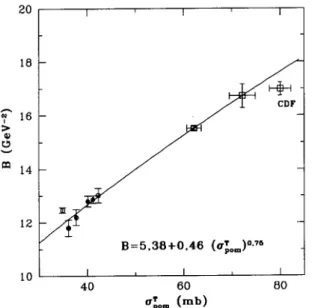
In Fig.1 we plot the two observables, T
and
B against eah other. At the ISR energies we use
T
pom
= (21:70 mb)s 0:0808
as representative of the
non-perturbativeontributions, instead of the full
ex-perimental values. At the highest energies (541-1800
GeV) itis believed that theproessisessentially
non-perturbative. Therelationbetweenthetwoobservables
isparametrizedintheform
B=B
0 +C(
T
)
; (10)
with B
0
=5:38GeV 2
, C =0:458GeV 2
, =0:75,
andwith T
giveninmilibarns. Thisformissuggested
bytheresultsofthealulationswiththemodelofthe
stohasti vauum [7℄, where aninterpretation for the
meaningoftheparametersisgivenintermsofQCDand
hadroniquantities. This isexplainedin detaillater.
in the model ofthe stohastivauum [7℄. Inthe
se-tions that follow we present ournew alulationsand
results.
Figure1. Relationbetweenthetwoexperimentalquantities
of the pp and pp systems. The values of T
at energies
up to 62.3 GeV shown inthis gure are the T
pom values
as given by the parameterization of Donnahie-Landsho,
namely T
pom
= (21:70 mb)s 0:0808
. We also inluded the
point[17 ℄ at19GeVand theFermilabCDFvalues[16 ℄at
1800GeV.ThevaluesofBfortheppsystemareshownwith
irles, whilethe valuesfor pp are represented bysquares.
Thesolidlinerepresentseq.(10),withvaluesfor,B0and
Cgiveninthegure.
II Nonperturbative QCD and
the Model of the Stohasti
Vauum in Soft High Energy
Sattering
Thenon-perturbativevauumexpetationvalues(suh
asgluonondensates)thatwererstintroduedin
al-ulations of hadron spetrosopy [18℄ were shown by
Nahtmann [6℄ to havefundamental role in soft
high-energysattering. Theappliationofthemodel ofthe
stohasti vauum to this problem followshis general
analysis,adopting howeveradierentfundamental
in-gredient. Instead of reduing the hadron-hadron
am-plitude to quark-quark sattering amplitudes, the
ba-si entities used are sattering amplitudes for Wilson
loops in Minkowskispae-time. Theloops areformed
bythetrajetoriesofthequarkandtheantiquarkofthe
hadronisystem,andthis approahhastheimportant
advantagethattheamplitudes aregaugeinvariant.
Themodelofthestohastivauum [8℄isbasedon
the assumption that the low frequeny ontributions
by asimplestohasti proess with aonverging
lus-ter expansion [19℄. The integration is speied by a
simple orrelator, whih is determined by two sales:
the strength of the orrelator(the value of the gluon
ondensate) and the orrelation length. This simple
modelleadstoonnementinanon-Abeliangauge
the-ory,withalinearpotentialbetweenstatiquarkswhih
agreeswithphenomenologialdeterminations[20℄.
In order to guarantee gaugeinvariane, the model
deals with the orrelator of the eld-strengths F
,
rather than with the expetation values of gauge
po-tentialsA
(x). Inordertogiveawelldenedmeaning
totheorrelator,whih isabiloal objet,the
olour-ontent of all elds must be parallel-transported to a
singlereferenepointw. Thentheparallel-transported
eldstrengthtensors
F
(x;w):= 1
(x;w)F
(x)(x;w); (11)
where (x;w)is a non-AbelianShwinger stringfrom
pointwtopointx,mustbeonstruted. Thisquantity
followsthegaugetransformationatthexedreferene
pointw
F
(x;w)!U(w)F
(x;w)U 1
(w) ; (12)
so that the vauum expetation value
F
(x;w)F
Æ (y;w)
A
withrespettothelow
frequen-iesisagaugeinvariantquantity.
With the approximation that the orrelator is
in-dependentofthereferenepointw,dependingonlyon
the dierene z = x y, its most general form [8℄ is
givenby
g 2
F C
(x;w)F D
(y;w)
A =
Æ CD
8 1
12
g 2
FF
(Æ
Æ
Æ
Æ
)D(z
2
=a 2
)
+ (1 )
1
2 h
z
(z
Æ
z
Æ
)
+
z
(z
Æ
z
Æ
)
D
1 (z
2
=a 2
)
: (13)
Here a is aharateristiorrelation length,
g 2
FF
isthegluonondensate
g 2
FF
=
g 2
F C
(0)F
C
(0)
A
; (14)
C ;D =1;:::;8 areolour indies, and thenumerial
fatorsin eq.(13)arehoseninsuhawaythat
D(0)=D
1
(0)=1: (15)
Lattiestudies[11℄ showthattheratio =(1 )is
ratherlarge(about3),sothatD(z 2
=a 2
)givesthe
dom-inantontribution. Thisdominanewasthereasonfor
the previous [7℄ neglet of the ontributions from the
part(1 )D
1 (z
2
=a 2
onsidera-The orrelator in eq.(13) is the starting point for
the evaluation of observablesin softhigh-energy
sat-tering. In the analysis made by Nahtmann [6℄, the
quark-quarksatteringamplitudefortheinterationof
the quarkswith the gluoneld is evaluated using the
eikonal approximation. If the energy of the quark is
veryhigh and thebakgroundeld hasonlya limited
frequenyrange,thequarkmovesonanapproximately
straight light-like line and the eikonal approximation
an be applied. In the limit of high energies there is
heliity onservation and spin degrees of freedom an
beignored. This quark-quark sattering amplitude is
expliitlygaugedependent. However,weanmakeuse
of the fat that in meson-meson sattering for eah
quark there is an antiquark moving on a nearly
par-allel line. The meson must be a olour singlet state
under loal gauge transformations, and to onstrut
suh a olourless state we have to parallel-transport
the olour ontent from the quark to the antiquark.
Sinethisparallel-transportoftheoloursismadebya
Shwinger string,weobtainfor themesona
retangu-larWilsonloopwhoselight-likesidesareformedbythe
quark and antiquark paths, and whose front ends are
theShwingerstrings. Thediretion ofthepathofan
antiquarkiseetivelytheoppositeofthatofaquark,
sothat theloophasawelldenedinternaldiretion.
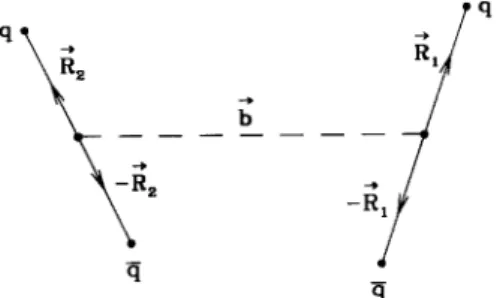
Theresultingloop-loopamplitudeisthenspeied,
not only by the impat parameter, but also by the
transverseextension vetors ~ R 1 and ~ R 2
. Inthe
trans-verseplanethetwointeratingloopsareseenasshown
inFig.2.
Figure2. Viewinthetransverseplaneofthetwoloopsthat
representthepathsofquarkandantiquarkinmeson-meson
sattering. The vetors ~ R 1 and ~ R 2 represent omponents
ofthemesontransversewave-funtions. Thevetor ~
bisthe
impatparametervetoronnetingthegeometrienterof
thetwohadrons.
ThefuntionalintegrationoverAisevaluatedusing
the model of the stohasti vauum. Sine the
orre-latoris givenin termsof theparallel-transportedeld
tensorF
(x;w), theline integrals R A dz are
trans-formed intosurfaeintegralsovertheeld tensorwith
thehelpofthenon-AbelianStokes-theorem. The
inte-grationsare then extendedoveropen surfaes S
1 and
S
2
havingtheloopsL
1 andL
2
asontours.
The exponential being expanded, the expetation
Gaussian proess. In theexpansionof thetraeof the
exponential at least two terms are neessary, beause
tr
A
=0, we obtainthe lowest order ontribution to
the loop-loop sattering amplitude. The integration
surfaes and details of the alulation have been
de-sribed before [7℄. The higher order terms are shown
to besmall asomparedto the leadingterm,and an
benegleted. Inthis approximationthesurfae
order-ing beomesirrelevant. Theexpetation valuesof the
produt of four elds is evaluated using the
fatoriza-tionhypothesis F C1 F C2 F D1 F D2 = F C1 F C2 F D1 F D2 + F C 1 F D 1 F C 2 F D 2 + F C 1 F D 2 F C 2 F D 1 : (16)
Itisonvenienttointroduetheeikonalfuntion
in termsofwhih theloop-loopamplitudeJ( ~ b; ~ R 1 ; ~ R 2 )
isgiventothelowestorderin theorrelatorby
J( ~ b; ~ R 1 ; ~ R 2 )= 1 576 ( ~ b; ~ R 1 ; ~ R 2 ) 2 : (17)
Inordertoextratasafatorthevalueofthegluon
ondensate,it is usefulto introduearedued eikonal
funtion andareduedloop-loopsattering amplitude
through e ( ~ b; ~ R 1 ; ~ R 2 ) 12 hg 2
FFi ( ~ b; ~ R 1 ; ~ R 2 ) (18) and e J LL 0( ~ b; ~ R 1 ; ~ R 2 ) 1 hg 2 FFi 2 J LL 0( ~ b; ~ R 1 ; ~ R 2 ) = [(e
~ b; ~ R 1 ; ~ R 2 )℄ 2
144576
: (19)
We have introdued the indies L;L 0
to indiate the
twoloops.
Tobeappliedto high-energysattering, themodel
of thestohastivauum mustbetranslatedfrom
Eu-lideanspae-time, to theMinkowskiontinuum. The
orrelationfuntionsD(z 2
=a 2
)andD
1 (z
2
=a 2
)mustfall
o for negativez 2
values(orresponding to Eulidean
distanes), and must have well dened Fourier
trans-formsintheMinkowskimetri,sinetheseenterin the
satteringamplitudes.
The loop-loop eikonal funtion is determined by
the geometry of the two loops and by the form of
the orrelationfuntions. Ineq.(13) there appear two
independent arbitrary salarfuntions, D(z 2 =a 2 ) and D 1 (z 2 =a 2
),whih aresupposed to fall o at large
dis-tanes withharateristilengthsa, alled orrelation
lengths. Lattie alulations [11℄ show however that
theformsofDandD
1
rates), withtheontributionfrom thetermwith D in
theorrelatorbeingabout3timeslargerthanthatfrom
D
1
. We then adopt the same shapes D D
1 , and
=3=4.
A onvenient general form [7℄ for the orrelation
funtion is D (n) ( j ~ j 2 )= 1 2 n 3 (n 3) ( n j ~ j) n 3 (n 1)K n 3 ( n j ~ j) 1 2 ( n j ~ j)K n 2 ( n j ~ j) ; (20) where K
(x) is the modied Bessel funtion, n 4,
and n = 3 p 4 (n 5=2) (n 3) : (21)
The dependene of the nal results on the partiular
hoiefor nis notverymarked,thereasonbeingthat
allorrelationfuntionsarenormalizedto1atthe
ori-gin, and derease exponentially at large distanes. It
is enoughthat thehosenfuntion falls monotonially
and smoothlyintherangeof physialinuene (upto
aboutonefermi,say),andthereannotbemuh
dier-ene in theresultsobtained using dierentreasonable
analytial forms. Thesimplerhoieis n=4, whih in
the Eulideanregionleadsto agoodrepresentationof
thelattiealulations[11℄. Wethenhaveforthe
or-relationfuntion D (4) ( j ~ j 2 )=( 4 j ~ j) K 1 ( 4 j ~ j) 1 4 ( 4 j ~ j)K 0 ( 4 j ~ j) ; (22) with 4 = 3 8 : (23)
Intheevaluationofthe(Eulidean)Wilsonloopin
the model of thestohasti vauum the D partof the
orrelator leads[8℄ to the arealaw for aWilson loop,
and to a relation involving the ondensate hg 2
FFi,
theorrelationlengthaandthestringtension
= 144 g 2 FF a 2 Z 1 0 D( u 2 )du 2 : (24)
For the family of orrelators written above the
inte-grationanbeperformedanalytiallyandforthease
n=4theresultgives
hg 2
FFi= 81
8a 2
: (25)
WethussaythatDrepresentstheonningorrelator,
whileD
1
is thenon-onning(andAbelian)part.
Afterthelimitsaretaken,whihmakethelongsides
of theretangularWilsonloopstendto 1inthe
di-retionof theollidingbeams,theremaining variables
intheintegrandsareoordinatesofpointsinthe
trans-inthenalexpressionsfortheeikonalfuntionsas
ar-guments of thetwo-dimensional inverse Fourier
trans-form,whihisgivenby
F (4) 2 ( j ~ j 2 )= 32 9 ( 4 j ~ j) 2 2K 0 ( 4 j ~ j) 4 4 j ~ j 4 j ~ j K 1 ( 4 j ~ j) = 32 9 2 ( 4 j ~ j) 3 K 3 ( 4 j ~ j) ; (26) where 2
isthe2-dimensionalLaplaianoperator,and
~
isanytwo-dimensionalvetorofthetransverseplane
andK
3
is amodied Bessel funtion. This Laplaian
formisimportantinthealulation,asitallows
lower-ingtheorder of theintegrations, throughGauss
theo-rem.
III Prole Funtion for
Hadron-Hadron Sattering
Wenowintroduethenotation ~
R (I;J),wheretherst
index(I=1,2)speies theloop,and theseond
spei-esthepartiularquarkorantiquark(J=1or2)inthat
loop.
Fig.3 showsaprojetiononthetransverse
satter-ingplane. Thevetors ~
Q(K ;L)inthetransverseplane
onnetthereferenepointC (withoordinatesw) to
thepositionsofthequarksandantiquarksoftheloops
1 and 2. The quantity (K ;L) is the angle between
~
Q(1;K)and ~
Q(2;L).
In the evaluation of the eikonal funtions
( ~
b; ~
R (1;1); ~
R(2;1)) oming from the onning ase
atypialresultingontributionis
Z 1 0 d Z 1 0
d os (1;1)
F (4) 2 ( j ~ Q(1;1) ~ Q(2;1)j 2
); (27)
where F (4)
2
is the above mentioned two-dimensional
Fouriertransformoftheorrelatorwithn=4. Taking
advantageof theLaplaianform,weanapplyGauss'
theoremintwodimensionsandeliminateonefurther
in-tegration. Thetermfrom thenon-onningorrelator
hasa total derivative under the integration sign, and
Figure 3. Geometrial variables of the transverse plane,
whih enter in the alulation of the eikonal funtion for
meson{mesonsattering. ThepointsC1 andC2arethe
me-son enters. In the integration, P2 runs along the vetor
~
Q(2;1), hanging the length z, whih is the argument of
the harateristi orrelatorfuntion. Inanalogous terms,
pointsP 1 , P 1 and P 2 runalong ~ Q(1;1), ~
Q(1;2)and ~
Q(2;2).
Thisexplainsthefour termsthatappearinsidethe
brak-etsmultiplyingintheexpressionfortheloop-loop
ampli-tude. Thelengthz 0
ofthe dot-dashedline istheargument
of the Bessel funtionarising from the non-onning
or-relatorD1;thereare foursuhterms,appearinginsidethe
braketsmultiplying(1 ).
Wethenwrite fortheeikonalfuntion ofthe
loop-loopamplitude e ( ~ b; ~
R (1;1); ~
R(2;1))=
os (1;1)I[Q(1;1);Q(2;1); (1;1)℄
os (2;2)I[Q(1;2);Q(2;2); (2;2)℄
+ os (1;2)I[Q(1;1);Q(2;2); (1;2)℄
+ os (2;1)I[Q(1;2);Q(2;1); (2;1)℄
+ (1 )
W[Q(1;1);Q(2;1); (1;1)℄
W[Q(1;2);Q(2;2); (2;2)℄
+ W[Q(1;1);Q(2;2); (1;2)℄
+ W[Q(1;2);Q(2;1); (2;1)℄
: (28)
ThequantitiesIwhihrepresentthenon-Abelian
on-tributions are given by integrations along the dashed
linesofthegure:
I[Q(1;K);Q(2;L); (K ;L)℄= 32 9 3 8 2 fQ(1;K) Z Q(2;L) 0 [Z 1 (x)℄ K 2 3 8 p Z 1 (x) dx +Q(2;L) Z Q(1;K) 0 [Z 2 (x)℄ K 2 3 p Z 2 (x)
dxg; (29)
withQ(K ;L)=j ~
Q(K ;L)jandwhere
Z
1
(x)=Q(1;K) 2
+x 2
2xQ(1;K)os (K ;L)
Z
2
(x)=Q(2;L) 2
+x 2
2xQ(2;L)os (K ;L) (30)
Thequantities W, whih ome fromthenon-onning
partoftheorrelator,aregivenby
W[Q(1;K);Q(2;L); (K ;L)℄=
32 9 2 3 8 [Z 3 ℄ 3=2 K 3 3 8 p Z 3 ; (31) where Z 3
=Q(1;K) 2
+Q(2;L) 2
2Q(1;K)Q(2;L)os (K ;L): (32)
From the eikonal funtion e we onstrut the
loop-loopamplitude e J L1L2 ( ~ b; ~ R 1 ; ~ R 2
),where ~ R 1 and ~ R 2 are
shorthandnotationsfor ~
R(1;1)and ~
R(2;1)respetively.
Thehadron-hadron amplitude is onstruted from
the loop-loop amplitude using a simple quark model
forthehadrons. Sineouramplitudeisindependentof
themomentum ofthequarks(as longastheenergyis
highenoughtoensurelight-likepaths),thedependene
of the wave-funtions onthe longitudinal momenta of
the quarks an be negleted, and we thus only
on-siderthetransversedependene,whih isgivenby the
Fouriertransformofthetransversewave-funtion. We
thusobtainthehadron-hadronsatteringamplitudeby
smearing overthevaluesof ~ R 1 and ~ R 2
in eq.(17)with
transversewave-funtions ( ~
R ).
Takingintoaounttheresultsoftheprevious
anal-ysis of dierent hadroni systems [7℄, in the present
alulation we only onsider for theproton a diquark
struture,wheretheprotonisdesribedasameson,in
whih thediquark replaesthe antiquark. Thus these
expressionsapplyequallywelltomeson-meson,
meson-baryonandbaryon-baryonsattering.
For the hadron transverse wave-funtion we make
theansatzof thesimpleGaussianform
H (R )=
p
2= 1
S
H
exp( R 2
=S 2
H
); (33)
whereS
H
isaparameterforthehadronsize.
We then write the redued prole funtion of the
eikonalamplitude b J H1H2 ( ~ b;S 1 ;S 2 )= Z d 2 ~ R 1 Z d 2 ~ R 2 e J L 1 L 2 ( ~ b; ~ R 1 ; ~ R 2 )j 1 ( ~ R 1 )j 2 j 2 ( ~ R 2 )j 2 ; (34)
whihisadimensionless quantity.
Forshort,from now onwewrite J(b) orJ(b=a) to
represent b
J( ~
The ontributions of both the onning and
non-onningorrelatorstotheeikonalfuntionandtothe
observables in high-energy sattering are being taken
intoaount. Aimingattheppandpp systems,weonly
onsidertheaseS
1 =S
2
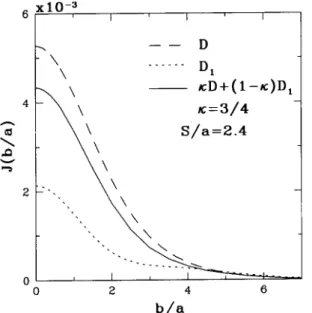
=S. Fig.4showsa
ompari-sonbetweentheresultsfortheprolefuntions J(b=a)
orresponding to S=a = 2:4 in the asesof pure
on-ning ( =1), pure non-onning ( =0) and mixed
( = 3=4) orrelators, in order to exhibit their
dier-enes.
Figure4. DimensionlessprolefuntionsJ(b=a)for S=a=
2:4 obtained in the ases of pure onning ( = 1), pure
non-onning(=0)andmixed(=3=4)orrelators.
Thedimensionlesshadron-hadronsattering
ampli-tudein theeikonalapproahisgivenby
T
H
1 H
2 =is[hg
2
FFia 4
℄ 2
a 2
Z
d 2
~
b exp(i~q ~
b) b
J
H1H2 (
~
b;S
1 ;S
2
); (35)
where the impat parameter vetor ~
b and the hadron
sizesS
1 ,S
2
areinunitsoftheorrelationlengtha,and
~
qisthemomentumtransferprojetedonthetransverse
plane, in units of1=a, sothat themomentum transfer
squared is t = j~qj 2
=a 2
. For onveniene, in the
ex-pressionabovewehaveexpliitlyfatorizedthe
dimen-sionlessombinationhg 2
FFia 4
:Thenormalizationfor
T
H1H2
is suh that the total ross-setion is obtained
throughtheoptialtheoremby
T
= 1
s ImT
H
1 H
2
; (36)
andthedierentialross-setionisgivenby
d e`
dt =
1
16s 2
jT
H
1 H
2 j
2
: (37)
Towriteonvenientexpressionsfortheobservables,
wedenethedimensionlessmomentsoftheprole fun-a)
I
k =
Z
d 2
~
bb k
b
J(b) ; k=0;1;2;::: (38)
whih depend only on S=a, and the Fourier-Bessel
transform
I(t)= Z
d 2
~
bJ
0 (ba
p
jtj ) b
J(b); (39)
where J
0 (ba
p
jtj) is the zeroth{order Bessel funtion.
Then
T
H
1 H
2
=is[hg 2
FFia 4
℄ 2
a 2
I(t):
SineJ(b)isreal, thetotalrosssetion T
, theslope
parameterB(slopeatt=0)andthedierentialelasti
ross-setionaregivenby
T
=I
0 [hg
2
FFia 4
℄ 2
a 2
; (40)
B= d
dt
ln d
e`
dt
t=0 =
1
2 I
2
I
0 a
2
=Ka 2
; (41)
and
d e`
dt =
1
16 I(t)
2
[hg 2
FFia 4
℄ 4
a 4
: (42)
Wehaveheredened
K= 1
2 I
2
I
0 :
Weobservethat in thelowestorder ofthe
orrela-torexpansionthe slopeparameterB doesnotdepend
onthevalueofthegluonondensatehg 2
FFiand,one
theproton radiusS isknown,maygiveadiret
deter-minationoftheorrelationlength.
TheQCDstrengthand lengthsalehavebeen
fa-torizedin theexpressions forthe observables,and the
orrelationlengthappearsasthenaturalunitoflength
for the geometri aspets of the interation. These
aspets are ontained in the quantities I
0
(S=a) and
I
2
(S=a), whih depend onthehadronistrutures and
ontheshapesandrelativeweights(parameter)ofthe
two orrelation funtions. It has been shown [7℄ that
forthease=1thetwomomentshavesimpleform
as funtions of S=a. To onsider arbitrary values for
,weremarkthattheprolefuntionanditsmoments
are quadrati funtions of , as they result from
in-tegrations of the squares of a (symboli) ombination
D+(1 )D
1
. TheprolefuntionJ(b=a)foran
ar-bitraryvalueoftheweightanbeobtainedonethe
prolefuntions havebeendeterminedforthree
dier-ent valuesof . It is shown in the next setion that
themomentsI
0
(S=a)andI
2
(S=a)forarbitrary(with
01) an berepresentedbysimilarly simple
ex-pressions.
Itisimportantthatthehigh-energyobservables T
andB requireonlythetwolowmomentsI
0 ,I
2 ofthe
prole funtions. The urvature of the forward peak
depends on higher momentsand onthe long distane
IV Experimental Observables
and QCD Parameters
TheurvesforI
0 =
T
=[hg 2
FFi 2
a 10
℄ andK=B=a 2
an beparameterized asfuntions of S=a with simple
powers,withgood aurayfor01. The
onve-nientexpressionsare
I
0 =
S
a
; (43)
and
K=+
S
a
Æ
: (44)
Thenumerialvaluesoftheparameters;;;;Æand
theratioÆ= (whihisofpartiularimportaneforthe
omparisonwiththedata)for=3=4are
=0:653210 2
; =2:791; =2:030
=0:3293; Æ=2:126; Æ==0:762:
Theparameterizationsofthetotalross-setionand
oftheslopeparameterB areveryonvenientfor
om-parisonoftheresultsofthemodelofthestohasti
va-uum with experiment. In order to have awide range
ofdatatoextratreliableinformationonQCD
param-eters, we onentrate on elasti pp and pp sattering.
ThedataextendingfromtheISRrange(20-60GeV)
to the Fermilab energy (1800 GeV) are presented in
table1andinFig.1.
The non-perturbative alulation made with the
model of the stohasti vauum orresponds to the
phenomenologial pomeron exhange of Regge
phe-nomenology [2, 3℄. Donnahie and Landsho [3℄
found that the parameterization T
pom
(pp;pp) =
(21:70 mb) s 0:0808
(with s in GeV 2
) works well over
a wide range of data above p
s = 5 GeV, so that we
mayusethisexpressionto representthepomeron
on-tribution at the energieswhere the non-pomeron part
isimportant(theISRenergies). At541and1800GeV
weassumethatpomeronexhangedominatesthe
sat-tering proess,and ignorepossibledierenesbetween
ppandppsystems. Wethentakethedataatthesetwo
highestenergiesasinput,andpreditthevaluesforthe
lower(ISR)energies.
The values of the slope parameter related to the
pomeronexhangemehanismarenotknown,andmust
be predited by a model. Our model makes spei
preditions for the relation between T
pom and B
pom ,
andweneedgooddatatotestauratelythese
predi-tions. ThedierenesB(pp) B(pp)are0.50,0.16and
0.45 GeV 2
at 30.5, 52.7 and 62.3 GeV respetively,
with error bars typially 0:55 GeV 2
(see table 1);
these dierenesdonotshownaderease withthe
in-reasingenergy,asexpetedfrompomerondominane,
but theerrorbarsare toolarge,largerthanthe
quan-tities themselves. The situation is simpler with the
thedierenes T
(pp) T
(pp)are2.02,0.94and0.57
mb respetively, dereasing ontinuously to zero, and
witherrorbarsnotlargerthanthevaluesofthe
dier-enes. Thus, in therange of theISR experiments,we
seetheross-setionsonvergingtothesame
pomeron-exhangevalues,butnottheslopes.
InFig.1,besidestheISRandhigherenergydata,we
showthepoint[17℄orrespondingto p
s=19GeVwith
T
pom
=34:92 mb and B =12:470:10 GeV 2
. This
point has been used [7℄ as an input in an appliation
of the model of thestohasti vauum to high-energy
sattering,andwenowseethatitisnotonsistent(due
toatoolargevalueforB)withtheISRdata,asshown
inFig.1. Thisonsiderationhasinueneinthe
numer-ialvaluesthatare obtainedfor theQCDparameters.
InFig.1weshowalsotheFermilabCDFvaluesat1800
GeV, whih must be onsidered as alternative to the
valuesobtainedintheE-710experiment,sinethey
re-fertothesameenergy;intheanalysispresentedbelow
weopt for the E-710values, whih t morenaturally
in ouralulation.
Onetheformsoftheorrelationfuntionsarexed,
theparametersinthemodelthatarefundamentally
re-lated to QCD arethe weight ,the gluon ondensate
hg 2
FFi and the orrelation length a. The hadroni
extension parameter S
H
aounts for the energy
de-pendene of the observables. In this setion we show
howthesequantitiesanbeevaluatedusingexlusively
high-energysatteringdata.
To obtain from eqs(40), (41), (43) and (44) a
re-lation between the observables T
and B at a given
energy,weeliminatetheradius, andwrite
B a
2
=
a 2
(<g 2
FF>a 4
) 2Æ=
Æ=
T
a 2
Æ=
: (45)
The form of eq.(45) is the same as given by eq.(10),
withanobviousorrespondeneofparameters.
Todetermine theparameters,werstremark that
theexponent=Æ=doesnotdependonQCD
quan-titiesandisalmostonstant(equaltoabout3/4)inthe
regionofvaluesofthat areobtainedin lattie
alu-lations ( 3=4). This tellsus that weannot easily
extratauniquevalueoffromhigh-energysattering
dataonly,but tellsusalsothatthepowerineq.(10)
mustsurelybeveryloseto
Æ===3=4: (46)
Thisisafortunateresultforouranalysis,beausethen
in pratiewe areleft withonly twofreequantities in
bothenergyindependentrelations(45)and(10). They
anbedeterminedusingasinputthetwolean
experi-mentalpointsfor T
andBat541and1800GeVgiven
in table1. Wethenobtain
B
0 =a
2
=5:38GeV 2
=0:210fm 2
;
Fig.1 shows the observables of soft high-energy
sattering, with the modiation that for the
to-tal ross-setions at the ISR energies we show
the non-perturbative pomeron-exhange ontribution
T
pom
(pp;pp) = (21:70 mb) s 0:0808
instead of the full
experimental value. The values of B for the pp
sys-temareshownwithirles,whilethevaluesforppare
represented by squares. The solidline iseq.(10), with
valuesfor,B
0
andCgivenabove. Weseethat using
the541and1800GeVdataasinput,themodelgivesa
verygoodpreditionfortheISRdata. Itisinteresting
to observethat the valuesof B for thepp system are
loser toourpredition forthenon-perturbativeslope
(the solid line) ompared to the pp values, whih are
ratherhigh.
Eq.(45)givestheorrespondenebetweenthe
phe-nomenologialquantities,B
0
,C andtheparameters
ofthemodelandofQCD.Sinethemodelparameters
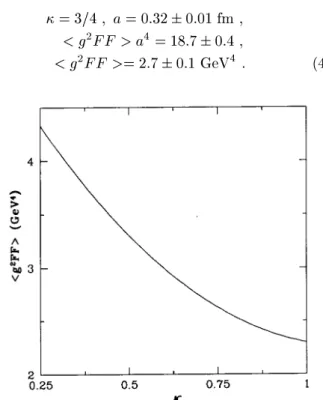
are funtions of only, we an also obtain the QCD
parametersasfuntionsof. Theyareplottedings.5
and 6. Theorrelationlengthisremarkablyonstant,
whilethegluonondensatedereasesas inreases.
Figure 5. Theorrelation lengthas a funtionof . The
values are determinedusingas inputthe data at 541and
1800 GeV.
Ofoursethese resultsaresubjettounertainties.
Wehaveadoptedanansatzfortheorrelationfuntion,
whihisarbitrary(althoughnumeriallyitouldnotbe
verydierent). There is some unertainty also in the
determination of the parameters ;::: representing
the nal results of the numerial alulation. On the
otherhand,themodelgivesaratheruniquepredition
for=Æ==3=4whih iswellsustainedbythedata
asshownin Fig.1.
To be spei, we borrow from lattie alulation
the value=3=4,andthen use theparametervalues
obtainedfor thisase. Taking into aountthe
exper-GeV,weobtain
=3=4; a=0:320:01fm;
<g 2
FF >a 4
=18:70:4;
<g 2
FF >=2:70:1GeV 4
: (48)
Figure6. Thegluon ondensate <g 2
FF > as afuntion
of, determinedusingas input the dataat 541and 1800
GeV.
With thevalue=33=40obtainedin morereent
lattieresults[21℄theentralvalueshangeslightlyto
=33=40; a=0:33fm;
<g 2
FF >a 4
=19:2;
<g 2
FF>=2:6GeV 4
: (49)
TheresultsofthepureSU(3)lattiegauge
alula-tionbyDi GiaomoandPanagopoulos[11℄forthe
or-relatorhF C
(x;0) F D
(0;0)i
A
havebeentted [7℄ with
thesameorrelationfuntion (22) usedin the present
work. Theorrelationbetweenthevaluesof<g 2
FF >
anda that wasthen obtainedanbewellrepresented
bytheempirialexpressions
L =
1:1122
a 1:310
; <g 2
FF >=
0:01813
a 4:656
;
<g 2
FF >a 4
=0:0172 p
L
; (50)
with the lattie parameter
L
in MeV, a in fm, and
< g 2
FF > in GeV 4
. This orrelation is displayed in
Fig.7,wheresomehosenvaluesof
L
aremarked.
L
usually takes values in the range 51:5 MeV. The
point representing our results of eq.(48) is marked in
the same gure. The dashed line represents the
re-lation between the gluon ondensate, the orrelation
lengthand thestring tensionobtained in the
applia-tionofthemodelofthestohastivauum[8℄tohadron
spetrosopy;forourformoforrelator,thisrelationis
given by eq.(25). The urve drawn orresponds to a
Figure7. Constraintsonthe valuesof hg 2
FFi andof the
orrelation lengtha. Thesolidline is the tof our
orre-latortothelattiealulation[11℄asgivenineq.(50).The
dashedline plots eq.(25), with =0:16 GeV 2
. The ross
enteredat a=0:32 fm, <g 2
FF >=2.7GeV 4
shows the
resultofouralulationgivenineq.(48).
Asanbeseenfromthegure,theonstraintsfrom
these three independent soures ofinformation are
si-multaneouslysatised,providingaonsistentpitureof
softhigh-energyppandpp sattering. The(puregauge)
gluonondensateiswellompatible withtheexpeted
value. Thelattieparameter
L
andthestringtension
arealsointheiraeptableranges. Aswedesribe
be-low,theresultingprotonsizeparameterS
p
takesvalues
quitelosetotheeletromagnetiradius[22℄.
In our model the inrease of the observables with
the energy is due to aslow energy dependene of the
hadroni radii. An expliit relation is obtained if we
bringintoeqs.(40)and(43)aparameterizationforthe
energy dependene of the totalross-setions, suh as
theDonnahie-Landsho[3℄form. Inthis asewe
ob-tainfortheprotonradius
S
p (s)=
a
1=
21:7mb
a 2
1=
s 0:0808=
(hg 2
FFia 4
) 2=
: (51)
Theenergydependene,givenbyapower0:0808=ofs
isveryslow,andthevaluesobtainedforS
p
areinthe
re-gionoftheprotoneletromagnetiradius[22℄,whihis
R
p
=0:8620:012fm. However,useofthe
Donnahie-Landshoparameterizationforthetotalross-setions
isnotappropriateatveryhighenergies. Usingeqs.(40)
and(43)anddiretlythedataat541and1800GeV,we
obtainthevaluesfortheprotonradiusthat areshown
inFig.8,wherealogsaleisusedfor p
s. Itis
remark-ablethat wehavean almostlinear dependene,whih
anberepresentedby
S (s)=0:671+0:057log p
s (fm ); (52)
with p
sinGeV.Withthisformfortheradius,whihis
shownindashedlineinFig.8,theross-setionsev
alu-atedatveryhighenergiesrisewithatermlog
p
s,and
aresmallerthanpreditedbythepowerdependeneof
Donnahie-Landsho. However, sine 2:8, they
stillviolatethebound log 2
p
s. Thismaybeorreted
usingapower2=insteadof1intheparameterization
forS
p
(s),andwethenobtain
S
p
(s)=0:572+0:123[log p
s℄ 0:72
(fm ): (53)
This form is shown in solid line in Fig.(8). Clearly it
gives a good representation for the existing data. At
14 TeV, whih is the expeted energy in the future
LHC experiments,weobtainS
p
(14TeV)=1:19fm=
1:38 R
p
= 3:7a and the model preditions for the
observablesare T
=92 mb and B=19.6 GeV 2
. The
dashedlinerepresentingeq.(52)leadsatthesameLHC
energy to T
=97 mb and B=20.1 GeV 2
, while the
Donnahie-Landsho formula leads to the still higher
value T
=101.5mb.
Figure 8. Energy dependeneof the proton radius. The
markedpointsareobtainedfromthetotalross-setiondata
(attheISRenergiesthetotalross-setionsarerepresented
by the pomeron exhange ontributions). Thetwo
repre-sentations for the radiusdependene are indistinguishable
with the present data, butgive quite dierent preditions
fortheross-setionvaluesattheLHCenergies.
The non-perturbative QCD ontributions to soft
high-energysattering areexpeted tobedominantin
theforwarddiretion,thusdeterminingthetotal
ross-setion(through theoptialtheorem)andtheforward
slopeparameter. The model, asitis presentedin this
paper,leadstoanegativeurvaturefortheslopeB(t),
whihdereasesasjtjinreases,asshowninFig.5. The
data however shows an almost zero urvature of the
peak, so that abovesome valueof jtj themodel leads
totoohighvaluesofthedierentialross-setion. This
at 541, 546 and 1800 GeV are shown, together with
the results of the model, without any free parameter
(the gluon ondensate, the orrelation length and the
hadroniradiushavebeenuniquelyxedbytheinputs
of T
andBat541and1800GeV).
Figure 9. Elasti dierential ross-setions at high
ener-gies [13 ℄. The solid lines represent the alulations with
themodelofthestohastivauumdesribedinthepresent
work, withoutfree parameters. The systematideviations
ourringforjtjlargerabout3010 3
GeV 2
arisefromthe
longrangebehavioroftheprolefuntionJ(b/a).
V Final remarks
We have explained thealulation of soft high-energy
sattering, inluding the two tensor forms in the
or-relator,andthustaking intoaountthetwo
indepen-oftheweightparameterthat measurestheratio
be-tweenthetwoontributions,givingthegeneralresults
thatallowthedetermination oftheobservable
quanti-ties andQCDparametersin termsof thisweight. We
show that there are little hanges in the nal results,
whenvariesin therangessuggestedbylattie
deter-minations.
The model of thestohasti vauum desribes the
most important data on total ross-setion and slope
parameterfor the pp and pp systems, extended from
p
s20to1800GeV,givingauniedandonsistent
de-sriptionofthesedataintermsoffundamental
quanti-ties. Thenon-perturbativeQCDparameters
determin-ing the observables are the gluon ondensate and the
orrelationlengthofthevauumeldutuations. The
thirdquantityenteringthealulationsisthetransverse
hadronsize,whihhasamagnitudelosetothe
eletro-magnetiradius, andwhose variationaountsforthe
energydependene oftheobservables.
The model allows a very onvenient fatorization
between the QCD and hadroni setors.
Elimina-tionofthehadron sizeparameterbetweenthe
expres-sions forthe two observables at a given energy yields
aparameter-free and energy independent relation
be-tweenthetotalross-setionandtheslopeoftheelasti
ross-setion whih agrees very well with experiment.
Startingfrom twoexperimental energiesasinput, this
expressiongivesapreditionoftheremainingdata,and
leadsto adetermination ofthe orrelationlength and
thegluonondensatefromhigh-energydataalone. The
resultsobtainedareingood agreementwiththe
orre-lations between thetwo QCDparameters obtainedin
the lattie alulations and in the appliation of the
stohasti vauummodelto hadronispetrosopy.
Intheexpansionoftheexponentialwithfuntional
integrations, the present alulation is restrited to
the lowest order non-vanishing ontribution, whih is
quadrati in the gluoni orrelator, and we may
on-ludefromourresultsthatthisisjustiedforthe
eval-uationsoftotalross-setionandslopeparameter. The
resulting amplitude is purely imaginary, and the
-parameter(theratiooftherealtotheimaginaryparts
of the elasti sattering amplitude) an only be
de-sribedifwegoonefurther order in theontributions
totheorrelator. Alsothefatorizationin eq.(16),
im-pliedbytheassumptionofaGaussianproess,is
impor-tantinthepresentformulationofthemodel,and
possi-blyhasonsequenesforthephenomenologialanalysis.
Reentdevelopmentsofthemodel[23℄givemore
au-ratedeterminationoftheprolefuntion asafuntion
oftheimpatparameter,withoutrequiringthe
assump-tionofsmallvaluesthefuntion. Thereisimportant
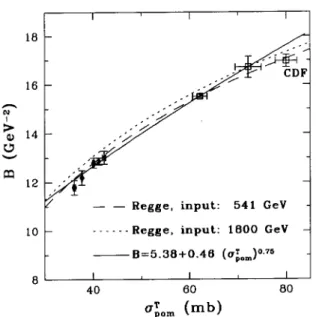
dif-Figure 10. Relation between observables of high-energy
satteringobtainedinouralulationsomparedtothe
rela-tionobtainedfromaReggeamplitudeaordingtoeq.(54).
The dashed line uses as input for the Regge formula the
p
s=541GeVdata andpasseslose tothe CDFpoint at
1800 GeV.The dottedline usesas inputthe valuesof the
E-710experimentat p
s=1800GeV.
Itisinterestingtoomparetheresultsofthemodel
of the stohasti vauum with Regge phenomenology.
InFig.10weplottherelationbetweenthe observables
givenby
T
Regge =
T
0 e
0:1616(B B
0 )
; (54)
obtainedfromaReggeamplitudeusingtheslopeofthe
pomerontrajetory 0
(0)
pom
=0:25GeV 2
. This
rela-tionrequiresaninputpair T
0 ,B
0
atahosenenergy.
Thedashedlineusesasinputthe p
s=541GeVdata
T
0
= 62:20 mb, and B
0
= 15:52 GeV 2
. It is
in-teresting to observe the tendeny of this line to pass
losetotheCDFexperimentalpoint,insteadofthe
E-710point. The dotted lineuses asinput thevaluesof
theE-710experimentat p
s=1800GeVandshowsa
deviationat541GeV.Thisisratherintriguing,asit
im-plies thateq.(54) favorsthe CDFexperimental results
at1800GeV.
Aknowledgments
We are grateful to H.G. Dosh for the kind and
fruitfulollaborationextendedalongseveralyears,and
aknowledge thepartiipationof FlavioPereirain the
alulations with the model of the stohasti vauum
thatareherereported.
Referenes
[1℄ ReviewArtiles: L.L.Jenkovszky, Fort.Phys.34,791
(1986);M.M.BlokandR.N.Cahn, Rev.Mod.Phys.
[2℄ P.D.B. Collins, An Introdution toRegge Theory and
High Energy Physis - (Cambridge University Press,
1977).
[3℄ A.DonnahieandP.V.Landsho, Phys.Lett.B296,
227(1992).
[4℄ M.Froissart, Phys.Rev.123,1053(1961);A.Martin,
Phys.Rev.129,1432 (1963).
[5℄ P.V.LandshoandO.Nahtmann, Z.Phys.C35,405
(1987).
[6℄ O.Nahtmann, Ann.Phys.209(1991)436.
[7℄ H.G.Dosh,E.FerreiraandA.Kramer, Phys.Lett.B
289,153(1992); Phys.Lett.B318,197(1993); Phys.
Rev. D 50, 1992 (1994); E. Ferreira and F. Pereira,
Phys.Rev.D55,130(1997);
[8℄ H.G.Dosh, Phys.Lett.B190,177(1987).
[9℄ H.G. Doshand Yu.A.Simonov, Phys.Lett. B 205,
339(1988).
[10℄ H.G.Dosh,LeturesonHadronPhysis,Ed.E.
Fer-reira,WorldSienti(1990)p.40.
[11℄ A. Di Giaomo andH. Panagopoulos, Phys. Lett. B
285,133(1992).
[12℄ B. Povh and J. Hufner, Phys. Rev. Lett. 58, 1612
(1987), Phys.Lett.B215,772(1988)andB245,653
(1990); Phys.Rev.D46,990(1992)990;C.Bourrely,
J.SoerandT.T.Wu, Nul.Phys.B247,15(1984)15;
Phys.Rev.Lett.54, 757(1985); Phys.Lett.B 196,
237(1987)7;J.DiasdeDeusandP.Kroll, Nuovo
Ci-mento A37,67(1977) 67; AtaPhys.Pol. B9, 157
(1978); J.Phys.G9,L81(1983);P.Kroll, Z.Phys.C
15,67(1982);T.T.ChouandC.N.Yang, Phys.Rev.
170,1591(1968) andD19,3268 (1979); Phys.Lett.
B 128, 457 (1983) and B 244, 113(1990); E. Levin
andM.G.Ryskin, Sov.J.Nul.Phys.34,619(1981).
[13℄ Mainreferenestothedata.(a)N.Amosetal, Nul.
Phys.B262,689(1985);(b)R.CastaldiandG.
San-guinetti, Ann.Rev.Nul.Part.Si.35,351(1985);()
C.Augieretal, Phys.Lett.B316,448(1993);(d)M.
Bozzoetal, Phys.Lett.B147,392(1984);M.Bozzo
et al, Phys.Lett. B147,385(1984); (e)N.Amoset
al, Phys.Lett.B 247,127(1990); Phys.Rev.Lett.
68,2433(1992);Fermilab-FN-562[E-710℄(1991).
[14℄ Data Compilations, Partile Data Group, Review of
PartileProperties, Phys.Rev. D50(1994)number3,
partI; ReviewArtiles,L.L.Jenkovszky, Fort.Phys.
34,791(1986);M.M.BlokandR.N.Cahn, Rev.Mod.
Phys.57,563(1985).
[15℄ G.Alner, Zeit.Phys.C32,153(1986).
[16℄ F. Abe et al. Phys.Rev. D50, 5550 (1994); Phys.
Rev.D50,5518(1994).
[17℄ J.B.Burqetal, Nul.Phys.B217,285(1983).
[18℄ M.A. Shifman, A.I. Vainshtein and V.I. Zakharov,
Nul.Phys.B147,385,448and519(1979).
[19℄ N.G.vanKampen, Physia 74, 215, 239 (1974) and
Phys.Rep.C24,172(1976); G.C.Hegerfeldt andH.
Shulze, J.Stat.Phys.51,691(1988).
[21℄ A. Di Giaomo, E.Maggiolaro and H. Panagopoulos,
hep-lat/9603017,Marh1996.
[22℄ Protonradius: G.G.Simonetal. Z.NaturforshungA
35,1(1980).
[23℄ E.R.Bergerand O.Nahtmann, Eur. Phys.J. C7,