Fiber Coupled Cholesteri Liquid Crystal Laser
M.F. Moreira, I.C.S. Carvalho,
PontifiaUniversidadeCatoliadoRiode Janeiro, Departamentode Fsia,
Cx. Postal38071,22452-970, RiodeJaneiro-Brasil
L.C.G. Valente,
PontifiaUniversidadeCatoliadoRiode Janeiro, Departamentode EngenhariaMe^ania,
Cx. Postal38071,22452-970, RiodeJaneiro-Brasil
P. Paly-Muhoray, B. Taheri,
LiquidCrystal Institute,Kent StateUniversity,Kent,OH44242-USA
and A.F. Mu~noz
PhysisDepartment, UniversidadAutonomaMetropolitana,MexioCity,Mexio
Reeivedon30November,2001
Lasing inholesteri liquid rystals is an exiting new phenomenon. Cholesteri liquid rystals
(CLC)areinherentlyperiodi. Intheirgroundstate,theyformastruturewheretheoptiaxisof
theuniaxialmaterialtwiststoformahelixandleadstoonedimensionalphotoniband-gapbehavior.
If a uoresent dye with emissionmathing the reetion band is addedto these materials, the
distributedfeedbakpropertiesofthestrutureanresultinlaseremissionwhenoptiallypumped.
Inthiswork,weshowlasinginaCLCdiretlyoupledtoanoptialber. Thelaseremissionofthis
deviewasharaterizedbypumpingtheinputendoftheoptialberwithananoseondNd:YAG
(532nm)laser.
I Introdution
Cholesteri liquid rystals (CLC) are hiral nematis
whihshowaperiodihelialstruturewherethe
dire-torisperpendiulartothehelixaxis. Theorientationof
thediretorvarieslinearlywithpositionalongthehelix
axis[1℄. Theperiodihelialstrutureofholesteri
liq-uidrystalresultsinaseletivereetionband. Inthis
band,irularlypolarizedlightwhosehandednessisthe
sameasthat oftheCLCis totallyreetedbya
semi-innitesample. Thereetedlighthasthesame
hand-ednessastheCLC.Theedgesofthereetionbandare
at thefreespaewavelengths =n
e
pand
+ =n
o p,
where n
e and n
o
are the extraordinary and ordinary
refrativeindiesrespetivelyandpisthepith ofthe
helialstruture[2℄.
If a uoresent dye, whose uoresene spetrum
overlapstheholesterireetion band,isdissolvedin
theCLC,itsuoreseneissuppressedinthereetion
band but is enhanedat theband edges. The
uores-ene is suppressed due to band gap struture of the
CLC. When appropriately hosen CLC-dye mixtures
are optially pumped, extremely low threshold lasing
anouratthebandedges[3℄. Thelasingwavelength
example, the wavelength for lasing at the low energy
bandedgeis =n
e p.
Goldberg and Shnur [4℄ rst proposed lasing in
CLCsystemsin1973. Lasingin dye-dopedholesteri
liquidrystalwasrstdemonstratedunambiguouslyby
Koppet al. [5℄, and subsequently byTaheriet al. [6℄
in thevisible range. More reently, UV-lasingin pure
CLC withoutthe use of dyeswas reported by Mu~noz
etal. [7℄.
The lasingCLC has opened potential appliations
asoptialsensorsand,aswereporthere,anbediretly
oupledtooptialbers. Sinethewavelengthoflasing
depends on the material properties of the holesteri,
andsinethesematerialpropertiesdependonexternal
fators,thesystemmaybeusedasasensor,wherethe
lasing wavelength provides information about the
ex-ternalfators. Forexample,sinetheholesteripith
pandtherefrativeindiesdependontemperature[2℄,
thelasingfrequeny anbeused asan aurateprobe
of loal temperature. The spetral enoding of
infor-mation and the possibility of use in onjuntion with
optialbers,makethisnewshemeveryattrative.
In this work, we desribethe experiment in whih
wasobservedfromtheCLCthroughtheber,
demon-stratingthefeasibilityofusingtheCLClaserasaber
sensor.
Theuseofoptialbersisveryadvantageous,sine
it allows the position of the CLC laser, whih an be
usedasasensorelement,tobeatdistanesgreaterthan
10 km from the reading site. A new ongurationfor
thelaserassembly isproposed toeÆientlyouplethe
CLClasertooptialbers.
II Experimental Setup
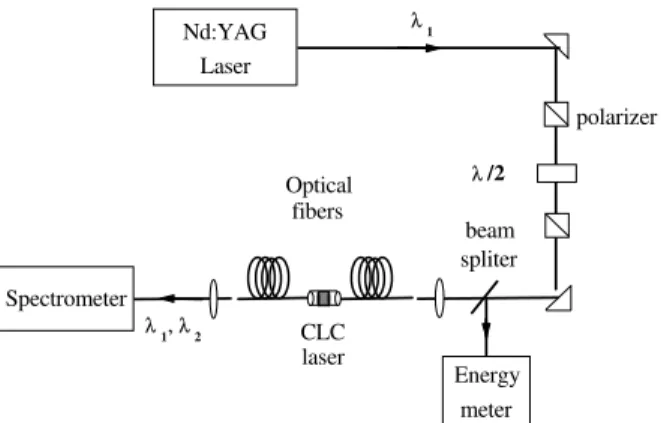
TheshematiofthesetupusedtooupletheCLClaser
into theberis shownin Fig. 1. Themultimode ber
usedinthisexperimenthasa100morediameterand
a140mladdingdiameter. Theberendswerepushed
into aNorlandUVCOptial Splieonnetor
ontain-ing the CLC-dye mixture. The onnetor onsists of
a preision alignment guide apable of oupling light
fromonebertotheother one. Whilepositioningthe
berends,weusedanoptialmirosopetoadjustthe
thikness of the holesteri mixture to approximately
25m.
connector
Fiber
input
Fiber
output
CLC laser
Figure1. Shematiofthe setup usedto ouple theCLC
laserbetweentwomultimodebers.
Thesample wasamixture oftheCLCBLO61and
thenematiliquidrystalmixtureE7. Theomposition
ofthesamplewas87.2wt.%BLO61and12.8wt.%E7.
ThelaserdyeDCM
(4-(diyanomethylene)-2-methyl-6-(4-dimethylaminostyryl)-4H-pyran)wasthendissolved
intheliquidrystalmixture. Thedyeshowedgood
sol-ubility in the liquidrystaland the dye onentration
usedwas1.5wt.%. Thenalmixturewasplaedinside
oftheberonnetor.
The output of a frequeny doubled Q-swithed
Nd:YAGlaserwith7nspulsesatwavelengthof=532
nmwasusedasthepumpbeamintheexperiment. The
experimental setupisshown inFig. 2. Twopolarizers
andahalf-waveplatewereplaedintheoptialpathof
thepumpbeamtoontrolthepulseenergy. This
radi-ationwasthenoupledtotheberentranethrougha
lens(f=1m)andguidedthroughtheber-CLC-ber
system. Anotherlens(f=1m)wasusedtoolletthe
emittedlaserlight( )andthepumplight( )atthe
output end ofthe ber. Theoutputwasfoused onto
theentraneapertureoftheTRIAX550spetrometer
forharaterizationoftheemission.
spliter
beam
λ
1
,
λ
2
λ
1
λ
/2
laser
CLC
polarizer
fibers
Optical
Spectrometer
meter
Energy
Laser
Nd:YAG
Figure2. Experimentalsetup for testingthe beroupled
CLClaser.
III Results
The reetion band for the dye doped CLC was rst
measuredoutsidethebersetupusinga23mell
fab-riatedusingglassoatedwithITOandpolyimide. The
reetionspetrumisshowninFig. 3. Thepeakofthe
uoresene spetrum ( 580nm) oinides with the
lowenergyedgeofthereetionbandoftheCLC.
400
450
500
550
600
650
0,0
0,5
1,0
1,5
Intensity (a.u.)
Wavelength (nm)
Figure 3. The reetion spetrum of the holesteri-dye
mixture.
Theemissionspetrumof theCLC laserwas
mea-sured for pump pulse frequeniesof 2, 5 and 10Hz as
shownin Fig. 4. Thespetrumpresents twoemission
modes of the CLC laser, harateristi of multi-mode
lasing. The bandwidths of rst (582.01 nm) and
se-ond (582.65nm) emission peaks are 1.1
A and 0.9
A,
572
574
576
578
580
582
584
586
588
2
3
4
Pump frequency = 2Hz
Intensity (a.u.)
Wavelength (nm)
2
4
6
8
Pump frequency = 5Hz
0
3
6
9
Pump frequency = 10Hz
Figure4. Emissionspetrumforthemixtureusingellsfor
dierentlaserpumpfrequenies(a)2Hz;(b)5Hzand()
10Hz.
AftertheharaterizationoftheCLClaserusingthe
ells the samplewas plaed inside the beronnetor
as desribedabove.
Laser emission wasdeteted when thepump pulse
from afrequenydoubled Nd:YAGlaser waslaunhed
into theinput endof theoptial ber. A typiallaser
emission spetrum isshownin Fig. 5. TheCLC laser
emission was at 578.67 nm with a bandwidth of 1.1
A. Up tonowithad notbeenpossibletostabilize the
wavelengthoftheemission;theberCLClasershowed
single mode operation, with mode position varying in
the570 600nmrangewiththesamebandwidth.
560
565
570
575
580
585
590
595
600
2,5
3,0
3,5
4,0
4,5
Intensity (a.u)
Wavelength (nm)
Figure5. FiberoupledCLClaseremission.
IV Conlusion
We have demonstrated that it is possible to generate
laseremissioninaCLClaserdiretlyoupledtoan
op-tialber. Thelaseremission wasunstable, likelydue
tothelakofwelldenedliquidrystalalignmentatthe
berendsloatedinsidetheonnetor. Ahievingsuh
alignment is a diÆult task beause the ber is very
fragileunder the proedures ommonly used for glass
ells. Other alignment tehniques areurrentlyunder
development. Although the work is at a preliminary
stage,theaboveresultsstronglysuggeststheviability
ofnewoptialbersensorsbasedontheCLClaser.
Aknowledgment
M.F. Moreira aknowledges studentship from
CAPES(Coordena~ao de Aperfeioamento dePessoal
de Nvel Superior - Brazil). P. Paly-Muhoray and
B. Taheri aknowledge support from the NSF under
ALCOM grant 89-DMR20147, and from the AFOSR
under MURI grantF49620-17-1-0014. This work was
alsosupportedbyanInternationalCollaborativeGrant
NSF-CNPq(NationalSieneFoundation-USA/
Con-selho Naional de Desenvolvimento Ciento e T
e-nologio-Brazil).
Referenes
[1℄ P.Collings,Liquid Crystals- Nature's DeliatePhase
ofMatter,(AdamHilger -1990).
[2℄ P.G.de Gennes and J. Prost, The Physis of Liquid
Crystals,(OxfordUniversityPress,Oxford,1993).
[3℄ B. Taheri, A.F. Munoz, P. Paly-Muhoray, and R.
Twieg,Mol.Cryst.Liq.Cryst.358,73(2001).
[4℄ L.S.GoldbergandJ.M.Shnur,Tunableinternal
feed-bakliquidrystallaser,U.S.patent3.771.065 (1973).
[5℄ V.IKopp,B.Fan,H.K.M.Vithanaand,A.Z.Genak,
Opt.Lett.23,1709(1998).
[6℄ B.Taheri,P.Paly-Muhoray,and H.Kabir, ALCOM
Symposium.ChiralMaterials andAppliations,
Cuya-hogaFalls,Feb.18-19(1999).