Twenty Years of Researh on Cholesteri Lyotropi
Liquid Crystals at the Chemistry Institute of the
University of S~ao Paulo
M. R. Alantara and E. G.Fernandes Jr.
InstitutodeQumia,Universidadede S~aoPaulo,
Av. Prof. Lineu Prestes 748,CidadeUniversitaria,
CEP05508-900, S~aoPaulo,SP,Brazil.
Reeivedon25November,2001
Inthispaperwepresent areviewof twentyyearsof researhonholesteriliquidrystalsat the
ChemistryInstituteoftheUniversityofS~aoPaulo. Theresultsontheinterationfores,responsible
for themaintenaneofthe helialstruture,areafuntionof thehemial variability obtainedin
thesesystems.Thelastresultsobtainedusingrheologialtehniquesarepresented,andresearhin
thiseldwasundertakeninordertounderstandtheholesterizationproesswhendierentsystems
andindutorsareinvolved.
I Introdution
AnykindofreviewonerningtheeldofLiquid
Crys-tals should begin with the work of Reinitzer [1℄ and
Lehmann [2℄, when this lass of materials was
disov-ered. However,theresultsobtained,bytheend ofthe
XIXentury,onthefusionofholesterylbenzoateand
itsbirefringeneobservedbymeansofpolarized
miro-sope,hadnoimpatonthesientiommunity.
Friedel [3℄, in his lassial work dated 1922,
stud-ied several mesomorphisystems observed viathe
po-larized mirosope,lassifying them throughtheir
ob-servedtextures andproperties. He wastherst
sien-tist to systematize the knowledge on Liquid Crystals,
reating a omplete database introduing the
nomen-laturestillin use.
Later,in1933,theFaradaySoietypromoteda
dis-ussion aboutthe ativitiesdevelopedduring the rst
three deades of studies on liquid rystals. It maybe
observed that impressive names as Bernal, Lawrene
andZoher[4℄registeredtheirresultsduringthis
meet-ing. It is also possible to verify that, by that time,
the eld of Lyotropi Liquid Crystals was still almost
ompletelyignored.
After the Faraday Soiety Meeting, the subjet
\Liquid Crystals" fell into a period of little ativity.
The development of newexperimental tehniques and
new materials would be vital to promote further
im-provement. Duringthisperiod,theworkofMBain
[5-8℄, larifying several phase diagrams of binary and
ternarysystemsbasedonamphiphileandwater,should
In1962, Saupe&Englert[9℄ observedforthe rst
timetheNMRprotonspetrumofbenzeneorientedon
a Liquid Crystal. Flautt and Lawson [10℄ made the
great stepin lyotropi investigationwith the
observa-tion,by 1
HNMR,ofthebroadlineofaquaternary
sys-tembasedonsodiumdeylsuphate. Atthesametime,
Prof. Leonard W. Reeves, professor at the Waterloo
University, Canada,aeptedaninvitation tostart, at
theChemistryInstituteoftheUniversityofS~aoPaulo,
a new branh of researh inserted in the ontext of
\modern Physi-Chemistry". It was the beginning of
theresearhofLiquidCrystalsinBrazil.
The investigation into lyotropi liquid rystals
started with the study of the struture of moleules
andionsdissolvedinlyomesomorphisystemsbut,after
1970,thelyotropimiellebeameoneofthemain
tar-getofstudyin thiseld,withNMR, espeiallythe 2
H
NMR,beingthemaintehniqueusedforthispurpose.
Thestudies of Reeves[11, 12℄ and Charvolin[13, 14℄,
duringthistime,shouldbeemphasized. Abasi
knowl-edgeabout thetehniques for orderprole analysis of
perdeuterated hains was obtained during this time,
with the basis of the work being developed by
Seel-ing[15, 16℄ and Smith [17,18℄, in theirstudy on
bio-logimembranestruture.
In1975, Diehl&Traey[19℄ obtained,fortherst
time,anindued holesterilyotropi systemwiththe
addition of sodium 2-deylsuphate to a lyomesophase
basedonsodiumdeylsulphate. However,inthiswork,
the main objetive wasnot the holesteri properties
It wasonlyin 1978thatRadley&Saupe[20℄
pub-lished systemati studies about indued holesteriity
on Lyotropi Liquid Crystals. The investigation of
holesterisystems,obtainedbytheadditionof
holes-terol, tartari aidorbruine sulphate, waspioneered
bySaupeand o-workers. It was the beginning ofthe
ativities of Saupe in the investigation into lyotropi
liquidrystals. Theseauthorsdemonstratedthatthese
mesophasesshowed,afteranorientationbyamagneti
eld, observed by means of the polarized mirosope,
textures similar to those observed for PBLG
(poly--benzyl-L-glutamate).
The year of 1980 should be onsidered as a
refer-eneintheeldofholesterilyotropirystals,beause
it was in this year that new holesteri
lyomesomor-phi systems, using hiral amphiphiles [21℄, were
pre-paredfor therst time. ThetermIntrisiCholesteri
wasgiventothesesystemssinetheirmielleswere
in-trinsially hiral. It was in the same year that J.A.
Vaninstartedthestudyofthesesystemsatthe
Chem-istryInstitute of theUniversityof S~ao Paulo. Several
works using these phases ould be developed here in
Brazil[22-28℄. Severalhiralamphiphiles,derivedfrom
N-ayl-aminoaids,weresynthesizedleadingtoseveral
intrinsiholesterisystemsthat hadtheiroptialand
magnetipropertiesextensivelystudied[23-25℄.
The use of hiral amphiphiles, as preursors of
holesteri lyomesophases, was responsible for the
in-reaseinthenumberofsystemsaswellasforrevealing
the possible anomalies resultingfrom theirholesteri
properties. The hemial variability obtainedin these
newsystemswould beresponsible foranewbranhof
researh, mainly onerned with thestudy of
intermi-ellarinterations. Severalresearhprojetsomparing
the properties obtained for these intrinsi holesteri
systems, with those obtained for indued holesteri
ones,weredevelopedoverthefollowingyears.
The distortion of the helioidal arrangement due
to the ompetition betweenthe wall eet orientation
and the twist power of dierent indutors, was
veri-edthroughoptialmirosopyutilizingpolarizedlight
tehniques [26℄. Thehelialtwistsense ofdierent
in-duedholesterilyophaseswasdeterminedanditwas
possible to observe that the absolute onguration of
the indutor is important only when the indutor is
loated predominantlyin theaqueous portion [28℄. It
waspossibletoverify,also,thatthetwistsensedoesnot
exlusivelydependontheabsoluteongurationofthe
hiralmoleule. Whentheindutorisloated
predom-inantlyintheaqueousportionitsstruture(that
om-prisesonstituition,ongurationandonformation)is
solely responsible for the helial twist sense. A
hy-drophobiindutor,evenwhensubmittedtostrutural
hanges dueto stronginterations in thehydroarbon
ore,shouldinduethesamehelialtwistsensefor
dif-ferentlyomesophases. Finally,for indutorssubmitted
sense should bedetermined byanindutor/mielle
in-teration[28℄.
Sinethebeginningofthestudiesonholesteri
ly-otropi liquid rystals at the Chemistry Institute of
the University of S~ao Paulo, the haraterization of
holesterisystemswasrevealed tobesimplein terms
oftheirbasiproperties,butextremelyomplexwhenit
ame to aomplete understandingof thefundamental
interations responsible for the formation of the
heli-al arrangement. Duringseveral years of work it was
impossibleto identifydierentholesterization
meha-nismsinrelationtophasetypeandonthenatureofits
omponents[25-28℄. In1995, thesearhfor new
teh-niques that ould ontribute to the understanding of
theforesatingonthese assoiationolloidsledusto
Rheology.
Therheologibehaviorofasystemevaluatesits
re-sistane to ow and to deformation, allowing the
es-timation of a marosopi mean value for the
stru-tural and hydrodynami interation between its
on-stituentpartiles, thisbeingdependent onparameters
like density, stability, moleular massand partile
di-mensions[29-31℄.Inreentyears,therheologi
proper-tiesofmanymaterialswereusedbyseveralgroups
[32-45℄ in order to gain information about the spatial
ar-rangementoftheunitsthatonstitutethesystem,and
itshangesin thephasetransitionregions[32,33℄.
Thetheoretial studies on liquid rystals rheology
beganwith Eriksen[46℄ andLeslie [47, 48℄, who
pro-posed the ow desription of nemati and holesteri
systems using the ontinuum theory [48℄. Although
some reports exist on the dynami properties of
liq-uid rystals [49℄, all of them were limited to parallel
plates, onentri ylinders or apillary ow
geome-tries. The studies on visosity, using one-and-plate
geometry, showed ompliated results sine the
dire-tor's orientation is not dened at the instant of the
measurement. Theproblemispartiularlyompliated
whenusinglargevolumesofsamples,sinethe
visome-ter walls[47℄anauseorientationanddislination
ef-fets [49℄. Some eortshave beenmade to determine
thearrangementbyoptialmirosopyunderpolarized
light,aswellasusingrheologialtehniques[32,33,50℄.
Rey[51,52℄developedatheoretialapproahtothe
rheologial behavior of holesteri liquid rystal
sys-tems. This approah gave important information on
the position and behaviorof thehelix under theow.
Rey[51,52℄proposedthatifthehelixwasalignedwith
theowdiretion,itwoulduntwistandmaintaina
on-gurationsimilartothatobtainedfornematisystems.
Shear-induedhangesin strutureandorientation
in lyotropi liquid rystalline phasesof surfatant
so-lutions have met inreasing interestoverthe pastfew
years. The rheologial properties of lyotropi liquid
rystalsare oftenaetedby theirmehanialhistory,
onformation oftheexiblelayerwereassoiated with
theowimposed bytheshearonlyotropiliquid
rys-tals[35,54,55℄. Itwaspossibletoobservethat,forlow
shear rate, the lamellae orientation is parallel to the
ow diretion while, for high shear rate, the
orienta-tionofthelamellaebeomesperpendiular[53℄.
Shear-induedtransitionswerealsoobservedinonentrated
solutionsatdenedhasbeendoneonexibleelongated
surfatantmiellesthat anbreakand reombine
on-tinuouslyasafuntionoftime,beingonsideredas
ex-amplesof`living' polymers[56-60℄.
Resultspublishedbyourlaboratoryinthisneweld
showedthatternarysystems,basedonsodium
deylsul-phate/sodiumsulphateandwater,wereharaterized
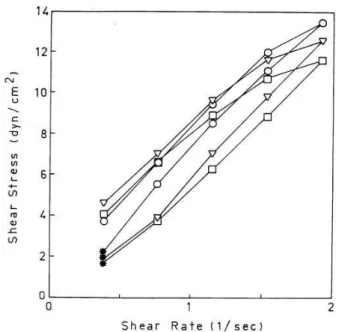
by their rheopeti behavior(Fig. 1). For up urves
only,alternationbetweenadilatantanda
pseudoplas-ti omponent was observed aording to the shear
ratevalue[34℄. Thedilatant/pseudoplastiinterhange
haraterizestheourreneofstruturalvisosity,
usu-allyattributabletoaloalizedinreaseinpartile
on-entration,orto progressivelygreateralignmentrates,
due to ompetitionbetweentheowveloitygradient
andthedisorderingeetofBrownianmotion. Inboth
ases,theobservedbehavioranbeassignedtoa
super-struture breakdown,arisingfrom shearow. It ould
alsobeobservedtoothat,asaonsequeneofthe
sam-plereorientationproess,thedilatant/pseudoplasti
in-terhange is morepronouned when the time interval
betweensuessiverheogramsisinreased[34℄.
Figure 1. Sequeneofrheograms oftheNC mesophase
re-peatedattimeintervalsof:(Æ)initialrheogram;()6min;
(r)23min[34 ℄.
N
D
systems, based on sodium deylsulphate,
sodiumsulphate,n-deanolandwater,alsopresenteda
pseudoplastirheopetibehavior[34℄. Areoverytime
anbelearlyobserved,sineonseutivesequenesare
tionalompetitionbetweenoweetsand
intermiel-larinterationsatingindierentdiretions [34℄.
Figure2. Sequeneofrheogramsofthe N
D
mesophase
re-peatedattimeintervalsof: (Æ)initialrheogram;()9min;
(r)12min[34 ℄.
Studies developed onN
C
systems, based on
dode-ylsulphate,showedthatwhenthesamplewassheared
in an atmosphere without water vapor saturation, an
inrease in the apparent visosity was observed. On
theotherhand,therheograms,obtainedonasaturated
atmosphere, showed a derease in the visosity [61℄.
The same system, holesterized by dierent amounts
of holesterol, showed a tendeny to align the
miel-lardiretion parallel to theowdiretion [62℄. In this
sense, the more ordered the system, smaller are the
resulting shear stresses. It was also possible to
ob-servethat, forholesterisystems,thisorientation
pro-essisminimizedbytheexisteneofhiralinteration,
whih preludes theomplete untwisting of thehelix.
Itwasveriedthat thehighertheindutor
onentra-tion,the largertheshear stressesobtained, indiating
aninreaseinthemiellarinterationfores. Theyield
stressremainsapproximatelythesame,buttheinrease
intheplastibehavioranbeobservedasafuntionof
theholesterolonentration. Itwasalsoobservedthat
inreasingholesteriityleadstoaninreaseinthe
on-sistenyindex,indiatingthatthesystemthatismore
resistant todeformations,i.e, aheliodalarraythat is
morerigidduetoinreasedhiralinterationfores[62℄.
Thestudy ofwaterativitybehaviorin liquid
rys-talswasreportedforlyomesophasebasedonsodium
do-deylsulphate(SLS), deylammonium hloride (DAC)
andpotassiumlaurate(KL)[63℄. Theresultsobtained
forthesesystemsshowedthatSLSmesophasehasmore
amountofaddedsolute, showingthat,aftertheinitial
holesterization of the system, the mielle-solvent
in-teration does not inrease with the helial struture
formation[63℄.
ThesystembasedonDACshowsaredutioninthe
interationforesbetweenthemiellesandthesolvent
aftertheformationofthehelialstruture. Rheologial
data showedthat, thegreaterthe indutor
onentra-tion,thelessertheinterationsbetweenmiellesinthe
system.[63℄.
ThesystembasedonKL showedadereasein the
waterativityonlyifhydrophiliindutorswereadded,
possiblybeauseoftheirhigheronentration. No
dif-ferene dueto theholesterizationitselfwasobserved.
It wasobservedthat the KL systemhas alossof
wa-terrategreaterthanthatoftheDACsystem. However,
bothsystemshavehighlossrates,makingitmandatory
to arryoutrheologialexperimentswith anadequate
ontrol of humidity [63℄. It ould be onluded that
eahsystemhasanuniquebehaviorinrelationtowater
ativity,due,mainly,todierenesinmiellegeometry
andintermiellararrangement,butalsotothefatthat
they are onstituted by dierent amphiphiles that, in
dierent ways, interat with the water moleules and
withthefreeionsin thesolution.
Theourreneof edgefrature onlyotropiliquid
rystalsduringrheologialmeasurementsouldbewell
desribedforsystemsbasedonKL[64℄. Theresults
ob-tainedshowedthattherheologialbehaviorduringthe
initialshearing(beforeanyfraturetookplae)maybe
desribedasnearly Newtonian,although athixotropi
response auses a small separation between the rst
and the seond shearing and between the third and
thefourthshearing. Thethixopropiresponseindiates
that the samples ontainmirodomains, with distint
orientations, that are broken down into a single
do-mainastheshearingproeeds[64℄. Itouldbeveried
toothat atemperatureloweringausestheinreaseof
both theelasti and the visous responses of the
sys-tem,whihmayleadtotheonditionsneessaryforthe
oureneoftheedgefratureduringshearing.
Sues-sive rheograms, performed at dierent temperatures,
(Fig. 3) showed that the frature rst happened the
fthrheogram,wherethedereasingoftheshearstress
to>70s 1
ouldbeobserved. Thesixthrheogram,
per-formedatthesametemperatureasthefth,showedan
additionaldereaseofthestressreadingsaftertheedge
frature,indiatingafurtherpropagation. Ateahnew
temperature, adereasein thefrature shearratewas
observed,indiatingthatthesamplefratureinreased
to agreater extent than that previously observed
ex-tent,i.e,thefratureorientationdidnotrelaxbetween
any tworheograms. The frature is stable during the
timerequiredforanordinaryrheologialmeasurement,
unless the temperature is raised [64℄. Theamount of
shearrateinrementalongarheogramdetermineshow
viousmehanialhistorywouldbe,itbeingmore
sensi-tivethesmallerthesizeoftheinrement. Itwas
possi-bletoreorientatethesampleandtorepeatedlyperform
the frature proedure on the same sample, showing
that the frature thresholdshear rateinreasesas the
samplebeomesmorealigned[64℄.
Figure3. Rheogramsof theLK/KCl/DeOH/H20system:
|5 th
shearing(25.0 o
C); j 6 th
shearing(25.0 o
C);-*-8 th
shearing(22.5 o
C);--9 th
shearing(20.0 o
C);-+-10 th
shear-ing (20.0 o
C);-4- 11 th
shearing (17.5 o
C); -r- 12 th
shear-ing (17.5 o
C);--13 th
shearing(15.0 o
C);-Æ-14 th
shearing
(15.0 o
C)[64 ℄.
The threshold shear rate for the edge frature to
our depends upon the type and degree of the
sam-ple alignment. Nemati lyotropi liquid rystals have
long-rangeorientationalorder. The original struture
wasformedbyseveralmirodomainsandtheregion
be-tweenanytwomirodomainswithdierentorientation
maybeviewedasastrutural defet. Whenthe
sam-pleissheared,aloalstressinreasetakesplaearound
eah ofthese defets [64℄. Part ofthis stress exessis
spentintheformofaplastiwork,aligningthemielles,
while therest ofit mayinitiate afrature. A
ompro-mise betweenthe initiationand thepropagation steps
wasobserved. Thepresene ofdefets is neessaryfor
thefraturetobeinitiatedbutagreatnumberofthem
in theoriginal sampledidnotontributetodereasing
thefratureshearrate[64℄.
Therheologialbehaviorofholesterilyotropi
liq-uidrystalsangiveinformationaboutthehiralfores
involved on the formation of the holesteri
arrange-ment. Theeetoftheseforesontheorientation
pro-ess of a liquid rystal based on DAC and submitted
to a period of shear wasstudied [65℄. Theresults
ob-tained showedthat the holesteri systemaquires an
initialpseudoplastiarrangementthatturnsto
Newto-nian as a funtion of the rest time orthe shear time
(Fig. 4). The orientation proess should involve an
initial stepinvolvingthedestrution ofthe holesteri
struture aused byshear,leadingto theformationof
mirodomains with dierentorientations. In aseond
forming the nalstruture that is quitesimilar to the
nemati one[65℄.
Figure 4. Rheogramsfor theholesteriphasewith 0.09%
molarofholesterol(CDA10): ()1 st
sweep;(Æ)2 nd
sweep
(immediatelyafterrst);(4)10minafter2 nd
;(r)30min
after3 rd
[65 ℄.
ThesameDACsystemwas alsostudied asa
fun-tion of the kind of indutor present in its
omposi-tion. Theresultsobtainedshowedahangeinthe
rhe-ologial behaviordependentonthehiralindutor
na-ture. Phaseswith hydrophobiindutor showeda
vis-osityderease with aninreasein holesterol
onen-tration [66℄, whilean inrease in D-(+)-Mannose
on-entrationleadstoavisosityinrease[67℄.
Changes in the rheologial behavior were also
ob-servedaordingtotheamountofsolventpresentinthe
phase. Forsystemswithholesterolandwithagreated
amountof water,thevisosityinreaseswiththe time
untilreahingamaximumvalue,followedbyaderease.
This behavior indiates that the phases should suer
some kind of deformation before reahing their
maxi-mum tensions. After that,anaommodationproess
of the struture auses a visosity derease [66℄. For
the systems with hydrophobi indutors, and with a
lesser amount of solvent, the visosity dereases to a
minimum value, whih is reahed later as a funtion
of inreasingindutoronentration. Afterthat,there
is aninreasein thevisosityuntil aonstantvalueis
obtained. Thissuggeststheourreneofabreakdown
of the struture, followed by its reorientation by the
ow[66℄.
For DAC systems with D-(+)-Mannose, the
rheo-logial behavior observed is quite similar for phases
with greated or lesser amounts of solvent, i.e., an
in-rease in visosityto amaximum value,followed bya
derease [67℄. The observed dierene is that in
sys-tems with greater amounts of solvent, the maximum
is reahedearlier. Theinreaseinthe visosityshould
haraterize a deformation of the struture with,
af-ter reahingamaximumtension, will beorientatedin
a preferential diretion, ausing aderease in the
vis-osity withoutbreaking down of theholesteri
stru-Theowativationfreeenthalpy(H #
)anbe
de-termined through the variation in the visosity as a
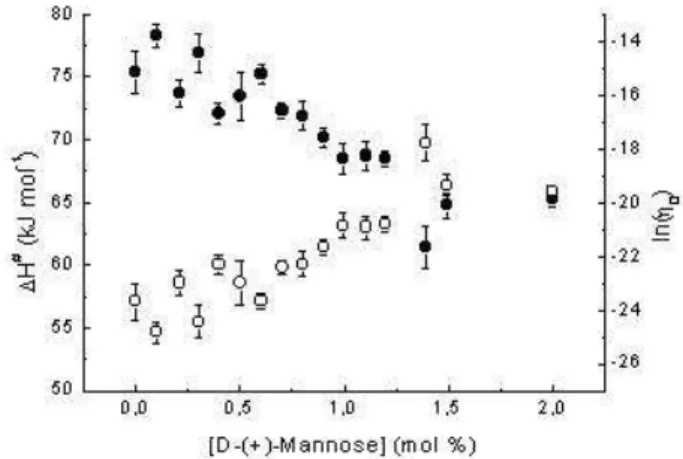
funtionofthetemperature[68℄. SystemsbasedonKL
and holesterized by D-(+)-Mannose showed a H #
dereasewith aninrease in theholesteriityupto a
limitvalueof1%molarofindutor(Fig. 5). Itappears
thatafter themovementofonemielle,theothers are
progressivelydraggedbytheationofthehiral
intera-tion. ApositiveS #
variationwasobservedindiating
theexisteneof aloally transientstatebeingless
or-ganizedduringtheproessofmiellardiusion. Onthe
other hand, aninrease in theindutor onentration
leadstoaderease in theS #
andonsequentlyto a
system,asawhole[68℄.
Figure5.Ativationowenthalpy()andnatural
logarith-miofthepre-exponenialfator(Æ)asfuntionof
D-(+)-mannose onentration. The error bars are the standard
deviationsofthelinearregressionoeÆients[68 ℄.
TheDACsystemsholesterizedbyholesterolshow
aderease in the ow ativation energy as afuntion
ofinreasingindutoronentration[69℄. Ontheother
hand,when D-(+)-Mannosewasused, theow
ativa-tion free enthalpy value inreases. In the systems in
whihahydrophobiindutorisused,thehiralfores
should help in the mielleoworientationproess. It
seemsthat,afterthemovementofonemielle,the
oth-erswould be draggedby elastifores, dereasingthe
ow ativation enthalpy. When a hydrophili
indu-tor is used, ow ativation enthalpy with inreasing
indutor onentration, probably beause the
indu-tornatureallowsagreaterinterationwiththesolvent,
therebyatingasabarrieragainstthemielleow
ori-entation.
After twenty years of researh on holesteri
ly-otropiliquidrystals wean saythat a omplete
un-derstandingoftheholesteristruturestillremainsout
ofreah. Theroutetoaompleteunderstandingofthe
rheologialproperties ofthesesystemsand thefators
responsiblefor themare just startingto beknown. A
lotofworkstillremainstobedonebeforealevelof
Aknowledgements
WeareindebtedtonanialsupportfromFunda~ao
de Amparo a Pesquisa do Estado de S~ao Paulo
(FAPESP).
Referenes
[1℄ R.Reinitzer,Monash.Chem.9,421(1888).
[2℄ O.Lehmann,Z.Physik.Chem.18,273(1889).
[3℄ G.Friedel,Ann.Phys.18,273,(1922).
[4℄ H.Zoher,Trans.FaradaySo.29,945(1933).
[5℄ J.W.MBain,R.D.Vold,andW.J.Jameron,J.Am.
Chem.So.61,30(1939).
[6℄ J.W.MBain,R.D.Vold,andM.Frik,J.Phys.Chem.
44,1013 (1940).
[7℄ J.W.MBainandW.W.Lee,Oil&Soap20,17(1943).
[8℄ J.W. MBainandW.C.Sierihs,J. Am.Chem.So.
25,221(1948).
[9℄ A.Saupeand G.Englert, Phys.Rev.Letters 11,462
(1963).
[10℄ K.B. lawson andT.J. Flautt, J.Am.Chem. So. 89,
5489(1967).
[11℄ L.W. Reeves, F.Y. Fujiwara, and M. Suzuki. ACS.
Symp.Ser.34,55(1976).
[12℄ B.J. Forrest and L.W. Reeves, Chem. Rev. 81(1), 1
(1981).
[13℄ J. Charvolin and B. Mely, ACS. Symp. Ser. 34, 48
(1976).
[14℄ J.Charvolin,NuovoCimento,3-D,3(1984).
[15℄ J.Seeling,Quart.Rev.Byophys.10,353(1977).
[16℄ J.SeelingandA. Seeling,Quart.RevByophys.13,19
(1980).
[17℄ I.C.P. Smith, in NMR of Newly Aessible Nulei,
vol.2, Chemially and Biohemialy Important
Ele-ments, Pierro Lazlo, (Ed. Aademi Press, N. York,
1983).
[18℄ I.C.P.SmithandH.C.Jarrel,A.Chem.Res.16,266
(1983).
[19℄ P.DiehlandA.C.Traey,FEBS.Lett.59,131(1975).
[20℄ K.RadleyandA.Saupe,Mol.Phys.35,1405(1978).
[21℄ M. Aimisand L.W.Reeves,Can. J.Chem.58, 1533
(1980).
[22℄ M.R. Alantara, M.V.M.C. de Melo, V.R. Paoli, and
J.A.Vanin,Coll.Int.Si.93,500(1983).
[23℄ M.R. Alantara, M.V.M.C. de Melo, V.R. Paoli, and
J.A.Vanin,Mol.Cryst.Liq.Cryst. 90,335(1983).
[24℄ M.R. Alantara, M.V.M.C. de Melo, V.R. Paoli, and
J.A.Vanin,Mol.Cryst.Liq.Cryst. 107,303(1984).
[25℄ M.R. Alantara, M.V.M.C. de Melo, V.R. Paoli, and
J.A.Vanin,Mol.Cryst.Liq.Cryst. 107,359(1984).
[26℄ M.R.AlantaraandJ.A.Vanin,Mol.Cryst.Liq.Cryst.
[27℄ T.M.H.Aido,M.R.Alantara,O.FelippeJr.,A.M.G.
Pereira, and J.A.Vanin,Mol. Cryst.Liq.Cryst. 185,
61(1990).
[28℄ T.M.H. Aido,M.R. Alantara, O.FelippeJr. A.M.G.
Pereira, and J.A.Vanin,Mol. Cryst.Liq.Cryst. 195,
45(1991).
[29℄ Y.K.Leong andD.V.Boger, J.Coll.Int. Si.136, 249
(1991).
[30℄ R.J. Hunter, Introdution to Modern Colloid Siene,
(OxfordUniversity,Oxford,1993).
[31℄ G.V.VinogradovandA.Ya.Malkin,Rheologyof
Poly-mers,(MIRPublishers,Mosou,1980).
[32℄ W. Rihetering, J. Lauger, and R. Linemann,
Lang-muir,10,4374-4379 (1994).
[33℄ J. Lauger, R.Weigel, K. Berger, K. Hiltrop, and W.
Rihtering,J.ColloidInterfaeSi. 181,521(1996).
[34℄ M.R. Alantaraand J.A.Vanin,Colloidsand Surf.A
97,151(1995).
[35℄ Zs. Nemeth, L. Halasz, J. Palinkas, A. Bota, and T.
Horanyi,CollandSurf.A145,107-119(1998).
[36℄ R.S.Porter,E.M.Barral,andJ.F.Johnson,J.Chem.
Phys.45,1452 (1966).
[37℄ D.Hantzshel,J.Shulte,S.Enders,andK.Quitzsh,
PCCP Physial Chemistry Chemial Physis 5,
895-904(1999).
[38℄ G.Moltalvo,E.Rodenas,andM.Valiente,J.Coll.Int.
Si.2,232-237(1998).
[39℄ D.J. LyouandS.C. Kim,Polymer Journal3,279-285
(1997).
[40℄ V.A.Prevysh,S.A.Wang,andR.J.Spontak,Colland
PolymerSi.3,284(1997).
[41℄ R.Linemann,J.Lauger,G.Shmidt,andW.
Riheter-ing,RheologialAta5,440(1995).
[42℄ L.WalterandN.Wagner,J.Rheology5,1525(1994).
[43℄ A.D.Rey,J.Chem.Phys.104,4343(1996).
[44℄ C.Smyth,E.D.Kudryashov,andV. Bukin,Colloids
andSurf.A183,517(2001).
[45℄ D.V.Trukhin,O.V.Sinyahenko,V.N. Kazakov, S.V.
Lylyk,A.M.Belokon,andU.Pison,ColloidsandSurf
B21,231(2001).
[46℄ J.L.Eriksen,Appl.MehRev.20,1029(1968).
[47℄ F.M. Leslie, Pro. R. So. London, Ser. A 307, 359
(1968).
[48℄ F.M.Leslie,Adv.Liq.Cryst.4,1(1979).
[49℄ P.G. de Gennes and J. Prost, The Physis of Liquid
Crystals,2 nd
Edition,(OxfordUniversityPress,
Clare-don,1993).
[50℄ E.PeuvrelandP.Navard,Liq.Cryst.7,95(1990).
[51℄ A.D. Rey, J. Non-Newtonian Fluid Meh. 64, 207
(1996).
[52℄ A.D.Rey,J.Rheol.44,855(2000).
[54℄ C.Gallegos, M.Nieto, C.Nieto, andJ.Mu~noz,Progr
ColloidPolymSi.84,236(1991).
[55℄ J.M.Frano,J.Mu~noz,andC.Gallegos,Langmuir11,
669(1995).
[56℄ T. Shikata, H. Hirata, and T. Kotaka, Langmuir 3,
1081 (1987).
[57℄ T.Shikata,H.Hirata,andT.Kotaka,Langmuir4,354
(1988).
[58℄ T. Shikata, H. Hirata, and T. Kotaka, Langmuir 5,
398-405(1989).
[59℄ J.F.A.Soltero,J.E.PuigO.Manero, andP.C.Shulz,
Langmuir11,3337(1995).
[60℄ F.Kern,F.Lequex,R.Zana,andS.J.Candau,
Lang-muir10,1714 (1994).
[61℄ M.R.Alantara,L.C.F.Dias,andJ.A.Vanin,An.
As-so.Bras.Quim.45,47(1996).
[62℄ M.R.AlantaraandL.C.F.Dias,ColloidsandSurf.A
136,155(1998).
[63℄ M.R. Alantara, A.F. deMoura, and E.G. Fernandes
Jr.,MolCryst.Liq.Cyst.333,69(1999).
[64℄ M.R.AlantaraandA.F.deMoura,ColloidsandSurf.
A175,303(2000).
[65℄ M.R.AlantaraandE.G.FernandesJr.,Colloids and
Surf.A177,75(2001).
[66℄ M.R. Alantara and E. G.Fernandes Jr., Mol Cryst.
Liq.Cryst.,inpress.
[67℄ M.R. Alantara and E. G.Fernandes Jr., Mol Cryst.
Liq.Cryst.,inpress.
[68℄ M.R. Alantara, A.F. deMoura, and E.G. Fernandes
Jr.,MolCryst.Liq.Cryst.29(2),191(2002).
[69℄ E.G.FernandesJr.,M.S.Dissertation,Chemistry