Surfae Charge Density Determination in
Eletri Double Layered Magneti Fluids
F.A. Tourinho 1
, A.F.C. Campos 1
, R. Aquino 1
, M.C.F.L.Lara 2
,
G. J.da Silva 2
, and J. Depeyrot 2
1
ComplexFluidsGroup,InstitutodeQumia
Universidadede Braslia,CP 04478,70919-970Braslia(DF),Brazil
2
ComplexFluidsGroup,Instituto deFsia
Universidadede Braslia,CP 04455,70919-970Braslia(DF),Brazil
Reeivedon3Deember,2001
Weanalyzepotentiometriandondutimetrimeasurements,simultaneouslyperformedinseveral
omplexsystems(Bronstedaid-base-type). Theresultsshowanexellentagreementbetween
re-portedandobtainedvaluesofthedissoiationonstantsoftheinvolvedequilibria. Asimilaranalysis
isproposedtoaount,ineletridoublelayeredmagnetiuids(EDL-MF),forthehargingofthe
partilesurfaebasedonaprotontransferproessattheinterfaewiththebulkdispersion. This
modelallowstorelatethepHdependeneofthephasediagramtothevariationsofthenanopartile
surfaehargedensity,whihleadstoausefulmethodtomonitortheolloidalstabilityofEDL-MF.
I Introdution
Eletri Double Layered Magneti Fluids (EDL-MF)
areultrastableolloidaldispersionsofspinelferritetype
nanopartiles eletrostatially dispersed in water [1℄.
The priniple ofstabilization is to ounterbalanethe
van der Waals and magneti dipolar attrations and
thesreenedeletrostati repulsionsbetweenpartiles,
through a proton transfermehanism [2℄, [3℄ between
thebulkdispersionandthepartilesurfae,whih
re-ates an adjustable harge density. Modiations in
the partileinterations induedbyvariationsof ioni
strength[4℄,temperature[5℄ormagnetield[6℄,may
leadtophasetransitions,eitherreversibleas
liquid-gas-like or irreversibleas oulation. Moreover, the
sta-bility of EDL-MF based on maghemite partiles has
beeninvestigatedasafuntion ofpH [7℄atroom
tem-perature and at onstant ioni strength. As the pH
ontrolsthe surfaehargedensity, interpartile
inter-ations also maybe tuned throughpH variationsand
the authors observed athixotropi gel phase between
thesolphaseoneandtheoulationzone.
Very reently, we showed that simultaneous
po-tentiometri andondutimetri measurementsare an
exellent tool to determine the superial density of
hargeinEDL-MF[3℄. Theresultsevidenedthe
EDL-MF systems behave as a mixture of strong aid and
weak diproti, the bulk dispersion and partile
sur-fae, respetively. The surfaehargeof the partiles
is generated through the aquation reations of
super-threekind ofsuperial sites. Theanalysis of
equilib-riainvolved betweenthepartile surfaeand thebulk
dispersion allows to determine the pH dependene of
thesurfaeharge density and toontrolthe olloidal
stability of the magneti sol. Furthermore,
measure-mentsperformedinEDL-MF basedonmanganese
fer-ritenanopartilesoftwodierentdiameteres[8℄showed
thatsurfaehargedensitydependsonthenanopartile
size. Indeed,theexisteneofsurfaedefets insmaller
nanopartilesleadstoareduedsaturationvalueofthe
surfaehargedensity.
Inthepresentwork,ourpotentiometriand
ondu-timetri approahis applied in theaseof wellknown
weakandstrongaidmixturesandthedissoiation
on-stantsinvolvedin suh equilibria are obtained. Then,
usingthesameproedure,theaid-basebehaviorofthe
surfaenanopartileis investigated and thesuperial
density of harge is determined for EDL-MF samples
basedonobalt[3℄andmanganeseferritenanopartiles.
Inthisontext,ourpaperisdividedasfollows. The
se-ondsetionpresentsabriefdesriptionofproton
trans-fermehanismin aid-baseBronstedequilibriaand
re-sultsofsimultaneouspotentiometriand
ondutimet-rititrationsaredisussedin theaseofbothsolution
mixtures of nitri aid with tartari one and with
di-hydrateEDTAsodiumsalt. Inthethirdsetion,based
onphenomenologialonsiderations,weshowhowthe
formalismof omplexequilibria, involving amphoteri
speies, an be applied in the ase of aid-base
harge density. Finally, our titration results are
pre-sentedanddisussed. Asanexample,wewillshowhow
theexisteneof athixotropigel phaseanberelated
tothepH-dependene ofthesurfaehargedensity.
II Strong and weak aids
mix-tures: potentiometri and
ondutimetri approah
II.1 General desription
AtypialpolyfuntionalaidH
n
Ainaqueousmedia
mayundergothefollowingdissoiationreations:
TheonentrationofeahspeiedependsonthepHandan beexpressedusingthetotalmolaronentrations
ofallspeiesC
T
, andthemolarfrationofeahone
n
,wheren denotesthenumberofassoiatedprotons:
[H
n A ℄=
n C
T ;
H
(n 1) A
=
(n 1) C
T ; :::
A n
=
0 C
T
: (4)
Thedenominatorin all
n
valueexpressionstakestheform:
[H
3 O
+
℄ n
+K
1 [H
3 O
+
℄ (n 1)
+K
1 K
2 [H
3 O
+
℄ (n 2)
+:::+K
1 K
2 :::K
n
; (5)
d
whereK
1 ,K
2 ...K
n
arethethermodynamial
equilib-riaonstantsofH
n
AandpK=-logK.Thenumerator
for
0
isthelastterminthedenominator;for
1 itisthe
nexttothelast,andsoforth. Insimpleases,asfor
ex-ampleamixture ofstrongandweakmonoprotiaids,
C
T
and the pK's valuesrelative to the weak aidare
generallyobtainedfrom potentiometrimeasurements.
Thisproedureisbasedonaneutralizationreationin
whih an aid (or a mixture of them) reats with an
equivalent amount of base. By onstruting atypial
titration urve, plotting the pH as a funtion of the
volume of standardbase solution, one andetermine,
from the inexions in the mono(bi)-log behavior, the
stoihiometri points (equivalene points), whih give
thevolumeofstandardbaseorrespondingtothe
neu-tralizationofeah proton. Nevertheless,in theaseof
amixtureofstrongandweak polyprotiaids,thepH
breaks in thetitration urveis notwell dened when
thedierenebetweenthesuessivepK'sisinferior to
4orwhenthepKissuperiorto8[9℄. However,wewill
show, for the rst time in theliterature, that in suh
ases,simultaneouspotentiometriandondutimetri
titrations are an exellent tool to obtain the
equiva-lene points. Then, C
T
is determined using the
equa-tionof massbalane. Moreover,the thermodynamial
onstantsanbeobtainedaordingtothe
Henderson-Hasselbah[10℄equationwhih writes:
pH=pK
n +log
[A n
℄
[HA (n 1)
℄
(6)
in the ase of general equilibrium (3). Thus, when
[HA (n 1)
℄=[A n
℄, thepH isequalto thepK.
II.2 Experimental
II.2.1 Potentiometri and ondutimetri
mea-surements
Thepotentiometridetermination ofasolutionpH
isbasedonthemeasurementofthepotentialdierene
betweenthe ellmadeof aglasseletrodesensitiveto
hydrogenionativityandatypialsilver-silverhloride
Hydrogen Eletrode). The potential of the glass
ele-trode, whih arises due to a omplex proess at the
interfaeof theglass membraneandisproportionalto
the pH, is measured using a potentiostat. The diret
measurement of the pH is obtained after the
alibra-tionoftheapparatusintheaidiandbasipHranges,
using standard buersof pH equal to 4and 7
respe-tively. Theeletrial ondutivity ofa solutionis a
result of theontribution of allhargedspeies in the
medium. Itanbedeterminedindiretlybymeasuring
theorrespondingondutaneofthesolutionandthe
ellonstantwhihdependsonthegeometryofthe
ex-perimentalsetup. Theellonstanthasbeenobtained
bymeasuringtheondutivityofastandardsolutionof
potassiumhloride(KCl)3molL 1
of known
ondu-tivity. Duringthetitrationsthemeasurementsare
per-formed onlyone thesystemreahestheequilibrium.
II.2.2 Mixture of nitriand tartari aids
A solution of tartari aid is mixed with
onen-trated nitriaidin order to obtainasolutionpH
ap-proximatelyequalto 2. Then, using aneletroni
bu-rette Metrohm 715 dosimat, 40 mL of the resulting
mixture is titrated with astandard sodium hydroxide
(NaOH) solution 0.120 mol / L. The potentiometri
readings were performed with a Metrohm 713
poten-tiometer (preision of 0.1 mV or 0.001 units of pH)
with a ombined eletrode(Metrohm 6.0222.100)and
aresistenethermometer(Pt100). Theondutimetri
measurementswerearriedoutusing aondutometer
(Metrohm 712) with an imersion-type measuring ell
(Metrohm6.0901.110). Asaommonproedurein
an-alytialhemistry,alltitrationswererepetedtwotimes.
All reagents used in this work are of analytial grade
from AldrihorMerk.
II.2.3 EDTA Titration
A solution of dihydrate EDTA sodium salt
(Na
2 H
2 Y2H
2
O) is prepared and the pH solution is
adjusted to 4.3. 40 mL of this solution is titrated
withstandardsodiumhydroxide(NaOH)solution0.120
mol/Lusingthesameapparatusdesribedpreviously.
II.3 Results and disussion
II.3.1 Mixture of nitriand tartari aids
Figure 1 exhibits the potentiometri and
ondu-timetri titrations obtained for the mixture of nitri
(strong)andtartari(weak)aidsandshowsthree
dis-tint regions dened by two equivalene points (EP
1
andEP
3
). Themeaningoftheseequivalenepointsan
bedesribed asfollows. Inthe region1,asthetitrant
volume inreases, the ondutivity strongly dereases
until therst equivalenepointEP
1
, due to the
om-pleteneutralizationoffreeH
3 O
+
ions(fromthestrong
byNa +
ionsoflowerspeimolarondutivity
intro-dued bythe titrant. Thus, we assign therst
equiv-alene point to the titration of the nitri aid. The
seond region orresponds to the tartari aid
titra-tion and in this pH range, the ondutivity inreases
slightly due to the apparition of ioni speies in the
medium by neutralisation of the 2protons of tartari
aid. The tartari aid beingdiproti, EP
3
is related
to the neutralization of the seond proton. As it an
beseeninFig. 1,theequivalenepointEP
2
relativeto
the rstproton is not evideneddue to the pK's
val-uesloseonetoanotherandthetitrationoftheseond
protonthereforebeginsbeforetheomplete
neutraliza-tionofthe rstone. Inthe region3, theondutivity
inreasesdue to the exess of base, with a lowerrate
thanthedereaseoneobservedintherstregion,sine
thespei molarondutivityof OH ions issmaller
thanthat ofH
3 O
+
ions. Then, EP
1
and EP
3
are
de-terminedbyusingthetehniqueofgraphialdiretion
lines[11℄andEP
2
anbealulatedbythesemi-sumof
EP
1
and EP
3
, sine thetitrantvolume mustbeequal
to titrateeah proton of thediproti aid. Hene,
ta-ble 1lists thepK
1
and pK
2
values dedued using the
Henderson-Hasselbahequation,inexellentagreement
with reported ones [12℄. One an note that from the
singlepotentiometrimeasurementsitwouldbe
impos-sible to graphially determine pK
1
and pK
2
sine the
rstequivalenepointisnotevidened.
Table1. DeterminedpK'svaluesoftartariaid
titration.
pK
1
pK
2
ThisWork 3:020:15 4:280:22
Reported values[12℄ 3.04 4.37
Figure 1. Simultaneous ondutimetri-potentiometri
titrationurvesof themixtureof nitriandtartari aids.
Theregionindexed1,2and3orrespondtothestrongaid
titration(HNO3), thetartariaidand thebaseexess
re-spetively. EP
1
and EP
3
II.3.2 EDTA Titration
Figure2showsthepotentiometriand
ondutimet-ri titrations obtained in this ase, and, also denotes
three distints regions. The region 1 orresponds to
thetitration oftheweakaidH
2 Y
2
andthe
ondu-tivity slightly dereases. At EP
1
, the H
2 Y
2
speie
is ompletely reated. Then, the seond region
orre-spondsto theHY 3
speie titrationuntilEP
2
leading
totheformationofY 4
speie. Theseresultsshowthat
thesuessivedereasesofthesolutionondutivityare
related to the respetive dereases of the spei
mo-larondutivityofthespeiesH
2 Y
2
,HY 3
andY 4
.
Althoughinthesequeneoftheformedspeiesthenet
hargeinreases,thisouldbeduetothehydrodynami
radiusoftheionwhihislarger,reduingthereforethe
ionmobility. Intheregion3,theondutivityinreases
due to the exessof base, as disussed in the setion
II.3.1.
Figure 2. Simultaneous ondutimetri-potentiometri
titrationurvesofthedihydrateofthe EDTA sodiumsalt
titration. Theregions1and2refertothetitrationofH2Y 2
and HY 3
speies, respetively. Theregion 3orresponds
to the exess of base titrant. The equivalene points are
determinedbythetehniqueofgraphialdiretionslines.
From a quantitative point of view, the dierene
betweenthetwoequivalenepointsEP
1
and EP
2
or-respondstothevolumeoftitranttoneutralizeone
pro-ton (see 10 or 12). Thus, the graphially determined
value of pK
3
and pK
4
of EDTA are listed in table 2
andomparedwithreported ones.
Table2. DeterminedpK
3
andpK
4
valuesofEDTA.
pK
3
pK
4
ThisWork 6:170:15 9:800:40
Reported values[12℄ 6.16 10.30
II.3.3 Partial Conlusions
TheresultspresentedinsetionIIshowthat
simul-taneous potentiometri and ondutimetri
measure-ments are a good tool to quantitatively haraterize
omplexsystems(Bronstedaid-base-type) sineit
al-lowsthedetermination ofthestoihimotripointsand
thehemialequilibriaonstants. Inthefollowing
se-tion,wewillshowthatthesamemeasurementsare
fun-damentaltoinvestigatethemehanismfortheharging
ofthepartilesurfaebasedonaprotontransfer
pro-ess atthe interfaewiththe bulkdispersion. Indeed,
EDL-MFbehaveasamixtureofstrongandweak
dipro-tiaidsandboththedierenebetweenthesuessive
pK'sisinferiorto4andtheseondpKissuperiorto8
[3℄.
III Appliation to EDL-MF
III.1 The Model
Experimentally, it is well known that stables sols
of EDL-MF an be obtained only for aidi or basi
medium. Inneutralmedium,losetothepointofzero
harge (PZC),the systemoulates[13℄. These
phe-nomenologialonsiderationsrevealthepH-dependene
of the surfaeharge density of the partilesand itis
wellknown that at low (high)pH valuesthepartiles
arepositively(negatively) harged. Moreoverin
EDL-MF,the superial partilessites, oupiedby
transi-tionmetals ions,anundergohydrolysisreations[14℄
aordingto theshematiandsimpliedequilibrium:
M
n+
+H
2
O M;H
2 O
n+
(7)
We therefore assume that the following hydrolysis
reations:
are responsible [3,15℄for the formationof the
super-ial harge of thepartiles in the olloidal dispersion.
Insuh model,thepartilesurfaebehavesasa
dipro-ti Bronsted aid, leading to three kinds of surfae
sites wheremostofthem areMOH +
2
instrongaidi
medium, MO in strongbasimedium and MOH,
the intermediate amphoteri sites, in the pH
PZC
for pH <pH
PZC
and negativefor pH >pH
PZC (see
Fig. 3). Wethereforeexpressthesuperialdensityof
hargeas: 0 = F A V( MOH + 2 MO
); (10)
where F is the Faraday onstant, A the total surfae
areaofpartilesis dispersionand Vthevolume ofthe
dispersion. If C
T
is thetotalonentrationof
super-ialsitesand
n
themolarfrationofeahone,wheren
denotesthenumberofassoiatedprotons,(10)writes:
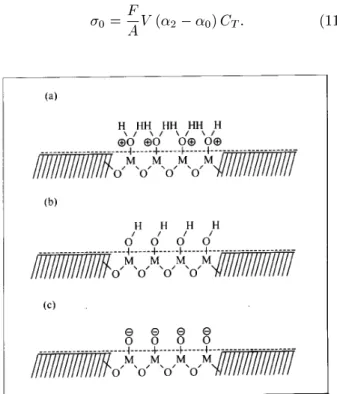
0 = F A V ( 2 0 )C T : (11)
Figure3. Shematidesriptionofthepartilesurfaeasa
funtionofthemedium.(a)referstostrongaidimedium
where the surfaesites are ompletelyprotonated andthe
superialdensityof hargeis saturated. (b)isrelated to
the neutralmedium. Inthisregion,mostofthesuperial
sites are amphoteri and theharge is minimal leadingto
anoulationzone. ()referstothestrongbasimedium.
Thesurfaesitesarenegativelyhargedandthesuperial
density ofhargeissaturated. Inboth(a)and()regions
theEDL-MFisastablesol.
Then, using the relation between the hydronium
onentration and the pH, the surfaeharge density
anbewrittenasafuntion ofpH:
0 = F A V 10 2pH K 1 K 2 10 2pH +K 1 10 pH +K 1 K 2 C T : (12)
Inthepresentwork,C
T
andtheonstantspK
1 and
pK
2
orrespondingtoequilibria(8)and(9)respetively,
are experimentally determined. Moreover, the total
surfae area of partiles an be obtained by using
X-III.2 Experimental
The elaboration of two dierent EDL-MF
sam-ples is arried out using the usual proedure [13℄.
CoFe 2 O 4 and MnFe 2 O 4
oxides nanopartiles are
pre-pared through hydrothermal opreipitating aqueous
solutionsofCo(NO
3 ) 2 -FeCl 3 andMnCl 2 -FeCl 3 ,
respe-tively, inalkalinemedium. Thenthepartilesare
on-venientlypeptized in aidi medium by adjustment of
theionistrength,resultingin stablesolsofhigh
qual-ity.
The mean nanopartile sizes are determined using
X-raysdiration spetrareorded from powder
sam-plesandarefoundequalto12.0nm(CoFe
2 O
4
)and9.0
nm(MnFe
2 O
4
)leadingtoEDL-MF sampleslabeledA
andBrespetively.
Simultaneous potentiometri and ondutimetri
titrations of 40 mL of eah sample (volume fration
A
=1.46%and
B
=0.81%orrespondingto1.7x10 22
and 2.1x10 22
partiles per m 3
, respetively) are
per-formed using titrant solutions of sodium hydroxide
0.106 mol L 1
and 0.088 mol L 1
for samples A and
B,respetively. All titrations are repeated two times.
Simultaneous potentiometriandondutimetri
read-ingsarearriedoutusingapparatusandonditions
de-sribed in setion II.2.2. Moreover our
potentiomet-ri measurements are obtained here using a pH glass
double-juntioneletrode(Metrohm6.0255.100),whih
inludesasalt bridgein orderto avoidthediret
on-tatoftheolloidalsolutiontotheglassmembrane.
III.3 Results and Disussion
Figure4exhibitstypialsimultaneous
potentiomet-ri and ondutimetri titration results obtained for
sample B. These experiments performed in the same
onditionsforsampleAhavebeenpresentedand
om-mented in a previous paper [3℄. The titration urves
obtainedformanganesebasedferrouid(sampleB)
fol-lowthe samequalitative behavior. As in Figs. 1 and
2,theshapeoftheurveindiatesthat EDL-MF
sam-ple behave as a mixture of strong and weak diproti
aids. Three distint regionsan beobserved and
la-beled 1, 2 and 3. The region 1 ends at EP
1 and is
relativetothestrongaidtitration(freeH
3 O
+
ionsof
the bulk dispersion). The seond region orresponds
toaweakdiproti aidtitration,in ourase, the
par-tile surfae. Aording to equilibrium reations (8)
and (9), the orresponding surfaesites MOH +
2 and
MOHaresuessivelytitratedthereforeallowingthe
determinationoftwoequivalenepoints: EP
2
andEP
3 ,
respetively. Until EP
2
, that orresponds to MOH +
2
sites titration, the ontribution of superial protons
tothe totalondutivity is negligibledue to themass
ofthepartiles. Thus,theondutivitysimultaneously
inreasesslightlysinethe onentrationof Na +
from
thetitrantinreases. AtEP
2
be-until EP
3
theseond superial proton is titrated. In
thisregime,averysmalldereaseoftheondutivityis
observed,and ould be assignedto adsorption ofNa +
ions onto the surfae. Finally, the region 3 is related
tothebase exess. Asused insetionII.3.1the
equiv-alene points EP
1
and EP
3
are determined by using
the tehnique of graphialdiretion linesand the
se-ond equivalene point EP
2
an be alulated by the
semi-sumofEP
1
andEP
3
. Then,pK
1
andpK
2 values
areobtainedusingtheHenderson-Hasselbahequation.
Moreover,thewhole superialsitesonentrationC
T
anbedeterminedusingthemassbalane. C
T
andpK
values, aswell astheirreprodutibility errorauray
obtainedforeahsamplearelistedintable3. Then
do-ing
2
=1and
0
=0,orvie-versa,in(11)the
modu-lusofthesaturationvalueofthesurfaehargedensity
max
0
isalulated(seetable 3).
Table3. Tripliate valuesfor sample A[3℄ and B. Total onentrationof superial sites C
T
, pK's valuesof the
weak aid superial sites pK
1
(MOH +
2
) and pK
2
(MOH), saturatedsurfaehargedensity max
0
, pH valueof
isoeletripointandtherespetivereproduibilityerrorsauray.
Sample C
T (molL
1
) pK
1
pK
2 j
0max j(Cm
2
) pH
IEP
0.014 5.3 8.7 0.320 7.0
A 0.015 5.0 8.5 0.337 6.8
(CoFe
2 O
4
) 0.014 5.2 8.6 0.320 6.9
0:0140:001 5:20:2 8:60:1 0:3260:010 6:90:1
C
T (molL
1
) pK
1
pK
2 j
0max j(Cm
2
) pH
IEP
0.015 4.9 9.1 0.271 7.0
B 0.015 4.8 9.1 0.271 7.0
(MNFe
2 O
4
) 0.014 4.9 9.2 0.270 7.1
0:0150:001 4:90:1 9:10:1 0:2710:001 7:00:1
Figure 4. Simultaneous ondutimetri-potentiometri
titrationurvesofsampleB.Theregionsindexed1,2and3
orrespond tothestrongaid titration(bulksolution),the
weak aid MOH +
2
and amphoteri MOH superial
sites titrations and the base exessrespetively. EP1 and
EP3aredeterminedbythetehniqueofgraphialdiretions
lines.
surfaesite
n
alulatedusing(5)isplottedasa
fun-tion of pH for sample B and represents a speiation
diagram whih illustrate the domains of protonation
of surfaesites. Sample B exhibits thesamebehavior
that sampleA [3℄: atlow(high)pH valuesorinaidi
(basi) medium (typially pH 3.5 and pH 10.5,
respetively), the partile surfae is harge saturated.
For small pH ranges around pK values, a domain of
oexistene of harged and neutral sites is evidened.
Closeto theneutralregion, themolarratioofharged
sites strongly dereases and ontrary to the expeted
result, the ferrouid dispersion does not present any
PZCsinethemolarratiooftheamphoterisites does
notreahtheunityvalue. However,anisoeletripoint
(IEP)isfoundandisreadilyrelatedtotheequilibrium
onstants[3,12℄ ofthesurfaesites speies. One the
pKvaluesareknown,theexatpHpositionoftheIEP
an bedeterminedbymeanofpKvalues,aordingto
theHenderson-Hasselbahequationwritteninthease
of equilibria (8) and (9). Table3 lists the alulated
pH
IEP
forsamplesA[3℄andB.
Finally,Figs. 6showthepHdependeneof
0
deter-minedin theaseofsample B.ForextremepH values
(pH 3.5 and pH 10.5)
0
reahes the maximum
and thepartile surfaebeomes saturated. Then,for
ob-surfaehargeisverysmalltoensureasuÆient
repul-sionbetweenpartilesandtheferrouiddispersionsare
notlongerstable.
Figure5. Speiationdiagramofsuperialsitesforsamples
B
n
isthemolarratioofeahsuperialsite,wheren
de-notesthenumberofassoiatedprotons. ForpH=7.0,there
isanisoletripoint.
Figure6. pHdependeneofthesuperialdensityofharge
forsampleB.ForpH<3.5inaidimediumandpH>10.5
inbasione,thenanopartilesarehargesaturatedandthe
ferroui is thermodynamially stable (without onsidering
ionistrengtheets).
Figure7exhibits thethreedierent states(sol,gel
and o) observed [7℄ for maghemite based EDL-MF
diluted solution ( =1.45 %) and weadd to this
ex-perimentalphasediagram,thevariationofthemodulus
ofthesurfaehargedensityobtainedinsamplesA[3℄
andB.Evenifthemagnetiuidssamplesofourstudy
ofreferene7,itanbeobservedthatthepHdependent
phasediagramisstraightlyrelatedwiththehangesof
thesuperialdensityofharge. Asexpeted,whenthe
nanopartileishargesaturatedtheobservedphase is
astable solandforlowvalueof
0
, intheregionlose
to the IEP, the system oulates. Moreover, the
o-inidene,in eitheraidi medium orbasione,of the
gelphasewitharegimeofinitialdereasingofthe
sur-fae harge density has reently been explained by a
hargesharingbetweenpartiles[3℄. Ithasbeenshown
thataprotonhopping(GrotthusMehanism)alongthe
hydrogen-bondnetworkofliquidwateradjaenttothe
partiles an lead to a three dimensional struuture.
Indeed,this polimerization-likeproessresultsin
rel-ativelylong-rangeinterationfores[16℄andisalready
wellknownin manyhydrophiliolloidalsystems.
Figure 7. Modulus of the superial density of harge in
samplesA[3℄()andB(o). Thedashedregions represent
thedierent statesobservedfor amaghemite based
EDL-MF.
IV Conlusions
Simultaneouspotentiometriandondutimetri
titra-tionsisproved tobea usefultoolforthe
understand-ingofthebehaviorofmixturesofstrongandweakaids
whenboththedierenebetweenthesuessivepK'sis
inferiorto 4andtheseondpKissuperiorto8.
More-over,theolloidalstabilityofeletrostatiallystabilized
ferrouiddispersionanbequantitativelyinvestigated
by usingthesesamemeasurements. Fortherst time,
a model for the interfae partile solution, where the
partile surfae behaves as a diproti weak aid and
thebulksolutionasastrongone,isproposedandleads
to saturation value of surfae harge density in good
agreementwith the ommonly reported one. The
ob-tainedresultsallowstorelatethepHdependeneofthe
phasediagramtothevariationsofthenanopartile
Aknowledgement
We aknowledge the Brazilian agenies FAP-DF,
CAPESandCNPq.
Referenes
[1℄ F.A.Tourinho,J.Depeyrot,G.J.daSilva,andM.C.L.
Lara,Braz.J.ofPhys.28,413(1998).
[2℄ J. N. Israelahvili, Intermoleular and Surfae Fores
(AademiPress,NewYork,1985).
[3℄ A.F.C. Campos, F.A. Tourinho, G.J. da Silva,
M.C.F.L. Lara, and J. Depeyrot, Eur. Phys. J.E. 6,
29(2001).
[4℄ J.-C.Bari,R.Perzynski,D.Salin,V.Cabuil,andR.
Massart,J.ofColloidInterf.Si. 132,43(1989).
[5℄ E. Dubois, V. Cabuil, F. Boue, J.-C. Bari, and R.
Perzynski,Progr.ColloidPolym.Si.104,173(1997).
[6℄ J.-C.Bari,R.Perzynski,D.Salin,V.Cabuil,andR.
Massart,J.Magn.Magn.Mater.85,27(1990).
[7℄ E. Hasmonay,A. Bee, J.-C. Bari,and R. Perzynski,
J.Phys.Chem.B103,6421(1999).
[8℄ F.A.Tourinho,A.F.C.Campos, R.Aquino,M.C.F.L.
Lara,andJ.Depeyrot,J.Magn.Magn.Mater.inpress.
[9℄ G.D. Christian, Analytial Chenistry, 4 th
edn. (John
Wiley&Sons,NewYork,1986)p.134.
[10℄ P.W. Atkins, Physial Chemistry, 5th edn. (Oxford
UniversityPress,Oxford,1994)p.301.
[11℄ E.Chromiak,Analyst120,149(1995).
[12℄ D.A.Skoog,D.M.West,andF.J.Holer,Fundamentals
ofAnalytialChemistry,(SaundersCollegePublishing,
Orlando,1996)p.280.
[13℄ F.A.Tourinho,R.Frank,andR.Massart,J.Mater.
Si.25,3249(1990).
[14℄ W.StummandJ.J.Morgan, Aquati Chemistry: An
Introdution EmphasizingChemialEquilibriaIn
Nat-uralWaters,(J.Willey&Sons,NewYork,1981).
[15℄ R.Itri, J. Depeyrot, F.A.Tourinho,and M.H.Sousa,
Eur.Phys.J.E.4,201(2001).
[16℄ H.E.StanleyandJ.Teixeira,J.Chem.Phys.73,3404