Abstract— We present experimental results concerning a new all-optical technique that multiplexes two binary signals into a quaternary one (4-ASK). The technique is based on parametric amplification. Values of the quaternary levels obtained experimentally, as a function of the extinction ratios of the binary input signals, show a rather good agreement with the simulated and the analytical results. The generated 4-ASK signals were propagated through 75 km of standard single-mode fiber and experienced eye penalties of only 0.5 dB. This indicates the robustness of the technique for practical applications in metropolitan area networks.
Index Terms— Optical packets, optical signal processing, parametric amplification, quaternary amplitude-shift keying signal.
I. INTRODUCTION
New network applications, especially those related to video transmission (VOD, video-on-demand),
have strongly increased the demand for broadband Internet [1-3]. Moreover, other new services like
ultrahigh-definition video transmission, high definition TV, digital cinema, e-science, etc. [4,5],
which are presently in their initial stages, tend to become massively deployed in the near future. As a
consequence, not only current Internet users will spend more time online, but also new users will be
lured. This will certainly push the demand for network bandwidth growth in the next years. Such state
of affairs strongly motivates the search for solutions that enable offering higher bandwidths without
changing the current fiber infrastructure.
A very attractive solution in this direction is the development of new all-optical signal processing
techniques. This would avoid the passage from the optical to the electronic domain, making possible
to gain transparency of the pulse length, modulation formats, signal bit rates, etc., which as a whole
will result in higher agility for the optical networks.
Experimental Analysis of All-optical 4-ASK
Signal Generation through Parametric
Amplification
J. D. Marconi,Centro de Engenharia, Modelagem e Ciências Sociais Aplicadas (CECS), Universidade Federal do ABC, Santo André, 09210-170, SP, Brazil
Optics and Photonics Research Center at Unicamp, University of Campinas, 13083-970, Campinas, SP, Brazil.
M. L. F. Abbade,
School of Electrical Engineering, PUC-Campinas, Rod. D. Pedro I- km 136, Campinas, SP, 13086-900, Brazil.
A. L. A. Costa, E. Moschim,
School of Electrical Engineering and Computer Science, Unicamp, Av. Albert Einstein – 400, Cidade Universitária Zeferino Vaz, Distrito Barão Geraldo, 13083-852, Campinas, SP, Brazil.
H. L. Fragnito
One of the aims of all-optical processing is to convert one modulation format into another. For
example, in [6] the conversion of non-return-to-zero to return-to-zero format is approached. In [7] and
[8] all optical techniques to perform analog-to-digital and digital-to-analog all-optical processing are
investigated. Conversion from on-off keying to multi-level signaling is analyzed in [9]. Also different
ways of converting binary amplitude optical signals to quaternary amplitude ones are presented in
[10-13]. A technique based on the parametric amplification to generate quaternary signals by coupling
three lasers, two modulated with a return-to-zero (RZ) modulation format and the third one being a
continuous-wave (cw) laser, was demonstrated in [12]. Recently, another technique also based on
parametric amplification to generate 4-ASK signals by coupling two binary amplitude-shift keying
(2-ASK) signals (two lasers) was presented [15]. However, the analysis performed in [15] comprises
simulation and theoretical results only.
In the present work we show, for the best of our knowledge, the first systematic analysis of
experimental results concerning to the technique presented in [15], which we call parametric
amplification amplitude multiplexing (PAAM). This scheme could be applied not only to enhance the
bit rate of optical channels but also to perform all-optical labeling [15].
The remaining of this work is organized in the following way. Section 2 provides a brief review for
the theoretical principles of parametric amplification and how it can be extended to provide PAAM.
Section 3 presents our experimental and simulation setups. Results are approached in Section 4
whereas our conclusions are described in Section 5.
II. THEORY
Fiber optics parametric amplification is performed by coupling and launching into an optical fiber a
probe signal, at frequency fS, and a high-power un-modulated pump, at frequency fP. In this situation,
illustrated in Fig. 1(a), the fiber acts as a nonlinear medium producing a four-wave mixing interaction
between the probe and the pump signals. The frequencies of the waves involved in this process satisfy
the relation 2fP + fS = fi, where fi represents the frequency of a new wave called idler. When fP is tuned
into the range of frequencies of the anomalous dispersion regime of the fiber, and the pump power is
much higher than the probe signal power, such probe signal experiences a parametric gain given by
= 1 + 02 ℎ 2, (1)
where
0 = , (2)
Fig. 1. Conceptual diagrams for (a) parametric amplification and (b) PAAM. (λk = c/fk, where c is the speed of light, k = P,
S, i represents the pump, the signal and the idler. λ0 is the zero dispersion wavelength of the fiber).
= 2 2− 2 + 2 /2. (3)
In (2) and (3) γ is the non-linear parameter of the fiber, PP is the pump power (considering a lossless
fiber with attenuation coefficient α= 0), L is the fiber length, and ∆β is the propagation constant
mismatch of the FWM process, which can be expressed as
Δ = 2 − 2+ 4
12 − 4, (4)
with ωk = 2πfk (k = P, S), and the coefficients β2(ωP) and β4(ωP) standing, respectively, for the second
and fourth order dispersion coefficients evaluated at ωP. Influence of fiber attenuation may be
considered in (1)- (4) by simply substituting PP by its average value
= = P = 0 1 − e−αL# αL⁄ , (5)
where z is the distance from the fiber input and α is the fiber attenuation coefficient.
In a first approximation, the bandwidth where the parametric gain results of practical interest can be
estimated as the region limited between the two frequencies where the parametric gain is maximum.
These frequencies are given by
max ,min = ± ,2|
2|, (6)
and, then, the gain bandwidth is
ω = max- min = 2,2
| 2|. (7)
Within this region the parameter x is real and the gain varies between Gmin = 1 + x0 2
and Gmax = 1 +
necessary to solve the transcendent equation x2 = sinh2(x) numerically. Outside such a bandwidth, the
parametric gain decreases to values which are not suitable for practical applications.
The performance of parametric amplifiers is generally analyzed for binary probe signals with two
amplitude levels representing bits “0” and “1” [17]-[20]; here, we designate the power of these levels
at the fiber input, respectively, by PS0
( )
0 and( )
01
S
P , and recall that PS0
( )
0 is ideally null.The technique investigated in this paper is illustrated in Fig. 1(b). Its theoretical principle is
essentially the same as the one of parametric amplification, but two new features are added to the
involved signals. The first is that the power of the probe signal is intentionally offset from zero, in
such a way that this signal now presents an extinction ratio (ER):
. = 1 0 / 0 0 , (8)
which no longer is infinity (as in the case of ideal on-off keying signals). The second feature is that
the pump is also modulated with binary information. We denote the powers, at the fiber input, of the
“0” and “1” bits transmitted by the pump as PP0
( )
0 and PP1( )
0 , respectively; and assume that PP0( )
0 is considerably higher than PS1( )
0 .With such modifications, the modulated pump will now provide two amplification factors, GP0 or
1
P
G , depending on whether the pump information is a “0” or “1” bit. Therefore, each of the binary
levels of the signal at fS will experience a lower or a higher gain and will split into two new power
levels at the fiber output. For instance, if the signal at fS is a “1” bit power level, the pump modulation
will split it in two power levels “01” and “11” depending, respectively, if the information carried by
the pump is a “0” or a “1” bit. The same reasoning also holds when the probe signal transports a “0”
bit power level. In this situation, the probe signal at the fiber output will either assume a “00” or a
“10” power level, depending again on whether pump information is a “0” or a “1” bit, respectively.
It is, thus, easy to verify that the power levels of the envelope of the signal at fS and at z = L are
/0100 = 0 0 0 , (9a)
/0101 = 0 1 0 , (9b)
/0110 = 1 0 0 , (9c)
where Poutij indicates the power of the signal at fS and at z = L when the pump and probe signal
transports, respectively, bits i and j (i, j = “0” or “1”) at z = 0. The amplification factors, GP0 and
1
P
G ,
may be obtained from (2) and expressed by
0,1 = 1 + 00,1#2 sinh0,10,1 2, (10)
with
00,1 = 0,1 , (11)
and
0,1= , 2 0,1#2− 2 0,1+ #2 ⁄2. (12)
Equations (9) clearly indicate the generation of a 4-ASK signal which contains information from
both the pump and probe signals. The four-levels of quaternary signals give rise to an eye-diagram
structure with three eyes. In this work, we refer to the eye that involve the two lowest power levels by
using the subscript “low”; analogously the subscripts “int” and “up” are utilized to refer to the eyes
that involve, respectively, the two intermediate and the two higher power levels. With this convention
in mind and considering the case Pout10 ≥Pout01 (
( )
0( )
00 1 1
0
S P S
PP G P
G ≤ ), we obtain the ERs for each of such
eyes as
45/6 = /01 01
/0100 = ., (13a)
4 1 = /0110
/0101 = .
. , (13b)
407 = /0111
/0110 = ., (13c)
where rG is defined as the ER associated with the amplification factors, factors, GP0 or
1
P
G ,
. = 10 . (14)
Analogously, for the case Pout10 ≤Pout01 (
( )
0( )
00 1 1
0
S P S
PP G P
G ≥ ), we obtain the ERs for each of such eyes
45/6 = /0110
/0100 = . , (15a)
4 1 = /0101 /0110 =
.
. , (15b)
407 = /0111
/0101 = . . (15c)
Equations (13) and (15) indicate that the power level distribution of the generated 4-ASK signal
may be adjusted by controlling only two parameters, rS and rG. Therefore, such distribution does not
depend on the powers of the signal at fS (only on its ER), but depend on the powers utilized on the
pump (equations (14), (10)-(12)). This last statement is reasonable considering that in our analytical
model the power of the probe signal is much lower in comparison with that of the pump power;
therefore such powers may be neglected [21]. A possible way for controlling rG is to set values for the
pump average power and for the pump ER.
. = 1 0 / 0 0 .
(16)
We note that (9), (13) and (14) hold even if PP0
( )
0 =0, i.e. if the pump ER is infinity (ideal on-off keying). In fact, in this special case of PAAM,G
P0= 1 and rG1
P
G
≅
. We also note that although thetheoretical model for PAAM (equations (9)-(15)) is intended to work for modulated signals, it is
based on a set of equations ((1)-(5)) that is derived for cw signals [21]. Therefore, a comparison
between this model and experimental results is essential to verify its applicability to practical
situations.
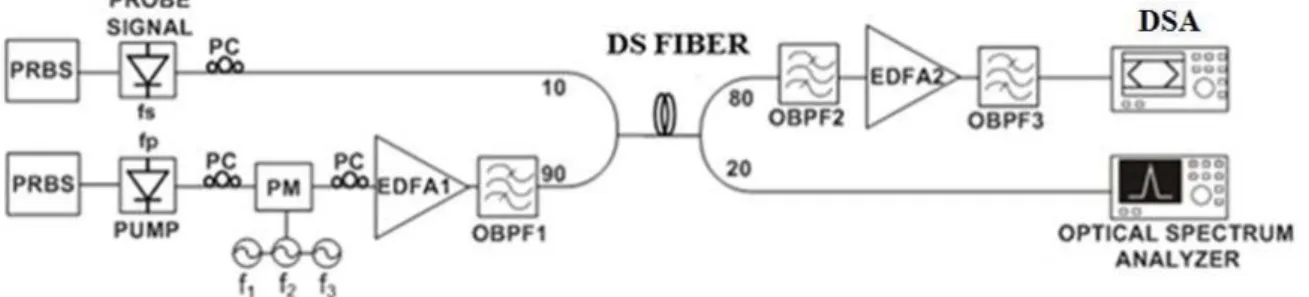
III. EXPERIMENTAL AND SIMULATION SETUPS
The experimental setup is shown in Fig. 2. Two DFB lasers tuned at λP = 1553.5 nm and λS =
1552.2 nm, were used as the pump and the signal, respectively. Here, λk = c/fk, with c representing the
speed of light in vacuum and the index k standing for P or S. The laser signals were directly
modulated at 1 Gb/s with a pseudo-random bit sequence.
The pump linewidth was intentionally broadened by phase modulation to suppress stimulated
Brillouin scattering (SBS). The phase modulator (PM) was driven with three RF signals (frequencies
f1 = 983 MHz, f2 = 601 MHz and f3 = 241 MHz). The pump was filtered with an optical band-pass
filter (OBPF) to suppress most of the amplified spontaneous emission (ASE) from the Erbium-doped
fiber amplifier (EDFA), EDFA1. The pump and the signal were finally coupled with a 90/10 coupler
and launched into a dispersion shifted fiber (DSF) with length L = 7 km, that acted as the nonlinear
medium. Fiber parameters are: attenuation coefficient α= 0.2 dB/km, zero-dispersion wavelength λ0 =
1550.2 nm, zero-dispersion wavelength variation λ0 = 0.08 nm, dispersion slope S0 = 0.074
ps/nm2/km, and nonlinear coefficient γ = 2.1 (W.km)-1. Polarizations controllers (PCs) were used to
align the pump and the signal states of polarization, in order to maximize the parametric gain. The
average power for the pump and the signal at the fiber input were Pp = 20.6 dBm and Ps = -6.3 dBm,
respectively. At the fiber output, an optical coupler delivered part of the power (~20%) of the optical
signals to an optical spectral analyzer (OSA). The other part was transmitted through a link where the
signal at fS was band-selected, amplified, and band-pass filtered to reduce the power of ASE
accumulated in the amplification stage. The eye-diagrams of the resultant 4-ASK optical signal,
whose average power was around 0 dBm, could then be observed in a digital signal analyzer (DSA).
An important goal of our work is to verify if the power levels of the 4-ASK signal may be
explained by the model presented in Section 2. Among other parameters, such evaluation depends on
the ERs of the binary input signals. With the equipment available in our labs, we found that we could
obtain a much more accurate control of these ERs by programming the modulation index of directly
modulated lasers rather than by providing an off-set current to external modulators. For this only
reason, we decided to perform these proof-of-concept tests with direct modulation. Nevertheless, the
analyzed technique should also hold for signals with external modulation and, because of the
femto-second response of parametric amplification [22], with higher bit rates as well. This was in fact
confirmed by the simulations presented in [15].
We analyzed the transmission of this quaternary signal, through a 75 km-long spool of standard
fiber. In this case, the signal was also passed through a -68 ps/nm dispersion compensating fiber and
amplified to recover the 0 dBm average power at the oscilloscope input.
We also performed simulations concerning the generation of the quaternary-amplitude signals. The
used simulation setup is the same as the one utilized for obtaining the experimental data (Fig. 2). In
addition to the experimental parameters reported above, the laser linewidth in the simulations was set
to 30 MHz; this is the maximum value indicated in the manual of the utilized lasers. In order to
perform simulations as similar to the experiments as possible, the phase modulation scheme used
experimentally was also considered in our simulations. This point is particularly important in our case
because, as it is well known, PM induces noise in the level “1” of the binary eye diagrams. As a
λ0 was accounted for by dividing the DSF in 10 segments of equal length and zero-dispersion
wavelength distributed in the range from λ0- λ0/2 to λ0+ λ0/2. The segments were randomly
ordered. In each segment, fiber propagation was handled by solving the non-linear Schrödinger
equation with the split-step Fourier method [23]. All simulations were performed in a commercially
available software program.
IV. RESULTS AND DISCUSSION
A. Spectral analysis
Fig. 3 presents the power spectra for the signal at (a) the fiber input, (b) the fiber output, and (c)
after OBPF3. Fig. 3(b) shows that the signal at fS experienced a loss of 3 dB between the fiber output
and input. As in PAAM we are interested in using the parametric interaction between the pump and
probe signals for allowing the amplitude multiplexing, the absence of a parametric gain is not relevant
in this experiment. The spectrum of Fig. 3(c) shows that after filtering a residual fraction of the pump
remains ~35 dB below of the generated 4-ASK signal at fS. Such ratio could be further improved by
using an additional optical band-pass filter to reduce even more the power of the spectral component
at fP.
Fig. 3. Optical spectra at (a) fiber input, (b) fiber output, and (c) output of the OBPF3.
A comparison between the simulated and the experimental spectra at the fiber output is presented in
Fig. 4(a). Both are very similar for powers higher than -45 dBm. The difference between them resides
in the noise region, which originates from the ASE in the pump Erbium booster amplifier. Depending
on the bandwidth of the band-pass filter there will be more or less noise around the pump that will
also be amplified by the parametric amplifier and cause the mentioned difference. It is observed that fS
is placed within the region of maximum gain, where in conventional parametric amplification (pump
not modulated) the signal performance is not affected by the phase modulation used to suppress the
SBS [16]. However, since the pump is modulated in PAAM, the gain bandwidth attained when the
pump transmits a “1”- bit is larger than the one reached when the pump carries a “0”- bit. For this
reason, in spite of our choice for the position of fs, we can expect that phase modulation will cause
some influence on the optical signal-to-noise ratio (OSNR) performance of the quaternary signal.
It should be noted that the spectra of Fig. 4(a) is, indeed, in an average position between the real
shows the simulated spectra for ‘0’- and ‘1’- bits, respectively (rG = 5). Obviously, such shift cannot
be detected by practical OSA due to the “slow” response of this equipment.
Fig. 4. (a) Experimental and simulated optical spectrum at the fiber output. (b) Spectral difference when the pump carries
the bit “1” and the bit “0” (rG = 5).
B. Time sequence comparison
Fig. 5 illustrates two bit sequences (before amplification) carried by (a) the pump signal, (b) the
probe signal, and (c) the resulting quaternary signal measured at the output of OBPF3. The pump and
probe signal ERs are, respectively, rP= 6.0 dB and rS= 2.6 dB. As expected from the considerations
of Section 2, the signal of Fig. 5(c) presents four well defined power levels. It is also observed that
when the bits of the pump and probe signals are repeated, the same power level of the quaternary
signal is achieved. The delay between the quaternary signals obtained in the results is explained by
noting that the probe signal is slightly delayed from the pump one in the experimental case (but not in
the simulation case).
Time (ns)
P
o
w
e
r
(m
W
)
2 4 6 8 10 12 14
0.0 1.5 3.0 4.5 6.0 0.6 0.9 1.2 0 1 2
3 Experimental
Simulation
0 1 0 1 0 0 1 0 1 0 0 1 0
0 1 1 0 0 1 0 0 1 0 0 0 0
00 11 01 10 00 01 10 00 11 00 00 10 00
(a)
(b)
(c)
Fig. 5. Sequences: (a) binary pump, (b) binary signal before amplification, and (c) quaternary signal after amplification.
C. ERs and comparison to the theoretical model
Fig. 6 shows the values of ρup, ρint and ρlow defined in (13) and (15) as a function of rS. Each graphic
simulated, and the experimental values were plotted. The agreement is rather good in all of the cases
for ρup and ρint. In the case of ρlow there exists a difference between the experimental and the analytical/
simulated values for rS > 6. One can easily see that the greater the value of rG, the larger the difference
between the experiment and the simulation; this difference is always < 1.4 dB and the experimental
ρρρρin t (d B ) ρρρρlo w (d B ) ρρρρu p (d B
) Analytical Simulated
Experimental
r
S(dB)
1 2 3 4 5 6 7 8 9
0.0 2.5 5.0 7.5 0.0 2.5 5.0 7.5 0.0 2.5 5.0 7.5
rG= 3 dB
(a)
10 01
out out
P ≥≥≥≥P 10 01
out out
P ≤≤≤≤P
1 2 3 4 5 6 7 8 9
0.0 2.5 5.0 7.5 0.0 2.5 5.0 7.5 0.0 2.5 5.0 7.5 Simulated Analytical Experimental
rG= 4 dB ρρρρin t (d B ) ρρρρlo w (d B ) ρρρρu p (d B )
r
S(dB)
(b)
10 01
out out
P ≥≥≥≥P 10 01
out out
P ≤≤≤≤P
Simulated Analytical
Experimental
1 2 3 4 5 6 7 8 9
0.0 2.5 5.0 7.5 0.0 2.5 5.0 7.5 0.0 2.5 5.0 7.5 ρρρρin t (d B ) ρρρρlo w (d B ) ρρρρu p (d B )
r
S(dB)
rG= 5 dB
(c)
10 01
out out
P ≥≥≥≥P 10 01
out out
P ≤≤≤≤P
1 2 3 4 5 6 7 8 9
0.0 2.5 5.0 7.5 0.0 2.5 5.0 7.5 0.0 2.5 5.0 7.5 ρρρρin t (d B ) ρρρρlo w (d B ) ρρρρu p (d B )
r
S(dB)
rG= 6 dB
Simulated Analytical Experimental (d) 10 01 out out
P ≥≥≥≥P 10 01
out out
P ≤≤≤≤P
1 2 3 4 5 6 7 8 9
0.0 2.5 5.0 7.5 0.0 2.5 5.0 7.5 0.0 2.5 5.0 7.5 ρρρρin t (d B ) ρρρρlo w (d B ) ρρρρu p (d B ) Simulated Analytical Experimental
r
S(dB)
rG= 7 dB(e)
10 01
out out
P ≥≥≥≥P 10 01
out out
P ≤≤≤≤P
Fig. 6. Values of ρup, ρint and ρlowas a function of rS for: (a) rG = 3.0 dB, (b) rG = 4.0 dB, (c) rG = 5.0 dB, (d) rG = 6.0 dB, and
(e) rG = 7.0 dB.
value is always below that of the simulated ones. Such variation may be explained by the following
4 = 45/64 1407 = . ., (17)
will also be high. Hence, since our measurements were taken for a fixed average power, the power of
level ‘00’ moved to a relatively low value, around ~-10 dBm. Such power level is comparable to the
one generated by the dark current of our oscilloscope. Thus, measurements for ρlow are not as accurate
in this case as the ones for other values of rG.
It is important to explain how the values of rS and rG were measured. To find rS we simply turned
off the pump, transmitted a binary signal at fS and measured the ER of the corresponding eye-diagram
at the DSA. To obtain rG, we used a continuous-wave (cw) at fs and a modulated pump with ER of rP.
As a result, parametric amplification provided two gains to the cw signal and converted it into a
binary signal whose eye diagram could be observed in the oscilloscope. The ER of such signal is
precisely rG.
D. Eye diagrams
Figures 7 and 8 exhibit two sets of three 4-ASK eye-diagrams for the signals at frequency fs. The
levels of the quaternary eye diagrams labeled as “00” and “11” always correspond to the upper and
lower levels of the quaternary pattern, respectively. The intermediate levels may be labeled as “01” or
“10”, depending on the value of the signal extinction ratio rs. For rs = 2.2 dB (see Fig. 7(a)), the
parametric gain obtained by signal level “0” when the pump level is “1” is higher than that obtained
by signal level “1” when the pump level is “0”. Consequently, the second and third power levels of
the quaternary eye diagram correspond to labels “01” and “10”, respectively. The case represented in
Fig 7(b) is obtained when the parametric gain provided by pump level “1” to signal level “0” is equal
to the gain provided by pump level “0” to probe level “1”. In such a situation, rS≈ rG (3.8 dB≈ 4 dB),
so the quaternary signal degenerates into a three-level case that should be avoided.
Fig. 7(c) presents the inverse case of the one shown in Fig. 7(a). Now rS = 6.8 dB > rG, and the gain
provided by pump level “1” to signal level “0” is higher than that provided by pump level “0” to
signal level “1”. Consequently, the power level of the label “10” is lower than that of the power level
of label “01”.
For the two values of rG presented in Figs. 7 and 8, there is a very good agreement between the eye
diagrams obtained through numerical simulations and the ones measured experimentally. Similar
11 10 00 01 Time (ns) P o w e r (m W ) (a) 10 01 out out
P ≥≥≥≥P
Time (ns) P o w e r (m W ) (b) 11
10 = 01
00
10 01
out out
P ====P
Time (ns) P o w e r (m W ) (c) 00 11 10 01 10 01 out out
P ≤≤≤≤P
Fig. 7. Experimental (white circles) and simulated (full lines) eye diagrams for rG = 4 dB, where (a) rS = 2.2 dB, (b) rS = 3.8
dB, and (c) rS = 6.9 dB.
(a) P o w e r (m W ) Time (ns) 11 10 00 01 10 01 out out P ≥≥≥≥P
(b) P o w e r (m W ) Time (ns) 11
10 = 01 00 10 01
out out P ====P
(c) P o w e r (m W ) Time (ns) 00 11 10 01 10 01 out out P ≤≤≤≤P
Fig. 8. Experimental (white circles) and simulated (full lines) eye diagrams for rG = 5 dB : (a) rS = 2.2 dB, (b) rS = 5.1 dB,
and (c) rS = 6.9 dB.
E. Fiber propagation and BER analysis
Finally in Fig. 9 we show the quaternary signal (a) before and (b) after propagation through 75 km
of standard fiber. After the fiber output, an EDFA was used to raise the average power of the
quaternary signal to the same value used in the fiber input (~ 0 dBm). As in the previous eye diagrams
the agreement between experiments and numerical results is very good.
Time (ns) (b) P o w e r (m W ) (a) Time (ns) P o w e r (m W ) 1.8 1.6 1.4 1.0 0.2 0.4 0.6 0.8 1.2
Fig. 9. Experimental (white circles) and simulated (full lines) eye diagrams: (a) before propagation, (b) after a 75 km
standard fiber propagation with rP = 0.86 dB (rG ≈ 2.5 dB), rS = 4.4 dB.
85/6 =92−1
1+92, (18a)
8 1 =93−2
2+93, (18b)
807 =94−3
3+94, (18c)
where in and σn are, respectively, the average and standard deviation of the electric current associated,
after photo-detection, with the n-th power level of the quaternary signal. The experimental and
simulation of such Q-factors are indicated in Table I for before and after fiber propagation.
TABLE I.Q VALUES BEFORE AND AFTER FIBER PROPAGATION.
Before Propagation After Propagation Experiment Simulation Experiment Simulation
qlow 7.4 7.3 6.8 6.4
qint 7.8 7.6 6.9 6.9
qup 12.4 12.2 11.0 11.1
With these values, we find that, after propagation, the experimental Q-factor penalties for the lower,
intermediate and upper eyes are, respectively, of 0.4, 0.5, and, 0.5 dB. These results, which are all
lower than 1 dB indicate that the generated 4-ASK signal presents good robustness for propagation
through lengths that are typical of metropolitan area networks.
Once rG > rS, the power levels correspond, in increasing order of magnitude, to dibits “00”, “01”,
“10”, and “11”. We recall that, in our notation, level “ij” means that bits i and j were originated,
respectively, from the signals at fP and fS. A possible way to recover the binary information of such
signals from the quaternary-amplitude signal is to convert the latter to the electronic domain and use
some logic operations to interpret which bits were sent.
We consider first the logic for recovering the binary signal transmitted by fP from the quaternary
signal of Fig. 9. Since the two lower power levels represent i = “0”, and the two upper power levels
stand for i = “1”, we could use a binary receiver with a threshold current between the two intermediate
power levels. Therefore, assuming that noise obeys a white Gaussian noise distribution, the BER
associated with such a signal may be estimated from
;<=>7 = ? 8 1 , (19)
where
is the complementary error function.
For recovering the binary information conveyed by fS, we observe that the four power levels stand,
in increasing order of power, j = “0”, “1”, “0”, “1” (i.e., consecutive power levels represent alternate
bits). In this case, it is possible to show that the BER is the average of the BERs associated with
lower, intermediate and upper eyes
;<=> = 1 3⁄ F? 85/6 + ? 8 1 + ? 807#G (21)
Using Eq. (18) and the values of Table I, we present in Table II estimations for the BERs before
and after propagation. Experimental results indicate that BERs are lower than 10-13, before
transmission, and lower than 10-11,after fiber transmission. Obviously, such values could be improved
by increasing the average power of the quaternary signal and/or by using optical band-pass filters with
narrower bandwidths. Anyway, for the sake of comparison with other systems, it is important to relate
the BERs presented in Table II with the signal-to-noise ratios of the quaternary signal. Such ratios
may be estimated from the eye diagrams of Fig. 9. Before fiber propagation, the maximum BER of
8.0x10⁻¹⁴ (for the signal at fs) is associated to a 16.6 dB signal-to-noise ratio in the experimental case;
after propagation such values are of, respectively, 7.6x10⁻¹² and 16.1 dB. This 0.5 dB degradation is
possibly caused by fiber dispersion penalties and to the addition of ASE noise by the EDFA used in
the receiver side.
TABLE II.BER ESTIMATION BEFORE AND AFTER FIBER PROPAGATION.
Before Propagation After Propagation Experiment Simulation Experiment Simulation BERfp 1.1x10
-14
1.7x10⁻¹⁴ 7.4x10⁻¹² 3.2x10⁻¹² BERfs 8.0x10⁻¹⁴ 4.8x10⁻¹⁴ 7.6x10⁻¹² 2.8x10⁻¹¹
As an alternative to this electronic detection scheme, it should be noted that the binary signals at fP
and fS could also be all-optically recovered from the quaternary-amplitude signal. This could be
achieved by transmitting this quaternary signal through devices that implement S- and U-shaped
transfer functions [24] or by using other techniques [7] as well.
F. Discussion on optimal power level distribution
The optimal power level distribution for 4-ASK signals depends on the dominant kind of noise and
was analyzed in [25]. If thermal noise is dominant, the power levels of such signal should be
uniformly distributed, i.e. in proportions of 0:1:2:3; this implies an infinite ρlow, ρint= 2.0, and ρup= 1.5.
In case ASE noise is dominant then a quadratic, 0:1:4:9, power level spacing is required, which leads
to ρint= 4.0, ρup= 2.25 and, again, to an infinite ρlow. Equations (13) and (15) show that, regardless of
For instance, in the case described by (15) and dominant thermal noise, one could set rG= 1.5 (1.7 dB)
and rs= 3.0 (4.7 dB) to achieve the previously mentioned optimal values. Similarly, for dominant ASE
noise, such values should be adjusted to rG= 2.25 (3.5 dB) and rs= 9.0 (9.5 dB). However, (13) and
(15) also show that the investigated technique imposes the restriction that ρlow= ρup; therefore, PAAM
is not able to provide the optimal value for ρlow.
A possible all-optical approach to solve this problem is to transmit the 4-ASK signal generated by
PAAM through an optical gate whose ideal transfer function is illustrated in Fig. 10. If the power
levels of the quaternary signal are adjusted to fit the transfer function as also indicated in Fig. 10, the
values of ρint and ρup are unchanged by the optical gate. On the other hand, the power of the lowest
level of the input 4-ASK signal is mapped to a null power value. In this way ρlow achieves the optimal
(infinite) value and the optimal power level distribution is obtained.
In practice, optical gates are implemented by using, for example, one or two stages of FWM [26],
and their transfer functions do not exhibit a linear behavior such as the one presented in Fig. 10.
Anyway, the discussion above remains valid because it is possible to pre-distort the power levels of
the quaternary signal generated by PAAM in such a way that the optimal values of ρint and ρup are
achieved when this signal is transmitted through the optical gate.
Finally, we note that in our experiments we found that the minimum BER after the considered
propagation occurred for rG= 2.5 dB and rs= 4.4 dB (Fig. 9). These values are close to but do not
match the above mentioned values for the dominance of thermal noise. Besides of a finite ρlow, this
difference is also influenced by the contributions of ASE noise and of the noise induced by the pump
phase modulation utilized to prevent SBS.
V. CONCLUSION
For the best of our knowledge, we have presented the first systematic experimental analysis
concerning PAAM. It was shown that our theoretical model presents a very good agreement
(difference lower than 1.4 dB) with experimental results. This is interesting because such model,
(9)-(15), considers a modulated pump but it is based on equations (1)-(5) derived for cw signals.
Therefore, our results also indicate that the conventional equations used for describing parametric
amplification ((1)-(5)) may also hold for modulated signals.
We also observed a good agreement between simulation and experimental results, even for time and
propagation analysis where noise contributions are clearly relevant. Such agreement was possible
because our simulations took into account the pump linewidth enhancement caused by the phase
modulator and also the random variation on the fiber zero-dispersion wavelength.
Our experiment also shows that the 4-ASK signal generated by PAAM may present BERs as low as
7.6 x 10⁻¹² even after propagation through a 75-km long standard fiber. Such value was obtained after
searching for an optimal power level distribution, but it could be certainly improved by utilizing
narrower filters or quaternary signals with higher average powers. The good experimental BER
performance of PAAM reinforce that it could be used in practical applications, at least where length
scales are comparable to the ones of metropolitan area networks (MANs). MANs are, in fact, the kind
of network where PAAM labelling application is relevant [15] and where the simplicity of detecting
intensity-modulated signals is still advantageous over phase-modulated ones [27].
ACKNOWLEDGMENT
The authors thank FAPESP and CNPq for funding this work under processes 574017/2008-9,
309031/2008-7, 142270/2007-5 and 2008/5787-2. The authors also thank to VPI Photonics Inc. for
providing us academic licenses of VPItransmissionMaker 8.5.
REFERENCES
[1] E. Desurvire, “Capacity demand and technology challenges for lightwave systems in the nest two
decades,” J. Lightwave Technol., vol. 24, no. 12., pp. 4697-4710, Dec. 2006.
[2] J. Berthold, A. A. M. Saleh, L. Blair, and J. M. Simmons, “Optical networking: past, present, and
future,” J. Lightwave Technol., vol. 26, no. 9, pp. 1104-1118, May 2008.
[3] A. E. Willner, O. F. Yilmaz, J. Wang, X. Wu, A. Bogoni, L. Zhang, and S. R. Nuccio, “Optically
efficient nonlinear signal processing,” ,” IEEE J. Sel. Top. Quantum Electron., in press.
[4] C. E. Abosi, R. Nejabati, and D. Simeonidou, “A novel service composition mechanism for the
[5] S. Namiki, T. Kurosu, K. Tanizawa, J. Kurumida, T. Hasama, H. Ishikawa, T. Nakatogawa, M.
Nakamura, and K. Oyamada, “Ultrahigh-definition video transmission and extremely green optical
networks for future,” IEEE J. Sel. Top. Quantum Electron., in press.
[6] J. Wang, J. Sun, Q. Sun, D. Wang, M. Zhou, X. Zhang, D. Huang, and M.M. Fejer, “Experimental
observation of all-optical non-return to zero-to-return-to-zero format conversion based on cascaded
second-order nonlinearity assisted by active mode-locking,” Opt. Lett., vol. 32. no. 16, pp. 2462-2464,
Aug. 2007.
[7] S. Oda and A. Maruta, “Two-bit all-optical analog to-digital conversion by filtering broadened and
split spectrum induced by soliton effect or self-phase modulation in fiber,” IEEE J. Sel. Top. Quantum
Electron., vol. 12, no. 2, pp. 307-314, May 2006.
[8] T. Nishitani, T. Konishi, H. Furukawa, and K. Itoh, “All-optical digital-to-analog conversion using
pulse pattern recognition based on optical correlation processing,” Opt. Express., vol. 13. no. 25.
pp.10310-10315, Dec. 2005.
[9] K. Mishina, S. Kitagawa, and A. Maruta, “All-optical modulation format conversion from
on-off-keying to multiple-level phase-shift-on-off-keying based on nonlinearity in optical fiber,” Opt. Express, vol.
15, no. 13, pp. 8444-8453, Jun. 2007.
[10] H. Soto and A. Gutiérrez, “All-optical 2-to-4 level encoder based on cross polarization
modulation in a semiconductor optical amplifier utilized to develop an all-optical 2 input digital
multiplexer,” Opt. Express, vol. 14, no. 20, pp. 9000-9005, Sep. 2006.
[11] M. L. F. Abbade, E. A. M. Fagotto, R. S. Braga, I. E. Fonseca, E. Moschim, and F.R. Barbosa,
“Optical amplitude multiplexing through four-wave mixing in optical fibers,” IEEE Photon. Technol.
Lett., vol. 17, no. 1, pp. 151-153, Jan. 2005.
[12] Porzi, C.; Nguyen, A.T.; Poti, L.; Bogoni, A., “Binary-to-Quaternary ASK Encoding in the
Optical Domain with Semiconductor Optical Amplifiers,” IEEE Photon. Technol. Lett., vol.21, no.10,
pp.654-656, May 2009.
[13] G. T. Zhou, K. Xu, J. Wu, C. Yan, Y. Su, and J. T. Lin, “Self-pumping wavelength conversion
for DPSK signals and DQPSK generation through four-wave mixing in highly nonlinear optical
fiber,” IEEE Photon. Technol. Lett., vol. 18, no. 22, pp. 2389-2391, Nov. 2006.
[14] Y. Liang, P. C. Chui, and K. K. Y. Wong, “Demonstration of an all-optical 2-to-4 level encoder
based on an optical parametric amplifier,” Res. Lett. Opt., vol. 2009, Article ID 981620, Jan. 2009.
[15] M. L. F. Abbade, A. L. A. Costa, F. R. Barbosa, F. R. Durand, J. D. Marconi, and E. Moschim,
“Optical Amplitude Multiplexing through Parametric Amplification in Optical Fibers,” Opt.Comm.,
vol. 283, no. 3, pp. 454-463, Feb. 2010.
[16] J. M. Chavez Boggio, A. Guimarães, F. A. Callegari, J. D. Marconi, and H. L. Fragnito, “Q
penalties due to pump phase modulation and pump RIN in fiber optic parametric amplifiers with
[17] G. Kalogerakis, K. Shimizu, M. E. Marhic, K. K. Y. Wong, K. Uesaka, and L. G. Kazovsky,
“High-repetition-rate pulsed-pumped fiber OPA for amplification of communication signals,” ,” J.
Lightwave Technol., vol. 24, no. 8, pp. 3021-3027, Aug. 2006.
[18] A. Mussot, E. Lantz, A. Durécu-Legrand, C. Simonneau, D. Bayart, H. Maillotte, and T.
Sylvestre, “Simple method for crosstalk reduction in fiber optical parametric amplifiers,” Opt.Comm.,
vol. 275, no. 2, pp. 448-452, Jul. 2007.
[19] J. M. Chavez Boggio, , F. A. Callegari, J. D. Marconi, A. Guimarães and H. L. Fragnito,
“Influence of zerodispersion wavelength varaiations on cross-talk in single-pumped fiber optic
parametric amplifiers,” Opt.Comm., vol. 242, no. 4-6, pp. 471-478, Dec. 2004.
[20] C. Peucheret, M. Lorenzen, J. Seoane, D. Noordegraaf, C. V. Nielsen, L. Gruner-Nielsen, and K.
Rottwitt, “Amplitude regeneration of RZ-DPSK signals in single-pumped fier-optic parametric
amplifer,” ,” IEEE Photon. Technol. Lett., vol. 21, no. 13, pp. 872-874, Jul. 2009.
[21] S. Song, C. T. Allen, K. R. Demarest, and R. Hui, “Intensity-dependent phase-matching effects
on four-wave mixing in optical fibers,” J. Lightwave Technol., vol. 17, no. 11, pp. 2285-2290, Nov.
1999.
[22] A. B. Grudinin, E. M. Dianov, D. V. Korobkin, A. M. Prokhorov, V. N. Serkin, and D. V.
Khaidarov, “Decay of femtosecond pulses in single-mode optical fibers,” JETP Lett., vol. 46, no. 11,
pp. 221-225, Sep. 1987.
[23] G. P. Agrawal, Nonlinear Fiber Optics, 3rd ed. New York: Academic Press, 2001.
[24] E.A. M. Fagotto and M. L. F. Abbade, “All-optical demultiplexing of 4-ASK optical signals with
four-wave mixing optical gates,” Opt.Comm., vol. 283, no. 6, pp. 1102-1109, Mar. 2010.
[25] S. Walklin, J. Conradi, "Multilevel signaling for increasing the reach of 10 Gb/s lightwave
systems," Lightwave Technology, Journal of , vol.17, no.11, pp.2235-2248, Nov 1999.
[26] A. Bogris, D. Syvridis, "Regenerative properties of a pump-modulated four-wave mixing scheme
in dispersion-shifted fibers," Lightwave Technology, Journal of , vol.21, no.9, pp. 1892- 1902, Sept.
2003.
[27] Javier Cano Adalid, “Modulation Format Conversion in Future Optical Networks,” Master