Abstract— This paper presents a computational model of electrons
dynamics and gain in four-level two-electron atomic systems. These systems, submitted to an electromagnetic wave, are governed by Pauli Exclusion Principle and they are modeled using the Time-Domain Transmission Line Matrix (TLM) method with the symmetrical condensed node (SCN) with novel voltage sources. The development of the proposed model is based on the incorporation, in Maxwell’s equations, of the coupled rate equations with Pauli Exclusion Principle, taking into account the dynamic pumping in the TLM formulation. The scattering matrix characterizing the SCN with the new voltage sources is provided and the numerical results are compared with those of the literature or with the theoretical ones.
Index Terms—Atomic media, TLM method, Pauli Exclusion Principle.
I. INTRODUCTION
During the propagation of an electromagnetic (EM) wave in a medium, it can be submitted to three
processes: spontaneous emission, stimulated absorption and emission. These processes contribute,
according to the rate equations, to the evolution of the population densities of electron energy states
during propagation [1]. On the other hand, the space-time evolution of EM waves, during
propagation, obeys Maxwell’s equations, and depends on the macroscopic polarization density owing
to the response of the medium to the EM wave. When the field has a low intensity, the polarization
density is supposed proportional to the electric field intensity. This kind of non-linear interaction
allows the exchange of energy between EM waves and the electrons of the medium. Several papers
have modeled these interactions using FDTD method [2]-[5], in particular the approach based on the
auxiliary differential equation (ADE), to study absorption in two-energy level atomic systems and
gain of four-level systems [2]. By coupling Maxwell’s equations and the rate equations describing
electrons population, this method can model EM wave propagation in random gain media [3]. It was
also used, by including Pauli Exclusion Principle and the dynamic pumping, to study EM wave
Modeling of Electromagnetic Waves
Propagation in Four-Level Two-Electron
Atomic Systems Governed by Pauli Exclusion
Principle Using the TLM Method
H. El Faylali, M. Iben Yaich, M. Khalladi and A. Rafaoui,
Electronic & Microwaves Group Faculty of Sciences, Abdelmalek Essaadi University P. O. Box: 2121, Tetuan 93000 Morocco
interaction with four-level two-electron atomic systems [4] and multi-level multi-electron atomic
systems [5].
The Transmission Line Matrix (TLM) method [6]-[11] was rarely used for modeling this kind of
phenomena, the first approach modeling quantum properties of two energy level atomic systems were
proposed in [8]. In order to explore this field and to contribute to the development of a novel
numerical model using the Time-Domain TLM method with the symmetrical condensed node (SCN),
we have introduced novel voltage sources to this node [9]-[11] by including Pauli Exclusion Principle
and dynamic pumping. This new model describes the space-time evolution of electrons populations’
densities in each energy level and gives the frequency evolution of the gain in the atomic system of
four-level two-electron. Furthermore, the scattering matrix characterizing the SCN with the new
voltage sources is provided and the simulation's results are compared to those of the literature or
obtained by the theoretical solutions.
II. FORMULATION
The propagation of EM waves in atomic systems induces a time depending dipolar moment in the
different atoms [1]. This shows the importance of the dipolar radiation theory which allows to give a
simple interpretation of several phenomena related with EM waves interactions with material in the
classical model. In addition to Maxwell’s equations which govern EM wave propagation in this
medium, it is necessary to take into account the equations of the oscillations due to wave and material
interactions, and also the energy level population rate equations, which allow to predict the number of
electrons in each energy level, coupled with Pauli Exclusion Principle.
A. Macroscopic polarization equations
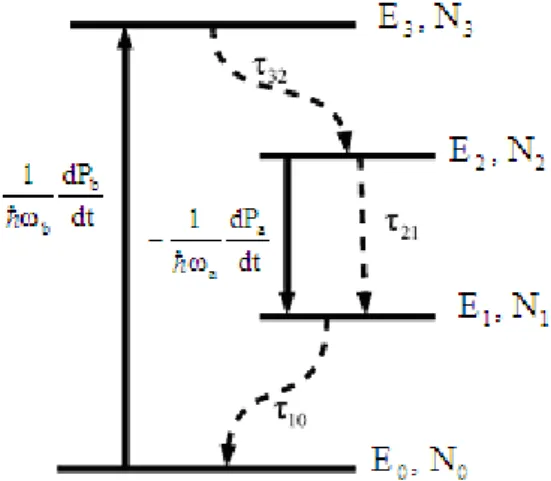
Electron transitions in atomic systems with four energy levels Ei and respective normalized
densities N (i = 0, 1, 2, 3)i are considered as in a simplified model of two oscillating dipoles: Pa for
1
E to E2 transitions with a frequency ωaand Pb for E0to E3 transitions with a pumping frequency
b
ω illustrated in Fig. 1.
The equations of macroscopic polarization are [4]:
2
2
a a
a a a a 1 2
2
2
2
b b
b b b b 0 3
2
d P (t) dP (t)
+ ω + ω P (t) = k (N - N )E(t) dt
dt
d P (t) dP (t)
+ ω + ω P (t) = k (N - N )E(t) dt
dt
(1)
Where
3 0
a 2 ra
a
6 c
k = πε γ
ω ,
3 0
b 2 rb
b
6 c
k = πε γ
ω .
ε0 is the permittivity of free space and ra 21 1 γ
τ
= , rb
30 1 γ
τ
= are the radiative energy decay rates.
a
ω
∆ and ∆ωbare the total energy attenuation rate which describe the spectral line width of the transition taking into account the energy loss by pumping and relaxation effects.
B. Pauli Exclusion Principle
In an atom having many electrons, we must take into account Pauli Exclusion Principle which
forbids two electrons to have the same quantum state. This principle allows to determine electron
distributions in the different energy levels. In a four-level two-electron atomic system, submitted to a
dynamic pumping, this principle appears through the rate equations describing electrons populations’
densities in each energy level by introducing a factor (1-N), where N is the normalized density of the
population in the lower energy level. In this case, the modified rate equations are given by [4]:
3 3 2 3 0 b
32 30 b
3 2 a
2 2 1
32 21 a
1 0 a
1 2 1
21 10 a
0 3 0 1 0 b
30 10 b
dN N (1-N ) N (1-N ) 1 dP
= - - + E
dt τ τ ω dt
N (1-N ) dP
dN N (1-N ) 1
= - + E
dt τ τ ω dt
N (1-N ) dP
dN N (1-N ) 1
= - - E
dt τ τ ω dt
dN N (1-N ) N (1-N ) 1 dP
= + - E
dt τ τ ω dt
ℏ
ℏ
ℏ
ℏ
(2)
Where Niis the normalized density of electrons populations in the energy levels E (i = 0, 1, 2, 3)i and
ij
τ is the life-mean -time of electrons between energy levels Ei and Ej.
C. TLM Model for a Four-Energy-Level Two-Electron Atomic Systems
In order to implement a numerical model for the simulation of the interaction of EM wave with
four-energy level two-electron atomic systems using the TLM method with the SCN and novel voltage
sources, we combine the equations (1) and (2) with those of Maxwell:
a b
0
0
(P (t)+P (t)) E(t)
H
t t
H(t) E
t ε
µ
∂ ∂
∇Λ = +
∂ ∂
∂ ∇Λ = −
∂ (3)
Let’s consider an EM wave propagating in a 3D regular mesh ( x = y = z) , Maxwell’s equations
1 n+
n+1 n n+1 n 2
t t
0 0
1 n+
n+1 n 2
0
1 t
E (i, j, k) = E (i, j, k) - (P (i, j, k) - P (i, j, k)) H (i, j, k) ε
t
H (i, j, k) = H (i, j, k) E (i, j, k)
ε µ ∆ + ∇Λ ∆ − ∇Λ (4)
Where P (i, j, k) = P (i, j, k)t t +P (i, j, k)t .
The TLM approach modeling EM wave interactions with atomic systems governed by Pauli
Exclusion Principle is formulated from the equations given below. In these equations, we have
replaced the EM parameters (E, H) by their equivalent voltages and currents (V, I):
0
V = E. L, I = H. L and V = Z .I∆ ∆ (5)
Where l is the space step and Z0is the intrinsic impedance of vacuum. Thus, the equations (4) become:
1 n+
n+1 n n+1 n 2
t t
0 0
1 n+
n+1 n 2
0
l t
V (i , j, k) = V (i, j, k) - (P (i, j, k) - P (i, j, k)) + l. H (i, j, k)
ε ε
t
I (i, j, k) = I (i, j, k) - l. E (i, j, k)
∇Λ
∇Λ
(6)
The fields (E, H) in the curls of equations (6) are converted into local incident and scattered voltage
pulses Vi and Vr on the faces of the SCN of the TLM Method [6]-[7]. Thus making use of charge and
energy conservation principle through the transmission lines forming the SCN, and imposing the
continuity conditions on the electric and magnetic fields [6], we obtain at time n t the following
scattering matrix of the SCN with voltage sources:
1 2 3 4 5 6 7 8 9 10 11 12
V 0 1 1 0 0 0 0 0 1 0 1 0
V 1 0 0 0 0 1 0 0 0 1 0 1
V 1 0 0 1 0 0 0 1 0 0 0 1
V 0 0 1 0 1 0 1 0 0 0 1 0
V 0 0 0 1 0 1 0 1 0 1 0 0
V 1 0 1 0 0 1 0 1 0 1 0 0 0
V 2 0 0 0 1 0 1 0 1 0 1 0 0
V 0 0 1 0 1 0 1 0 0 0 1 0
V 1 0 0 0 0 1 0 0 0 1 0 1
V 0 1 0 0 1 0 1 0 1 0 0 0
V V r − − − − − − = − − − − − sx 1 sx 2 sy 3 sy 4 sz 5 sz 6 sz 7 sy 8 9 sx 10 sz 11 sy 12 sx
V 0 0
V
V 0 0
V
0 V 0
V
0 V 0
V
0 0 V
V
0 0 V
V 1
0 0 V
V 4
0 V 0
V
V V 0 0
V 0 0 V
V
1 0 0 1 0 0 0 1 0 0 0 1 0 V 0
V
0 1 1 0 0 0 0 0 1 0 1 0 V 0 0
i + − (7)
The obtained matrix models EM wave propagation in an atomic system taking into account the
physical effects related with the medium polarization with the voltage sources (V , V , V )sx sx sx which
n+1 n n+1 n
su su tu tu
0
l
V +V = - (P (i, j, k) - P (i, j, k))
ε (8)
Where u=x, y, z. Pn+1is the medium’s polarization at time tn+1= (n+1) t. Its expressions are deduced
from the time discretization ofequations (1):
n 2
n+1 2 n a n-1 n n u
au 2 a au 2 au a 1u 2u
a 2
n+1 2 n b n
bu 2 b bu 2 bu
b
ω V (i, j, k)
2 t 2 1
P (i, j, k) = ( - ω )P (i, j, k) + ( - )P (i, j, k) + k (N N )
2+ ω t t 2 t t l
ω
2 t 2 1
P (i, j, k) = ( - ω )P (i, j, k) +( - )P
2+ ω t t 2 t t
−
n
-1 n n u
b 0u 3u
V (i, j, k) (i, j, k) + k (N N )
l
−
(9)
The TLM method with voltage sources algorithm implementation is based on a recursive
computation of Paun+1(i, j, k) and Pbun+1(i, j, k) given by the equation (9). This allows to update voltage
sources given by (8), Vn+1(i, j, k) from (6) and to determine the population densities Nn+1i with i=0,
1, 2, 3 given by (2). Local scattered voltage pulses Vr at the SCN are obtained from the scattering
matrix expressed in (7). Finally, we establish connections between nodes along the spatial TLM
lattice.
III. NUMERICAL RESULTS
The proposed model was used to simulate the effect of an incident EM wave on a four-level
two-electron atomic system. This allows to predict the two-electrons dynamic between energy levels by the
modified rate equations, by introducing Pauli Exclusion Principle and pumping dynamic as well as the
incident signal amplification by this system. The physical parameters characterizing this atomic
system of four energy levels E0<E1<E2<E3 with two electrons are [2]:
14 a
ω = 2π.10 rad/s,
16
ωb= 2π.10 rad/s, ∆ωa=∆ωb= 4π.10 rad/s12 , with the electron life-time between energy levels
-10 32
τ = 0,99.10 s, τ21=1,35.10 s-7 , τ10=1.10 s-9 , τ30=1.10-10s, and initial normalized electrons
population densities in the energy level N = N =1 and 0 1 N = 0. The spatial TLM lattice considered is 2
(1,1,1000) l, with l is the mesh width taken to be 3.10-2 m. The atomic system spans the cells
located between 8 l and 208 l in the z direction. The air-system interface is excited first with a
sine wave of amplitude 2.108V/m and frequency 1.1014 Hz. In order to prove the efficiency of the
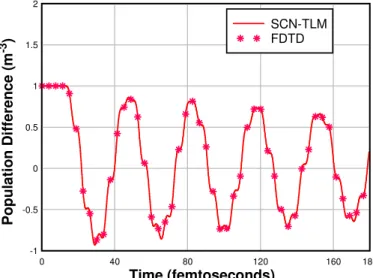
proposed model, we present in Fig. 2 the time evolution of the population difference N12= N -N1 2 at
Time (femtoseconds)
P
o
p
u
la
ti
o
n
D
if
fe
re
n
c
e
(
m
-3 )
0 40 80 120 160 180
-1 -0.5 0 0.5 1 1.5 2
SCN-TLM FDTD
Fig. 2. Comparison of population difference as computedted by SCN-TLM and FDTD methods.
In the beginning of the dynamic pumping, the electrons move from E1 to E0, then to E3 and finally
to E2. The population in level E1 starts to decrease and the population in level E2starts to increase.
The time evolution, of the electrons population densities in the different energy levels, is shown in
Fig. 3.
Time (femtoseconds)
P
o
p
u
la
ti
o
n
s
D
en
si
ti
es
(m
-3 )
0 100 200 300 400 500 600 700 800 -0.2
0 0.2 0.4 0.6 0.8 1 1.2
(a)
N3 N2 N1 N0
Time (femtoseconds)
P
o
p
u
la
ti
o
n
s
D
en
si
ti
es
(
m
-3 )
600 620 640 660 680 700 720 740 760 780 800 0.4
0.44 0.48 0.52 0.56 0.6
(b)
N2 N1
Fig. 3. (a) Time variation of the population densities N0, N1, N2 and N3. (b) The inversion between energy levels E1 and E2.
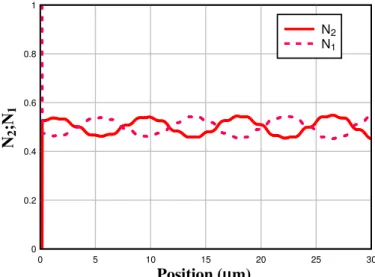
Figure 4 illustrates the space evolution of the population densities after 8000 time step. N1decreases
and N2increases quickly at z = 24.10−2 mwhich corresponds to the air-system interface. Through
the TLM mesh, N1and N2vary slightly about the same limit value 0.5 in the opposite direction,
Position (µµµµm)
N2
;N
1
0 5 10 15 20 25 30
0 0.2 0.4 0.6 0.8 1
N2
N1
Fig. 4. Evolution of the population densities along the TLM mesh after 8000 time step.
In the second part, we have excited the air-system interface using a Gaussian wave of
amplitude 1V/m and frequency 1.10
14Hz [2]. The values of the electric field magnitudes in
the two edges, air-system and system-air, allow to evaluate the amplification factor as shown
in Fig. 5. Here again, the TLM method generates results in very good agreement with those
of [2] and with the theoretical ones [1].
Frequency (10 14 Hz)
A
m
p
li
fi
c
a
ti
o
n
F
a
c
to
r
0.9 0.92 0.94 0.96 0.98 1 1.02 1.04 1.06 1.08 1.1
0.98 0.99 1 1.01 1.02 1.03 1.04 1.05 1.06 1.07
Theory SCN-TLM FDTD
Fig. 5. Comparison of amplification factor versus frequency as computed by theory, FDTD and SCN-TLM methods.
IV. CONCLUSION
We have developed a novel modeling approach for EM wave propagation in four-level two-electron
atomic systems, using the SCN-TLM method, with new voltage sources including Pauli Exclusion
Principle and dynamic pumping coupled with the population rate equations. In order to illustrate the
validity of this novel model combining both classical electrodynamics with quantum mechanics, we
have simulated the electrons dynamic between two energy levels through the variation of populations’
densities by the modified rate equations with Pauli Exclusion Principle, pumping equation and
results and those available in the literature proves its validity and efficiency. Hence, this study
contributes to the widening of the field of the problems treated by the TLM method.
REFERENCES [1] A. E. Siegman, Lasers , CA: Univ. Sci. Books, 1986.
[2] A. S. Nagra, and R. A. York, “FDTD Analysis of wave Propagation in Nonlinear Absorbing and Gain Media,” IEEE Tarns. Antennas and Propagation, vol. 46, no. 3, 1998, pp. 334-340.
[3] X. Jiang, and C. M. Soukoulis, “Time dependent theory for random lasers”, Physical Review Letters, vol. 85, no. 1, 2000, pp. 70-73.
[4] S.H. Chang, and A. Taflove, “Finite-difference time-domain model of lasing action in a four-level two-electron atomic system, ” Optics Express, vol. 12, no. 16, 2004, pp.3827-3833.
[5] H. Yingyan, and Ho. S. Tiong, “Computational model of solid-state, molecular, or atomic media for FDTD simulation based on a multi-level multi-electrons system governed by Pauli exclusion and Fermi-Dirac thermalization with application to semiconductor photonics, ” Optics Express, vol. 14, no. 8, 2006, pp. 3569-3587.
[6] C. Christopoulos, “The transmission–line modeling method TLM,” IEEE Series on Electromagnetic Wave Theory, New York, 1995.
[7] H. Jin, and R. Vahldieck, “Direct derivation of the TLM symmetrical condensed node and hybrid symmetrical condensed node from Maxwell’s equations using centred differencing and averaging,” IEEE Trans. Microwave Theory Tech.,vol. 42, no. 12, 1994, pp. 2554-2561.
[8] J. D. Paul, C. Christopoulos, and D.W.P. Thomas, “Time-Domain Simulation of Electromagnetic Wave Propagation in Two-Level Dielectrics,” International Journal of Numerical Modelling: Electronic Networks, Devices and Fields, vol. 22, no. 2, 2007, pp. 129-141.
[9] M.Iben Yaich, and M. Khalladi, “The far-zone scattering calculation of frequency-Dependent materials objects using the TLM method,” IEEE Trans. Antennas and Propagation, Vol. 50, no. 11, 2002, pp. 1605-1608.
[10]R. Abrini, M. I. Yaich, and M. Khalladi, “Efficient modeling of isotropic cold plasma media using JE-TLM method,”
IEICE Electronic Express, vol. 4, no. 15, 2007, pp. 429-497.