www.jped.com.br
REVIEW
ARTICLE
Physical
activity
and
nutrition
education
at
the
school
environment
aimed
at
preventing
childhood
obesity:
evidence
from
systematic
reviews
夽
Paulo
Henrique
Guerra
a,b,∗,
Jonas
Augusto
Cardoso
da
Silveira
c,
Emanuel
Péricles
Salvador
b,daEscoladeArtes,CiênciaseHumanidades,UniversidadedeSãoPaulo(USP),SãoPaulo,SP,Brazil
bGrupodeEstudosePesquisasEpidemiológicasemAtividadeFísicaeSaúde(GEPAF),UniversidadedeSãoPaulo(USP),
SãoPaulo,SP,Brazil
cDepartmentofPediatrics,UniversidadeFederaldeSãoPaulo(USP),SãoPaulo,SP,Brazil
dDepartmentofPhysicalEducation,UniversidadeFederaldoMaranhão(UFMA),SãoLuís,MA,Brazil
Received9April2015;accepted3June2015 Availableonline9October2015
KEYWORDS Review; Children; Physicalactivity; Nutritioneducation; Overweight; School
Abstract
Objective: Toorganize themainfindings andlistthemostfrequent recommendationsfrom
systematicreviewsofinterventionsdevelopedattheschoolenvironmentaimedatreducing overweightinchildrenandadolescents.
Datasource:Searches for systematic reviewsavailable until December 31,2014 were
con-ducted in fiveelectronic databases: Cochrane, PubMed, SciELO, SPORTDiscus, andWeb of Science.Manualsearchforcross-referenceswerealsoperformed.
Summaryofthefindings: Oftheinitial2139references,33systematicreviewsadequatelymet
the inclusion criteria and were included inthe descriptive summary. In thisset, interven-tionswithperiodsoftimegreaterthansix monthsinduration(nine reviews),andparental involvementinthecontentand/orplannedactions(sixreviews)wereidentifiedasthemost frequentandeffectiverecommendations.Additionally,itwasobservedthatboysrespondmore effectivelytostructuralinterventions,whereasgirlsrespondtobehavioralinterventions.None oftheincludedreviewswasabletomakeinferencesaboutthetheoreticalbasisusedin inter-ventionsas, apparently, thoseinchargeoftheinterventionsdisregardedthiscomponent in theirpreparation.
夽
Pleasecitethisarticleas:GuerraPH,SilveiraJA,SalvadorEP.Physicalactivityandnutritioneducationattheschoolenvironmentaimed atpreventingchildhoodobesity:evidencefromsystematicreviews.JPediatr(RioJ).2016;92:15---23.
∗Correspondingauthor.
E-mail:[email protected](P.H.Guerra).
http://dx.doi.org/10.1016/j.jped.2015.06.005
Conclusions: Althoughthesummaryidentifiedevidencewithimportantapplicationsintermsof publichealth,therearestillgapstobefilledinthisfieldofknowledge,suchastheeffectiveness ofdifferenttheoreticalmodels,theidentificationofthebeststrategiesinrelationtogender andageofparticipantsand,finally,theidentificationofmoderatingvariablestomaximizethe benefitsprovidedbytheinterventions.
©2015SociedadeBrasileiradePediatria.PublishedbyElsevierEditoraLtda.Allrightsreserved.
PALAVRAS-CHAVE Revisão;
Crianc¸as; Atividadefísica; Educac¸ãonutricional; Sobrepeso;
Escola
Aatividadefísicaeaeducac¸ãonutricionalnoambienteescolarvisandoaprevenc¸ão
daobesidadeinfantil:evidênciasderevisõessistemáticas
Resumo
Objetivo: Organizaros principaisachadose elencar asrecomendac¸ões maisfrequentesdas
revisõessistemáticasdeintervenc¸õesdesenvolvidasnoambienteescolarcomfinsnareduc¸ão doexcessodepesoemcrianc¸aseadolescentes.
Fontedosdados: Buscas porrevisões sistemáticas disponíveis até31 de Dezembro de2014
foramrealizadasemcincobasesdedadoseletrônicas:Cochrane,PubMed,SciELO,SPORTDiscus, eWebofScience.Buscasmanuaisporreferênciascruzadastambémforamdesenvolvidas.
Síntesedosdados: Das2.139referênciasiniciais,33revisõessistemáticasresponderam
ade-quadamente aos critérios de inclusão e compuseram a síntese descritiva. Neste conjunto, identificou-secomorecomendac¸õesmaisfrequenteseefetivasintervenc¸õesquepossuem perío-dosdetempo superior aseismesesde durac¸ão(9 revisões),eoenvolvimentodospaisnos conteúdose/ouac¸õesprevistas(6revisões).Alémdisso,observou-sequemeninosrespondem deformamaisefetivasasintervenc¸õesestruturaisenquantoasmeninasàsintervenc¸ões compor-tamentais.Demodoconsistenteentreasrevisõesincluídas,nenhumadelasconseguiurealizar inferênciassobreabaseteóricautilizadanasintervenc¸ões,umavezque,aparentemente,os responsáveispelasintervenc¸õesdesconsideraramessecomponenteemsuaelaborac¸ão.
Conclusões: Emboraasíntesetenha identificadoevidências comaplicac¸ões importantesem
termosdesaúdecoletiva,aindaexistemlacunasaserempreenchidasnessecampodo conheci-mento,taiscomoaefetividadedediferentesmodelosteóricos,oreconhecimentodasmelhores estratégiasemrelac¸ãoaosexoeaidadedosparticipantese,porfim,aidentificac¸ãodevariáveis moderadorasparapotencializarosbenefíciosproporcionadopelasintervenc¸ões.
©2015SociedadeBrasileiradePediatria.PublicadoporElsevierEditoraLtda.Todososdireitos reservados.
Introduction
Inchildren and adolescents,the high prevalence of over-weight observed in different parts of the world1 has reinforcedtheneed toimplementnew preventive strate-gies,highlightingtheimportantroleofphysicalactivity(PA) andnutritioneducation(NE).2
Researchers and health professionals agree on the school’spotentialasafavorableplaceforthedevelopment ofinterventions thatinvolve practicesand contents inPA and/or NE, considering some advantages offered by this environment,forinstance,the scopeofactions;thelarge numberofstudentsreceivingthesamestimulusatthesame time;thecontinuityofthestrategiesovertime,duetothe permanenceofchildrenand/oradolescentsinschools;and thepossibilityofbothstructuralandoperationalchanges.2---4 As a result of this consensus, the scientific literature has received reports of a large number of interventions developedin the schoolenvironment withthe purposeof preventing and/or reducing child obesity after the early 2000s,5whichfavoredthedevelopmentofthefirst system-atic reviews on the subject.6---8 However, apart from the
associatedgoals, itisnoteworthythat thesereviewshave conflictingandinconclusiveresults,mostlyduetothegreat variability ofthe methods employedinthe original publi-cations (e.g., theoretical basis, time of duration, actions developed), as well as due to the type and number of assessedstudies.5,9
Aiming to correct these uncertainties, other system-aticreviewswereconducted,seekingtoprovideplausible explanations for the high variability among the original results,10---12 increasing the number of correlated reviews with discordant results, which probably has limited their acceptanceinpractice,aswellastheirimplementationas publicpolicy.Conversely,whilethedebateonthe inconclu-siveresultsofthesereviewswasexpanded,theconfirmation ofthecommonevidenceofthesereviewswasrelegatedto thebackground.Inpracticalterms,forschoolprofessionals, theseevidencecouldguidethedesignandimplementation ofnewinterventions,aimedatpreventingchildhood over-weight.
interventionsdevelopedattheschoolenvironmentwiththe purposeofreducingoverweightinchildrenandadolescents.
Methods
Eligibilitycriteria
Forthesummarycomposition,theauthorssoughtsystematic reviewsofinterventionstudieswhosestrategieswere devel-opedintheschoolenvironment,aimingatpreventingand/or reducingoverweightinchildrenand/oradolescents. Inter-ventionscouldincludetheoreticaland/orpracticalcontents ofPAand/orNE.
Narrativereviews,essays,overviews,andmeta-analyses werenotincluded.Specifically,thenon-inclusionof meta-analysesaimedtoimprovethecomparabilitybetween the resultsofsystematicreviews,whichhaveamoredescriptive approach.Reviewspublishedinorientallanguageswerenot includedeither,duetothedifficultyofaccessand transla-tion.
Searchstrategies
Two strategies were used for retrieving references of interest:(i)systematicsearchesinfiveelectronicdatabases (Cochrane, PubMed, SciELO, SPORTDiscus, Web of Sci-ence), using a previous referential model adapted to eachdatabase5:(school)AND(physicalactivity) OR (phys-ical education) OR (exercise) OR (physical fitness) OR (sports) OR (nutrition) OR (nutritional science) OR (child nutrition sciences) OR (nutrition education) OR (diet) OR (energy intake) OR (energy density) OR (calories) OR (calorie)OR(food)OR(fruit)OR(vegetable))AND((weight) OR (obese) OR (overweight) OR (weight reduction) OR (anthropometric) OR (anthropometry) OR (nutritional
status) OR (nutrition assessment) OR (body mass index) OR (BMI) OR (body weights and measures) OR (waist cir-cumference) OR(adiposetissue))ANDrevieworoverview or meta-analysis or metanalysis and (ii) manual searches for references in the individual collections of articles by eachauthor,aswellasbyidentifyingcross-references.This research included studies published until December 31, 2014.
Selection,extractionandsynthesisofdata
One reviewer (PG) processed the data in three phases: (i) conference and removal of duplicates among the databases;(ii)titleand abstractreading, whereallworks characterizedasreviewswereincluded;(iii)dataextraction andpreparationofthedescriptivesummary.
Results
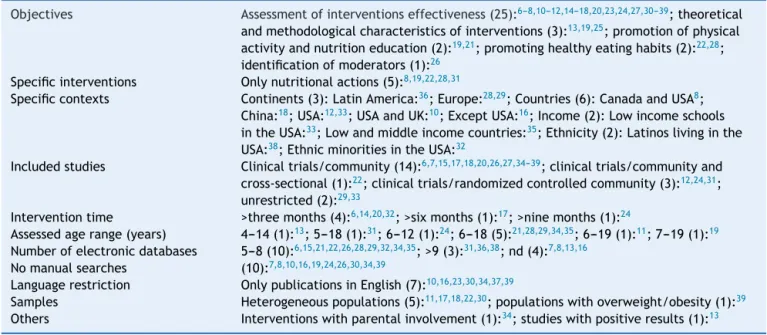
The electronic and manual searches retrieved 2139 rele-vantreferences, whichwereevaluatedbytheir titlesand abstracts.Afterthisphase,156remainedandwere evalu-atedregardingthefulltext;amongthese,only33reviews adequatelymettheeligibilitycriteria,andwerethenused toconstitutethedescriptivesummary(Fig.1).6---8,10---39
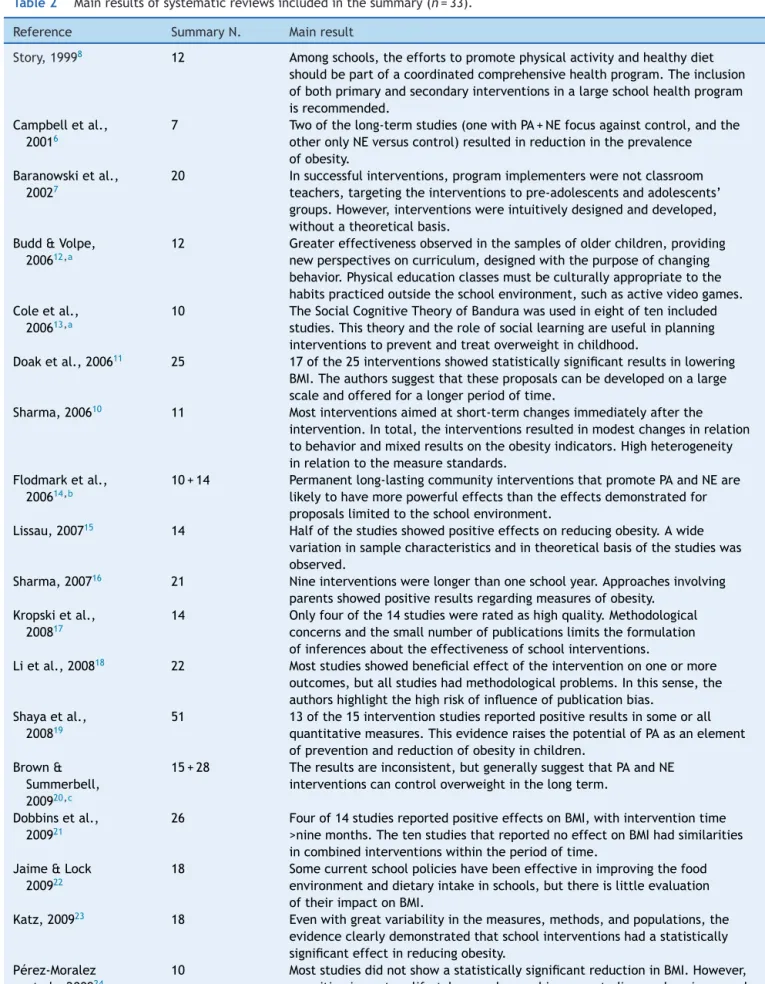
Among the papers included in thissystematic reviews, 25 assessed the effectiveness of interventions con-ducted at schools aiming at obesity prevention and/or control.6---8,10---12,14---18,20,23,24,27,30---39 Even though manyof the reviews recovered data from different anthropometric measures in their respective summaries, most of the interventionssought changes in body mass index. In four publications,obesitywasverifiedasasecondary outcome (Table1).19,21,22,28Regardingthegeographicalaspect,eight reviews restricted their goals to interventions developed
Electronic searches in five databases (n=2381)
Cochrane; PubMed; SciELO; SPORTDicus; web of science
Removing duplicates between databases (n=251)
Assessment by titles and abstracts (n=2130)
Manual searches (n=9)
Articles excluded in the assessment by title and abstract (n=1983)
Full text assessment (n=156)
Articles excluded in the full text assessment (n=123)
Data extraction and descriptive summary (n=33)
Table1 Methodologicalcharacteristicsoftheincludedsystematicreviews(n=33).
Objectives Assessmentofinterventionseffectiveness(25):6---8,10---12,14---18,20,23,24,27,30---39;theoretical
andmethodologicalcharacteristicsofinterventions(3):13,19,25;promotionofphysical
activityandnutritioneducation(2):19,21;promotinghealthyeatinghabits(2):22,28;
identificationofmoderators(1):26
Specificinterventions Onlynutritionalactions(5):8,19,22,28,31
Specificcontexts Continents(3):LatinAmerica:36;Europe:28,29;Countries(6):CanadaandUSA8;
China:18;USA:12,33;USAandUK:10;ExceptUSA:16;Income(2):Lowincomeschools
intheUSA:33;Lowandmiddleincomecountries:35;Ethnicity(2):Latinoslivinginthe
USA:38;EthnicminoritiesintheUSA:32
Includedstudies Clinicaltrials/community(14):6,7,15,17,18,20,26,27,34---39;clinicaltrials/communityand
cross-sectional(1):22;clinicaltrials/randomizedcontrolledcommunity(3):12,24,31;
unrestricted(2):29,33
Interventiontime >threemonths(4):6,14,20,32;>sixmonths(1):17;>ninemonths(1):24
Assessedagerange(years) 4---14(1):13;5---18(1):31;6---12(1):24;6---18(5):21,28,29,34,35;6---19(1):11;7---19(1):19
Numberofelectronicdatabases 5---8(10):6,15,21,22,26,28,29,32,34,35;>9(3):31,36,38;nd(4):7,8,13,16
Nomanualsearches (10):7,8,10,16,19,24,26,30,34,39
Languagerestriction OnlypublicationsinEnglish(7):10,16,23,30,34,37,39
Samples Heterogeneouspopulations(5):11,17,18,22,30;populationswithoverweight/obesity(1):39
Others Interventionswithparentalinvolvement(1):34;studieswithpositiveresults(1):13
inspecific countriesorcontinents, suchasLatin America, Canada, China, United States, Europe, and the United Kingdom.8,10,12,18,28,29,32,36Conversely, other reviews sought toassess theroleofinterventionsinspecific groups,such asthosedeveloped in populations withoverweight,39 low socioeconomicstatus,33,35 andspecific ethnicities,suchas the publication that aimed to determine the effects of interventionsdirected tochildren of Hispanicorigin living intheUSA.38
Table 1 also shows that six reviews established cut-off points for the duration of the interventions, seeking strategies that were developed for minimum periods of three,6,14,20,32 six,17 and nine months.24 Eight reviews sought original articles specifically reported in English.10,16,23,25,30,34,37,39However,itisnoteworthythatonly one of these reviews focused specifically on studies con-ductedincountrieswhoseofficiallanguageisEnglish,i.e., theUnitedKingdomandUnitedStates.10Additionally,there wasahighheterogeneityconcerningthesearchmethodsin thescientificliteratureinrelationtothenumberofsearched databases(rangingfromoneto14),useofmanualsearches (n=23),andyearofpublication(23usedarticlespublished after1990).
Table2shows thattheoldestsystematic reviewinthis summarywaspublishedin1999.8However,anincreaseinthe frequencyofreviewspublishedfrom2006onwards(n=30; 91.8%)wasobserved10---39;2009wastheyearwiththe high-estnumberof publications (n=6; 21.1%).20---25 Also,it was observedthat,after2006,atleasttwocorrelated system-aticreviewswerepublishedannually.Asaconsequenceof thedifferentmethodologicaloptions,theselectedreviews showed great variability in the number of included arti-cles,withaminimumoffive34andmaximumof51original studies.19
Regardingthemostfrequent recommendations,Table2 indicates that nine reviews highlighted the effective-ness of interventions with a duration of at least six months.6,11,14,16,20,21,27,31,36 Six reviews also showed the importanceoftheinvolvementofparentsand/orguardians
in intervention strategies.16,25,30,31,34,39 One review17 demonstratedthatgendercouldbeakeydifferentiatorfor strategyeffectiveness:structuralinterventionsweremore effective on boys, whereasbehavioral interventions were moreeffectiveingirls.Finally,thefollowinginconsistencies wereobservedinafew studies:(i)adequacy ofstrategies accordingtothedifferentagegroups7,12(ii)implementation of strategies by teachers7,30,36; (iii) theoretical basis of interventions13,15; (iv) inclusionofstrategies in theschool curriculum31; and (v) methodological quality of available interventions.17,18,35
Discussion
This summary was based on data from 33 systematic reviews of interventions developed at the school envi-ronment aimed to prevent and/or reduce overweight. A large number of publications recommended the development of continued strategies with at least six months of duration,3,6,11,14,16,20,21,27,31 and that included parents/guardians in the planned contents and/or actions.16,25,30,31,34,39
Duration
of
interventions
The evidenceassessedinthissummaryshowedthe impor-tance of the time variable for interventions to promote positivechangesinthepracticeofPAand/orintheimpact ofNEontheconsumptionoffruitsandvegetables,resulting inadecreaseinoverweight.
Table2 Mainresultsofsystematicreviewsincludedinthesummary(n=33).
Reference SummaryN. Mainresult
Story,19998 12 Amongschools,theeffortstopromotephysicalactivityandhealthydiet
shouldbepartofacoordinatedcomprehensivehealthprogram.Theinclusion ofbothprimaryandsecondaryinterventionsinalargeschoolhealthprogram isrecommended.
Campbelletal., 20016
7 Twoofthelong-termstudies(onewithPA+NEfocusagainstcontrol,andthe otheronlyNEversuscontrol)resultedinreductionintheprevalence ofobesity.
Baranowskietal., 20027
20 Insuccessfulinterventions,programimplementerswerenotclassroom teachers,targetingtheinterventionstopre-adolescentsandadolescents’ groups.However,interventionswereintuitivelydesignedanddeveloped, withoutatheoreticalbasis.
Budd&Volpe, 200612,a
12 Greatereffectivenessobservedinthesamplesofolderchildren,providing newperspectivesoncurriculum,designedwiththepurposeofchanging behavior.Physicaleducationclassesmustbeculturallyappropriatetothe habitspracticedoutsidetheschoolenvironment,suchasactivevideogames. Coleetal.,
200613,a
10 TheSocialCognitiveTheoryofBandurawasusedineightoftenincluded studies.Thistheoryandtheroleofsociallearningareusefulinplanning interventionstopreventandtreatoverweightinchildhood.
Doaketal.,200611 25 17ofthe25interventionsshowedstatisticallysignificantresultsinlowering
BMI.Theauthorssuggestthattheseproposalscanbedevelopedonalarge scaleandofferedforalongerperiodoftime.
Sharma,200610 11 Mostinterventionsaimedatshort-termchangesimmediatelyafterthe
intervention.Intotal,theinterventionsresultedinmodestchangesinrelation tobehaviorandmixedresultsontheobesityindicators.Highheterogeneity inrelationtothemeasurestandards.
Flodmarketal., 200614,b
10+14 Permanentlong-lastingcommunityinterventionsthatpromotePAandNEare likelytohavemorepowerfuleffectsthantheeffectsdemonstratedfor proposalslimitedtotheschoolenvironment.
Lissau,200715 14 Halfofthestudiesshowedpositiveeffectsonreducingobesity.Awide
variationinsamplecharacteristicsandintheoreticalbasisofthestudieswas observed.
Sharma,200716 21 Nineinterventionswerelongerthanoneschoolyear.Approachesinvolving
parentsshowedpositiveresultsregardingmeasuresofobesity. Kropskietal.,
200817
14 Onlyfourofthe14studieswereratedashighquality.Methodological concernsandthesmallnumberofpublicationslimitstheformulation ofinferencesabouttheeffectivenessofschoolinterventions.
Lietal.,200818 22 Moststudiesshowedbeneficialeffectoftheinterventionononeormore
outcomes,butallstudieshadmethodologicalproblems.Inthissense,the authorshighlightthehighriskofinfluenceofpublicationbias.
Shayaetal., 200819
51 13ofthe15interventionstudiesreportedpositiveresultsinsomeorall quantitativemeasures.ThisevidenceraisesthepotentialofPAasanelement ofpreventionandreductionofobesityinchildren.
Brown& Summerbell, 200920,c
15+28 Theresultsareinconsistent,butgenerallysuggestthatPAandNE interventionscancontroloverweightinthelongterm.
Dobbinsetal., 200921
26 Fourof14studiesreportedpositiveeffectsonBMI,withinterventiontime >ninemonths.ThetenstudiesthatreportednoeffectonBMIhadsimilarities incombinedinterventionswithintheperiodoftime.
Jaime&Lock 200922
18 Somecurrentschoolpolicieshavebeeneffectiveinimprovingthefood environmentanddietaryintakeinschools,butthereislittleevaluation oftheirimpactonBMI.
Katz,200923 18 Evenwithgreatvariabilityinthemeasures,methods,andpopulations,the
evidenceclearlydemonstratedthatschoolinterventionshadastatistically significanteffectinreducingobesity.
Pérez-Moralez etal.,200924
Table2(Continued)
Reference SummaryN. Mainresult
Zenzen&Kridli, 200925,a
16 NEwasshowntobeaneffectivemethodinchangingeatinghabits atschool.Aprogramthatincludesthepromotionofhealthylifestyle supportedbystrongparentalinfluenceisalsocrucial.
Brandtetal., 201027
22 SchoolinterventionsthatcombinePAandNEwereeffective,especially ininterventionslastingmorethanoneyear.
VanCauwenberghe etal.,201028
42 Regardingthemagnitudeofeffectsinchildren,multicomponent
interventionsaimingattheintakeoffruitsandvegetablesshowedstrong evidence.Inadolescents,educationalinterventionsonbehaviorshowed moderateevidenceandmulticomponentprogramsinbehaviorshowed limitedevidence.
DeBourdeaudhuij etal.,201129
11(27articles) ConsideringtheobesityreductioninEuropeanchildrenandadolescents, thecombinationofeducationalandenvironmentalcomponentsmaybe preferableininterventionsinPAandNE.Resultsofcustomizededucational programsviacomputerinadolescentsarepromising.
Sharma,201130 25 MostinterventionscombinedPAandNEstrategies,andwereimplemented
byteachers.Intermsofactivities,almostallinterventionshadacurricular component,andsoughttheinvolvementofparents/family.
Silveiraetal., 201131
24 Themaincharacteristicsofinterventionswithpositiveresults:duration >1year,introductionoftheproposalinregularschoolactivities,parent involvement,permanentofferofNEincurriculum,andsupplyoffruitsand vegetablesbyschoolfoodservices.
Yildirimetal., 201126
6 Inconsistentresultsandthesmallnumberofstatisticallysignificanteffects madetheresultinconclusive.However,gender(female)andunfavorable valuesatbaselinearethemostprominentmoderatorsontheeffectsofthe intervention.
Johnsonetal., 201232
7 Allstudiesreportedbenefitsinhealthbehaviorsand/oranthropometric measurements.Effectivenesswasobservedwhentheprogramobjectives werespecific,withextendedactionintothecommunity.
Krishnaswami etal.,201233
16 Sevenofthe12anthropometricstudiesoutcomeshadatleastonepositive result.
VanLippevelde etal.,201234
5 Resultsdifferastoparentalinvolvementinhealthbehaviorsofchildren. Interventionsthatpredictparentalinvolvementshouldincludedifferent strategiesandapproachdifferentdeterminantsandpractices.
Verstraetenetal., 201235
25 Eightofthe12studiesreportedstatisticallypositiveeffectinreducing BMI.Theauthorsobservedthepotentialoftheschoolenvironmentto improvefeedingbehaviorandPAbypromotingthemaintenanceofa healthyweight.However,theneedforfurtherreviewsandbetterdesigned studiesisobserved.
Lobeloetal., 201336
10 Themostsuccessfulinterventionshadprimaryfocus,timelongerthansix months,involvementofteachersandhealthprofessionals,betterstudy designs,andfewerlimitationsonperformance.
Quitério,201337 27 TheresultsoftheinterventionsinPErelatedtohealthshowedpositiveand
consistentresults.However,aconsiderablenumberoftheseinterventions didnotobtainareductioninBMI,bodyfatmeasuresand%BF.
Holubetal., 201438
15 InterventionsinvolvingLatinpopulationshadinconclusiveresults.Apart fromthedeepinvolvementofappropriatelyconductedstudies,fewhad significantresultsinrelationtoobesityafterfollow-up.
Kelishadi& Azizi-Soleiman 201439
32 School-basedinterventionscanhavelastingresultsinlargergroups. Comparedtointerventionsconductedinotherenvironments,theschool wasthemostfavorableplaceforthedevelopmentofstrategiesaimedat reducingoverweight/obesity,especiallywhentheyinvolvethefamily.
PA,physicalactivity;PE,physicaleducation;NE,nutritioneducation;%BF,bodyfatpercentage;BMI,bodymassindex. aIntegrativereview.
b 2002reportupdateoftheSwedishCouncilonTechnologyAssessmentinHealthCare---SBU/eightofthetenincludedstudieswere schoolchildren.
monthsastheminimumtimeforstabilizingbehaviorchange involving PApractice.Thus,the summaryof theavailable evidencerecommendsthatfutureinterventionscarriedout intheschoolenvironmentcompriseperiodslongerthansix, forbetterconsolidationofhealthyhabits.
Throughoutthedevelopmentofthissummary,therewas a gradual efforton the part of theauthors toclarify the issues related to the intervention duration, with specific focus on the most recent systematic reviews. Although Campbelletal.had6alreadyconsideredthisfactorintheir 2001 review design, it was not until2006 that this crite-rionbecamemorefrequent,allowingtheauthorstoexplore otherinterventioncharacteristicsthatwouldindicatemore effectivenessinthecontroland/orpreventionofexcessive weightgainamongchildrenandadolescents.
Complementary to the main finding of this study, two pieces of evidence suggest that, in addition to time, communityinvolvementleadstopositiveimpactson anthro-pometric outcomes.14,32 Conversely, evidence recovered from reviews that had a more specific focus suggest that the findings relatedto theintervention duration are independent from geographic, socioeconomic, or cultural characteristicsofthetargetpopulations.8,10,18,36
Environmentandcommunity
The findingsofthissummaryalsoindicatethatindividual, family,andcommunityvariablescaninfluencetheadoption ofahealthylifestyle.
Due to its positive effects on the original studies, as the second most frequent recommendation, six system-aticreviewsrecommendedtheinvolvementofparents(or guardians) in the interventions.16,25,30,31,34,39 This strategy seeks toextendthe impactof healthybehavioral changes beyondtheschoolenvironment,aimingatextendingthese changes intothe family,so thatparents can become role modelsofhealthyhabits,favoringtheexpansionofthechild andadolescents’protectionnetwork.
At the individual level, one of the reviews found that positiveresultsin promotingPAandhealthydietcouldbe achievedbyaddingeducationalinterventionto environmen-tal changes.29 In addition, it was observed that some of theinterventionsalsosoughttopromoteincreasedaccess andavailability ofhealthy foods (either at homeor in its surroundings), as well as to restrict the consumption of ultra-processedfoodsandsugarydrinks.
For adolescents, the possibility of intervention in the virtualenvironment,overcominganybarrierregarding dis-tancefor participationin programs,representsa feasible alternativeforchangesindietandPA.Arecentsystematic review suggests that interventions offered by technolog-ical means (text messages and smartphone applications) havepositiveimpactsbothonPApromotionandoverweight reduction.41 In this regard, it raises the possibility that futureinterventionscanprovidedigitalcontentas comple-mentarystrategies.
Regarding the community, two reviews indicated that interventions with positive results in diet PA, and body weight had joint actions between the school and the community32,33; one of them included low-income populations.33 Extending the activities to the surrounding
communityrepresentsthepossibilityofcreatingahealthy environment,sothatthebehaviorlearnedatschoolcanbe reproducedinthecommunityinwhichitisinserted,.This evidenceissupportedbyShayaetal.,19whorecommended thecreationofacollaborationnetworkamongcommunity schools.
Finally,DeBourdeaudhuijetal.,14inareviewthat consid-eredonlyindividualandenvironmentalstrategies,observed thatthe use of computers asan educational toolshowed consistentresultsforbothPAlevelchangesandchangesin thenutritionalstatusofstudents.
Ageandgender
Among the main results from the review by Budd and Volpe,12 it was observed that samples with older age responded better tointerventions, benefitting more from itscontents.Moreover,interventionsthatpromotedgreater energy expenditure within the school environment, aim-ingatcompensatingthelowenergyexpenditureofleisure activitiesoutsideschool,wereconsideredtobeappropriate strategies.
BrownandSummerbell20foundthatyoungerandfemale childrenhadbetterresultswiththeinterventions.Regarding thereview by Van Cauwenbergheetal.,28 which involved interventions carried out in European countries, it was observed that educational interventions led to behavior changeinadolescents,andthatencouragingthe consump-tionoffruitsandvegetableshadaneffectonchildren,but with inconsistent results regarding anthropometric varia-bles.Onehypothesisforthiscontroversialresultliesonthe designoftheanalyzedstudies.
While the studies selected by Brown and Summerbell werecommunitytrials,theinterventionsanalyzedbyBudd and Volpiwere randomizedcontrolled trials, that is, the latterhadgreatercontrolof externalvariablesthatcould interfereinthefinalresults.Conversely,thereviewby Krop-skietal.,17inadditiontohavingasdifferentialthequality classificationof theincludedarticles,found thatgirlsand boys respond better to different types of interventions: structural interventionshave greater impact onboys and behavioralinterventionsresultindeeperchangesingirls.
Theoreticalbasisofinterventions
was the lack of a theoretical basis for the design and implementationofinterventionsattheschoolenvironment. SuchlimitationwasalsoemphasizedbyColeetal.,13 who identified eight interventions based on Albert Bandura’s socialcognitivetheory(SCT).Fortherecord,interventions basedon theSCT consider both the social characteristics ofchildrenwhoreceivetheinterventionandthepotential action of teachers, who in turn, will be responsible for implementingthestrategies.
Thelackofatheoreticalbasistosupportaneducational intervention can beseen asa reflection of the biological educationof health professionals, ignoring or giving little value todifferent aspects of learning at each age group. Thischaracteristicisobservedinstudieswheretheauthors work withbroader age ranges, offeringthe same activity protocoltoall,withoutanyadjustmenttoagegroupand/or gender.In this sense,observing that many studies donot evenmention thetheoretical model of intervention, it is reasonabletowonderwhethertheabsenceofsatisfactory resultsisnotduetothelimitedcapacityofthestudies(in terms ofthe specificityof the interventionstructure) but rathertothe degreeof comprehensionof theproblemby theresearchers.
Moderatingvariables
Theanalysisoftheincludedpublicationsdemonstratedthat oneofthemainobjectivesofaninterventioninvolvingthe promotionof PA and/or NEin children and adolescentsis topromoteahealthybehaviorpattern.However,thereare differentvariablesthat,whenincludedamongtheproposed interventions and their outcomes, can produce different results in individuals or groups; they are called moder-ating variables. Based on the review by Yildirim et al.,26 whichaimed toidentify whichmoderating variableswere moreconsistentintheanalyzed interventions,it couldbe observedthatfemaleindividualsandthosewithworse indi-catorsofobesityatthebeginningoftheinterventionshowed betterresultsintheanalyzedinterventions.
Limitations
Themainlimitationofthisresearchliesinthefactthatthe phasesofreadinganddataextractionofthereviewswere conductedbyasingleinvestigator(PG).Seekingtominimize thelossofrelevant evidence,articleswereexcludedonly whenelementsotherthanthoseofinterestforthepresent researchwereidentifiedinfulltexts.
Anotherlimitationofthisstudyisthedifficultyin com-paringstudies,giventhegreatheterogeneitybetweenthe methodsusedby theincludedsystematicreviews;forthis reason, the present study was designed to give feasible recommendations tobe implementedin school units that showedtobemoreeffectiveintheprevention/reductionof overweightinchildrenandadolescents.Moreover,itfocused onspecificaspectsforfurtherstudiesinthislineofresearch.
Conclusions
The available evidence allows for the recommendation of futurestrategies that consider long-term interventions involvingnotonlychildren andadolescents,butalsotheir
parents or guardians. Additionally, it was observed that boysrespondmore effectivelytostructuralinterventions, whereasgirlsrespondbettertobehavioralinterventions.In contrast,thissummaryhighlightstheneedforfurther stud-iestotestdifferenttheoreticalmodelsofinterventions,to identifythebeststrategiesregardinggenderandageofthe participants, and todetermine which arethe moderating variablesforoverweight.
Funding
Paulo H Guerra is a postdoctoral fellow of Fundac¸ão de Amparo à Pesquisa do Estadode São PauloFAPESP (Case: 2013/22204-7).Thisresearchreceivednospecificgrantfrom any funding agency in the public, commercial or not-for-profitsectors.
Conflict
of
interest
Theauthorsdeclarenoconflictsofinterest.
Acknowledgments
This workisdedicatedtoEduardoVieiraGuerra,thatwas born in thedate thatwe received thefirstreview of this manuscript.Hiscomingintotheworldbringusalotofjoy andmotivation.
References
1.NgM,FlemingT,RobinsonM,ThomsonB,GraetzN,Margono C,et al. Global, regional, and nationalprevalence of over-weightand obesityin childrenandadultsduring1980---2013: asystematicanalysisfor theGlobalBurdenofDiseaseStudy 2013.Lancet.2014;384:766---81.
2.WaxmanA,AssemblyWH.WHOglobalstrategyondiet,physical activityandhealth.FoodNutrBull.2004;25:292---302. 3.Council on Sports Medicine and Fitness, Council on School
Health. Active healthy living: prevention of childhood obe-sitythroughincreasedphysicalactivity.Pediatrics.2006;117: 1834---42.
4.AmericanDieteticAssociation.PositionoftheAmericanDietetic Association:individual-,family-,school-,andcommunity-based interventions for pediatric overweight. J Am Diet Assoc. 2006;106:925---45.
5.GuerraPH,NobreMR,daSilveiraJA,TaddeiJA.School-based physical activity and nutritional education interventions on bodymass index: a meta-analysis of randomised community trials---ProjectPANE.PrevMed.2014;61:81---9.
6.CampbellK,WatersE,O’MearaS,SummerbellC.Interventions forpreventingobesityinchildren.CochraneDatabaseSystRev. 2001:CD001871.
7.BaranowskiT,CullenKW,NicklasT,ThompsonD.School-based obesityprevention:ablueprintfortamingtheepidemic.AmJ HealthBehav.2002;26:486---93.
8.StoryM.School-basedapproachesforpreventingandtreating obesity.IntJObes.1999;23:S43---51.
9.WatersE,deSilva-SanigorskiA,HallBJ,BrownT,CampbellKJ, GaoY,etal.Interventionsforpreventingobesityinchildren. CochraneDatabaseSystRev.2011:CD001871.
11.DoakCM,VisscherTL,RendersCM,SeidellJC.Theprevention ofoverweightandobesityinchildrenandadolescents:areview ofinterventionsandprogrammes.ObesRev.2006;7:111---36. 12.Budd GM, Volpe SL. School-based obesity prevention:
research, challenges, and recommendations. J Sch Health. 2006;76:485---95.
13.ColeK,WaldropJ,D’AuriaJ,GarnerH.Anintegrativeresearch review:effectiveschool-basedchildhoodoverweight interven-tions.JSpecPediatrNurs.2006;11:166---77.
14.FlodmarkC-E,Marcus C,BrittonM. Interventionstoprevent obesity in children and adolescents: a systematic literature review.IntJObes.2006;30:579---89.
15.LissauI.Prevention ofoverweightin theschoolarena. Acta Paediatr.2007;96:12---8.
16.SharmaM.Internationalschool-basedinterventionsfor preven-tingobesityinchildren.ObesRev.2007;8:155---67.
17.Kropski JA, Keckley PH, Jensen GL. School-based obesity prevention programs: an evidence-based review. Obesity. 2008;16:1009---18.
18.LiM,LiS,BaurLA,HuxleyRR.Asystematicreviewof school-basedinterventionstudiesfor thepreventionorreductionof excessweightamongChinesechildrenand adolescents.Obes Rev.2008;9:548---59.
19.ShayaFT,FloresD,GbarayorCM,WangJ. School-based obe-sityinterventions:aliteraturereview.JSchHealth.2008;78: 189---96.
20.Brown T, Summerbell C. Systematic review of school-based interventionsthatfocusonchangingdietaryintakeandphysical activitylevelstopreventchildhoodobesity:anupdatetothe obesityguidanceproducedbytheNationalInstituteforHealth andClinicalExcellence.ObesRev.2009;10:110---41.
21.DobbinsM,DeCorbyK,RobesonP,HussonH,TirilisD. School-basedphysicalactivityprogramsforpromotingphysicalactivity andfitness inchildrenandadolescentsaged 6---18. Cochrane DatabaseSystRev.2009:CD007651.
22.JaimePC,LockK.Doschoolbasedfoodandnutritionpolicies improvedietandreduceobesity?PrevMed.2009;48:45---53. 23.KatzDL.School-basedinterventionsforhealthpromotionand
weightcontrol:notjustwaitingontheworldtochange.Annu RevPublicHealth.2009;30:253---72.
24.Pérez-Morales M, Bacardí-Gascón M, Jiménez-Cruz A, Armendáriz-Anguiano A. Intervenciones aleatorias contro-ladas basadas en las escuelas para prevenir la obesidad infantil:revisiónsistemática de2006 a2009. Arch Latinoam Nutricion.2009;59:253---9.
25.ZenzenW, KridliS.Integrativereviewofschool-based child-hood obesity prevention programs. J Pediatr Health Care. 2009;23:242---58.
26.YildirimM,vanStralenMM,ChinapawMJ,BrugJ,vanMechelen W, Twisk JW, et al. For whom and under what circum-stancesdoschool-basedenergybalancebehaviorinterventions work? Systematicreview onmoderators. Int JPediatr Obes. 2011;6:e46---57.
27.Brandt D-TS, Moss A, Berg S, Wabitsch M. Schulbasierte Prävention der Adipositas. Bundesgesundheitsbla. 2010;53: 207---20.
28.VanCauwenbergheE,MaesL,SpittaelsH,vanLentheFJ,Brug J,OppertJM,etal.Effectivenessofschool-basedinterventions inEuropetopromotehealthynutritioninchildrenand adoles-cents:systematicreviewofpublishedand‘grey’literature.Br JNutr.2010;103:781---97.
29.DeBourdeaudhuijI,VanCauwenbergheE,SpittaelsH,Oppert JM,RostamiC,BrugJ,etal.School-basedinterventions pro-moting both physical activity and healthy eating in Europe: a systematic review within the HOPE project. Obes Rev. 2011;12:205---16.
30.SharmaM.Dietaryeducationinschool-basedchildhoodobesity preventionprograms.AdvNutr.2011;2:207S---16S.
31.Silveira JA, Taddei JA, Guerra PH, Nobre MR. Effectiveness of school-basednutrition education interventionsto prevent andreduceexcessiveweightgaininchildrenandadolescents: a systematic review. J Pediatr (Rio J). 2011;87: 382---92.
32.JohnsonT,WeedLD,Touger-DeckerR.School-based interven-tionsfor overweightandobesity inminorityschoolchildren. JSchNurs.2012;28:116---23.
33.Krishnaswami J, Martinson M, Wakimoto P, Anglemeyer A. Community-engagedinterventionsondiet,activity,andweight outcomesinUSschools:asystematicreview.AmJPrevMed. 2012;43:81---91.
34.Van LippeveldeW, VerloigneM,De BourdeaudhuijI, BrugJ, BjellandM,LienN,etal.Doesparental involvementmakea differenceinschool-basednutritionandphysicalactivity inter-ventions?Asystematicreviewofrandomizedcontrolledtrials. IntJPublicHealth.2012;57:673---8.
35.VerstraetenR,RoberfroidD,LachatC,LeroyJL,HoldsworthM, MaesL,etal.Effectivenessofpreventiveschool-basedobesity interventionsinlow-andmiddle-incomecountries:asystematic review.AmJClinNutr.2012;96:415---38.
36.LobeloF,GarciadeQuevedoI,HolubCK,NagleBJ,Arredondo EM, Barquera S, et al. School-basedprograms aimedat the prevention and treatment of obesity: evidence-based inter-ventions for youth inLatin America. JSch Health. 2013;83: 668---77.
37.Quitério AL. School physical education: the effective-ness of health-related interventions and recommendations for health-promotion practice. Health Educ J. 2013;72: 716---32.
38.HolubCK,LobeloF,MehtaSM,SánchezRomeroLM,Arredondo EM, ElderJP. School-wide programs aimedat obesity among Latinoyouth intheUnitedStates:areviewoftheevidence. JSchHealth.2014;84:239---46.
39.Kelishadi R, Azizi-Soleiman F. Controlling childhood obesity: a systematicreviewonstrategiesand challenges.JResMed Sci.2014;19:993---1008.
40.ProchaskaJO, DiClementeCC.Stagesof changeinthe mod-ification of problem behaviors. Prog Behav Modif. 1992;28: 183---218.