Abs tract
In this paper, we have considered a new class of critical technique that called the He’s Variational Approach (VA) to solve the nonlin-ear vibration of an electrostatically actuated microbeam. It has been indicated that the Variational Approach (VA) is quickly conver-gence and does not demand small perturbation and also sufficiently accurate to both linear and nonlinear problems in engineering. The obtained results show that the approximate solutions are uniformly legitimate on the whole solution field.
K eywords
Electrostatically actuated microbeam, Nonlinear vibration, Analyti-cal method.
Nonlinear vibration of an electrostatically actuated
microbeam
1 INTRODUCTION
Studying on the nonlinear oscillators models which are arisen in many areas of physics and engi-neering is one of the most interesting topics for scientists. Micro electromechanical systems (MEMS) are used in many engineering applications such as: microswitches, transistors, accelerometers,etc (Senturia,2001). Yang et al (2012) consider the electro-dynamic response of an electrically actuated micro-beam. They studied the effects of initial curvature and nonlinear deformation. Nathanson et al. (1967) and Taylor (1968) had an experimental study on the pull-in instability of electrostatical-ly-actuated micro electromechanical systems (MEMS).
Qian et al (2012) the large-amplitude vibration of electrostatically actuated microbeams by using an homotopy analysis method. They used the Euler–Bernoulli beam theory and the Galerkin ap-proach for the MEMS beam model. Fu et al. (2011) applied the energy balance method to investi-gate the nonlinear oscillation problem arising in the MEMS microbeam model. The problem gets complex in large amplitude of vibration and other physical parameters. It is impossible to prepare an exact solution for such a problem.
Generally, finding an exact solution for nonlinear problems is very difficult. Therefore, many an-alytical and numerical approaches have been investigated to solve nonlinear equations such as Ho-motopy perturbation (He,2005; Ganji et al,2006), energy balance method (Pakar and Bayat,2013a), Variational Iteration method (He,1999), Hamiltonian Approach (Bayat et al,2013a), max-min
ap-Ma hd i B ay at Ma hm ou d B aya t* Im an P ak ar
Department of Civil Engineering, Mash-had Branch, Islamic Azad University, MashMash-had, Iran
Received in 03 May 2013 In revised form 05 Jun 2013
proach (Zeng and Lee ,2009), parameter expansion method (Bayat et al., 2012a), and other analyti-cal and numerianalyti-cal methods (He,2008 ;2007; Ke,2009; Chen,2009;Bayat and Pakar,2013b; Shar-ma,2011; Pakar and Bayat,2013b;Pakar et al,2012a,b;Bayat,2012b; Bayat,2011;Bayat et al,2013c).
In this study He’s Variational Approach is used to find analytical solutions for the large-amplitude vibration of electrostatically actuated microbeams. Variational Approach first was devel-oped by J.H. He (2007) . This approach is used in this study and investigated in different works (Bayat et al,2012a;2013b; Pakar and Bayat,2012b), which have the following advantages, over above-mentioned methods:
1. They provide physical insight into the nature of the solution of the problem. 2. The obtained solutions are the best among all the possible trial-functions
In the first section we describe the basic idea of He’s variational approach. The considered sys-tem is presented in section 2 and we will study the applications of He’s variational approach meth-od, to illustrate the applicability and accuracy of the methmeth-od, in section 3. Section 4 contains some comparisons between VA solution and energy balance; eventually we show that VA can meet to a precise periodic solution for nonlinear systems.
It is shown that the solutions are quickly convergent and their components can be simply calcu-lated.
2 BASIC CONCEPT OF VARIATIONAL APPROACH
He (2007) suggested a variational approach which is different from the known variational methods in open literature. Hereby we give a brief introduction of the method:
′′
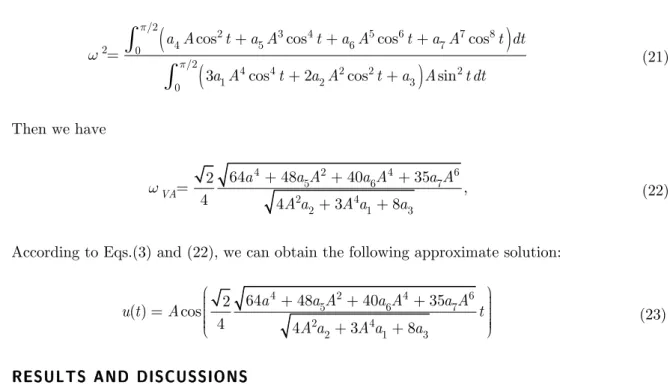
u +f u
( )
= 0 (1)Its variational principle can be easily established utilizing the semi-inverse method (He, 2007):
J u
( )
= −12u′
2+F u
( )
⎛ ⎝ ⎜⎜ ⎜
⎞ ⎠ ⎟⎟⎟⎟dt
0
T/4
∫
(2)Where T is period of the nonlinear oscillator, ∂F
∂u =f . Assume that its solution can be
ex-pressed as:
u t
( )
=Acos( )
ωt (3)Where A and ware the amplitude and frequency of the oscillator, respectively. Substituting
J A
(
,ω)
= −12A
2ω2sin2ωt+F(Acosωt) ⎛
⎝ ⎜⎜ ⎜
⎞ ⎠ ⎟⎟⎟⎟ 0
T/4
∫
dt= 1
ω −
1 2A
2ω2sin2t+F A
(
cost)
⎛⎝ ⎜⎜ ⎜
⎞ ⎠ ⎟⎟⎟⎟ 0
π/2
∫
dt=−1
2A
2ω sin2t dt+ 0
π/2
∫
ω1F A
(
cost)
0π/2
∫
dt(4)
Applying the Ritz method, He require:
∂J ∂A=
0
∂J ∂ω =
0
(5)
(6)
But with a careful inspection, for most cases we have:
∂J
∂ω =−
1 2
A2 sin2t dt−
0 π/2
∫
ω12 0 F A(
cost)
π/2∫
dt <0 (7)Thus, modify conditions Eq.(5) and Eq.(6) into a simpler form:
∂J
∂ω =
0 (8)
From which the relationship between the amplitude and frequency of the oscillator can be ob-tained.
3 NONLINEAR VIBRATION OF AN ELECTROSTATICALLY ACUATED MICROBEAM
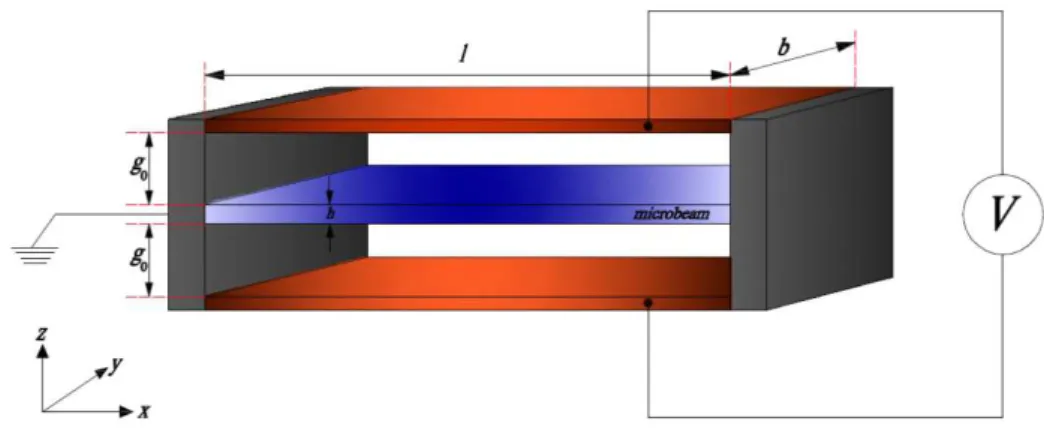
Figure 1 represents a fully clamped microbeam with uniform thickness h, length l, width b (b>>5h),
effective modulus E =E
(
1−ν2)
, Young’s modulus E, Poisson’s ratio υ and density ρ. Byapply-ing the Galerkin Method and employapply-ing the classical beam theory and takapply-ing into account of the mid-plane stretching effect as well as the distributed electrostatic force, the dimensionless equation of motion for the microbeam is as follow [6]:
(a
1u4+a2u2+a3)u+a4u+a5u3+a6u5+a7u7 =0, u(0)=A, u(0)=0, (9)
Where u is the dimensionless deflection of the microbeam, a dot denotes the derivative with
re-spect to the dimensionless time variable t =τ EI (ρbhl4) with I and t being the second moment of
In Eq. (9), the physical parameters a
i
(
i=1−7)
are given by (Fu et al, 2011):a
1 = φ
6d
ξ
0 1
∫
(10)a
2 =−2 φ 4d
ξ
0 1
∫
(11)a
3= φ
2d
ξ
0 1
∫
(12)a
4 = φ φ′′′′ −Nφ φ′′ −V 2
φ
(
)
dξ0 1
∫
(13)a
5 =− 2φ φ′′′′
3−2N ′′
φ φ3+αφ φ′′
( )
φ′ 2dξ0 1
∫
⎛⎝
⎜⎜⎜ ⎞⎠⎟⎟⎟⎟dξ
0 1
∫
(14)a
6= φ φ′′′′
5−N ′′
φ φ5+2αφ φ′′ 3
( )
φ′ 2dξ0 1
∫
⎛⎝
⎜⎜⎜ ⎞⎠⎟⎟⎟⎟dξ
0 1
∫
(15)a
7=− αφ φ′′
5 ′
φ
( )
2dξ 01
∫
⎛⎝
⎜⎜⎜ ⎞⎠⎟⎟⎟⎟dξ 0
1
∫
(16)In which, the following nondimensional variables and parameters are introduced
α= 6g0
2
h2
,ξ= x l , N =
Nl2
EI , V
2
= 24ε0l
4V2
Eh3g03 (17)
While a prime (
'
) indicates the partial differentiation with respect to the coordinate variablex. Thetrial function is φ ξ
( )
=16ξ2(
1−ξ)
2. The parameter N denotes the tensile or compressive axialload, g0 is initial gap between the microbeam and the electrode, V the electrostatic load and ε0
Figure 1 Schematics of a double-sided driven clamped-clamped microbeam-based electromechanical resonator
4 APPLYING VARIATIONAL APPROACH TO MICROBEAM
In Eq. (9), Its Variational principle can be easily obtained:
J u
( )
= −1 2 a 1u 4 +a 2u 2 +a 3(
)
u2+12 a 4u 2 +1 4 a 5u 4 +1 6 a 6u 8 +1 8 a 7u 8 ⎛ ⎝ ⎜⎜ ⎜ ⎞ ⎠ ⎟⎟⎟⎟dt 0 t
∫
(18)Choosing the trial function u t( )=Acos( )wt into Eq.(18) we obtain:
J(A)=
−1
2A
2ω2sin2ωt a 1A
4cos4ωt+a 2A
2cos2ωt+a 3
(
)
+1
2a4A
2cos2ωt+1 4a5 A
4cos4ωt+1 6a6A
6cos6ωt+1 8a7A
8cos8ωt
⎛ ⎝ ⎜⎜ ⎜⎜ ⎜⎜ ⎜⎜ ⎜ ⎞ ⎠ ⎟⎟⎟ ⎟⎟⎟ ⎟⎟⎟ ⎟⎟ 0 T/4
∫
dt (19)The stationary condition with respect to A leads to:
∂J
∂A=
−Aω2sin2ωt a
1A
4cos4ωt+a 2A
2cos2ωt+a 3
(
)
+a 4Acos
2ωt+a 5A
3cos4ωt+a 6A
5cos6ωt +a 7A
7cos8ωt
⎛ ⎝ ⎜⎜ ⎜⎜ ⎜⎜ ⎞ ⎠ ⎟⎟⎟ ⎟⎟⎟ 0 T/4
∫
dt =0= −
Aω2sin2t 3a
1A4cos4t+2a2A2cos2t+a3
(
)
+a 4Acos
2t+a 5A
3cos4t+a 6A
5cos6t+a 7A
7cos8t
⎛ ⎝ ⎜⎜ ⎜⎜⎜ ⎞ ⎠ ⎟⎟⎟ ⎟⎟⎟ 0 π/2
∫
dt =0=−ω2 3a
1A4cos4t+2a2A2cos2t+a3
(
)
Asin2t dt0 π/2
∫
+ a
4Acos2t+a5A3cos4t +a6A5cos6t+a7A7cos8t
(
)
dt0 π/2
∫
=0(20)
ω2=
a
4Acos2t+a5A3cos4t+a6A5cos6t+a7A7cos8t
(
)
dt0
π/2
∫
3a
1A4cos4t+2a2A2cos2t+a3
(
)
Asin2t dt0
π/2
∫
(21)Then we have
ω VA=
2 4
64a4+48a 5A
2+40a 6A
4+35a 7A
6
4A2a 2+3A
4a 1+8a3
, (22)
According to Eqs.(3) and (22), we can obtain the following approximate solution:
u(t)=Acos 2 4
64a4 +48a
5A2+40a6A4 +35a7A6
4A2a
2 +3A
4a 1+8a3
t ⎛
⎝ ⎜⎜ ⎜⎜⎜
⎞
⎠ ⎟⎟ ⎟⎟
⎟⎟ (23)
5 RESULTS AND DISCUSSIONS
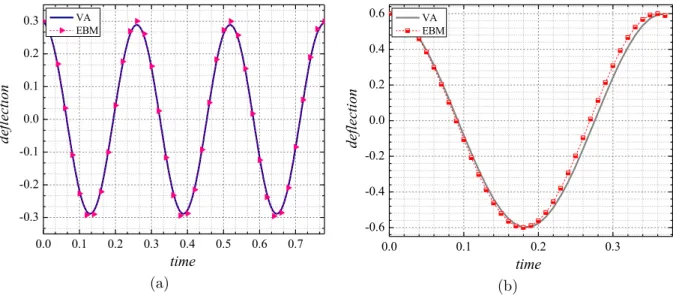
To demonstrate and verify the accuracy of this new approximate analytical approach, some compar-isons of the time history oscillatory displacement responses with those of the energy balance method are presented in Figs. 2(a) and 2(b). Table 1 shows the comparison of frequency corresponding to various parameters of system with energy balance method (Fu et al., 2011).
Table 1 Comparison of frequency corresponding to various parameters of system
Constant parameters Variational Approach solution Energy Balance solution
A N a V wVA
EBM w
(Fu et al,2011)
0.3 10 24 0 26.3644 26.3867
0.3 10 24 10 24.2526 24.2753
0.3 10 24 20 16.3556 16.3829
0.6 10 24 0 28.5579 28.9227
0.6 10 24 10 26.1671 26.5324
0.6 10 24 20 17.0940 17.5017
(a) (b)
Figure 2 Comparison of variational approach solution of deflection with the EBM solution based on time for cases (a): N =10, a =24, V =10, A=0.3 (b): N =10, a =24, V =20, A=0.6
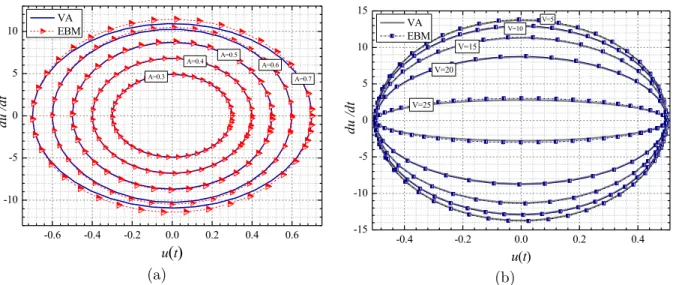
Figure 3(a) and 3(b) show the comparisons of the analytical solution ofu(t) based on u(t) with the
energy balance solution. Figures 4(a) and 4(b) are presented to show the effects of amplitude and V parameter on the phase plan of the system.
(a) (b)
Figure 3 Comparison of variational approach solution of phase plan with the EBM solution for cases (a): N =10, a =24, V =10, A=0.3 (b): N =10, a =24, V =20, A=0.6
0.0 0.1 0.2 0.3 0.4 0.5 0.6 0.7
-0.3 -0.2 -0.1 0.0 0.1 0.2 0.3
de
fl
ec
ti
on
time VA
EBM
0.0 0.1 0.2 0.3
-0.6 -0.4 -0.2 0.0 0.2 0.4 0.6
de
fl
ec
ti
on
time VA
EBM
-0.3 -0.2 -0.1 0.0 0.1 0.2 0.3 -4
-2 0 2 4
du /
d
t
u(t)
VA EBM
-0.6 -0.4 -0.2 0.0 0.2 0.4 0.6
-10 -5 0 5 10
du /
dt
u(t)
(a) (b)
Figure 4 (a): Effect of amplitude on the phase plan of the problem for N =10, a =24, V =10 (b): Effect of V parameter on the phase plan of the problem for N =10, a =24, A=0.5
Figure 5 is the effect of V parameter on nonlinear frequency of electrostatically microbeam base on amplitude. It can be observed that from the figure, the nonlinear frequency is increased when the V parameter is increasing but after reaching to the peak points of amplitude the nonlinear frequency is decreased by increasing V parameter.
Figure 5 Effect of V parameter on nonlinear frequency of electrostatically microbeam base on amplitude
-0.6 -0.4 -0.2 0.0 0.2 0.4 0.6
-10 -5 0 5 10
A=0.7 A=0.6 A=0.5 A=0.4
d
u
/
d
t
u(t) VA
EBM
A=0.3
-0.4 -0.2 0.0 0.2 0.4 -15
-10 -5 0 5 10 15
V=10
V=15
V=20
V=25
du /
dt
u(t) VA
EBM
V=5
0.2 0.4 0.6 0.8 1.0
5 10 15 20 25 30
Nonl
ine
ar
f
re
que
nc
y
Amplitude
V=0
V=5
V=10
V=15
Figure 6 Effect of N parameter on nonlinear frequency of electrostatically microbeam base on amplitude
Figure 7 Effect of αparameter on nonlinear frequency of electrostatically microbeam base on amplitude
The figure 6 is the effect of N parameter on nonlinear frequency of electrostatically microbeam base on amplitude. The N parameter has the same behavior of V on the nonlinear frequency of the sys-tem by increasing it. The figure 7 is considered the aon the nonlinear frequency of the system for different values of amplitude. It is evident that Variational Approach (VA) shows an excellent agreement with the energy balance solution and quickly convergent and valid for a wide range of vibration amplitudes and initial conditions. The accuracy of the results shows that the VA can be potentially used for the analysis of strongly nonlinear oscillation problems accurately.
6 CONCLUSION
In this paper, the Variational Approach was employed to solve the nonlinear governing equation of an electrostatically actuated microbeam. Excellent agreement between approximate frequencies and the numerical solutions are demonstrated and discussed. The high accuracy of this method demon-strated that the proposed approach can be applied for any strong conservative nonlinear problems
0.2 0.4 0.6 0.8 1.0
20 22 24 26 28
Nonl
ine
ar
f
re
que
nc
y
Amplitude N=5
N=10 N=15 N=20 N=25
0.2 0.4 0.6 0.8 1.0 16
18 20 22 24 26 28
Nonl
ine
ar
f
re
que
nc
y
Amplitude
α=6
α=12
α=18
α=24
without any limitations. We can suggest Variational Approach as strongly nonlinear method as novel and simple method for oscillation systems which provide easy and direct procedures for de-termining approximations to the periodic solutions.
References
Bayat M, Pakar I, Bayat M, On the large amplitude free vibrations of axially loaded Euler-Bernoulli beams, Steel and Composite Structures, 14(1) : 73-83 73,2013a.
Bayat, M., Pakar, I., and Domairry, G. Recent developments of some asymptotic methods and their applications for nonlinear vibration equations in engineering problems: a review. Latin American Journal of Solids and Struc-tures, 9(2):1-93, 2012a.
Bayat, M., and Pakar, I. On the approximate analytical solution to non-linear oscillation systems. Shock and Vibration, 20(1):43-52, 2013b.
Bayat M , Pakar I, Accurate analytical solution for nonlinear free vibration of beams, Structural Engineering and Mechanics,43(3): 337-347,2012b.
Bayat M , Pakar I ,Shahidi M. Analysis of Nonlinear Vibration of Coupled Systems with Cubic Nonlinearity, Mechanika, 17(6): 620-629,2011.
Bayat M, Pakar I , Bayat, M. Analytical solution for nonlinear vibration of an eccentrically reinforced cylindri-cal shell, Steel and Composite Structures, 14(5) :511-521, 2013c.
Chen, S.-S., and Chen, C. o.-K. Application of the differential transformation method to the free vibrations of strongly non-linear oscillators. Nonlinear analysis: Real world applications, 10(2):881-88, 2009.
Ganji, D., and Sadighi, A. Application of He's homotopy-perturbation method to nonlinear coupled systems of reaction-diffusion equations. International Journal of Nonlinear Sciences and Numerical Simulation, 7(4):411, 2006.
Fu, Y., Zhang, J., and Wan, L. Application of the energy balance method to a nonlinear oscillator arising in the microelectromechanical system (MEMS). Current Applied Physics, 11(3):482-85, 2011.
He, J.-H. Homotopy perturbation method for bifurcation of nonlinear problems. International Journal of Nonlin-ear Sciences and Numerical Simulation, 6(2):207-08, 2005.
He, J.-H., “Variational iteration method: a kind of nonlinear analytical technique: some examples,” International Journal of Non-Linear Mechanics, 34(4): 699–708, 1999.
He, J.-H. An improved amplitude-frequency formulation for nonlinear oscillators. International Journal of Non-linear Sciences and Numerical Simulation, 9 (2), 211-212, 2008, 2008.
He, J.-H. Variational approach for nonlinear oscillators. Chaos, Solitons & Fractals, 34(5):1430-39, 2007.
Ke, L.-L., Yang, J., Kitipornchai, S., and Xiang, Y. Flexural vibration and elastic buckling of a cracked Timo-shenko beam made of functionally graded materials. Mechanics of Advanced Materials and Structures, 16(6):488-502, 2009.
Pakar I, Bayat M , Vibration analysis of high nonlinear oscillators using accurate approximate methods, Struc-tural Engineering and Mechanics, 46(1):137-151, 2013a.
Pakar I, Bayat M ,An Analytical Study of Nonlinear Vibrations of Buckled Euler_Bernoulli Beams, Acta Physi-ca PoloniPhysi-ca A, 123(1):48-52,2013b.
Pakar, I., Bayat, M., and Bayat, M. On the approximate analytical solution for parametrically nonlinear excited oscillators. Journal of vibroengineering, 14(1):423-29, 2012a.
Pakar I ,Bayat M, Analytical study on the non-linear vibration of Euler-Bernoulli beams, Journal of vibroengi-neering, 14(1): 216-224, 2012b.
Qian, Y., Ren, D., Lai, S., and Chen, S. Analytical approximations to nonlinear vibration of an electrostatically actuated microbeam. Communications in Nonlinear Science and Numerical Simulation, 17(4):1947-55, 2012.
Senturia S. Mircrosystem design. Kluwe, MA: Norwell; 2001.
Sharma, K., Bhasin, V., Vaze, K., and Ghosh, A. Numerical simulation with finite element and artificial neural network of ball indentation for mechanical property estimation. Sadhana, 36(2):181-92, 2011.
Taylor, G. The coalescence of closely spaced drops when they are at different electric potentials. Proceedings of the Royal Society of London. Series A. Mathematical and Physical Sciences, 306(1487):423-34, 1968.
Yang, J., Hu, Y., and Kitipornchai, S. Electro-dynamic behavior of an electrically actuated micro-beam: Effects of initial curvature and nonlinear deformation. Computers & Structures, 96-97: 25-33, 2012.