BGD
6, 5409–5430, 2009Mountain birch – large source of sesquiterpenes into
atmosphere
S. Haapanala et al.
Title Page
Abstract Introduction
Conclusions References
Tables Figures
◭ ◮
◭ ◮
Back Close
Full Screen / Esc
Printer-friendly Version
Interactive Discussion Biogeosciences Discuss., 6, 5409–5430, 2009
www.biogeosciences-discuss.net/6/5409/2009/ © Author(s) 2009. This work is distributed under the Creative Commons Attribution 3.0 License.
Biogeosciences Discussions
Biogeosciences Discussionsis the access reviewed discussion forum ofBiogeosciences
Mountain birch – potentially large source
of sesquiterpenes into high latitude
atmosphere
S. Haapanala1, A. Ekberg2, H. Hakola3, V. Tarvainen3, J. Rinne1, H. Hell ´en3, and A. Arneth2,1
1
Department of Physics, University of Helsinki, Finland
2
Department of Physical Geography and Ecosystems Analysis, Lund University, Sweden
3
Air Chemistry Laboratory, Finnish Meteorological Institute, Finland
Received: 29 April 2009 – Accepted: 20 May 2009 – Published: 2 June 2009
Correspondence to: S. Haapanala ([email protected])
BGD
6, 5409–5430, 2009Mountain birch – large source of sesquiterpenes into
atmosphere
S. Haapanala et al.
Title Page
Abstract Introduction
Conclusions References
Tables Figures
◭ ◮
◭ ◮
Back Close
Full Screen / Esc
Printer-friendly Version
Interactive Discussion Abstract
Emissions of volatile organic compounds (VOCs) from mountain birches were mea-sured in Abisko, northern Sweden. Mountain birches make up majority of the tree biomass in Scandinavian high latitudes, area subject to significant climate warming. The measurements were carried out in two growing seasons. The emissions of a 5
branch from four individual trees were measured in June–August 2006 and one of them again in July 2007. The measurements were conducted using a dynamic flow through chamber covered with Teflon film. The studied mountain birches were found to emit substantial amounts of linalool, monoterpenes and sesquiterpenes. The monoterpene emission was dominated by sabinene. The magnitude and composition of sesquiter-10
pene emission changed dramatically between the years. For example, the average
α-farnesene emission in 2006 was almost 2000 ng g−1
dwh
−1while in 2007 the emission
ofα-farnesene was negligible. Also the emissions of other sesquiterpenes decreased in 2007 to a fraction of that in 2006. One possible explanation for the change in emis-sions is the herbivory damage that occurred in the area in 2004. Herbivory is known 15
to enhance the emissions of sesquiterpenes, especially those ofα-farnesene, and the effect may last several years.
1 Introduction
Volatile organic compounds (VOCs) are a diverse group of hydrocarbons emitted to the atmosphere by both biogenic and anthropogenic sources (Guenther et al., 1995; Simp-20
son et al., 1999; Piccot et al., 1992). Their double bonds give rise to high reactivities towards the hydroxyl radical (OH), ozone (O3), and the nitrate radical (NO3). Therefore the volatile organic compounds play an essential role in the regulation of the oxidizing capacity of the atmosphere. The VOCs also contribute to the formation and growth of secondary organic aerosols (Kulmala et al., 2004; Tunved et al., 2006), and they may 25
BGD
6, 5409–5430, 2009Mountain birch – large source of sesquiterpenes into
atmosphere
S. Haapanala et al.
Title Page
Abstract Introduction
Conclusions References
Tables Figures
◭ ◮
◭ ◮
Back Close
Full Screen / Esc
Printer-friendly Version
Interactive Discussion in remote regions (Law and Stohl, 2007).
Biogenic VOC emissions in the tropical, temperate and boreal vegetation zones have been extensively studied while the high-latitude, e.g. subarctic, ecosystems have gained much less attention (Tiiva et al., 2008; B ¨ackstrand et al., 2008; Ekberg et al., 2009). However, the subarctic vegetation zone covers large areas on the globe and de-5
spite its relatively low biomass density it can have a significant impact on atmospheric VOC concentrations, at least on the local to regional scales. Largely as a result of the prevalence of short and cool summers, biogenic VOC (BVOC) emissions from the northern regions are likely to be relatively small compared to the global emissions. However, atmospheric reactions such as particle formation from biogenic pre-cursors 10
and ozone destruction/formation occur on regional rather than global spatial scales (e.g. Tunved et al., 2006; Svenningsson et al., 2008).
Mountain birch (Betula pubescens ssp. czerepanovii (Orlova) H ¨amet-Ahti), a species of downy birch, covers an area of almost 600 000 ha in the Scandinavian sub-arctic. The birch species in boreal and temperate regions have been found to emit 15
substantial amounts of a wide range ofC5toC15 VOCs (Isidorov et al., 1985; K ¨onig et al., 1995; Hakola et al., 1998, 2001; Vuorinen et al., 2005). BVOCs emitted from the mountain birch in the subarctic may thus be of significant regional importance for the complex relationship between the ecosystem carbon flux, atmospheric chemistry and climate, but at the present there is only one emission study available (Steinbrecher et 20
al., 1999).
The subarctic mountain birch forests are exposed to herbivory by caterpillars of the autumnal moth (Epirrita autumnata) and severe outbreaks often occur with intervals of about 9–10 years. In some cases, large forest areas have suffered from mortality of most of the trees (Tr ¨ag ˚ardh, 1939; Haukioja et al., 1988). Mechanical damage of 25
BGD
6, 5409–5430, 2009Mountain birch – large source of sesquiterpenes into
atmosphere
S. Haapanala et al.
Title Page
Abstract Introduction
Conclusions References
Tables Figures
◭ ◮
◭ ◮
Back Close
Full Screen / Esc
Printer-friendly Version
Interactive Discussion et al., 2007).
The aim of the present study is to characterize the VOC emissions from a natural mountain birch forest. To obtain the emission parameters, usable in emission invento-ries and emission model development, the temperature and the photosynthetic photon flux density (PPFD) were carefully recorded during the measurements. In addition to 5
the VOC emission measurements, ecosystem scale photosynthesis was measured si-multaneously at the same site. From these data we also managed to study the link between delayed responses of herbivory damage and the atmospheric VOC emissions of plants.
2 Materials and methods 10
2.1 Measurement site
The measurements took place in Stordalen Nature Reserve, located near Abisko in northern Sweden (68◦20′N, 19◦03′E, 360 m a.s.l.). The long-term annual mean
tem-perature at Abisko climate station (68◦21′N, 18◦49′E, 388 m a.s.l.) is
−0.8◦C with the
warmest month being July (mean temperature 11.0◦C) and the coldest January (mean
15
temperature−11.9◦C). The sheltered valley has a relatively dry microclimate with mean
annual precipitation of 304 mm. The highest precipitation occurs in July (mean rainfall 54 mm) and the lowest in April (mean rainfall 12 mm) (Alexandersson et al., 1991). Snow accounts for about half of the precipitation.
The woody vegetation at the measurement site is dominated by mountain birch. 20
BGD
6, 5409–5430, 2009Mountain birch – large source of sesquiterpenes into
atmosphere
S. Haapanala et al.
Title Page
Abstract Introduction
Conclusions References
Tables Figures
◭ ◮
◭ ◮
Back Close
Full Screen / Esc
Printer-friendly Version
Interactive Discussion magnitude as in the growing seasons preceding the outbreak in 2004 (T. Johansson1,
personal communication, 2009).
In summer 2006 we conducted VOC emission measurements on four individual trees (numbered as 1–4) and, as a complementary measurement, one of them (number 4) was measured again in summer 2007. The measurements took place during 28 June– 5
5 August 2006 and during 16–17 July 2007. During both of the campaigns the leaves of the studied trees were mature. Due to the fact that all the measurements were conducted in the middle of the growing season, the seasonal variation of the emission was not studied.
2.2 Sampling 10
For the VOC emission measurements a branch growing about 2 m above the ground level was placed in a transparent chamber made of Teflon film. The canopy is open and at that height, about half of total tree-height, the branch is sun-exposed. The en-closure installation took place at least one day before the measurements to avoid any effects of rough handling on the emission, has been shown to cause increased emis-15
sions (e.g. Juuti et al., 1990; K ¨onig et al., 1995; Hakola et al., 2001). The enclosure was appropriately ventilated until just prior to sampling initiation. The volume of the cylindrical enclosure was about 15 l. Inflowing air was pumped to the enclosure at a rate of about 5 l min−1. Ozone was removed from the inflow air using MnO
2 coated
copper nets. Samples from both inflow and outflow air were collected by trapping 20
C5-C15 hydrocarbons to cartridges filled with Tenax-TA and Carbopack-B/Carbograph 1TD adsorbents. The samples were taken using a constant flow rate of about 0.1 to 0.2 l per minute and sampling times of 55 to 120 min resulting in 6 to 12 l sample vol-ume. The adsorbent samples were analyzed using an automatic thermodesorption device (Perkin-Elmer ATD-400) connected to a gas chromatograph (HP-5890), with a 25
mass-selective detector (HP-5972). The accuracy of the repeated adsorbent
calibra-1
BGD
6, 5409–5430, 2009Mountain birch – large source of sesquiterpenes into
atmosphere
S. Haapanala et al.
Title Page
Abstract Introduction
Conclusions References
Tables Figures
◭ ◮
◭ ◮
Back Close
Full Screen / Esc
Printer-friendly Version
Interactive Discussion tion sample analysis was estimated to be about 6% for each compound. This value
was used as an accuracy estimate for the concentrations. Emission rates were deter-mined based on differences in concentration between inlet and outlet air. For further description of the enclosure system and chemical analysis, see Hakola et al. (2006).
Despite the relatively high air flow through the enclosure, the temperature inside the 5
enclosures increased during periods of strong solar radiation. The highest recorded temperature inside the enclosures was 31.4◦C, with the corresponding ambient
tem-perature being 18.0◦C. During the measurements the temperature di
fference between the enclosure and the ambient air varied from 0 to 15◦C, with the average increase
be-ing as high as 7.1◦C. This should be taken into account when interpreting the regional
10
emission values.
3 Results and discussion
3.1 Measured emissions
Mountain birches were found to emit large amounts of mono- and sesquiterpenes. In addition, linalool emission was found to be substantial, about half of the monoterpene 15
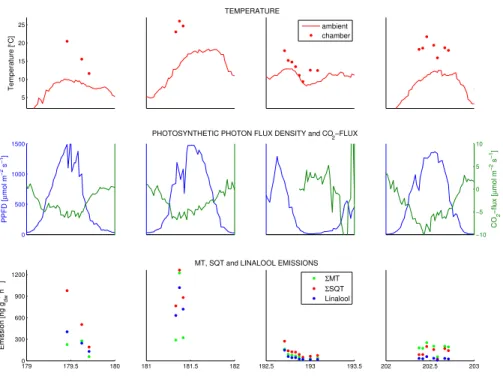
emission. Isoprene emission was negligible. Examples of the emissions of the different VOC groups are shown in Fig. 1 together with records of temperature, light intensity and net ecosystem CO2 exchange from eddy covariance flux tower at the same site. From these results it is apparent that the emissions are strongly dependent on the temperature inside the chamber.
20
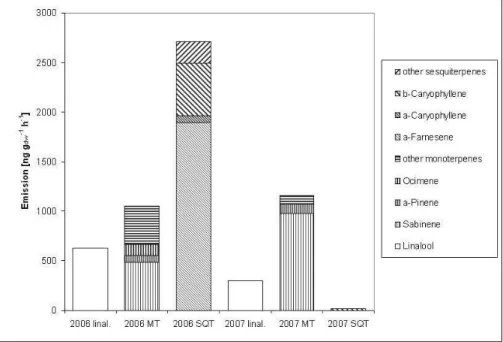
The average emission spectra of the most abundant compounds during the mea-surements in 2006 and 2007 are shown in Fig. 2. When considering single monoter-pene species, the monotermonoter-pene emission was dominated by sabinene. Other abundant monoterpenes were ocimene, trans-ocimene, terpinolene and α-pinene. The same compounds were identified by Hakola et al. (2001) from the emissions of downy birch 25
BGD
6, 5409–5430, 2009Mountain birch – large source of sesquiterpenes into
atmosphere
S. Haapanala et al.
Title Page
Abstract Introduction
Conclusions References
Tables Figures
◭ ◮
◭ ◮
Back Close
Full Screen / Esc
Printer-friendly Version
Interactive Discussion was 1100 ng g−1
dwh
−1 (970 ng C g−1
dw h
−1), ranging from 0 to 14 000 ng g−1
dwh
−1. In 2007
the average sum was almost equal, 1200 ng g−1
dwh
−1 (1060 ng C g−1
dwh
−1), and varied
between 0 and 4000 ng g−1
dwh
−1. In Fig. 3a we show the monoterpene emissions of
birch 4 as a function of temperature. The results show that even though the average emission was almost the same, the emission patterns in different years were some-5
what different. In 2006, clear increase above zero line can be distinguished during the warmest periods, whereas in 2007 some monoterpene release took place already at relatively cool temperatures around 15◦C.
In 2006 sesquiterpenes were emitted in high amounts, the average sum emis-sion being 2700 ng g−1
dwh
−1 (2380 ng C g−1
dwh
−1). The sesquiterpene emission varied
10
between 0 and 31 000 ng g−1
dwh
−1. The dominant sesquiterpene compound was α
-farnesene, followed byβ-caryophyllene. In 2007 the sesquiterpene emission was re-duced to a fraction of that in 2006. The average sum emission was only 16 ng g−1
dwh
−1
(14 ng C g−1
dwh
−1), which is less than 1% of that in the previous year. The
dominat-ing compound wasβ-caryophyllene whileα-farnesene was lacking completely. From 15
Fig. 3b the differences between the magnitudes of the sesquiterpene emissions can clearly be seen.
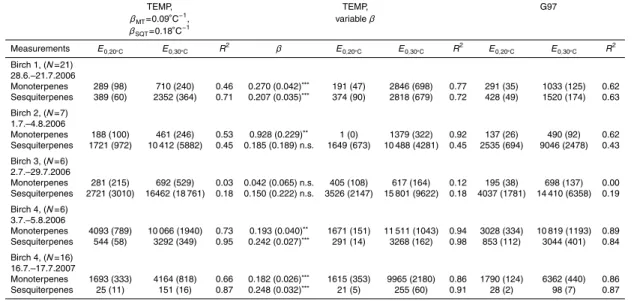
The tree-to-tree variation of the emissions was high (see Table 1). Trees 1 and 4 had almost equal emissions of mono- and sesquiterpenes. Trees 2 and 3 had somewhat smaller monoterpene but significantly higher sesquiterpene emissions than the other 20
trees. Mountain birch has several phenotypes, from small polycormic (multi-stemmed) shrubs to large monocormic (single-stemmed) trees (Vaarama and Valanne, 1973). Hybridization with dwarf birch (Betula nana L.) is common and it is one of the factors affecting the growth form. This variation may be one of the factors explaining the diff er-ences in the emissions between the trees. Also Hakola et al. (2001) point out the large 25
BGD
6, 5409–5430, 2009Mountain birch – large source of sesquiterpenes into
atmosphere
S. Haapanala et al.
Title Page
Abstract Introduction
Conclusions References
Tables Figures
◭ ◮
◭ ◮
Back Close
Full Screen / Esc
Printer-friendly Version
Interactive Discussion 3.2 Temperature and light dependence of emission rates
To study the temperature and light dependence of VOC emission rates we performed nonlinear regression analysis using two widely applied emission algorithms. TEMP-algorithm (Guenther et al., 1993) is a simple exponential model of the form
E =E0exp(β(T −T0)), (1)
5
where E is emission rate at temperature T, E0 is emission potential at temperature
T0, andβis an empirical coefficient describing the strength of the temperature depen-dence. It describes emissions from storage pools inside the plants and it is usually considered as the monoterpene emission algorithm. G97-algorithm (Guenther et al., 1993; Guenther, 1997) is both temperature and light dependent description of emission 10
rate given by
E =E0CTCL, (2)
whereEis emission rate at temperatureT and PPFDL,E0is emission potential at tem-peratureT0 and PPFD L0. Temperature dependence factorCT is Arrhenius-type de-scription of enzymatic activity having maximum above 35◦C.C
Lis light dependence fac-15
tor following light dependence of photosynthesis, and saturating at 1000µmol m−2s−1.
It is applied to isoprene and monoterpene emissions that are not stored but emitted rather directly from production (e.g. Rinne et al., 2002; Kuhn et al., 2004).
The regression analysis was performed separately for each of the four studied birches and both years. The regression with the TEMP algorithm was performed both 20
with a fixed and a variable strength of the temperature dependence. The selection of fixedβ value is based on commonly used values for the emission rates. For monoter-penes, β=0.09◦C−1 was used following the proposal of Guenther et al. (1993) and
confirmed by several investigators thereafter for various plan species. For sesquiter-penes, a larger range of values has been reported. The average value from the studies 25
listed by Duhl et al. (2008) isβ=0.18◦C−1, which was adapted to this study. A
BGD
6, 5409–5430, 2009Mountain birch – large source of sesquiterpenes into
atmosphere
S. Haapanala et al.
Title Page
Abstract Introduction
Conclusions References
Tables Figures
◭ ◮
◭ ◮
Back Close
Full Screen / Esc
Printer-friendly Version
Interactive Discussion measured emission together with ones obtained from fittings of the two algorithms. In
addition, the differences between the measured and predicted emissions are shown. Both mono- and sesquiterpene emissions were slightly better explained by the solely temperature dependent algorithm (TEMP). In most cases, allowing theβcoefficient to vary produces somewhat better regression statistics, especially for the monoterpenes. 5
This method yield to the average correlation coefficientsR2of 0.72 for monoterpenes and 0.65 for sesquiterpenes. Forcing the temperature coefficients to constants de-creased the correlation coefficientsR2to 0.48 and 0.63 for mono- and sesquiterpenes, respectively.
The temperature dependence coefficientβvaried from 0.04◦C−1to 0.93◦C−1for the
10
monoterpene emission and from 0.15◦C−1 to 0.25◦C−1 for the sesquiterpene
emis-sion. The average temperature coefficients for mono- and sesquiterpene emissions were 0.32◦C−1 and 0.21◦C−1, respectively. Neglecting the non significant regression
results with theP value>0.05 (marked n.s. in Table 1) the temperature coefficients be-come 0.39◦C−1and 0.23◦C−1for mono- and sesquiterpene emissions, respectively. For
15
comparison, Hakola et al. (2001) reportedβvalue of 0.11◦C−1for monoterpenes and
0.14–0.22◦C−1for sesquiterpenes from their downy birch measurements. This
temper-ature coefficient of sesquiterpene emission rate is in the same range with our results. The monoterpene emission rate, however, seems to be significantly more sensitive to temperature in mountain birch than in downy birch.
20
The temperature and light dependent algorithm (G97) was able to reproduce the measurement data reasonably well in most of the cases. This algorithm explicitly sets the emission to zero in total darkness. Similar behavior was also seen in the present data during nighttime for both mono- and sesquiterpenes (see Figs. 1 and 4). This is easy to understand since birches do not have resin ducts where terpenes could be 25
BGD
6, 5409–5430, 2009Mountain birch – large source of sesquiterpenes into
atmosphere
S. Haapanala et al.
Title Page
Abstract Introduction
Conclusions References
Tables Figures
◭ ◮
◭ ◮
Back Close
Full Screen / Esc
Printer-friendly Version
Interactive Discussion In addition to the standard way of using these algorithms, we tried to reproduce the
emissions using a linear combination of TEMP and G97 algorithms, following the ap-proach used by e.g. Steinbrecher et al. (1999). This exercise was conducted only for the data from 2007 when the trees were supposed to function normally, without special resistance to herbivory. The hybrid algorithm slightly improved the fit, as expected. 5
Holzke et al. (2006) used a hybrid algorithm, where they made use of the temperature dependence part of G97 algorithm as the pool emission, instead of the TEMP algo-rithm. In practice, the difference between these two approaches is small when applied in a narrow temperature range. However, the use of the TEMP algorithm allows setting the temperature dependence factorβto a value obtained from the current dataset. 10
3.3 Emission potentials
Emission potentials were calculated for each tree using both TEMP and G97 algorithms (see Table 1). The emission potentials were calculated at the temperatures of 20◦C
and 30◦C. The emission potentials at 20◦C are calculated to give the correct order of
magnitude of the emission rates at the temperatures that really occur in the area. The 15
values at 30◦C are shown for easy comparison to other studies, and these values are
discussed below. In all cases, tree-to-tree variations in the emission potentials were high.
Best fittings were obtained using the variable temperature coefficients in the TEMP algorithm. The resulting emission potentials for monoterpenes varied from 617 to 20
11 511 ng g−1
dwh
−1, the average value being 5264 ng g−1
dwh
−1. Emission potentials for
sesquiterpenes varied between 255 and 15 801 ng g−1
dwh
−1, the average value being
6526 ng g−1
dwh
−1. The lowest sesquiterpene emission potential was obtained in 2007,
when the sesquiterpene emission was clearly different from the emission in 2006. For comparison, Hakola et al. (2001) reported late summer monoterpene emission 25
potentials of downy birch ranging from 170 to 5490 ng g−1
dwh
−1. For sesquiterpenes,
they measured emission potentials 310–6940 ng g−1
dwh
BGD
6, 5409–5430, 2009Mountain birch – large source of sesquiterpenes into
atmosphere
S. Haapanala et al.
Title Page
Abstract Introduction
Conclusions References
Tables Figures
◭ ◮
◭ ◮
Back Close
Full Screen / Esc
Printer-friendly Version
Interactive Discussion of both mono- and sesquiterpenes obtained from our measurements are somewhat
higher than those measured before for downy birch.
If we force the temperature dependence to a fixed value β=0.09◦C−1, the
result-ing emission potentials are strongly decreased. For example birch 4, measured in 2007, had the monoterpene emission potential of 9965 ng g−1
dwh
−1 when the
temper-5
ature dependence coefficient was taken from the dataset. The emission potential was decreased to 4164 ng g−1
dwh
−1 when the temperature dependence was forced to
β=0.09◦C−1.
The monoterpene emission potentials of G97 algorithm range from 490 to 10 819 ng g−1
dwh
−1, the average value being 3880 ng g−1
dwh
−1. For sesquiterpene
emis-10
sion rate the emission potential vary between 98 and 14 410 ng g−1
dwh
−1, averaging at
5624 ng g−1
dwh
−1. The lowest sesquiterpene emission potential comes from 2007 data,
and it significantly differs from those of 2006 data, as with the TEMP algorithm.
3.4 Possible reason for high sesquiterpene emission
The change in the sesquiterpene emission between the years was dramatic. Climatic 15
conditions did not heavily differ between the years. While sampling birch 4, the eff ec-tive temperature sum (+5◦C threshold) was between 150 and 320 d.d. (degree days)
in 2006 and 270 d.d. in 2007. The effective temperature sum was calculated using the air temperature data from Stordalen mire, located a few hundred meters from the birch measurement site. A possible reason for the very high sesquiterpene emission might 20
be herbivory damage that occurred in the area in 2004. Stress induced emissions can differ from normal emissions in both magnitude and composition. There is plenty of literature where a changed emission pattern, particularly increased emissions of the sesquiterpenesα-farnesene andβ-caryophyllene, is linked to various stress factors of the plants (e.g. Par ´e and Tumlinson, 1999; Holopainen, 2004). Stress factors include 25
BGD
6, 5409–5430, 2009Mountain birch – large source of sesquiterpenes into
atmosphere
S. Haapanala et al.
Title Page
Abstract Introduction
Conclusions References
Tables Figures
◭ ◮
◭ ◮
Back Close
Full Screen / Esc
Printer-friendly Version
Interactive Discussion emissions may help plants to defend themselves by repelling the insects, disturbing
their growth and breeding, or by attracting the natural enemies of the insects. Staudt et al. (2007) studied the effects of gypsy moth (Lymantria dispar L.) feeding on VOC emission from holm oak (Quercus ilex L.). Feeding induced the emissions of new VOC compounds, consisting of sesquiterpenes, a homoterpene and a monoterpene alco-5
hol. Also undamaged leaves of infested trees emitted new VOCs, but with a different composition and at lower rates.
In addition to the instant responses, plants have delayed responses. Immunological memory of mountain birch after the herbivory by autumnal moth is discussed by Ru-uhola et al. (2007). They found out that delayed induced resistance lasted as long as 10
five years. The trees exposed to herbivory five years earlier maintained decreased per-formance of moth larvae. In addition, some changes in the chemical composition of the leaves was observed. The quercetin to kaemferol ratio was increased whereas pheno-lic compounds were not significantly affected. The general features of plant memory were recently reviewed by Bruce et al. (2007). They define a plant memory, or stress 15
imprint, as a genetic or biochemical modification of a plant that occurs after stress ex-posure. These changes in gene expression or plant metabolism cause the plant to respond in a different way to the future stress factors.
Our results suggest that also the changes in the VOC emissions may last several years. If a single insect outbreak affects the emissions for about three years and out-20
breaks occurs about once a decade, the mountain birch forest acts as high sesquiter-pene emitter during about one third of the years. As sesquitersesquiter-penes are known to be important for formation and growth of secondary organic aerosols (e.g. Bonn and Moortgat, 2003) there may be link between occurrence of herbivores and aerosol par-ticle formation events.
BGD
6, 5409–5430, 2009Mountain birch – large source of sesquiterpenes into
atmosphere
S. Haapanala et al.
Title Page
Abstract Introduction
Conclusions References
Tables Figures
◭ ◮
◭ ◮
Back Close
Full Screen / Esc
Printer-friendly Version
Interactive Discussion 4 Conclusions
We measured the branch scale emissions of various VOC compounds from mountain birch, a dominant tree species of the European subarctic ecosystems. The mountain birch leaves were found to emit a large quantity of VOCs, with rates higher than those from downy birch. The data of Tarvainen et al. (2005) suggests that also a Scots pine 5
forest in the north may emit more sesquiterpenes than similar trees in the mid-latitudes. This may be, at least partly, explicable by the short but intensive growing season in the north.
Herbivory damage is supposed to significantly affect the sesquiterpene emission. Ideally, this variability between the years should be taken into account in the emission 10
inventories. Even small changes in the emissions of sesquiterpenes may influence the local atmospheric chemistry strongly due to the fact that sesquiterpenes are chemically very reactive. There interactions raise also questions for future climate change impacts in insect outbreaks and herbivory, and their interactions with atmospheric processes, but today the available data is far too limited to comment on whether such changes will 15
be substantial. In our case, our dataset is limited to just two growing seasons. While it indicates possible substantial effects in response to insect attacks, much more further research is needed for more accurate predictions.
From the present data it is obvious that both monoterpene and sesquiterpene emis-sion of mountain birch approaches zero in the darkness. This suggests that majority 20
of the emission originates directly from synthesis rather that from pools. The exact be-havior is difficult to characterize from field data, as temperature and PPFD are strongly correlated.
Acknowledgements. This research was supported by the Academy of Finland Center of Excel-lence program (project 1118615). We acknowledge the Academy of Finland (projects 206162
25
BGD
6, 5409–5430, 2009Mountain birch – large source of sesquiterpenes into
atmosphere
S. Haapanala et al.
Title Page
Abstract Introduction
Conclusions References
Tables Figures
◭ ◮
◭ ◮
Back Close
Full Screen / Esc
Printer-friendly Version
Interactive Discussion
are grateful to the staffat Abisko Scientific Research Station for environmental data and sup-port.
References
Alexandersson, H., Karlstr ¨om, C., and Larsson-McCann, S.: Temperature and precipitation in Sweden 1961–1990, reference normals. SMHI, Norrk ¨oping, 88 pp., ISSN 0283-7730, 1991.
5
Bonn, B. and Moortgat, G. K.: Sesquiterpene ozonolysis: Origin of atmospheric new particle formation from biogenic hydrocarbons, Geophys. Res. Lett., 30, 1585, doi:10.1029/2003GL017000, 2003.
Bruce, T., Matthes, M., Napier, J., and Pickett, J.: Stressful “memories” of plants: Evidence and possible mechanisms, Plant Sci., 173, 603–608, 2007.
10
B ¨ackstrand, K., Crill, P. M., Mastepanov, M., Christensen, T. R., and Bastviken, D.: Total hy-drocarbon flux dynamics at a subarctic mire in northern Sweden, J. Geophys. Res., 113, G03026, doi:10.1029/2008JG000703, 2008.
Duhl, T. R., Helmig, D., and Guenther, A.: Sesquiterpene emissions from vegetation: a review, Biogeosciences, 5, 761–777, 2008,
15
http://www.biogeosciences.net/5/761/2008/.
Ekberg, A., Arneth, A., Hakola, H., Hayward, S., and Holst, T.: Isoprene emission from wetland sedges, Biogeosciences, 6, 601–613, 2009,
http://www.biogeosciences.net/6/601/2009/.
Ghirardo, A., Koch, K., Schnitzler, J. P., and Rinne, J.: 13CO2 feeding experiments of four 20
common European boreal tree species: 13C incorporation into monoterpenes, in: 4th In-ternational conference on proton transfer reaction mass spectrometry and its applications, edited by: Hansel, A. and Dunkl, J., Conference series, Innsbruck university press, 325 pp., ISBN 978-3-902571-99-1, 2009.
Guenther, A. B., Zimmerman, P. R., Harley, P. C., Monson, R. K., and Fall, R.: Isoprene and
25
Monoterpene Emission Rate Variability: Model Evaluations and Sensitivity Analyses, J. Geo-phys. Res., 98, 12609–12617, 1993.
BGD
6, 5409–5430, 2009Mountain birch – large source of sesquiterpenes into
atmosphere
S. Haapanala et al.
Title Page
Abstract Introduction
Conclusions References
Tables Figures
◭ ◮
◭ ◮
Back Close
Full Screen / Esc
Printer-friendly Version
Interactive Discussion
J., and Zimmerman, P.: A global model of natural volatile organic compound emissions, J. Geophys. Res., 100, 8873–8892, 1995.
Guenther, A.: Seasonal and spatial variations in natural volatile organic compound emissions, Ecol. Appl., 7, 34–45, 1997.
Hakola, H., Rinne, J., and Laurila, T.: The hydrocarbon emission rates of tea-leafed willow
5
(Salix phylicifolia), silver birch (Betuna pendula) and european aspen (Populus tremula), Atmos. Environ., 32, 1825–1833, 1998.
Hakola, H., Laurila, T., Lindfors, V., Hell ´en, H., Gaman, A., and Rinne, J.: Variation of the VOC emission rates of birch species during the growing season, Boreal. Env. Res., 6, 237–249, 2001.
10
Hakola, H., Tarvainen, V., B ¨ack, J., Ranta, H., Bonn, B., Rinne, J., and Kulmala, M.: Seasonal variation of mono- and sesquiterpene emission rates of Scots pine, Biogeosciences, 3, 93– 101, 2006,
http://www.biogeosciences.net/3/93/2006/.
Haukioja, E., Neuvonen, S., Hanhim ¨aki, S., and Niemel ¨a, P.: The autunmal moth in
Fennoscan-15
dia, in: Dynamics of forest insect populations. Patterns, causes, implications, edited by: Berryman, A., 603 pp., Plenum Press, New York, ISBN 0-306-42745-1, 163–178, 1988. Holzke, C., Hoffmann, T., Jaeger, L., Koppmann, R., and Zimmer, W.: Diurnal and seasonal
variation of monoterpene and sesquiterpene emission from Scots pine (Pinus sylvestrisL.), Atmos. Environ., 40, 3174–3185, 2006.
20
Holopainen, J. K.: Multiple functions of inducible plant volatiles, Trends Plant Sci., 9, 529–533, 2004.
Isidorov, V. A., Zenkevich, I. G., and Ioffe, B. V.: Volatile organic compounds in the atmosphere of forests, Atmos. Environ., 19, 1–8, 1985.
Juuti, S., Arey, J., and Atkinson, R.: Monoterpene emission rate measurements from a
Mon-25
terey pine, J. Geophys. Res., 95, 7515–7519, 1990.
Kuhn, U., Rottenberger, S., Biesenthal, T., Wolf, A., Schebeske, G., Ciccioli, P., Rbancaleoni, E., Frattoni, M., Tavares, T. M., and Kesselmeier, J.: Seasonal differences in isoprene and light-dependent monoterpene emission be Amazonian tree species, Glob. Change Biol., 10, 663–682, 2004.
30
BGD
6, 5409–5430, 2009Mountain birch – large source of sesquiterpenes into
atmosphere
S. Haapanala et al.
Title Page
Abstract Introduction
Conclusions References
Tables Figures
◭ ◮
◭ ◮
Back Close
Full Screen / Esc
Printer-friendly Version
Interactive Discussion
K ¨onig, G., Brunda, M., Puxbaum, H., Hewitt, C. N., Duckham, S. C., and Rudolph, J.: Relative contrubution of oxygenated hydrocarbons to the total biogenic VOC emissions of selected Mid-European agricultural and natural plant species, Atmos. Environ., 29, 861–874, 1995. Law, K. S. and Stohl, A.: Arctic Air Pollution: Origins and Impacts, Science, 315, 1537–1540,
2007.
5
Par ´e, P. and Tumlinson, J.: Plant volatiles as a defence against insect herbivores, Plant Physiol., 121, 325–331, 1999.
Piccot, S., Watson, J., and Jones, J.: A global inventory of volatile organic compound emissions from anthropogenic sources, J. Geophys. Res., 97, 9897–9912, 1992.
Rinne, J., Guenther, A., Greenberg, J., and Harley, P.: Isoprene and monoterpene fluxes
mea-10
sured above Amazonian rainforest and their dependence on light and temperature, Atmos. Environ., 36, 2421–2426, 2002.
Ruuhola, T., Salminen, J.-P., Haviola, S., Yang, S., and Rantala, M. J.: Immunological memory of mountain birches: Effects of Phenolics on performance of the autumnal moth depend on herbivory history of trees, J. Chem. Ecol., 33, 1160–1176, 2007.
15
Simpson, D., Winiwarter, W., B ¨orjesson, G., Cinderby, S., Ferreiro, A., Guenther, A., Hewitt, C.N., Janson, R., Khalil, M. A. K., Owen, S., Pierce, T. E., Puxbaum, H., Shearer, M., Skiba, U., Steinbrecher, R., Tarrason, L., and ¨Oquist, M. G.: Inventorying emissions from nature in Europe, J. Geophys. Res., 104, 8113–8152, 1999.
Staudt, M. and Lhoutellier, L.: Volatile organic compound emission from holm oak infested by
20
gupsy moth larvae: evidence for distinct responses in damaged and undamaged leaves, Tree Physiol., 27, 1433–1440, 2007.
Steinbrecher, R., Hauff, K., Hakola, H., and R ¨ossler, J.: A Revised Parametrisation for Emission Modelling of Isoprenoids for Boreal Plants, in: Biogenic VOC emissions and photochemistry in the boreal regions of Europe, edited by: Laurila, T. and Lindfors, V., Air pollution research
25
report No 70, Commission of the European Communities, Luxembourg, 158 pp., ISBN 92-828-6990-3, 29–43, 1999.
Svenningsson, B., Arneth, A., Hayward, S., Holst, T., Massling, A., Swietlicki, E., Hirsikko, A., Junninen, H., Riipinen, I., Vana, M., dal Maso, M., Hussein, T., and Kulmala, M.: Aerosol par-ticle formation events and analysis of high growth rates observed above a subarctic
wetland-30
forest mosaic, Tellus, 60B, 353–364, 2008.
BGD
6, 5409–5430, 2009Mountain birch – large source of sesquiterpenes into
atmosphere
S. Haapanala et al.
Title Page
Abstract Introduction
Conclusions References
Tables Figures
◭ ◮
◭ ◮
Back Close
Full Screen / Esc
Printer-friendly Version
Interactive Discussion
http://www.atmos-chem-phys.net/5/989/2005/.
Tiiva, P., Faubert, P., Micheksen, A., Holopainen, T., Holopainen, J. K., and Rinnan, R.: Warming increases isoprene emission from a subarctic heath, New Phytol., 180, 853–863, doi:10.1111/j.1469-8137.2008.02587x, 2008.
Tr ¨ag ˚ardh, I.: Sveriges skogsinsekter, 2nd ed, Hugo Gebers f ¨orlag, Stockholm, Sweden, 1939
5
(in Swedish).
Tunved, P., Hansson, H.-C., Kerminen, V.-M., Str ¨om, J., Dal Maso, M., Lihavainen, H., Viisanen, Y., Aalto, P. P., Komppula, M., and Kulmala, M.: High Natural Aerosol Loading over Boreal Forests, Science, 312, 261–263, 2006.
Vaarama, A. and Valanne, T.: On the taxonomy, biology and origin of Betula tortuosa Ledeb,
10
Reports from Kevo Subarctic Research Station, 10, 70–84, 1973.
BGD
6, 5409–5430, 2009Mountain birch – large source of sesquiterpenes into
atmosphere
S. Haapanala et al.
Title Page
Abstract Introduction
Conclusions References
Tables Figures
◭ ◮
◭ ◮
Back Close
Full Screen / Esc
Printer-friendly Version
Interactive Discussion
Table 1. The results of the nonlinear regression analysis of the monoterpene and
sesquiter-pene emission rates using both the temperature dependent TEMP algorithm (Guenther et al., 1993) and the temperature and light dependent G97 algorithm (Guenther et al., 1993; Guen-ther 1997). E0(ng g−1
dwh −1
) are the emission potentials at temperatures of 20◦C and 30◦C and
incident PPFD of 1000µmolphotonsm− 2
s−1 in the G97 algorithm. β (◦C−1) is the coe
fficient describing the strength of the temperature dependence in the TEMP algorithm. R2is the re-gression statistic and theP values for fittedβare indicated using asterisks. The values in the parentheses are the standard errors. N indicates the number of samples in each subset.
TEMP, TEMP, G97
βMT=0.09◦C−1, variableβ
βSQT=0.18◦C−1
Measurements E0,20◦C E0,30◦C R 2
β E0,20◦C E0,30◦C R
2
E0,20◦C E0,30◦C R 2
Birch 1, (N=21) 28.6.–21.7.2006
Monoterpenes 289 (98) 710 (240) 0.46 0.270 (0.042)∗∗∗ 191 (47) 2846 (698) 0.77 291 (35) 1033 (125) 0.62
Sesquiterpenes 389 (60) 2352 (364) 0.71 0.207 (0.035)∗∗∗ 374 (90) 2818 (679) 0.72 428 (49) 1520 (174) 0.63
Birch 2, (N=7) 1.7.–4.8.2006
Monoterpenes 188 (100) 461 (246) 0.53 0.928 (0.229)∗∗ 1 (0) 1379 (322) 0.92 137 (26) 490 (92) 0.62
Sesquiterpenes 1721 (972) 10 412 (5882) 0.45 0.185 (0.189) n.s. 1649 (673) 10 488 (4281) 0.45 2535 (694) 9046 (2478) 0.43 Birch 3, (N=6)
2.7.–29.7.2006
Monoterpenes 281 (215) 692 (529) 0.03 0.042 (0.065) n.s. 405 (108) 617 (164) 0.12 195 (38) 698 (137) 0.00 Sesquiterpenes 2721 (3010) 16462 (18 761) 0.18 0.150 (0.222) n.s. 3526 (2147) 15 801 (9622) 0.18 4037 (1781) 14 410 (6358) 0.19 Birch 4, (N=6)
3.7.–5.8.2006
Monoterpenes 4093 (789) 10 066 (1940) 0.73 0.193 (0.040)∗∗ 1671 (151) 11 511 (1043) 0.94 3028 (334) 10 819 (1193) 0.89
Sesquiterpenes 544 (58) 3292 (349) 0.95 0.242 (0.027)∗∗∗ 291 (14) 3268 (162) 0.98 853 (112) 3044 (401) 0.84
Birch 4, (N=16) 16.7.–17.7.2007
Monoterpenes 1693 (333) 4164 (818) 0.66 0.182 (0.026)∗∗∗ 1615 (353) 9965 (2180) 0.86 1790 (124) 6362 (440) 0.86
Sesquiterpenes 25 (11) 151 (16) 0.87 0.248 (0.032)∗∗∗ 21 (5) 255 (60) 0.91 28 (2) 98 (7) 0.87
∗∗∗P <0.001 ∗∗P <0.01 ∗P <0.05
BGD
6, 5409–5430, 2009Mountain birch – large source of sesquiterpenes into
atmosphere
S. Haapanala et al.
Title Page
Abstract Introduction
Conclusions References
Tables Figures
◭ ◮
◭ ◮
Back Close
Full Screen / Esc
Printer-friendly Version
Interactive Discussion
5 10 15 20 25
Temperature [
°
C]
TEMPERATURE
ambient chamber
0 500 1000 1500
PPFD [
µ
mol m
−2 s
−1
]
PHOTOSYNTHETIC PHOTON FLUX DENSITY and CO2−FLUX
−10 −5 0 5 10
CO
2
−flux [
µ
mol m
−2 s
−1
]
179 179.5 180 0
300 600 900 1200
Emission [ng g
dw
−1
h
−1
]
181 181.5 182 192.5 193 193.5 202 202.5 203 MT, SQT and LINALOOL EMISSIONS
ΣMT
ΣSQT
Linalool
Fig. 1.A timeseries of the meteorological variables together with the ecosystem scale CO2flux
BGD
6, 5409–5430, 2009Mountain birch – large source of sesquiterpenes into
atmosphere
S. Haapanala et al.
Title Page
Abstract Introduction
Conclusions References
Tables Figures
◭ ◮
◭ ◮
Back Close
Full Screen / Esc
Printer-friendly Version
Interactive Discussion
BGD
6, 5409–5430, 2009Mountain birch – large source of sesquiterpenes into
atmosphere
S. Haapanala et al.
Title Page
Abstract Introduction
Conclusions References
Tables Figures
◭ ◮
◭ ◮
Back Close
Full Screen / Esc
Printer-friendly Version
Interactive Discussion
Fig. 3. (a)Monoterpene and(b)sesquiterpene emissions from the mountain birch number 4 in
BGD
6, 5409–5430, 2009Mountain birch – large source of sesquiterpenes into
atmosphere
S. Haapanala et al.
Title Page
Abstract Introduction
Conclusions References
Tables Figures
◭ ◮
◭ ◮
Back Close
Full Screen / Esc
Printer-friendly Version
Interactive Discussion
Fig. 4. The measured and predicted emissions of(a)monoterpenes and(b) sesquiterpenes