New Method for Obtaining Complex Roots in
the Semilassial Coherent-State Propagator Formula
Ademir Luix Xavier,Jr.
CenterforResearh andTehnology,
SalesianUniversitaryCenter,AvAlmeidaGarret267
CEP13087-290,Campinas, SPBrazil
Reeivedon9Otober,2000
A semilassial formula for the oherent-state propagator requires the determination of spei
lassial paths inhabiting aomplexphase-spaeand governedbya Hamiltonianux. Suh
tra-jetoriesare onstrainedtospeialboundaryonditionswhihrendertheir determinationdiÆult
by ommon methods. Inthis paperwepresent anew methodbasedon Runge-Kuttaintegrator
foraquik,easyandauratedeterminationofthesetrajetories. Usingnonlinearonedimensional
systemswe show thatthesemilassial formulais highlyaurateasomparedtoitsexat
oun-terpart. Further,welarify howthephaseofthesemilassialapproximationisorretlyretrieved
duringthetimeevolution.
I Introdution
Semilassialmethodshavealonghistoryin thestudy
of several quantum systems. These methods (also
termedquasi-lassial)areabletodesribethebehavior
of quantum statesas expansionsin terms of the
las-sial behavior. Thereisaharateristilimitforthese
expansionsinwhihtheassoiatedationofthesystem
issuÆientlylargeifomparedtothefundamental
on-stant~. However,sine the haraterization of
quan-tum statesstronglydependsontherepresentation,the
semilassial limit(or the semilassialapproximation
to thestate) anbe implemented by numerous
meth-ods.
Interesting questions arise when a representation
that makesuseof thephase-spaeis introdued [1℄[2℄.
As we know, suh representation an not be unique
sine theunertaintypriniplepreludes theomplete
desriptionofstatesdependingonanonialonjugate
variables. However,phase-spaerepresentationsan
in-deed provide useful information mainly if arried out
in thesemilassiallimit(formallywritten asthelimit
~!0).
The oneptof oherent-state wasreatedin 1926
byE.Shrodinger[3℄whileasystematistudyofthese
statesstartedmuhlaterinquantumoptis[4℄,thanks
to theformalequivaleneoftheevolutionbetweenthe
harmoniosillatorstatesandthequantizedosillation
modesoftheeletromagnetield. Intermsofthe
os-illator states, jn >, a oherent-state an be written as
jz>=exp
1
2 jzj
2
1
X
n=0 z
n
p
n!
jn>;(1)
where z is the oherent state label assoiated to the
eigenvalue
z= 1
p
2
q
b +i
p
(2)
ofthe reationanddestrution state operators[5℄. In
(2),qandparetheaveragepositionandmomentumof
thestate(1) andb and aretheorresponding
uner-taintiessuhthat
b=~: (3)
The dynamis of quantum systems is fully
de-termined by the so alled oherent-state propagator
(CSP),whihisjusttheoherent-statematrixelements
ofthetimeevolutionoperator
K(z 00
;z 0
;t 00
t 0
)=<z 00
jexp i ^
H(t 00
t 0
)
~ !
jz 0
>;
(4)
where ^
H isthesystemHamiltonianoperatorsandt 00
t 0
isthetimeintervalbetweentheinitial andnalstates
in onsideration. Coherent-states are a lass of the
so-alledontinuousrepresentations [6℄. The elements
givenby (4)ontaintheentirequantum dynamis
as-soiated to the system. For instane, an initial state
an be easily evolved in time by using a propagation
integralwhere(4)atsasakernel. Ontheotherhand,
theFouriertransformofthediagonalelementsof(4)is
ananalytialfuntionwhosepolesaretheenergylevels
ofthesystem.
Intheontext oftheformalismrepresentedbythe
CSP, an interesting program is the searh for a
semi-lassial approximation to (4) [6℄ in the stepsof
sim-ilar works [7℄ whih were ableto providestate
transi-tionamplitudes builtin termsof anunderlying
lassi-alskeleton. Suhsemilassialapproximationformula
exists[8-10℄and,aswewillshow,isabletoprovide
a-uratevaluesfortheCSP evenin thepurelyquantum
regime,that is,fornonzerovaluesof~.
Theorganizationof thepaperis asfollows: in
se-tionII wegivethemain elementsforthe semilassial
oherent-state propagator (SCSP) formula,
emphasiz-ing the role of the omplex roots. In setion III we
desribeanewmethodforndingomplextrajetories
byasimpleRunge-Kuttaintegrator. InsetionIVwe
disuss the behavior of the SCSP phase fator under
time evolution and give some examples of SCSP
al-ulation with onedimensional systems (harmoniand
quartiwells). Finally,insetionVwedisussthemain
results.
II Semilassial formulas for the
CSP
In a previous paper [10℄ we have presented the main
relationsdesribingthesemilassialapproximationto
theCSP.TheSCSPisbasedonasteepestdesent
pro-edurein whihspeialrootsareusedtoonstrutthe
semilassialversionoftheoherent-statekernel. These
roots anbe viewedaslassialtrajetories that obey
speialboundaryonditions in aomplexphasespae
(thatis,bothpositionandmomentumareomplex
vari-ables). Usual lassial dynamis is ontained in the
omplexoneforthesetoftrajetorieswhoseimaginary
position and momentum vanish. Theaim ofreferene
[10℄ wasto provideanumerialprogramforthe
deter-mination of the omplex roots in terms of whih the
SCSP, ~
K(z 00
;z 0
;T);ouldbealulatedin thetime
in-tervalT =t 00
t 0
. This isbeausethehardesttask in
theSCSPapproximationisthealulationofsuh
om-plextrajetories. Itisthereforehighlyreommendedto
developedalternativetoolsforthis problem. Welabel
heretheomplexrootsbythevariablesuand whih
are funtions of the omplexonjugate pairz and z
.
TheSCSPapproximationisgivenby
~
K(z 00
;z 0
;T)=exp
1
2 jz
00
j 2
1
2 jz
0
j 2
X
k r
1
k exp
i
~ S
k (
00
;u 0
;T)+i
k
(5)
d
Relation(5) isan approximationvalid for~ small,
that is ~ small in omparison with other \ations" of
thesystem(forinstanetheintegralofpdqalonga
er-tainpathinphase-spae),and 00
andu 0
standsforz 00
andz 0
respetively. Also
k
isaphase-fatorgained
af-terthetime evolutionwhihwewill disusslater
(se-tionIV). Thesumoverkontainstermsthatare
fun-tionsof omplexpaths onnetingtheinitial andnal
statesjz 0
>andjz 00
>. These omplextrajetoriesare
desribed in terms of omplex the variables u and
evolvingaordingtoHamiltonequations
i~u_ =
~
H
; i~_ =
~
H
u
; (6)
whihobeytheboundaryonditionsu 0
=z 0
and 00
=
z 00
. The funtion ~
H in Eqs (6) is the \smoothed"
Hamiltonian
~
H(q;p)=<zj ^
H(q;p)jz>: (7)
To omplete the desription of Eq. (5), the funtion
S
k (
00
;u 0
;T)is thegeneralizedation ofthe k-th
on-tributingomplextrajetoryandisgivenby
S( 00
;u 0
;T)= Z
T
0
i~
2
(u_ u)_ ~
H
dt i~
2 (
00
u 00
+ 0
u 0
): (8)
Also,inEq. (5)wehave
k = i~
2
S
k
u 0
00
1
exp i
~ Z
T
2
~
H
u
k dt
!
S
k (
00
;u 0
;T), ~
H and
k
are omplex funtions. The
dynamis generated by Eqs. (6) inhabits a omplex
phase spaewhere bothposition andmomentum have
real andimaginaryparts. Thisis arequirementofthe
semilassialapproximation ~
K(z 00
;z 0
;T)sine,fromthe
pointofviewofthelassial\real"mehanis,itisnot
alwayspossible tond alassialtrajetorylinking z 0
to z 00
duringthetimeintervalT. Therearesimplytoo
manyboundaryonditionsto be satised. By
extend-ingthedynamisoveraomplexalgebra,itispossible
tosatisfytheadditionalonditions. Therefore,Eq. (5)
givesthetransition probabilitybetweenstateslabeled
byz 0
andz 00
thatarelassiallyonnetedbyomplex
trajetories.
TheSCSPwas suessfullyalulatedforavariety
of onedimensionalsystems[11℄. Inpartiular, itswas
possibletoproposeanewtunnelingtimeforone
dimen-sionalsatteringproblems[12℄wherethedwellingtime
wassimply taken as the time interval of the omplex
trajetorywithin thepotentialbarrier.
III New numerial method for
alulating theomplex roots
of the SCSP
We have previously proposed [11℄ amethod based on
the monodromy matrix [13℄ for the determination of
omplextrajetoriesoftheSCSP.Givenaninitialguess
trajetory, thismethod iteratestheentireinitialguess
for anumber of times aording to the linearized
dy-namisasin theusual Newton'smethod. Convergene
is attainedwhenthenal orretedtrajetorysatises
Eq. (6)withinagivenauranyrange. Theadvantage
ofthismethodwasthedeterminationoftheSCSP
am-plitude fator,Eq. (9), asabyprodutof theproess.
However,themonodromymethodisofsomewhathard
implementation, besidessuering from lak of
onver-geneiftheinitialguessorbitisnotsuÆientlyloseto
theanswer.
Hamiltonequations, Eqs. (6), suggeststhatanext
pointpreditormethodouldbeused[14℄,theonly
dif-ulty beinghowto fulll the unusual boundary
on-ditions u 0
=z 0
and 00
=z 0
. Here we present anew
methodwhihimplementsthisidea. Inwhatfollowswe
workoutthemainrelationsforonedimensionalsystems
only.
q=x
1 +ip
2 ;
p=p
1 +ix
2 ;(10)
wherex
1 ,p
2 ,p
1 andx
2
arerealnumbers. Ifwerestrit
ourselvesto analytialHamiltonians[11℄,weanshow
thatEqs. (6)beome
_ x
1 =
~
H
1
p
1 ; x_
2 =
~
H
1
p
2 ;
_ p
1 =
~
H
1
x
1 ; p_
2 =
~
H
1
x
2
; (11)
Weseethattheonedimensionproblem(twodegreesof
freedominlassialphase-spae)was transformedinto
atwodimensionalone(fourdegreesoffreedomin
om-plexphase-spae). InEqs. (11)wehave
~
H
1 =<[
~
H℄: (12)
Further,theboundaryonditionstoEqs. (11)are
x 0
1
b
x 0
2 =q
0
; x 00
1 +
b
x 00
2 =q
00
;
p 0
1 +
b
p 0
2 =p
0
; p 00
1
b
p 00
2 =p
00
; (13)
In order to integrate Eqs. (11) by Runge-Kutta
methods for instane, we need the initial onditions
x
1 (0),p
1 (0), x
2
(0)and p
2
(0). These areunfortunately
unknownsineonlythepropagatorlabelsq 0
,p 0
,q 00
,p 00
and the total time T are given. Let us however nd
awayout. Firstwehoose theinitial variables x
1 (0)
andp
1
(0) astheinitial guessfor eah trajetorytobe
integrated. Aordingto (13)wehave
x
2 (0)=
b (x
1 (0) q
0
);
p
2 (0)=
b
(p
0
p
1
(0)); (14)
thatis,giventhepair(x 0
1 ;p
0
1
),theompletesetofinitial
onditionsis determined. Integrating Eqs. (11) using
theseinitialonditionsledtoatrajetorythatoftenfail
tosatisfythenal boundaryonditions
x
1 (T)+
b
x
2 (T)=q
00
;
p
1 (T)
b
p
2 (T)=p
00
D(x 0 1 ;p 0 1 ;T)=
s
x
1 (T)+
b
x
2 (T) q
00 2 + h p 1 (T) b p 2 (T) q
00 i
2
(16)
d
whih is alulated after integrating Eqs. (11) under
theinitial onditions (14)and(15). This funtion
a-tuallymeasuresthedistaneoftheinitialguess(x 0 1 ;p 0 1 )
totheanswer. Therefore,lookingforananswertothe
omplexroot problemunder(13)wasonvertedinto a
searh forthezerosof(16). This proessis illustrated
inFig.1.
Figure1. Shematirepresentationof thesearhfor zeros
ofDinthespaeofinitialguesses(x 0 1 ;p 0 1 )
In the spae of initial variables (x 0
1 ;p
0
1
), we start
from aninitialguess and alulatethegradientvetor
ofD, ~ rD= D x 0 1 ; D p 0 1 ; (17)
whih points to the negative of the dereasing values
of D. Theinitial variables are updated at everyj-th
iterationstepaordingto
x (j)
1
(0)=x (j 1) D (j) x 0 1 ; p (j) 1
(0)=p (j 1) D (j) p 0 1 ; (18)
with asmall distanein the spae(x 0
1 ;p
0
1
). Inorder
tofastenonvergene,thevalueofthegradientofDis
onlyupdatedwhenitsvalueinagiveniterationsurpass
the value of a previous one. Also, to attain auray
andonvergene,thevalueofthedistaneshouldbe
de-reasedproportionallyto D. Iterationontinues until
thevalueofD beomessmallerthanaertainÆ>0.
Beforepresentingsomeexamplesof themethod at
work,wegivetherelationsoftheSCSPas funtionof
the dynamial variables (x 0
1 ;p
0
1
) whih label the
om-plex rootfor agivenboundaryondition. The
prefa-tor,Eq. (9),ontainstheseondderivativeofS
k whih is 2 S u 0 00 =~ b p 00 1 q 0 b x 00 1 p 0 i x 00 1 q 0 + p 00 1 p 0 (19)
Afterndingaroot,thefuntion(19)isfoundby
alu-latingthesensitivityofthenaltrajetoryoordinates
x 00 1 andp 00 1
underhangesinq 0
andp 0
. Writingthe
om-plexation,Eq. (8)in theform
S( 00
;u 0
;T)=I
s +f; with I s = Z T 0 i~ 2
(u_ u)_ ~ H dt; f = i~ 2 ( 00 u 00 + 0 u 0 ); then I s = 1 2 Z [p 2 dx 2 +p 1 dx 1 (x 1 dp 1 +x 2 dp 2 )℄+ +i 1 2 Z [x 2 dx 1 +p 1 dp 2 (x 1 dx 2 +p 2 dp 1 )℄+ [ ~ H 1 (x 1 ;p 1 ;x 2 ;p 2 )+i
~ H 2 (x 1 ;p 1 ;x 2 ;p 2 )℄T; (20) sine ~
H is aonstantofmotion. Also
Z
T
0
2
H
u dt=
1
2 Z
T
0 b
2
2
~
H
1
x 2
1 +
2
2
~
H
1
p 2
1 !
dt i
2 Z
T
0 b
2
2
~
H
1
x
1 p
2 +
2
2
~
H
1
x
2 p
1 !
dt (22)
d
whereweusethefatthat ~
H isananalytifuntionof
q andp.
IV Examples of SCSP
determi-nation
The omplete determination of the SCSP in Eq. (5)
alsorequirestondthephase
k
whiharisesfromthe
phase of the amplitude term (19). A given omplex
funtion z(t)anberepresentedinCartesiannotation
z(t)=a(t)ib(t); (23)
witha(t)andb(t)realfuntions. However,oneanalso
write z(t)in thepolarform
z(t)=r(t)exp (i(t)+in); (24)
withn=[0;2;4;:::℄andthephase
(t)=artan
b(t)
at)
: (25)
Suppose that wetake p
z(t). A phasefator arisesin
thepolarrepresentationsine
p
z= p
rexp
i(t)
2 +
in
2
and the \true" phase is learly underestimated sine
using(25)
2
(t)
2 :
So,in ordertoorretlyretrievethephase,wehaveto
follow the sign of the funtions a(t) and b(t). Let us
allthe\true"phase'(t)andfurtherassumethatz(t)
is aperiodifuntion oft withperiod. TableI gives
the orretphaseintermsof thesignofa(t) andb(t).
Moreover, everytime that t > m with m an integer
number, thephase '!'+2. We takethenumber
z(t)astheomplexfuntion(19)
2
S
u 0
00
=a(T)+ib(T);
sothat
(T)= 1
2
(T)+s
2
+; (26)
withs=0;1;1;or2aordingtothelineasein Table
1 (1,2,3or 4, respetively) and =1;2;3;::: asT
be-(19). Notethat the phase(26)and theassumption of
periodiityisvalidforlosedsystems(suhasquantum
wells). Inthe aseof openedsystem(sattering
prob-lems) =0: Eah omplex trajetoryontributing to
(5)hasitsproperphasefator.
Table I: Relation between the phase and the true
phase'ofthe omplexnumberz asafuntion of the
signin (t)andb(t). Fourasesaredistinguished.
(t) b(t) '
>0 0 0=2 '=(1)
<0 0 =2< '=+ (2)
<0 0 <3=2 '=+ (3)
>0 0 3=2<2 '=+2(4)
Toillustratetheappliationofthemethodandthe
exelleneoftheSCSPinomparisontotheexat
al-ulation of the CSP we present some examples. We
restrit to one dimensional Hamiltonians of the type
(harmoniandquartiterms)
H(q;p)= 1
2 p
2
+ 1
2 q
2
+q 4
; (28)
with 0: If = 0 we obtain the simple harmoni
osillatorfor whih theSCSPis exat. Thesmoothed
Hamiltonianiseasilyfoundtobe
~
H 1
2 p
2
+ 1
2
(+6b 2
)q 2
+q 4
+ 1
4 (
2
+b 2
+3b 4
); (29)
where the \zero point" energy appears as aonstant.
Theoherentstatenatureoftheinitialstatealso
mod-iesthe harmonipotentialso that the newharmoni
frequenyis
!=!
lassial r
1+ b
2
Figure2.Perspetiveviewinphase-timespaeofaomplex
trajetoryinthequartiosillator. (a)and(b)arethereal
andimaginarypartsrespetively.
In Fig.2 we see an example of omplex trajetory
alulated for the purely quarti system ( = 0) and
= 0:2 using the method exposed in setion III.
Thisgureshowsthetimeevolutionoftheoordinates
(x
1 ;p
1
) (part a) and (x
2 ;p
2
) (part b) along t. The
CSP labels are q 0
= 8;0; q 00
= 6:0; p 0
= p 00
= 15:0
and T = 3:5. This orbit is losed to a real
traje-tory for whih x
2
(t) = p
2
(t) = 0:0 (q 0
= q 00
= 8:0;
p 0
=p 00
= 15:0)in whih ase theprimitive period is
1.003. Therefore in the (x
1 ;p
1
) graph, the trajetory
showsthreedistintturnsalongtwithastruturethat
losely resemble the phase-spae trajetory of quarti
systems. A similartimeevolutionisseenin the
imagi-narypart(b). Thetrajetoryhas1000pointsandthe
nalvalueoftheDfuntionwas8:610 12
. Theinitial
oordinateswhihgeneratethistrajetoryare
x
1
(0)=6:68642954;
p
1
(0)=14:9244986
InordertogainondeneintheaurayoftheSCSP,
wemustalulate the\exat"CSP andompareit to
its semilassial version. The exat CSP is obtained
byitsexpansionintermsof thesystemeigenfuntions
systemeigenenergies:
K(z 00
;z 0
;T)= X
N <z
00
jn><njz 0
>exp
iE
n T
~
:
(30)
InEq.(30),<zjn>istheHusimifuntion ofthen-th
eingenstate and E
n
is theorresponding eigen energy.
Bothjn>andE
n
areeasilyalulatedbythe
diagonal-izationofHamiltonian(28)in asuitablebasis[15℄and
performing the projetionintegrals into the
oherent-staterepresentation.
Usingthe relationspresentedin setion III for the
SCSP, we have alulated the time evolution of both
onventional CSP and SCSP for dierent values of
and using~=1:0andb=1:0. InFig.3 weshowthe
ase=1:0and=0:01. Thegureshowstheperfet
agreementbetweentheexatCSP (line)and its
semi-lassialounterpart(irles)for bothreal and
imagi-naryomponentsfromT =0:0toT =10:0. Inthisase
q 0
=q 00
=0:0 andp 0
=p 00
=1:0. Ateverypropagator
time T, a single omplex trajetory with 3000 points
is usedto alulate theSCSPuntil D10 12
. In
or-dertoobtainafasteronvergene,the(x 0
1 ;p
0
1
)pairofa
giventrajetoryisusedasinitialguessforthefollowing
one. InfatthenumberoftimepointsbetweenT =0:0
and T =10:0is1000but we onlyshowasamplewith
50pointsinFig. 3and4.
Figure 3. Timeevolution of the real and imaginaryparts
oftheexat(lines)andSCSP(irles)fortheharmoni +
quartiosillator. Theagreementisexellent.
The agreement between the exat CSP and the
SCSPfor~=1:0 showsthat themethodis valideven
outsidethesemilassialrange. As wepreviouslysaid,
theSCSPfortheharmoniosillatorisexat,thatis,it
ompletelyagreeswiththeCSPalulatedbythe
on-ventionalapproah. Thisraisesthequestionofwhether
theagreementinFig. 3ouldbeexplainedbythe
per-turbativeharater(a harmoniosillatorslightly
evolutionof a purely non linear system with = 0:0
and =0:1.
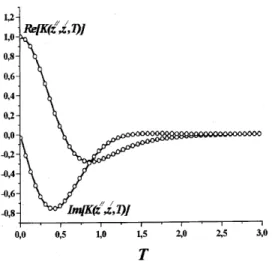
Figure 4. Timeevolution of the real and imaginary parts
oftheexat(lines)andSCSP(irles)forapurelyquarti
osillator. Theagreementisexellent.
Fig. 4showsthe resultsfrom T =0:0 to T =3:0
Again the agreementbetween the real and imaginary
parts of exat CSP and SCSPis exellent. This ase
was simulated with the same parameters of Fig. 3,
q 0
=q 00
=0:0; p 0
=p 00
= 1:0 and b = 1:0. The same
onvergeneapproahwasused,eahtimepoint(along
1000 points) is built from asingle omplex trajetory
whose initial guess is taken from the previous(x 0
1 ;p
0
1 )
pair.
Wewouldliketopointoutherethat,inordertoget
theSCSPvalueforlongertimesinthequartiase,itis
neessarytoinludeontributionsfromseveralomplex
trajetories.Thesearegeneratedbyfamiliesofreal
tra-jetoriesathigherenergies. Duetothedynamial
har-aterofthequartipotential,theshortertheperiodof
itslassialtrajetoriesthehighertheirenergies. Thus
losetothepropagatortimeT =0,aninnitenumber
ofomplextrajetoriesexistbuttheirontributions
ap-proahzero(theimaginarypartoftheiromplexation
isverylarge)andtheonlyrelevantrootisthesoalled
\free" omplextrajetory. Close to T =0, theinitial
oherentpaketbehavesasafreepartileandtheSCSP
isthereforeonstrutedbyfreeomplexpaths.
V Conlusion
Wehaveshownherethatthesemilassial
approxima-tionintheoherent-staterepresentationleadsto
au-rate values of the CSP amplitudes even far from the
semilassial domain (large values of ~). The
exel-lene and importane of the method is therefore
on-rmed. Thisimportaneisjustiedbythepossibilityof
extending the semilassialmethod overmulti
dimen-sional systemswhih would leadto interesting results
mainly intheeldofmoleulardynamis.
Wehavepresentedanewmethodbasedonasimple
Runge-Kutta algorithm that allows a quik and easy
beexerisedwiththephasefator[16℄oftheSCSP
am-plitude whih arises from the amplitude fator of the
semilassialpropagator.
Therelativerole ofeah omplextrajetoryin the
SCSPamplitude(dependingonthesystem)stillneeds
tobefurtherlaried. Intheaseofthequarti
poten-tial, the number of ontributing omplex trajetories
growswithT asthenumberofturnsofrealtrajetory
familiesinreases. Thisisnottheasewithotherkinds
ofpotentialswheretheorbitperiod-energyrelationis
dierent. Therole ofomplextrajetoriesisspeially
importantinthesemilassialdeterminationofspetra
byFouriertransformoftheCSPdiagonalelements. A
workinthisdiretionwillbepresentedelsewhereinthe
future.
Aknowledgments
Theauthorwouldliketoaknowledgeenlightening
disussions with Prof. Marus de Aguiar and the
-nanial support by FAPESP under ontrat number
00/03168-0.
Referenes
[1℄ E.Wigner,Phys.Rev.40,749(1932).
[2℄ K.Husimi, Pro. Phys. Math. So. Of Japan 22, 264
(1940).
[3℄ E.Shrodinger,Naturwissenshaften14,664(1926).
[4℄ J.R.KlauderandE.C.G.Sudarshan,Fundamentalsof
QuantumOptis,WABenjamin,In(1968).
[5℄ C.Cohen-Tannoudji,B.DiuandF.Laloe,Quantum
Me-hanis,vol.1,Ed.JohnWiley&Sons(1977).
[6℄ R. Klauder, Path integrals, Proeedings of the NATO
advanedSummer shool, Ed. by G. J. Papadopoulos
andJ.T.Devreese,PlenumNY(1975).
[7℄ M. C. Gutzwiller, J. Math. Phys. 8, 1979 (1967); 10,
1004(1969);12,343(1971).
[8℄ J.R.Klauder,Phys.Rev.D19,2349(1979).
[9℄ M.BarangerandM.A.MdeAguiar,unpublishednotes.
[10℄ AL.Xavier,JrandM.A.M.deAguiar,Phys.Rev.A
54,1808(1996).
[11℄ AL.Xavier,JrandM.A.MdeAguiar,Ann.ofPhys.
252,458(1997).
[12℄ A LXavier, Jr and M. A. M. deAguiar, Phys.Rev.
Lett.79,3323(1997).
[13℄ M.Baranger,K.T.R.DaviesandJ.H.Mahoney,Ann.
ofPhys.186,95(1988).
[14℄ W.H.Press,S.A.Teukolsky,W.T.VetterlingandB.
P. Flannery, Numerial Reipes inFortran 77: the art
ofsientiomputing.CambridgeUniv.Press.(1992).
[15℄ M.AM.deAguiarandAL.Xavier,Jr,Phys.Lett.A
164,279(1992).
[16℄ J.M.VanVlek, Pro.Aad.Natl. Si.USA14,178