Ar
ti
cl
e
0103 - 5053 $6.00+0.00
*e-mail: [email protected]
Silica-Supported Quinolinium Tribromide: a Recoverable Solid Brominating
Reagent for Regioselective Monobromination of Aromatic Amines
Zheng Li,* Xiunan Sun, Lue Wang, Yanbo Li and Yuanhong Ma
Gansu Key Laboratory of Polymer Materials, College of Chemistry and Chemical Engineering, Northwest Normal University, Lanzhou, Gansu, 730070 P. R. China
Sintetizamos tribrometo de quinolina suportado em sílica, que mostrou ser um reagente de bromação eiciente, estável e reutilizável para a monobromação regiosseletiva de aminas aromáticas. Esse processo tem a vantagem de apresentar alto rendimento sob condições moderadas e usando procedimentos experimentais simples.
Silica-supported quinolinium tribromide was synthesized and found to be an eficient, stable, and recoverable solid brominating reagent for the regioselective monobromination of aromatic amines. This protocol has advantages of high yield, mild condition and simple work-up procedure.
Keywords: bromination, aromatic amine, silica-supported quinolinium tribromide
Introduction
Bromination of aromatic substrates has received signiicant interest in recent years due to the increasing commercial importance of bromo-organics in the synthesis of a large number of natural products as well as in the manufacture of pharmaceuticals, agrochemicals and other specialty chemicals. Bromo-organics are key intermediates in the preparation of organometallic reagents and play vital roles in transition metal coupling reactions.1 Bromo-organics can also be used as potent
antitumor, antibacterial, antifungal, antineoplastic, antiviral and antioxidising agents.2 The conventional
bromination of aromatic substrates typically uses liquid bromine as brominating reagent under harsh reaction conditions.3 However, liquid bromine is a corrosive
reagent and can be dificult to manipulate on small scale, thus special care is required for its storage and transportation. Recently, a variety of new methods for the bromination of aromatic compounds have been reported in the literature ranging from NBS,4 KBr/mineral acid,5
[bmim]Br3,6 NaBr/NaClO 2,
7 KBr/PhCH
2Ph3PHSO5,
8
KBr/H2O2,9N-methylpyrolidin-2-one hydrotribromide/
H2O2,10 RBr/NaH,11 hexamethylenetetramine-Br 2,
12
N,N,N’,N’-tetrabromobenzene-1,3-disulfonylamide or poly(N-bromobenzene-1,3-disulfonylamide),13
1,2-dipyridiniumditribromide-ethane,14 ethylenebis
(N-m e t hy l i (N-m i d a z o l i u (N-m ) d i t r i b r o (N-m i d e ,1 5 1 bu t y l 3
-methylpyridinium tribromide,16tert-butylhydroperoxide/
HBr,17 LiBr/(NH
4)2Ce(NO3)6,
18 KBr/NaBO 3·4H2O,
19
2 - m e t h y l - 4 - p o l y ( s t y r y l m e t h y l ) t h i a z o l i u m hydrotribromide,20 LiBr/(diacetoxyiodo)benzene,21
alkalimetal bromide/NaIO4,22 bromodimethylsulfonium
bromide,23 HBr/H 2O2,
24
1,8-diazabicyclo[5.4.0]undec-7-ene hydrobromide perbromide,25 metal bromides/
sodium bismuthate,26N-octyl quinolinium tribromide27
and pyridinium hydrobromide perbromide.28 However, some methods still suffer from drawbacks of dificult handling, low selectivity, low yield and corrosion.
Very recently, silica-supported reagents and catalysts,29 especially the silica-supported brominating
reagent,30 were investigated,which had the advantages
of high eficiency, high activity and easy handling. In continuation of our study on the chemical transformation using silica-supported reagent, in this paper, we report a new bromination method which uses silica-supported quinolinium tribromide (SQTB) instead of liquid bromine as an alternative electrophilic bromine source to deliver a stoichiometric amount of bromine to aromatic amines and regioselectively synthesize monobromination products under mild condition.
Experimental
1H NMR spectra on a Mercury-400BB instrument
using CDCl3 or DMSO-d
6 as solvents and Me4Si
as internal standard. Melting points were observed in an electrothermal melting point apparatus. Gas chromatography was determined on Shimadzu GC 2010. The course of reaction and purity of products were checked by TLC.
Preparation of silica chloride
Silica chloride was prepared according to modiied literature method.31 Silica gel (80-200 mesh) was washed
with 1 mol L-1 HCl, followed by deionized water, 30%
H2O2 and then again deionized water. After being washed, the silica was dried overnight at 100 oC in vacuum to
give preconditioned silica gel. To preconditioned silica gel (10 g), in a round bottomed lask equipped with a condenser and a drying tube, thionyl chloride (40 mL) was added and the reaction mixture was reluxed for 48 h. The unreacted thionyl chloride was distilled off and the resulting grayish whitepowder was dried at 100 oC in vacuum and stored in a tightly capped bottle.
This silica chloride can be used for months without losing its activity.
Preparation of silica-supported quinoline
Silica-supported quinoline was prepared according to modiied literature method.31 Silica chloride (5 g)
was added to the solution of 8-hydroxyquinoline (7.3 g, 50 mmol) and triethylamine (5.1 g, 50 mmol) in 20 mL of acetonitrile, and the slurry was reluxed for 24 h. Then, the mixture was iltered and the solid was washed with dichloromethane (3×20 mL) and deionized water (3×50 mL), and then dried at 100 oC in vacuum to give
the product. The silica supporting capacity for quinoline is ca. 1.2 mmol g-1, which was estimated by carbon
elemental analysis.
Preparation of silica-supported quinolinium tribromide
To the silica-supported quinoline (5 g, 6 mmol based on the supported quinoline), hydrobromic acid (48 wt.% in water, 6.7 g, 40 mmol) was added. The mixture was stirred vigorously at room temperature for 12 h. Then sodium bromate (0.75 g, 5 mmol) was added, and the resulting mixture was reluxed for 48 h. Then, the mixture was iltered, the solid was washed with deionized water (3×50 mL) and dried at 100 oC in vacuum to give the
product. The silica supporting capacity for quinolinium tribromide is ca. 1.2 mmol g-1, which was estimated by
carbon elemental analysis. IR ν
max/cm
-1 (KBr): 3429,
2926, 1631, 1454, 1361, 1104, 976, 805.
General procedure for the monobromination of aromatic amines using silica-supported quinolinium tribromide
To an aromatic amine (1 mmol) in 20 mL of acetonitrile, silica-supported quinolinium tribromide (1 g, 1.2 mmol based on the supported quinolinium tribromide) was added. The mixture was stirred at room temperature or at reflux for appropriate time indicated in Table 2 until the reaction was completed as monitored by TLC. The resulting mixture was iltered to recover the spent silica-supported quinolinium tribromide, which was washed by CH2Cl2 (3×10 mL) and regenerated by further reaction with hydrobromic acid and sodium bromated. The iltrate was evaporated off the solvent under reduced pressure and extracted with ether (4×10 mL). The ether solution was washed with deionized water (4×10 mL), dried by magnesium sulfate and then evaporated off ether to give the crude product, which was recrystallized from ethanol to give the pure product. The analytical data for representative compounds are shown below.
2-Bromo-4-methoxybenzenamine (entry 9) 1H NMR (CDCl
3, 400 MHz) d 3.73 (s, 3H, CH3), 4.20
(br s, 2H, NH2), 6.25-6.70 (m, 3H, Ar-H). IR ν
max/cm
-1
(KBr): 3392, 3299, 1594, 1478.
4-Bromo-N,N-dimethylbenzenamine (entry 10) 1H NMR (CDCl
3, 400 MHz) d 2.91 (s, 6H, CH3), 6.55
(d, J 8.8 Hz, 2H, Ar-H), 7.27 (d, J 8.8 Hz, 2H, Ar-H). IR ν
max/cm
-1 (KBr): 3094, 15892, 1502, 1358, 1225.
N-(4-bromophenyl)-benzamide (entry 14) 1H NMR (CDCl
3, 400 MHz) d 7.47-7.57 (m, 7H,
Ar-H), 7.80 (br s, 1H, NH), 7.85-7.87 (m, 2H, Ar-H). IR ν
max/cm
-1 (KBr): 3331, 1645, 1518.
2-Amino-6-bromobenzothiazole (entry 16) 1H NMR (DMSO-d
6, 400 MHz)d 7.22 (d, J 9.2 Hz,
1H, Ar-H), 7.31 (d, J 9.2 Hz, 1H, Ar-H), 7.63 (s, 2H, NH2), 7.78 (s, 1H, Ar-H). IR ν
max/cm
-1 (KBr): 3457, 3089,
1634, 1534, 1447, 1306, 1107.
3-Bromo-9-ethyl-carbazole (entry 19) 1H NMR (CDCl
3, 400 MHz): d 1.40-1.44 (t, 3H, J 7.2
Hz, CH3), 4.32-4.35 (q, 2H, J 7.2 Hz, CH2), 7.24-7.53 (m, 5H, Ar-H), 8.03-8.05 (m, 1H, Ar-H ), 8.20 (s, 1H, Ar-H). IR ν
max/cm
Results and Discussion
Preparation of silica-supported quinolinium tribromide (SQTB)
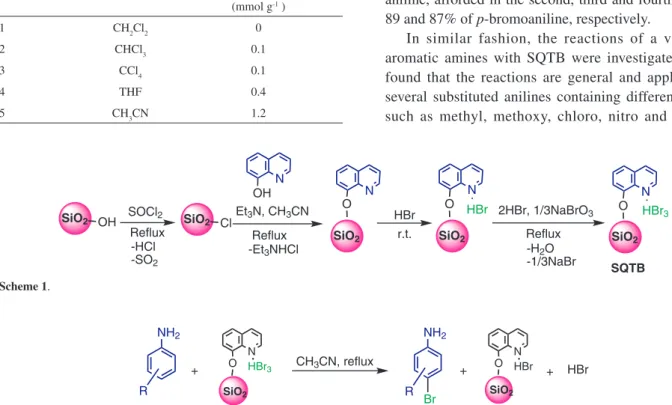
Silica-supported quinolinium tribromide was synthesized by the relux of preconditioned silica gel in thionyl chloride irst to give silica chloride, then silica chloride was further reacted with 8-hydroxyquinoline in acetonitrile under refluxing condition to yield silica-supported quinoline. Silica-supported quinoline was further treated with hydrobromic acid at room temperature to form silica-supported quinolinium bromide, which was then reluxed with the mixture of hydrobromic acid and sodium bromate to afford silica-supported quinolinium tribromide (SQTB) in high yield (Scheme 1). It is noteworthy to mention that the silica supporting capacity for quinolinium tribromide is affected by solvents. The CH2Cl2, CHCl3, CCl4, THF and CH3CN were tested for the supporting reaction. It was found that the reaction in acetonitrile gave the best result (Table 1). SQTB is a stable solid and has no offensive odor of typical bromine.
Monobromination of aromatic amines using silica-supported quinolinium tribromide (SQTB)
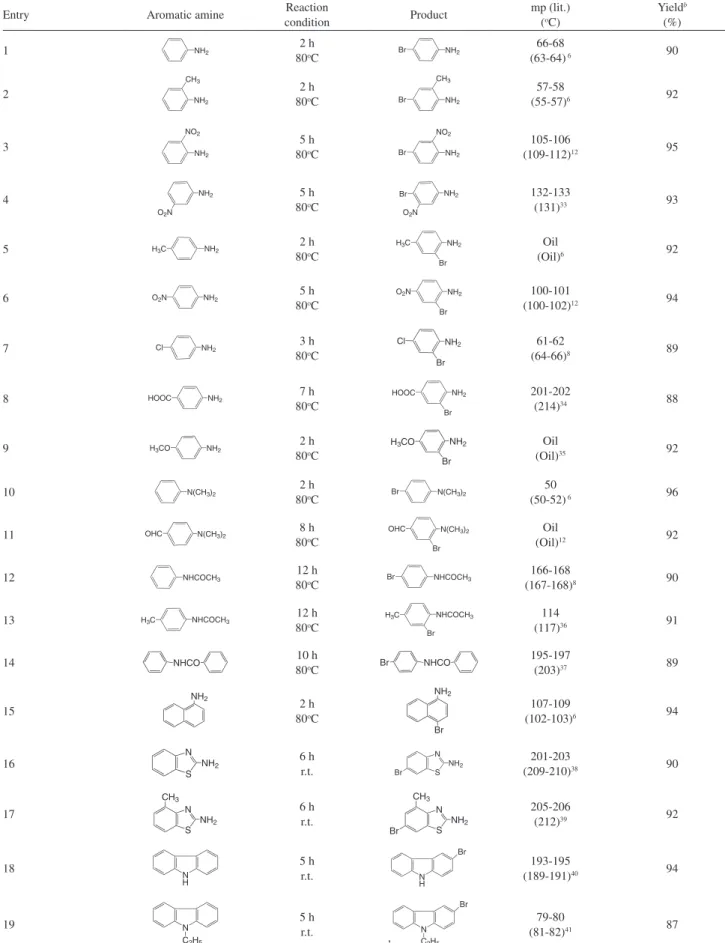
In order to explore the application of SQTB as a brominating reagent, aniline was selected as a model substrate. It was found that aniline reacted with SQTB in acetonitrile eficiently at relux condition leading to regioselective monobromination, preferentially in the para
position due to stereoelectronic effects (Table 2, entry 1), producing p-bromoaniline in high yield (Scheme 2). Moreover, due to use of the reagent in a stoichiometric amount, no polybromination occurred with SQTB. Although the unsupported quinolinium tribromide32
reported in the literature could also be an oxidizing agent for amines, no oxidizing products were observed for SQTB under the studied conditions. It is important to mention that the solvents play an important role in the bromination reaction by SQTB. The reaction hardly proceeded in CH2Cl2, C2H5OH, DMF, 1,4-dioxane, DMSO and CS2. However, the reaction in CH3CN afforded product in high selectivity, nearly complete conversion. Therefore, CH3CN was selected as the reaction solvent. Furthermore, the spent SQTB could be easily recovered from the reaction system only by iltration, and then could be easily regenerated by further reaction with hydrobromic acid and sodium bromate. The bromination ability of the reagent was renewed. For example, the recycled SQTB, that was used under the conditions of Table 2 for the bromination of aniline, afforded in the second, third and fourth runs 90, 89 and 87% of p-bromoaniline, respectively.
In similar fashion, the reactions of a variety of aromatic amines with SQTB were investigated. It was found that the reactions are general and applicable to several substituted anilines containing different groups, such as methyl, methoxy, chloro, nitro and carboxyl Table 1. The effect of solvents on the silica supporting capacity for
quinolinium tribromide
Entry Solvent
Silica supporting capacity for quinolinium tribromide
(mmol g-1 )
1 CH2Cl2 0
2 CHCl3 0.1
3 CCl4 0.1
4 THF 0.4
5 CH3CN 1.2
Scheme 1.
SiO2 Cl SOCl2
Reflux
Et3N, CH3CN O
N
HBr HBr 2HBr, 1/3NaBrO3
Reflux O
N.
HBr3 O
N
r.t. OH
N
SQTB .
SiO2 OH
SiO2
SiO2 SiO2
-HCl -SO2
Reflux
-H2O -1/3NaBr -Et3NHCl
Scheme 2.
NH2
R
NH2
R CH3CN, reflux
Br HBr3
O N.
SiO2
HBr O
N .
SiO2
+ + HBr
+ SiO2 Cl SOCl2
Reflux
Et3N, CH3CN O
N
HBr HBr 2HBr, 1/3NaBrO3
Reflux O
N.
HBr3
O N
r.t. OH
N
SQTB .
SiO2 OH
SiO2
SiO2 SiO2
-HCl -SO2
Reflux
-H2O -1/3NaBr -Et3NHCl
NH2
R
NH2
R CH3CN, reflux
Br HBr3
O N.
SiO2
HBr O
N .
SiO2
+ + HBr
Table 2.Monobromination of aromatic amines with silica-supported quinolinium tribromide (SQTB)a
Entry Aromatic amine Reaction
condition Product
mp (lit.) (oC)
Yieldb
(%)
1 NH2
2 h
80oC NH2
Br 66-68
(63-64) 6 90
2 NH
2
CH3
2 h
80oC NH2
CH3
Br
57-58
(55-57)6 92
3 NH
2
NO2
5 h
80oC NH2
NO2
Br
105-106
(109-112)12 95
4 NH2
O2N
5 h 80oC
NH2
O2N
Br 132-133
(131)33 93
5 H3C NH2
2 h 80oC
NH2
H3C
Br
Oil
(Oil)6 92
6 O2N NH2 5 h
80oC
NH2
O2N
Br
100-101
(100-102)12 94
7 Cl NH2
3 h 80oC
NH2 Cl
Br
61-62
(64-66)8 89
8 HOOC NH2 7 h
80oC
NH2
HOOC
Br
201-202
(214)34 88
9 H3CO NH2
2 h 80oC
NH2 H3CO
Br
Oil
(Oil)35 92
10 N(CH3)2
2 h
80oC Br N(CH3)2
50
(50-52) 6 96
11 OHC N(CH3)2 8 h
80oC
N(CH3)2 OHC
Br
Oil
(Oil)12 92
12 NHCOCH3
12 h
80oC Br NHCOCH3
166-168
(167-168)8 90
13 H3C NHCOCH3
12 h 80oC
H3C NHCOCH3
Br
114
(117)36 91
14 NHCO 10 h
80oC Br NHCO
195-197
(203)37 89
15
NH2
2 h 80oC
NH2
Br
107-109
(102-103)6 94
16
S N
NH2
6 h
r.t. S
N NH2 Br
201-203
(209-210)38 90
17
S N
NH2
CH3
6 h r.t.
S N
NH2
CH3
Br
205-206
(212)39 92
18
N H
5 h
r.t. N
H
Br
193-195
(189-191)40 94
19 N
C2H5
5 h r.t.
’
N C2H5
Br
79-80
(81-82)41 87
groups. If the substituents are electron-rich groups, the reaction time is shorter than the electron-withdrawing groups (Table 2, entries 2-9). When the para position of the substituted anilines is occupied, the reactions lead to selective monobromination in the ortho position (Table 2, entries 5-9).
In order to explore the generality of the method developed for the monobromination of activated aromatic substrates, experiments for reactions of secondary or tertiary anilines or amides with SQTB were also conducted. They were also effective and gave the corresponding monobromination products in excellent yield (Table 2, entries 10-14). Furthermore, in a similar fashion, the reactions of 1-aminonaphthalene, 2-aminobenzothiazole, 2-amino-4-methyl-benzothiazole, carbazole and 9-ethylcarbazole with SQTB were also attempted. Corresponding monobromination products were also obtained in high yield (Table 2, entries 15-19).
In comparison with other brominating reagents according to Eissen’s method,42 SQTB used in this protocol
has similar property to sol-gel entrapped pyridinium hydrobromide perbromide reported by Levin,30 both of
which could be easily recovered from the reaction systems, regenerated by further reactions with hydrobromic acid/ sodium bromate or bromine, and reused many runs without obvious loss of activities. Employing SQTB as a transport medium for bromine could reduce the hazardous potential of using molecular bromine.43 The cost and
environmental impact of SQTB could be minimized by its recyclability. However, producing by-product (sodium chloride) in the preparation of SQTB and using volatile solvent (acetonitrile) in the brominating reactions are still the insuficiency of this protocol.
In conclusion, the silica-supported quinolinium tribromide was found to be an eficient, regioselective, stable and recoverable solid brominating reagent for the monobromination of aromatic amines including primary, secondary and tertiary amines, as well as amides and heterocycles. The ease of work up, high yield and high selectivity are the features of this reagent.
Acknowledgments
The authors thank the National Natural Science Foundation of China (20772096), Key Laboratory of Eco-Environment-Related Polymer Materials (Northwest Normal University), Ministry of Education of China for the inancial support of this work.
References
1.Beletskaya, I. P.; Cheprakov, A. V.; Chem. Rev. 2000, 100, 3009; Meijere, A.; Meyer, F. E.; Angew. Chem., Int. Ed. Engl. 1994,
33, 2379; Cabri, W.; Candiani, I.; Acc. Chem. Res. 1995, 28, 2. 2. Butler, A.; Walker, J. V.; Chem. Rev. 1993, 93, 1937; Gribble,
G. W.; Acc. Chem. Res. 1998, 31, 141; Gribble, G. W.; Chem. Soc. Rev. 1999, 28, 335.
3. Jiang, X. F.; Shen, M. H.; Tang, Y.; Li, C. Z.; Tetrahedron Lett. 2005, 46, 487; Wang, L.; Jing, H. W.; Bu, X. L.; Chang, T.; Jin, L. L.; Liang, Y. M.; Catal. Commun. 2007, 8, 80; Gnaim, J. M.; Sheldon, R. A.; Tetrahedron Lett.2005, 46, 4465; Esakkidurai, T.; Kumarraja, M.; Pitchumani, K.; Catal. Lett.2004, 92, 169. 4. Ganguly, N. C.; De, P.; Dutta, S.; Synthesis2005, 1103;
Rajagopal, R.; Siddiqui, S. A.; Daniel, T.; Lahoti, R. J.; Srinivasan, K. V.; J. Mol. Catal. A: Chem. 2004, 210, 165; Rajagopal, R.; Jarikote, D. V.; Lahoti, R. J.; Daniel, T.; Srinivasan, K. V.; Tetrahedron Lett.2003, 44, 1815.
5. Myint, Y. Y.; Pasha, M. A.; J. Chem. Res.2004, 732; Joshi, A. V.; Baidossi, M.; Mukhopadhyay, S.; Sasson, Y.; Org. Process. Res. Dev.2004, 8, 568.
6. Le, Z. G.; Chen, Z. C.; Hu, Y.; Zheng, Q. G.; Synthesis2004, 2809; Chiappe, C.; Leandri, E.; Pieraccini, D.; Chem. Commun. 2004, 2536.
7. Hirano, M.; Monobe, H.; Yakabe, S.; Morimoto, T.; Synth. Commun.1998, 28, 1463.
8. Adibi, H.; Hajipour, A. R.; Hashemi, M.; Tetrahedron Lett. 2007, 48, 1255.
9. Sadygov, O. A.; Alimardanov, K. M.; Chalabiew, Ch. A.; Russ. J. Appl. Chem.2006, 79, 949.
10. Singhal, S.; Jain, S. L.; Sain, B.; J. Mol. Catal. A: Chem.2006,
258, 198.
11. Guo, M. J.; Varady, L.; Fokas, D.; Baldino, C.; Yu, L. B.;
Tetrahedron Lett.2006, 47, 3889.
12. Heravi, M. M.; Abdolhosseini, N.; Oskooie, H. A.; Tetrahedron Lett.2005, 46 8959.
13. Ghorbani-Vaghei, R.; Jalili, H.; Synthesis2005, 1099. 14. Kavala, V.; Naik, S.; Patel, B. K.; J. Org. Chem., 2005, 70, 4267. 15. Hosseinzadeh, R.; Tajbakhsh, M.; Mohadjerani, M.; Lasemi,
Z.; Monatsh. Chem.2009, 140, 57.
16. Borikar, S. P.; Daniel, T.; Paul, V.; Tetrahedron Lett. 2009, 50, 1007.
17. Barhate, N. B.; Gajare, A. S.; Wakharkar, R. D.; Bedekar, A. V.; Tetrahedron 1999, 55, 11127; Barhate, N. B.; Gajare, A. S.; Wakharkar, R. D.; Bedekar, A. V.; Tetrahedron Lett. 1998, 39, 6349.
18. Roy, S. C.; Guin, C.; Rana, K. K.; Maiti, G.; Tetrahedron Lett. 2001, 42, 6941.
19. Roche, D.; Prasad, K.; Repic, O.; Blacklock, T. J.; Tetrahedron Lett. 2000, 41, 2083.
21. Braddock, D. C.; Cansell, G.; Hermitage, S. A.; Synlett 2004, 461.
22. Dewkar, G. K.; Narina, S. V.; Sudalai, A.; Org. Lett. 2003, 5, 4501.
23. Majetich, G.; Hicks, R.; Reister, S.; J. Org. Chem. 1997, 62, 4321.
24. Vyas, P. V.; Bhatt, A. K.; Ramachandraiah, G.; Bedekar, A. V.;
Tetrahedron Lett. 2003, 44, 4085.
25. Muathen, H. A.; J. Org. Chem. 1992, 57, 2740. 26. Muathen, H. A.; Helv. Chim. Acta 2003, 86, 164.
27. Kaushik, M. P.; Polshettiwar, V.; Indian J. Chem., Sect B 2006,
45, 2542.
28. Fieser, L. F.; Fieser, M.; Reagents for Organic Synthesis Wiley: New York, 1967, vol. 1, p. 967; Reeves, W. P.; King, R. M.;
Synth. Commun.1993, 23, 855; Steenkamp, J. A.; Ferreira, D.; Roux, D. G.; Tetrahedron Lett.1985, 26, 3045; Jovanovic, M. V.; Biehl, E. R.; J. Org. Chem.1984, 49, 1905.
29. Salehi, P.; Dabiri, M.; Zoligol, M. A.; Fard, M. A. B.; J. Braz. Chem. Soc.2004, 15, 773; Li, Z.; Zhu, A. G.; Mao, X. R.; Sun, X. N.; Gong, X.; J. Braz. Chem. Soc.2008, 19, 1622; Li, Z.; Ding, R. B.; Lu, Z.; Xiao, S. X.; Ma, X. L.; J. Mol. Catal. A: Chem.2006, 250, 100; Li, Z.; Ma, X. L.; Liu, J.; Feng, X.; Tian, G. Q.; Zhu, A. G.; J. Mol. Catal. A: Chem. 2007, 272, 132; Li, Z.; Lu, Z.; Zhu, A. G.; Feng, X.; Liu, J.; Tian, G. Q.; Catal. Lett.2008, 120, 100; Li, Z.; Lu, Z.; Lett. Org. Chem.2008, 5,
495; Li, Z.; Liu, J.; Gong, X.; Mao, X. R.; Sun, X. N.; Zhao, Z. X.; Chem. Pap.2008, 62, 630.
30. Levin, Y.; Hamza, K.; Abu-Reziq, R.; Blum, J.; Eur. J. Org. Chem. 2006, 1396.
31. Zoligol, M. A.; Madrakian, T.; Ghaemi, E.; Afkhami, A.; Azizian, S.; Afshar, S.; Green Chem.2002, 4, 611.
32. Joshaghani, M.; Raiee, E.; Shahbazi, F.; Jafari, H.; Amiri, S.; Omidi, M.; ARKIVOC 2007, 164.
33. Ramana, M. M. V.; Malik, S. S.; Parihar, J. A.; Tetrahedron Lett. 2004, 45, 8681.
34. Johnson, O. H.; Green, D. E.; Pauli, R.; J. Biol. Chem.1944,
153, 37.
35. Kelley, W. S.; Justus Liebigs Ann. Chem.1971, 744, 129. 36. Scott, J. M. W.; Can. J. Chem.1960, 38, 2441.
37. Roychowdhury, A.; Kumar, V. V.; Bhaduri, A. P.; Synth. Commun.2006, 36, 715.
38. Li, D. F.; Jiang, G. J.; Li, J. S.; Chem. J. Chin. Univ.1990, 11, 205. http://www.cjcu.jlu.edu.cn.
39. Hunter, R. F.; J. Chem. Soc.1926, 1385.
40.Smith, K.; James, D. M.; Mistry, A. G.; Bye, M. R.; Faulkner, D. J.; Tetrahedron1992, 48, 7479.
41. Bruck, P.; J. Org. Chem.1970, 35, 2222.
42. Eissen, M.; Lenoir, D.; Chem. Eur. J.2008, 14, 9830. 43. Ryu, I.; Mathsubara, H.; Yasuda, S.; Nakamura, H.; Curran, D.
P.; J. Am. Chem. Soc.2002, 124, 12946; Chiappe, C.; Capraro, D.; Conte, V.; Pieraccini, D.; Org. Lett.2001, 3, 1061.
Received: April 8, 2009