Abstract
The classical problem of the response characteristics of uniform structural member resting on elastic subgrade and subjected to uniform partially distributed load is studied in this work. The closed form solutions of the governing fourth order partial differen-tial equations with variable coefficients are presented using an elegant analytical technique for the moving force and mass models. Various results and analyses are carried out on each of the perti-nent boundary conditions and phenomenon of resonance is studied for the dynamical system. It was found that in all illustrative examples considered, for the same natural frequency, the critical speed for moving distributed mass problem is smaller than that of the moving distributed force problem. Hence, resonance is reached earlier in moving mass beam-load interaction problem. Finally, this work has suggested valuable methods of analytical solution for this category of problems for all boundary conditions of practical interest.
Keywords
Dynamic characteristics, Resonance, Subgrade, Distributed Loads, Dynamical system.
Behavioral Study of Finite Beam Resting on Elastic Foundation
and Subjected to Travelling Distributed Masses
1 INTRODUCTION
Analyses of the dynamic characteristics of elastic structural members resting on elastic subgrade, such as railway, tracks, highway pavements, navigation locks and structural foundations constitute an important part of the civil Engineering, Mathematical Physics and other related fields. These elastic structures are very useful in many fields of research, thus their dynamic behaviours when under the action of travelling loads of different forms have received extensive attention in the open literature [ Oni and Omolofe (2005a), Hassan et al (2016), Omolofe (2013), Ismail (2015)]. When these important engineering structures are resting on an elastic foundation, the structure-foundation interaction effects play significant roles in their response behaviour and alter the dynamic states of
B. Omolofe a T.O. Adeloye b
a Department of Mathematical Sciences
Federal University of Technology, Akure, Nigeria.
Email: [email protected]
b Department of Mathematical Sciences
Federal University of Technology, Akure, Nigeria. Email: [email protected]
http://dx.doi.org/10.1590/1679-78253071
the structures from those vibrating in the absence of foundation [Ugurlu et al (2008)]. Hence, the dynamic behaviour of structures on elastic foundation is of great importance in structural, aero-space, civil, mechanical and marine engineering applications.
Consequently, it is important to clarify the influence of the foundation on the behaviour of elas-tic structures in engineering designs. Furthermore, to accurately assess the dynamic response of any structural member on elastic foundations, a mechanical model is required to predict the interaction effects between such structures and foundations. Beams on elastic foundation and under the actions of the moving loads have received a considerable attention in literature; see for example references [Clastornik et al (1986), Thambiratnam and Zhuge (1996), Sun and Luo (2008), Ying et al (2008)] However, most of these works employed the simplest mechanical model which was developed by Winkler and generally referred to as a one-parameter model. The deficiency of this model is that it assumes no interaction between the springs, so it does not accurately represent the characteristics of many practical foundations [Eisenberger and Clastornik (1987)]. Thus to overcome the deficiencies inherent in Winkler formulation, a two-parameter foundation models which takes into account the effect of shear interactions between springs has been suggested.
In general, such analyses are mathematically complex due to the difficulty often encounter in modeling the mechanical response of the subgrade which is governed by many factors. When these structures are acted upon by moving loads, the dynamic analyses of the system become much more complicated.
It is known from earlier studies that, the problem of assessing transverse vibrations of elastic solid structures subjected to moving loads has been commonly considered for a point-like type of moving load, see for examples [Gbadeyan and Oni (1992), Sadiku and Leipholz (1989), Lee (1994), Oni and Omolofe (2005b), Oni and Awodola (2005)]. While studies concerning a dynamical system involving moving distributed loads are not so common. However, in engineering practice moving loads are most often in the form of distributed mass rather than that of moving lumped mass. When the moving load is distributed, the problem of investigating the load-structure interactions becomes much more complicated. Thus, to study the dynamic characteristics of such dynamical systems to the degree of aceptable accuracy required and also for practical purposes, it is useful to consider elastic structural members subjected to moving distributed loads.
More recently, [Andi (2013), Ogunyebi (2006), Andi and Oni (2014)] carried out dynamical analysis of structural members carrying uniform partially distributed masses with general boundary conditions under travelling distributed loads. In these studies, versatile analytical techniques were used to obtain solutions valid for all variants of classical boundary conditions. Though these authors presented a very good analysis of the response of beams to distributed loads, but their studies failed to represent the physical reality of the problem formulation as they employed in their studies a simplified model of the distributed load in which the factor that measures the degree of the load distribution was omitted.
Thus, this work therefore concerns the problem of the behavioral study of a slender member continuously supported by elastic subgrade and subjected to uniform partially distributed moving masses and sets at solving this class of dynamical problem for all pertinent boundary conditions often encountered by practicing engineers.
y
x
2
2
L
M V
t
g
y
x
2
2
L
M V
t
g
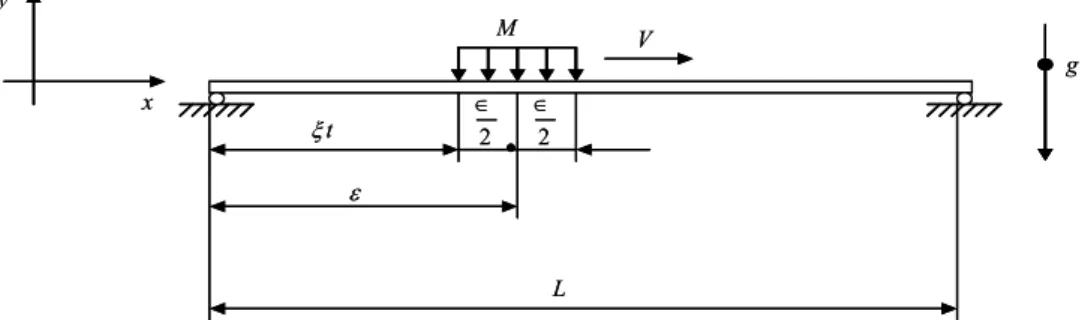
Figure 1: Schematic diagram of a beam under partially distributed load.(Esmailzadeh and Gorashi 1995).
2 THEORY AND FORMULATION OF THE PROBLEM
Consider the vibration of a structural member resting on elastic foundation and traversed by uni-form partially distributed masses M. The mass M is assumed to strike the beam at the point x=0 and time t=0 and travels across it with a constant velocity v. The equation of motion, assuming uniform cross section is given by the fourth order partial differential equation.
t
x
Q
x
t
x
z
G
t
x
Kz
t
t
x
z
x
t
x
z
N
x
t
x
z
EI
,
,
,
,
2,
,
2
2 2
2 2
4 4
(1)
where, E is the modulus of elasticity, I is the second moment of the beam’s cross-section,
is the mass per unit length of the beam, N is the axial force,K
is the foundation constant, G is the shear rigidity,z
x
,
t
is the deflection of the beam, measured upward from its equilibrium position when unloaded andQ
x
,
t
is the travelling distributed load.It is remarked here that the beam under consideration is assumed to have simple ends at both ends x=0 and x=L . Thus the boundary conditions are
t
z
L
t
z
0
,
0
,
,
2 22
2
0
,
,
x
t
L
z
x
t
z
and the initial conditions of the motions of the slender member is given as
t
x
z
x
z
0
,
0
0
,
(3)If the load inertia is taking into consideration,
Q
x
,
t
can be expressed as
g
t
x
z
t
x
Q
t
x
Q
,
f,
1
,
(4)while the moving force
Q
f
x
,
t
acting on this engineering structure is given as
2
2
,
H
x
H
x
Mg
t
x
Q
f (5)where H is the Heaviside unit step function with the property,
0
,1
0
,
0
x
x
x
H
(6) and2
vt
(7)For the limiting condition, as
0
one obtains
2
2
1
x
v
H
x
H
x
(8)where
x
v
is the Dirac delta function.Furthermore, the operator
used in (4) is defined as
x
x
t
x
t
2
2 2 2 2 2
2
(9)Considering equation (5) and (8) would lead to the foundation for moving point mass. Howev-er, in this work
is not limited to be a small length.Substituting (4) into (1) and taking into account (5) and (9) after some rearrangements gives
which is the fourth order partial differential equation describing the flexural motions of our engi-neering member when traversed by uniform partially distributed masses. In what follows, an ana-lytical technique that will be used to treat the problem above will be discussed.
3 SOLUTION PROCEDURES
To solve the problem above, a versatile method often used in problems involving mechanical vibra-tions will be adopted. This method will be employed to remove the ties in the governing differen-tial equation (10) and to reduce it to sequence of second order ordinary differendifferen-tial equation with variable coefficients. This solution technique involves solving equation of the form.
,
,
0
z
x
t
Q
x
t
(11)where
= The differential operator (linear or non-linear)
x
t
z
,
= The structural displacement
x
t
Q
,
= The transverse load acting on the structureA sequence of linearly independent functions
U
i
x
which are the normalized deflection curves for the ith mode of the vibrating beam satisfying simply supported boundary conditions are chosen asL
x
i
x
U
i(
)
sin
(12)and appropriate solutions sought in the form
1 2 ,
i i i
i
Z x t Y t U x
L
(13)The functions
Y
i
t
are the unknown functions of time to be determined. Thus, the unknown functionsY
i
t
are obtained from the condition that the expressionU
i
x
should be orthogonal to the functionsU
j(
x
)
. In this way, we get a set of coupled ordinary differential equations
,
0
1
0
Y
it
U
ix
Q
x
t
U
jx
dx
i L
(14)
From which we obtain
Y
i
t
. These set of coupled second order ordinary differential equations are called Galerkin’s equations. The set of coupled second order ordinary differential equations (14) are further treated using the modified asymptotic method of Struble. Furthermore, the following property of Heaviside function...
!
5
)
(
2
!
3
)
(
2
)
(
2
2
)
(
1
2 40
iv L
f
f
f
dx
x
H
x
H
x
will be useful and also the function
Q
x
,,
t
is assumed to be expressible as
1)
(
)
(
,
i ii
x
t
U
t
x
Q
(16)where
i
t
are unknown functions of time.3.1 Operational Simplification
It is evident that an exact closed form solution of the partial differential equation (10) is impossible. Thus, substituting the expressions (13) and (15) and (16) into (10) after some rigorous mathemati-cal procedures and rearrangements one obtains
0 2 2 2 ) ( 2 2 2 ) ( 2 2 2 2 ) ( 2 2 2 ) ( 2 ) ( 2 ) ( 2 ) ( 2 ) ( 2 2 2 2 2 1 4
x H x H L i L Mg t Y L x i Sin x H x H L i L Mv t Y L x i Cos x H x H L i L Mv t Y L x i Sin x H x H L M t Y L x i Sin L i L G t Y L x i Sin L K t Y L x i Sin L t Y L x i Sin L i L N t Y L x i Sin L i L EI i i i i i i i i (17)In order to determine an expression for
Y
i
t
, it is required that the expression on the left hand side of equation (17) be orthogonal to the functionU
j
x
. To this effect, multiplying equation (17) byU
j
x
, integrating from end x = 0 to end x=L and after some simplifications and rear-rangements one obtainsL j Sin P t Y L j i Cos L j i L j i Cos L j i L j Sin L i Sin L i v t Y L j i Cos L j i L j i Cos L j i L j Sin L i Cos L i v t Y L j i Cos L j i L j i Cos L j i L j Sin L i Sin t Y t Y i j i i mf i i
) ( ) ( ) ( ) ( ) ( 48 ) ( ) ( ) ( ) ( ) ( 48 2 ) ( ) ( ) ( ) ( ) ( 48 2 ) ( ) ( 2 2 2 2 2 2 2 2 2 2 2 2 1 (18) where 2 2 4 2
L
i
G
K
L
i
N
L
i
EI
mf
,
224
1
1
2
L
j
L
Mg
P
(19)L j Sin P L j i Cos L j i L j i Cos L j i L j Sin L i Sin L i v t Y L j i Cos L j i L j i Cos L j i L j Sin L i Cos L i v t Y L j i Cos L j i L j i Cos L j i L j Sin L i Sin t Y t Y j i i mf i ) ( ) ( ) ( ) ( 48 ) ( ) ( ) ( ) ( ) ( 48 2 ) ( ) ( ) ( ) ( ) ( 48 2 ) ( ) ( 2 2 2 2 2 2 2 2 2 2 2 2 (20) where
L
M
(21)Equation (20) is the transformed equation governing the motion of a uniform simply supported beam resting on bi-parametric elastic foundation and subjected to travelling masses. In what fol-lows, a closed form solution of equation (20) is sought, to this end, we shall consider two special cases of equation (20) namely the moving force and moving mass problems.
3.2 The Moving Force Beam-Load Interaction Problem
The second order ordinary differential equation describing the behaviour of a thin beam resting on elastic sub-grade and under the actions of a uniform partially distributed moving force may be ob-tained from equation (20) by setting
0
. In this case, one obtainsL
j
Sin
P
t
Y
t
Y
i(
)
mf2 i(
)
(22)In view of (7) equation (22) can further be written as,
L
vt
j
Sin
P
t
Y
t
Y
i mf i o
22
(23)Equation (23) is a classical case of a moving force problem associated with the system. Equation (23) after some simplifications yields
L
vt
j
Cos
P
L
vt
j
Sin
P
t
Y
t
Y
i(
)
mf2 i(
)
1
2
(24)To obtain an expression for
Y
i(
t
)
, equation (24) is subjected to a Laplace transformation de-fined as
0
( )
e dt
st
(26)where
s
is the Laplace parameter. Applying the initial conditions (3), one obtains the following algebraic equation2 2 2 2 2 1 2
2
(
)
(
)
a
s
s
P
a
s
a
P
s
Y
s
Y
s
i mf i
(27)where
L
v
j
a
(28)Equation (27) after some simplifications leads to
2 2 2 2 2 2 2 2 2 1
)
(
a
s
s
s
P
a
s
a
s
P
s
Y
mf mf
mf mf
mf
mf i
(29)Thus, this problem reduces to that of finding the Laplace inversion of the equation (29) bove. To this effect, the following representations are adopted.
2 2
)
(
mf mf
s
s
F
, 1(
)
2 2a
s
a
s
G
and 2(
)
2 2a
s
s
s
G
(30)so that the Laplace inversion of equation (29) is the convolution of
F
i andG
i’s defined as0
(
) ( ),
1,2
t
i i
F G
F t
u G u
i
(31)Thus, the Laplace inversion of equation (29) is given as
B mf A mf
i
I
P
I
P
t
Y
1 2)
(
(32)
t mf mf mf mfA
t
u
t
u
audu
I
0
sin
sin
cos
cos
sin
(33)
t mf mf mf mfB
t
u
t
u
audu
I
0
cos
sin
cos
cos
sin
(34)Evaluating integrals (33) and (34) one obtains
at
a
t
a
I
mf mfmf
A
sin
sin
1
2
2
(35)
at
t
a
I
mf mf mfmf
B
cos
cos
1
2
2
(36)Substituting (35) and (36) into equation (32), gives the expression for
Y
i(
t
)
as
P
at
a
t
P
at
t
a
t
Y
mf mf mf mf mfmf mf
i
sin
sin
cos
cos
1
)
(
2
2 1
2
(37)Thus, in view of (13), taking into account (12) and (37) gives
L
x
i
t
at
P
t
a
at
P
a
L
t
x
z
i
mf mf
mf mf
mf mf
mf
sin
sin
cos
cos
sin
1
2
)
,
(
1 2 2 1 2
(38)
which represents the transverse response of Euler-Bernoulli beam resting on elastic sub-grade and subject to uniform partially distributed moving forces when the inertial effect of the system is ne-glected.
3.3 The Moving Mass Beam-Load Interaction Problem
) 2 2 ( 1 ) ( ) 2 2 ( 1 ) ) ( ) ( ( ) ( ) 2 2 ( 1 ) ) ( ) ( ( ) ( ) 2 2 ( 1 ) ) ( ) ( 2 ( ) ( ) 2 2 ( 1 ) 2 ( ) ( ) 2 2 ( 1 ) ( ) ( 1 2 1 2 12 11 10 1 2 9 8 2 1 1 2 7 6 1 2 5 2 4 2 1 2 2 1 L i Cos H L i Sin L j Sin LgQ t Y L i Cos H L i Sin L j i Cos H L j i Cos H L j Sin L i Sin H t Y L i Cos H L i Sin L j i Cos H L j i Cos H L j Sin L i Cos H t Y L i Cos H L i Sin L j i Cos H L j i Cos H L j Sin L i Sin t Y L i Cos H L i Sin L i Cos H L i Sin H t Y L i Cos H L i Sin L i Sin L i Cos H t Y j j j i i j i mf i i i
(39) Where 2 12 2 11 2 10 2 9 2 8 2 7 2 6 4 2 5 2 4 3 2 3 2 2 1 ) ( 24 1 , ) ( 24 1 , 2 , ) ( 12 ) ( 12 1 , ) ( 24 1 , ) ( 24 1 , 6 2 , 3 , 4 , 6 1 L j i L v i H L j i L i H L v i H L j i L i v H L j i L i H L j i H L j i H L i H L i H L i H L i v H L i H (40)the presence of the effect of the moving mass. Following the procedures extensively discussed in [Oni and Omolofe (2005b)], the homogeneous part of equation (39) is simplified to take the form
0
)
(
)
(
22 2
Y
t
dt
t
Y
d
i mm
i
(41)
where
25 4 1
*
)
2
(
)
2
1
2
(
1
mf mf
mm
H
H
H
(42)is called the modified natural frequency representing the frequency of the free system due to the presence of the moving mass. Thus, the entire equation (39) reduces to
2
2
* 2
( )
( )
sin
2
i
mm i o
j
vt
d Y t
Y t
LgQ
dt
L
(43)which when solved in conjunction with the initial conditions yields an expression for
Y t
i
as
2 2
1
2
1
( )
sin
sin
cos
cos
i mm mm mm mm mm
mm mm
Y t
Q
at
a
t
Q
at
t
a
(44)where
1 o
cos
2
j
Q
LgQ
L
, 2sin
2
o
j
Q
LgQ
L
(45)Thus, in view of (13), taking into account (12) and (44) gives
2 2
1
2
1
2 1
( , ) mmsin sin mm mmcos mmcos mm sin
i mm mm
i x
z x t Q at a t Q at t
L a L
(46)4 COMMENTS ON THE CLOSED FORM SOLUTIONS
In an important study such as this, investigating the phenomenon of resonance is very crucial be-cause the transverse displacement of an elastic beam may increase without limit. It is seen from equation (38) that the simply supported beams on elastic subgrade and under the actions of travel-ling distributed forces reaches a state of resonance whenever
L
v
k
mf
(47)while equation (46) clearly shows that the same beam under the actions of moving distributed masses will experience resonance effects whenever
L
v
k
mm
(48)but, from equation (42)
0 1 4 22 5
1
2 1 2 1
mf mf
mm
H H H
(49)
which implies
2 5 4 1
0 2
1
2 1 2 1
mf mf
H H H
L v k
(50)
It is therefore clear that, for the same natural frequency, the critical speed for the system con-sisting of a simply supported Bernoulli-Euler beam resting on elastic foundation and under the ac-tions of travelling distributed force is greater than that of moving distributed mass problem. Thus, for the same natural frequency, resonance is reached earlier in the moving distributed mass than in the moving distributed force system.
5 ANALYSIS OF RESULT AND DISCUSSION
In this section, the analysis proposed in the previous sections are illustrated by considering a ho-mogenous beam of modulus of elasticity E2.9012109N/m2, the moment of inertial
2 3
10 87698 .
2 kgm
beam2758.291kg/m. The load is also assumed to travel with constant velocity V8.128m/s. The
values of foundation moduli are varied between 0N/m3and 40000 / 3
N m , the values of axial force N
varied between 0N and 2.0108N.
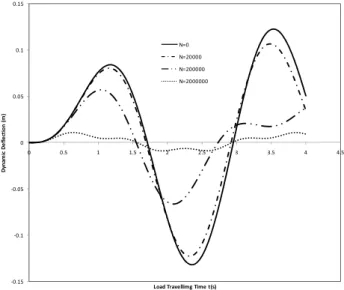
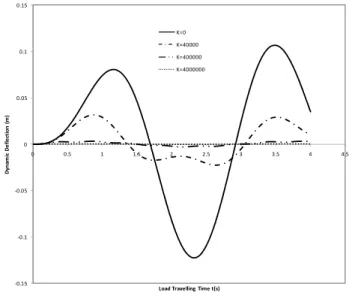
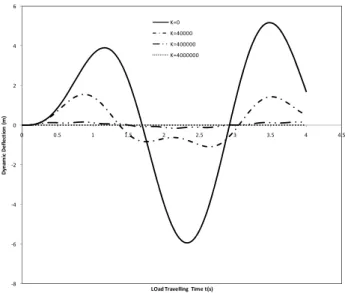
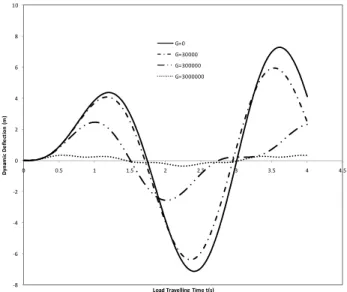
Figure 2 displays the transverse displacement response of a simply supported uniform beam un-der the action of uniform partially distributed forces travelling at constant velocity for the various values of axial force N and for fixed values of subgrade moduli K=40000 and shear modulus G=30000. The figures show that as N increases, the response amplitude of the uniform beam de-creases. Similar results are obtained when the simply supported beam is subjected to partially dis-tributed mass travelling at constant velocity as shown in figure 8. For various travelling time t, the displacement response of the beam for various values of subgrade moduli K and for fixed values of axial forcé N=20000 and shear modulus G=30000 are shown in figure 3. It is observed that higher values of subgrade moduli K reduce the deflection of the vibrating beam. The same behavior char-acterizes the response of the simply supported beam under the actions of uniform partially distrib-uted masses moving at constant velocity for various values of subgrade moduli K as shown in figure 9. Also, figures 4 and 10 display the deflection profile of the simply supported uniform beam respec-tively to partially distributed forces and masses travelling at constant velocity for various values of shear modulus and fixed values of axial forcé N=20000 and subgrade moduli K=40000. These fig-ures clearly show that as the value of the shear moduli increases, the deflection of the simply sup-ported uniform beam under the action of both moving forces and masses travelling at constant ve-locity decreases.
‐ . ‐ . ‐ .
. . .
. . . . .
Dy
a
ic
De
fle
ct
io
Load Travelli g Ti e t s
N= N= N= N=
Figure 2: Transverse displacement response of a simply supported structural members resting on elastic foundation and under the actions of uniform partially distributed forces for
‐ . ‐ . ‐ . . . .
. . . . .
Dy
a
ic
De
fle
ct
io
Load Travelli g Ti e t s
K= K= K= K=
Figure 3: Displacement response of a simply supported structural members resting on elastic foundation and under the actions of uniform partially distributed forces for various values
of foundation modulus K and for fixed values of N = 20000, G = 30000.
‐ . ‐ .
‐ . ‐ .
. . .
.
. . . . .
Dy
a
ic
De
fle
ct
io
Load Travelli g ti e t s
G= G= G= G=
Figure 4: Deflection Profile of a simply supported structural members resting on elastic foundation and under the actions of uniform partially distributed forces for various
Figure 5: Response Amplitude of a simply supported structural members resting on elastic foundation and under the actions of uniform partially distributed forces for various values
of the load width and for fixed values of G = 30000, K=40000 and N = 20000.
‐ . ‐ . ‐ . . . . .
. . . . .
Y
a
ic De
fle
ct
io
LOad Travelli g Ti e t s
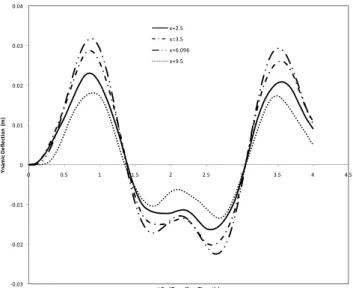
x= . x= . x= . x= .
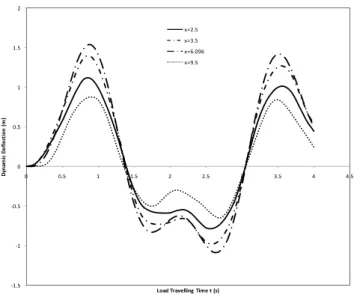
Figure 6: Response of a simply supported structural members resting on elastic foundation to uniform partially distributed forces for various values of the load
‐ . . . . . . . . .
. . . . .
Dy
a
ic
De
fle
ct
io
Load Travelli g Ti e t s
V= . V= . V= . V= .
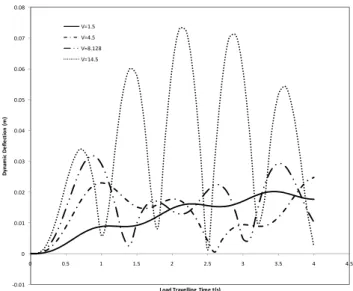
Figure 7: Response characteristics of a simply supported structural members resting on elastic foundation to uniform partially distributed forces for various values of the travelling
load velocities and for fixed values of G = 30000, K=40000 and N = 20000.
‐ ‐ ‐ ‐
. . . . .
Dy
a
ic
De
fle
ct
io
Load Travelli g Ti e t s
N= N= N= N=
Figure 8: Transverse displacement response of a simply supported structural members resting on elastic foundation and under the actions of uniform partially distributed masses for various values
of axial force N and for fixed values of K = 40000, G = 30000.
‐ ‐ ‐ ‐
. . . . .
Dy
ai
c D
ef
le
ct
io
LOad Travelli g Ti e t s
K= K= K= K=
Figure 9: Displacement response of a simply supported structural members resting on elastic foundation and under the actions of uniform partially distributed masses for various values
‐ ‐ ‐ ‐
. . . . .
Dy
a
ic
De
fle
ct
io
Load Travelli g Ti e t s
G= G= G= G=
Figure 10: Deflection Profile of a simply supported structural members resting on elastic foundation and under the actions of uniform partially distributed masses for various values
of shear modulus G and for fixed values of K=40000 and N = 20000.
Figure 11: Response Amplitude of a simply supported structural members resting on elastic foundation and under the actions of uniform partially distributed masses for various values
‐ . ‐ ‐ . . .
. . . . .
Dy
ai
c D
ef
le
ct
io
Load Travelli g Ti e t s
x= . x= . x= . x= .
Figure 12: Response of a simply supported structural members resting on elastic foundation to uniform partially distributed masses for various values of the load position
x and for fixed values of G = 30000, K=40000 and N = 20000.
‐ . . . . .
. . . . .
Dy
a
ic
De
fle
ct
io
Load Travelli g Ti e t s
V= . V= . V= . V= .
Figure 13: Response characteristics of a simply supported structural members resting on elastic foundation to uniform partially distributed masses for various values of the travelling
‐ . ‐ ‐ . . .
. . . . .
Dy
a
ic
De
fle
ct
io
Load Travelli g Ti e t s
MOVING FORCE MODEL MOVING MASS MODEL
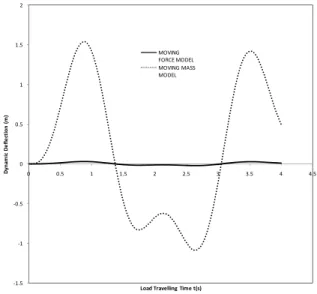
Figure 14: Comparison of the dynamic characteristic of moving force and moving mass cases of a uniform simply supported beam for fixed values of G = 0, K=0 and N =0.
‐ ‐ ‐ ‐
. . . . .
Dy
a
ic
De
fle
ct
io
Load Travelli g Ti e t s
MOVING FORCE MODEL MOVING MASS MODEL
‐ . ‐ . ‐ . ‐ . . . .
.
. . . . .
Dy
a
ic
De
fle
ct
io
Load Travelli g Ti e t s
K=G=N= K= ,G= ,N=
Figure 16: Comparison of the deflection profiles of the simply supported moving force uniform beam for values K=G=N=0 versus G = 30000, K=40000 and N = 20000.
‐ ‐ ‐ ‐
. . . . .
Dy
a
ic
De
fle
ct
io
Load Travelli g Ti e t s
K=G=N= K= ,G= ,N=
Figure 17: Comparison of the deflection profiles of the simply supported moving mass uniform beam for values K=G=N=0 versus G = 30000, K=40000 and N = 20000.
mov-ing distributed load travellmov-ing at constant velocity for fixed values of N=0, K=0, G=0 and N=20000, K=40000 and G=30000. From these figures, it is seen that the dynamic deflection of the beam under the actions of the moving load is greatly affected when the structural parameters N, K and G are incoporated into the governing equation of motion. Figure 16 compares the deflection profiles of the moving force model of the beam for the two set of values K=0, N=0, G=0 and N=20000, K=40000 and G=30000. It is deduced from this figure that the amplitude of deflection for the set of values N=0, K=0 and G=0 is much higher tan that of the set of values N=20000, K=40000 and G=30000. Similar result is obtained for a moving mass model of this structural member as shown in figure 17.
6 CONCLUDING REMARKS
The classical problem of the response characteristics of uniform structural member resting on elastic subgrade and subject to uniform partially distributed load is studied in this work. The closed form solutions of the governing fourth order partial differential equations with variable coefficients are presented for the moving force and mass models. Various results and analyses are carried out and phenomenon of resonance is studied for the dynamical system. The findings of this study exhibit among others the following useful and interesting features:
i.This study has provided a useful information on the effect of axial force, foundation stiffness, load width, load velocity and shear modulus on uniform Bernoulli-Euler beam resting on Pasternak foundation and under the action of uniform partially distributed loads.
ii. Results also show that higher values of the structural parameters K, N and G are required in the case of moving mass problem than that of the moving force beam problem.
iii.It is found that the dynamic stability of the elastic beam subjected to moving load is greatly enhanced with the presence of the structural parameters N, K and G.
iv.This study has also provided a very useful information on the conditions under which the vi-brating system will experience the occurrence of undesirable phenomenon called resonance for both the moving distributed force and mass problems involving Bernoulli –Euler beams.
References
Adetunde, I.A. (2003), Dynamic analysis of Rayleigh beam carrying added mass and Traversed by uniform partially distributed moving loads. Ph.D Thesis. University of Ilorin, Ilorin, Nigeria.
Andi, E.A. (2013), Flexural vibrations of elastic structures with general boundary conditions and under travelling distributed loads. Ph.D Thesis, Federal University of Technology Akure.
Andi, E.A., Oni, S.T. (2014), Dynamic Behaviour under Moving Distributed Masses of Nonuniform Rayleigh Beam with General Boundary Conditions. Chinese Journal of Mathematics. http://dx.doi.org/10.1155/2014/565826. Clastornik, J., Eisenberger, M., Yankelevsky, D.Z., Adin, M.A. (1986), Beams on VariableWinkler elastic foundation, Journal of Applied Mechanics, ASME, 53(4), 925-928.
Esmailzadeh, E., Ghorashi, M. (1995), Vibration analysis of beams traversed by uniform partially distributed moving masses using moving masses. Journal of sound and vibration Engineering: 184(1), pp 1-17.
Gbadeyan, J.A., Oni, S.T. (1992), Dynamic Response to moving concentrated masses of elastic Plate on a non-Winkler’s elastic foundation. Journal of sound and vibration, 154(2), 343-358.
Hasan, O., Zeki, K., Binnur, G.K. (2016), Dynamic Analysis of Elastically Supported Cracked Beam Subjected to a Concentrated Moving Load. Latin American Journal of Solids and Structures 13, 75-200.
İsmail, E. (2015) A new FEM procedure for transverse and longitudinal vibration analysis of thin rectangular plates subjected to a variable velocity moving along an arbitrary trajectory load. Latin American Journal of Solids and Structures 12, 808-830.
Lee, H.P. (1994) Dynamic Response of a beam with intermediate point consytaints subject to a moving load. Journal of sound and vibration, 171, 361-368.
Ogunyebi, S.N. (2006) Dynamical Analysis of finite prestressed Bernoulli-Euler beams with general boundary condi-tions under travelling distributed loads, M. Tech. Dissertation, Federal University of Technology, Akure, Nigeria. Omolofe, B. (2013), Deflection profile analysis of beams on two-parameter elastic subgrade, Latin American Journal of Solids and Structures 10(3) 263-282.
Oni, S.T., Awodola, T.O. (2005); Dynamic Response to moving concentrated masses of uniform Rayleigh beams resting on variable Winkler elastic foundation. Journal of the Nigeian Association of Mathematical Physics 9, 151-162.
Oni, S.T., Omolofe, B. (2005a), Dynamic behavior of non-uniform Bernoulli-Euler beams subjected to concentrated loads travelling at varying velocities. Journal of the Nigerian Association of Mathematical Physics, Vol. 9, pp 79-102. Oni, S.T., Omolofe, B (2005b); Dynamic Analysis of a prestressed elastic beam with general boundary conditions under moving loads at varying velocities. Journal of Engineering and Engineering Technology, FUTA, 4(1), 55-72. Sadiku, S., Leipholz, H.H.E (1989); On the dynamics of elastic systems with moving concentrated masses, Ingenieur Achives, 57, 223-242.
Sun, L., Luo, F. (2008), “Steady-State Dynamic Response of a Bernoulli-Euler Beam on a Viscoelastic foundation Subject to a Platoon of Moving Dynamic Loads”, Journal of Vibration and Acoustics, Vol. 130, pp 0510021-0510021. Thambiratnam, D.P., Zhuge, Y. (1996); Dynamics analysis of beams on an elastic foundation subjected to moving loads. Journal of sound and vibration, Vol. 198, No 2, pp 149-169.
Ugurlu, B., Kutlu, A., Ergin, A., Omurtag, M.H. (2008); Dynamics of a rectangular plate resting on an elastic foun-dation and partially in contact with a quiescent fluid. Journal of sound and Vibration 317, pp 308-328.