Eets of Magnetohydrodynamis Matter Density
Flutuations on the Solar Neutrino Resonant
Spin-Flavor Preession
N. Reggiani a
, M.M.Guzzo by
J.H. Colonia bz
, and P.C. de Holanda b;x
a
Institutode Ci^eniasExatas
PontifiaUniversidade CatoliadeCampinas
13020-970Campinas,SP,Brasil
b
InstitutodeFsiaGlebWataghin
UniversidadeEstadual deCampinas-UNICAMP
13083-970Campinas,S~aoPaulo,Brasil
InstitutodeFsiaCorpusular
Universitatde Valenia
46100Burjassot, Valenia,Spain
Reeived28February,1999
Takingintoaountthestringentlimitsfromhelioseismologyobservationsonpossiblematter
den-sityutuationsdesribedbymagnetohydrodynamistheory,wendtheorrespondingtime
vari-ationsofsolarneutrinosurvivalprobabilityduetotheresonantspin-avorpreessionphenomenon
withamplitudeoforderO(10%). Wedisussthephysispotentialofhighstatistisrealtime
exper-iments,likeasSuperkamiokande,toobservetheeetsofsuhmagnetohydrodynamisutuations
ontheir data. We onlude that theseobservations ould be thought as a test of the resonant
spin-avorpreessionsolutiontothesolar neutrinoanomaly.
I Introdution
Aording to all attempts to build a solution to the
solar neutrino anomaly based on the resonant
spin-avor preession mehanism [1℄, when one assumes a
neutrino magneti moment of order
= 10
11
B ,
whihisslightlybelowitspresentexperimentallimit[2℄,
an average magneti eld of order 10 4
G [3, 4℄ is
re-quired to oniliatethe presentsolar neutrino
experi-mentaldata[5℄-[9℄andsolarneutrinotheoretial
predi-tions[10℄-[15℄. Using thesetypialvaluesforthesolar
magnetield weobserved[16℄ that
magnetohydrody-namis[17,18℄naturallypreditstheexisteneofsolar
magneti osillationswhih periodis of theorder of 1
to10days. Resonantspin-avorpreessionmehanism
generatesasolutiontothesolarneutrinoanomalyonly
ifneutrinos are verysensitiveto themagneti eld as
well asmatter density proles inside the Sun and, in
partiular, are very sensitive also to the
magnetohy-drodynamis utuations of these quantities.
There-foreweexpetthat theseutuations will generatean
aordinglyutuatingexperimentalneutrinoounting
rate. Theorrespondingobservablesignalof this
phe-nomenon is a periodial time utuation of the solar
neutrinoux,in partiular,in thehigh energyportion
ofthesolarneutrinospetrum,detetedinpresentreal
timeexperiments[9,19℄. These eetsanbethought
asatesttotheresonantspin-avorpreessionsolution
tothesolarneutrinoproblemsinetheyanlearlybe
distinguishedfromothersouresoftimemodulationin
the solar neutrino observations like the eet of
sea-sonal variation of the Sun-Earth distane on vauum
osillations,MSWeets attheEarth,andsolar
mag-neti ativityrelatedtotheappearaneofsunspotson
thesolarsurfae.
Ingeneral,magnetohydrodynamis[17,18℄predits
twodierentkindsofstableutuations. Alfvenwaves,
when transverse osillations of the uid with respet
Email:ie-siaaad.puamp.br
y
Email:guzzoi.uniamp.br
z
Email:oloniai.uniamp.br
to the magneti eld and the propagation vetor are
present and, therefore, no utuation of matter
den-sityorpressureisobserved. Andmagnetosoniwaves,
whih present longitudinal osillationsof density with
respettothepropagationvetor. Inreferene[16℄ we
analyzedtheeetsofpurelyAlfvenwaveswhereonly
magnetiutuationsaetsthesolarneutrinosurvival
probability. Nevertheless, if matter density
perturba-tions are present in the way desribed by
magnetohy-drodynamis,theireetsanbeimportantforthe
rel-evanthigh energy neutrinosobserved in real time
ex-periments [9, 19℄. There are twomain reasons whih
an be evoked to justify this. The presene of matter
suppresses, in general, theneutrinospin-avor
prees-sion mehanism, one that matter appears in the
di-agonalentriesofthe evolutionmatrix,whih are
spin-avoronserving. That is whythe preseneof a
reso-nane, a position along the neutrinotrajetorywhere
themattereetsareanelledbyatermproportional
to thesquaredmassdierenedividedbytheneutrino
energy,isimportantfortheneutrinospin-avor
onver-sion. Therefore,utuationsofthematterdensityan
generate modiations in this resonane anellation
leading to important variations on the nal
probabil-ityof neutrinospin-avor preession. Theseond
rea-sonto onsider theeet ofdensityutuationsisthe
peuliar behaviorofthe adiabatiity parameterin the
resonant spin-avor preession phenomenon. In fat,
severalauthorsdisussedtheeetofdensityvariations
onthesolarneutrinomatter enhanedtransitions, the
MSW eet [20℄. In this ontext, they onlude that
theeetsofdensityperturbationsontransitionsof
so-larneutrinosmaybesubstantialiftheseperturbations
our in the entral region of the Sun and therefore
only low energyneutrinos are sensitive to suh eets
sine their resonane layer ours deeper in the Sun.
Notehoweverthat this onlusion annotbe
straight-forwardinvokedhere. Whiletheadiabatiityinreases
withinreasing resonanedensityfor theMSW eet,
itisinverselyproportionaltotheresonanedensityfor
thespin-avorpreession phenomenon and theeets
of density perturbations in the solar onvetive zone
maybeimportant. Thislowdensity regionisrelevant
for high energy solar neutrinos sine a resonane for
suh neutrinosanbefoundthere. Consequentlyhigh
neutrinosobservedinrealtimeexperimentsanbe
sen-sitivetomatterutuations inthisregion.
In this paper we investigate the impat of matter
density utuations indued by soni
magnetohydro-dynamiswavesonobservabletimeutuationsofhigh
energysolarneutrinoux detetedin real time
exper-iments and ompare these eets with onsequenes
from purely magneti (Alfven) utuations. We
on-ludethat bothmagnetiand densityutuationsan
be equally relevant, although matter density
utu-ations are muh more onstrained from
helioseismol-ogyobservations. Taking into onsiderationsuh
on-straints, westill expet to nd periodialtime
utu-ationsin solarneutrinoountingratedue to
magneto-hydrodynamismatterdensitywavesoforderof10%of
thetotalnumberofevents.
II Magnetohydrodynamis and
neutrino spin-avor
prees-sion
We are assuming a non-vanishing neutrino transition
magnetimoment. Inthisase,theinterationof
neu-trinos with a magneti eld will generate spin-avor
preession whih is given by the evolution equations
[21℄
i d
dr
R
L
= p
2
2 G
F N
e (r)
4E
j
~
B
? (r)j
j
~
B
? (r)j
p
2
2 G
F N
e (r)+
4E !
R
L
(1)
d
where
L (
R
)istheleft (right)handed omponentof
the neutrino eld, = jm 2
L m
2
R
j is their squared
mass dierene, E is the neutrino energy, G
F is the
Fermi onstant, N
e
(r) is the eletron number density
distribution and j ~
B
?
(r)j is the transverse omponent
of the magneti eld. Finally, we are assuming that
the neutron number density is 1=6 of the eletron
numberdensityinanypointintheSun,whihgivesus
an=5=6forMajorananeutrinos, in whih asethe
nalright-handedstates
R
areativenoneletron
an-tineutrinos. ForDira neutrinos,=11=12,in whih
neutrinos[21℄. InthispaperwewillassumeMajorana
neutrinos. Note howeverthat themultipliativefator
11/10whih hasto beinluded in for Dira
neutri-nosdoesnotleadto importantalterations in our
on-lusions, whih are, in thisway,valid forMajorana or
Diraneutrinos.
From Eq. (1) we observe that the neutrino
spin-avorpreessionmehanismdependsonboththe
mag-netield j ~
B
?
(r)jas wellas thematterdensity
distri-butionN
e
(r)alongthesolarneutrinotrajetory. These
quantitiesareaetedbymagnetohydrodynamis
u-tuations. Inordertodesribethem,weonsiderthe
lin-earizedmagnetohydrodynamisequations [17,18℄,
fol-lowing thesame stepsof referene[16℄, where
magne-tohydrodynamis spetrum is generated by small
dis-plaements ~
from an equilibrium onguration. We
arepartiularly interestedinthemagneti andmatter
density utuations generated by the displaement ~
given,respetively,by[22℄
Æ ~
B= ~
r( ~
~
B
0
) and Æ=
~
r( ~ ): (2) where ~ B 0
is the equilibrium magneti eld
ongura-tion assumed to bethe one relevant to the solar
neu-trino problem desribed in referene [3℄ and is the
solarmatterdistributionalulatedinthestandard
so-larmodel[10℄-[14℄.
A ruial region of the magnetohydrodynamial
spetrumis the ontinuum region whih is assoiated
with singularities of the Hain-Lust equation [16, 22℄.
This happens when the frequeny of the
magnetohy-drodynamialutuationis equalto
w 2 A = k 2 B 2 0 or w 2 S = p
p+B 2 0 k 2 B 2 0 ; (3)
where p is the pressure and = C
p =C
v
is the ratio
of spei heats. w 2 = w 2 A and w 2 = w S dene the
Alfvenand slowontinuumregions in the
magnetohy-drodynamialspetrum[22℄. Magnetiwavesand
mat-ter densityutuationsassoiatedwith these
frequen-ies are alled loalized modes sine they present the
interesting feature of been highly peaked around the
position,r
s
,where thesingularityours [23℄.
In order to numerially overome the singularities
assoiated with the ontinuum spetra, a resistivity
layerinthepositionofthesingularityisintrodued[24℄.
Thewidthofthislayerisdiretlyrelatedwiththewidth
Ærof theloalizedmagnetiormatterdensity
utua-tionwhihanbeestimated[25℄:
Ær8 0 !(r s ) 1=3 2B 0 B 0 1=3 ; (4) where 0
isthevauumpermeability. Inourpartiular
senario,Æranahieve10 1
(normalized bythesolar
Toanalyzetheonsequenesof theloalizedwaves
onthesolarneutrinoobservations,wehavenowto
de-netheamplitudeofpossiblemagnetiandmatter
den-sityutuations. The solarmagnetield isrelatively
free to utuatesine themagneti pressureB 2
=8is
negligiblysmallwhenomparedwiththedominantgas
pressure p [10℄ if we onsider the matter density
dis-tribution preditedby thestandardsolar modeland
the magneti eld strength of order of those ones
re-quiredto solvethesolarneutrinoanomaly[3℄. Infat,
inthisase,B 2
=8pvariesfromapproximately10 6
in
the entral regions of the Sun to order 10 4
lose to
the solar surfae. From this argument, the magneti
eld an be aslargeas10 9
Gin the solarore or10 7
Gin thesolaronvetivezone. Morestringentbounds
onthe magnetield intheonvetivezonearefound
in refs. [26, 27℄ where the disussion is based on the
non-lineareetswhiheventuallypreventsthegrowth
of magnetields reatedbythe dynamoproess. By
equatingthemagnetitensiontotheenergyexessofa
sinking elementat the bottom of the onvetivezone,
Shmitt and Rosner [26℄ obtainedfew times 10 4
G as
an upper bound. Therefore utuations of the solar
magneti eld of the same order of magnitude of the
magnetieldusedinreferene[3℄anbefoundinside
the Sun. Despite this fat, theyannot bearbitrarily
largewhen weareonsidering thelinearized
magneto-hydrodynamisequations[16,22℄. Thisimpliesthatthe
displaements ~
mustbesmall, j ~
j <1, suh that the
non-linear terms anbe negleted. This implies that
jÆ ~ Bj=j ~ B 0
j <1. Theerror assoiatedwith this
approx-imation is (jÆ ~ Bj=j ~ B 0 j) 2
. The maximum possible
valuefortheratiojÆ ~
Bj=j ~
B
0
jisrelatedwithalear
sta-tistialdistintionbetweenthemaximumandthe
min-imum value of the perturbed magneti eld, whih is
given approximatelyby (jÆ ~
Bj=j ~
B
0
j)= (in units of ).
Tohaveaminimum2- distintion betweenthe
max-imum and minimum magneti eld, we must have a
maximumvalueoftheperturbationjÆ ~
Bj=j ~
B
0 j=0:5.
Something very dierent happens with possible
matterdensityutuations. Infat,theyarevery
on-strained by helioseismologyobservations. The largest
density utuations Æ inside the Sun are indued by
temperatureutuations ÆT duetoonvetionof
mat-ter between layers with dierent loal temperatures.
Anestimateofsuheetispresentedinreferene[28℄
andgives Æ =m p g(r r 0 ) ÆT T 2 = r r 0 R 0 ÆT T (5) wherem p
isthenuleonmass,g(r)isthegravity
ael-erationandR
0
0:09R
(R
isthesolarradius)is
anumerialfatoromingfrom theapproximately
ex-ponentially dereasingstandard matter density
distri-p
isnotinonitwithhelioseismologyobservations[29℄,
taking(r r
0 )=R
0
1,wehavetoonsiderdensity
u-tuationsÆ=smallerthan10%. Infat,inanaurate
analysisofhelioseismologyonsequenesonmatter
den-sityutuations[30℄itwasonludedÆ=anbevery
large(largerthan10%)onlyforveryinnerpartsofthe
Sun (r < 0:04) as well as for very superial regions
(r > 0:98). For 0:04 < r < 0:25, Æ= dereases
ap-proximatelylinearlyandahievesits smallervalue2%
in r0:25. Finallyin theregionwhere 0:4<r<0:9,
Æ=isapproximately5%. Weimposetheseonstraints
as boundary onditions for the amplitudes of density
utuationswewillonsiderin thefollowing.
Finallyweananalyze theonsequenesof the
lo-alizedmagnetohydrodynamismodesonthesolar
neu-trinouxsolvingtheneutrinoevolutionequationswhen
a non-vanishing neutrino transition magneti moment
isassumed. Wewilladopthereaphenomenologial
approah, in lose analogyto what was done in
refer-ene[16℄. Wewillassumethatmagnetohydrodynamis
introdues gaussian shaped utuations whih will be
added to theequilibriumongurationof both matter
density and/or magneti eld prole. This gaussian
perturbation isenteredin r
s
, with width Ær. Forthe
matterdensityutuationwehave:
Æ(r;t)=
(r s )exp " r r s Ær 2 # sin[w(r s
)t℄; (6)
where
istheutuationamplitudenormalizedtothe
valueofthestandardmatterdensity(r)alulatedin
the position of the singularityr
s
and Ær is the width
of the utuation. The frequenies w(r
s ) = w
A or
w(r
s )=w
S
are given in equation (3)and introduea
periodialtimemodulationonthestandardmatter
den-sityprole. Similarly,ourassumptionforthemagneti
utuationsisobtainedfromtheaboveequation
substi-tuting!B
0
,i.e.,thestandardmatterdensitybythe
equilibriumeldprole. Thereforethenalmatter
den-sity(aswellasthemagnetieldprole)willbegiven
by some equilibrium prole summed to the
perturba-tion shown in Eq. (6). Wewill assume theparameter
and
B
varyingfrom0to0.05,whihmeansthatthe
matter density as well as the magneti eld utuate
aroundtheirequilibrium valueswithmaximum
ampli-tude around 5% of this value. These utuationswill
generate anaordingtime utuationof theneutrino
ountinggovernedbytheevolutionequations(1).
Sine we have a very stringent experimental limit
ontheneutrinomagnetimoment[2℄,alargemagneti
eld is neessaryto nda relevantspin-avor
onver-sionofneutrinoswhihpropagatingthroughit. Inthis
paperwewillonsideramagnetieldproleproposed
6 7
entral regions of the Sun and fall by two orders of
magnitudewhentheonvetivezoneisreahed[31℄:
B 0 (r)= ( a 1 0:2 r+0:2 2
G for 0<r0:7
B
C
for r>0:7;
(7)
where B
C
isthe magnetield in theonvetivezone
givenbythefollowingproles:
B C =a 2 1 r 0:7 0:3 n
G for 0:7<r1:0 (8)
or B C =a 2
1+exp
r 0:95
0:01
1
G for 0:7<r1:0:
(9) a 1 10 5 10 7 and a 2 10 4 10 5
in suhawaythat
theontinuityofthemagnetieldatthepointr=0:7
is satisedand n = 2,6 and 8. We assumealso that
themagnetiequilibriumproleB
0
(r)isinthez
dire-tion. Forthe solarsenario, p>> B 2 0 and therefore w A w S .
InFig.1weshowtheperiodsof themagneti and
matterdensityutuationsassoiatedwiththe
ontin-uumspetragivenin(3)forseveralmagnetield
pro-les given by the Eqs. (7)-(9). We observe that for
theonsideredmagnetieldstypialperiodsvaryfrom
O(1)toO(10)days. Timeutuationsofsolarneutrino
observationspresentingperiodsof thisorderof
magni-tudeonstitute themost importantsignalof the
exis-teneofsolarmagnetohydrodynamisutuationsand
aruialtestfortheresonantspin-avorneutrino
pre-essionmehanismto thesolarneutrinoproblem[35℄.
III Results
The utuations of the magneti and matter density
indueutuationsin thesurvivalprobabilityP(
L !
L
). Weassumethatthisprobabilitydoesn'tdependon
theneutrinoprodutionpoint,andnosigniant
osil-lationoursontheneutrinowayfromtheSunsurfae
tothedetetor,atEarth. WealsoassumethatnoEarth
eetwillbepresent. So,thesurvivalprobabilityis
ob-tainedsimplyby integrating numerially Eq(1), from
theneutrinoprodutionpointtothesolarsurfae,with
theiniialonditionthatallneutrinosareproduedas
left-handedneutrinos, (
R ; L ) T t=0
=(0;1) T
. The
inte-grationgivesustheneutrinostateatthesolarsurfae,
and then the survival probability is alulated using
P(
L !
L
) = j <
L
j(t) > j 2
. We have done this
Figure.1Periodsofthemagnetohydrodynamisutuations
fortheontinuumspetrawhenthemagnetiproleshown
inEq.(8)whenn=2,n=6,n=8andexponentialprole
ofEq.(9). We adoptedthe parametersa
1
1:010 6
G,
a
2
4:010 4
Gandk10 10
m 1
.0.
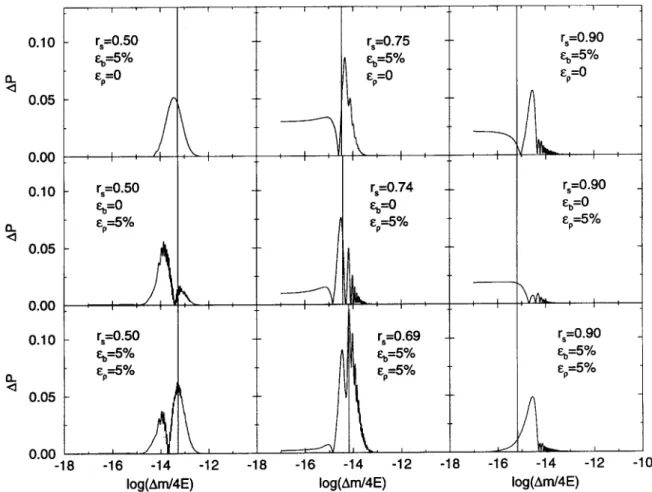
Theresultsof ouranalysisare shownin Fig. 2. In
this gure we present the amplitude P of the
u-tuations of the survival probability as a funtion of
m=4E, forsomevaluesof r
S
, the position ofthe
lo-alized mode. This utuations are alulated
om-puting the survival probability at distints moments
t of the perturbations in Eq. (6), and seleting the
moments when this probability reahes a maximum
and a minimum. The amplitude of the utuations
is the dierene between these two values. We show
the phenomenon for r
S
= 0:5, 0.9 and for the value
ofr
S
whihgivesthemaximumprobabilityamplitude,
usually around r
S
0:7. We adopted the magneti
eld prolegivenin Eqs. (7) and(8), with n=6and
=110 11
B
. Othermagnetieldprolesshown
in Eqs. (7), (8) and (9) generate very similar
onse-quenes ofmagnetohydrodynamisutuationsonthe
solarneutrinosurvivalprobabilityandwewillnotshow
them here. Weassumed
and
B
in Eq.(6), i.e., the
relativeamplitudeofmatterdensityandmagnetield
proleutuations, respetively, tovary from 0to 5%
asitisindiatedin Fig. 2. Also,vertiallinesindiate
thevalueofLog(m=4E)orrespondingtoaresonane
oiniding with the indiated singularity r
S
. We an
observethattheutuationsofthesurvivalprobability
aremaximaneartheregionsoftheresonanesand are
wellloalizedinm=4Eforr
s 0:7.
We veried also that, for xed values of r
S
and m=4E, theorrespondingprobabilityamplitude
varies linearlywith themagnitudeofthe amplitudeof
thematterdensityÆand/ormagnetieldutuation
Æ ~
B. For instane, when
=
b
, the maximal
proba-bility utuation orrespondingto themagneti elds
giveninEq.(8)oursinr
S
=0:69andanbewritten
asP 2:2010 2
forn=2,P 2:4810 2
for n =6 and P 2:6410 2
for n = 8.
Con-sideringtheexponentialbehaviorforthemagnetield
in theonvetivezone, themaximal amplitudeof
sur-vival probability ours in r
S
=0:68and presentsthe
followinglinearbehaviorwith
: P 2:8110 2
.
Therefore, given the results of Fig. 2, onean easily
infertheamplitudeofthesurvivalprobabilityforother
valuesofÆandÆ ~
B. Notethatthisapproximately
lin-ear behavior is valid for
< 0:2, whih inludes the
physiallimitforhelioseismologiallyaeptable
varia-tionsofthematterdensity.
FromFig. 2,weobservealsothatthemaximaleet
ofthematterdensityand/ormagnetieldutuation
on thesurvivalprobabilityours ifthese
magnetohy-drodynamisutuationsarefoundinthebeginningof
theonvetivezonewherer
S
0:7. Thisanbe
under-stoodwhenweexaminethebehavioroftheadiabatiity
parameter for thespin-avoronversionphenomenon.
Aswehavealreadymentioned,thisparameterinreases
with r and approahes the unit for r 0:7. In fat,
it was pointed out previously (see, for instane [36℄)
that thisisaprivilegedsituationfortheneutrino
on-version. Note also that aording to referenes [3, 4℄,
the requiredvalueof mto nda solutionto the
so-lar neutrino anomaly is O(10 7
) eV 2
or smaller. If
m = O(10 7
) eV 2
, neutrinos of O(10) MeV in
en-ergy will experiene their resonane around r = 0:7
andthereforewillbeverysensitivetothemaximal
am-plitudeprobabilityindiatedin Fig.2. This isexatly
theenergyrangeprobedbyrealtimeexperiments,like
asSuperkamiokande[9℄andSNO[19℄,whihare,
there-fore,verysuitabletoinvestigatethehypothesisofsolar
magnetohydrodynamisperturbationsandtheireets
Figure.2 AmplitudePofthesurvivalprobability infuntionofm=4E forsomevaluesofrs. Themaximumprobability
amplitudeoursaroundrs=0:7. Thevertiallinesorrespondtoaresonaneoinidingwiththesingularityrs.
After several hundred days of taking data,
Su-perkamiokande observations are, in priniple, able to
verifytheexisteneoftimeutuationwithperiodfrom
O(1)to O(10)days. Unfortunately,these dataarenot
published noravailable. Neverthelessweanarguethe
potential ofthis experiment to perform suh analysis.
Fig.3showstheamplitudeoftheexpetedeventrates
inSuperkamiokandeexperimentwhenweassumethata
magnetohydrodynamisutuationisloalizedaround
r
S
0:7. We onvulated the standard 8
B-neutrino
produtionspetrum[10℄, the
e
e sattering
ross-setion inreasinglinearlywithenergyand the
experi-mental eÆieny whihis approximately20%for
neu-trinoenergiesaround5MeVuptoamaximumof70%
forneutrinoenergiesof10MeVorlarger. Theseevent
ratesaregiveninsolarneutrinounits(SNU)forseveral
valuesofm. Weobservethatform=310 7
eV 2
,
themaximumeventrateamplitudeisobtained. I.e.,
af-terhavingbeenpreessedduetotheexisteneofasoni
magnetohydrodynamialwaves,thenumbersolar
neu-trinossattering withSuperkamiokandeeletrons
u-tuateswithamplitudearound0.003-0.004SNU,ifthese
neutrinospresentenergiesaround8and 10MeV.This
isapproximately10-15%ofthetotalrateofsattering
eventsin this energyrange. Note that ifmis
dier-ent from the values shown in Fig.3, this means that
neutrinoswith energies around5 -15 MeV will
expe-riene resonane in a position dierent from r
s 0:7
and,althoughnotmaximal,theirountingratewillstill
utuate.
IV Conlusions
Magnetohydrodynamis predits magneti as well as
matterdensityutuationsin theSun. Thepurposeof
thispaperistoanalyzetheeetsofpossiblesolar
mat-ter density utuationsonsolar neutrinoobservations
taking into aountthe stringent limitson these
u-tuations oming from helioseismology. We verify also
thepotentialofhigh statistisreal timesolarneutrino
experiments,likeasSuperkamiokande,toobservethese
eets. We showed that the survival probability
u-tuations of ative solar neutrinos due to the resonant
neutrino spin-avorpreession an be of order 10%if
amplitudes of themagneti ormatter density
utua-tions
b or
areoforderof5%(20%if
b =
=10%).
Figure.3 Amplitude R of the expeted event rates to
Superkamiokande experiment for some values of the mass
squaredierenem.
wehavetolookforsolarneutrinodatatimeutuations
ofthis orderin thetimesaleompatible withthe
pe-riods predited by the theory. From Figure 1, we see
that relevanttime saleanbeoforderO(1)to O(10)
days. ColletingO(20)eventsaday,Superkamiokande
presents astatistiserror of approximately10%in an
interval of 5 days. Furthermore, aFourieranalysis of
the experimental observations tting a period of time
oftheorderofthetotalperiodofSuperkamiokande
ob-servation(of orderof hundreddays),oulddrastially
redue theinvolvederrorsand theamplitudesoforder
of 10%shownin Figures 1and 2ouldbe
experimen-tallytested. Thereisnoavailable publishedsolar
neu-trinodata to ondutaonlusiveanalysisof possible
datautuationwith period O(1 10)days. Analysis
of time utuations on solar neutrino data onduted
uptonow,privilegeddierentperiods: exat24hours
asaresultofMSWeetinside theEarth,sixmonths
to oniliate seasonal variation and neutrino vauum
osillationsor11yearstoverifysolarmagnetiativity
eetsonspinipphenomenon.
We onlude that Superkamiokande is potentially
interestingtoinvestigatingtheeetsonsolarneutrino
observationsomingfrommagnetohydrodynamis
u-tuations. The observation of these eets ould be
taken as an evidene of the resonant spin-avor
pre-Aknowledgements
Thiswork wassupported byFunda~aode Amparo
a Pesquisa do Estado de S~ao Paulo (FAPESP),
Pro-grama de Apoio a Nuleos de Exel^enia (PRONEX)
and Conselho Naional de Desenvolvimento Ciento
eTenologio(CNPq).
Referenes
[1℄ A. Cisneros, Astrophys. SpaeSi. 10 (1970) 87; M.
Voloshin, M.I. Vysotsky and L. Okun, Sov. J. Nul.
Phys. 44 (1986) 440; J. Shehter and J.W.F. Valle,
Phys. Rev.D 24(1981) 1883; E. Akhmedov, Sov. J.
Nul.Phys.48(1988)382;Phys.Lett.B213(1988)64;
C.S. Limand W.J. Mariano, Phys.Rev.D37 (1988)
1368.
[2℄ C.Casoetal., \ReviewofPartile Physis",The
Eu-ropeanPhysialJournalC3(1998)1.
[3℄ E.Kh. Akhmedov, A. Lanza and S.T. Petov, Phys.
Lett.B303(1993)85.
[4℄ M.M. Guzzo and H. Nunokawa, \Current status of
theResonantSpin-avorSolutiontothesolarneutrino
problem",HEP-PH/9810408.
[5℄ K.Lande(HomestakeCollaboration) inNeutrino '98,
Proeedingsofthe XVIIIInternationalConferene on
NeutrinoPhysisandAstrophysis,Takayama,Japan,
4{9June1998,editedbyY.SuzukiandY.Totsuka,to
bepublishedinNul.Phys.B(Pro.Suppl.),sanned
transparenies are available at URL
http://www-sk.irr.u-tokyo.a.jp/nu98/san/index.html.
[6℄ Y. Fukuda et al. (Kamiokande Collaboration), Phys.
Rev.Lett.77(1996)1683.
[7℄ V.Gavrin(SAGECollaboration) inNeutrino'98[5 ℄.
[8℄ T. Kirsten(GALLEXCollaboration) in Neutrino '98
[5 ℄.
[9℄ Y. Suzuki (SuperKamiokande Collaboration) in
Neu-trino '98[5 ℄.
[10℄ J.Bahalland R.Ulrih,Rev.ofMod.Phys.60,297
(1988); J. N. Bahall, Neutrino Astrophysis,
Cam-bridgeUniversityPress,NewYork,(1989).
[11℄ J. N. Bahall and M.H. Pinsonneault, Rev. of Mod.
Phys.67(1995)781.
[12℄ J. N.Bahall, S.Basuand M.H.Pinsonneault, Phys.
Lett.B433(1998)1.
[13℄ For a reent review, see J. N. Bahall,
astro-ph/9808162.
[14℄ E. G.Adelbergeretal., astro-ph/9805121,Rev.Mod.
Phys.,(tobepublished,Otober1998).
[15℄ J.N.Bahall,P.I.KrastevandA.Yu.Smirnov,Phys.
Rev.D58(1998)096016.
[16℄ M.M.Guzzo,N.ReggianiandJ.H.Colonia,Phys.Rev.
D56(1997)588.
[18℄ P.Foukal,SolarAstrophysis,Wiley-Intersiene
Pub-liation (1989).
[19℄ G.T.Ewan,\SudburyNeutrinoObservatory",in
Fron-tiersofNeutrinoAstrophysis,editedbyY.Suzukiand
K.Nakamura,UniversalAademyPress,Tokyo(1993)
p.135.
[20℄ P.I.Krastev and A. Yu. Smirnov, Phys.Lett. B 226
(1989) 341; Mod. Phys. Lett. A 6 (1991) 1001; A.
AbadaandS.T.Petov, Phys.LettB279(1992)153;
F.N. Loretti and A.B. Balantekin, Phys. Rev. D 50
(1994)4762.
[21℄ For a reviewonneutrino spin-avor preessionsee J.
Pulido,Phys.Rep.211(1992)167.
[22℄ J.PGoedbloedandP.H.Sakanaka,ThePhysisof
Flu-ids17(1974)908.
[23℄ J.P.Goedbloed,Physia12D(1984)107.
[24℄ L. Villard. K. Appert, R. Grubber and J. Valavik,
Comp.Phys.Rep.4(1986)95.
[25℄ J.M.Kappraf andJ.A.Tataronis,J.PlasmaPhysis
18(1977)209;T.Sakurai,M.GoossensandJ.V.
Holl-weg,SolarPhysis133(1991)227.
[26℄ J. Shmitt and R. Rosner, Astrophys. J. 265 (1983)
901.
[27℄ X.Shietal.,Comm.Nul.Part.Phys.21(1993)151.
[28℄ H. Nunokawa, A. Rossi, V.B. Semikoz and J.W.F.
Valle,Nu.Phys.B472 (1996)495.
[29℄ S.Turk-Chiezeetal.,Phys.Rep.230(1993)57.
[30℄ G.FiorentiniandB.Rii,\Solarneutrinos:wherewe
areandwhatisnext?" ASTRO-PH/9801185.
[31℄ Somemehanismstogeneratesuheldsaresuggested
inA.Cisneros inrerefene [1℄ and D. Moss, Monthly
NotesR.Astron.So.224(1987)1019.
[32℄ E.Parker,Astrophys.J.198(1975)205.
[33℄ V.D.KuznetsovandS.I.Syrovastskii,Sov.Astron.23
(1979) 715; V.N. Krivodubskii, Sov. Astron. Lett. 13
(1987)338.
[34℄ J.H. Colonia, P.C. de Holanda, M.M. Guzzo and N.
Reggiani,inpreparation.
[35℄ Obviously,ifutuationsofexatonedayperiodis
ob-servedinthe solar neutrino data, MSWeet at the
Earthisanaturalexplanationto beevoked.However
any utuationwith dierent fromexat oneday
pe-riodrulesoutMSW.
[36℄ M.M.GuzzoandJ.Bellandi, Phys.Lett.B317(1993)