Many Partile Theory for the Luminesene,
Charaterization and Simulation of
Quantum Well Laser Strutures
M.F. Pereira Jr.,
InstitutodeFsia,UniversidadeFederaldaBahia,40210-340, SalvadorBABrazil
A. A.Bernussi, W. Carvalho Jr.,MarioT. Furtado,and A. L. Gobbi
LaboratoriodeOptoeletr^onia, LNLS,13083-970,Campinas,SP, Brazil
Reeivedon23April,2001
A photonGreen's funtion theoryis usedto inorporate Bethe-Salpeter-like many body
orre-tions in the the omputations of nonlinear optial spetra of semiondutor quantum well laser
materials. The numerial results presented reprodueseveral features found inthe experimental
haraterization oftheatualdevies.
Thesimulationofsemiondutorlasersisa
fasinat-ing hallengeto modernPhysis.[1℄They operatein a
highlyexitedregime,wheremany-partileeetsplay
adominantrule.[2℄ A previous approah for quantum
well lasers has suessfully desribed the ombination
of resonantavity, band struture and manybody
ef-fetsinatemperatureregimeandformaterialswherea
vertex-typeofapproximationstillsuessfullydesribes
the exited media.[3℄ There are howeverexperimental
onditions,speiallyatlowtemperatures,wherehigher
orderCoulomborretionsmustbedealtwith. Amore
general theory is thus required. [4, 5℄ In this paper
wepresentsolutionsofaBethe-Salpetertypeof
equa-tion forquantum wells within a photonGreen's
fun-tionsapproahapableofhandlingtheresonantavity
mirosopially, as well as quantum onnement and
band strutureeets. Themirosopiapproah
on-sistently desribesPauli-bloking,thesreening ofthe
Coulombinteration,Coulombenhanementofthe
po-larizationfuntion,andbandgap shrinkage.
The many-body approah used here is based on
Keldysh Green's funtions for arriers (G), photons
(D),and plasmons (W)to desribetheoupled
light-exited semiondutor system. [3, 4, 6, 7℄ Here, we
just outline the method with words and a few
repre-sentative equations. The Keldysh Green's funtion's
time evolution is desribed byDyson equations,
har-aterizedbyfreepropagatorsG 1
o ,D
1
o ,W
1
o
,and
self-energies,,P,andp,beingthearrierself-energy,the
transverse,andthelongitudinalpolarizationfuntions,
respetively. Detailed band-struture and
quantum-Hamiltonian, are inluded in the free-arrier
propaga-torG 1
o
, andserveastheinputforthesolutionofour
many-bodyproblem. Eahoftheselfenergieshanges
thebareintodressedpropagatorsin aspeiway.
ThetransversepolarizationP desribestheoptial
responseofthesystem,andanbewrittenasasumof
anRPAtermandaCoulomb-orrelationontribution,
expressed by thesolutions of the(integro-dierenial)
Bethe-Salpeterequation,[4℄
P(1;1;2;2)=G(1;2)G(2;1)+G(1;3)G(4;1)P(3;4;2;2):
(1)
Inordertodesribelightemission,werefertothe
quan-tum mehanial Poynting vetor. If we neglet
reso-nantavityeets,thePLspetrumisgivenessentially
by the arrier reombination spetrum, desribed by
P <
(!). If wewish to desribe the avity, the photon
Green's funtion presented here handles the problem
in rst priniples. The polarization funtion satises
the Kubo Martin Shwinger (KMS) sum rule. [2, 4℄
So,oneImPrisomputed,thearrierreombination
spetrais immediately obtained, ( is the total,
ele-tron+hole,hemialpotential),
P <
(!)=
2iImfP r
(!)g
1 exp((~! ))
: (2)
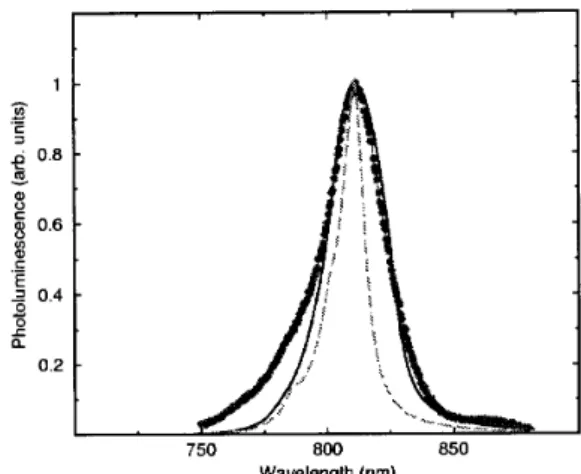
Fig. 1 ompares the measured (symbols)
photolumi-nesene (P.L.) with the numerial solutions of Eqs.
Figure1. Photoluminesenespetraofa30nmInGaAsP
quantumwell at 300K. Thesymbols depit experimental
results, while the solid and dashed urves are omputed,
respetivelywithandwithoutinhomogeneousbroadening.
Figure 2. Evolutionof theabsorptionspetra(solid)from
thelinearregime(topurve)tothegainregion,asthe
exi-tationarrierdensityisinreasedthemedium. Thedashed
urveistheP.L.omputedforalowarrierdensityandthe
symbolsare experimentaldata. All numerial parameters
are equal to those of Fig.1 for a 30 nm InGaAsP
quan-tumwellat300K.(a)and(b)areomputed,respetively,
withoutandwithinhomogeneousbroadening.
Further experimental investigations (not shown)
suggest a sizable Stokes shift between P.L. and
pho-tourrent measurements (P.C.). Although the
resolu-tion of the P.C. is not high enough at the moment
for nal onlusions, a Stokes shift an be desribed
by the theory, as shown in Fig. 2. The
inhomoge-neousbroadeningissimulatedherebymeansofa
Gaus-sian distribution of thefundamental band gap,as
de-pitedinFig.2. fortheomputednonlinearabsorption
spetra obtainedfrom dierentarrier densities, from
(!) =(2! p
(1)) ImP r
(!), for the QW of Fig.
1. NotetheinreaseofStokesshiftbetweenabsorption
and emissionin theinhomogeneouslybroadenedurve
(b) in omparison with (a). Possible explanations for
quaternary alloy (InGaAsP), reduing the band gap,
and inreasing the Stokes shift between emission and
absorption. (ii) Non- mixing of the quaternary alloy
in the well and barrier regions, givingrise to gap
en-ergymodulation, broadeningtheemissionpeak. Both
eetsarestronglydependentonthegrowth
tempera-ture,andatthattemperature,thewellmaterialwould
be outof thenon- mixing region. However,bothwell
and barrier ould be ordered at that temperature. A
more detailed experimental analysis is foreseen for a
ompleteomparisonwithexperiments.
Theabsorption spetrahereontainsonlytherst
fewtransitions. A diret omparison with thefull
ex-perimentalphotourrentspetrum,requiresallallowed
transitions(notshown). Thetransitionsdepitedplay
themajorroleinthegainspetra,sinethehigher
sub-bandsarenotappreiably populated.
Fig. 3 depits the inreasing Stokes shift with
inho-mogeneousbroadeningahievedhere,byinreasingthe
broadeningoftheGaussiandistribution.
Figure3. LinearAbsorptionpeak(triangles)andPeak
Lu-minesene(irles)asafuntionofinhomogeneous
broad-ening,desribedbythewidthoftheGaussiandistributions
broadening.
In summary, regardlessof the eetive
dimension-alityofthesystemthemirosopimehanismsgiving
rise to optial gain, the semiondutor must be
on-sistently treated as both resonator and gainmedium.
Highdensity(e.g. Vertex)approximations,maybe
mis-leading,speially forsystems with largeexiton
bind-ingenergy,andareavoidedhere,bymeansofaphoton
Green's funtion theory for quantum well laser
spe-trathat allowstheonsistentinlusionofbeyondRPA
orretions in the polarization funtion by means of
Bethe-Salpeter-Equation-likeorretions. The
numer-ial odes used here inlude a simplifying ansatz for
thenon-interating polarizationbubbleused asinput
for the full numerial solution of the Bethe- Salpeter
equationdiagramthatinludesCoulomb-Many-Body
orretions. The algorithm avoids a Kramers-
Kro-nig integration in the loop and allows the redution
of a omplex to a real matrix in the numerial
ma-trixinversionomputation that inreasesthe speed of
re-physial eetsand makeastarting pointfor
simulat-ing the operation of semiondutor lasers, ampliers,
and otherhot-semiondutor-avityoptoeletroni
de-vies,andtheurrentnumerialresultssuessfully
re-produeseveraloperationalharateristisofthelasers
developedat Funda~aoCPQd-LNLS.
Aknowledgments
Researh supported by Conselho Naional de
Pesquisas,CNPqofBrazil.
Referenes
[1℄ P. Zory, Quantum Well Lasers, Aademi Press, San
Diego,1993.
[2℄ R. Zimmermann, Many-Partile Theory of Highly
Ex-ited Semiondutors, "Teubner Texte zur Physik",
Leipzig(1987).
[3℄ M.F.PereiraJr.andK.Henneberger,Phys.Rev.B53,
16485(1996).
[4℄ M.F.PereiraJr.andK.Henneberger,Phys.Rev.B58,
2064 (1998).
[5℄ P.Mihler,M.Vehse,J.Gutowski,M.Behringer,andD.
Hommel,M. F.PereiraJr.,andK.Henneberger,Phys.
Rev.B58,2055(1998).
[6℄ K. Henneberger and S.W.Koh, Phys.Rev.Lett. 76,
1820 (1996).
[7℄ K. Henneberger and H. Haug, Phys.Rev. B 38, 9759