The Ising Model as a Playground for the Study of
Wetting and Interfae Behavior
D. P. Landau 1
, AlanM. Ferrenberg 1;2
, and K.Binder 3
1
Center forSimulationalPhysis, TheUniversityofGeorgia,
Athens GA30603,U.S.A.
2
UniversityomputingandNetworkingServies,
theUniversityofGeorgia,Athens, GA30602U.S.A.
3
Institut fuerPhysik,JohannesGutenberg UniversitaetMainz,
D-55099 Mainz,Germany
Reeivedon8Deember,2000
Computersimulationshave played animportant role in the eluidationof wetting and interfae
unbinding phenomena. In partiular, use of the Ising-lattie-gas modelin a lm geometry and
subjettodiversesurfaeandbulkmagnetieldshaspermittedextensiveMonteCarlosimulations
to reveal new features of the phase diagrams assoiated with these phenomena and to provoke
newtheoretialstudies. Thestatus of ourknowledgeaboutthe nature of wetting and
interfae-deloalizationtransitionswhihhasresultedfromtheseIsingmodelsimulationswillbesummarized.
I Introdution
Thestudyofsurfaewettingphenomenahasalong
his-tory with muh experimental and theoretial researh
havingbeenarriedouttoexaminethenatureofthe
re-sultantbehavior. Inomparison,omputersimulations
studieshavebeenratherlimited,largelybeauseofthe
tehnialdiÆulties in dealingwith realistimodelsof
liquidsand liquid-wallinterations. Amajoradvane
in thisareawas madebyNakanishi andFisher[1℄ who
drewtheanalogybetweenwettingphenomenaand
sur-faeritialbehaviorintheIsingmodel. Consequently,
apowerfulapproahtothestudyofwettingwithshort
range interations is to use an Ising-lattie-gas model
andtotakeadvantageofallofthe\tehnology"whih
hasbeendevelopedforperforming MonteCarlo
simu-lationofIsing models.
Within the ontext of the Ising-lattie-gas model
weanbestexaminewettingbehaviorbyonsideringa
semi-inniteIsing model withasimpleinteration
be-tween\spins"andbetween\spins"andthewalls. The
simplest aqpproahto therealization ofthis geometry
onaniteomputeristouseaverythikIsingslabfor
whihthetopandbottomsurfaes aresowidely
sepa-rated that eah atsasthoough it isthe boundary to
asemi-innite system. Onthe otherhand, thin uid
lms that are adsorbed on substrates or onned in
slit-likeapillaries pose hallengingfundamental
ques-surfae phenomena. The reognitionof this situation
has resulted in great ativity whih has attempted to
eluidate various features of these phenomena[2℄-[17℄.
(Suh systemsaneasily besimulated usingthe same
slab geometry desribed ealier for the study of
semi-innitesystemsbymerelyreduingthethiknesofthe
system being simulated.) Of partiular interest is the
asewherethetwosurfaesoftheuidlmfavor
dier-entphases: e.g.,in theaseofauidnearagas-liquid
oexistene in the bulk, one wall favors high-density
liquidandtheotherwallpreferslow-densitygas.
Simi-larly,forabinarymixture(A;B)undergoingphase
sep-arationinthebulk,onesurfaefavorsanA-rihphase,
the other favors aB-rih phase. In the latter ase, a
situation equivalent to suh \ompeting walls" is also
often realizedwhen themixture is on asubstrateand
the other surfaeis \free" (i.e., againstair [16℄). In
thefollowingsetionswewillreviewtherihvarietyof
behaviorthat hasbeenfoundusingMonteCarlo
stud-iesoftheseIsing-lattie-gasmodelsin onned
geome-tries of various kinds with dierent interations with
thewall(s).
II Bakground
The generimodelfor thestudy of wetting and
transition is a pseudospin variable s
i
= 1 at lattie
site i. Thegeometry ofthe systemplaysanessential
roleintheappliationofthemodeltoproblemsin
wet-tingandinterfaeformation. Aslabgeometryisused
inwhihperiodiboundaryonditionsareusedinboth
diretionsparalleltothesurfaes,andthetopand
bot-tom havefreeboundaryonditions. Abulkeld may
beapplied,playingtheroleofahemialpotential
dif-ferene,orasurfaeeldmayatonthesurfaesalone.
Restritingthespin-spin interationstonearest
neigh-bor pairwise interations J in the bulk and J
s in the
surfae planes, we nd that the Hamiltonian for this
modelis
H= J X
<i;j> (b)
s
i s
j J
s X
<i;j> (s)
s
i s
j H
1 X
<i2n=1> s
i H
D X
<i2n=D> s
i
(1)
d
wherethesum P
<i;j> (b)
runsoneoverallpairsof
neigh-boring spinswhere atleast onesiteis notin asurfae
plane, while the sum P
<i;j> (s)
is limited to pairs with
both sites in one of the same (two) surfaes. It is
possible to study wetting in this model by examining
verythik geometrieswithidential elds at eah
sur-fae. The systemisinitially magnetizedin one
dire-tion andan applied surfaeeld attemptsto overturn
spins at the surfae. It is important, however, that
the thikness of the system is suÆiently great that
any overturned layersof spinsat thetwosurfaes are
far from eah other so that the system appears to be
semi-innite. The shemati wetting phase diagrams
preditedbyNakanishiandFisher[1℄areshowninFig.1
forthreedierentstrengthsofsurfaelayerouplingJ
s .
Theseshowwetting transitionsbelowT
(1) thatmay
be of rst order orseond order,depending upon the
temperature, surfae eld and surfae layer oupling.
Inadditiontothewettingtransitions,pre-wetting
sur-faesarepreditedtoappearin thepreseneofabulk
eld. For dierent enhanement of the surfae layer
oupling the triritial wetting transition may
disap-pearompletely.
Figure1.ShematiphasediagramsforwettingtransitionsintheIsing-lattiegasmodel. Viewsasafuntionoftemperature,
eldandsurfaeeldareshownforthreedierentvaluesofthesurfaeexhangeenhanement.
A quitedierentpitureisexpetedforsimple
in-terfaeunbindingstudiesforwhihompetingsurfaes
at lattie planes n = 1 and n = D are desribed by
surfae elds of opposite sign, H
1
= H
D
. At high
temperaturestheinterfaeisinthemiddlesothemean
valueof M ,theorderparameter,iszero. For
temper-atures below the ritialtemperature T
b
in the bulk,
but suÆiently abovethe wetting transitionT
w of the
orrespondingsemi-innite system(D ! 1), this
ge-ometry stabilizes aoexistene betweentwophases of
oppositesignoftheorderparameter,withafreely
u-tuating interfae in the middle of the lm, and mean
order parameter is still zero. However, aphase
tran-sition appears at T
(D) [7℄-[10℄,[12℄-[14℄ suh that for
T < T
(D), the interfaebeomes loalized at one of
the walls, and then the average order parameter of
the lm is nonzero. Sine T
(D ! 1) ! T
w rather
non-ompetingwallswhere\apillaryondensation"[6℄,[11℄
ours,thisunonventionalphasetransitionhasevoked
greatinterest[7℄-[10℄,[12℄-[14℄. Mostwork,however,
ad-dressestheissueofritialwettingforthe
orrespond-ing semi-innitegeometry [18℄,[19℄, and thetransition
in a thin lm is also 2nd order [8℄,[10℄,[12℄-[14℄. Even
withshortrangefores,oneanobtainpronouned1st
order wetting transitions in semi-innite geometry by
hoosingasuitableenhanementofthepairwise
inter-ation near the wall[18℄ suh as in Eq.(1). A mean
eld theory [9℄ whih treated the orresponding thin
lmasesuggestedthat1storderinterfaeloalization
transitionswouldbefoundasthethiknessvaried.
Itiswellknownthatinrealuidsthelongrangeof
thevan derWaals foresexerted bywallson theuid
moleules has the onsequenethat the wetting
tran-sition is almost always 1st order [5℄ in asemi-innite
geometry. Thus, it is likelythat under many
irum-stanesthe interfaeloalization-deloalization
transi-tion in thin lms is 1st order as well. Nonetheless
the rih variety of pheonmena unovered via Monte
Carlo simulationsould bevaluable in desribing
er-tainphysialsituations[16℄,[20℄.
III Results of Monte Carlo
Sim-ulations
Ifverythikslabswithequalwallsarestudied, Monte
Carlo simulations[18℄ reveal wetting transitions that
generallysubstantiatethepitureenvisonedbyNak
an-ishi and Fisher. If the slab is magnetized up and a
surfaeeld isappliedin theoppositediretion,awell
dened interfae forms between a layerof overturned
spins at the surfae and the magnetized bulk. (Far
from the surfae the magnetization reahes the value
thatithasinasystemwithperiodiboundariesandis
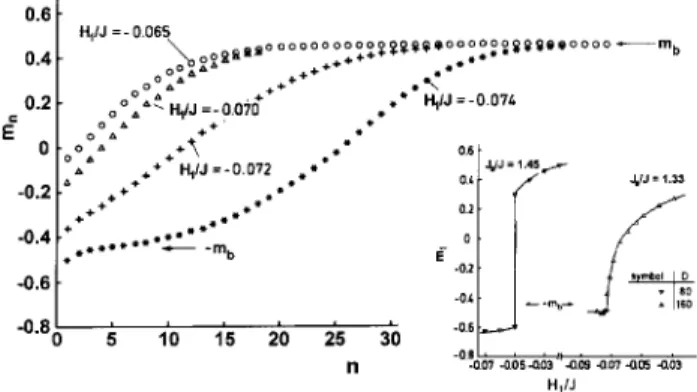
essentiallythat for aninnitesystem.) Proles, suh
asthose in Fig.2, showthat theinterfae movesaway
from the surfaeasthe magnitudeof the surfaeeld
H
1
inreases. Furthermore, these proles show that
evenwhentheinterfaeisfarfromthesurfaethereis
a small variation of the magnetization in the viinity
of the surfaethat is desribed bya lengthsale that
is distint from the distane from the interfaeto the
wall. Atlowtemperaturesthetransition is1st order,
and asthe temperature is inreased themagnitude of
ritialpointisreahedbeyond whihthetransitionis
2ndorder. Thisbehavior,ompletewithhysteresisfor
therstordertransition,isdemonstrated intheinsert
to Fig.2. At very low temperatures, i.e., below the
rougheningtransition, layeringours;andasthe
sur-fae eld is varied, thethikness of the lm inreases
onelayeratatimeinsteadofviaasinglewetting
tran-sition. Wewillnotdisussthislayeringfurtherexept
to say that there are still interesting questions to be
answered regarding the manner in whih the layering
giveswaytowetting.
Figure2. ProlesofmagnetizationinathikIsinglmasa
funtionofdistanefromthesurfaefora128128160
withJs=J =1:33.. Theinsetshowsthevariationofthe
sur-faelayermagnetizationwithsurfaeeldfortwodierent
valuesofenhanedsurfaeoupling.
Thenature oftheritialbehaviorassoiatedwith
the 2nd order wetting transition had been predited
by a renormalization group treatment[21℄ to be
non-universal. Thequantities thatenter thedimensionless
parameterthat wasexpetedtoontroltheritial
be-havior were all measureable for the Ising model so a
rmpredition waspossible. Surprisingly, whendata
from simulationson systems overinga wide rangeof
sizes werearefullyanalyzedforboththesurfaelayer
magnetization and thesurfaelayersuseptibility, the
onlusion was that the ritial behavior was indeed
meaneldlike! Thisndinginspiredanumberofnew
theoretial studiesulminating intheintrodution, by
BoulterandParry[23℄,ofaseondlengthintothe
the-ory that desribed the variation of the magnetization
in theviinityofthewallwiththeresultthat the
the-oretial preditionwasmodied. Although wedonot
yet haveanal resolution, it islear that in this ase
simulationwasinstrumental inenouraging additional
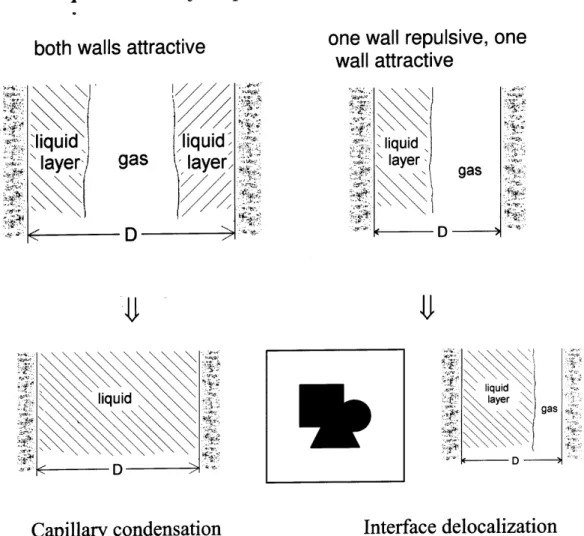
Figure 3. Shemati view of the omparison between apillary ondensation and interfae deloatization in a thin slit
geometry.
Wettingbehaviorinthinapillariesisquitedierent
fromthesenariojustdesribedforthiksystems,anda
shemativiewofthetwopossibilekindsof
harateris-tibehaviorisshowninFig.3. Inthin apillarieswith
equal walls the entire volume lls upwith uid more
easilythanwettingwouldourinthesemi-innite
sys-tem, andapillary ondensationresults. Monte Carlo
simulations[22℄ showedthat thequalitativefeatures of
thephasediagramremainsimilarto thatforthebulk,
buttheentireboundaryisshiftedinhemial
potential-eld spae. The resultant phase diagram, shown in
Fig. 4,hasnotraeofanyunusualbehavioratthe
wet-tingtransitioninthiksystems,buttheritial
temper-atureisdepressedrelativetothatintheinnitesystem.
This means, of ourse, that the density-temperature
(i.e., magnetization-temperature) phase diagram also
aquiresanasymmetry,andtheritialpointisshifted
awayfrom50%density. Thus,intheend,theapillary
ondensation in thin slits is relativelystraightforward
In thin apillaries with opposite walls the
Ising-lattie-gas model provides a laboratory for the study
ofinterestinginterfaebehavior. Inthisgeometrythe
phasetransitionouringinthebulkatatemperature
T
b
issupressedandinsteadaninterfaeformsbetween
oexisting phases that are determined by the surfae
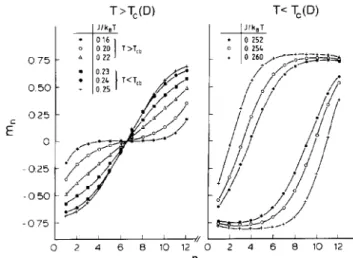
elds. Typial proles, suh as those shown in Fig.5
forL =12, reveal that abovethetransition when the
interfaeis in the enter of the lm, the overall
mag-netizationis zero. AtatemperatureT
(D)<T
b the
interfaebeomesbound to onewallorthe other and
an interfae loalization transition takes plae. The
results of the simulations show that the transition is
shifted below the wetting transition in a semi-innite
systemandbelongstotheuniversalitylassofthetwo
dimensional Ising model. In addition, between this
transitionandT
b
themaximumvalueofthelayer
sus-eptibilityvariesexponentiallywiththethiknessD of
har-expetations[5℄, l isdierent thanthebulkorrelation
length.
Figure 4. Phase boundary for apillary ondensation in
a apillary of thikness D = 16 and wall potentialH1 =
0:75. Thearrowsshowtheloationofthewetting
transi-tioninthebulkTwandthebulkritialtemperatureTb.
Figure5.Prolesofthelayermagnetizationplottedvslayer
numberfor athinlm (L=12)withunlike walls. Onthe
leftareprolesforT >T(D);andontherightareproles
forT<T(D)withthesysteminitiallymagnetizedwithall
spinsuporallspinsdown. Curvesareonlyaguidetothe
eye.
To add still further to the range of intriguing
be-havior that an our when the apillary has unlike
walls, we turn to the ase when the surfae oupling
is enhaned. Then, as the thikness of the apillary
is modied, the transition an hange from 1st order
to2ndorder[29℄. UsingMonteCarlosimulationswith
wellover10 6
MCSperdatapointweexaminedthe
be-haviorfor several valuesof J
s
1:3J, where the
wet-tingtransition at thesurfaeof asemi-innite system
would be very strongly rst order at J=k
B
T = 0:25.
Ina thin lm we found that thetriritial point, i.e.,
theratioJ
st
=J wherethetransition hanges from2nd
orderto 1storder,is enhaned. Thisalso impliesthat
at a xed ratio of J
s
=J there might be a 2nd order
thiklms;i.e., theorderoftheinterfae
loalization-deloalization transition an bemodied by hanging
thethiknessofthelm. Thus,atriritialpoint
o-ursatxed J
s
=J at someritial thiknessD
t .
Sim-ulations were limited to very thin lms (D = 4;6;8)
sineforthiklms,slowinterfaialutuationsmade
runs impossiblylong. Multiplequantities,suhas the
averageorder parameter<jMj>andthe logarithmi
derivativeof <jMj>;wereexamined. ForJ
s
=J =1:3
and D = 6the variation of the order parameternear
K
=J=k
B T
is verysmoothandstronglyrounded by
nite size: The data have exatly the same features
as orresponding data for J
s
=J = 1 [13℄,[14℄ and all
related evidene[26℄(e.g. proles oforder parameter,
energyet. arossthelm)supporttheonlusionthat
the transition is still 2nd order (although it is 1st
or-der for D ! 1 [18℄). For J
s
=J = 1:5, however, a
steep variationof <jMj>with K indiates that this
is already a rounded 1st order transition. This
inter-pretationis supported by thepositions ofthemaxima
ofotherquantitiesthathaveharateristidivergenies
at thetransition. MonteCarlodata alsoshowedthat
the triritial point ould also be reahed by varying
thethiknessDwhileholdingthesurfaeoupling
on-stant. (This approahis more likelyto be realized in
anexperiment.) Forexample,anitesizesaling
anal-ysis of the data for the logarithmi derivative of jMj
shows that the positions of the peaks are ompatible
with theharateristibehaviorK
max
(L) K
/L
2
for1stordertransitions[27℄whileinthe2ndorderase
K
max (L) K
/L
1
[13℄,[14℄(ata2ndordertransition
the extrapolation should vary asL 1=
, where = 1
for the 2-d Ising-like deloalization transition). Lee
and Kosterlitz' [28℄ analysis of the free energybarrier
to determine the order of aphasetransition produes
thesame result. ForJ
s
=J =1:45theenergy
distribu-tion forD =4showsonlyasinglepeak forall lattie
sizes (i.e., the transition is 2nd order), but forD =8
thedistributionisdoublepeakedandtheresultingfree
energybarrierinreasesrapidlywithL(i.e.,the
transi-tionis strongly1storder). Additional strongevidene
forthehangeoftheorderofthetransitionomesfrom
a study ofthe variation of themaxima of thespei
heat,suseptibility,aswellasthelogarithmiderivative
ofjMjwithL.
IV Conlusion
In onlusion, we have presented evidene that the
Ising-lattiegasmodelprovidesthe opportunityto
prising resultthat ritialwetting is mean-eld in
na-ture, in ontradition to the prevailing theory. This
simulational work prompted further theoretial eort
whih revisedthe prevailing viewby observing that a
potentiallyritialelementhadbeenleftoutofthe
the-ory. In thin Ising lms with opposing wallsone an
hangetheorderofthetransitionfrom2ndto1storder
by inreasing the thikness, keeping the surfaeelds
andexhangeouplingsnearthewallonstant. The
o-urene ofsuh atriritialpointanbeinferredfrom
the meaneld treatmentof Swift et al[9℄, but Monte
Carlo simulationsprovide evidenethat this newtype
of triritial point persists beyond mean eld theory.
Theritialbehaviorofthisspeialtriritialpointstill
remainstobeinvestigated[26℄. Itisalsointerestingto
ask whihfeatures ofourresultswill arryovertoreal
systems. For liquid-gas transitions, one expets that
the vander Waals foresimply rst orderwetting [5℄,
and it is not lear whether seond order interfae
lo-alizationtransitionsbeomepossibleinathinlm
ge-ometry. On theother hand,for \symmetrial"binary
polymer mixtures it is oneivable that the dierene
betweenthe vanderWaalsfores ofthetwospeiesis
very small, and an eetively short-range interation
dominates [16℄. Reent experiments on interfaes in
onned geometry are onsistent with suh a piture,
but experimental evideneforaninterfaeloalization
transitionisstilllaking. Clearly,moreexperimentson
relatedsystemsareneededto resolvetheseissues.
Aknowledgements: This researh was supported
in part by NSF grant DMR-9727714 and DFG grant
SFB262/D1.
Referenes
[1℄ H.NakanishiandM.E.Fisher,J.Chem.Phys.78,3279
(1983).
[2℄ Fluid Interfaial Phenomena, edited by C.A. Croxton
(Wiley,New York, 1986).; LiquidsatInterfaes, edited
byJ.Charvolin,J.F.Joanny,andJ.Zinn-Justin
(North-Holland,Amsterdam,1990).
[3℄ Physis of Polumer Surfaes and Interfaes, edited by
I.C.Sanhez(Butterworth-Heinemann,Boston,1992).
[4℄ K.Binder, inPhase Transitions and Critial
Phenom-ena,editedbyC.Domband J.L.Lebowitz (Aademi,
London,1983),Vol.8,p.1.
[5℄ S.Dietrih,inPhaseTransitions andCritial
Phenom-ena,editedbyC.DombandJ.L.Lebowitz(Aademi,
London,1988),Vol.11, p.1.
[6℄ H.NakanishiandM.E.Fisher,J.Chem.Phys.78,3279
(1983).
[7℄ E.V.Albano,K.Binder,D.W.Heermann,andW.Paul,
[8℄ A.O. Parry and R. Evans, Phys. Rev. Lett. 64, 439
(1990).
[9℄ M.R. Swift, A.L. Owzarek, and J.O. Indekeu,
Euro-phys.Lett.14,475(1991).
[10℄ A.O.ParryandR.Evans,PhysiaA181,250(1992).
[11℄ K.BinderandD.P.Landau,J.Chem.Phys.96,1444
(1992).
[12℄ K. Binder, A.M. Ferrenberg and D.P. Landau, Ber.
Bunsenges.Phys.Chemie98,340(1994).
[13℄ K.Binder, D.P.Landau, andA.M.Ferrenberg, Phys.
Rev.Lett.74,298(1995);Phys.Rev.E51,2823(1995).
[14℄ K.Binder,R. Evans,D.P.Landau, and A.M.F
erren-berg,Phys.Rev.E53,5023(1996).
[15℄ Y. Rouault, J. Bashnagel, and K. Binder, J. Stat.
Phys.80,1009(1995).
[16℄ T.Kerle,J.KleinandK.Binder,Phys.Rev.Lett.77,
1318(1996).
[17℄ A. Werner, F. Shmid, K. Binder and Mueller, J.
Chem.Phys.107,8175(1997).
[18℄ K.Binder and D.P. Landau, Phys. Rev. B 37, 1745
(1988);K.Binder,D.P.LandauandS.Wansleben,Phys.
Rev.B40,6971 (1989).
[19℄ Ithasbeensuggested[M.E.FisherandA.J.Jin,Phys.
Rev.Lett. 69, 792 (1992)℄ that the wetting transition
of the Ising model is neverseond order but atually
weakly rstorder for Js =J. If this is true, it would
onlyaetthebehaviorextremelylosetoT
(D),a
re-gionthatisnotaessiblehere.
[20℄ T.Kerle,J.Klein,andK.Binder,Euro.Phys.J.B7,
401(1999); D. Ross, D. Bonn, and J.Meunier (to be
published).
[21℄ E. Brezin, B.I. Halperin, and S.Leibler, Phys.Rev.
Lett.50,1387(1983);R.Lipowsky,D.M.Kroll,andR.
K.P.Zia,PhysRev.B27,4499(1983);D.S.Fisherand
D.A.Huse,Phys.Rev.B32,247(1985); R.Lipowsky
andM.E.Fisher,Phys.Rev.B36,2126(1987).
[22℄ K.BinderandD.P.Landau,J.Chem.Phys.96,1444
(1992).
[23℄ C. J. Boulter and A. O. Parry, Phys. Rev. Lett 74,
3403 (1995); Physia A 218 109(1995): A. O. Parry
andC.J.Boulter,PhysiaA218,77(1995).
[24℄ A.M.FerrenbergandR.H.Swendsen,Phys.Rev.Lett.
61,2635(1988);63,1195(1989).
[25℄ A.M. Ferrenberg, D.P. Landau and R.H. Swendsen,
Phys.Rev.E51,5092(1995).
[26℄ See: K.Binder,Rep.Prog.Phys.60,487(1997), and
referenestherein.
[27℄ D. P. Landau, in Finite Size Saling and Numerial
SimulationsofStatistialSystems(WorldSienti,
Sin-gapore,1990).
[28℄ J.Lee and J.M. Kosterlitz, Phys. Rev.Lett. 65, 137
(1990).
[29℄ A.M.Ferrenberg,D.P.Landau,andK.Binder,Phys.