Inuene of the Adsorption Energy on the Dieletri
Contribution to the Anhoring Energy of
Nemati Liquid Crystals
H.A. Pereira 1
,L.R. Evangelista 1;2
, D. Olivero 2
, and G.Barbero 2
1
Departamentode Fsia-UniversidadeEstadual deMaringa,
Av. Colombo5790,87020-900 Maringa, PR,Brazil
2
DipartimentodiFisiadelPolitenioand
I.N.F.M.,Corso DuadegliAbruzzi,24-10129Torino,Italy
Reeivedon30November,2001
Theinueneof the ioniadsorption ontheanhoring energyofa nematiliquidrystal sample
is investigated. Wedeterminethebehavioroftheanhoringenergyasafuntionofthethikness
of thesample, andasafuntionoftheadsorptionenergyofions. Weshowthatthe ontribution
to the anhoring energy, dueto ioni adsorption, anbe of the same orderof magnitude of the
bare anhoring strength. Our analysis generalizes similar alulations previously published by
inorporatingtheeetofadsorbedhargesonthepotentialandeldprolesinthesample.
I Introdution
From the pratial point of view it is important to
know the alignment of a nemati liquid rystal
sam-ple when it is in ontat with asolid substrate. The
uniformalignmentofliquidrystalsin thisaseis
ru-ialfordisplayappliationsandotherliquidrystalline
devies [1℄. Therefore, theliquid rystalsurfae
prop-ertiesand, inpartiular, theharateristisfeaturesof
theanhoringoftheliquidrystalsareveryimportant
for theperformane of theliquid rystal devies sine
thestrengthoftheanhoringaetsthethreshold
har-ateristisof thesample[2℄. Itisknownthat inmany
realsamplestheanhoringenergyanbethikness
de-pendent [3, 4℄ and an be also dependent on thebias
voltage[5℄. However,thepreisenature andtheorigin
oftheanhoringenergyinnematiliquidrystalsisstill
asubjetofmanyfundamentalandexperimental
stud-iesandannotbeonsideredasasolvedproblem[3,6℄.
Toexplain the thikness dependene of the anhoring
energyfound in somereal nemati liquid rystal
sam-plesthephenomenonoftheseletiveionadsorptionhas
beeninvoked[7-10℄. The inuene ofthe seletiveion
adsorptionontheanisotropipartoftheanhoring
en-ergystrengthhasbeendisussedbyseveralauthors in
the last years [4,5,11-16℄. Aording to this point of
view [8, 9℄, the adsorption phenomenon is
responsi-harge separation is onnetedan eletri eld
distri-bution aross the sample. The oupling of this eld
with the dieletri and exoeletri properties of the
liquid rystal givesrise to adieletri energy density,
loalized near to the limiting surfaes, on mesosopi
thiknesses. Thisenergyanbeonsideredasasurfae
energy, whih renormalizesthe anisotropipartof the
interfaial energy haraterizing the interfae nemati
liquidrystal- substrate. Thedistribution oftheeld
arossthesample andits onnetionwith the
adsorp-tion energy has been disussed in [10, 17, 18℄. In the
aseinwhihthephenomenonofseletiveadsorptionis
absent,theeet disussedaboveisalsoabsent.
Sum-marizing: thehargeseparationinduedbyanexternal
eldgivesrisetoaspatialdependenteletrieldinside
thesample. This eletrieldoupleswith the
diele-tri andexoeletripropertiesofthenematimedia.
Reently,aompletemodelfortheadsorption
phe-nomena in an isotropi liquid wasproposed, in whih
theeetofexternaleldswastakenintoaountina
suessfulway[18℄. Inthismodel,thepreseneof
pos-itiveandnegativehargeswastakenintoaount,but
theadsorptionwasonsideredasseletivewithrespet
to thepositiveones,i.e., theadsorptionenergyforthe
negative harges wastaken as innite. It was shown
alsothat, aordingtothevalueoftheexternal
between the two regimes is xed by the surfae
den-sity of ions, originated from the hemialdissoiation
oftheimpuritiespresentintheliquid. Inthelow
volt-ageregiontheeletrieldin thesamplehangessign.
Ontheontrary,inthehighvoltageregion,theeletri
eld iseverywhereorientedin thesamediretion.
Veryreently, thedieletri ontribution to the
an-horingstrengthinanematiliquidrystalsamplewas
analyzed [19℄. The analysis wasperformed in the
hy-pothesis thattheeletrodesareperfetlyblokingand
thatthereisnoseletiveionadsorption. Theproposed
theorypreditsaneetiveanhoringenergydependent
ontheapplied voltage,in goodagreementwith
exper-imentalresults. Aording tothesignof thedieletri
anisotropyandoftheexoeletrioeÆientthe
depen-deneoftheanhoringenergystrengthwiththeapplied
voltageanbemonotoniornot. Forlargeapplied
volt-age theeetive anhoringenergy strengthtends to a
onstantvalue.
In this paper, we fous our attention on theeet
of anadsorptionenergyontheanhoringenergyof
di-eletri origin. More preisely, we expliitly onsider
the phenomenon of seletive ioni adsorption and its
inuene on the anhoringenergy of an NLC sample.
First, wereall theformalismproposed in Ref.[19℄ to
analytiallydeterminethedieletriontributiontothe
anhoringenergy. After that, we present the general
equations governing the eld distribution in the
sam-ple, whenthephenomenonofioniadsorptionistaken
into aount, as is done in Ref. [18℄. Finally, we
ap-plythisformalismtodeterminethebehaviorofthe
an-horingenergy asa funtion of the adsorption energy
and as afuntion of the thikness of the sample. We
showthat thetrendandtheorderofmagnitudeofthe
anhoringenergyof dieletriorigin,theoretially
pre-dited in our analysis, as a funtion of the thikness
of the sample, is in good agreement with
experimen-tal results. We show furthermore that the magnitude
of the anhoring energy of dieletri origin is strongly
aeted by the adsorptionenergy of positive ionsand
presentsanonmonotonibehaviorasafuntion ofthis
energy. Itisalsoshownthat theexoeletri
ontribu-tion plays a dominant role in establishing the orret
orderof magnitudefortheanhoringenergy.
II Dieletri ontribution to the
anhoring strength
Letusonsideranematiliquidrystallimitedbytwo
solid surfaes, at a distane d apart. The z axis is
normaltotheboundingsurfaes,withtheorigininthe
middle of the sample. The liquid is supposed to
on-tain ions and submitted to an external eld. As we
shall show below, in this ase the eletri eld prole
insidethe sampleisz dependentand willbedenoted
byE(z). TheeldE(z)diersfromtheoneinthebulk,
E
B
=E(0),mainlylosetotheboundingsurfaes,due
to the presene of the ions, as it will be disussed in
details later. If theliquid is an anisotropiuid, as a
nematiliquidrystals,thepreseneoftheioniharges
givesriseto asurplusof surfaeenergy haraterizing
thenemati liquidrystal-substrateinterfae. To
eval-uate thedieletri ontributions to the surfaeenergy
we have to take into aount the oupling of the
ex-ternal eld with the dieletrianisotropy, f
D
(E), and
with the exoeletri properties of the liquid rystal,
f
Q
(E)[8,9℄.
The quantities f
D
(E) and f
Q
(E), whih are bulk
energydensities,aregivenby
f
D (E)=
1
2
a E
2
(z)os 2
; (1)
and
f
Q
(E)=e
os 2
1
3
dE(z)
dz
; (2)
where=os 1
(~n~z)istheangleformedbythe
dire-toreld~nwiththez axis. Furthermore
a =
k
?
is the dieletri anisotropy (k and ? refer to ~n), and
e=e
11 +e
33
thetotalexoeletrioeÆient.
Letus indiatebyE
B
=E(0)andbyE
S
=E(d=2)
thevaluesoftheeletrieldin themiddleandatthe
surfaeof the sample, respetively. The dieletri
en-ergy,perunit surfae,is
F
E =
Z
d=2
d=2 [f
D (E)+f
Q
(E)℄dz: (3)
Thisquantityanbewritten as
F
E =
Z
d=2
d=2 [f
D (E) f
D (E
B )+f
Q (E) f
Q (E
B )℄dz
+ Z
d=2
[f
D (E
B )+f
Q (E
B
Taking into aountthat E(z) E
B
is dierent from zero, pratially, only in twosurfaes layers of mesosopi
thikness,forthepreseneoftheions,weanputEq. (4)in theform
F
E =f
1 +f
2 +
Z
d=2
d=2 [f
D (E
B )+f
Q (E
B
)℄dz; (5)
where
f
1 =
1
2
a os
2
1 Z
0
d=2 [E
2
(z) E 2
B ℄dz e
os 2
1 1
3
(E
S E
B
); (6)
and
f
2 =
1
2
a os
2
2 Z
d=2
0 [E
2
(z) E 2
B ℄dz+e
os 2
2 1
3
(E
S E
B
); (7)
with
1
= ( d=2) and
2
= (d=2). f
1 and f
2
are the dieletri ontributions, due to the ions, to the surfae
energy. Therelevantanhoringenergystrengths,oinidingwiththeoeÆientofos 2
i
(i=1;2), arethen
W
D =
1
2
a Z
d=2
0
E 2
(z) E 2
B
dz; (8)
and
W
Q
=e(E
S E
B
); (9)
d
whererefertoz=d=2. Onetheeletrield
dis-tribution arossthesample isknown,oneandiretly
evaluatetheontributionofdieletriorigintothe
an-horing energy of a nemati liquid rystal sample, by
meansof Eqs.(8) and (9). It isneessaryto reinfore
the fat that these equations represent only the
on-tribution of dieletri origin to the anhoring energy.
There isaloalized surfaeenergywhih doesnot
de-pend on the presene of ions in the sample. It is an
intrinsi harateristi of the interfae. In this sense
thedieletriontributionrenormalizesthis\bare"
an-horingenergy,W
0
,givingrisetoaneetiveanhoring
energythatanbewrittenin theform
W
e =W
0 +W
D +W
Q
: (10)
In this paper we fous ourattention onlyon the
on-tribution ofdieletrioriginin order toemphasizethe
neessityto takeinto aountthepreseneofionsand
ofanadsorption energyontheanhoringenergyofan
NLCsample.
Inorder to show the importane of the above
for-malism,letusalulateW
D andW
Q
byexpliitly
tak-ingintoaountthepreseneoftheionsinthesample.
Todothiswehavetoestablishtheeletrieldprole
insideit. Theequationsgoverningtheeletrield
dis-tributionswereestablishedin Ref. [18℄. However,itis
onvenient topresentthem herein details, due tothe
extensiveusethat willbemadealongthispaper.
III The model for the eletri
eld distributions
The model dealswith aell in the shapeof aslab of
thiknessd, lled with a liquid haraterized bya
di-eletri onstant , but ontaining impurities. These
impurities are the soure of the ions by means of a
hemialreation,whoseativationenergyisindiated
byE
ativation
. TheativationenergyE
ativation anbe
identiedwiththeeletrostatisinterationenergy
be-tweenthepositiveandnegativeionsresultingfromthe
dissoiation of the partile. We onsider the ase in
whihthe surfaesare idential, but inthe hypothesis
that theadsorptionenergyforpositiveionsisdierent
fromtheonefornegativeionsineahsurfae. Weusea
Cartesianrefereneframewhosez-axisisnormaltothe
limitingwalls,loatedatz=d=2. Weassumethatall
the physial quantities enteringin themodel are only
z dependent. Thedistribution of hargesprodued by
the ioni adsorption gives riseto a liquid whih is
lo-ally harged, but globally neutral. We denote by n
0
the bulk density of impurities for an innite sample.
Theequilibriumdistributionofthebulkdensityofnon
dissoiatedimpuritiesisgivenby
n
b =n
0 e
; (11)
where is the hemial potentialin k
B
T units. F
ur-thermore, the bulk densities of positive and negative
ionsaregivenby
n (z)=n e
(z)
where=E
ativation =k
B
T istheativationenergyand
(z) = qV(z)=k
B
T is the eletrostati energy of the
harge q, in k
B
T units. This means that in our
for-malismthesurfaeeletrialpotentialisalsomeasured
in units of k
B
T=q and, for onveniene, the quantity
S
will be heneforth referredsimply as the \surfae
potential".
Thesurfaedensityofadsorbedionsofagivensign
isgivenby
i; =N
e
A
i
; (13)
where i = 1;2 refers to the surfaes (1 for z = d=2
and 2 for z = d=2) and N
are the surfae densities
of siteswhere theions(+ and )anbeadsorbed. In
theaboveexpressionwehaveintroduedtheadsorption
energiesA
(for+and ions)measuredink
B
T units.
The adsorptionenergyanbe identiedwiththe
ele-trostatiinterationenergyofanadsorbedionwithits
image in the substrate (physial adsorption) [22℄.
Fi-nally, in(13)
1
= (z= d=2)and
2
= (z=d=2)
arethevaluesofthesurfaepotentials. Weworkinthe
hypothesis that only the internal hargesmoveto the
surfae. The external harges supplied to the system
aresupposed to remainin thesurfae, separatedfrom
theliquidbyblokingeletrodes. Weassume,
further-more, that N
+
= N = N and, in this manner, the
atualsurfaedensityofadsorbedionsisgivenby
N
i =Ne
(e A+ i
+e A + i
): (14)
Theatualsurfaehargedensityduetotheadsorption
phenomenonis
Q
i =q(
i;+
i;
)=q
i
: (15)
Notie that the surfae densities of harges will have
both the internal ontribution (oming from the ioni
hargespresentin the liquid)and theexternal
ontri-bution(omingfrom theexternalpowersupply).
To establish the fundamental equations governing
the equilibrium distributions of harges and elds in
ourmodelwestartbyimposingtheonservationofthe
number of partiles in the system. This requirement,
perunitsurfae,iswrittenas
N
+ +N
2
+N
B +
1 +
2
2
=n
0
d; (16)
where
N
=
Z
d=2
d=2 n
(z)dz; and N
B =
Z
d=2
d=2 n
b
(z)dz=n
b
d: (17)
Usingthedenitionsof n
(z),givenby(12),and
i
,givenby(13),itis possibletorewriteEq. (16)in theform
e
(
n
0 e
Z
d=2
d=2
osh (z)dz+n
0 d+
N
2
e A+
e 1
+e 2
+e A
e 1
+e 2
)
=n
0
d: (18)
Inthisasethehemialpotentialisgivenby
e
=1+ 1
2n
0 d
e A
+
e 1
+e 2
+e A
e 1
+e 2
+ e
d Z
d=2
d=2
osh (z)dz: (19)
d
This equation onnets the hemial potential with
the surfae potentials
1 and
2
. It is the rst
fun-damental equation ofthe model. Inthe asein whih
weonsideronlyadsorptionofpositiveions,wehaveto
put A
+
=A, and A ! 1. Inthis limitingaseEq.
(19)isreduedtoEq. (6)ofRef.[18℄(forA
1 =A
2 ).
The seond fundamental equation of the model is
obtained in the framework of the Poisson-Boltzmann
theory,bymeansofthePoisson'sequation
d 2
V
2 =
q
[n
+
(z) n (z)℄; (20)
beauseweonsider onlythesteady-statedistribution
of hargesand elds when the applied voltage is held
onstant. Equation(20)anbeput intheform
d 2
dz 2
= 1
L 2
e
sinh ; (21)
where
L= s
k
B T
2n
0 q
2
(22)
isanintrinsilengthoftheproblem. Thislengthis
on-neted to theDebyesreening length
D
the relation
D = Le
=2
[10℄. Equation (21)an be
integratedtogive
1 2 d dz 2 = e L 2
[osh (z)+℄; (23)
whereisanintegrationonstanttobedeterminedby
theboundaryonditions.
Sinetheeletrieldisgivenby
E(z)= dV dz = k B T q d dz ; (24)
in thepresene of anexternaleld the boundary
on-ditionsare
E( d=2) = k B T q d dz z= d=2 = q ( 1 ); E(d=2) = k B T q d dz z=d=2 = q ( 2 +); (25)
where is the surfae density of external harges.
Equations (25)are written by assuming that the
sur-faeatz= d=2isonnetedwiththenegativepoleof
the externalpowersupply. The set of equations (19),
(21)and(25)furnishestheompleteformalsolutionof
theeletrostatiproblem,giving,
1 ,
2 and.
Intheabsene ofexternal eld,equations (25)are
redued,respetively,to
E( d=2)=q
1
and E(d=2)= q
2
: (26)
Equations(25)permitstoonsidertwoseparatedases
forwhih
1
>0(lowvoltageregime)and
1
<0
(highvoltageregime).
When
1
0, E( d=2) > 0 (i.e.,
(d =dz)
z= d=2
< 0) and E(d=2) < 0 (i.e.,
(d =dz)
z=d=2
> 0). This implies that the eletrial
potentialhas a minimum at some point z
inside the
slab,wheretheeletrield vanishes[18℄,namely
d dz z=z
=0; (27)
andtheintegrationonstantin(23)anbewrittenas
= os
; (28)
where
= (z
). InthisaseEq. (23)anbe
rewrit-tenas d dz = p 2 L e ( )=2 p osh osh ; (29)
where thesign refers to theregion d=2 z z
,
and+totheregionz
zd=2. Equations(29)an
I[ ; 2 ; osh ℄ I[ 1 ; ; osh ℄= p 2 d L e ( )=2 ; (30) where
I[a;b;℄= Z b a d p osh + : (31)
In this manner the boundary onditions (25) an be
rewrittenas p 2k B T q 2 L e ( )=2 p osh 1 osh = 1 ; p 2k B T q 2 L e ( )=2 p osh 2 osh = 2 + : (32)
The fundamental equations of the model for the low
voltage regimeare then (19), (30)and (32). We have
to solvethis systemoffour equationsto obtain,
1 ,
2 and
. One thissystemofequations issolved,it
is straightforward to obtain the surfaeharge
densi-ties
i
bymeansof Eqs.(13). Asitfollowsfrom these
equations, the surfaeharge densitiesdepend on the
external harges at the surfae through the hemial
potentialandtheeletripotentialsatthesurfaes.
Theborderseparatingthetworegimesisdenedby
1 ( )
=0,where
istheritialsurfaedensity
ofexternalharges.For=
, ( )= 1 ( ),asit
followsfromEqs. (32). Inthehigh-voltageregime the
adsorbed harge, at z = d=2, is then smaller than
the one sent by the power supply on the eletrode.
From Eqs. (25) we now have that E( d=2) < 0 and
E(d=2) < 0. The eletrial potential is a monotoni
funtion ofzand,onsequently,theeletrield never
vanishes for d=2 z d=2 [18℄. In this ase, from
Eq. (23)weobtain
I[ 1 ; 2 ;℄= p 2 d L e ( )=2 ; (33)
onnetingto
1 and
2
. ByusingEqs.(23)and(25)
wededuethattheboundaryonditionsread
k B T q p 2 L p osh 1
+ = q
1 k B T q p 2 L p osh 2
+ = q
+
2
: (34)
Inthehigh-voltageregime,thefundamentalequations
are(19),(33)and(34). Theseequationsgive,
1 ,
IV Eletri eld distributions
and anhoring energy
In this setion weshall onsider two partiular
situa-tionsto investigatetheeet oftheadsorption energy
on the eletri eld distributions in the sample and,
onsequently,ontheanhoringenergyofdieletri
ori-gin. Thebasiequationsof themodel arenumerially
solvedtoobtain,
1 ,
2 and
(low-voltageregime)
or (high-voltage regime). One these quantities are
determineditispossibletoestablishtheproleofE(z)
fordierentvaluesofandA
andalsod.
Case I: A
+
=A6=0, A !1, =0
This ase refers to a situation in whih only
pos-itive harges are adsorbed, in the absene of external
voltage. Sine we havesupposed that thesurfaes are
idential, the eletrial potential distribution is
sym-metri, i.e.,
1 =
2 =
s , andz
=0, whih means
thatthepotentialisminimumatthemiddleofthe
sam-ple,
= (z=0)=
0
. Inthissimpleasethethree
equations to be solved onnet
s
, and
0
.
Equa-tion(19)isreduedto
e
=1+ N
n
0 d
e A s
+e
J[
0 ;
s ; osh
0
I[
0 ;
s ; osh
0 ℄
; (35)
where
J[a;b;℄= Z
b
a
osh
p
osh +
d : (36)
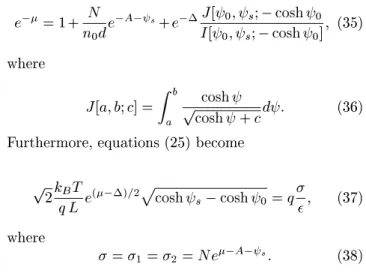
Furthermore,equations(25)beome
p
2 k
B T
qL e
( )=2 p
osh
s osh
0 =q
; (37)
where
=
1 =
2 =Ne
A s
: (38)
From the above equations the hemial potential an
bewrittenas
e
=2
k
B T
NLq 2
2
e
+2(A+ s)
(osh
s osh
0 ):
(39)
Finally,Eq. (30)anbewritten as
I[
0 ;
s ; osh
0 ℄=
p
2
2 d
L e
( s)=2
: (40)
The behavior of ,
s and
0
as a funtion of the
thikness of the sample d was investigated in details
in Ref. [10℄. Here, our attention will be devoted to
thealulationoftheanhoringenergy. Thissimplied
ase is of partiular importane beause it permits to
anhoringenergy of dieletri originin the absene of
externalharges.
0
1
2
3
4
5
6
7
8
0.00
0.02
0.04
0.06
0.08
0.10
0.12
W
(erg
/cm
2
)
d (
µ
m)
Figure1. AnhoringenergyW =WE =WD+WQ versus
the thikness of the sample d, inthe absene of external
appliedvoltage=0.Theurvewasplottedfor
a =14
0 ,
e=410 11
C/m[24 ℄, D =0:6 m[21 ℄, =8:0, and
A= 0:3.
InFig.1thebehaviorofW =W
E =W
D +W
Q asa
funtionofthethiknessofthesampledisshown. The
trendis ingood agreementwiththedatafrom Ref.[3℄
asdisussed in[9℄. Theagreementobtainedin [9℄was
fairly good. However, in [9℄ two approximationswere
made. Therstoneonsideredanexponential
dereas-ingdistributionfortheeletrield inthesample;the
seondoneonsidered anapproximatedexpression for
thesurfaedensityofhargesasafuntionofthe
thik-nessof the sample. The presentmodel removes these
simplifyinghypohtesis.
-50
-40
-30
-20
-10
0
-3.5
-3.0
-2.5
-2.0
-1.5
-1.0
-0.5
0.0
H. A. Pereira et al. - Fig. 2
W
(er
g/
c
m
2
)
A
Figure2. Anhoring energyW
E
versustheadsorption
en-ergyofpositiveharges A=A
+
intheabseneofexternal
appliedvoltage=0. Theparametersare thesameasin
Fig.1.
InFig.2thebehavioroftheanhoringenergyof
di-eletrioriginW =W
E
asafuntionoftheadsorption
energy for positive harges is shown. When the
ad-sorptionenergyisnotveryhightheorderofmagnitude
of W agrees with the ones usually found (W 10 2
is very high, W tends to a onstant value,
indepen-dentofthevalueofA. Thisvalueisoftheorderoffew
erg/m 2
andorrespondspratiallytoastrong
anhor-ingsituation. Thisresultindiatesagainthattheioni
adsorptionanplayafundamental rolein establishing
theorretorderofmagnitudeofW.
Case II: A
+
=A6=0, A !1, 6=0
Inthisase,wehaveagainonlyadsorption of
pos-itive harges, but now in the presene of an external
voltage. InFig.3wepresentanillustrativeresultwhen
theexternaldensityofhargeis=N =0:6. Thegure
showsthebehaviorofW =W
E
asafuntionofd. This
situation hasto beomparedwiththeonedepitedin
Fig. 1 where the external harges are absent. Notie
that theeet of anexternal eletrield strongly
af-fetsthe magnitudeof the anhoringenergy. This
re-sultisinompleteagreementwiththeonesestablished
in [19℄, where it was demonstratedthat the anhoring
energyisbias-voltagedependent.
1
2
3
4
5
6
7
8
0.6
0.8
1.0
1.2
1.4
1.6
1.8
2.0
2.2
2.4
2.6
W
(erg
/cm
2
)
d (
µ
m)
Figure3. ThesameasinFig.1,inthepreseneofexternal
appliedvoltage =N =0:6. Theparameters are thesame
asinFig.1.
-50
-40
-30
-20
-10
0
-3.0
-2.5
-2.0
-1.5
-1.0
W
(er
g/
c
m
2
)
A
Figure4. ThesameasinFig.2,inthepreseneofexternal
appliedvoltage =N =0:6. Theparameters are thesame
InFig.4thequantityW =W
E
isplottedasa
fun-tion of the adsorption energy A, also in the presene
of an external hargedensity =N =0:6. This gure
illustrates the ombined eet of an external voltage
andanadsorptionenergyinthebehaviorofW =W
E .
BotheetsattoinreasethemagnitudeofW. Again
wehaveasaturationvalueforW forlargevaluesofA,
orrespondingtoasituationofstronganhoring(when
A! 1).
InFig.5theanhoringenergyW =W
E
isshownas
afuntionofthediereneofpotentialarossthe
sam-ple. =
2 1
istheeetivediereneofpotential,
i.e.,itomesfromtheexternalhargesandtheinternal
hargesthatmovetothesurfae. ThevalueofW isan
inreasing funtion of this dierene of potential, but
presentsamaximumnear =50, i.e.,V '1:25V
(formonovalentions). Forlargediereneofpotential
theanhoringenergyofdieletriorigintendstoa
sat-urationvalue. Theurvewasplottedforanadsorption
energyA= 0:4.
0
10
20
30
40
50
60
0
1
2
3
4
5
6
7
8
|W
| (
e
rg
/c
m
2
)
∆Ψ
Figure 5. Anhoring energy of dieletri origin W
E as a
funtionoftheeetivepotentialdierenearossthe
sam-ple = 2 1, for A+ = 0:3 and A ! 1. The
parametersarethesameasinFig. 1.
Finally, just toshowtheeet oftheadsorptionof
negativehargesonthenetsurfaehargedensity,this
quantity is exhibited as afuntion of the thiknessof
the sample in two ases - in the absene of external
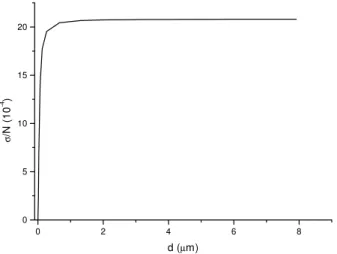
applied voltage. In Fig. 6 =N =
1
=N =
2 =N is
shownasfuntionofthedfortheaseA
+
= 0:4and
A !1. Inthisase,only theadsorption ofpositive
harges isonsidered. Oneobservesthat thebehavior
of is linearwithd, forsmall d,and tendsto avalue
whih is independent of d, for very large values of d,
asdisussedin [10℄. InFig.7thesamequantityis
ex-hibitedasafuntion of dfortheaseA
+
= 0:4and
A = 1:0Theglobalbehaviorissimilar,inthesense
thatthereisalinearbehaviorforsmalldanda
satura-tionvalueforlarged. However,asexpeted, theorder
given by =
+
(see Eq. (15)). Furthermore,
in this situation tends toasaturationvalueonlyfor
verylarge valuesof d, as ompared with the previous
asewherethesaturationis abrupt.
0
2
4
6
8
0
5
10
15
20
σ
/N
(
1
0
-4
)
d (
µ
m)
Figure 6. Surfaehargedensity versus thethiknessof
thesampleintheaseofadsorptionofonlypositiveharges
A+= 0:4(A !1). Theparametersarethesameasin
Fig. 1.
0
1
2
3
4
5
6
7
8
0
2
4
6
8
10
12
14
16
H. A. Pereira et al. - Fig. 7
σ
/N
(
1
0
-6
)
d(
µ
m)
Figure 7. Surfae harge density versus the thikness
of the sample in the ase of adsorption of positive (with
A+ = 0:4)andnegative (withA = 1:0)harges. The
parametersarethesameasinFig.1.
A more extensive analysis onsists in taking into
aount also the eet of the adsorption of negative
hargeson the anhoringenergy. Due to the
general-ity of the proposed model, it is also possible to
on-sider dierentsurfaes,withdierentadsorption
ener-gies for eah speies of ions. This will permit a
om-plete overview on the main preditions of the model.
This analysis is under progress and will be published
V Conlusions
We haveanalyzed the eet of the seletive ioni
ad-sorption on the anhoring energy of a nemati liquid
rystalsample. The problem of asample of thikness
dformed bytwoidential surfaes,undertheationof
anexternalappliedvoltagewasanalyzed. Itwasshown
thattheadsorptionenergyhasaprofoundeetonthe
magnitudeoftheanhoringenergy. Ouranalysis
rein-forestheonlusionthattheanhoringenergydepends
ontheexternalappliedvoltage,in agreementwiththe
preditionsof Ref. [19℄. Furthermore, we haveshown
that,alsointheabseneofexternaleld,theanhoring
energyisstronglyinuenedbytheadsorption energy
oftheions. Theanhoringenergypresentsa
nonmono-toni behaviorasafuntion of theadsorption energy.
Forverylargevaluesofthisquantity,theanhoring
en-ergy tends to a saturation value whose magnitude is
of the order of a few erg/m 2
. In the ases we have
analyzed, the presene of the exoeletriity was
ex-pliitlytakenintoaount,andplaysadominantrole.
Inonlusion,toinvestigatetheorretbehaviorofthe
anhoringenergyin a realsample one hasto onsider
therenormalizationof the anhoringenergy of
diele-triorigin. Thisontributionresultsfromtheoupling
of spatial dependent eletri eld inside the sample
-originated from the ioni adsorption- with the
diele-triandexoeletripropertiesofthemedium.
Aknowledgments
ThisworkhasbeenpartiallysupportedbyFunda~ao
Arauaria,Capes,andINFM.
Referenes
[1℄ P.J.Coolings,LiquidCrystals,(AdamHilger,Bristol,
1990),Chapters6and7.
[2℄ G. Barbero and L. R. Evangelista, An Elementary
Courseon theContinuum Theory forNemati Liquid
Crystals,(WorldSienti,Singapore,2000).
[3℄ L.M.Blinov,A.Yu.Kabaenkov,andA.A.Sonin,Liq.
Cryst.5,645(1989).
[4℄ O.A.Gomes,R.C.Fal~ao,andO.N.Mesquita,Phys.
Rev.Lett.86,2577(2001)
[5℄ G. Strangi, C. Versae, and N. Saramuzza, Appl.
Phys.Lett.78,2455(2001).
[6℄ B.Jerome,Rep.Prog.Phys.54,391(1991).
[7℄ G.BarberoandG.Durand,Liq.Cryst.2,401(1982).
[8℄ G.BarberoandG.Durand,J.Phys.(Frane)51,281
(1990).
[9℄ A. L. Alexe-Ionesu, G. Barbero, and A. G. Petrov,
Phys.Rev.E48,R1631(1993).
[10℄ G. Barbero, A. K. Zvezdin, and L. R. Evangelista,
Phys.Rev.E59,1846(1999).
[12℄ U.Kuhnau,A.G.Petrov,G.Klose,andH.Shmiedel,
Phys.Rev.E59,578(1999).
[13℄ V. G. Nazarenko, V. M. Pergamenshhik, O. V.
Ko-val'huk,A.B.Nyh,andB.I.Lev,Phys.Rev.E60,
5580(1999).
[14℄ V. U. Fazio, and L. Komitov, Europhys.Lett. 46(1),
38(1999).
[15℄ R. Meister, and B. Jer^ome, J. Appl. Phys. 86, 2473
(1999).
[16℄ A. L. Alexe-Ionesu, A. T. Ionesu, N. Saramuzza,
G.Strangi,C.Versae,G.Barbero, andR.Bartolino,
Phys.Rev.E011708-1(2001).
[17℄ K.Bohin,V.Kralj-Igli,andA.Igli,Eletrohimia
Ata46,3033(2001).
[18℄ L. R. Evangelista and G. Barbero, Phys.Rev.E 64,
021101-1, (2001).
[19℄ D. Olivero, L. R. Evangelista,and G.Barbero, Phys.
Rev.E65,031721(2002).
[20℄ R. N. Thurston, J. Cheng, R. B. Meyer, and G. D.
Boyd,J.Appl. Phys.56,264(1984).
[21℄ R.N.Thurston,J.Appl. Phys.55,4154(1984).
[22℄ L.D.LandauandE.I.Lifshitz,Eletrodynamiquedes
MilieuxContinus,(MIR,Mosow,1956).
[23℄ J.Israelahvili,IntermoleularFores(AademiPress,
London,1985),Chap.12.
[24℄ G.Barbero, A. N. Chuvyrov, A. P. Krekhov, and O.