MULTI DI MENSI ONAL TOOLS: APPLI CATI ON OF PAI N
QUALI TY CARDS I N CHI LDREN
1Lisabelle Mariano Rossat o2 Fernanda Milani Magaldi3
Rossat o LM, Magaldi FM. Mult idim ensional t ools: applicat ion of pain qualit y car ds in childr en. Rev Lat ino- am Enfer m agem 2 0 0 6 set em br o- out ubr o; 1 4 ( 5 ) : 7 0 2 - 7 .
This pilot , descript ive and field explorat ory st udy aim ed t o verify t he represent at ive of t he qualit y of pain, applying t he Pain Qualit y Cards t o 50 children and t eenagers hospit alized in t he first half of 2004, aft er being approved by t he Et hic Com m ission. Result s have shown t hat t here is no relat ionship bet ween t he age group and t he num ber of posit ive answers. The ident ificat ion of t he cards was different t o each group, 61,1% of t he cards were ident ified for t he pre- scholar, 77,8% for t he scholar and 27,8 for t he t eenagers. The use of t he inst r um ent has r ev ealed it self successful and able t o ev aluat e, discr im inat e and m easur e t he differ ent dim ensions of pain.
DESCRI PTORS: pain m easurem ent ; child; nursing
I NSTRUMENTOS MULTI DI MENSI ONALES: APLI CACI ÓN DE LAS TARJETAS DE LAS
CUALI DADES DEL DOLOR EN NI ÑOS
Est udio pilot o, descript ivo y explorat orio de cam po. El obj et ivo fue verificar la represent at ividad de las cualidades del dolor de niños y adolescent es, aplicando las Tarj et as de las Cualidades del Dolor a 50 niños y adolescent es en el prim ero sem est re de 2004, después de obt ener la aut orización del com it é de ét ica de la escuela de la enferm ería. Los result ados apunt aron no haber correlación ent re grupo de det erm inada edad y núm er o de r espuest as afir m at iv as. La ident ificación de las t ar j et as fue dist int a par a cada gr upo, es decir , 61,1% de las tarj etas fueron identificadas para el pre- escolar, 77,8% para el escolar y 27,8% para el adolescente. La ut ilización del inst r um ent o m ost r ó ser fact ible y capaz de ev aluar , discr im inar y m ensur ar las dist int as dim ensiones del dolor.
DESCRI PTORES: dim ensión del dolor; niño; enferm ería
I NSTRUMENTOS MULTI DI MENSI ONAI S: APLI CAÇÃO DOS CARTÕES DAS
QUALI DADES DA DOR EM CRI ANÇAS
Est udo pilot o, descr it ivo e ex plor at ór io de cam po. O obj et ivo foi ver ificar a r epr esent at ividade das qualidades da dor de crianças e adolescent es, aplicando os Cart ões das Qualidades da Dor a 50 crianças e adolescen t es n o pr im eir o sem est r e de 2 0 0 4 , após obt er a apr ov ação do Com it ê de Ét ica da Escola de Enferm agem , USP. Os result ados apont aram não haver correlação ent re faixa et ária e núm ero de respost as afir m at iv as. A ident ificação dos car t ões foi difer ent e par a cada gr upo, ou sej a, 61, 1% dos car t ões for am identificados para o pré- escolar, 77,8% para o escolar e 27,8% para o adolescente. A utilização do instrum ento m ost rou ser fact ível e capaz de avaliar, discrim inar e m ensurar as diferent es dim ensões da dor.
DESCRI TORES: m edição da dor; criança; enferm agem
1
CNPq Scient ific I nit iat ion Proj ect ; 2 Facult y, e- m ail: rossat [email protected]; 3 Undergraduat e Nursing st udent . Universit y of São Paulo at School of Nursing
I NTRODUCTI ON
P
ain sensat ions ar e fear ed by people of all ages, m ainly by childr en. How ever, t her e is a st r ongpopular belief t hat t he lat t er do not feel pain. Alt hough
w i t h o u t a n y sci e n t i f i c f o u n d a t i o n s, m a n y h e a l t h
pr ofessionals st ill m aint ain t his belief.
Var ious r easons explain w hy pain in childr en
does n ot r eceiv e t h e sam e at t en t ion as adu lt pain ,
in clu din g h ealt h pr of ession als’ dif f icu lt y t o m easu r e
infant pain, eit her because t hey do not ask if t hey are
feeling pain or because t hey do not know t hat younger
children experience great er com m unicat ion difficult ies.
My t h s o ccu p y a si g n i f i ca n t p l a ce a m o n g
a r g u m e n t s f o r t h e i n s u f f i c i e n t t r e a t m e n t a n d
ident ificat ion of pain, highlight ing opioids as causes
o f p h y si ca l d e p e n d e n ce , t o l e r a n ce , p sy ch o l o g i ca l
d ep en d en ce an d r esp ir at or y d ep r ession . Mor eov er,
pr of ession als’ lim it ed k n ow ledge an d t r ain in g abou t
pain , disin f or m at ion an d con f u sion am on g con cept s
of t oler ance, phy sical and psy chological dependence
an d r espir at or y depr ession , w h ich im pede ef f ect iv e
co m m u n i ca t i o n a b o u t t h i s su b j e ct , r e su l t i n t h e
in adequ at e an d im pr ecise assessm en t an d h an dlin g
of infant pain( 1).
Unt il t he 1970’s, t he belief was t hat children
w er e in cap ab le of q u an t if y in g ab st r act p h en om en a
lik e pain int ensit y. St udy r esult s hav e dem onst rat ed
t hat t hey are capable of indicat ing t he levels of t heir
suffering, provided t hat adult s give t hem an adequat e
inst r um ent , such as a scale, diagr am or dr aw ing( 1).
Th e r e a r e v a r i o u s p a i n a s s e s s m e n t
i n st r u m en t s. Un i d i m en si o n al t o o l s o n l y d i m en si o n
i n t e n si t y, w h e r e a s m u l t i d i m e n si o n a l o n e s a sse ss
qualit ies and differ ent dim ensions( 2).
Tools like t he visual analogue scale, num erical
scale, cup scale and color scale, assess children’s pain
int ensit y and ar e r elat ed t o t heir dev elopm ent lev el.
To u n d e r s t a n d t h e m , c h i l d r e n n e e d n o t i o n s o f
ar it hm et ic, besides color discr im inat ion sk ills( 3).
The face scale also assesses pain int ensit y, is
const it ut ed by six faces and seem s t o be m ore adequat e
for pr e- school childr en w ho hav e lear ned neit her t o
read nor writ e, nor any arit hm et ic knowledge( 3).
I n our cont ext , we highlight a t ool developed
for pain int ensit y assessm ent in school- age childr en.
This face scale consist s of charact ers designed by t he
renowned cart oonist Maurício de Souza and well- known
t o Brazilian children( 4). Anot her nat ional st udy applied
t his scale t o hospit alized children wit h pain com plaint s( 1).
Pa i n a s s e s s m e n t i s o n e o f t h e m o s t
challenging pr oblem s healt h car e pr ov ider s ar e faced
w it h . We b eliev e t h at p ain assessm en t is n ot on ly
a i m ed a t d et er m i n i n g i n t en si t y, a s sh o w n b y t h e
ab ov e scales.
Lit er at ur e em phasizes t he need for r esear ch
a b o u t p a i n q u a l i t y, d u r a t i o n a n d i n f l u en ce i n t h e
p s y c h o - a f f e c t i v e s p h e r e , s u p p o r t i n g d i a g n o s i s ,
t her apy choice and efficacy ev aluat ion( 5).
The use of pain assessm ent t ools guarant ees
t h e ev alu at ion of w h at t h e ch ild is feelin g, an d n ot
w h at t h e pr of ession al believ es ( s) h e is f eelin g. For
t he sake of bet t er pain com prehension, t he processes
t he child ex per iences, bot h t he phy sical and m ent al
d e v e l o p m e n t s t a g e s n e e d t o b e t a k e n i n t o
con sid er at ion .
Lack of k now ledge of adequat e inst r um ent s,
in com binat ion w it h childr en’s difficult ies t o ex pr ess
t h eir p ain , can b e con sid er ed on e of t h e ob st acles
nur ses face in assessing child pain( 6).
Nur ses ar e in a pr iv ileged posit ion t o assess
pain in children, and are part icularly able t o influence
pain con t r ol, pr ov ided t h at t h ey h av e au t on om y t o
assess an d p r escr ib e m ed icat ion if n ecessar y. Th is
o p p o si t i o n sh o u l d a l so b e u sed t o est a b l i sh l i n k s
bet w een in f an t pain r esear ch an d h ospit al pr act ice,
i n t h e at t em p t t o d ecr ease o r m i t i g at e su f f er i n g ,
learning t o assess children wit h pain t hrough a variet y
of appr oach es.
A n e x i s t i n g g a p i n c h i l d p a i n q u a l i t y
a sse ssm e n t st i l l r e m a i n s, d u e t o t h e a b se n ce o f
adequ at e t ools f or ch ildr en ’s cogn it iv e dev elopm en t
lev el.
Th e r e f o r e , p a i n a sse ssm e n t i n st r u m e n t s
n eed t o b e t est ed w h ich n ot on ly assess, b u t also
d i st i n g u i sh a n d m e a su r e d i f f e r e n t d i m e n si o n s o f
ch ild r en ’s p ain ex p er ien ces.
This st udy, which used an assessm ent t ool t o
e s t i m a t e d b e h a v i o r a l a n d p e r c e p t u a l p a i n
dim ensions( 7), is j ust ified by it s pot ent ial cont r ibut ion
t o a m or e com plet e child pain ev aluat ion.
Th u s , t h i s s t u d y a i m e d t o v e r i f y t h e
r ep r esen t at iv en ess of p ain q u alit ies in h osp it alized
childr en and adolescent s.
METHODOLOGY
We c a r r i e d o u t a p i l o t , d e s c r i p t i v e a n d
pr e- school and school- age childr en and adolescent s,
bet ween t hree and 16 years of age. The t ot al num ber
of par t icipant s am ount ed t o 50 hospit alized childr en
wit h pain com plaint s, in t he first sem est er of 2004.
The following select ion crit eria were adopt ed:
pre- school, school or adolescent age; present ing pain
com plaint s at t he m om ent t he car ds w er e applied or
b e i n g a ch i l d w i t h ch r o n i c p a i n , p r e se n t i n g p a i n
com plaint s or not at t he m om ent t he t ool was applied;
besides t he abilit y t o com m unicat e and v er balize or
indicat e one’s needs.
Fir st , t he r esear ch pr oj ect w as appr ov ed by
t h e Et h ics Com m it t ee f or Resear ch Pr oj ect An aly sis
at t h e Un iv er sit y of São Pau lo Colleg e of Nu r sin g .
Aft er obt aining appr ov al, a gr ant ee st udent collect ed
dat a at t he pediat r ic hospit alizat ion unit of a public
hospit al in t he cit y of São Paulo.
Before t he st art of dat a collect ion, t he children
and adolescent s received inform at ion about t he st udy
goal. They received t he guarant ee t hat t heir ident it ies
w ould be pr eser v ed and t hat , in case of any sign of
pain or discom fort , t he int erview would be im m ediat ely
in t er r u p t ed , w it h t h e p ossib ilit y t o r est ar t or st op
collaborat ing at any t im e, wit hout any effect on hospit al
ca r e.
Th e i n t e r v i e w e e s w e r e st i m u l a t e d t o t a l k
about each of t he cards, st art ing from t wo m ot ivat ing
quest ions: I s Cebolinha in pain? and Tell m e what his
pain is like and what he is feeling.
The cards represent ed by t he 18 pain qualit y
descript ors( 7) t o assess whet her t hey at t ribut ed sim ilar
m eanings t o t he pain descript or and t o t he illust rat ion.
Nex t , par t icipan t s w er e ask ed t o in dicat e t h e car ds
t hat best r epr esent ed t heir pain.
Th e r esu lt s w er e or gan ized in t h r ee figu r es
and a t able, w it h per cent ages and absolut e figur es.
I n r e sp o n se t o st a t i st i ca l a d v i ce , t h e n e ce ssa r y
st at ist ical t est s( 8) w er e applied t o t he car d r esult s, in
o r d e r t o su m m a r i z e i n f o r m a t i o n a b o u t t h e ca r d
sco r e s.
RESULTS
Th e s t u d y r e s u l t s a r e p r e s e n t e d b e l o w ,
c o n s i d e r i n g t h e p o p u l a t i o n ’ s i d e n t i f i c a t i o n a n d
dist r ibut ion accor ding t o t he cor r elat ion bet w een t he
car ds and t he pain descr ipt or s.
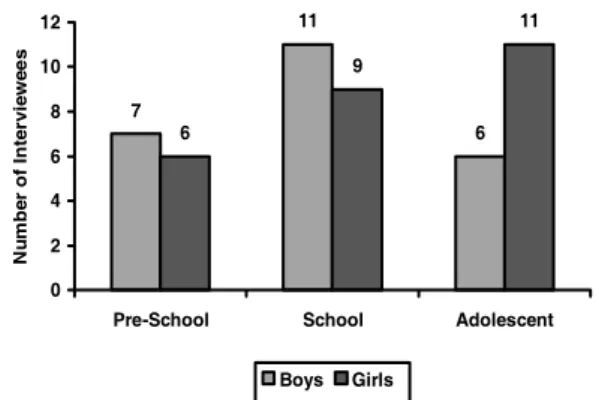
The r esear ch subj ect s w er e 5 0 childr en, 2 4
( 4 8 % ) b o y s a n d 2 6 ( 5 2 % ) g i r l s. Th i r t een ( 2 6 % )
subj ect s w er e in t he pr e- school gr oup, 20 ( 40% ) in
school age and 17 ( 34% ) in t he adolescent group.
Am on g t h e boy s, sev en ( 3 0 % ) belon ged t o
t h e p r e- sch ool g r ou p , 1 1 ( 4 5 % ) t o t h e sch ool- ag e
group and six ( 25% ) t o t he adolescent group. Am ong
t h e g ir ls, six ( 2 5 % ) w er e in t h e p r e- sch ool g r ou p ,
nine ( 35% ) in t he school- age group and 11 ( 40% ) in
t he adolescent group, as show n in Figure 1.
2TG5EJQQN 5EJQQN #FQNGUEGPV
0
W
O
D
G
T
Q
H
+P
VG
TX
KG
Y
G
G
U
$Q[U )KTNU
Figure 1 - Gender and age dist ribut ion of int erviewees.
São Paulo, 2004
The r esult s w er e or ganized in fr equencies of
sim ilar it y an d n on - sim ilar it y bet w een t h e ch ildr en ’s
an sw er s an d each car d’s act u al m ean in g. Mor eov er,
t h ey w er e sep ar at ed p er g r ou p ( p r e- sch ool, sch ool
and adolescent ) and analyzed by m eans of a binom ial
t e st f o r sm a l l sa m p l e s. I n t h i s t y p e o f t e st , t h e
proport ion bet ween t wo levels of a fact or is analyzed
in one sam ple. The binom ial dist r ibut ion indicat es a
relat ion bet ween t he size of sam ple N and t he num ber
o f ca ses X o f t h e a n a l y zed f a ct o r, t h e r esp ect i v e
p r o b ab i l i t y v al u e t h at can b e asso ci at ed w i t h t h e
predet erm ined significance level p < 0.01. The general
r esult s of t his t y pe of analy sis ar e descr ibed below .
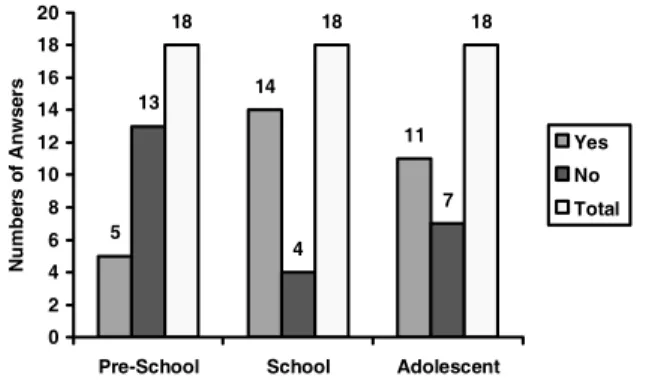
Each g r ou p p osit iv ely id en t if ied a d if f er en t
n u m b er of car d s ( Fig u r e 2 ) . Th e ag e r an g e is n ot
cor r elat ed w it h t h e n u m ber of af f ir m at iv e an sw er s.
Th e Ch i- Squ ar e t est f or t h e pr opor t ion of cor r ect ly
ident ified car ds per gr oup indicat es t hat gr oups and
an sw er s ar e m u t u ally in depen den t ( obser v ed ch i =
9.45, crit ical chi = 5.991, degrees of freedom = 2) .
As t o t h e n u m b e r o f st a t i st i ca l l y co r r e ct
answ er ed per gr oup for t he t ot al of 18 car ds, in t he
pr e- school gr oup, fiv e ( 28% ) car ds w er e r ecognized
and 13 ( 73% ) were not . I n t he school group, 14 ( 78% )
cards were recognized, whereas only four ( 22% ) were
not . I n t he adolescent gr oup, 1 1 ( 6 2 % ) car ds w er e
r ecognized and sev en ( 38% ) w er e not , as show n in
Fi g u r e 2 - Co n t i n g e n cy o f p o si t i v e a n d n e g a t i v e answ er s about t he ident ificat ion of t he st udy car ds. São Paulo, 2004
Each g r ou p id en t if ied t h e car d s d if f er en t ly ( Table 1) . For t he pre- school group, t he binom ial t est in d icat ed t h at 6 1 . 1 % of t h e car d s w er e id en t if ied cor r ect ly, ag ain st 7 7 . 8 % f or t h e sch ool g r ou p an d
27.8% for t he adolescent gr oup.
The follow ing car ds w er e cor r ect ly ident ified by all gr oups ( squeeze and bit e) :
Th e st u d y r esu l t s p r esen t ed t h e ab i l i t y of
children aged t hree or older t o ident ify t he locat ion of
t heir pain, as well as t o use words t hat describe t heir
pain( 9).
To assess pain in sm all children, such as
pre-school childr en for ex am ple, special at t ent ion should
b e g i v e n t o t h e w a y t h e y p e r c e i v e t h e p a i n f u l
ex p er ien ce, as ch ild r en in t h is ag e r an g e p er ceiv e
pain as a phy sical ex per ience and liv e w it h it in an
egocent r ic w ay( 9 ).
Table 1 - Car d ident ificat ion and r ecognit ion in each
st udy gr oup. São Paulo, 2004
2TG5EJQQN 5EJQQN #FQNGUEGPV
0 W O D G TU Q H # P Y U G TU ;GU 0Q 6QVCN
Bite
Squeeze
A m aj or it y of car d s w as id en t if ied b y t w o g r o u p s, i . e. t h o se r ep r esen t i n g ( p r i ck , t er r i f y i n g , t o r m e n t e d , t i r e so m e , p a i n f u l , st r o n g , n a u se a t e d , scat t er ed, it ching, t hr obbing and bur ning) . Only t w o
cards ( m addening and j erking) were ident ified by one gr ou p; t h ese w er e n ot iden t if ied by t h e pr e- sch ool and school group and by t he pre- school and adolescent gr ou p, r espect iv ely.
Non e of t h e gr ou ps cor r ect ly iden t if ied t h e car ds r epr esent ing displeased, cold and hook- like:
Displeased Cold Hook-like
s d r a C r o t p i r c s e D n i a
P Pre-school School Adolescent
d e s a e l p s i
D No No No
k c i r
P No Yes Yes
g n i y f i r r e
T No Yes Yes
d e t n e m r o
T No Yes Yes
e m o s e r i
T No Yes Yes
l u f n i a
P Yes Yes No
g n o r t
S No Yes Yes
g n i n e d d a
M No No Yes
e z e e u q
S Yes Yes Yes
d e t a e s u a
N No Yes Yes
d e r e t t a c
S No Yes Yes
e k il -k o o
H No No No
g n i h c
tI Yes Yes No
d l o
C No No No
g n i b b o r h
T Yes Yes No
e t i
B Yes Yes Yes
g n i n r u
B No Yes Yes
g n i k r e
J No Yes No
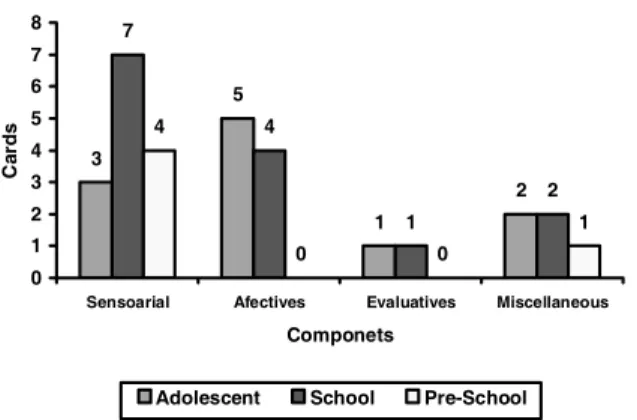
Th e f i g u r e b e l o w d i s p l a y s e a c h g r o u p ’ s
r ecogn it ion of t h e car ds accor din g t o t h e sen sor ial,
a f f e c t i v e , e v a l u a t i v e a n d m i s c e l l a n e o u s
c o m p o n e n t s . Pr e - s c h o o l c h i l d r e n i d e n t i f i e d f o u r
car d s w it h sen sor ial com p on en t s ( p ain f u l, it ch in g ,
b i t e a n d t h r o b b i n g ) , sch o o l ch i l d r e n r e co g n i z e d
sev en ( j er k i n g , p a i n f u l , i t ch i n g , t h r o b b i n g , p r i ck ,
b u r n in g an d b it e) an d ad olescen t s id en t if ied t h r ee
( pr ick , b u r n in g an d bit e) .
I n t h e a f f e c t i v e c o m p o n e n t , p r e - s c h o o l
ch i l d r e n d i d n o t r e co g n i ze a n y ca r d , sch o o l - a g e
c h i l d r e n i d e n t i f i e d f o u r ( t e r r i f y i n g , t o r m e n t i n g ,
t i r e s o m e a n d n a u s e a t e d ) a n d a d o l e s c e n t s f i v e
( t er r i f y i n g , m ad d en i n g , t o r m en t i n g , t i r eso m e an d
n au seat ed) . Wit h in t h e ev alu at iv e com pon en t , pr
e-school children did not recognize any card eit her, and
sch ool- ag e ch ild r en an d ad olescen t s id en t if ied on ly
one ( st r ong pain) . I n t he m iscellaneous com ponent ,
p r e- sch ool ch ild r en r ecog n ized on e ( sq u eeze) an d
school- age and adolescent s t w o car ds ( scat t er ed and
Figure 3 - Card recognit ion according t o com ponent s.
São Paulo, 2004
We com par ed our r esult s w it h anot her pain
d e s c r i p t o r s t u d y ( s e n s o r i a l - d i s t i n g u i s h i n g ,
m ot iv at ion al- affect iv e an d cogn it iv e- ev alu at iv e) . Six
a n s w e r s p r e s e n t c o g n i t i v e - e v a l u a t i v e c o n t e n t s ,
in d icat ed b y w or d s t h at d et er m in e a p ain v alu e or
degr ee ( quit e, lit t le, no, m uch) ( 1), in accor ding w it h
t he ot her st udy.
Th e sen sor ial- dist in gu ish in g classif icat ion is
pr esen t ed as a com plem en t of an an sw er, in w h ich
t h e ch ild u ses t h e w or d h ot t o r ef er t o a t h er m al
sen sat ion( 1 ). Th e m ot iv at ion al- affect iv e classificat ion
i s n o t co n si d er ed i n t h e r esea r ch a n sw er s( 1 ), b u t
appears in t he result s of t he ot her st udy.
DI SCUSSI ON
Th e st u d y r e su l t s sh o w e d t h a t o u r st u d y
o b j e c t i v e w a s a c h i e v e d . I n o t h e r w o r d s , w e
m an ag ed t o v er i f y t h e r ep r esen t at i v en ess of p ai n
q u a l i t i e s i n h o s p i t a l i z e d p r e - s c h o o l a n d s c h o o l
ch ildr en an d adolescen t s w it h pain com plain t s or in
ch r o n i c p a i n , t h r o u g h t h e a p p l i ca t i o n o f t h e Pa i n
Qu alit y Car d s( 7 ).
Figure 2 displayed how m any st at ist ically right
answ er s w er e giv en by each gr oup, in a t ot al of 18
car ds. Th e pr e- sch ool gr ou p r ecogn ized f iv e ( 2 8 % )
car d s an d d id n ot id en t if y 1 3 ( 7 3 % ) car d s. I n t h e
sch ool- age gr ou p, 1 4 ( 7 8 % ) car ds w er e r ecogn ized
and four ( 2 2 % ) w er e not . I n t he adolescent gr oup,
1 1 ( 6 2 % ) ca r d s w er e r eco g n i zed , w h er ea s sev en
( 38% ) w er e not .
Th e r esu lt s sh ow ed n o cor r elat ion bet w een
ag e r an g e an d t h e n u m b er of af f ir m at iv e an sw er s.
The pr e- school gr oup ident ified 61. 1% of t he car ds,
against 7 7 . 8 % for t he school- age gr oup and 2 7 . 8 %
for t he adolescent gr oup. Tw o car ds ( m addening and
j erking) were ident ified by one single group. None of
t he gr oups m anaged t o cor r ect ly ident ify t hr ee car ds
( displeased, cold and hook- like) .
Th i s st u d y co n t r i b u t e s b y p r e se n t i n g t h e
su ccessf u l ap p licat ion of t h e Pain Qu alit y Car d s( 7 ),
b e c a u s e i t c o n s i d e r s m o r e c o m p o n e n t s o f p a i n
dim en sion s, h elpin g pr of ession als t o det er m in e an d
assess pain t reat m ent , and also by showing t he need
t o use such a t ool, confirm ed by t he lim it at ions of t he
inst rum ent s present ed at t he st art of t his art icle, which
only assess child pain int ensit y.
Nurses need t o underst and t he charact erist ics
of child developm ent and behavior t o be able t o assess
and m easure pain in children. The st udy aut hors alert
about t he inex ist ence of an adequat e inst r um ent for
all children( 11).
Figu r e 3 sh ow s h ow each gr ou p r ecogn ized
t h e c a r d s a c c o r d i n g t o t h e s e n s o r i a l , a f f e c t i v e ,
ev aluat iv e and m iscellaneous com ponent s per gr oup.
Pr e- sch o o l ch i l d r en i d en t i f i ed f o u r ca r d s ( p a i n f u l ,
it ching, bit e and t hrobbing) , school children recognized
sev en ( j er k i n g , p a i n f u l , i t ch i n g , t h r o b b i n g , p r i ck ,
b u r n in g an d b it e) an d ad olescen t s id en t if ied t h r ee
( pr ick , bur ning and bit e) .
I n t h e a f f ect i v e co m p o n en t , a s sh o w n b y
Figu r e 3 , pr e- sch ool ch ildr en did n ot r ecogn ize an y
car d, school- age childr en r ecognized four ( t er r ify ing,
t orm ent ing, t iresom e and nauseat ed) and adolescent s
id en t if ied f iv e ( t er r if y in g , m ad d en in g , t or m en t in g ,
t i r e s o m e a n d n a u s e a t e d ) . W i t h r e s p e c t t o t h e
evaluat ive com ponent , t he pre- school children did not
r ecognize any car d eit her, w hile school- age childr en
and adolescent s ident ified only one ( st r ong pain) . I n
t h e m iscellan eou s com p on en t , p r e- sch ool ch ild r en
r e c o g n i z e d o n e ( s q u e e z e ) a n d s c h o o l - a g e a n d
adolescent s t w o ( scat t er ed and squeeze) .
St udy result s show t hat children aged five or
si x i d en t i f i ed sen so r i al - d i st i n g u i sh i n g w o r d s m o r e
f r eq u en t ly t h an m ot iv at ion al- af f ect iv e or cog n it iv
e-ev aluat iv e w or ds( 12).
An o t h e r st u d y e st a b l i sh e d t h e u se o f 1 7
sensor ial- dist inguishing and one cognit iv e- ev aluat iv e
w or d f or pain descr ipt ion by ch ildr en bet w een n in e
and 15 years old( 13).
An aly t ic par adigm s ar e u n der con st r u ct ion ,
pr esen t in g som e con sider at ion s b y t h e au t h or, w h o
exposes argum ent s result ing from hum an int elligence
5GPUQCTKCN #HGEVKXGU 'XCNWCVKXGU /KUEGNNCPGQWU
%QORQPGVU
%
C
TF
U
r esear ch , in dicat in g t h at it ar e ex per ien ces an d n ot
co g n i t i v e st r u ct u r e s t h a t l e a d a p e r so n t o m o r e
elabor at e lev els of t hink ing( 14).
Th e st u d y r e su l t s d e m o n st r a t e d t h a t a l l
children in t his st udy used at least one charact erist ic
m et h od of p ain r elief, w h ich is d ist r act ion , b esid es
r ecei v i n g t h e n u r ses’ h el p f o r sel f - ca r e a n d t h ei r
par ent s’ pr esence( 15).
Children bet ween six and 12 years old clearly
defined t he w ord pain as physical or m oral suffering,
as sorrow. The children m anaged t o link pain wit h t he
fear of get t ing hur t or of invasive exam s, confir m ing
t h e h y pot h esis t h at t h ey ar e capable of ex pr essin g
t h em selv es ab ou t t h e p ain , b y m ean s of ad eq u at e
inst r um ent s( 16).
I n h o sp i t a l s, t h er e i s a n u r g en t n eed f o r
g r eat er co n t r o l o f acu t e p ai n i n ch i l d r en , u si n g a
sy st em ized assessm ent sy st em and analgesia( 17).
I n v i e w o f i n h e r e n t l i m i t a t i o n s o f c h i l d
d ev el o p m en t , n ew st u d i es ar e n eed ed t o i d en t i f y
r esou r ces t h at can h elp ch ildr en fr om pr e- sch ool t o
ad olescen t ag e t o p r esen t in f or m at ion ab ou t t h eir
p ain .
CONCLUSI ON
The result s of t his st udy reveal t hat :
- each gr oup ident ified t he car ds differ ent ly ;
- on ly t w o car ds ( Squ eeze an d Bit e) w er e cor r ect ly
ident ified by all gr oups;
- t w o car ds ( Maddening and Jer k ing) w er e ident ified
by only one gr oup;
- t hr ee car ds ( Displeased, Cold and Hook- like) w er e
not ident ified cor r ect ly by any of t he gr oups.
Th e u se of t h e Pain Qu alit y Car d t ool( 7 ) is
viable. The t ool can not only assess, but also dist inguish
an d m easu r e t h e d if f er en t d im en sion s of t h e p ain
experience in children and adolescent s. I t s use should
be encouraged and accessible t o healt h professionals,
wit h a view t o t he qualit at ive evolut ion of care delivery
t o children and adolescent s in pain. This requires t he
in ser t ion of t h e p ain t h em e in t h e cu r r icu la of all
m edical, nur sing and par am edical schools.
Th i s s t u d y i s l i m i t e d b y t h e s i z e o f t h e
p o p u l a t i o n . Th e r e f o r e , n e w s t u d i e s w i t h m o r e
par t icipan t s ar e n eeded, w it h a v iew t o br oaden in g
k now ledge about t he t hem e.
REFERENCES
1 . Rossat o LM. Ut ilizan d o in st r u m en t os p ar a av aliação d a
p er cep ção d e d o r em p r é- esco l ar es f ace a p r o ced i m en t o
d o l o r o s o . [ d i s s e r t a ç ã o ] . S ã o Pa u l o ( S P) : Es c o l a d e
En f er m ag em / USP; 1 9 9 7 .
2 . So u sa FAEF. D o r : o q u i n t o si n a l v i t a l . Rev La t i n o - a m
En f er m agem 2 0 0 2 m aio- j u n h o; 1 0 ( 3 ) : 4 4 6 - 7 .
3 . W o n g D I , Ba k er CM. Pa i n i n ch i l d r en : co m p a r i so n o f
assessm en t scales. Ped iat r Nu r s 1 9 9 8 ; 1 4 ( 1 ) : 9 - 1 7 .
4 . Cl a r o MT. Esca l a d e Fa ces p a r a Av a l i a çã o d a d o r em
crianças: et apa prelim inar. [ dissert ação] . Ribeirão Pret o ( SP) :
Escola d e En f er m ag em / USP; 1 9 9 3 .
5 . Pim en t a CAM, Teix eir a MJ. Qu est ion ár io d e d or McGill:
p r op ost a d e av aliação p ar a a lín g u a p or t u g u esa. Rev Esc
En f er m ag em USP 1 9 9 6 ; 3 0 ( 3 ) : 4 7 3 - 8 3 .
6. Viana DL. Sensibilizando- se par a cuidar : a ex per iência da
enferm eira frent e a avaliação da dor na criança. [ dissert ação] .
São Paulo ( SP) : Escola de Enfer m agem / USP; 2 0 0 4 .
7 . Ro ssa t o LM, Ro d r i g u e s AC, Go d o y LD P, Sa n t a n a XE,
Pi m en t a CAM. Car d s p ai n o f ch ar act er i st i cs f o r u se w i t h
childr en. Pr oceedings of t he 8t h Wor ld Pain Congr ess; 1996.
Au gu st 5 - 8 ; Van cou v er, Can ada. p. 1 8 4 .
8. Siegel S. Est at íst ica não par am ét r ica par a as ciências do
com por t am ent o. São Paulo, ( SP) : McGr aw - Hill; 1 9 7 5 .
9 . Set z VG, Ped r ei r a MLG, Pet er l i n i MAS, Ha r a d a MJCS,
Per eir a SR. Av aliação e int er v enção par a o alív io da dor na
cr ian ça h osp it alizad a. Act a Pau l En f er m ag em 2 0 0 1 m
aio-ag ost o; 1 4 ( 2 ) : 5 5 - 6 5 .
1 0 . St ei n P. I n d i ces o f Pa i n I n t en si t y : co n st r u ct v a l i d i t y
a m o n g p r e s c h o o l e r s . Pe d i a t r N u r s 1 9 9 5 M a r c h - A p r i l ;
2 1 ( 2 ) : 1 1 9 - 2 3 .
11. Jer r et M, Evans K. Childr en’s pain vocabular y. Jour nal of
Ad v Nu r s 1 9 8 6 ; 1 1 ( 4 ) : 4 0 3 - 8 .
1 2 . M e l z a c k R. Th e M c Gi l l Pa i n Q u e s t i o n n a i r e : m a j o r
pr oper t ies an d scor in g m et h ods. Pain 1 9 7 5 ; 1 : 2 7 7 - 9 9 .
1 3 . Ab u - Saad H. Assessi n g ch i l d r en ’s r esp o n ses t o p ai n .
Pa i n 1 9 8 4 ; 1 9 : 1 6 3 - 7 1 .
1 4 . Yo o s H L. Ch i l d r e n ’s i l l n e s s c o n c e p t s : o l d a n d n e w
p ar ad ig m s. Ped iat r ic Nu r s 1 9 9 4 ; 2 0 ( 2 ) : 1 3 4 - 4 0 .
15. Polk k i T, Piet ila AM, Vehv ilainen-Julk unen K. Hospit alized
children’s descr ipt ions of t heir exper iences w it h post sur gical
pain r eliev ing m et hods. I nt J Nur s St ud 2003; 40( 1) : 33- 44.
1 6 . S o a r e s V V, V i e i r a L JES. Pe r c e p ç ã o d e c r i a n ç a s
h o s p i t a l i z a d a s s o b r e r e a l i z a ç ã o d e e x a m e s . Re v Es c
En f er m ag em USP 2 0 0 4 ; 3 8 ( 3 ) : 2 9 8 - 3 0 6 .
17. Jordan- Marsh M, Hubbard J, Wat son R, Hall RD, Miller P,
Mohan O. The social ecology of changing pain m anagem ent :
do I have t o cry? J Pediat r Nurs 2004 June; 19( 3) : 197- 203.