Measuring Shear Viscosity Using Correlations
Sean Gavin1 and Mohamed Abdel-Aziz2
1Department of Physics and Astronomy, Wayne State University, Detroit, MI, 48202, USA 2Institut f¨ur Theoretische Physik, J.W. Goethe Universit¨at, 60438 Frankfurt am Main, Germany
Received on 15 December, 2006
Measurements of transverse momentum fluctuations can be used to determine the shear viscosity [1]. We use current data to estimate the viscosity-to-entropy ratio in the range from 0.08 to 0.3, and discuss how future measurements can reduce this uncertainty.
Keywords: Relativistic Heavy Ions; Event-by-event fluctuations
I. INTRODUCTION
Elliptic flow measurements at RHIC are described by ideal viscosity-free hydrodynamics, indicating that the quark-gluon system produced in these collisions is a nearly perfect liq-uid [2–6]. In particular, the strong suppression of flow due to shear viscosity predicted by weak-coupling transport cal-culations is not observed [5]. This result is exciting because a small viscosity relative to the entropy density of the system may indicate that the system is more strongly coupled than ex-pected: The collisional shear viscosity is proportional to the mean free path, which is shorter when the coupling is stronger. But is the viscosity really small? Hiranoet al.point out that color glass condensate formation may produce more elliptic flow than considered in refs. [4, 5], requiring a larger viscosity for agreement with data [8]. We therefore seek experimental information on viscosity that does not rely on elliptic flow.
We propose that transverse momentum correlation mea-surements can be used to extract information on the kinematic viscosity,
ν=η/T s, (1)
whereηis the shear viscosity,sis the entropy density andT is the temperature. This ratio characterizes the strength of the viscous force relative to the fluid’s inertia and, consequently, determines the effect ofηon the flow [6]. We argue that vis-cous diffusion broadens the rapidity dependence of transverse momentum correlations, and then show how these correla-tions can be extracted from measurements of event-by-event pt fluctuations.
A number of experiments have studied transverse momen-tum fluctuations at SPS and RHIC [9, 10]. Interestingly, the STAR collaboration reports a 60% increase of the relative ra-pidity width for pt fluctuations when centrality is increased [15]. While the STAR analysis differs from the one we pro-pose, model assumptions provide a tantalizing hint that the viscosity is small.
Any experimental information on the kinematic viscos-ity of high energy densviscos-ity matter is vital for understanding the strongly interacting quark gluon plasma. Theorists had long anticipated a large collisional viscosity based on weak coupling QCD [16] and hadronic computations [17], with values of η/s roughly of order unity for both phases near the crossover temperature∼170 MeV. Supersymmetic Yang
FIG. 1: (Color online) Shear flow results when plates move past one another.
Mills calculations give the significantly smaller ratioη/s= 1/4πin the strong coupling limit [18]. Lattice QCD calcula-tions of the shear viscosity will eventually settle the question of the size of the viscosity near equilibrium [19]. However, the effective viscosity in the nonequilibrium ion-collision sys-tem may differ from these calculations. In particular, plasma-instability contributions can also explain the small viscosities in nuclear collisions [20].
We begin in the next section by formulating a simple model to illustrate how shear viscosity attenuates correlations due to fluctuations of the radial flow. In section III, we show how transverse momentum fluctuations can be used to measure these correlations. The magnitude of viscosity in heavy ion collisions at RHIC and SPS energies is discussed in section IV. In section V, we then demonstrate the impact of viscos-ity on the rapidviscos-ity distribution of fluctuations. We explore the implications of current fluctuation data in section VI.
Before wading into the quark-gluon liquid, it is useful to recall how shear viscosity affects the flow of more common fluids. In a classic example of shear flow, a liquid is trapped between two parallel plates in thexyplane, while one plate moves at constant speed in thexdirection as shown in fig. 1. The fluid is pulled along with the plate, so thatvxvaries with the normal distancez. The viscous contribution to the stress energy tensor is then
Tzx=−η∂vx/∂z; (2) see ref. [21] for a general treatment.
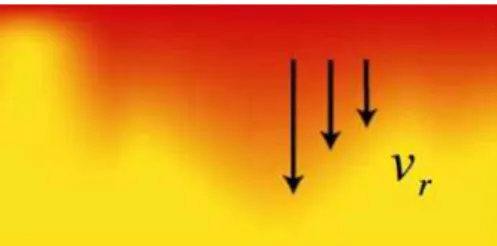
FIG. 2: (Color online) The transverse velocity deviates from the av-erage by an amount that varies throughout the collision volume. Vis-cosity drives this deviation to zero.
Uµ=γ(1,v) is the four-velocity of the fluid, andγ= (1−
v2)−1/2. The dissipative contribution isτµν. Following Lan-dau and Lifshitz, we define the four velocity to vanish when T0i=0 [21]. Then the momentum current isT
0i=γ2(e+P)vi andτµνdepends only on the viscosity, withτ00=0=τ0iand
τi j=−η{∇ivj+∇jvi− 2
3δi j∇·v} −ζδi j∇·v (3) in a local rest frame. We mention that the bulk viscosityζ re-sists compression or expansion in which∇·v=0; the classic example is a Hubble-like expansion. Typically ζ≪η [17]; see however [23].
II. VISCOSITY AND DIFFUSION
Central nuclear collisions produce a high energy density fluid that flows outward with an average radial velocity vr. In the hydrodynamic description of these collisions, we typ-ically assume that vr varies smoothly with spacetime (t,x) and is the same for all collisions of a fixed impact parame-ter. For central collisions,vris cylindrically symmetric. More realistically, small deviations u(x) of the radial flow occur throughout the fluid, varying with each ion-collision event. Such deviations occur, e.g., because the number and location of nucleon-nucleon subcollisions varies in each event.
Viscous friction arises as neighboring fluid elements flow past each other as illustrated in fig. 2. This friction reducesu, driving the velocity toward the local averagevr. The final size of the velocity incrementudepends on the magnitude of the viscosity and the lifetime of the fluid.
In order to illustrate how the damping of radial flow fluc-tuations depends on the viscosity of the fluid, we introduce a velocity increment in the radial directionuthat depends only on the longitudinal coordinatezandt. Our aim is to determine the linear response of the fluid to this perturbation. For sim-plicity, we take the unperturbed flow as slowly varying, and work in a co-moving frame wherevr locally vanishes. As in (2), the flow of neighboring fluid elements at different radial speedsu(z)produces a shear stress
Tzr=−η∂u/∂z. (4)
This stress changes the transverse momentum current of the fluid, which is generally
T0r=γ2(ε+p)vr (5)
for energy densityε, pressure p, andγ= (1−v2)−1/2 [21]. The perturbationuresults in the change
gt(x) =δT0r≈(ε+p)u (6) in the co-moving frame, while
∂gt/∂t=−∂Tzr/∂z, (7) which follows from the energy-momentum conservation equation∂µTµν=0.
We combine these results to obtain a diffusion equation for the momentum current
∂gt/∂t=ν∇2gt (8)
to linear order. The kinematic viscosity is given by
ν=η/(ε+p). (9)
This quantity measures the relative strength of the viscous relative to the fluid’s and inertia, as is most apparent in the nonrelativistic limit, whereε+p→ρforρthe mass density (c=1). It follows thatν≈η/ρ[21]. In our relativistic system at small net baryochemical potential,µ≈0, so thatε+p≈T s. Thenνis given by (1).
Observe that (8) applies for any fluctuation gt for which
∇·gt =0 [21]; our physically-motivated radialgt(z,t) is a specific instance of such a flow. Such shear modes are related to sound waves (compression modes) but diffuse rather than propagate [22]. Note that the scale over which sound is at-tenuatedΓs= (4η/3+ζ)/T sdepends on both shear and bulk viscosity [21–23].
Viscosity tends to reduce fluctuations by distributing the ex-cess momentum densitygt over the collision volume. This ef-fect broadens the rapidity profile of fluctuations. We write (8) in terms of the spatial rapidityy=1/2 ln(t+z)/(t−z)and proper timeτ= (t2−z2)1/2to find
∂gt/∂τ= (ν/τ2)∂2gt/∂y2. (10) A similar equation is used to study net charge diffusion in ref. [26], and we can translate many of those results to the present context. Defining
V ≡ (y− y)2=
y2gtdy
gtdy (11)
fory=0, we multiply both sides of (11) byy2and integrate to obtain
d dτV =
2ν
τ2. (12)
For a constantν, we compute the rapidity broadening
∆V=2ν
τo
1−ττo, (13)
exp[−y2/2V(τ)1/2]. The ratio (11) remains finite despite the fact thatgt→0 in that limit.
We briefly remark on the effect of the mean radial flowvr and transverse degrees of freedom on the growth of the rapid-ity width. In the comoving frame wherevr is small, we can generalize (8) as
∂gt
∂τ +vr·∇⊥gt+gt·∇⊥vr= ν τ2
∂2 ∂y2+∇
2 ⊥
gt. (14) We transform the diffusion equation (14) into (10) by replac-inggtby a quantity that is averaged over the transverse coor-dinater⊥. To see this, integrate both sides of (14) overr⊥. The transverse contributions lead to “surface terms” that van-ish to this linear order. We stress that this result is independent of the azimuthal anisotropy of the collision volume. This re-sult follows becausegtis conserved – it doesn’t matter where the momentum is in the transverse plane, as long as we add it up. Of course, that only applies if we limit our interest to the rapidity dependance. To study the azimuthal behavior of fluctuations we must solve the full eq. (14).
III. CORRELATIONS AND DIFFUSION
A. Transverse momentum correlations
We extend this discussion to address a more general ensem-ble of fluctuations by considering the correlation function
rg=gt(x1)gt(x2) − gt(x1)gt(x2). (15) In local equilibrium, rg has the value rg,eq. The spatial
ra-pidity dependence of ∆rg≡rg−rg,eq is broadened by mo-mentum diffusion. If the rapidity width of the one-body den-sity follows (13), then the width of∆rgin the relative rapidity yr=y1−y2grows from an initial valueσofollowing
σ2=σ2
o+2∆V(τf), (16) whereτf is the proper time at which freeze out occurs. This equation is entirely plausible, since diffusion spreads the ra-pidity of each particle in a given pair with a variance∆V. We then take
∆rg(yr,ya)∝e−y2r/2σ2−y2a/2Σ2, (17)
where (16) gives the width in relative rapidity and the width in average rapidityya= (y1+y2)/2 isΣ.
To compute fluctuation observables in the next sections, we identify spatial and momentum-space rapidity at a fixed freeze out proper timeτf. Observe that ISR and FNAL data on the rapidity dependence of multiplicity fluctuations [24] can be characterized as Gaussian near midrapidity. Moreover, these data show that charged particle correlations are functions of the relative rapidityyrwith only a weak dependence on the av-erage rapidityya. Correspondingly, we takeΣ≫σ. In the next section we see that diffusion increases bothσandΣcompared to their initial valuesσoandΣoat the hadronization timeτoin accord with (25) and (26). For simplicity, we assume thatΣo is sufficiently large that we can neglect the time dependence ofΣin (26).
B. Transport in fluctuating systems
Observe that (16) and (17) are exact for our diffusion model. To see that this is the case, we apply the theoretical framework developed by Van Kampen and others [25] to vis-cous diffusion. We have used this framework elsewhere to study the effect of diffusion on net charge fluctuations [26]. Since the key results of this section, (16) and (17), are “obvi-ous,” this section may be skipped on a first reading. However, the details are amusing.
The framework of ref. [25] generalizes the classic prob-lem of Brownian motion, in which a dust particle wanders through a fluid with mean displacementdthat satisfiesd2∼
x2 − x2∝ton average. Microscopic molecular collisions cause the particle’s motion, while friction of the macroscopic particle with the liquid dampens it. Here, we seek an evolu-tion equaevolu-tion forrg, in whichgt(x,t)replaces the Brownian
x. Our equation forrgmust have the correct limitrg,eqwhen the system is in equilibrium. Equation (33) in the next section implies that
rg,eq(x1,x2) = δ(x1−x2)
f(x1,p)p2td p
= np2tδ(x1−x2), (18) where f(x,p)is the phase space distribution of particles,nis the density.
In the previous section we found thatgt obeys a diffusion equation (8) in the regime of small fluctuations, but this state-ment requires clarification. Consider an ensemble of systems with different initialgt. At the macroscopic scales of inter-est, viscosity indeed dampens fluctuations, working to drive gt(x,t)→0. Opposing this dampening are Brownian-like ve-locity and thermal fluctuations due to the microscopic motion and collisions of particles. These fluctuations are present at all times prior to freeze out. In equilibrium, fluctuations and viscous dissipation are balanced.
To describe the effect of these fluctuations on the momen-tum current, we treatgt as a stochastic quantity. It is the av-erage ofgt over our ensemble that satisfies (8); such an en-semble average is always implicit in hydrodynamics. Going further, we write a Langevin equation for the fluctuatinggt as
∂gt
∂t +∇·jg=0, (19)
wherejg=−ν∇gt+kandk is a stochastic contribution to the current. If we divide the fluid into tiny cells with a macro-scopic number of particles, then particle and momentum flow into and out of each cell gives rise tok. Observe that (19) con-serves the transverse momentum current in each ‘event’ in the ensemble. The currentkis a Langevin noise term satisfying
k=0 and
Applying the methods in [25] to (19), we find that the cor-relation function (15) satisfies the diffusion equation
∂
∂t−ν(∇ 2 1+∇22)
∆rg(x1,x2) =0, (21) where∆rg=rg−rg,eq. This equation means that over time rg→rg,eq as small deviations in the momentum current dif-fuse over the collision volume. As for (8), we emphasize that (21) only applies in the linear regime where fluctuations are small.
To get a rough understanding of how (21) comes about, consider the changeδgtin the time incrementδt. The change of the two-point equal-time function at points 1≡(x1,t)and 2≡(x2,t)isδgt(1)gt(2)=δgt(1)gt(2)+gt(1)δgt(2)+
δgt(1)δgt(2), where the incrementδgt= (∂gt/∂t)δtis given by (19). In the absence of noise, the term δgt(1)δgt(2) would vanish as δt2. However, noise forces g
t to undergo a “random-walk” so thatδgt receives a stochastic increment ∝ δt1/2. This increment contributes to δgt(1)δgt(2)∝ δt. One finds
∂
∂t−ν(∇ 2 1+∇22)
rg(1,2) =∇1·∇2K(1)δ(1−2); (22) the right side is zero in the absence of noise. ChoosingK so thatrg→rg,eqfor a uniform system in equilibrium gives (21).
The correlation function∆rg(y1,y2,τ)then obeys
∂
∂τ− ν τ2
∂2 ∂y21−
ν τ2
∂2 ∂y22
∆rg=0. (23)
We write (23) in terms of the relative rapidityyr≡y1−y2and average rapidityya= (y1+y2)/2:
∂ ∂τ−
2ν τ2
∂2 ∂y2
r −
ν τ2
∂2 ∂y2
a
∆rg=0; (24) the “2” follows from the transformation to relative rapidityyr. To compute the widths of∆rg(yr,ya,τ)in relative or average rapidity, one multiplies (24) byy2r ory2a and integrates over both variables. We find
∆(yr− yr)2=2∆V(τ) (25) and
∆(ya− ya)2=∆V(τ), (26) where∆V(τ)is calculated in the previous section.
IV. VISCOSITY IN ION COLLISIONS
Gyulassy and Hirano survey computations of the ratio of the shear viscosity to the entropy and find that both the hadron gas and the perturbative quark gluon plasma haveη/s∼1, if one naively extrapolates these calculations nearTC[6]. These values correspond to ν=η/T s roughly of order 1 fm for TC=170 MeV. On the other hand, they argue that the entropy
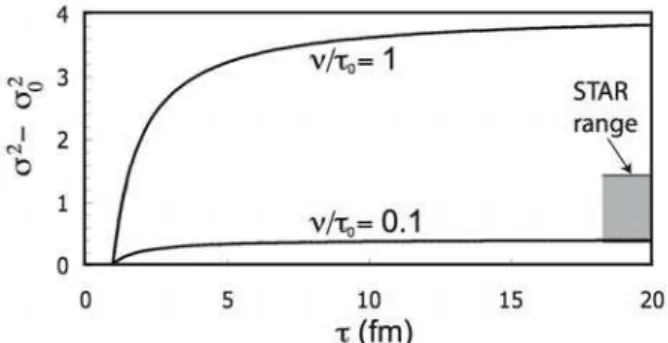
FIG. 3: Rapidity spread vs. time for momentum diffusion from (13) and (16) for two viscosity values. The gray area marks the range extrapolated from data in ref. [15] using (42).
increase nearTCreducesη/sfor a strongly interacting plasma, perhaps to the supersymmetric Yang-Mills valueη/s=1/4π. Motivated by these estimates, we show in fig. 3 the increase ofσgiven by (13) and (16) as a function ofτ. Calculations for two valuesν/τo∼0.1 and 1 schematically exhibit the likely range of viscous broadening. Forτo∼1 fm, these values re-spectively correspond toη/s∼1/4πand 1. We provide these calculations as benchmarks; more realistically,νwould effec-tively increase withτdepending on the state of the fluid.
We stress that the rapidity width depends on the viscous dif-fusion coefficient integrated over the collision lifetime. Com-paring the viscous and perfect scenarios in fig. 3, we see that the largest contribution to this width comes from the earliest times. Consequently, we expect measurements of this width to yield information on the viscosity when the evolution is dominated by partons.
V. FLUCTUATIONS AND CORRELATIONS
A. Transverse momentum covariance
Variation of the radial fluid velocity over the collision vol-ume induces correlations in the transverse momentaptof par-ticles [27]. To describe such correlations, we observe that an inhomogeneous fluid near local thermal equilibrium can be divided into cells that are small enough to be regarded as uniform, while containing a macroscopic number of particles. Particles emerging from cells of different radial velocityvr are more likely to have different pt than particles from the same cell. We describe the number of particles of momen-tum p in a cell at positionx at the instant of freeze out as dn=f(x,p)d pdx, whered p≡d3p/(2π)3anddx≡d3x. We take the phase space densityf(x,p)to be a Boltzmann distrib-ution corresponding to the fluid velocityv(x)and temperature T(x). The temperature and velocity profiles both vary from event to event. A similar formulation is used in [28] to com-pute nonequilibriumptfluctuations. Here, we focus on central collisions, where there is a body of RHIC data suggesting that local equilibrium is likely achieved.
transverse momentum covariance
C
=N−2∑
i=jptipt j − pt2, (27)
whereilabels particles from each event and the brackets rep-resent the event average. The average transverse momentum is
pt ≡
∑
pti/N. (28) This quantity vanishes in local thermal equilibrium, where the momenta are uncorrelated and particle number fluctuations satisfy Poisson statistics, so that N2 − N2=N. It fol-lows thatpt1pt2eq=N(N−1)pt2/N2=pt2.This covariance is related to the spatial correlations of the momentum current (15) by
C
=N−2∆rg(x1,x2)dx1dx2. (29) To obtain this result, observe that near local equilibrium f(x,p) =f+δf, where the average distribution isf(x,p)
and the event-wise deviationδf is necessarily small. Then
Npt =
ptdn
=
ptfd pdx+
gt(x)dx
≡
ptfd pdx. (30)
The contribution of fluctuations to the momentum current,
gt(x) =
δf(x,p)ptd p, (31) vanishes on event averaging. Similarly, the unrestricted sum is
∑
ptipt j =pt1pt2dn1dn2 = N2pt2+
gt(x1)gt(x2)dx1dx2.(32) We find
rgdx1dx2 =
∑
alli,jptipt j − N2pt2
= N2
C
+∑
p2ti; (33) the second equality follows from (27). In local equilibrium,C
≡0 impliesrg,eqdx1dx2=∑pti2. Subtracting this term from (33) gives (29).
B. Multiplicity variance
The correlation information probed by
C
differs from that found in the multiplicity varianceR= (N2 − N2− N)/N2. (34)
Multiplicity fluctuations and their relation to correlation func-tions are discussed in [29]. As before, and in accord with [29], we write
R=N−2
∆rndx1dx2, (35) where∆rn=rn−rn,eqand
rn=n(x1)n(x2) − n(x1)n(x2). (36) The density correlation function (36) carries different infor-mation than (15) because particle number is not conserved. Density fluctuations evolve by the full hydrodynamic equa-tions, whilegt follows diffusion. We mention that
rn,eq=n(x1)δ(x1−x2), (37) which is analogous to (18) but somewhat easier to understand. Equation (37) implies that (36) vanishes when particle number fluctuations obey Poisson statistics, a property that is evident from (34).
C. Rapidity dependance ofptcovariance
Viscosity information can be obtained from
C
as follows. For simplicity, we identify spatial and momentum space ra-pidity. The broadening in rapidity of∆rgdepends on the shear viscosity via (16). Equation (29) implies that the rapidity de-pendence of∆rgcan be measured by studying the dependence of (27) on the rapidity window in which particles are mea-sured.We illustrate this acceptance dependence in fig. 2 for the ν/τovalues from fig. 1 as follows. The covariance
C
is com-puted by integrating∆rgover an interval−∆/2≤y1,y2≤∆/2 corresponding to the experimental acceptance. We use (17), (29), and assumeΣ≫∆/2 to obtainN
C
≈ 1N ∆/2
−∆/2
∆/2
−∆/2∆
rg(y1,y2)dy1dy2
≈ 2 N
∆/2
0 dya
∆/2−ya
−∆/2+ya
∆rg(yr,ya)dyr
≈ N
C
∞erf
∆/√8σ, (38)
where the total number of charged particles isN∝ ∆ and
N
C
∞ is the value obtained for a large rapidity window. We assumeτf/τo∼20.VI. CURRENT DATA
A. Rapidity dependence ofptfluctuations
FIG. 4: Rapidity dependence of thept covariance (27) forτf/τo∼
20. The initial distribution hasσo∼0.5.
to the variation of thept of particles as well as their number density, in that both quantities affect the momentum current. Other measures ofptfluctuations in the literature are designed to minimize any density contribution, often termed “volume fluctuations” [31]. This difference is important for the follow-ing discussion.
The STAR analysis in ref. [15] incorporates some of these ideas and, intriguingly, finds a broadening in rapidity together with a narrowing in azimuth forptcorrelations in central com-pared to peripheral collisions. We will use the rapidity in-formation to estimate the viscosity. However, the measured quantities differ sufficiently from
C
that this estimate requires significant model assumptions. We therefore regard the result only as a signal of our method’s promise.STAR employs the transverse momentum fluctuation ob-servable∆σ2
pt:nto construct a correlation function as a
func-tion of rapidity and azimuthal angle. They find that near-side correlations in azimuth are broadened in relative rapidity, with a rapidity width σ∗ that increases from roughly 0.45 in the most peripheral collisions to 0.75 in central ones [15]. In our terms,
∆σ2pt:n=N
−1
∑
i=j(pti− pt)(pt j− pt). (39)
To relate this to our observables, we expand the right side and use (28) to find
N∆σ2pt:n=
∑
i=j
ptipt j − N(N−1)pt2, (40)
since the average number of pairs is N(N−1). We then obtain
∆σ2 pt:n
N =
C
− pt2R, (41)
whereCandRare respectively given by (27) and (34). The quantity∆σ2
pt:ntherefore depends on both momentum
current and density correlation functions (15) and (36),
∆σ2pt:n=N−
1
{∆rg− pt2∆rn}dy1dy2. (42) We can directly compareσ∗toσin fig. 1 if∆rgand∆rnhave the same widths. Equation (16) then implies that the widths in central and peripheral collisions satisfy
σ2
c−σ2p=4ν(τ−f,1p−τ− 1
f,c). (43)
Observe that the dependence on τo cancels. Taking the freeze out times in central and peripheral collisions to be τf,c∼ 20 fm andτf,p∼ 1 fm, we then find ν∼0.09 fm. The valueτf,p∼1 fm is reasonable, since ref. [15] argues that the average participant path length is about 1 fm for these peripheral collisions. We use (1) to findη/s∼0.08.
This result is remarkably close to the supersymmetric Yang Mills value 1/4π, and is consistent with some hydrodynamic comparisons to elliptic flow data [5]. However, we must be cautious: If∆rgand∆rnhave different rapidity widthsσand
σnthen their relation toσ∗ depends on the relative strength of these contributions. Data in ref. [32] may indicate thatσn is roughly twice σ∗. As we argue shortly, σis bounded by σn andσ∗. At the maximum value σ=2σ∗, our dynamic assumptions yieldη/s=0.3. Together, our estimates con-stitute an uncertainty range for the viscosity-to-entropy ratio, 0.08<η/s<0.3. We also indicate the range ofσ2
c−σ2p im-plied by the STAR data in fig. 3 as a gray band corresponding toσ∗<σ<2σ∗.
To showσis bounded byσnandσ∗, we observe that (42) implies thatσ∗follows from a distribution in relative rapidity
f(yr) =∆rg− pt2∆rn. (44) It follows that
σ2 ∗=
y2rf(yr)
f(yr) =
σ2G−σ2 npt2N
G− pt2N , (45) whereG=
∆rgandN=∆rn. We then find
σ2=σ2∗+βσ2n
1+β , (46)
whereβ=pt2N/G. Althoughβis not measured, the width cannot exceedσn∼2σ∗. (We restrict our integrals to a rapid-ity and pt region where a Gaussian parameterization of∆rg and∆rnmakes sense; henceβ≥0).
We briefly comment on the narrowing in azimuth forpt cor-relations observed in ref. [15] in central compared to periph-eral collisions. The diffusion broadening of azimuthal corre-lations is compensated by a narrowing due to the mean radial flowvr, which hurls particles outward, and surface bias, which hides particles that flow in the wrong direction. Opening-angle effects in resonance decays lead to further narrowing. These effects are familiar in HBT. To address the azimuthal dependence of correlations, an equation analogous to (24) can be derived from (14). One must also account for the azimuthal anisotropy of the collision volume.
B. Other experimental information
As an aside, we now note some of the information from other experimental pt fluctuation studies. The observable
δpt1δpt2studied in [28] and measured in [9], [10] and [11] satisfies
∆σ2 pt:n=
N(N−1)
FIG. 5: (Color online) Energy dependence of theptfluctuations
us-ing the observable (47). Data are from [9], [10], and [11].
whereR= (N2 − N2− N)/N2measures multiplicity fluctuations [29]. The energy dependence of this quantity is shown in fig. 5.
The energy independence of these measurements supports the hypothesis that the largest contribution to pt fluctua-tions is from the collective behavior of soft and semi-hard particles rather than jets as sometimes noted [34]. New PHENIX energy-dependence data further supports the soft origin of fluctuations [35]. Observe that (47) implies that ∆σ2
pt:n will increase with energy in proportion to the
multi-plicity ifδpt1δpt2is energy dependent. All this concerns the overall scale of the fluctuations. Little can be said about the energy dependence of the rapidity distribution of these fluctu-ations at present.
Alternative observables Φpt, Fpt, and ∆σpt proposed in
[30], [13], and [14] satisfyFpt≈Φpt/σ≈ Nδpt1δpt2/2σ
2 forσ2=p2
t−pt2, see e.g. [31]. Broadly, the differences in these various quantities is important only in peripheral colli-sions where the multiplicity is small. The different quantities have depend differently on the experimental efficiency, e.g.,
δpt1δpt2 is designed to minimize efficiency dependence. Other differences may reflect the different experimental ac-ceptance and analysis issues.
VII. SUMMARY
In summary, we find that shear viscosity can broaden the ra-pidity correlations of the momentum current. This broadening can be observed by measuring the transverse momentum co-variance (27) as a function of rapidity acceptance. Our rough
estimate from current data,η/s∼0.08−0.3, is small com-pared to perturbative computations [6]. To reduce the exper-imental uncertainty, we suggest measuring
C
to allow more direct access to the momentum density correlation function.We stress that there is additional theoretical uncertainty in this estimate, mainly due to our freeze out model. In prac-tice,σ2
c−σ2p≈4ντ−f,1p, sinceτf,p≪τf,c. The freeze out time in peripheral collisionsτf,pis not plausibly smaller than our value 1 fm (the nucleon radius), but may be twice as large. This would double the upper limit of our uncertainty band. That added uncertainty can eventually be reduced by measur-ingτf,pas in [33]. HBT and resonance effects omitted here may contribute only at the 10% and 15% levels, respectively [10]. Minijets, color glass, and other particle production ef-fects modify σo in (16). We assume that any modification cancels in studying the centrality dependence at fixed beam energy. As to our hydrodynamic treatment, we have not con-sidered alternative transport formulations that enforce causal-ity [36]. Furthermore, our linearized diffusion model of flow fluctuations is physically reasonable but highly idealized. A more refined hydrodynamic description will be necessary to confront the measurements we suggest.
How can we reduce the theoretical uncertainty? The viscos-ity of a common fluid can be measured by applying a known pressure and observing the resulting flow in a fixed geometry, e.g., a pipe. Alternatively, one can study the attenuation of high frequency sound waves from a calibrated source. Efforts to compare flow measurements to viscous hydrodynamic cal-culations are analogous to the first method [5]. Our observable
C
is in the spirit of ultrasonic attenuation. The early dynamics produces a spectrum of fluctuations analogous to sound waves that are attenuated by viscosity [37]. We suggest that experi-menters pursue both approaches to extract quantitative viscos-ity information from ion collisions, since the initial conditions and model parameters are all unknown.Acknowledgements
We thank J. Dunlop for kindly bringing the data in ref. [15] to our attention, and R. Bellwied, M. Gyulassy, G. Moschelli, and C. Pruneau for useful discussions. This work was supported in part by a U.S. National Science Foundation PECASE/CAREER award under grant PHY-0348559 (S.G.) and BMBF, GSI and DAAD (M.A-A.).
[1] S. Gavin and M. Abdel-Aziz, Phys. Rev. Lett. 97, 162302 (2006).
[2] I. Arseneet al.[BRAHMS Collaboration], Nucl. Phys. A757, 1 (2005); K. Adcoxet al.[PHENIX Collaboration],ibid. 184; B. B. Backet al.[PHOBOS Collaboration],ibid. 28; J. Adams
et al.[STAR Collaboration],ibid. 102.
[3] K. H. Ackermannet al.[STAR Collaboration], Phys. Rev. Lett. 86, 402 (2001); C. Adleret al.[STAR Collaboration], Phys. Rev. Lett. 87, 182301 (2001); Phys. Rev. Lett. 89, 132301
(2002); Phys. Rev. C66, 034904 (2002); J. Adamset al.[STAR Collaboration], Phys. Rev. C 72, 014904 (2005); K. Adcox
et al. [PHENIX Collaboration], Phys. Rev. Lett.89, 212301 (2002); S. S. Adleret al.[PHENIX Collaboration], Phys. Rev. Lett.91, 182301 (2003); B. B. Backet al.[PHOBOS Collabo-ration], Phys. Rev. Lett.89, 222301 (2002); Phys. Rev. Lett.94, 122303 (2005); Phys. Rev. C72, 051901 (2005).
arXiv:nucl-th/0605008.
[5] D. Teaney, Phys. Rev. C68, 034913 (2003); J. Phys. G30, S1247 (2004).
[6] T. Hirano and M. Gyulassy, Nucl. Phys. A769, 71 (2006). [7] L. P. Csernai, J. I. Kapusta, and L. D. McLerran, Phys. Rev.
Lett.97, 152303 (2006).
[8] T. Hirano, U. W. Heinz, D. Kharzeev, R. Lacey, and Y. Nara, Phys. Lett. B636, 299 (2006).
[9] C. Pruneau, Proc. Quark Matter 2005, in press; J. T. Mitchell, J. Phys. G30, S819 (2004).
[10] J. Adamset al.[STAR Collaboration], Phys. Rev. C72, 044902 (2005).
[11] D. Adamovaet al.[CERES Collaboration], Nucl. Phys. A727, 97 (2003).
[12] T. Anticicet al.[NA49 Collaboration], Phys. Rev. C70, 034902 (2004).
[13] S. S. Adleret al.[PHENIX Collaboration], Phys. Rev. Lett.93, 092301 (2004).
[14] J. Adamset al.[STAR Collaboration], Phys. Rev. C71, 064906 (2005).
[15] J. Adams et al. [STAR Collaboration], J. Phys. G 32, L37, (2006); arXiv:nucl-ex/0509030.
[16] A. Hosoya and K. Kajantie, Nucl. Phys. B 250, 666 (1985); P. Danielewicz and M. Gyulassy, Phys. Rev. D31, 53 (1985); G. Baym, H. Monien, C. J. Pethick, and D. G. Ravenhall, Phys. Rev. Lett.64, 1867 (1990); H. Heiselberg, Phys. Rev. D49, 4739 (1994); P. Arnold, G. D. Moore, and L. G. Yaffe, JHEP 0011, 001 (2000);0305, 051 (2003).
[17] S. Gavin, Nucl. Phys. A 435, 826 (1985); M. Prakash, M. Prakash, R. Venugopalan, and G. Welke, Phys. Rept.227, 321 (1993); A. Muronga, Phys. Rev. C 69, 044901 (2004); S. Muroya and N. Sasaki, Prog. Theor. Phys.113, 457 (2005). [18] P. Kovtun, D. T. Son, and A. O. Starinets, Phys. Rev. Lett.94,
111601 (2005);87, 081601 (2001).
[19] A. Nakamura and S. Sakai, arXiv:hep-lat/0510039.
[20] M. Asakawa, S. A. Bass, and B. Muller, Phys. Rev. Lett.96, 252301 (2006).
[21] L. D. Landau and E. M. Lifshitz,Fluid Mechanics(Pergamon,
Oxford, 1959).
[22] D. M. Forster,Hydrodynamic fluctuations, Broken symmetry, and Correlation Functions, (Benjamin, New York, 1975). [23] K. Paech and S. Pratt, arXiv:nucl-th/0604055.
[24] J. Whitmore, Phys. Rept.27, 187 (1976); L. Foa, Physics Re-ports,22, 1 (1975); H. Boggild and T. Ferbel, Ann. Rev. Nucl. Part. Sci.24, 451 (l974).
[25] N. G. Van Kampen,Stochastic Processes in Physics and Chem-istry, (Elsevier Science, Amsterdam, 1997); C. W. Gardiner,
Handbook of Stochastic Methods for Physics, Chemistry and the Natural Sciences, (Springer, Berlin, 2002).
[26] M. Abdel-Aziz and S. Gavin, Phys. Rev. C70, 034905 (2004). [27] S. A. Voloshin, Phys. Lett. B632, 490 (2006).
[28] S. Gavin, Phys. Rev. Lett.92, 162301 (2004); J. Phys. G30, S1385 (2004).
[29] C. Pruneau, S. Gavin and S. Voloshin, Phys. Rev. C66, 044904 (2002).
[30] M. Gazdzicki and S. Mrowczynski, Z. Phys. C54, 127 (1992). [31] S. A. Voloshin, V. Koch, and H. G. Ritter, Phys. Rev. C60,
024901 (1999).
[32] J. Adamset al.[STAR Collaboration], Phys. Rev. C73, 064907 (2006).
[33] M. Lisa, Acta Phys. Polon. B35, 37 (2004); C. Markert, J. Phys. G31, S169 (2005).
[34] M. Abdel-Aziz and S. Gavin, Nucl. Phys. A774, 623 (2006). [35] J. T. Mitchell, Proc. Quark Matter 2006.
[36] A. Muronga, Phys. Rev. Lett.88, 062302 (2002); Phys. Rev. C 69, 034903 (2004); A. Muronga and D. H. Rischke, arXiv:nucl-th/0407114; U. W. Heinz, H. Song, and A. K. Chaudhuri, Phys. Rev. C73, 034904 (2006); A. K. Chaudhuri, Phys. Rev. C74, 044904 (2006); R. Baier, P. Romatschke, and U. A. Wiede-mann, Phys. Rev. C73, 064903 (2006); R. Baier and P. Ro-matschke, arXiv:nucl-th/0610108.
[37] The fluctuations probed by ourptobservable are shear modes,