Considerations on Nonequilibrium
Entropy and Temperature
J. Galv~aoRamos,
Aurea R.Vasonellos, and Roberto Luzzi
Grupo Me^aniaEstatstiade SistemaDissipativos
InstitutodeFsia\GlebWataghin"
UniversidadeEstadualde Campinas
Cx. Postal6165,13083-970, Campinas,SP,Brazil
Reeived4April,2000
Several aspets of the Thermodynamis of systems away from equilibrium are onsidered.
Par-tiularattentionis giventothequestion ofthe oneptsof entropy andtemperatureinarbitrary
nonequilibriumonditions. Eventhoughsuhstatefuntionandthermodynamivariableare
elu-siveinsuhonditions,itiselaboratedanddisussedanapproahtothemthatanbeobtainedin
theframeworkoftheso-alled InformationalStatistial Thermodynamis. Thisistheapproahto
Thermodynamisbasedonthestatistial-mehanialfoundationsprovidedbyaGibbsensemble-like
algorithm innonequilibriumsituations. Theresulting nonequilibriumtemperature-like variable{
dubbedasquasitemperature{isshowntobeaquantitymeasurablewithappropriate\thermometri
devies". Aomparison ofquasitemperatures thatariseindierentapproximatednonequilibrium
statistial-thermodynamidesriptionsofthedissipativesystemisdone. Thevalidityofthese
dier-entapproximationsisevaluated,and(intheframeworkofthetheory)generalizedGibbs,Clausius,
andBoltzmann'srelations,aswellaspropertiesoftheorrespondingentropy-likefuntion(or
infor-mationalentropyinJaynes-Shannonsense),thatthetheoryintrodues,arepresented. Coneptual
andphysialaspetsofthequestionarealsodisussed,andapartialomparisonoftheseonepts
withthosearising inotherapproahes toirreversible thermodynamisis briey attempted. This
artile is anenlargement ofa paperinFortshrittederPhysik/ProgressofPhysis, 47,9(1999),
wherehavebeenaddedextensiveommentsonthesubjet.
I Introdution
Nowadays, whereas the Thermodynamis of
equilib-riumstates(orThermostatis)isaverywellestablished
andsuessfuldisiplineoflongstanding,thesame
an-notbesaidof theThermodynamis ofnonequilibrium
states(or IrreversibleThermodynamis),although the
latter has reeived a good deal of attention in reent
deades, however permeated with lively ontroversy.
Nonequilibrium Thermodynamis hasassoiatedquite
diÆultoneptual(andalsopratial)problems: Two
fundamentalonesarethedenitionofentropyand
tem-peratureoutofequilibrium{ifsuhoneptsmayhave
anymeaning {along theevolutionof irreversible
pro-esses in Nature, and the eventual setting of steady
statesinsomeases.
Thisstatefuntionandthisintensivevariablehave
apreisedenitionin equilibriumstates. Temperature
isaperfetlymeasurablequantityinequilibriumstates,
and beingmeasurable{that is,itsvalueanbe
deter-minedinanexperiment(intheaseofentropyindiret
determinationviaalorimetrimeasurementispossible
butofthediereneofitsvaluesbetweenaninitialand
a nal equilibrium state) { we ould say that it has
physial meaning. Outof equilibrium the situation is
not so lear ut and, exept for partiular situations
thatare peuliar orasymptotiases. Meixner [1℄has
forefully argued that a nonequilibrium entropy
fun-tion is either not possible to dene or several
deni-tions are possible. This is the point of view we
pur-sue,disuss, and illustrate in thispaper,however
pre-senting the idea that in a ase by ase analysis one
may introdue, in a some way ontrolled
approxima-tion,asatisfatorystatefuntionthat playstheroleof
anonequilibrium entropy-likefuntion, andlet usall
itquasientropy(InsetionIVweelaborateontheuseof
theprexquasi,andonthelevelsofdesriptionof
Ther-modynamis). Consequently, there is not an absolute
temperatureoutofequilibrium, butanbeintrodued
aquantity (whih beomesthe reiproalof the
fun-tionalderivativeofthequasientropywithrespettothe
energyof the subsystems of theopen system) playing
therole of a nonequilibrium temperature-like variable
in thephysisofondensedmatter {as
quasitempera-ture.
Aording to the historial aount of S.G. Brush
[2℄ the onept of temperature preeeds the
founda-tion of Thermodynamis asa well established siene
(It appears to go bak to Galileo (. 1592) who
in-vented a thermosope; Santorious (. 1611) and J.
Ray(.1632)developedanopenapillarthermometer,
and DukeFerdinandoII ofTosana(.1640)aoneof
loseapillar;SirFranisBaon(.1640)advanedthe
ideathatitisnottemperaturethatistransmittedfrom
hottooldbodies). Asknown,theoneptofabsolute
temperature in equilibrium is due to Lord Kelvin who
set it on the universal thermodynami basis provided
byCarnot'stheory. Outsidethedomainofequilibrium
states,oneptsakin toanonequilibrium temperature
have been introdued, on phenomenologialbasis and
forpartiularsubsystems(partialsetsofdegreesof
free-dom)ofasampleundergivenexperimentalonditions.
This wasdonebyseveralauthors seeminglybeginning
withLevDavydovihLandaumorethanhalfaentury
ago: Theyweregivenforplasma[3℄;foreletronor
nu-learspins[4℄;formoleules[5℄;foreletronsexitedin
strong eletrields [6℄; for eletrons in
superondu-tors[7℄;forphotoexitedarriers(photoinjeted
itiner-anteletronsandholesinsemiondutors)[8℄;for
pho-toexited phonons [9℄; et. Also theoretially-oriented
denitions ofquantitiesplayingtheroleof
nonequilib-rium temperatures were introdued in the ontext of
existingphenomenologialthermodynamitheories
[10-15℄;wereturntothesepointsinthenalsetionwhere
onludingremarksarepresented.
Kinetiandstatistial-mehanialtheorieshavealso
dealt with these questions, astheyshould. As known
the grandiose Gibbsian sheme for Statistial
Me-hanis provides well established mirosopi
founda-tions for Thermostatis. For nonequilibrium
situa-tions there nowadays exist tentatives to provide
mi-rosopi (statistial-mehanial) foundations to
Irre-versibleThermodynamis, and, therefore,within their
sopesitispossibletolookforapproahestothe
ther-mal physisof nonequilibrium dissipativemarosopi
systemsat the moleularlevel. Onesuh approah to
irreversiblethermodynamisisfoundedonthe
Nonequi-librium StatistialOperatorMethod(NESOM), a
rig-orous, soundlybased,oniseand pratialformalism,
whihisalargegeneralizationofGibbs'theory(Itmay
beonsideredaGibbs'ensemblealgorithmforarbitrary
nonequilibrium systems). NESOM had preursors in,
amongothers,Kirkwood[16℄,Green[17℄,Zwanzig[18℄,
andMori[19℄. Afundamentalpiee forthefoundation
of themethod is the quiterelevant oneptonsisting
in the priniple of orrelation weakening and the
a-ompanying hierarhy of relaxation times introdued
by Bogoliubov [20℄. Several approahes to the
NE-SOMareavailable,somebasedonheuristiarguments,
othersonprojetion-operatortehniques. However,all
theseapproahesanbebroughttogetherundera
uni-fyingvariationalpriniple,asreviewedinreferene[21℄.
Along this line of thought, the NESOM may be
on-sideredasbeingenompassedwithin theframeworkof
Jaynes'PreditiveStatistialMehanis[22,23℄,whih
is based onthe priniples of Bayesianprobabilityand
sientiinferene,togetherwithariterionforsetting
upprobabilitydistributions,namelythemaximum
en-tropy formalism (MaxEnt) [24℄. MaxEnt-NESOM
re-oversasspeialasymptoti limitingasesequilibrium
statistial mehanis and linear response theory [25℄,
and therefore provides statistial-mehanial basisfor
thermostatis andlassial(sometimes alledlinearor
Onsagerian)irreversiblethermodynamis,andlassial
hydrodynamis.
Clearly, it is then tempting to look for
statisti-al foundations within theframework of the
MaxEnt-NESOMfortheirreversiblethermodynamisofsystems
arbitrarily away from equilibrium. This seems to be
possiblewhenresortingtotheMaxEnt-NESOM
inlud-ing nonlinearities in the basi variables onsisting of
onserved(orquasi-onserved)densitiesandtheir
non-onserving uxes of all orders, as well as nonloality
(spaeorrelations)andretro-eets(timeorrelations
intheformofa\fading"memory),leadingtowhatan
be referredto as Informational Statistial
Thermody-namis (IST), also sometimesdubbed as
Information-theoretiThermodynamis. ISTwaspioneeredby
Hob-son[26℄afterthepubliationofJaynes'seminalpapers
[27℄ on the foundations of statistial mehanis based
oninformation theory. A briefdesriptionandpartial
historial notes are given in referene [28℄, and
Sieni-utjzand Salamon[29℄summarizeexisting
extremum-priniple theories in nonequilibrium thermodynamis;
seealsoreferenes[30,31℄.
Weonsider next, in theontext of IST,the
ques-tion of the denition of an entropy-like funtion and
atemperature-likevariableinarbitrarynonequilibrium
onditions. Forthatpurpose thepaperisorganizedas
follows: In next setion weprovide a very brief
theo-retialbakground,indiatingthe mainaspetsof the
method and the pointsrelevant to theanalysis to
fol-lowin setion III, where wepresentthe denitions of
theeld ofquasitemperaturesin twodierent
desrip-tionsofthemarosopistateofthesystem,aswellas
a generalized Gibbs' relation and a generalized
Clau-sius' expression for the hange of quasientropy. The
lastsetionisdevotedtoadisussionoftheresultsand
onludingremarks.
II Theoretial bakground in
brief
The Nonequilibrium StatistialOperatorMethod {in
either itsheuristi onstrution orthe variationalone
in severalpapersandbooks;seeforexample
[21,25,32-41℄. For the sake of ompleteness we present in this
setionaverybriefreviewofthistheory,whihonsists
on theresultsand expressionswhihare tobeusedin
Setion III andthereof.
In MaxEnt-NESOM the nonequilibrium
maro-sopistateofthesystemisharaterizedintermsofa
basisetofthermodynamivariables(marovariables),
whih are the statistial averages of a orresponding
set of dynamialquantities (miro-mehanial
observ-ables) takenin termsofastatistialoperatorprovided
by the formalism. The main gist behind this
proe-dureistoeliminateallirrelevantinformationneessary
to haraterizethemarostate, andanbeonsidered
afar-reahinggeneralizationofmethodsintroduedby
ZwanzigandMori[18,19℄,withdetailsgivenelsewhere
[21,38℄. Theonstrution ofthe formalism,asalready
notied, is strongly based onthe fundamental
Bogoli-ubov'sproedureofontrationofdesriptionwiththe
aompanyinghierarhyofrelaxationtimes[20℄,a
ques-tion further disussed byUhlenbek [42℄,and
illustra-tiveexamplesintheaseofaspin-lattiesystemanda
highly exitedphotoinjetedplasmain semiondutors
aregiveninreferenes[43℄and[44℄respetively. These
ideas were largelyimplemented, systematized and
ex-tendedbytheRussianShool,mainly,Zubarev[32-36℄
andPeletminskii[39,45℄. Twofundamental,and
physi-ally quiterelevant,iniialstepsareintrodued: First,
the separation of the Hamiltonian of the system into
twoparts,namely
b
H = b
H
o +
b
H 0
; (1)
where b
H
o
isalledthe\relevant"(orseular)part
on-sisting of the kineti energies of the subsystems and
a part of the interations, namely { following
Bogoli-ubov'spriniple{those strongenoughto have
assoi-atedorrelationeetswithveryshortrelaxationtimes,
meaning those muh smaller than the harateristi
time sale of the experiment (typially the resolution
timeofthedetetingapparatus),andpossessingertain
symmetry properties as desribed below. The other
term, ^
H 0
,ontainstheinterationsrelatedtolong-time
relaxationmehanisms(thatis,weemphasize,involving
proesseswithrelaxationtimeslargerthanthe
hara-teristi time sale of theexperiment). Seond,the
re-quiredsymmetry,referredtoabove,onsistin whatwe
allZubarev-Peletminskii law,whih is
1
i~ h
b
P
j ;
b
H
o i
= n
X
k =1
jk b
P
k
; (2)
wherej=1;2;:::;n,theupperirumexindiates
me-hanialquantities(Hermitianoperators), theleft side
istheommutatorofthebasidynamialvariablesf ^
P
j g
with ^
H
o
, and the 's are { in an appropriate
quan-tum representation{-numberswithdimensionof
fre-queny. However, may be thease, and this shall
ap-pear morelearly asweproeed in ontinuation,that
quantities f ^
P
j
g an be dependent on the spae
vari-able(i.e. when theyare loal densities) and then the
quantities may also depend on the spae variable
or be dierential operators. It is worth notiing the
ase of the MaxEnt-NESOM generalized
nonequilib-riumgrand-anonialensemble,asdesribedin[46,47℄:
itsonstrution requires introduing- asin the
situa-tionin equilibrium - the loal densities of energy and
ofpartiles,say ^
h(~r)andn^(~r) . Appliationtothemof
theseletionruleof Eq. (2)ommandsthat theuxes
of energyand partiles of all orders must be inluded
asbasivariables, asshownin SetionIII.
Steps (1) and (2) are of fundamental relevane to
theformalism,andshallbebetterharaterizedaswe
proeed. At this point let us stress the quite
impor-tantonsequenethatEq.(2) providesaseletion rule
forthe hoie ofthe basivariables in away to
intro-due a losure ondition in the kineti theory whih
providestheequationsofevolutionfor thebasiset of
variables: This is thestatistial-mehanialproedure
thatinMaxEnt-NESOMimplementstheso-alled
prin-iple of equipresene of phenomenologial irreversible
thermodynamis(Thatis, ifaquantityappearsin the
equationsof evolutionforthe hosenset ofbasi
vari-ables,itoughttobeinorporatedasanadditional
vari-able in the thermodynami state spae) [29,48℄. In
ertain ases, for example the
thermo-hydrodynami-likeoneonsidered inthispaper,thelosureondition
of Eq. (2) is not satised in a nite number of steps
(thatisforniten),and,therefore,pratialuseofthe
formalismusuallyrequirestointrodueanappropriate
trunationproedureat aertain levelin the hain of
operations in Eq. (2). This trunation implies in
ne-gleting,that is, in onsideringasirrelevantthe
infor-mationfortheprobleminhandsprovidedbyaertain
subset of basi variables. In other words, one
intro-duesatrunateddesriptionofthemarosopistate
ofthe systemand, evidently, ajustiation of the
ap-proximationisrequiredin eahase. Forthis purpose
onelooksforaharaterizationoftheapproximationin
termsof a harateristi expansionparameter, say an
analogof the Knudsen number in Chapman-Enskog's
kinetitheory,aquestiondisussedelsewhere[49℄with
apartiularasealreadyonsideredintheseondof
ref-erenes[31℄: SuÆe it to say that in spae-dependent
problems,astheoneonsideredin thispaper,
onsist-inginathermo-hydrodynamiintermsofthedensities
ofpartiles andenergy and theiruxes, asatisfatory
parameteris
=, where is eah wavelength in the
Fourier analysis (in the spae oordinate) of the
mo-tion of the basi variables, and
is a harateristi
length of the system (typially an average veloity of
propagation of the motion multiplied by a
harater-istitime). From this we anderivethe intuitive
ri-terion thatwhen smoother and smoother in spaethe
), themoreand moreontratedthedesriptionwe
an use (the shortest desription - or stringest
trun-ation - orresponds to thelimit of traditional
hydro-dynamis). It may be notied that this also implies,
beauseoftheexisteneofafrequenydispersion
rela-tion withlowfrequeniesorrespondingto the largest
wavelengths,that,ingeneral,thereisaorrespondene
withasmootherandsmootherin timemovement,and
then, summarizing, suessivetrunations arepossible
asthesystemapproahesaninreasinglyquasi-uniform
and quasi-statibehavior. We returnto this question
in nextsetion(seealsoAppendixI).
One the representative set of basi variables has
beenhosen in thewaydesribedabove, the
nonequi-librium statistial operator is built in the
MaxEnt-NESOM,andthereforeintheontextofJaynes'
Predi-tiveStatistialMehanis,usingtheprinipleof
maxi-mizationof theinformational-statistialentropy. This
is done in the generalized way advaned by Zubarev
andKalashnikov[34℄andrevisitedbyusin[21℄,namely
inludingretro-eets asafading memory, what is
at-tained through the inlusion of an ad ho hypothesis
whihintroduesfrom theoutsetirreversibleevolution
from aninitialondition ofpreparationofthe system:
In this way the advaned solutions of Liouville
equa-tions are disregarded, and it is introdued a
general-ization of Kirkwood's time-smoothing formalism [16℄.
The proedure amount to inorporating into the
for-malismtheoneptofBogoliubov'squasi-averages[50℄,
whihisasymmetry-breakingproessthatin thisase
orrespondsto abreaking ofthetime-reversal
symme-try in Liouville equation [21,32-38℄. We stress that
the nonequilibrium statistial operator %(t) does
sat-isfy Liouville equation, but, aording to the
formal-ism,irreversibilityisintroduededinanadhomanner
bydisregarding the subsetof advaned solutionsfrom
the whole set of solutions of Liouville equation, that
is, those returning in time. This is aomplished by
thefading-memoryhypothesis(apartiular
Kirkwood-Zubarev time-smoothing proedure) amounting to a
kindofgeneralizedStosszahlansatz.
Thenonequilibrium statistial operator, %(t), thus
obtained, is dependent (superoperator) on the basi
set of dynamial quantities (mehanial observables)
and a orresponding set of Lagrange multipliers
(in-tensivenonequilibrium thermodynami variables)that
thevariationalproedureintrodues. Moreover,athird
relevantpointis that %(t)an be split into twoparts,
namely
%(t)=%(t; 0)+% 0
(t) ; (3)
where %(t; 0) is an auxiliary distribution, or
oarse-grained partof%(t), whih provides theinstantaneous
marostate of the system but does not aount for
the irreversibleevolutionof thesystem, what is taken
are of by % 0
(t): This partial term % 0
is the one that
ontributestotheprodutionofinformationalentropy
while %does not. A fourthimportant stepin the
the-oryonsistsintheonstrutionofanonlinearquantum
kineti theory, that is, thederivation of theequations
of evolution for the basi variables, then providing a
desriptionoftheevolutionofthemarosopistateof
thesystem. Theyaregivenbytheaverageintermsof
the MaxEnt-NESOMstatistial operator ofthe
orre-spondingHeisenberg'sequationsofmotion,namely
d dt D b P j jt E = 1 i~ h b P j ; b H i jt ; (4)
wheretriangularbraketsstandforthestatistial
aver-age
hjti=Trf%(t)g : (5)
UsingEqs.(1)and (3),Eq.(4)anberewrittenas
d dt D b P j jt E =J (0) j
(t)+J (1)
j
(t)+J
j
(t) ; (6)
where
J (0)
j
(t)=Tr 1 i~ h b P j ; ^ H o i %(t;0) ; (7a) J (1) j
(t)=Tr 1 i~ h b P j ; ^ H 0 i %(t;0) ; (7b) J j
(t)=Tr 1 i~ h b P j ; ^ H 0 i % 0 (t) : (7)
Equation (6)is afar-reahinggeneralizationof Mori's
equations[21,47℄,whereJ (0)
is, inMori's terminology,
apreessionterm(oronservingtermasbetterlaried
later on)and J (1)
is in mostasesnullbeauseof the
symmetryharateristisofthe interationsin ^
H 0
and
the dependene of %(t; 0) on the basi variables. The
lasttermJ isaollisionoperator,theoneontributing
to theprodutionof informationalentropy. This
olli-sionoperatorhasaformidablestrutureof
unmanage-ableproportions,butitispossibletoderivealternative
expressionsforitintermsofaseriesofpartialollision
operators, anda trunation ofsuh series anbe
per-formed(inaertainorderintheinterationstrengthsin
^
H 0
)attaininganowmathematiallypratialapproah
[51℄. Thishasbeenshowntobepartiularlysuessful
in dealing with highly exited semiondutors probed
in ultrafastlaserspetrosopyexperiments[52℄.
We all the attention to the fat that quantities
^
P
j and Q
j
(t) = Tr n ^ P j %(t) o
an besalars, vetors,
or tensors of any rank, the former even spae
depen-dent(densitiesofdynamialquantities),andthelatter
spae andtimedependent deningelds of
thermody-nami variables. This is theaseto beonsidered
be-low. We notied that - disregarding J (1)
in Eq. (6)
- the equations of evolution for the
thermodynamis-eld variables always takea general form as given by
theexpression[47℄
Q [r℄
j
(~r;t)+div I [r+1℄
j
(~r;t)=J [r℄
j
where r indiates tensor rank(r =0 forsalar, r=1
forvetor,r2fortheusualtensors). InthisEq. (8),
is presentthe divergeneof thetensor ofnextrankto
theonewhoseevolutionisonsidered,whihistheux
ofthelatter. Therighthandsideontainstheollision
operatorJ
j
,aountingforsouresandsinksthatmay
be present (that is, takesare of pumping and
relax-ation eets). Wemaynotiedthat foranullollision
operatorwedo havetheloalonserving equation for
thequantityQ [r℄
j (~r;t):
Finally,theonnetionwithirreversible
thermody-namisisdoneintroduingastatefuntion,a
quasien-tropy in this ase dubbed as informational entropy,
givenbytheexpression[21,28,31,53℄,
S(t)= Trf%(t)P(t)ln%(t)) g= Trf%(t)ln%(t; 0)g ;
(9)
thatis,theaverageofminusthelogarithmofthe
oarse-grained statistial operator. In this Eq. (8) P(t) is a
time-dependentprojetionoperator[21℄{a
generaliza-tionofthoseintroduedbyZwanzig[18℄andMori[19℄
{ whose role, implying in theinrease of the
informa-tional entropy along the evolution of the system (or
H -like theorem), isdisussedelsewhere[53℄. The
infor-mational entropyprodutionfuntion isthen
(t)=
d
dt
S(t)= Tr
%(t) d
dt
ln%(t; 0)
; (10)
where the last equal sign is a result that, we reall,
%(t) satisesaLiouville equationwith aninnitesimal
sourethatgoestozeroafterthetraeoperationinthe
alulationofaverageshasbeenperformed[21℄
(imply-ingin onlyonservingtheretardedsolutions).
Equations(1)to(10)ontainthemain resultsthat
are of relevane for the analysis to be presented in
next setions. As nal words in this Setion we
no-tie that: (i) the nonlinear, nonloal-in-spae, and
memory-dependent MaxEnt-NESOM transport
equa-tions [f. Eqs. (4)to (7)℄ reoveraspartiular
asymp-toti results (whih follow further imposing quite
re-stritive onditions) Boltzmann's equation [37℄ and
Mori's equations [21,47℄; (ii) In the framework of the
MaxEnt-NESOMan bederivedgeneralizedforms for
Glansdor-Prigogine's thermodynami evolution
ri-terion and (in)stability riterion, as well as, in the
stritly linearregime, atheorem of minimum
produ-tion of quasientropy [54℄; (iii) The MaxEnt-NESOM
allows for the onstrution of a nonlassial
thermo-hydrodynami theoryoflargesope,whihreoversas
anasymptotiresultlassialhydrodynamis[55℄;(iv)
Asalreadynotied,theformalismprovidesmirosopi
foundations to phenomenologial irreversible
thermo-dynamis [38,53,54℄,and the results of items (iii)and
(iv)shallbepartiallyusedintheanalysisthatfollows.
III On the question of
quasi-thermodynami v
ari-ables
We turn now to the question of a nonequilibrium
temperature-likevariablein IST, orbetterto sayto a
eld of nonequilibrium temperature(quasitemperature
inthenomenlatureweproposed)intheframeworkof
a MaxEnt-NESOM thermo-hydrodynamis. Consider
for simpliity a one-omponent gas of quasi-partiles
(forexamplearriersorphononsinondensedmatter)
in ontatwith athermalreservoir,the latterat
tem-perature T
o
. For the hoie of the representative set
of basivariables we begin introduing the density of
partilesand thedensityof energy, theassoiated
dy-namial operators being indiated by n(~b r) and b
h(~r)
(orresponding to the idea of introduing a
nonequi-librium grand-anonialensemble). Aording to the
method,onetheseparationoftheHamiltonianas
ex-pressedbyEq.(1) hasbeenperformed,weproeed to
inorporate additionalbasivariables- asenforedby
thelosureonditionofEq.(2)-alulating
1
i~
[bn(~r);H
o
℄= div b
~
I
n
(~r) ; (11a)
1
i~ h
b
h(~r);H
o i
= div b
~
I
h
(~r) ; (11b)
where b
~
I
n
(~r)and b
~
I
h
(~r)(whosedetailedexpressionswe
omitforbrevity;see[46,47℄)areinterpretedasthe
dy-namialquantitiesrepresentingtheuxofpartilesand
of energy respetively, a result that follows from the
work of Peletminskii and Sokolovskii [56℄ (see also in
[33℄ Ch. IV, setion 19.1). Hene,both uxes are
in-orporatedto therepresentativesetof basivariables,
and thenext stepin the hain that the proedure
in-troduesleadsto that
1
i~ h
~
I
n (~r);H
o i
= div b
I [2℄
n
(~r) ; (12a)
1
i~
b
~
I
h (~r);H
o
= div b
I [2℄
h
(~r) ; (12b)
aordingto [56℄ and [46℄, where the right hand sides
ontainthedivergeneof seondranktensorsthat are
theux oftheux (ortheseond orderux) of
parti-lesandenergyrespetively. Theyareinorporatedto
the set of basi variables, the proedure of Eq. (2) is
repeated,thedivergenesofthird orderuxesariseon
theright,and so onindenitely. Consequently, in the
present ase the representative set of basi variables,
enforedby the losure ondition of Eq. (2), is
om-posed of
b
h(~r);bn(~r); b
~
I
h (~r);
b
~
I
n (~r);
n
b
I [r℄
h (~r)
o
; n
b
I [r℄
n (~r)
o
;
wherer=2;3;:::indiatesthetensorialrankandorder
of theux. Moreover,systemand reservoironstitute
an isolated system, and sine the reservoir is
onsid-eredto beidealit needsbedesribedonlyin termsof
itsHamiltonianH
R
,andthestatistialoperatoristhen
expressedas[57℄
%
tot
(t)=%(t)%
R
; (14)
where %
R
is the anonial distribution in equilibrium
ofthereservoirwithtemperatureT
o
,and%(t)the
sys-temMaxEnt-NESOMstatistialoperatorgivenbytwo
termsasindiatedin Eq. (3), and standsfordiret
produt. The auxiliaryoarse-grained partof it is in
thisasegivenby
%(t;0) = expf (t) Z
d 3
r[(~r;t) b
h(~r)+
+A(~r;t)bn(~r)+~
h (~r;t)
b
~
I
h (~r)+~
n (~r;t)
b
~
I
n (~r)+
+ 1 X r=2 F [r℄ h
(~r;t) b
I [r℄
h (~r)+
1 X r=2 F [r℄ n
(~r;t) b
I [r℄
n
(~r)g : (15)
where, we reall, (whih plays the role of the logarithm of a nonequilibrium partition funtion) ensures the
normalizationofthedistribution,and
n
(~r;t);A(~r;t);~
h (~r;t);~
n (~r;t);
n
F [r℄
h (~r;t)
o ; n F [r℄ n (~r;t)
oo
; (16)
are the orresponding Lagrange multipliers that the method introdues [21,32-36,45,54℄; dotstands as usual for
salarprodutandforfullyontratedprodutoftensors. Finally,thesetofbasivariablesisdesignatedby
n
h(~r;t);n(~r;t); ~
I
h (~r;t);
~
I
n (~r;t);
n
I [r℄
h (~r;t)
o ; n I [r℄ h (~r;t)
o o
; (17)
whereh(~r;t)=h b
h(~r)jti=Tr n
b
h(~r)%(t) o
,et.
TheinformationalentropyisgivenbyEq.(9),and theninthisaseaquirestheform
S(t) = (t)+ Z
d 3
rf(~r;t)h(~r;t)+A(~r;t)n(~r;t)+
+~
h (~r;t)
!
I
h
(~r;t)+~
n (~r;t)
!
I
n
(~r;t)+
+ X r2 h F [r℄ h
(~r;t)I [r℄
h
(~r;t)+F [r℄
n
(~r;t)I [r℄
n (~r;t)
i g Z d 3
r s(~r;t) ; (18)
where we have dened the informational-entropy density, s(~r;t) (see [54℄). This informational-entropy density
satisesageneralizedGibbs'relationgivenby
ds(~r;t) = (~r;t)dh(~r;t)+A(~r;t)dn(~r;t)+
+~
h
(~r;t)d ~
I
h
(~r;t)+~
n (~r;t)d
~
I
n (~r;t)+
+ X r2 h F [r℄ h
(~r;t)dI [r℄
h
(~r;t)+F [r℄
n
(~r;t)dI [r℄
n (~r;t)
i
: (19)
Furthermore, we all the attention to the important fat that the Lagrange multipliers (whih onstitute a set
of intensive nonequilibrium thermodynami variables also giving aomplete desription of themarostate of the
systemasthebasisetofspeivariablesofEq.(17)does)aredierentialoeÆientsoftheinformationalentropy,
namely
(~r;t)=Æ
S(t)=Æh(~r;t) ; A(~r;t)=Æ
S(t)=Æn(~r;t); (20a)
~
h
(~r;t)=Æ
S(t)=Æ ~
I
h
(~r;t) ; ~
n
(~r;t)=Æ
S(t)=Æ ~
I
n
(~r;t); (20b)
F [r℄
h
(~r;t)=Æ
S(t)=ÆI [r℄
h
(~r;t) ; F [r℄
n
(~r;t)=Æ
S(t)=ÆI [r℄
n
wherer=2;3;::::;andÆstandsforfuntionalderivative
[58℄. TheseEqs. (20)an beonsideredas
nonequilib-riumthermodynamiequationsofstate.
Theinformationalentropydened above,Eqs.(18)
and (19), goesovertheone in lassial(linear or
On-sagerian) thermodynamis, and to the onein
equilib-rium when the appropriate limits are taken ([53℄ and
below); we reall that thedesription in terms of the
dynamial variables of Eq. (13) amounts to a
gener-alized nonequilibrium grand-anonialstatistial
oper-ator, and when nal equilibrium with the reservoiris
ahieved,onereoverstheusualgrand-anonial
distri-bution in equilibrium[46,47℄. Takingthisfat into
a-ountweredenetheMaxEnt-NESOMLagrange
multi-plierassoiatedwiththeenergydensityh(~r;t)asthe
re-iproalofanonequilibriumspae-andtime-dependent
temperature-like variable to be alled, as noted,
qu-asitemperature (or better to say a quasitemperature
eld), anddenotedby(~r;t); i.e.
1
(~r;t)=k
B
(~r;t) ; (21)
where k
B
is Boltzmannonstant. Moreover,forusein
whatfollows,weintroduethedenitions: (1)themass
density
g(~r;t)=mn(~r;t) ; (22)
where misthemassofthepartilesinthesystem;(2)
thedriftveloityeld
~ v(~r;t)=
~
I
n
(~r;t)=n(~r;t) ; (23)
and(3)thequasipartileinternal energyeld
"(~r;t)= h(~r;t)
g(~r;t) 1
2 v
2
(~r;t) : (24)
Furthermore,inallthefollowinganalysiswewill use
-withoutlossofgeneralitybutinordertohavealearer
piture of the physial ideas - a lassial mehanial
approah.
Wenextturn ourattentionto theonsiderationof
thequasitemperatureof Eq. (21),whih asdened by
Eq.(20a)isafuntionaloftheenergydensityand
par-tile density and the uxes of all order of these
den-sities[f. Eq. (18)℄. Let us onsider now a ouple of
asymptoti(limiting)situations. Thismeanstrunated
desriptionsofthemarosopistateofthesystem
on-sistingintonegletinginthestatistial operatorofEq.
(15)ertainsets oftermsinvolvinghigherorder uxes
whiharepresentin theexponential. Wehavealready
ommentedontheharaterizationofthis
approxima-tion as implying to go over onditions involving ever
smootherspae andtimedependene in themotionof
massand of energy. We onsider this trunation
pro-edureintheaseofthephotoinjetedplasmain
semi-ondutorsin AppendixI.
III.1 First trunated desription:
lassi-al Fourier's heat diusion
Weonsider rst thease when weneglet all
ontri-butionsinEq. (14)exeptforthesets
n
h(~r;t);n(~r;t); ~
I
n (~r;t)
o
;
(1) (~r;t);A
(1) (~r;t);~
n(1)
(~r;t) ; (25)
d
forthemarovariablesandtheLagrangemultipliers
re-spetively;forthelattersubindex(1)meansthosegiven
in this desription,that is, in termsof only h,n, and
~
I. Introduingthedenition
~
n(1)
(~r;t)= m
(1) (~r;t)~v
( 1)
(~r;t) ; (26)
where~v hasdimensionsofveloity,takingintoaount
Eq. (22)andthat astraightforwardalulationinthis
rstdesriptionresultsin that
~
I
n
(~r;t)=n(~r;t)~v
(1)
(~r;t) ; (27)
wearrivetotheonlusionthat inthisdesriptionthe
veloityeld of Eq.(26), related to thetwo Lagrange
multipliers
(1) and ~
n(1)
, oinides with thedrift
ve-loityof Eq. (23), whih is the onein lassial
hydro-dynamis, thatis~v
(1)
(~r;t)=~v(~r;t).
Moreover,analsostraightforwardalulationinthe
lassial limitto be onsistently used in what follows,
givesfortheenergydensitytheexpression
h(~r;t)= 3
2 n(~r;t)
1
(1) (~r;t)+
1
2 g(~r;t)v
2
(~r;t) : (28)
But taking into aount Eqs. (21){(24) - however
re-allingthatnowisgiveninthetrunateddesription
of Eq. (25), and then we all it T
(1)
(~r;t) { together
withEqs. (27)and(28),itresultsadependeneofthe
quasitemperaturein termsofthebasivariables given
by
k
B T
(1) (~r;t)=
2
3 h(~r;t)
n(~r;t) m
3 "
~
I
n (~r;t)
n(~r;t) #
2
= 2
3
"(~r;t) ;
(29)
where"isgivenbyEq.(24). Butthisexpressionis
pre-iselythedenitionoftheso-alledkinetitemperature
[59,60℄,whih oinides withtheonegiven inlassial
qua-sitemperature(or kineti temperature) is afuntional
ofonlytheenergyand partile(ormass)density.
Wehavesubtitled this subsetionas lassialheat
Fourierdesription,beausewhenonewritesthe
equa-tions of evolution for the basi variables, the one for
theenergydensityrequirestobeomplementedinthis
trunateddesriptionbyFourier'sonstitutiveequation
fortheenergyuxleadingtotheparaboliFourier
dif-fusionequationforthethermalmotion(f. App. I).
III.2 Seond trunated desription:
Telegraphist-like equation
for the propagation of thermal motion
ConsidernowinEq.(15)onlytheontributionsarising
outbykeepingthesets
n
h(~r;t);n(~r;t); ~
I
h (~r;t);
~
I
n (~r;t)
o
;
(2) (~r;t);A
(2) (~r;t);~
h(2) (~r;t);~
n(2)
(~r;t) ; (30)
d
forthemarovariablesandtheLagrangemultipliers
re-spetively; forthelatterthesubindex(2)meansthose
given in this desription, that is, they are funtionals
of h; n; ~ I n ; and ~ I h
. To learly evidene the
inu-ene of the preseneof the ux of energy ~
I
h
(andthe
aompanyingLagrange multiplier ~
h
)in omparison
with the rst desription of the previous subsetion,
we rewrite the auxiliary statistial operator in terms
ofapart,alled% 0
(2)
, depending onthetermsarrying
; A;and~
n
,plusaseondterm,alled %
(2)
,whih
arries allthe dependene on the ontribution ~
h
~
I
h
(for details see App. II). Moreover, we introduethe
denitions
~v o
(2)
(~r;t)= ~
n(2) (~r;t)=
m
(2) (~r;t)
; (31)
h(~r;t)=h o
(~r;t)+h(~r;t) ; (32a)
n(~r;t)=n o
(~r;t)+n(~r;t) ; (32b)
~
I
h (~r;t)=
~
I o
h
(~r;t)+ ~
I
h
(~r;t) ; (32)
~
I
n (~r;t)=
~
I o
n
(~r;t)+ ~
I
n
(~r;t) ; (32d)
wherewehaveintrodued
h o
(~r;t)=Tr n
b
h(~r)% o
(2) (~r;t)
o
; (33a)
h(~r;t)=Tr n
b
h(~r)%
(2) (~r;t)
o
; (33b)
et., whihare funtionalsof theLagrange multipliers
in the given representation. We all the attention to
thefatthatwhileh o
isafuntionalofonly
(2) , A (2) , and~ n(2)
,hisdependingonthemandalsoon~
h(2) .
Beause of Eqs. (32a) and (32d), the drift veloity of
Eq.(27)anbewrittenas
~v(~r;t)= ~
I
n (~r;t)
n(~r;t) =
~
I o
n
(~r;t)+ ~
I
n (~r;t)
n o
(~r;t)+n(~r;t)
; (34)
andthen
~
v(~r;t)=~v o
(2)
(~r;t)+~v(~r;t) ; (35)
where
~ v o
(2) (~r;t)=
~ I o n ( ! r ;t)=n o
(~r;t) ; (36)
with~v o
(2)
dependingonlyon
(2) ;A
(2) ;and~
n(2) ,while
~v
(2)
dependsonthemandalsoon~
h(2)
(goingtozero
when ~
h(2)
goes to zero). Finally, we introdue the
quasitemperaturein thisseonddesription,namely
1
(2)
(~r;t)=k
B T
(2)
(~r;t) : (37)
Makingforsimpliitytheassumptionthattheterm
~ h ~ I h
inludedin thedesriptionused inthis
subse-tion,Eq.(30),produessmalleets,weresortthento
aalulationthatkeepsonlytherstorderontribution
in ~
h
in h, n, et. Straightforward mathematial
manipulationsleadusto thefollowingresults:
~
v(~r;t)=~v o
(2)
(~r;t) (5=2m)~
h(2) (~r;t)
h k B T (2) (~r;t)
i 2 ; (38) and
h(~r;t) = 3
2 n(~r;t)k
B T
(2) (~r;t)+
1
2
mn(~r;t)v 2
(~r;t)
5
n(~r;t)~v(~r;t)~
h(2) (~r;t)
h k B T (2) (~r;t)
i
2
Taking into aountthat, as shown, in the rstdesription (subsetion III.1) thedrift veloity~v
(1)
and the
qua-sitemperatureT
(1)
oinidewiththoseoflassial(linear orOnsagerian)thermo-hydrodynamis,weonludethat
~ v ~v
0
(2)
diersbyatermproportional(inthislinearapproximation)to~
h
,andthesameisvalidforthedierene
in quasitemperatures,namely,usingEqs.(29)and(39)wendthat
T
(2)
(~r;t) T
(1)
(~r;t) = T
(2)
(~r;t)
k (~r;t)'
' 5
3
~
h(2)
(~r;t)~v(~r;t)
k
B
2
k
(~r;t) ; (40)
d
where
k
is theso-alledkinetitemperature. Hene,
while, wereall, thekineti temperature {that is the
quasitemperature in the strongly trunated rst
de-sription of subsetion III.1 - is only a funtional of
thedensities ofmassandofenergy,the
quasitempera-ture in theseond desriptionof this subsetionIII.2
isafuntional,besidesthem,oftheuxesofmassand
of energy (or, alternatively [f. Eq. (38)℄ of the drift
veloityandtheLagrangemultiplier ~
h ).
Wehavesubtitled this subsetionas
\telegraphist-like equation for the propagation of thermalmotion",
beausewhenonewritestheequationsofevolutionfor
the basivariables, theonefor theenergydensityand
alsotheoneforthemassdensitybeomehyperboli-like
equations(ofthetelegraphisttypewithsoures)
imply-ingindampedundulatorymotion. Thiskindofmotion
goesoverto overdamped motion,and this one
prati-ally orresponds to the diusive motion as resulting
fromFourierlaw,asintherstdesription,inthelimit
of long wavelengths (f. Appendix I). This is in
a-ord withourpreviousstatementthat moreandmore
ontrated desriptions are possible as smoother and
smootherinspaeandtimeisthemovement. This
par-tiulartransitionisdesribedelsewhere[61℄forthe
spe-i ase of the photoinjeted nonequilibrated plasma
in GaAs (see also Appendix I), and is also evidened
in an analysisin theframeworkof IST ofexperiments
relatedtothetehno-industrialproessofthermal
laser-stereolithography[62℄.
III.3 Measurement of a nonequilibrium
temperature-like variable
WehavedesribedhowoneandeneinISTa
nonequi-libriumtemperature-likevariableforasubsystem{the
so-alled quasitemperature { whih, we stress, is the
Lagrange multiplier that the method introdues, and
whih an be expressed as the reiproal of the
vari-ational derivative of the MaxEnt-NESOM
(informa-tional) entropy with respet to the subsystem energy
density. This is indiated in Eqs. (20) and Eq. (21).
Thus, we emphasize one again, it is a funtional of
theompletesetofbasivariablesthatthelosure
on-dition (priniple of equipresene) of Eq. (2) (see also
Eqs. (11)et seq. in the presentase) imposes. When
itisintroduedatrunationinthedesription,asdone
insubsetionsIII.1andIII.2,wedohavean
approxi-matedexpressionforsuhquasitemperatureforthe
par-tiularsituationswhentoneglethigherorderuxesis
aeptable(thatis,thetrunationriterionjustiesthis
inthegivenexperimentalsituation). Inthedesription
in terms of the stringent trunation desribed in
sub-setion3.1,one reoversthelimitoflassial(linearor
Onsagerian)thermodynamisandtheusualexpression
forthe so-alled kinetitemperature(the onein loal
equilibrium). Moreover,when the nalglobal
equilib-rium(withthereservoirs)isattained,this
quasitemper-ature,orthosearisingin anytrunateddesription,
say T
(1) and T
(2)
in previous subsetions, go overthe
absolutetemperatureofequilibrium.
Clearly,aquestiontobedeidedisthatofthe
mea-surement of these quasitemperatures. As noted, the
quasitemperatureis a thermodynami variable in IST
and then, together with the others, haraterizes the
nonequilibrium marostate of the system that anbe
probedin theexperiment. A desriptionand
interpre-tation of an experiment, we reall and emphasize, is
irrevoably required to be done in the framework of
aresponse funtion theory (that is, in terms of
orre-lation funtions [63℄ over, now in the situation being
onsidered, the nonequilibrium ensemble). As shown
elsewhere [21,64℄ the MaxEnt-NESOM allows for the
onstrutionofaresponse funtion theoryforsystems
arbitrarilyawayfromequilibrium,whih,dierentlyto
the ase of experiments near equilibrium onditions,
requires to be oupled to the set of equations of
mo-tion [f. Eqs. (4) to (7)℄, i.e. those that arise out
of the generalized nonlinear quantum kineti theory
that the method produes [21,47,51℄, whih desribes
theirreversibleevolutionofthesystem. Moreover,
be-sides the ase of mehanial perturbations whih an
beexpressedintermsofaninterationenergybetween
system and the external soure to be inluded in the
Hamiltonian operator, within the MaxEnt-NESOM it
thermalperturbations (the seventh of referenes[31℄),
whih has been applied to the study of the
photoin-jeted plasma in semiondutors [65℄. The response
funtion theory for mehanial perturbations in
far-from-equilibrium systemswassuessfully used in the
aseofthephotoinjetedplasmainsemiondutors
un-derhighlevelsofexitation,whenoptialandtransport
properties are observed in pump-probe experiments,
and we an perform\thermometri measurements" of
thequasitemperaturesofthephotoinjetedarriersand
also of the phonon modes. Using the very powerful
andhigh-resolutionexperimentaltehniqueofultrafast
laserspetrosopy[66℄itispossibletofollowthe
ultra-fastrelaxationproessesthatdevelopinsemiondutor
and biologialsystemsin thefemtoseond (10 15
se)
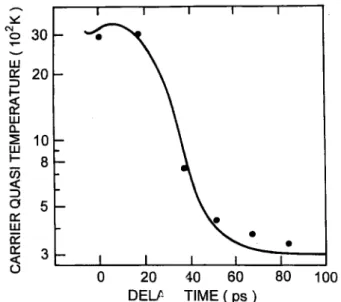
time sale [52,67,68℄. We illustrate the point in Fig.
1 whih shows the evolution of the arrier
quasitem-peraturein apump-probeexperimenton GaAs, when
time-resolved luminesene spetra are obtained: the
fulllineisthealulationinMaxEnt-NESOM[68℄and
the dotsare from theexperimental data [69℄,showing
averygoodagreement. Moreover,theinueneofthe
presene in the representativeset of basivariables of
the energy ux has been analized in the ase of
pho-toinjetedplasmainsemiondutorsin thepreseneof
aneletrield. Thepreseneofintermediatetostrong
eletrields { what is ommonin semiondutor
de-vies where a dierene of a few volts provided by a
simplepoketbatteryproduesstrongeldsoversmall
(nanometers) distanes { reates strong eletri
ur-rents(stronguxofarriers),whihisaompanied,as
aresultofeletro-thermaleets,ofarelativelystrong
ux of energy. Therefore, the inuene of the terms
proportionalto~
h
in Eqs.(38)to(40)[whihanalso
beexpressedasproportionaltoarossprodutofboth
uxes, namely ~
I
n (~r;t)
~
I
h
(~r;t) in Eqs. (39) and (40)℄
beomesrelevantateldsbeginningwithafewkV/m.
Thealulationsin MaxEnt-NESOM[70℄are
orrobo-ratedbytheanalysisoftheexperimentaldatareported
byMendezetal. [71℄obtainedinexperimentsof
modu-lation spetrosopyinsemiondutorheterostrutures.
Infat,inthisaseoneandeterminethedependene
of the quasitemperature with the eletri eld
inten-sity, on the one hand from the experimental data as
shown in Fig. 2(rightordinate)and alsoonthebasis
ofaalulationperformedintheframeworkof
MaxEnt-NESOM[70℄. Furthermore,thedierenebetweenthe
quasitemperatureinluding thepreseneof theux of
energyand theoneexluding it, thelatterbeingthen
theso-alledkinetitemperature(or theloal
equilib-riumtemperaturealbeitthesystemisuniform),anbe
obtained. This is haraterized by the funtion , as
desribed in [70℄ and shown in Fig. 2 (left ordinate):
this funtion desribes the dierene between the
qu-asitemperature in the preseneof the energy ux and
thekineti(orloalequilibrium) temperature. It
indi-atesthat infat[f. Eq.(40)℄beauseofthepresene
of theenergy ux thequasitemperatureislargerthan
theoneinthedesriptionthatleadstotheequivalentof
lassialthermodynamis. InFig. 3itisshownthis
dif-ferenein termsoftheeletrield, andtheestimated
valuesoftheontributiontotheenergyuxthatis
pro-portionalto theMaxEnt-NESOMLagrange multiplier
~
h [70℄.
Figure1. Evolutionofthearriers'quasitemperatureinthe
photoinjetedplasmainGaAs. Fulllineisaparameter-free
alulationinMaxEnt-NESOM,andthedots arefromthe
experimentaldatatakenfromreferene[69℄(Afterreferene
[68℄). ReservoirtemperatureTois300K :
Figure2.Thesteady-statearriers'quasitemperature(right
ordinate) dependene on the eletri eld intensity in a
GaAs-GaAlAs heterostruture: the dots are from the
ex-perimentaldataofreferene[71℄ andthefulllineisa
poly-nomialinterpolation. Thefuntion(leftordinate)points
to the dependene of the quasitemperature with the
en-ergyux(Afterreferene[70℄). ReservoirtemperatureT
o is
300K :
Therefore,wemaysaythattheoneptof
thatsuhquasi-thermodynamivariableanbe
hara-terizedandmeasuredexperimentally. Westressthatit
is afuntionalof thewholeset of marovariablesused
for the desription of the nonequilibrium (even
arbi-trarily far from equilibrium) thermodynami state of
the system, the one established by the seletion rule
of Eq. (2)in MaxEnt-NESOM,theounterpartofthe
prinipleof equipresenein phenomenologial
thermo-dynami theories. The fat that suh
quasitempera-tures may be alulatedin trunated desriptionsis a
meretehnialquestionofpratialharater:resorting
to an appropriateriterion wean introdue
approxi-mations by negletingunimportant ontributions in a
ase by ase analysis (see Appendix I for an
illustra-tion).
Figure3.IntheaseofthesystemoftheaptiontoFig. 2,
the perentualvalue ofthehangeintheloalequilibrium
temperaturedue to the presene of the energyux(right
ordinate). Theontributionto the energy uxassoiated
totheMaxEnt-NESOMLagrangemultiplier~isshownon
theleft ordinate(Afterreferene [70℄).
Figure4.Evolutionofarriers'quasitemperatureinthe
pho-toinjetedplasmainGaAs. Thefulllineisaparameter-free
alulation inMaxEnt-NESOM,and thedotsarefromthe
experimental datataken from referene [72℄. The dashed
lineisaalulationdisregardingambipolardiusioneets,
whihweanseearerelevant. Thearrowindiatestheend
oftheexitinglaserpulse. AfterRef. [73℄.
We omplement theillustrations with other
exam-ples. In the ase of the experiments of Amand and
Collet[72℄,it isshownin Fig. 4theomparisonof
ex-perimentaldatawiththealulation{intheonditions
of theexperiment {in MaxEnt-NESOMof the
evolu-tionintimeofthequasitemperatureofthearriers[73℄.
Moreover,inthisaseisalsoreporteddataonthe
evo-lution ofthe arriers'onentration, whih hangesin
timeduetoreombinationeetsandambipolar
diu-sionoutoftheativevolumeofthesample: the
exper-imentaldata andthealulationhavegoodagreement
asshownin Fig. 5.
Figure5. Evolution ofthe arriers' density inthe ase of
theaptiontoFig. 4. AfterRef. [73℄.
Figure6. Thease of n-dopedGaN (n=110 17
m 3
):
evolutionoftheeletrondriftveloityfordierentvaluesof
theeletrield; reservoirtemperatureisTo=300K. It is
evident a veloity overshoot for elds larger thanroughly
Asnotied,inthepreseneofeletrieldsthe
ar-riers produe a urrent and then the ux of arriers
needs be introdued as a basi variable. In
MaxEnt-NESOM the aompanying Lagrange multipliers an
be interpreted as the drift veloity, ~v
e( h)
(t), of
ele-trons (e) and holes(h) dividedby k
B T
( t). The
ur-rentofeahtypeof arriersisproportional( ~
I
e( h) (t)=
(+)en(t)~v
e( h)
(t))tothisdriftveloity. Thedrift
ve-loity isderivedin MaxEnt-NESOMand in Fig. 6we
showtheevolutionintimeofthedriftveloityof
ele-tronsinn-dopedGaN[74℄(inthisasethearriersare
onlyeletrons). Weanseethepreseneofanexpeted,
so-alled, veloity overshoot, that is, during the
tran-sienttheveloityattainsavaluelargerthantheonein
the steady state. Compounds of the III-Nitridetype,
asGaN, arenowadays ofinterest beause of theiruse
{asaresultofbeingofwidegap{inlaseranddiodes
working in theblue andnear ultraviolet region ofthe
eletromagnetispetrum. Wedonotpresent
ompar-ison with experimental values beause the latter are
not yet available. The dependene of the drift
velo-ity in the steady state with the eletri eld strength
is also alulated, and in Fig. 7 we show a
ompari-son of our results in MaxEnt-NESOM with results of
aalulationinaomputer-modellingMonteCarlo
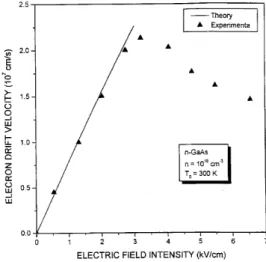
ap-proah[74℄. However,intheaseofGaAs the
alula-tionanbeompared withexperimental results. This
isshowninFig. 8fortheso-alledOhmidomain
(di-retproportionalityofurrentandeletrield),whih
extendsuptoeldintensityofroughly2:5kV=m;
be-yondthispointtheresultsarenotvalidbeauseofthe
intervalley sattering not aounted for in the model
usedinthealulation[75℄.Furthermore,intheplasma
in semiondutors, theenergyin exessof equilibrium
of the arriers, is being transferred to the lattie
vi-brations (mainly the optial phonons) whih then
be-ometheso-alled\hotphonons",thatishavinga
qu-asitemperature larger than the reservoirtemperature.
InFig. 9wepresenttheevolutionofthe
quasitemper-ature in thease of a partiular mode of longitudinal
optialphononsinphotoexitedGaAs. Thealulation
inMaxEnt-NESOMompareswellwiththe
experimen-taldata(dots), andtheso-alled\hotphononveloity
overshoot"(during evolution the quasitemperature of
somephonon modesbeomeslarger thanthe arriers'
quasitemperature)isevidened[76℄.
Figure 7. Comparison ofalulations inMaxEnt-NESOM
(analytialones)eithMonteCarloomputationalmodelling
inn-dopedGaAs. AfterRef. [75℄.
Figure 8. Eletron drift veloity inthe steady state of
n-dopedGaAs,showingintheOhmiregionaomparisonof
a alulation inMaxEnt-NESOM withexperimental data.
AfterRef. [75℄.
Figure9. Evolutionofthequasitemperatureofarriersand
of LO phonons for the modeindiated. Dots are
experi-mentalpointsderivedfromRamansatteringspetra. The
so-alled\hotphonontemperatureovershoot"isevidened.
III.4 Generalized Clausius' and
Boltz-mann's relations and a H -theorem
We lose this setion notiing that there exist a
Clausius-like expression for the inrease of the
infor-mational entropyin IST,resultingasaonsequeneof
themodiationofexternalonstraintsimposedonthe
system. Infat, onsider theinformationalentropy of
Eq.(18),and letus all
`
(` =1;2;:::;s)aset of
pa-rametersthatharaterizetheexternalonstraints
im-posed onthesystem(one ofthemmaybethevolume,
others external elds, et.). Introduing innitesimal
modiations,sayd
`
,theinnitesimalvariationof
in-formational entropy, as shown in the Appendix III, is
givenby
d
S(t) = Z
d 3
rf(~r;t)Æh(~r;t)+A(~r;t)Æn(~r;t)+
+~
h (~r;t)Æ
~
I
h
(~r;t)+~
h (~r;t)Æ
~
I
n (~r;t)+
+ X
r2 h
F [r℄
h
(~r;t)ÆI [r℄
h
(~r;t)+F [r℄
n
(~r;t)ÆI [r℄
n (~r;t)
i
g
Z
d 3
r ds(~r;t) ; (41)
d
where Æh,et.,aregivenby
Æh(~r;t)=dh(~r;t) D
d b
h(~r)jt E
; (42a)
Æn(~r;t)=dn(~r;t) hdbn(~r)jti ; (42b)
et: (42)
Theexpressionsforthesenonexatdierentialsare(see
Appendix IV) thedierenebetween theexat
dier-entialof eahquantity(dh,dn,et.) and
D
d b
h jt E
=Tr (
s
X
`=1
b
h
` d
` %(t)
)
; (43a)
hdbnjti=Tr (
s
X
`=1 bn
` d
` %(t)
)
; (43b)
et:; (43)
whih are the average value of the hange in the
or-responding dynamial quantity due to the
modia-tion of the ontrol parameters. The usual ase of a
hangeofvolumestartingwiththeequilibrium
anon-ial distribution is presented as a simple illustration
in Appendix IV. From Eq. (41) it is evident that the
MaxEnt-NESOM Lagrangemultipliers are integrating
funtionsforthenonexatdierentials. Letusnow
in-troduethefollowingredenitionsoftheLagrange
pa-rameters,
A(~r;t)= (~r;t)(~r;t) ; (44a)
~
h
(~r;t)= (~r;t)~
h
(~r;t) ; (44b)
~
n
(~r;t)= (~r;t)~
n
(~r;t) ; (44)
F [r℄
h
(~r;t)= (~r;t)F [r℄
h
(~r;t) ; (44d)
F [r℄
n
(~r;t)= (~r;t)F [r℄
n
(~r;t) ; (44e)
whih, togetherwith theuseofEq. (21)whih denes
the quasitemperature , allows us to write a
spae-dependent (in a innitesimal region around point ~r)
Clausius-like expression for arbitrary nonequilibrium
onditions,namely
s(~r;t) s(~r;t
o )=
Z
t
to dt
0 ds(~r;t
0
)
dt 0
= Z
t
to dt
0 Æ
q
(~r;t)
k
B (~r;t)
; (45)
Æq(~r;t) = dt 0
Æ
q
(~r;t)=Æh(~r;t) (~r;t)Æn(~r;t)
~
h (~r;t)Æ
~
I
h
(~r;t) ~
n (~r;t)Æ
~
I
n (~r;t)
X
r2 h
F [r℄
h
(~r;t)ÆI [r℄
h
(~r;t)+F [r℄
n
(~r;t)ÆI [r℄
n (~r;t)
i
: (46)
In Eq. (45) is to be understood that the time integration extends in the time interval from t
o
to t, along the
trajetory of evolution of the nonequilibrium dissipativeevolution of the system, where t
o
is the initial time of
preparationofthesystemandtthetimeameasurementisperformed. Asshownlateron,f. Eq.(61),thequantity
in Eq. (45)integratedoverthevolumeofthesystemisnonegative.
Moreover,using theredenitionsof Eqs.(44), wemaynotied that thegeneralizedGibbs relationof Eq. (19)
beomes
(~r;t)ds(~r;t) = dh(~r;t) (~r;t)dn(~r;t)
~
h (~r;t)d
~
I
h
(~r;t) ~
n
(~r;t)d ~
I
n (~r;t)
X
r2 h
F [r℄
h
(~r;t)dI [r℄
h
(~r;t)+F [r℄
n
(~r;t)dI [r℄
n (~r;t)
i
; (47)
d
where on theleft it hasbeenevidenedthe
quasitem-perature . In this Eq. (47), plays the role of a
quasi-hemial potential, ~v of a drift veloity, and ~;
F [r℄
h andF
[r℄
n
are,say,nonlassialnonequilibrium
ther-modynami variables, playing the role of higherorder
driftveloitiesas disussedin [46,47℄.
Atthis point, withoutgoingintodetails to be
pre-sented elsewhere [53℄, we omment on an interesting
result. Itonsists in akindofrelationof the
informa-tional entropyin ISTandBoltzmann's famous
expres-sionfortheentropyintermsofthenumberof
omplex-ionsat themirosopimehaniallevelof desription
of the system, whih are ompatible with the
maro-sopi onstraints. The nonequilibrium marosopi
onstraints in IST are, we reall, the set of
informa-tional variables, forexampletheset of Eq.(17)whih
aretheaveragevaluesoverthenonequilibriumensemble
ofthemehanialquantitiesofEq.(13)(wenoteagain
that this is the ase of a generalized nonequilibrium
grand-anonial-likeensemble). The informational(or
IST)entropyis,asseen,afuntionalofthesevariables
[f. Eq.(19)℄,whih inthe thermodynami limit
satis-esthat
S(t)!lnWfQ(~r;t)g; (48)
whereQstandsforallthevariablesinthesetindiated
in Eq. (17), and W is the number of omplexions {
phase spae volume or number of quantum states (in
lassial andquantum mehanisrespetively) {
om-patiblewiththeimposedmarosopionstraints. The
demonstrationfollowsasimilar linethan theoneused
in equilibriumstatistialmehanis.
Also, it is worth notiing that dening the
quasi-entropyoperator
^
S(t;0) = P(t)ln%(t)= ln%(t; 0)= (49)
= (t)+ Z
d 3
rf(~r;t) b
h(~r)+A(~r;t)bn(~r)+
+~
h (~r;t)
^
~
I
h
(~r)+~
n (~r;t)
^
~
I
n (~r)+
+ X
r2 h
F [r℄
h
(~r;t) ^
I [r℄
h
(~r)+F [r℄
n
(~r;t) ^
I [r℄
n (~r)
i
whose average value with the statistial operator [f.
Eq. (9)℄produestheIST entropyof Eq.(18),hasthe
interestingpropertythat,ifListheLiouvilleoperator
of thesystem,then[77℄
Tr ("
iL; b
S (t;0)
#
%(t) )
=(t) ; (51)
where
(t)=Tr 8
>
<
>
: d
b
S (t)
dt %(t)
9
>
=
>
; =
d
S(t)
dt
; (52)
istheIST-entropyprodutionofEq.(10).
This result is a manifestation in the
MaxEnt-NESOM-basedIST,oftheideaofomplementarity
be-tween the mirosopi and marosopi levels of
de-sriptions of many-body systems, as seemingly rstly
onsideredbyNielsBohr[78℄,andelaboratedby
Rosen-feld[79℄andPrigogine[80℄;thistopiisonsidered
else-where[77℄. Thequestionof thediagonalization ofthe
informationalentropyoperator,theanalysisofits
spe-trumofeigenvalues,andsomephysialimpliationsare
givenintheRef. [81℄.
Finally, we notie that the informational entropy
hasassoiatedaH -theoreminJanel'ssense[82℄. The
informationalentropydensitys(~r;t)satisesa
ontinu-ityequationoftheform[54℄
t
s(~r;t)+div ~
I
s
(~r;t)=
s
(~r;t) ; (53)
where ~
I
s
istheux ofinformationalentropy,namely
~
I
s
(~r;t) = (~r;t) ~
I
h
(~r;t)+A(~r;t) ~
I
n (~r;t)+
+~
h
(~r;t)I [2℄
h
(~r;t)+~
n
(~r;t)I [r℄
n
(~r;t)+
+ X
r3 [F
[r 1℄
h
(~r;t)I [r℄
h
(~r;t)+F [r 1℄
n
(~r;t)I [r℄
n
(~r;t)℄ ; (54)
d
andtheuseofthedenitionsofEqs.(44)and(22)allow
us tointrodueageneralizedheatux ~
I
q
givenby
~
I
q
(~r;t)=(~r;t) ~
I
s
(~r;t) : (55)
Moreover,
s
istheloalinspaeinformational-entropy
produtionfuntion,denedinRef. [54℄,whihis
om-posedoftwoontributions,namely
s
(~r;t)=(~ r;t)+
f
(~r;t) ; (56)
where is
(~r;t)=ds(~r;t)=dt ; (57)
withdsdened inEq.(19)and
f
(~r;t) = ~
I
h
(~r;t)O(~r;t))+ ~
I
n
(~r;t)OA(~r;t)+
+ X
r2 [
[r℄
h
(~r;t)gradF [r 1℄
h
(~r;t)+
+ [r℄
n
(~r;t)gradF [r 1℄
n
(~r;t)℄ : (58)
Theloalinspaeinformational-entropyprodution
is omposed of two terms, the rst on the right of
Eq.(56)istheone duetorelaxationeetsarisingout
oftheinterations ^
H 0
in Eq. (1) andontainedin the
ontributions to the nonequilibrium statistial
opera-torinEq.(3),whih,aftertheequationsofevolution{
Eqs.(4)to(7){areused,anbeexpressedas
(~r;t) = (~r;t)J
h
(~r;t)+A(~r;t)J
n (~r;t)+
+~
h (~r;t)
~
J
h
(~r;t)+~
n (~r;t)
~
J
n (~r;t)+
+ X
r2 h
F [r℄
h
(~r;t)J [r℄
h
(~r;t)+F [r℄
n
(~r;t)J [r℄
n (~r;t)
i
where J
h ;J
n
, et. are the ollision operators of Eq.
(7) in the partiular presentase, that is, assoiated
to the equations of evolution for the energy and
par-tile densities and their vetorial and tensorial uxes
in the desriptionof Eq. (17). We reall that J (0)
in
Eq. (6) [the generalized Mori's preession term, and
the onegiven riseto thedivergene of the ux in Eq.
(8)℄ does not ontribute to the informational-entropy
prodution (see Ref. [54℄). Theseond termonthe
rightofEq.(56)[f. Eq. (58)℄isaontributionin the
form of produts (salar and tensorial) of uxes and
thermodynami fores (the latter being the gradients
oftheLagrangemultipliersorintensivenonequilibrium
thermodynamivariables),inasimilarformtotheone
thatappearsin phenomenologialthermodynami
the-ories. It should be notied that after integrationover
spae of the informational-entropyprodution density
ofEq.(56)weobtainthat
s (t)=
Z
d 3
r
s (~r;t)=
Z
d 3
r(~r;t)=(t) =d
S(t)=dt ; (60)
whihisthebulkinformational-entropyprodution,sinetheintegralof
f
vanishes(seeAppendixIV). Thisbulk
informational-entropyprodutionhasassoiatedwhatwehavealledaweakprinipleofnon-negativeinformational
entropy prodution[53,54℄,namely
S(t) =
S(t)
S(t
o )=
S(t) S
G (t)=
= Z
t
t
o dt
0 Z
d 3
r
s (~r;t
0
)= Z
t
t
o dt
0
(t
0
)0 ; (61)
d
where,wereall,t
o
standsfortheinitialtimeof
prepa-ration of the system in the given experiment and t is
the time when ameasurementis performed. It ought
to benotied that this theorem impliesin an inrease
oftheinformationalentropyalongtheevolutionofthe
marosopistateofthesystemasirreversibleproesses
develop in the medium, starting at time t
o
. But it
doesnottellusthattheinreaseismonotoni,ormore
speially, loally monotoni, aproperty imposed by
someauthors in other theories. However,it is
onje-turablethat thismaybeso -at leastforthe
instanta-neousbulkinformational-entropyprodution{beause
along the evolution of the systemit seems reasonable
to expetaontinuouslossofinformation. Butthisis
notthe asewhen atrunation is introdued (that is,
thelosureondition,imposedbyZubarev-Peletminskii
seletionrule of Eq. (2), isviolated): during the
irre-versibleevolutionofthesystematertainintervalsthe
prodution of informational entropy may be negative
[83℄,but,however,itispredominantlypositive,sothat
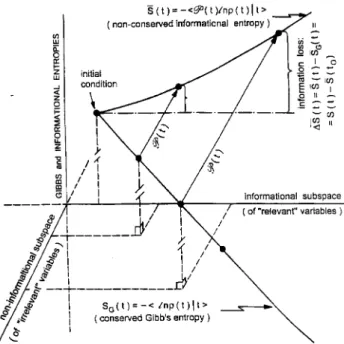
the integralform of Eq. (61) issatised [84℄. Fig. 10
provides agraphial desriptionof this inrease of
in-formational entropy: Wereall that the proedure
in-volvesthedenitionof aspaeof, whatanbealled,
\relevant" (or informational) variables, that is, those
hosen on the basis of the seletion rule of Eq. (2).
An\orthogonal"spaeisomposedbythe\irrelevant"
variables, that is, those absentfrom the informational
onstraints in MaxEnt-NESOM [85℄. The role of the
time-dependentprojetionoperatorinEq.(9)annow
be better understood: It introdues aoarse-graining
proedure implying that it projets the logarithm of
the \ne-grained" statistial operator onto the
sub-spae of the relevant (i.e. basi) variables, produing
the logarithm of the \oarse-grained"statistial
oper-ator %(t; 0). We stress that the oarse-graining whih
follows by appliation of the projetion proedure is
time dependent, what isaresult that theoperationis
dependentonthemarosopistateofthesystematthe
timetheprojetionisperformed. Theproedure
elimi-natesthe\irrelevant"variables,whiharehiddeninthe
statistial operator in the ontribution% 0
(t), sine the
timederivativepresentinitsdenitiondrivesitoutside
theinformationalsubspae. Topologialand
geometri-al analyses of thequestionare provided by Balian et
al. [85℄. (See also Fig. 4). Theresultof Eq. (61)an
be onsidered as a H -theorem in Janel's sense [82℄,
andtheinreaseininformationalentropyisaresultof
the loss in information arising outof the hosen
on-trateddesriptionofthemarostateofthesystem(or
inompletenessofinformation). Atthispointwedonot
laimanylearutonnetionwiththe
phenomenolog-ialseondlawofthermodynamis,andwithClausius'
onept of unompensated heat, exept for the
analo-gies [e.g. Eqs.(18),(19),(46),(48)℄,andthefat that
in the proper asymptoti limit one reovers the well
knownandestablishedresultsofloal equilibriumand
fullequilibrium thermodynamis. Additional
Figure10. GraphialdesriptionoftheGibbs'and
informa-tional entropiesdependingontheMaxEnt-NESOM
statis-tial operator. Theprojetion {dependingonthe
instan-taneous state ofthe system {introdues aoarse-graining
proedure onsisting into projeting onto the subspae of
the\relevant"variablesassoiatedtotheinformational
on-straintsin MaxEnt-NESOM (f. Eqs. (8)and (60); After
referene [38℄).
IV Disussion and onluding
remarks
Wehaveonsideredsomegeneralaspetsofthe
thermo-dynamis ofdissipativesystemsinonditions
arbitrar-ily away from equilibrium; in this onluding setion
we further elaborate on the matter. On the previous
setionspartiular attentionwasgiventothequestion
of entropy-like and temperature-like onepts in the
nonequilibriumthermodynamisofdissipativesystems.
Conerningtemperatureoutofequilibrium,wehave
al-readymentionedintheIntrodutiontheuseof
nonequi-librium temperatures on phenomenologialbases
dat-ingbakapparentlytoarstproposalbyLevD.
Lan-dau morethanhalf aenturyago[3-9℄. Inthease of
the lassial irreversible thermodynamis no diÆulty
arisessineitispostulatedloalequilibrium (asnoted
areasonableapproximationinthelinearregimearound
equilibrium for quasi-stati and quasi-uniform
ondi-tions). Forarbitrarilyaway-from-equilibriumsituations
dierentoneptsofnonequilibriumtemperatureshave
been onsidered by several authors in several
thermo-dynami approahes. Meixnersetstheoneptof
\dy-namial temperature" [10℄; Muller introdues
\old-ness"[11℄;Mushikpostulatesa\ontattemperature"
[12℄;Keizerintroduesanonequilibriumtemperaturein
the framework of the postulation of anonequilibrium
thermodynamis basedonstatistial onsiderationsof
moleularutuations[13℄;Nettletononsidersthe
on-ept of a \kineti temperature" related to the kineti
energyperpartile [59℄. Within theframeworkof
Ex-tended Irreversible Thermodynamis (EIT [86,87℄) it
is dened a nonequilibrium temperature stemming as
the partial derivative of a postulated nonequilibrium
entropy-likefuntionharateristiofEITwhih
inor-porates thedissipativeuxes[88℄.
More reently, Garia-Colin and Chan-Eu
at-temptedtosetaoneptofanabsolutenonequilibrium
temperature stritly basedon the zeroth law and the
seondlawdesribedin aCarnot-Clausius'framework
[60℄.Intheproess,aquasientropyisintrodued,alled
alortropy,whihpossessesadierentialformsimilarin
appearanetotheoneinourEq.(46)above,butwhere
aloal equilibrium temperature and amomentum
ex-pansion,thelatterexpressedintermsofaompleteset
of tensor Hermite polynomials are present instead of
the tensorial uxes of all orders in Eq. (43).
Aord-ing to these authors, in the proposed deomposition
ofa Carnotyleintoan innitenumberof
innitesi-malCarnotyles,thetemperatureoftheworking
sub-staneundergoinganirreversibleproessharateristi
of the innitesimal Carnot yle of interest is
nees-sarilythe sameasthe temperature of oneof the heat
reservoirs,andmustberegardedastheloal
tempera-tureof thebody in question [60℄. Viewedin this way
theheatreservoiroftheinnitesimalyleinquestion
maydoubleasathermometerin theabsolute
tempera-turesalethatindiates thetemperaturevalueT:The
body undergoes an irreversible proess and T is the
thermodynami temperature of theinnitesimal body
as well asthe heat reservoir{ athermometer [60,89℄.
Itseemstousthat, ontheonehand,this impliesthat
loalequilibriumhasbeenahievedand thus a
restri-tionisintroduingloosinggenerality;andontheother,
ingeneralonditions,aspointedoutbyJaynes[90℄,T
denotesthetemperatureofaheatbathwithwhihthe
systemismomentarilyinontatandthismay ormay
notbethetemperatureofthe system[emphasisisours℄.
Moreover, Carnot'spriniple(in its original form)
de-sribesonlythenetresultofaproessthat beginsand
ends in thermal equilibrium; it does not permit us to
drawanysuhonlusionasdS=dt0atintermediate
times: Indeedentropyhasbeendenedonlyfor
equilib-riumstates,inwhihthereisnotimedependene. The
alortropyfuntion annotbediretlymeasuredbut is
tobedeterminedintermsoftheloaltemperatureand
the other variables in the thermodynami state spae
(energy,theHermitepolynomials,et.), andtherefore,
one needs to obtain and solve the onstitutive
equa-tionsforthose variables. The alortropyis onsidered
asrepresentingaling abinetontaininginformation
on the physial properties of the marosopi system