Rigorous Results for Aperiodi and Almost
Periodi Substitution Sequenes
S.T. R.Pinho
Institutode Fsia
UniversidadeFederaldaBahia
40210-340, Salvador,BA,Brazil
e-mail:suaniufba.br
and T. C. Petit Lob~ao
Departamento deCi^eniasExatas
UniversidadeEstadualde Feirade Santana
44031-460,FeiradeSantana,BA,Brazil
e-mail: thierryuefs.br
Reeivedon15August,2000
Reent studiesof the eets of geometri utuations, assoiated with aperiodi exhange
inter-ations, on the ritial behavior of ferromagneti Ising modelson hierarhial latties, were the
motivationto investigate some properties of two-letter sequenesgenerated by uniform
substitu-tions. We rigorously identifythe substitutionsthat generateeitherperiodior aperiodi(almost
periodiornot)sequenes. Forinstane,twoknownsubstitutions,theThue-Morseandthe
period-doublingrules,generateaperiodisequenesofalmostperioditype.
I Introdution
Theaperiodiharaterofstruturessuhassequenes
generated by substitution rules dened on anite
al-phabet hasbeeninvestigated byseveralauthors in
re-entyears. Intherealmofphysis,thisisrelatedtothe
disovery, in the late 1980's, of new strutures alled
quasirystals [1℄. There are several theoretial
stud-ies of aperiodi strutures assoiated with innite
se-quenes generated by suessive juxtapositions of
let-ters of a nite alphabet aording to some
substitu-tionalrule. Forexample,theFibonairule,
:
a7!ab
b7!a
(1)
generatesaninnitesequenebysuessiveappliations
oftheruleonthelettera,
a!(a)=ab! 2
(a)=(a)(b)=
=aba! 3
(a)=abaab! 4
(a)=abaababa ::: (2)
Althoughthese substitutionalsequenes havebeen
studied by mathematiians mainly, in the ontext of
algebra [2℄ and dynamial systems [3℄, there is also a
loselink betweensubstitutionalsequenesand
physi-onstrutaperiodieletronisystemsandspinmodels
whose exhange ouplings J
i
are dened by a
substi-tution rule. Consider a one-dimensional Ising model,
withnearest-neighborexhangeinterationsJ
a andJ
b ,
aordingtotherule(1). Inthethermodynami limit,
this \Fibonai hain" orresponds to the k th
power
of (a), from Eq. (2), for k ! 1. It is ertainly
in-teresting to investigatethe role of aperiodiity on the
propertiesofthese modelsystems.
Theeets ofgeometriutuations ontheritial
behaviorofspinmodelswithaperiodiexhange
inter-ationsis animportanttopi ofequilibrium statistial
mehanis. There isaheuristi riterion,proposed by
Luk [6℄, in analogywith the Harris riterion for
fer-romagneti disordered systems [5℄, to aount for the
relevane of the geometri utuations. Aording to
Luk'sriterion,iftheexhangeinterationsofa
ferro-magnetiIsingmodelobeyasubstitutionrule,the
rit-ialbehaviorhangeswithrespettothepureperiodi
model(forJ
a =J
b
)iftheutuationsareunbounded.
Theseutuationsarerelatedtothedierenebetween
thenumberofourrenesofaertainletteronanite
generationandtheexpetednumberifweonsiderthe
frequenyintheinniteword[7℄.
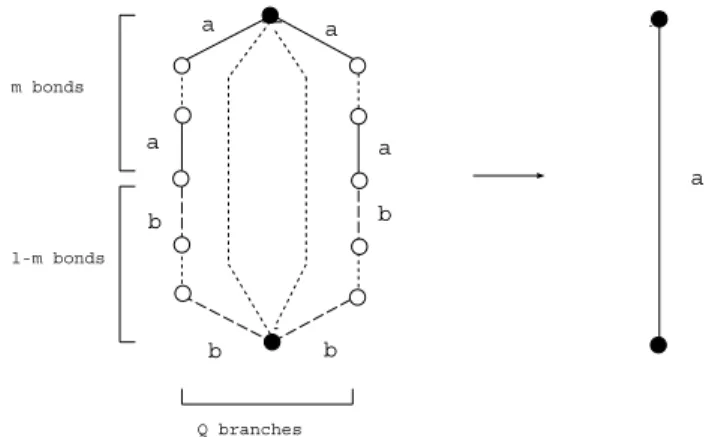
ferromag-al lattie(DHL) [9℄. Theexhangeinterationsalong
the branhesof theDHL lattie are hosenaording
to suitablebinary(two-letter) substitutionalrules(see
Figure 1). Note that, to preserve thetopology of the
DHL (eah branh hasthe same number of bonds `),
the substitutions haveto beuniform (eah letter
gen-erateswordsofthesamelength`).
a
a
b
b
a
a
b
b
a
m bonds
l-m bonds
Q branches
Figure 1. The deation rule assoiated with a
substitu-tion (ination)rule that transformsthe ouplingonstant
of typea suhthata7!a m
b ` m
inageneralized(`bonds
bybranh)diamondhierarhiallattie(DHL).Thisruleis
appliedforeahbranhoftheDHL.
Someoftheseuniformbinarysubstitutionsgenerate
aperiodi sequenes(whih mayormaynotbealmost
periodi). Also, there are someof those substitutions
that generatejust periodisequenes. Inthiswork,we
identify lasses of periodi, almost periodi, and
ape-riodi innite sequenes, assoiated with these
substi-tutions, and present some rigorous results related to
their periodi/aperiodi harater. Most of these
re-sults may be extendedto somelassesof substitution
withanynumberofletters. SetionII presentsthe
ba-sioneptsandresultsofthetheory. Ourresultsand
proofs related to periodiity, aperiodiity, and almost
periodiity of the sequenes are presented in Setion
III.Finally, in Setion IVwepresentsomeonluding
remarksandadisussionofsomeimportantaspetsof
these resultsfortheanalysisofspinmodels.
II Basi Conepts
Most of theonepts presented in this Setion anbe
foundin theworksofQueele[3℄andCobham[10℄.
Let A be a nite set, alled the alphabet, whose
elements, x, are letters. The juxtaposition of `
let-ters, not neessarily dierent, is alled a nite word
of length `. An innite (right)word resultsfrom the
juxtaposition of an innite number of letters with an
initial one (on the left). The set of all nite words
with letters in A is alled A
; we note by A N
the
set of all innite words, sine an element of A N
is
an appliation of the set of the natural numbers N
in A, i.e., a mathematial sequene. ForA = fa;bg,
we have A
= fa;ab;aa;bb;aab;abb;:::g and A N
=
fabaaa:::; aabba:::; :::g
DenitionII.1 A substitution on an alphabet A is
amap
:A ! A
(3)
x 7! (x);
whih assoiates witheah letterx,in A,anite word
(x)inA
.
DenitionII.1.1Asubstitutionisbinaryifthe
num-beroflettersofA,jAj,is2.
DenitionII.1.2 Asubstitutionisuniformof
mod-ulus`if,toeveryxin A,thenumberoflettersin(x)
is`,insymbols,j(x)j=`.
DenitionII.1.3Auniformsubstitutionismodular
if(x)=X,forallx inA andX isaniteword.
Denition II.1.4 A uniform binary substitution is
alternated if (a) = abab:::a or abab:::b and
(b)=baba:::b or baba:::a,respetively.
TheFibonaisubstitution(1) isbinarybut isnot
uniform. The Rudin-Shapiro substitution is uniform
butis notbinary, sineitis denedonA=fa;b;;dg
by: a7!a,b7!d, 7!ab,d7!db. An exampleof
alass ofuniformbinarysubstitutions ofmodulus` is
givenby
:A ! A
(4)
a 7! a m
b ` m
;
b 7! b q
a ` q
;
where ` > 1 and m 6= 0 or q 6= 0. The Thue-Morse
and period-doubling substitutions arepartiular ases
of(4)with `=2,where m=q=1and m=1,q=0,
respetively.
It is obvious that a substitution : A ! A
may be extended by onatenation to : A
! A
and to : A N
! A N
. By onatenation we mean
(a
1 a
2 :::a
j
) = (a
1 )(a
2 ):::(a
j
) and (a
1 a
2 :::) =
(a
1 )(a
2
)::: . Bysuessiveappliationsofa
substi-tution,starting,forinstane, fromlettera,itis
gen-eratedasequeneofnitewords(a;(a); 2
(a);:::);we
mayobservethisproessfortheFibonaisubstitution
in(2).
DenitionII.2 ThesubstitutionmatrixMassoiated
with the substitution : A ! A
is an nn
ma-trix, where n=jAj, whoseelements m
ij
arethe
num-ber of ourrenes of letter x
i
in (x
j
), in symbols
m
ij =j(x
j )j
Forthelassofsubstitutions(4),wehave
M=
m ` q
` m q
; (5)
whose eigenvalues are the integer values:
1
= ` and
2
= m+q `. We may observe that substitutions
, suh that a 7! aY, b 7! W with jYj
a
= m 1,
jYj
b
=` (m 1),jWj
b
=qandjWj
a
=` qhavethe
sameassoiatedmatrixM. Forexample,themodular
binary substitution (a 7! ab , b 7! ab) has the same
matrix of Thue-Morse substitution whose eigenvalues
are
1
=2and
2 =0.
It is easy to show that the eigenvalues of the
as-soiatedmatrix ofanymodular binarysubstitution of
modulus ` are
1
= ` and
2
= 0, sine the matrix
elements are suh that m
11 = m
12
and m
21 = m
22 .
Notethat,eveninasejXj
b
=0(orjXj
a
=0),wehave
1
=` and
2 =0.
Analogously, the eigenvaluesof theassoiated
ma-trixofanalternatedsubstitutionofoddmodulus`are
1
=` and
2
=1,sinethematrixelementsare suh
thatm
11 =m
22 andm
12 =m
21 =m
11 1.
Denition II.2.1 A substitution matrix M is
prim-itive if there exists a positive integer r suh that all
elementsofM r
arestritlypositive..
DenitionII.3 Let beasubstitution; anelement
of A N
is a substitution sequene of if is a xed
pointof, i. e., ()=.
RemarkI Ifisasubstitutionsequene,itiseasyto
demonstratethat
(
1 )=
1 Y;
where
1
means the rst letter of and Y is anite
word.
Reiproally, for suessiveappliations of
start-ing, for instane, from a, if the rst letter of (a) is
a, that is, (a)j
1
=a, then k +1
(a) = k
(a)W, for all
k, where W is a nite word (see (2) for a Fibonai
rule). Inthis sense,wesay that thesequene of
pow-ers k
(a) is self-similar. This property guarantees, in
ase j(a)j > 1, that the substitution determines a
substitution sequene that may be denoted by the
symbol
= lim
k !1
k
(a)
and,obviously,
1 =a.
Denition II.3.1 A substitution sequene is periodi
with no radial if it is generated byinnite suessive
ourrenesof ablokT (whih isalled period)with
lengtht=jTj(=TTTTT:::). Iftheperiodi
substi-by =R TTT:::. A substitution is aperiodi if it is
non-periodi.
Denition II.3.2 A substitution sequene is almost
periodiif,forallblok(niteword)Y,ourringin,
there exists, at least, apositiveintegern suh that Y
oursin eah wordof lengthnontainedin.
Inother words, thedistane between any two
su-essive ourrenesof any blok is limited. Fora
pe-riodi sequene, this distane is zero; so, we may say
that, in a ertainsense,periodi sequenes arealmost
periodi aswell.
Theorem II.1 Let be a uniform substitution that
generatesa substitution sequene. If itssubstitution
matrixMisprimitive, so isalmost periodi.
Thedemonstration of this theorem is presented in
referene[10℄.Thisresultmaybegeneralizedfora
non-uniformsubstitution [11℄.
III Results
InthisSetion, weanalyzesubstitutionsthat are
bi-nary (A = fa;bg), uniform (j(a)j = j(b)j), and
de-termine a substitution sequene , i. e., () = ;
thustherstletter,
1
,in thesequene, issuhthat
(
1 )=
1
Y (seeRemarkI).Wenowassumethatthis
rstletterisa. Therefore,wewrite
:A ! A
(6)
a 7! aY ;
b 7! W ;
withjYj=` 1,jWj=`and`>1.
Mostoftheresultsofthissetion arebasedonthe
followinggeneraldenition:
DEFINITION III.1 Let 2 A N
, =
1
2 :::;
the lettera
k
2A=fa
1 ;a
2
;:::gis o-nal in if, for
any naturalnumberr,there existsanatural number s,
greaterthanr,suhthata
k =
s
. Wewritea
k 21.
Wemaynotiethat,ifalettera
k
iso-nalin,it
appearsinnitelyoftenin .
III.1 Periodiity
Wehavetwotrivialperiodisubstitutionsequenes
determinedby(6), thatwillbealledofsimpleperiod;
these are related to the pure ase of the spin model.
Letusprovethefollowingtheorem.
isperiodi, with period T suh thatjTj=1, andit
presentsonly twotypes:
(I)=aaaa:::,if bis noto-nal in;
(II)=abbb:::,if a isnoto-nal in.
Demonstration: Letus suppose that b 2= 1: sine
is innite, then a 2 1; if b 2 Y, inasmuh as
(a) =aY, then b 21. So, weonludethat b 2= Y;
sine=lim
k !1
k
(a),itfollowsthat=aaa:::.
Now,letussupposethata2=1. Then,analogously,
b 21. If a2W, thena 21, beause(b)=W; so
a 2= W. If a2 Y, sine (a) =aY, 2
(a) =aY(Y),
andsoon,wewouldhavea21. So,weonludethat
a2=Y,anditiseasytoseethat=abbbb:::.
2
Thenexttheorem isaornerstoneto manyresults
that follow.
THEOREM III.2 Let be a periodi substitution
sequene; the rstlettera iso-nalin if,and only
if, doesnot haveradial.
Demonstration: Supposethat =R TTTT:::and
jTj=t. Sinea iso-nalin and isperiodi, then
a 2 T. Take a 2 T for a xed blok T; it is
pos-sible to onsider a nite number n of iterations suh
thattheblokgeneratedfromais n
(a)=R TXwhere
X is a nite word. But n
(a) is also in the periodi
part of ; so R also ours in the periodi part of .
If we ount t = jT 0
j letters from the rst a, we have
=T 0
T 0
T 0
T 0
::: , in other words, does nothavea
radial.
For the onverse, if does not have radial, it is
periodifromtherstletteraofthesequeneanditis
obviousthat aiso-nalin sine=TTTT:::.
2
In view of the last results, we will always assume
thatthesubstitutionin(6)issuhthatthenumberof
lettersb in(a)isnon-zero,or,insymbolsj(a)j
b >0.
Moreover,wemayalsoassumethatbothlettersaand
b areo-nalin.
LEMMA III.1 Consider a substitution sequene
generated by the substitution , where both letters are
o-nal in. If ismodular,then is periodi
with-outradialandthelengthofthe period, jTj,isequal or
smaller than the modulus `. Conversely, if is
peri-odi without radial and suhthat jTj=`,then is a
modularsubstitution.
Demonstration: If : a 7! X and b 7! X, then
2
(a) =(X)= X:::X with j 2
(a)j =` 2
. Bynite
indution, sine = lim
k !1
k
(a), weonlude that
=XXXX:::;obviously,jTjjXj.
For the onverse, if is periodi with no
radi-al and jTj = `, then (a) = T. Sine both
let-ters are o-nal in , they belong to the period and
2
(a) = (T) = T:::T. So, we also have (b) = T;
therefore,thesubstitutionis modular.
2
LEMMA III.2 Ifthe modulus` ofanalternated
sub-stitution isodd,then the substitution sequeneis p
e-riodi withperiod T =ab:
Demonstration: Sine ` is odd, : a 7! ab:::a,
b7!ba:::b. Byonatenation,
2
(a)=(a)(b):::(a)=ab:::aba:::b::::::ab:::a;
and so on. Thus, by indution, we have, for any k,
k
(a) =TT:::TT, with T = ab. Therefore, the
sub-stitutionsequeneisperiodiwithT =ab.
2
III.2 Almost periodiity
Wedividethesubstitutionsdesribedin(6)intotwo
lasses:
(a)jWj
a =0;
(b)jWj
a >0:
LEMMA III.3 Sequenes assoiated with
substitu-tionsoftype (a)arenotalmost periodi.
Demonstration: Sine j k
(b)j = k` for any k, it is
easyto see that thereare arbitrarilylarge bloks in
withoutthe letter a. Sothe blok Y = a may be
ar-bitrarilyfarfrom another suhblok. Inother words,
thesubstitutionsequeneis notalmostperiodi.
2
LEMMA III.4 Sequenes assoiated with
substitu-tionsoftype (b)arealmost periodi.
Demonstration: It iseasy toprovethatthe
substi-tution matrix is primitive. Let Y and W suh that
jYj
a
= m 1, jYj
b
= ` (m 1), jWj
b
= q and
jWj
a
= ` q. Sine ` > q (even when q = 0), the
matrix (5) is primitive beause both elements of the
seond diagonal, m
21
= ` m and m
12
= ` q, are
non-zero. Therefore,for anypositiveintegerr,all
ele-mentsofM r
arestritlypositive. UsingTheoremII.1,
itisprovedthat thesequeneisalmostperiodi.
2
Let us generalize LEMMA III.4 for non-uniform
binary substitutions whose eigenvalues are irrational
numbers. For this purpose, onsider the substitution
m 1,jYj
b
=n,jWj
a
=pandjWj
b
=q;ifits
eigenval-uesareirrationalnumbers,itiseasytoprovethatp6=0
andn6=0. Byanargumentanalogousto theprevious
demonstration, M is primitive. Using the
generaliza-tionofTheoremII.1fornon-uniformsubstitutions,the
sequeneisalsoalmostperiodi. Thesesequenes
gen-eratedbysubstitutionswithirrationaleigenvalues(as,
forexample,theFibonaisubstitution)maybealled
quasiperiodi sine they havea strong relation to the
quasirystals.
Aperiodiity
Usingthepreviousresults,weobtainthefollowing
theoremsaboutaperiodiity:
THEOREM III.3 Sequenes assoiated with
substi-tutions(6)suhthatW =b `
(jWj
a
=0)areaperiodi.
Demonstration: Sinea2Y andb2Y,aandbare
o-nalin. Supposethatthesubstitutionsequeneis
periodi; usingTHEOREM III.2, the sequenehas no
radial. Sine W =b `
, therearebloksofbarbitrarily
large. However,theperiodisniteand=TTTT:::,
soT isjustformedbyb's. Therefore,thereisa
ontra-ditionbeausethereexist a'sin.
2
THEOREM III.4 Sequenes assoiated with
substi-tutions (6) suh that Y = Xb and W = Za, with X
andZ 2A
,are aperiodi.
Demonstration: Sine Ais nite and thesequene
is innite, some letteris o-nalin . Ifthis letter
isa,theletterbisalsoo-nalin beausea7!aXb.
Analogously,forb,theletteraisalsoo-nalin,sine
b7!Za. So,thelettersaandb areo-nalin .
Sup-posethatthesequeneisperiodi. UsingTHEOREM
III.2,inasmuhasbothlettersareo-nalin,the
se-quene is=TTTT:::, whereT is theperiod. Sine
thesubstitutionisuniformoflength`,thelastletterof
theperiodT,in ak-iteration,mustbethesameasthe
lastletterofthe`periodsT generatedfromtheperiod
T in the (k+1)-iteration. However, for this lass of
substitutions,(a)=aXband (b)=Za. So, wehave
aontradition;thus, thesequeneisaperiodi.
2
IV Disussion and Conlusions
For sequenes generated by binary substitutions, the
geometriutuationsarerelatedtothesmallest
eigen-value
2
of thesubstitution matrix. Forany
substitu-tion whih generates a simple periodi sequene with
jTj=1,wehave
2
=0(this isapartiular aseof a
modular substitution as disussed in Setion II). This
pure model. Even for modular substitutions (whose
words(x)havetheletters aand b),
2
=0(see
Se-tionII),andthesubstitutionsequeneisperiodiwith
T =(a)=(b)(see LEMMAIII.1 inSetion III). In
thissense,inviewofLuk'sriterion,thenon-pure
pe-riodi models (for J
a 6=J
b
), with jTj> 1,are similar
to the pure models (forJ
a =J
b
). Also, the aperiodi
models,generated bysubstitutionswith thesame
ma-trix as a modular one, present irrelevant geometrial
utuations.
For alternated substitutions of odd modulus, we
haveseeninSetion IIthat
2
=1. InLEMMA III.2,
we proved that these substitution sequenes are
peri-odi. For one-dimensionalferromagneti Ising models
whoseouplingsobeythesesubstitutionrules,this
or-responds to a marginal ase (
2
= 1), aording to
Luk's riterion. However, for theIsing model on the
generalizedDHL,wemayprove(seereferene[12℄)that
thegeometrialutuations arealsoirrelevant. Thisis
alsothe asefor aperiodi substitutionsequeneswith
thesamematrixasanalternatedoneofoddmodulus.
Relevantutuationsonlyourforaperiodi
mod-els. Inotherwords,aperiodiityisaneessaryondition
forhangingtheritialbehavior. It isthenneessary
toprovetheaperiodiharaterofthesubstitution
se-quenes. However,aperiodiityisnot asuÆient
on-dition. If the utuations are bounded, the aperiodi
modelbelongstothesameuniversalitylassasthe
or-respondentpuremodel.
Analogously,foralmostperiodisequenes,the
u-tuations may berelevantorirrelevant. However,fora
one-dimensional Ising model whose ouplings are
ho-sen aording to a uniform binary substitution, it is
easyto seethat, ifthesequeneisnotalmostperiodi
(` =q), the utuations are always relevant, beause
2
=m>1. Itisinterestingtopointoutthat,forthe
IsingmodelinthegeneralizedDHL,thisonditiondoes
notguaranteetherelevaneofutuations.
Inreferene[8℄,twoexamplesofaperiodiandalso
almostperiodimodelsonhierarhiallattiesare
pre-sented. While the utuations are relevant for oneof
them, theyare irrelevantfor the other one. The
rele-vane of the utuations depends on the substitution
rule (through the eigenvalues of the substitution
ma-trix), on the topologial harateristis of the lattie
(theresultsmaydierforaDHLandaone-dimensional
lattie) and also onthe model (seereferenes [7℄, [14℄
fortheanalysesof thePottsmodelonaDHL).
Inthiswork,wepresentsomeresults,withrigorous
proofs, for uniform binary substitutions used for
gen-erating aperiodi exhange ouplings of ferromagneti
spinmodelsonageneralizedDHL.Mostofourresults
arebasedonTHEOREMIII.2,whihistheornerstone
ofourwork. Weprovetheperiodiharaterofthe
se-quene generated by modular substitutions (LEMMA
periodisequenes(LEMMASIII.3andIII.4). Wealso
demonstratetheaperiodiharaterofthesubstitution
sequene assoiated with two lasses of substitutions
(THEOREMS III.3 and III.4). Most of the onepts
and results of Setion II are valid for alphabets with
anynite numberof letters. We onjeturethat most
of ourresultsmightbegeneralizedforsubstitutions of
anynumberofletters.
Aknowledgments: We thank S. R. Salinas for
protable questions that were the motivation of this
work. We also thank him for a areful reading of
this manusript. We aknowledge several disussions
with T. A. S. Haddad and S. R. Salinas. The rst
author aknowledges a fellowship from the program
CAPES/PICDandthehospitalityofInstitutodeFsia
of Universidade deS~aoPaulo,where partof thiswork
wasdeveloped.
Referenes
[1℄ D. Shehtman, I. Bleh, D. Gratias, and J.W. Cahn,
Phys.Rev.Lett.53,1951 (1984); D.Levine,andP.J.
Steinhardt,Phys.Rev.Lett.53,2477(1984).
[2℄ M.Lothaire,CombinatoryonwordsinEnylopediaof
Mathematisanditsappliations17,editedbyG.Rota,
Addison-Wesley Publishing Company, Massahusetts,
1983.
[3℄ M.Queele,Substitutionaldynamissystems-Spetral
Analysis,LeturesNotesinMathematis1294,
Springer-Verlag,Berlin, 1987.
[4℄ J.M.Luk, P.Moussa,andM. Waldshmidt(editors),
Number Theory and Physis, Springer Verlag, Berlin
(1989).
[5℄ A.B.Harris,J.Phys.C7,1671(1974).
[6℄ J.M.Luk,Europhys.Lett.24,359(1993).
[7℄ T.A.S.Haddad, Comportamento rtiouniversal em
ferromagnetosdePottsomintera~oesaperiodias,
Mas-terDissertation,UniversidadedeS~aoPaulo,S~aoPaulo,
1999.
[8℄ S. T. R. Pinho, T. A. S. Haddad, and S. R. Salinas,
Braz.J.Phys.27,567(1997); S.T.R.Pinho, T.A.S.
Haddad,andS.R.Salinas,PhysiaA,257,515(1998).
[9℄ M.KaufmanandR.B.GriÆths,Phys.Rev.B24,496
(1981);R.B.GriÆthsand M.Kaufman,Phys.Rev.B
26,5022(1982).
[10℄ A.Cobham,Math.SystemsTheory6,164(1972).
[11℄ O.B.R.Lovon,Medidadeorrela~aoqu^antiaom
po-teniaisde substitui~ao de Thue-Morse,Master
Disser-tation,UniversidadeFederaldeS~aoCarlos,S~aoCarlos,
1997.
[12℄ S.T.R.Pinho,ModelodeIsingemredesaperiodiase
ritialidadeauto-organizada,PhDThesis,Universidade
deS~aoPaulo,S~aoPaulo,1998.
[13℄ T.A. S. Haddad, S.T. R. Pinho, and S. R. Salinas,
Phys.Rev.E61,3330(2000).
[14℄ A.C.N. deMagalh~aes, S.R.Salinas, andC. Tsallis,