ISSN 0104-6632 Printed in Brazil
www.abeq.org.br/bjche
Vol. 25, No. 01, pp. 207 - 215, January - March, 2008
Brazilian Journal
of Chemical
Engineering
SEPARATION OF ETHANOL AND WATER BY
EXTRACTIVE DISTILLATION WITH SALT AND
SOLVENT AS ENTRAINER: PROCESS
SIMULATION
I. D. Gil
*, A. M. Uyazán, J. L. Aguilar, G. Rodríguez and L. A. Caicedo
Departamento de Ingeniería Química, Universidad Nacional de Colombia Ciudad Universitaria, Phone: +(57) (1) 3165672, Fax: +(57) (1)-3165617,
Carrera 30 45-03, Bogotá D.C., Colombia E-mail: [email protected]
(Received: February 1, 2007 ; Accepted : November 6, 2007)
Abstract - The aim of this work is to simulate and analyze an extractive distillation process for azeotropic ethanol dehydration with ethylene glycol and calcium chloride mixture as entrainer. The work was developed with Aspen Plus® simulator version 11.1. Calculation of the activity coefficients employed to describe vapor liquid equilibrium of ethanol – water – ethylene glycol – calcium chloride system was done with the NRTL-E equation and they were validated with experimental data. The dehydration process used two columns: the main extractive column and the recovery column. The solvent to feed molar ratio S/F=0.3, molar reflux ratio RR=0.35, number of theoretical stages Ns=18, feed stage Sf=12, feed solvent stage SS=3, and feed solvent temperature TS=80 ºC, were determined to obtain a distillate with at least 99.5 % mole of ethanol. A substantial reduction in the energy consumption, compared with the conventional processes, was predicted by using ethylene glycol and calcium chloride as entrainer.
Keywords: Simulation; Extractive distillation; Ethylene glycol; Calcium chloride.
INTRODUCTION
Anhydrous ethanol is widely used in chemical industry as powerful solvent and as raw material or intermediate in chemical synthesis of esters, organic and cyclic compound chains, detergents, paints, cosmetics, aerosols, perfumes, medicine and food, among others. Besides, ethanol and gasoline mixtures can be used as fuels reducing environmental contamination and anhydrous ethanol addition improves octane index (Barba et al., 1985; Black, 1980; Chianese and Zinnamosca, 1990; Meirelles et.al., 1992). Several processes for ethanol dehydration are used such as heterogeneous azeotropic distillation, which uses different solvents such as benzene, pentane and cyclohexane;
208 I. D. Gil, A. M. Uyazán, J. L. Aguilar, G. Rodríguez and L. A. Caicedo
ethanol produced by such a process can be used only as gasohol and for this particular process the amount of solvent is high and can only be applied with a petroleum refinery (Chianese and Zinnamosca, 1990).
Extractive distillation is a partial vaporization process, in the presence of a non-volatile and high boiling point separating mass agent that it is usually called entrainer or separating agent, which is added to the azeotropic mixture to alter the relative volatility of the key component without additional azeotrope formation (Perry et al., 1992; Black and Distler, 1972). Generally, entrainer is fed in the upper part of the column, above the feed stream and it remains in a considerable concentration in the liquid phase along the column. It is withdrawn as a bottom product with one of the components that are being separated and it is sent to a second regeneration column operated under vacuum. The most common solvents used in extractive distillation are glycols (Perry et al., 1992; Meirelles et al., 1992), glycerol (Lee and Pahl, 1985), gasoline (Chianese and Zinnamosca, 1990) and for the case of saline extractive distillation, acetate and inorganic salts such as: CaCl2, AlCl3, KNO3, (CuNO3)23H2O, Al(NO)39H2O, K2CO3 (Barba et al., 1985; Furter, 1992; Ligero and Ravagnani, 2003; Llano and Aguilar, 2003; Pinto et al. 2000; Schmit and Vogelpohl, 1983).
Extractive distillation with salts and solvents as separating agents turns up as a new possibility to obtain high purity products. This process combines the traditional extractive distillation with the “salt effect” principle. With this combined method, it is possible to solve several eventual problems of transport, dissolution, corrosion and obstruction found when only salt is used as separating agent. In addition, it has the following characteristics (Rongqi and Zhanting, 1999):
Allows continuous operation because of the high efficiency and the low waste of solvent.
A high purity product can be obtained.
The relative volatility of the ethanol-water system is increased, compared to the effect produced by each of independent agents.
Improves the solvent performance. Compared with normal extractive distillation, the quantity of the solvent to recycle is reduced to its fourth or fifth, the number of theoretical stages required can be reduced to its third, as well as energy consumption.
There is one industrial packing column reported by Fu (2004b) used to separate ethanol-water
mixtures, which was simulated and the results were in good agreement with industrial data. Also, some laboratory studies have been done to separate non-polar systems, such as C4 hydrocarbon mixtures and polar systems, such as ethanol-water, from which it is possible to reach to some conclusions about the efficiency of separating agents in the processes (Zhigang et al., 2002). Analysis of ethanol-water system was focused on obtaining experimental data of the vapor-liquid equilibrium for the system ethanol-water-ethylene glycol-calcium chloride, as well as on performing experimental runs in the laboratory that have allowed to establish some operating parameters, reported by Rongqi and Zhanting (1999). One of the results to enhance from this work is that the separating agent (salt-solvent mixture) was recovered in a later stage of the separation and recycled to the process, not being necessary to separate the salt and the solvent.
The aim of this work is to study and establish industrial operating conditions for the extractive distillation of ethanol using ethylene glycol-calcium chloride mixture as entrainer.
METHODOLOGY
Problem Definition
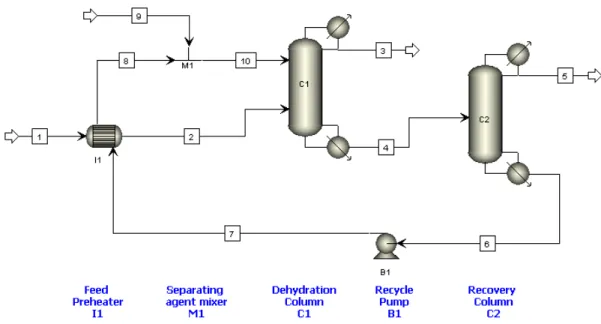
All the work was developed using Aspen Plus Simulator, version 11.1. Activity coefficient calculations for the mixture were made with the NRTL-E thermodynamic model for electrolytes systems, which was validated with experimental data reported in previous works (Zhigang et al. 2002) using Aspen Split Simulator. In Fig. 1 the flowsheet of the system on which the simulation was run is shown.
Figure 1: Flowsheet for the extractive distillation using salt and solvent.
Process Simulation
a) Thermodynamic Model
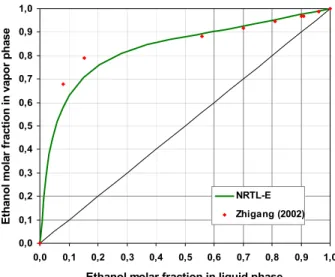
Initially, the thermodynamic model was validated calculating the vapor-liquid pseudo-binary equilibrium in the Aspen Split simulator by Aspen Tech. In Fig. 2 the curve for the vapor-liquid pseudo-binary equilibrium (101.3 kPa) for ethanol-water-ethylene glycol-calcium chloride system is shown, plotted by the simulator with the NRTL-E thermodynamic model, together with experimental data reported by Zhigang et al. (2002).
b) Configuration
In this work the reflux ratio, number of theoretical stages required for the separation, azeotropic mixture and separating agent feeding stages, feed temperature of separating agent, solvent to feed molar ratio and salt concentration in the solvent were evaluated. Operating pressure in extractive column was set at 1 atm. The thermal condition for the azeotropic feed (stream 2) was saturated liquid, as in other works (Meirelles et al., 1992; Ligero and Ravagnani, 2003; Chianese and Zinnamosca, 1990); in order to establish a comparative pattern of the process from the energy consumption viewpoint with respect to other technologies.
In Fig. 1 a flowsheet for the simulation of extractive distillation system is shown. The extractive distillation column (C1) and the solvent regeneration column (C2) are modeled. Besides this, a heat recovery scheme is proposed. This recovered heat is provided by the solvent recycle stream (7), which is used to preheat the azeotropic feed (1).
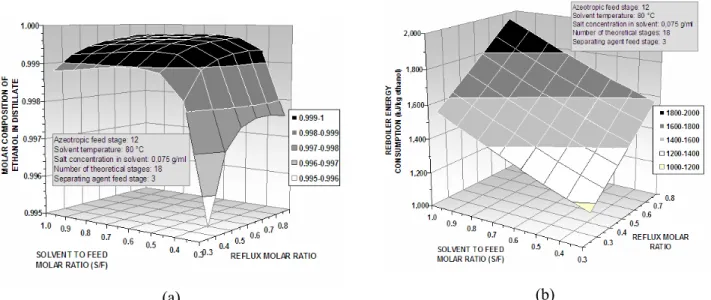
Sensitivity analyses were made and it was possible to visualize the effect of two variables on a specific design condition by observing the response surface plots. The efficient operating criteria considered were: energy consumption of the reboilers for each column and the distillate composition in the extractive column, which should be 99.5% molar of ethanol. The mole recovery of ethanol present in the azeotropic mixture was over 97.5%. In the recovery column the main restriction was the purity of the solvent obtained at the bottom, which was expected to be water free and to be then recycled to the extractive column without affecting the purity of the ethanol recovered. In addition, the bottom temperature should be lower than 150°C to avoid thermal degradation of the solvent (Meirelles et al., 1992; Stupiello, 2003). For this reason the column pressure was fixed to reach that condition.
The inlet streams for the process were: azeotropic ethanol and a mixture of ethylene glycol with purity higher than 99.8% molar and calcium chloride in a concentration near to 0.1 g/ml of ethylene glycol. The basis for the simulation was 100 kmol/h of azeotropic ethanol as saturated liquid, condition that was used as a starting point in previous works (Meirelles et al. 1992; Rongqi and Zhanting, 1999). The separating agent was the mixture ethylene glycol-calcium chloride with a flow rate of 30 kmol/h in solvent base at 80°C. Other initial input values were:
Theoretical stages number for extractive column: 22.
Top stage: 1
Feed stage: 12.
Solvent feed stage: 3.
Reflux Ratio: 0.6.
210 I. D. Gil, A. M. Uyazán, J. L. Aguilar, G. Rodríguez and L. A. Caicedo
0,0 0,1 0,2 0,3 0,4 0,5 0,6 0,7 0,8 0,9 1,0
0,0 0,1 0,2 0,3 0,4 0,5 0,6 0,7 0,8 0,9 1,0
Ethanol molar fraction in liquid phase
E
thano
l m
o
la
r f
rac
ti
on
i
n
v
a
po
r ph
a
s
e
NRTL-E
Zhigang (2002)
Figure 2: Pseudo-binary ethanol-water-ethylene-glycol-calcium chloride equilibrium,
Pseudo-binary ethanol-water-ethylene-glycol-calcium chloride equilibrium,
RESULTS AND DISCUSSION
Effect of Azeotropic Mixture Feed Stage and Number of Theoretical Stages
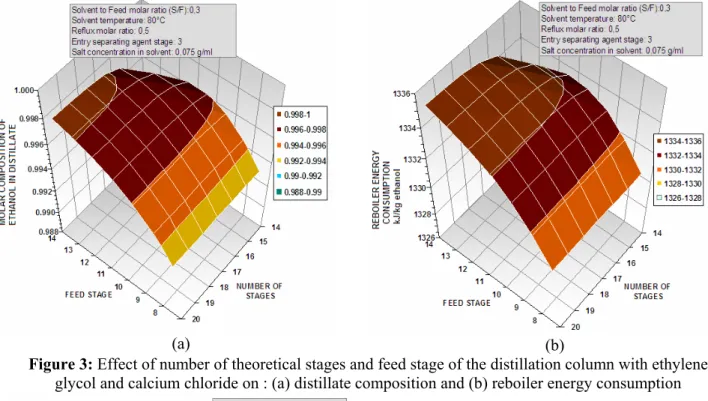
In Fig. 3 the effect of feed stage and number of theoretical stages on the molar composition of distillate in the extractive column is presented. It can be observed that for stage numbers above 16 the values for molar fraction of ethanol in distillate and energy consumption remain approximately constant for any azeotropic feed stage.
For values below 16 only some combinations of feed stage and number of theoretical stages allow to obtain 99.5% molar ethanol, therefore, in order to work in a safe region of the design and taking into account approximately constant behavior, 18 is the number of stages chosen for the column. In the same way, it is observed that, as the azeotropic feed stage is closer to the reboiler, the molar fraction of ethanol in distillate increases, and so does the energy consumption, this shows that the biggest separation takes place in the rectifying section and in higher ethanol content zones. This agrees with the vapor-liquid pseudo-binary equilibrium curve reported, which presents a closer approach to the 45° in the region of high ethanol content and a more ideal behavior in low ethanol concentration zone, in which the separation is easier and only few theoretical stages are required to make the separation. Stage 12,
then, was chosen in order to obtain the ethanol composition required in the distillate and decrease the reboiler energy consumption.
Effect of Separating Agent Feed Stage
The results shown in Fig. 4(a) allow establishing a maximum in the distillate molar fraction for all the tested conditions when the solvent is fed on the third stage. The two top bands define a favorable composition zone, which is not greatly affected by changes in the reflux ratio. However, the value of this ratio must be low to avoid energy wastes during operation. Reflux ratios in a range of 0.3-0.4 reach composition requirements with lower energy consumption in the reboiler.
(a) (b)
Figure 3: Effect of number of theoretical stages and feed stage of the distillation column with ethylene
glycol and calcium chloride on : (a) distillate composition and (b) reboiler energy consumption
(a) (b)
Figure 4: Effect of molar reflux ratio and solvent feed stage of the distillation column with ethylene
glycol and calcium chloride on : (a) distillate composition and (b) reboiler energy consumption
Effect of Salt Concentration in the Solvent
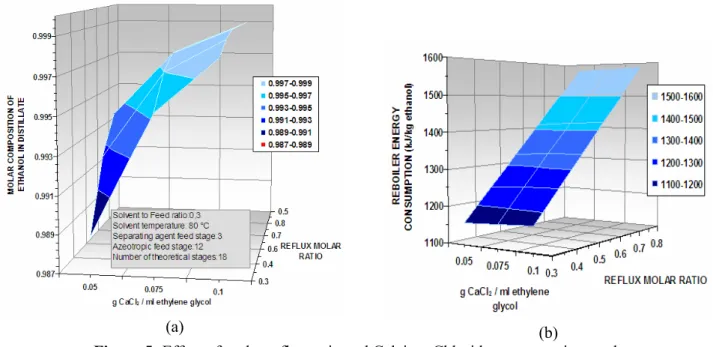
The experimental data of the vapor-liquid equilibrium mixture reported by Zhigang et al. (2002), used to fit the NRTL-E model, use a calcium chloride concentration of 0.1 g/ml of ethylene glycol. For this work this value has been chosen as a starting point, but two lower concentrations (0.05 and 0.075 g of CaCl2/ml of ethylene glycol) were used with the aim of establishing the minimal quantity of salt required for this separation.
The results show that when calcium chloride concentration increases, distillate composition and energy consumption also increases (Fig. 5). Moreover, comparing this operation with that in
212 I. D. Gil, A. M. Uyazán, J. L. Aguilar, G. Rodríguez and L. A. Caicedo
(a) (b)
Figure 5: Effect of molar reflux ratio and Calcium Chloride concentration on the
extractive distillation column with ethylene glycol and calcium chloride on: (a) distillate composition and (b) energy consumption in the boiler.
Addition of salt, together with the low reflux ratio, does not lead to higher energy consumption, and as it is observed, for fixed reflux ratios, the slope respect to the salt concentration axis is near to zero. Taking into account these criteria, the salt concentration was fixed at 0.075 g salt/ml of solvent, in order to obtain the lowest energy consumption.
Effect of Solvent to Feed Ratio (S/F)
Solvent to feed ratio (S/F) causes a direct effect on the distillate purity. Sensitivity analyses, plotted in Fig. 6, show that increasing S/F ratio it is possible to have an important improvement in the overhead product quality, without considerably affecting energy consumption. At a constant reflux ratio, for different values of S/F within the interval 0.3-0.4, the energy consumption increased in 3.8%. In the same way, maintaining the S/F ratio at 0.3, and increasing values of the reflux ratio until a distillate composition equivalent to the one obtained in the previous variation is reached; the increase in energy consumption was 26.6%. Consequently, the reflux ratio must be operated in the lowest possible value, so the ratio S/F can be manipulated to reach the distillate composition without high energy consumption, and reminding that high S/F ratios increase the energy consumption in reboiler of the regeneration column.
Explanation for the predominance of the S/F ratio effect over reflux ratio effect on the distillate composition is that a higher amount of solvent leads to a better separation compared to the one obtained
with a higher reflux ratio. Also, increasing the reflux ratio leads to the dilution of the solvent diminishing its effect. High S/F ratios are needed since a high quantity of solvent will make the dilution effect caused by high refluxes negligible. Rising S/F and reflux ratios increase the liquid flow in the column. Both situations imply an increase in energy consumption. However, the liquid brought by reflux must be vaporized, opposite to the solvent restriction of remaining in liquid phase on column. This offers an explanation for the bigger effect caused by reflux ratio.
Effect of Feed Solvent Temperature
(a) (b)
Figure 6: Effect of molar reflux ratio and of S/F molar ratio on the extractive distillation column with ethylene
glycol and calcium chloride on: (a) distillate composition and (b) reboiler energy consumption .
(a)
(b)
Figure 7: Effect of molar reflux ratio and entry separating agent temperature in the extractive distillation column
with ethylene glycol and calcium chloride on: (a) distillate composition and (b) reboiler energy consumption.
Effect of Reflux Ratio
The effect of the reflux ratio on the distillate composition is shown in all sensitivity analyses. For a wide range of reflux ratio, only small variations in ethanol purity were observed. The increase in the reflux ratio leads to high contents in the distillate up to a maximum, which decreases later for reflux ratios higher than 0.8, in all cases. This behavior is due to the solvent dilution into the column, condition that diminishes its effect on the relative volatility of the mixture ethanol-water. For this reason, it is necessary to compensate content diminishment by increasing the ratio S/F.
A summary of the operating conditions obtained for extractive and recovery distillation columns is shown in Table 1 and the corresponding material balance for the entire process is shown in Table 2 according to the
214 I. D. Gil, A. M. Uyazán, J. L. Aguilar, G. Rodríguez and L. A. Caicedo
Table 1: Operating conditions obtained for the two columns
Operating variable Extractive Column Recovery Column
Feed flow (kmol/h) 100 44
Solvent flow (kmol/h) 30 ---
Distillate flow (kmol/h) 86.864 13.70
Molar fraction of ethanol in distillate 0.9963 ---
Feed temperature (ºC) 78.18 120.98
Solvent temperature (ºC) 80 ---
Molar reflux ratio 0.35 0.25
Number of theoretical stages 18 11
Feed stage 12 6
Pressure (atm) 1 0.2
Solvent feed stage 3 ---
Solvent to Feed ratio (S/F) 0.3 ---
CaCl2 concentration (g/ml solvent) 0.075 ---
Energy consumption (kJ/kg ethanol) 1 204 221 Recovered energy in stream 7 (kJ/kg ethanol) 111
Net energy consumption (kJ/kg ethanol) 1 425
Table 2: Material balance for the extractive distillation process
Stream 1 2 3 4 5 6 7 8 9 10
Temperature (°C) 50,000 78,189 78,350 120,990 47,877 149,984 150,013 80,000 80,000 79,982 Pressure (bar) 1,013 1,013 1,013 1,013 0,202 0,202 1,013 1,013 1,013 1,013
Molar flow (kmol/h)
Water 11,000 11,000 0,283 10,723 10,717 0,005 0,005 0,005 - 0,005 Ethanol 89,000 89,000 86,546 2,454 2,454 0,000 0,000 0,000 - 0,000 Ethylene glycol - - 0,036 29,964 0,534 29,430 29,430 29,430 0,570 30,000 Calcium chloride - - 0,000 1,201 0,000 1,201 1,201 1,201 - 1,201 Total molar flow (kmol/h) 100,000 100,000 86,864 44,343 13,706 30,637 30,637 30,637 0,570 31,207 Total mass flow (kg/h) 4.298,3 4.298,3 3.994,4 2.299,4 339,3 1.960,1 1.960,1 1.960,1 35,4 1.995,5
Table 3: Energy consumption for ethanol dehydration technologies
CONCLUSIONS
The thermodynamic model chosen fits properly the experimental vapor-liquid equilibrium data for the mixture studied. Thereby, the simulation results were supported on a solid thermodynamic basis, which can describe the mixture behavior in a very accurate way.
This work made possible to establish operating conditions for an extractive distillation process using salt and solvent. Reflux ratio has the greatest effect on energy consumption, and it must be operated at low values, together with an entry solvent temperature between 70 and 90°C. In the same way, it is concluded that S/F ratio is a useful variable for
compensating changes in operating conditions of the column, and that can be used to obtain high ethanol concentrations in the overhead product, without implying in important energy consumption. To sum up, it was found that extractive distillation is a process energetically competitive with respect to other technologies, as it is shown in Table 3. Comparing energy consumption reports, it is found the lowest energy consumption values are for molecular sieves and extractive distillation with ethylene glycol technologies, what makes them competitive and an appealing subject of research and implementation. As it was previously mentioned, the technology using molecular sieves presents low energy consumption, but it spends additional energy
Process type Feed Molar
Composition
kJ/kg of ethanol
Process studied 88% ethanol 1 425
for redistill the alcohol recycle generated by the operation (Jacques et al. 1999). Additionally, ethanol obtained by extractive distillation with salt and solvent as entrainer is comparable with the former obtained by adsorption with molecular sieves in terms of quality, taking into account that the content of ethylene glycol in the final product is lower than the minimal required (0.1% w/w max) and the salt is not present. In this way, anhydrous ethanol produced by this method is suitable for several applications like chemical synthesis of esters, organic and cyclic compound chains, detergents, paints, cosmetics, aerosols, among others.
ACKNOWLEDGEMENTS
This work was supported financially by research grants from Research Division of the National University of Colombia (DIB) (project 1064 from August 2003) and Colciencias by financial support of research project code: 1101-06-14844.
REFERENCES
Barba, D., Brandani, V., & di Giacomo, G. Hyperazeotropic ethanol salted-out by extractive distillation. Theorical evaluation and experimental check. Chemical Engineering Science. 40 (1985) 2287-2292.
Black, C., & Distler, D. E. Dehydration of aqueous ethanol mixtures by extractive distillation. In: R.F. Gould, Extractive and azeotropic distillation, Advances in Chemistry Series 115 (1972) 1-15. Black, C. Distillation modeling of ethanol recovery
and dehydration processes for ethanol and gasohol. Chemical Engineering Progress 76 (1980) 78-85.
Chianese, A., & Zinnamosca, F. Ethanol dehydration by azeotropic distillation with mixed solvent entrainer. The Chemical Engineering Journal 43 (1990) 59-65.
Fu, J. Simulation of Salt-Containing Extractive Distillation for the System of Ethanol/Water/ Ethanediol/KAc. 1. Calculation of the Vapor-Liquid Equilibrium for the Salt-Containing System. Industrial and Engineering Chemical Research 43 (2004) 1274-1278.
Fu, J. Simulation of Salt-Containing Extractive Distillation for the System of Ethanol/Water/ Ethanediol/KAc. 2. Simulation of Salt Containing
Extractive Distillation. Industrial and Engineering Chemical Research 43 (2004) 1279-1283.
Furter, W. F. Extractive distillation by salt effect. Chemical Engineering Communications 116 (1992) 35-40.
Jacques, K., Lyons, T. P. & Kelsall, D. R. Alcohol Textbook. Nottingham University Press, 1999. Lee, F., & Pahl, R. H. (Solvent screening study and
conceptual extractive distillation process to produce anhydrous ethanol from fermentation broth. Industrial Engineering Chemical Process Des. Dev 24 (1985) 168-172.
Ligero, E.L., & Ravagnani, T.M.K. Dehydration of ethanol with salt extractive distillation – a comparative analysis between processes with salt recovery. Chemical Engineering and Processing 42 (2003) 543-552.
Llano, M., & Aguilar, J. Modeling and simulation of saline extractive distillation columns for the production of absolute ethanol. Computers and Chemical Engineering 27 (2003) 527-549.
Lynn, S., & Hanson, D.N. Multieffect extractive distillation for separating aqueous azeotropes. Industrial Engineering Chemical Process Des. Dev 25 (1988) 936-941.
Meirelles, A., Weiss, S., & Herfurth, H. Ethanol dehydration by extractive distillation. Journal of Chemical Technology & Biotechnology 53 (1992) 181-188.
Perry, R. Chemical Engineer’s Handbook, 7th ed., McGraw-Hill, New York, 1992.
Pinto, R. T. P., Wolf-Maciel, M. R., & Lintomen, L. Saline extractive distillation process for ethanol purification. Computers and Chemical Engineering 24 (2000) 1689-1694.
Rongqi, Z., & Zhanting, D. Extractive Distillation with Salt in Solvent. Science and Technology. (1999). Schmit, D., & Vogelpohl, A. Distillation of
ethanol-water solutions in the presence of potassium acetate. Separation science and technology 18 (1983) 547-554.
Stupiello, J. Aspectos técnicos para tener en cuenta en las etapas de fermentación y destilación en la producción de alcohol. In: Memorias Seminario de Alcohol Carburante. June Cali, Colombia, 2003. Ulrich, S., & Pavel, S. Design and operation of a
pervaporation plant for ethanol dehydration. Journal of membrane science 36 (1988) 463-475. Zhigang, L., Hongyou, W., Rongqi, Z., & Zhanting,