492/ Vol. XXXIII, No. 4, October-December 2011 ABCM
Elder M. Mendoza Orbegoso
[email protected] Pontifícia Universidade Católica do Rio de Janeiro Departamento de Engenharia Mecânica 22451-900 Rio de Janeiro, Brazil
Luís F. Figueira da Silva
[email protected] Pontifícia Universidade Católica do Rio de Janeiro Departamento de Engenharia Mecânica 22451-900 Rio de Janeiro, Brazil
André R. Novgorodcev Junior
[email protected] Petróleo Brasileiro S.A. Cenpes-Petrobras 21941-598 Rio de Janeiro, Brazil
On The Predictability of Chemical
Kinetics for the Description of the
Combustion of Simple Fuels
This work presents a systematic comparison between several detailed chemical kinetic models recently developed and available experimental data. The aim is to assess the predictive capabilities of the combustion with air of the following fuels: hydrogen, methane, ethanol and liquefied petroleum gas, in a large range of equivalence ratio. The prevailing thermodynamical conditions range from ambient to the more stringent ones, such as high pressure combustion. In order to assess the predictive performance of the twelve chosen chemical kinetics models, the results of numerical simulations are compared with existing experimental data of the combustion process in two simplified physical systems: the perfectly stirred reactor and the freely propagating premixed laminar flame. When ambient conditions are considered, the comparisons reveal a good agreement among most of detailed kinetic mechanisms, on the prediction of thermochemical properties of practical interest with respect to the corresponding experimental data only, as far as lighter fuels such as hydrogen, methane and ethanol are considered. The chosen mechanisms are shown to meet with difficulties when mixtures of liquefied petroleum gas and air are considered, even in ambient conditions. The obtained results highlight the necessity for (i) updating the existing mechanisms with the use of recent experimental results and (ii) the development of new comprehensive models.
Keywords: detailed kinetic mechanisms, hydrogen, natural gas, ethanol, liquefied petroleum gas
Introduction1
In the past few years, the detailed chemical kinetic modeling has become one of the most important tools used in the description of the combustion process. The continued development of detailed kinetic mechanisms for the combustion of several gaseous fuels was mainly advanced by the necessity to satisfy more stringent criteria involved in the development of more efficient combustion systems and in the reduction of the pollutant emissions, as a response to the expected depletion of the fossil fuels and the fulfillment of the environmental regulations. These energetic and environmental concerns convey the imperative need to understand the combustion process as a fundamental step in order to utilize it in an efficient and environmental friendly way.
Because of overriding national and international concerns, special attention is being paid to: the development of kinetic mechanisms for fossil fuels having rightly coupled the nitrogen kinetic scheme with the purpose of obtaining a complete understanding of the formation of NOx emissions, and the development of new mechanisms for the combustion description of alternative fuels. These developments would promote a comprehensive understanding of the combustion phenomena and the effects associated with the substitution of conventional hydrocarbons fuels by environmentally-friendlier alternative fuels. Therefore, the validation of a specific kinetic mechanism for several thermodynamic conditions must be performed through exhaustive comparisons of the simulation results obtained of simplified combustion systems against the corresponding experimental data.
Furthermore, turbulent combustion models used in computational fluid dynamics, which aims at describing finite Damkohler number situations, should incorporate either detailed information about combustion chemistry – which is the case of transported probability density function formulations (Pope, 1985; Haworth, 2010) – or global chemical timescale information, such as the turbulent flame closure model (Zimont, 2000), or the level set closure (Peters, 2000) respectively. Thus, the construction of such
Paper received 21 September 2010. Paper accepted 24 May 2011. Technical Editor: Demetrio Neto
detailed chemical mechanisms is crucial to the development of predictive tools related to the combustion process description in engineering applications.
Several detailed kinetic mechanisms for fuels of practical interest can be found in the literature (Pilling, 2009). However, even for the case of simpler species, such as hydrogen and methane, there is no complete neither unified kinetic scheme that can model the oxidation of these fuels in a broad range of thermodynamical conditions (pressure, temperature and equivalence ratio). When heavier hydrocarbons (i.e. butane, heptane, etc.) and/or mixtures of hydrocarbons (i.e. natural gas, liquefied petroleum gas, etc.) are considered, the validation range becomes smaller. This difficulty could be attributed to the large number of degrees of freedom and the multiple reaction pathways that a kinetic mechanism must undergo for a complete description in the combustion of a specific fuel, particularly at lower temperature and high pressure ranges. Currently, it is recognized that there is no kinetic mechanism sufficiently complete or “comprehensive” enough, even for simple fuels such as hydrogen and methane (Law et al., 2003). Thus, the use of existing combustion mechanisms requires, a priori, the knowledge of the corresponding predictive range.
Detailed Mechanism for Gaseous Fuels
In a combustion process, the oxidation of a fuel is achieved by means of a substantial number of elementary reactions that describe the collision process among molecules. This ensemble of elementary reactions with the corresponding kinetic parameters defines a combustion mechanism, also known as detailed kinetic mechanism. In this section several detailed kinetic mechanisms developed in the past decade by research groups worldwide are described, and the majority of which are currently available for their evaluation and/or simulation in combustion systems.
Hydrogen mechanism
The combustion of fossil fuels produces gases that are responsible for the greenhouse effect, and given the concern on the depletion of petroleum-based fuels resources worldwide, it is imperative to consider alternative fuels as energy source. Under this context, hydrogen is often the most attractive alternative fuel because the combustion products are free of carbon dioxide, the main culprit responsible for the greenhouse effect. Although the oxidation process of this clean fuel involves two chemical elements (H and O) only, the kinetic description is of relative difficulty, since it involves several reaction steps that describe the initialization, propagation, branching and termination processes.
The development of chemical kinetic mechanisms for the hydrogen oxidation began with the work of Westbrook and Dryer (1981), which reported a revision of the chemical kinetic of combustion process, indicating that the H2/O2 mechanism is well
characterized for a variety of numerical applications at atmospheric conditions. Yetter et al. (1991a) published a detailed kinetic mechanism which consisted of 19 elementary reactions involving 9 chemical species in the H2/CO oxidation. This mechanism was
validated by Yetter et al. (1991b) through Plug Flow Reactor (PFR) experiments at 852−1138 K and atmospheric pressure.
This mechanism also was validated through shock tube experiments at 823−2870 K, 0.3−2.2 atm and 0.00005−3 of equivalence ratio. Furthermore, Kim et al. (1994) updated and validated the Yetter et al. (1991a) mechanism in PFR experiments for 1−9.6 atm, 960−1200 K and 0.33−2.1 of equivalence ratio.
Mueller et al. (1999) updated the Kim et al. (1994) mechanism in which simulations of PFR at 0.3−15.7 atm and 850 −1040 K were conducted for the oxidation of 1% of hydrogen with 0.5% of oxygen in order to validate the proposed modifications. The experiments of Tse et al. (2000), corresponding to spherical heat bomb at higher pressures, demonstrated the insufficiency of the Mueller et al. (1999) mechanism for the hydrogen/air combustion in laminar flame predictions above 5 atm.
Afterwards, O’Conaire et al. (2004) updated the Mueller et al. (1999) mechanism and proposed a H2/O2 mechanism that consists of
21 chemical reactions and 9 elementary species. This mechanism has been validated against shock tubes experiments at 967−2700 K and 1−87 atm and laminar flame measurements of H2/O2/N2 and
H2/O2/He mixtures at 1−20 atm, 298 K and 0.5−5.5 of equivalence
ratio.
Li et al. (2004) proposed a comprehensive H2/O2 mechanism
which consists of 9 species and 19 chemical reactions and was built on the basis of the Mueller et al. (1999) mechanism. The validation of the Li et al. (2004) mechanism involves laminar flame experiments for H2/O2/N2, H2/O2/He and H2/O2/Ar mixtures at 1−20
atm, 298 K and within the flammability limits, and shock tubes experiments at 1−87 atm and 900−2700 K.
Konnov (2008) reported a recent modification of their previous mechanism (Konnov, 2004) for the description of the hydrogen oxidation by updating almost all of the 30 kinetic rates in
accordance to recent chemical data, particularly those reported by Baulch et al. (2005). The Konnov (2008) mechanism is capable of describing shock tube experiments at 900−2700 K and pressures that range from the atmospheric one to 87 atm. This mechanism was also validated through laminar flame experiments at 0.35−4 atm and at ambient temperature.
Natural gas mechanism
The validation work for each of the mechanisms considered here is of such an extent that fully describing the corresponding range of validity would require a specific dedicated paper. Therefore, the interested reader should refer to the original papers in order to gain an insight on such matter.
The development of the detailed chemical kinetic mechanism for the natural gas combustion began in the 70s, when several high-temperature kinetic models for the hydrogen, carbon monoxide and methane oxidation were constructed under the support of large quantity of experimental data (Seery and Bowman., 1970; Cooke and Williams, 1971). During the early 80s, Westbrook et al. (1982) proposed the first chemical mechanism for combustion of the C1 and C2 hydrocarbons, being composed of 93 reversible elementary reactions and 26 chemical species. This mechanism was subsequently revised by Westbrook and Dryer (1984) with the addition of elementary reactions for C1 and C2 sub-mechanisms. These authors also suggested the addition of C3 elementary reactions in order to obtain an accurate numerical description of the methane combustion.
The compilations of Glarborg et al. (1986) and Miller and Bowman (1989) were the starting point of the development of nitrogen oxidation mechanisms, whereas Baulch et al. (1994a) and Baulch et al. (1994b) published compilations of updated rate coefficients for many elementary reactions relevant to the oxidation of simple fuels. Those compilations were updated and expanded by Baulch et al. (2005) on the basis of recent theoretical and experimental studies of elementary reactions.
Frenklach et al. (1992) proposed that a set of systematic procedures for combustion researches should form the basis of developing a “comprehensive” chemical kinetic mechanism for any fuel. These recommendations were followed during the construction of some widely used kinetic models, such as the GRI-Mech (Smith et al., 1999) and Leeds (Hughes et al., 2002) mechanisms.
The GRI-Mech was developed in order to describe the methane oxidation. It is based on a set of elementary reactions, where the attributed values for the reaction rate parameters are provided by associating theoretical, experimental, and numerical data. The early versions of the GRI-Mech were the GRI-Mech 1.1 (Frenklach et al., 1995a) and the Mech 1.2 (Frenklach et al., 1995b). The GRI-Mech 3.0 (Smith et al., 1999) is the latest version available, which was built for the combustion of the natural gas and considers 53 chemical species and 325 reversible elementary reactions. The GRI-Mech 3.0 (Smith et al., 1999) presents many advantages and also some drawbacks; the most relevant advantage is the correct representation of the majority of experimental results available for the natural gas combustion, as well as the most relevant constituents hydrocarbons, methane and ethane. Nonetheless, this is only verified when the application conditions are close to laboratory conditions. However, the main drawback of the GRI-Mech version – as a building block – is the absence of “hierarchy”, and this created the difficulty of shifting new kinetic parameters without retuning when more accurate experimental data become available (Hughes et al., 2002), and the awkwardness in developing new mechanisms for other heavier hydrocarbons.
ethylene, acetylene, carbon monoxide and hydrogen, in a broad range of operational parameters. This mechanism was built in a same way as the GRI-Mech, namely, by means of the utilizing of gas kinetics measurements, although the former was developed in respect to the kinetic data published by Baulch et al. (1994a) and Baulch et al. (1994b). The available version consists of 351 irreversible reactions and 37 chemical species, when the NOx oxidation is not considered. The Leeds Methane, NOx and SOx mechanism accounts for the nitrogen and sulfur oxidation kinetics and includes 78 species and 892 irreversible (450 reversible) reactions and is of particularly relevance when ammonia, NH3, may be found in the reactive mixture.
The Konnov (2000) kinetic mechanism, which includes 127 chemical species and 1200 reversible elementary reactions, simulates the natural gas combustion, as well as the C2−C3 hydrocarbons combustion, the hydrogen oxidation and the NOx formation in flames. This mechanism was developed on the basis of the methane mechanism developed by Borisov et al. (1982), where important extensions were considered, such as the methanol and ethanol mechanisms (Borisov et al., 1992a,b), the NOx mechanism from Miller and Bowman (1989) and the CEC compilations kinetic data (Baulch et al., 1994a,b).
The San Diego (Williams, 2005) natural gas combustion mechanism is based on the principle that a kinetic mechanism must only include a moderate number of species and reactions that are representative of the description of several fuels as methane, methanol, ethane, ethylene, ethanol, propane and propyne. This mechanism considers 180 reversible reactions among 40 chemical species.
Tan et al. (1992) developed a chemical kinetic mechanism for the combustion C1−C3 hydrocarbons, GDF-Kin. This mechanism has a hierarchical structure, i.e., it was sequentially developed starting from the hydrogen oxidation mechanism up to the heaviest hydrocarbons sub-mechanism available. The first version of the GDF-Kin mechanism consists of 508 reversible elementary reactions involving 82 chemical species. El-Bakali et al. (2006) proposed an upgrade of this mechanism, GDF-Kin 3.0, which consists of the revision of the GDF-Kin 2.0 (El-Bakali et al., 2004) with the addition of the kinetics of nitrogen oxidation from Dagaut et al. (1998) NOx sub-mechanism. The number of elementary reactions and chemical species of GDF-Kin 3.0 (El-Bakali et al., 2006) are 883 and 121, respectively.
Le Cong and Dagaut (2007) developed a kinetic mechanism initially consisting of 737 reversible reactions and 98 chemical species, which allows simulating the natural gas and syngas combustion over an extensive range of operation conditions. This mechanism was built upon the mechanism developed by Dagaut (2002) for the combustion of the natural gas, and the systems used in the validation of this mechanism include shock tubes, premixed laminar flames, PSRs and PFRs. Recently, Le Cong and Dagaut (2008) extended their previous mechanism (Le Cong and Dagaut (2007)) in order to describe the combustion of mixtures of hydrogen and natural gas diluted on water vapor. This last version contains 128 chemical species involving 924 elementary reversible reactions. Excellent agreements were reached between this mechanism and existing experimental data (Le Cong, 2007).
Ethanol mechanism
The kinetics of gas phase ethanol oxidation has been extensively investigated during the past five decades. Mullins (1953) determined, through PFR experiments for autoignition delay time of the ethanol and air at atmospheric pressure and for temperatures ranging between 1050 and 1300 K. Natarajan and Bhaskaran (1981) performed an experimental and analytical study related to the
determination of the delay ignition time for 90% diluted in argon of oxygen and ethanol mixtures. The ignition was obtained downstream reflected shock waves for 1−2 atm, for temperature and equivalence ratios that cover the range of 1300−1700 K and 0.5−2, respectively. The authors also developed the first known kinetic mechanism for the ethanol oxidation, formed by 57 reactions and 27 species. Gulder (1982) obtained, through constant volume spherical bomb experiments, the premixed laminar burning velocity for ethanol/air mixtures at 1−8 atm, 300−500 K and for equivalence ratio in the range of 0.7−1.4.
Experimental and numerical simulation studies related to the ethanol kinetics were developed by Egolfopoulos et al. (1992). In the experiments, the authors used the counterflow twin-flame method in order to determine the premixed laminar burning velocity in the combustion of ethanol with air at ambient pressure and for temperature lying within 363 and 453 K. In addition, studies conducted by Egolfopoulos et al. (1992) showed a detailed chemical kinetic that describes the ethanol oxidation by means of 195 reactions involving 35 chemical species. This mechanism was adjusted and validated through comparisons with the corresponding experiments. This mechanism was also validated by the experimental results of Natarajan and Bhaskaran (1981). Hence, the experiment of reflected shock wave provided evidence that is in agreement with the autoignition delay time, when 2.5% of ethanol with 7.5% of oxygen and 90% of argon were burnt at atmospheric pressure and temperatures in the range 1300−2500 K.
In a related study, a detailed kinetic mechanism describing the ethanol oxidation at temperatures above 1000 K was also developed by Marinov (1997, 1999), either by the use of sub-mechanisms to describe the hydrogen oxidation (Marinov et al., 1996), propane (Marinov et al., 1997a), ethylene (Marinov and Malte, 1995) or methane and ethane (Marinov et al., 1997b), and arranged in a hierarchical manner. The mechanism (Marinov, 1997, 1999), which consists of 57 chemical species and 393 elementary reactions, was widely validated through simulations related to ethanol combustion in reflected shock tube (Natarajan and Bhaskaran, 1981; Dunphy and Simmie, 1991), premixed laminar flame (Gulder, 1982; Egolfopoulos et al., 1992), Turbulent Flow Reactor (Norton and Dryer, 1991), and Jet Stirred Reactor (Aboussi, 1991) experiments.
Another detailed mechanism that describes the pyrolysis and oxidation of ethanol and methanol was developed by Li (2004) and Li et al. (2005, 2007), from experimental results of ethanol combustion in Variable Pressure Flow Reactor, VFR, at elevated pressures. This mechanism is composed by 228 reactions and 39 reversible species built in a hierarchical structure, i.e., the oxidation of ethanol follows a sequence of events, beginning from the decomposition reactions followed by the attack of radical to ethanol, the intermediate species production, and finally, the conversion of aldehyde’s in carbon monoxide and their subsequent oxidation in carbon dioxide (Li, 2004). Li (2004) and Li et al. (2005, 2007) mechanism shows a better agreement than the Marinov (1997, 1999) mechanism when experimental data in VFR is considered, Li et al. (2005). The Li (2004) and Li et al. (2005, 2007) mechanism was also validated through experiments related to the ethanol combustion in a reflected shock tube. In this particular case, an improved estimate is obtained, when compared the Marinov (1997, 1999) mechanism, of the autoignition delay time in the oxidation of 1.43% of ethanol (φ = 0.5) diluted by argon at 1 and 2 atm, and within the temperature range of 1250 to 1667 K. Laminar burning velocity, sL, comparisons were considered in the validation of the Li
(2004) and Li et al. (2005, 2007) mechanism, where an enhanced estimate of sL is demonstrated, when Egolfopoulos et al. (1992)
experimental data is considered.
reactions by the addition of the ethanol sub-mechanism, leading to a mechanism that consists of 235 reversible reactions involving 46 chemical species. This mechanism aims at describing the oxidation of ethanol in diversified combustion situations, particularly at reflected shock tubes (Natarajan and Bhaskaran, 1981; Dunphy and Simmie, 1991) and premixed (Egolfopoulos et al., 1992) and non-premixed (Saxena and Williams, 2007; Li et al., 2007) laminar flames.
Dagaut and Togbé (2008) conducted experiments and numerical simulation in a Jet Stirred Reactor, with the aim of determining the oxidation kinetics of E85, an 85/15% mixture of ethanol and gasoline. The obtained experimental results allowed to develop a combustion mechanism composed of 1866 reactions and 235 species. This mechanism, built hierarchically, is based on the Dagaut (2002) natural gas mechanism, followed by the addition of sub-mechanisms that describe the oxidation of a gasoline surrogate composed of iso-octane, toluene, 1-hexene and ethanol. The ethanol sub-mechanism was extracted from Marinov (1997, 1999) mechanism with updated kinetic data obtained through experiments. The Dagaut and Togbé (2008) mechanism was validated in the case of 0.2% of ethanol diluted by nitrogen combustion, yielding a good agreement against experiments of Jet Stirred Reactor at 10 atm, and for equivalence ratios of φ = 0.6, 1 and 2.
Experiments in a spherical bomb were performed by Bradley et al. (2009) allowing for the determination of the premixed laminar burning velocity, sL, of ethanol and air mixtures for pressures and
temperatures that reach 14 atm and 393 K, respectively. Experiments at ambient pressure and 358 K were compared to those reported by Gulder (1982) at 350 K, Egolfopoulos et al. (1992) at 363 K, and Liao et al. (2007) at 358 K. The former shows values of sL that are smaller than those compared by the latter, particularly at
the fuel rich zone. This behavior is also exhibited for pressures and temperatures that are above atmospheric conditions.
Rohl and Peters (2007) reduced the Marinov (1997, 1999) mechanism – composed of 57 species and 383 reactions – to 38 species and 228 reactions, with the purpose of decreasing the computational cost of CFD simulation. This skeletal mechanism was validated by comparisons with the original one and with kinetic obtained in a shock tube (Natarajan and Bhaskaran, 1981; Dunphy and Simmie, 1991), and to premixed laminar flame velocities.
Recently, Cancino et al. (2009) proposed a chemical kinetic mechanism for the description of the combustion and pyrolysis of ethanol, which includes the set of 1136 reactions and 136 chemical species. This mechanism is based on the Marinov (1997, 1999) mechanism and the C3 Konnov (2000) sub-mechanism. The kinetic data of Li (2004), Park et al. (2002), Park et al. (2003), and Xu et al. (2004) were also accounted for, in order to describe the ethanol decomposition. Unlike the Marinov (1997, 1999) and San Diego 20051201 (Williams, 2005) mechanisms, the mechanism of Cancino et al. (2009) is able to accurately describe the ethanol combustion in reflected shock tube at intermediate temperatures and high pressures. In particular, this mechanism properly reproduces the experiments of Cancino et al. (2007), corresponding to the autoignition delay time in the oxidation of ethanol with air at temperatures within the range of 750−1200 K, and for pressures up to 50 atm.
Liquefied Petroleum Gas mechanism
The Liquefied Petroleum Gas (LPG) is extensively utilized as an alternative fuel in internal combustion engines and as a domestic fuel. It is mainly composed of propane and butane; however, other heavier hydrocarbons, such as pentane and hexane, may be present in a variety of proportions. This fuel is produced commercially in crude oil refineries and is stored at elevated pressures and
temperatures that are below the critical temperature, in order to maintain it at liquid phase.
The main advantage of LPG over the natural gas is considered by its ease of storage in low pressure vessels which makes it transportable in tanks and cylinders. Furthermore, the LPG has a good “interchangeability” property; this in other words implies its ability to be substituted with another fuel in a combustion process without significantly altering the performance, in terms of efficiency and pollutant emissions.
The development of detailed chemical mechanism for the LPG oxidation began with the work of Warth et al. (1998) and Sung et al. (1998), who reported the construction of detailed kinetic mechanism for the n-butane oxidation. The kinetic scheme of Warth et al. (1998) involves 778 reactions and 168 chemical species, whereas the Sung et al. (1998) mechanism comprehends a set of 92 species involved in 621 elementary reactions. This last mechanism was validated by Sung et al. (2001), via comparisons to Davis and Law (1998) experiments. The accuracy of this mechanism on the prediction of laminar burning velocity of iso-butane and n-butane combustion with air at standard conditions of pressure and temperature was demonstrated. Mishra and Rahman (2003) determined the flammability limits of air and LPG (30% of butane and 70% of propane) at ambient conditions and within 0.53−2.48 of equivalence ratio, by the use of a constant volume combustion chamber.
Dagaut and Hadj Ali (2003) built a detailed mechanism that consists of 827 reactions involving the kinetic of 112 chemical species. This mechanism was developed having as a basis the natural gas mechanisms of Dagaut (2002) and Dagaut et al. (2000), and the iso-butane mechanism of Dagaut et al. (1994). The validation of the Dagaut and Hadj Ali (2003) kinetics was performed using Jet Stirred Reactor (JSR) experiments at atmospheric pressure and for temperatures within the 950−1450 K range of the combustion of a mixture of 24.8% of iso-butane, 39% of n-butane and 36.2% of propane as being representative of a LPG. This mechanism was also validated through experiments of laminar flames by Liao et al. (2004), which was determined by experiment and simulation, the laminar burning velocity of a LPG mixture composed of 0.02% of ethane, 0.92% of propylene, 27.65% of propane, 1.72% of butilene, 25.68% of iso-butane and 42.6% of n-butane at ambient conditions and 0.7−1.4 of equivalence ratio.
A detailed kinetic mechanism was developed in the University of Southern California, USC, by Wang et al. (2007) in order to describe the C1−C4 combustion. This mechanism was built over the Davis et al. (2005) mechanism for the H2/CO oxidation, with the
addition of the Mech 1.2 (Frenklach et al., 1995b) and GRI-Mech 3.0 (Smith et al., 1999) mechanisms for the description fo C1−C2 hydrocarbons, and by the inclusion of the sub-mechanism C3 of Davis et al. (1999) for the propene combustion. The USC 2.0 (Wang et al., 2007) mechanism is the last version available, which consists of 111 species involving 784 reversible reactions. With the exception of the premixed laminar flame simulation of pure hydrocarbons including the propane and n-butane at ambient conditions, there is none work to the best of the authors’ knowledge that validates the last version of this mechanism for the combustion of LPG.
Methodology
more stringent ones, i.e. pressures and temperatures up to 20 atm and 1400 K.
In order to analyze the performance of several kinetic mechanisms for the aforementioned gaseous fuels, recent experimental data corresponding to the determination of the laminar burning velocity and the prediction of major and minor species evolution in a Jet Stirred Reactor (JSR) are considered. Although it is also possible to compare mechanism predictions against other experimental data, such as counter flow diffusion flames and shock tubes, these simulations are not considered for sake of brevity.
Unstrained one-dimensional laminar burning velocity calculations are performed using the PREMIX (Kee et al., 1985) computer code within the CHEMKIN package (Kee et al., 1989) in order to assess the performance of the different kinetic mechanisms in premixed laminar flames situations. The converged solution is obtained considering a distribution of adapted grid points and accounting for the gradient and curvature criteria of 0.1. The PSR code (Glarborg et al., 1991) is used to determine the thermochemical properties representing a Jet Stirred Reactor (JSR).
In the case of hydrogen oxidation, the Li et al. (2004), the O’Conaire et al. (2004), the Konnov (2008) and the GRI-Mech 3.0 (Smith et al., 1999) mechanisms were considered, whereas San Diego 20051201 (Williams, 2005), the GRI-Mech 3.0 (Smith et al., 1999) and the Le Cong and Dagaut (2008) mechanisms were used for the comparisons concerning the methane combustion. The San Diego 20051201 (Williams, 2005), Rohl and Peters (2007), Marinov (1997, 1999), Dagaut and Togbé (2008) and Cancino et al. (2009) were employed in the modeling of the ethanol oxidation. Finally, the Sung et al. (1998) and the USC 2.0 (Wang et al., 2007) mechanisms were considered, for the LPG combustion.
Results and Discussions
In this section, the comparisons of the obtained results with the eight aforementioned detailed kinetic mechanism are presented against recent experimental data available at the literature for the combustion of the hydrogen, natural gas (methane), ethanol and liquefied petroleum gas, respectively.
Hydrogen oxidation
The laminar burning velocity of hydrogen and air has been experimentally measured at different values of pressure and equivalence ratio (Dowdy et al., 1991; Aung et al., 1998; Tse et al., 2000). Measurements of a hydrogen/air premixed laminar burning velocity at moderate pressures (over 10 atm) are rare to find due to the limitations imposed by thermo-diffusive instabilities (Tse et al., 2000) arising as a consequence of the high Reynolds number at such pressures.
Figure 1(a) depicts a comparison at ambient conditions (1 atm and 280 K) of the laminar burning velocity, sL, calculated by the use
of the Li et al. (2004), O’Conaire et al. (2004), Konnov (2008) and GRI-Mech 3.0 (Smith et al., 1999) mechanisms, against the freely outwardly propagating spherical laminar premixed flames data taken from Dowdy et al. (1991), Aung et al. (1998) and Tse et al. (2000). An important dispersion is observed by the most recent experiments of laminar burning velocity, even at atmospheric conditions, which maximum values range from 260 to 310 cm/s. Moreover, an excellent agreement is obtained from the Li et al. (2004) and O’Conaire et al. (2004) mechanisms against the experimental data reported by Tse et al. (2000) in all equivalence ratio range. The Konnov (2008) mechanism reproduces accurately the Tse et al. (2000) experiments only at lean mixtures, but it yields a good representation of the Dowdy et al. (1991) data in the rich equivalence ratio region.
Figure 1. Comparisons among the simulated (lines) and calculated (dots) of the premixed laminar burning velocity, in the oxidation of the hydrogen with air for (a) 1 atm and (b) 4 atm. — Li et al. (2004); − − O’Conaire et al. (2004); – · – Konnov (2008); ··· GRI-Mech 3.0 (Smith et al., 1999); □ Aung et al. (1998); ○ Tse et al. (2000); and ∇ Dowdy et al. (1991).
The GRI-Mech 3.0 (Smith et al., 1999) mechanism predicts a maximum laminar burning velocity of 320 cm/s at φ = 1.7, slightly superior than that obtained by the experimental results. When the equivalence ratio is increased, the GRI-Mech 3.0 (Smith et al., 1999) predictions underestimate the Tse et al. (2000) and Dowdy et al. (1991) data. None of the mechanisms analyzed in this work reproduces the Aung et al. (1998) experiments in all the rich region of equivalence ratio.
Figure 1(b) shows the laminar burning velocity comparisons of the hydrogen/air combustion at ambient temperature and 4 atm. This figure allows to verify that the Konnov (2008) mechanism offers a good representation of most of the measurements performed by the Aung et al. (1998) data, whereas the Li et al. (2004) and O’Conaire et al. (2004) mechanisms predict values that are slightly lower and higher in the lean and rich regions, respectively.
Li et al. (2004) and O’Conaire et al. (2004) mechanisms, which estimate a combustion extinction (at about 890 K), similar to the experimental results from Le Cong and Dagaut (2009).
Figure 2. Comparisons among the simulated data (lines) using several mechanisms with respect to experimental data of Le Cong and Dagaut (2009) of the combustion of 1% of H2 with O2 diluted on N2, in a JSR for 1
atm of pressure, 0.5 of equivalence ratio andττττr= 120 ms. — Li et al. (2004); − − O’Conaire et al. (2004); – · – GRI-Mech 3.0 (Smith et al., 1999); and □ Le Cong and Dagaut (2009).
Natural gas oxidation
The analysis of the detailed chemical mechanisms for the natural gas combustion is performed using experimental data related to methane combustion. This usual procedure is justified by the large representativity of this alkane of the chemical kinetics description of the natural gas, and by the availability of a vast amount of experimental information related to the combustion kinetic of this hydrocarbon.
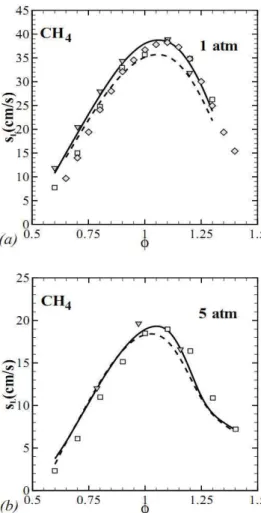
Figure 3. Comparisons among the simulated (lines) and calculated (dots) of the premixed laminar burning velocity in the oxidation of the methane with air for (a) 1 atm and (b) 5 atm. — GRI-Mech 3.0 (Smith et al., 1999); − − San Diego 20051201, (Williams, 2005); □ Rozenchan et al. (2002); ∇ Gu et al. (2000); and ◊ van Maaren and de Goey (1994).
results of the Rozenchan et al. (2002) and van Maaren and de Goey (1994) only in the 0.8 and 1 region of equivalence ratio, underestimating the experiments at the rich mixture region. A comparison between the GRI-Mech 3.0 (Smith et al., 1999) and the San Diego 20051201 (Williams, 2005) mechanisms reveal a discrepancy in the laminar burning velocity that does not overcome the 15% for equivalence ratios spanning from 0.95 to 1.15. However, this disagreement is reduced as the mixture moves to either the lean or to the rich regions.
For the purpose of extending these comparisons, Figure 3(b) shows the laminar burning velocity calculated by the GRI-Mech 3.0 (Smith et al., 1999) and San Diego 20051201 (Williams, 2005) mechanisms and compared to the experimental results of Rozenchan et al. (2002) and Gu et al. (2000) in the combustion of a premixed methane/air at 5 atm and ambient temperature. In this specific case, the GRI-Mech 3.0 (Smith et al., 1999) and San Diego 20051201 (Williams, 2005) mechanisms predict, with relative accuracy, the measurements of Rozenchan et al. (2002) and Gu et al. (2000) in all the equivalence ratio range (0.7−1.4), showing deviations that reach 10%. A comparison between the GRI-Mech and the San Diego mechanisms reveals similar disagreements of the laminar burning velocity at the vicinity of the stoichiometric region. However, the discrepancy does not overcome 7%, proving a good estimate in the prediction of sL for both mechanisms when the pressure is moderate.
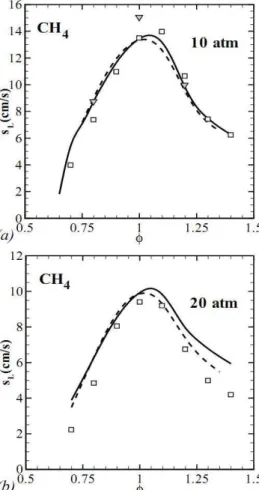
Figure 4. Comparisons among the simulated (lines) and calculated (dots) of the premixed laminar burning velocity in the oxidation of the methane with air for (a) 10 atm and (b) 20 atm. — GRI-Mech 3.0 (Smith et al., 1999); − − San Diego 20051201 (Williams, 2005); □ Rozenchan et al. (2002); and ∇
Gu et al. (2000).
Figure 5. Comparisons at the simulated data (lines) using several mechanisms with respect to experimental data of Le Cong and Dagaut (2009) about the combustion of 1% of CH4 with O2 diluted on N2, in the
operation of a JSR for 1 atm of pressure, 0.5 of equivalence ratio and ττττr =
120 ms. — Le Cong and Dagaut (2008); − − GRI-Mech 3.0 (Smith et al., 1999); – · – San Diego 20051201 (Williams, 2005); and □ Le Cong and Dagaut (2007).
The GRI-Mech 3.0 (Smith et al., 1999) and San Diego 20051201 (Williams, 2005) mechanisms have also been used to determine sL at high pressures, and the corresponding results are
use of the GRI-Mech (Smith et al., 1999) mechanism with respect to San Diego 20051201 (Williams, 2005) mechanism. This latter mechanism is the one which better predicts the Rozenchan et al. (2002) experiments, as illustrated in Fig. 4(b).
The experimental data from Le Cong and Dagaut (2007), corresponding to the Jet Stirred Reactor (JSR) at high pressure has been modeled as a means of comparing the GRI-Mech 3.0 (Smith et al., 1999), San Diego 20051201 (Williams, 2005) and the Le Cong and Dagaut (2008) mechanisms. Figure 5 shows the evolution ofve the major species as a result of the combustion of 1% of methane with oxygen diluted in nitrogen, in a Jet Stirred Reactor at 10 atm and 120 ms of residence time, τr. In Fig. 5 it can
be noted with good estimate that the Le Cong and Dagaut (2008) mechanism provides, when compared to the experimental measurements. However, the GRI-Mech 3.0 (Smith et al., 1999) and San Diego 20051201 (Williams, 2005) mechanisms diverge considerably from the Le Cong and Dagaut (2007) experiments, underpredicting the reactants concentrations and overestimating from the combustion products formation.
The results underscore the inadequacy of GRI-Mech 3.0 (Smith et al., 1999) and San Diego 20051201 (Williams, 2005) mechanisms to the prediction of the thermochemical parameters of the methane combustion in a PSR operating at higher pressures, in contrast to the Le Cong and Dagaut (2008) mechanism, that is well suited for this kind of simulation.
Ethanol oxidation
The first comparison presented of available kinetic mechanisms in the description of the ethanol combustion corresponds to laminar flame simulations. Figure 6 shows the results of those calculations using three kinetic mechanisms, the Marinov (1997, 1999), San Diego 20051201 (Williams, 2005) and Rohl and Peters (2007), and their comparisons against experimental data of Gulder (1982), Egolfopoulos et al. (1992), Bradley et al. (2009) and Meuwissen (2009) corresponding to the premixed laminar velocity burning of ethanol and air combustion at ambient conditions (1 atm and 300 K). An appreciable scatter pertaining to the experimental measures of sL is
observed. Note that this dispersion is more pronounced in the equivalence ratio within the range of 0.8 to 1.2.
Figure 6. Comparisons among the simulated (lines) and calculated (dots) of the premixed laminar burning velocity in the oxidation of ethanol with air at 1 atm and 300 K. — San Diego 20051201 (Williams, 2005); − − Rohl and Peters (2007); – · – Marinov (1997, 1999); □ Gulder (1982); ○
Egolfopoulos et al. (1992); ∇ Bradley et al. (2009); and ◊ Meuwissen (2009).
This kind of discrepancy may be a consequence of the use of different setups, such as constant volume combustion bomb,
counter-flow premixed laminar flame, etc., that led to the determination of sL. It is worth to emphasize that, with the exception
of the Bradley et al. (2009) and Meuwissen (2009) measures, the premixed laminar burning velocity for the ethanol combustion at ambient conditions was estimated through extrapolation, frequently by the use of power-law equations (Gulder, 1982; Liao et al., 2007).
Regarding the comparisons depicted in Fig. 6, the combustion mechanisms lead to an overestimation of sL at fuel-lean region that
can reach 25%, when the simulation results are compared to experimental data. Nevertheless, the three mechanisms are able to predict the laminar burning velocity for equivalence ratios greater than 1.2.
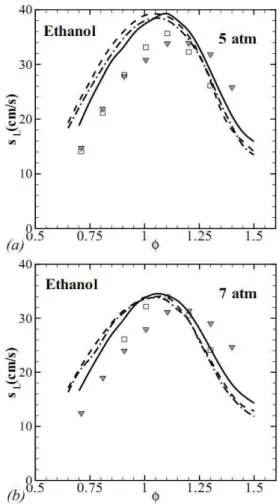
Figure 7. Comparisons among the simulated (lines) and calculated (dots) of the premixed laminar burning velocity in the oxidation of ethanol with air at 358 K and for (a) 5 atm and (b) 7 atm. — San Diego 20051201 (Williams, 2005); − − Rohl and Peters (2007); – · – Marinov (1997, 1999); □ Gulder (1982); and ∇ Bradley et al. (2009).
Figure 7 shows the results obtained with Marinov (1997, 1999), San Diego 20051201 (Williams, 2005) and Rohl and Peters (2007) simulations, and their comparisons with the Gulder (1982) and Bradley et al. (2009) experimental data, referring to the laminar burning velocity of ethanol and air at pressures of 5 and 7 atm, and 358 K of temperature. Furthermore, a behavior similar to that seen in Fig. 6 is found. This is due to the overestimation of the results of sL given by the kinetic mechanisms, for lean equivalence ratios, that
2005) mechanism and Gulder (1982) experiments is contrary to the experimental data of Bradley et al. (2009), and could be attributed to the neglected thermo-diffusive effects in both the simulations carried out in this work and the experiments of Gulder (1982).
Figure 8. Comparisons of species evolution as function of residence time, given by: — Dagaut and Togbé (2008); − − Marinov (1997, 1999); – · – San Diego 20051201 (Williams, 2005); and – ·· – Cancino et al. (2009) mechanisms, with respect to experimental data of Aboussi (1991), corresponding to the combustion of 0.2% of C2H5OH with 0.6% of O2 and
99.2% of N2, in a JSR operation at 1 atm of pressure and 1056 K.
The mechanisms of Marinov (1997, 1999), Dagaut and Togbé (2008), San Diego 20051201 (Williams, 2005) and Cancino et al. (2009) were used in computations of the ethanol oxidation in a Jet Stirred Reactor (JSR). Figure 8 presents the residence time evolution of ethanol, carbon monoxide, carbon dioxide and methane, obtained by the use of these mechanisms, and the experimental data of Aboussi (1991) concerning to the combustion of premixed ethanol and oxygen diluted with nitrogen, in a Jet
Stirred Reactor at ambient pressure and 1056 K. This figure agrees with the experiments on Aboussi (1991), of the prediction of the C2H5OH, CO and CO2 species given by the Marinov (1997, 1999)
and Dagaut and Togbé (2008) mechanisms, whereas only the San Diego 20051201 (Williams, 2005) mechanism correctly estimates the CO and CO2 concentrations. However, the results of Cancino et
al. (2009) mechanism present a contrary trend when compared to the results of Aboussi (1991). These discrepancies increase as the residence time decreases, reaching up to two orders of magnitude. This is rather surprising, since this mechanism is based on the Marinov (1997, 1999) mechanism.
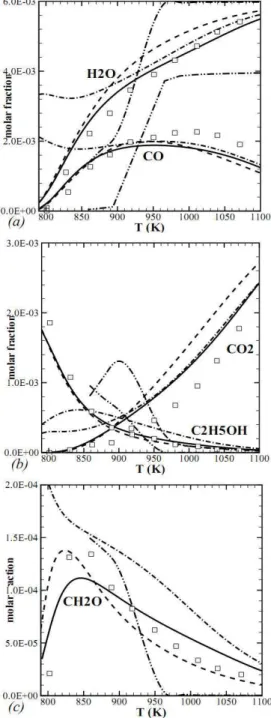
Figure 9. Comparisons of species profiles as function of temperature, given by: — Dagaut and Togbé (2008); − − San Diego 20051201 (Williams, 2005); – · – Cancino et al. (2009); and – ·· – Marinov (1997, 1999) mechanisms, referring to experimental data of Dagaut and Togbé (2008), corresponding to the combustion of 0.2% of C2H5OH with 1.0% of O2 and
98.8% of N2, in a JSR operation at 10 atm of pressure and 0.7 s of
Figure 9 shows the experimental results from Dagaut and Togbé (2008) and the numerical simulations using the Marinov (1997, 1999), Dagaut and Togbé (2008), San Diego 20051201 (Williams, 2005) and Cancino et al. (2009) mechanisms, corresponding to temperature evolution of the molar fractions of ethanol, water vapor, carbon monoxide, carbon dioxide, formaldehyde and methane, of the ethanol oxidation process at 10 atm in a Jet Stirred Reactor. An excellent agreement among the simulation using the Dagaut and Togbé (2008) mechanisms and the experiments developed by these authors is observed, whereas the San Diego 20051201 (Williams, 2005) mechanism gives good predictions of the evolution of almost all species. The Cancino et al. (2009) mechanism estimates quite rightly the variation of the majority of the species concentrations at temperatures about 950 K. However, the molar concentrations of all chemical species predicted by this mechanism show an inflection point at the proximity of PSR operation temperature of 900 K, reversing the trends of the chemical species evolution exhibited by the experimental data. Finally, the Marinov (1997, 1999) scheme is unable to predict the evolution with temperature of all chemical species determined experimentally by Dagaut and Togbé (2008).
Liquefied Petroleum Gas oxidation
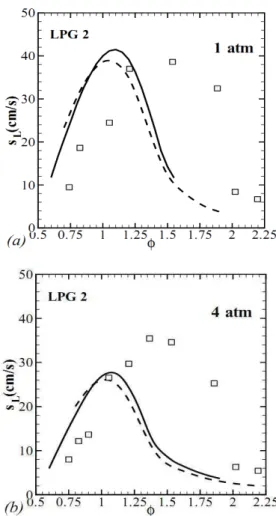
The comparisons of spherical bomb experiments by Liao et al. (2004) and numeric simulations using the USC 2.0 (Wang et al., 2007) and Sung et al. (1998) mechanisms of the laminar burning velocity of a characteristic LPG (0.02% of C2H6, 0.92% of C3H6,
27.65% of C3H8, 1.72% of C4H8, 25.68% of i-C4H10 and 42.6% of
n-C4H10) with air at ambient conditions are shown in Fig. 10. In this
case, an excellent agreement in sL is found by both kinetic schemes
when compared with the experimental data of Liao et al. (2004). This excellent agreement is guaranteed by the Sung et al. (1998) mechanism in almost the whole equivalence ratio range, whose discrepancies with respect to the measured data are smaller than 10%. The USC 2.0 (Wang et al., 2007) mechanism underpredicts, (i.e., up to 25%), the Liao et al. (2004) experiments as the mixing composition moves away from the stoichiometry and becomes richer in fuel.
Figure 10. Comparisons of the results obtained with the USC 2.0 (Wang et al., 2007) and Sung et al. (1998) mechanisms against the Liao et al. (2004) experiments, in the determination of laminar burning velocity for the LPG combustion (0.02% of C2H6, 0.92% of C3H6, 27.65% of C3H8, 1.72% of C4H8,
25.68% of i-C4H10and 42.6% of n-C4H10) with air at ambient conditions. —
Sung et al. (1998); − − USC 2.0 (Wang et al., 2007); and □ Liao et al. (2004).
From Fig. 10, a difference related to the estimate of the maximum value of the laminar burning velocity for aforementioned mechanisms could be noticed. The USC 2.0 mechanism (Wang et
al., 2007) predicts a maximum value of sL to be equal to 39 cm/s at
1.05 of equivalence ratio, whereas the results obtained by the Sung et al. (1998) mechanism estimates a value of 42 cm/s for the maximum laminar burning velocity at 1.1 of equivalence ratio, which is the closest estimated to the Liao et al. (2004) experimental data (41.6 cm/s at φ = 1.1).
Figure 11. Comparisons of the USC 2.0 (Wang et al., 2007) and Sung et al. (1998) mechanisms against the Huzayyin et al. (2008) data in the calculus of the laminar burning velocity for the combustion of a characteristic LPG formed by 0.04% of C2H6, 26.41% of C3H8, 26.31%
of i−C4H10 and 47.22% of n−C4H10. — Sung et al. (1998); − − USC 2.0
(Wang et al., 2007); and □ Huzayyin et al. (2008).
Figure 11 depicts the laminar burning velocity obtained through numerical simulation using the Sung et al. (1998) and USC 2.0 (Wang et al., 2007) mechanisms, against the cylindrical combustion bomb experiments of Huzayyin et al. (2008) for ambient temperature combustion of another representative composition of LPG (0.04% of C2H6, 26.41% of C3H8, 26.31% of i−C4H10 and 47.22% of n−C4H10)
Figure 12. Comparisons at the simulated data (lines) using the USC 2.0 (Wang et al., 2007) and Le Cong and Dagaut (2008) mechanisms with respect to experimental data (symbol) of Dagaut and Hadj Ali (2003) about the combustion of 1% of LPG (36.2% of C3H8, 24.8% of i−C4H10 and 39% of
n−C4H10), in the operation of a JSR for 1 atm of pressure, 4.0 of
equivalence ratio and ττττr = 120 ms. — Le Cong and Dagaut (2008); − − USC
2.0 (Wang et al., 2007); and □ Dagaut and Hadj Ali (2003).
Figure 12 depicts the CO, CO2 and O2 evolution calculated by
the Le Cong and Dagaut (2008) and the USC 2.0 (Wang et al., 2007) mechanisms in comparison with the corresponding experiment reported by Dagaut and Hadj Ali (2003), for the combustion with air and another specific LPG (composed of 36.2% of propane, 24.8% of iso-butane and 39% of n-butane) in a Jet Stirred Reactor at atmospheric pressure and for equivalence ratio
4.0. In this figure, one can observe a strong discrepancy between both the Le Cong and Dagaut (2008) and the USC 2.0 (Wang et al., 2007) kinetic schemes when compared to the experimental data.
Both the USC 2.0 (Wang et al., 2007) and Le Cong and Dagaut (2008) mechanisms reproduce tendencies similar to the Dagaut and Hadj Ali (2003) experiments; however, these results correspond to an over-prediction that is, in cases, 10 times the values reported in the experiment. On the other hand, the USC 2.0 Wang et al. (2007) mechanism exhibits a better prediction in CO2 composition than Le
Cong and Dagaut (2008) whereas, the CO concentration is best estimated by the latter kinetic scheme. The inaccuracy exhibited by both mechanisms could be related to the lack of experimental data for the LPG combustion, and coupled with the difficulty in the development of comprehensive mechanisms for this fuel due to the large number of species and reactions that demands their correct kinetic description.
Concluding Remarks
The present study presented a review of the main, unrestricted access, detailed mechanisms for the oxidation of gaseous fuels that are of practical interest. Some of these mechanisms simulation results were compared to recent experimental data, in order to characterize their performance, in two simplified combustion systems, i.e., the freely propagating premixed laminar flame and the Perfectly Stirred Reactor, in conditions ranging from atmospheric to the most stringent, high pressure ones.
Concerning the hydrogen oxidation, the results of the simulations indicate the Li et al. (2004) and O’Conaire et al. (2004) schemes as mechanisms that generate the set of recent experimental results. This conclusion is in agreement with those reported by Strohle and Myhrvold (2006), which also established that the Li et al. (2004) mechanism presented a better prediction of the hydrogen oxidation over a broad range of thermodynamical conditions.
For the natural gas case, it was observed that a large predictability range is obtained when the GRI-Mech 3.0 (Smith et al., 1999) mechanism was used for the laminar burning velocity calculations at atmospheric and moderate pressures. The San Diego 20051201 (Williams, 2005) mechanism is the suitable one for the laminar flame simulations when the pressure is above 10 atm.
However, the inadequacy of the use of both mechanisms was demonstrated when PSR simulations is considered at elevated pressures. In this specific case, the use of the Le Cong and Dagaut (2008) mechanism is recommended.
In the case of the determination of the laminar burning velocity of ethanol with air, the discrepancies among several experimental data reach 30% at ambient pressure and temperature conditions. Nevertheless, the San Diego 20051201 (Williams, 2005) was the mechanism that best reproduced the experiments of Bradley et al. (2009), with discrepancies smaller than 18%. The results obtained through simulation of PSR using the available ethanol mechanisms show evidence of a good predictability of the Dagaut and Togbé (2008) over the other mechanisms, when the former is compared to available experimental data. The Marinov (1997, 1999) and Cancino et al. (2009) mechanisms fail to predict the thermochemical parameters in the Jet Stirred Reactor experiments of Dagaut and Togbé (2008) and Aboussi (1991), respectively. This disability suggests that the Marinov (1997, 1999) mechanism could benefit from updated kinetic data.
Cong and Dagaut (2008) mechanisms provided estimates of the evolution of major species which present an order of magnitude discrepancy with respect to the experiments. These results highlight the necessity of updating the existing LPG combustion mechanisms with the use of recent experimental results as well as the development of new comprehensive kinetic models.
Acknowledgement
This work was supported by a discretionary grant of Petrobras S.A. under the Research and Development Project, and performed while Luís Fernando Figueira da Silva was a Visiting Professor, funded by the National Petroleum Agency (Brazil), on leave from Centre National de la Reserche Scientifique, France. The authors thank Professor Amir Oliveira for commenting on the manuscript.
References
Aboussi, B., 1991, “Etude Experimentale et Mod´elisation de l‘Oxydation de l‘Ethanol”, PhD thesis, Université d’Orléans, Orléans-France.
Aung, K.T., Hassan, M.I. and Faeth, G.M., 1998, “Effects of Pressure and Nitrogen Dilution of Flame/Stretch Interactions on Laminar Premixed H2/O2/N2 Flames”, Combustion and Flame, Vol. 112, No. 1-2, pp. 1-15.
Baulch, D.L., Bowman, C.J., Cobos, C.J., Cox, R.A., Just, T., A., K.J., Pilling, M.J., Stoker, D., Troe, J., Tsang, W., Walker, R.W., and Warnatz, J., 2005, “Evaluated Kinetic Data for Combustion Modeling: Supplement II”,
Journal of Physical and Chemical Reference Data, 34(3):757-1397.
Baulch, D.L., Cobos, C.J., Cox, R.A., Frank, A.P., Hayman, G., Th, J., Kerr, J.A., T., M., Pilling, M.J., Troe, J., Walker, R.W. and Warnatz, J., 1994A, “Summary Table of Evaluated Kinetic Data for Combustion Modeling: Supplement I”, Combustion and Flame, Vol. 98, No. 1, pp. 59-79. Baulch, D.L., Cobos, C.J., Cox, R.A., Frank, P., Hayman, G., Th, J., Kerr, J.A., Murrels, T., Pilling, M.J., Troe, J., Walker, R.W., and Warnatz, J., 1994b, “Evaluated Kinetic Data for Combustion Modeling: Supplement
I”, Journal of Physical and Chemical Reference Data, Vol. 23, No. 6, pp.
847-1103.
Borisov, A.A., Dragalova, E.M., Zamanskii, V.V., Lisyankii, V.V. and G.I., S., 1982, “Kinetics and Mechanism of Methane Self Ignition”, Russian Journal of Physical Chemistry B, Khimicheskaya Fizika, Vol. 4, No. 4, pp. 536-543.
Borisov, A.A., Zamanskii, V.M., Konnov, V., Lisyanskii, V.V., Rusakov, S.A. and Skachkov, G.I., 1992A, “High-Temperature Ethanol ignition”, Soviet Journal of Chemical Physics, Vol. 9, No. 8, pp. 2527-2537.
Borisov, A.A., Zamanskii, V.M., Lisyanskii, V.V., and Rusakov, S., 1992b, “High-Temperature Methanol Oxidation”, Soviet Journal of
Chemical Physics, Vol. 9, No. 8, pp. 1836-1849.
Bradley, D., Lawes, M., and Mansour, M.S., 2009, “Explosion Bomb Measurements of Ethanol-Air Laminar Gaseous Flame Characteristics at Pressures up to 1.4 MPa”, Combustion and Flame, Vol. 156, No. 7, pp. 1462-1470.
Cancino, L.R., Friki, M., Oliveira, A.A.M., and Schulz, C., 2007, “Shock-Tube Study of the Ignition Delay Times of Ethanol at High Pressures and Intermediates Temperatures, Experimental and Numerical Approaches” 2007 Fall Technical Meeting: Eastern States Sections of the Combustion Institute.
Cancino, L.R., Oliveira, A.A. M., Friki, M., and Schulz, C., 2009, “Thermal Oxidation of Ethanol: Experimental and Numerical Analysis of Ignition Chemistry of Ethanol-Air Mixtures in Shock Heated Gases”, Twenty Seventh International Symposium in Shock Waves, Vol. 27, No. 1, pp. 300-306.
Cooke, D.F. and Williams, A., 1971, “Shock-Tube studies of the Tgnition and Tombustion of Ethane and Slightly Rich Methane Mixtures with Oxygen”, Thirteenth Symposium (International) on Combustion, Vol. 13, pp. 757-766.
Dagaut, P., 2002, “On the Kinetics of Hydrocarbons Oxidation from Natural Gas to Kerosene and Diesel Fuels”, Physical Chemistry Chemical Physics, Vol. 4, pp. 2079-2094.
Dagaut, P. and Hadj Ali, K., 2003, “Kinetics of Oxidation of a LPG Blend Mixture in a JSR: Experimental and Modeling Study”, Fuel, Vol. 82, No. 5, pp. 475-480.
Dagaut, P., Lecomte, F., Chevailler, S. and Cathonnet, M., 1998, “Experimental and Detailed Kinetic Modeling of Nitric Oxide Reduction by a Natural Gas Blend in Simulated Reburning Conditions”, Combustion
Science and Technology, Vol. 139, No. 1, pp. 329-363.
Dagaut, P., Luche, J., and Cathonnet, M., 1994, “Experimental and Kinetic Modeling of the Reduction of NO by Isobutane in a JSR at 1 atm”,
International Journal of Chemical Kinetics, Vol. 32, No. 6, pp. 365-377.
Dagaut, P., Luche, J. and Cathonnet, M., 2000, “The Kinetics of C1 to C4 Hydrocarbons/NO Interactions in Relations with Reburning”, Twenty Eighth Proceedings of the Combustion Institute, Vol. 28, No. 2, pp. 2459-2465.
Dagaut, P. and Togbé, C., 2008, “Experimental and Modeling Study of the Kinetics Oxidation of Ethanol-Gasoline Surrogates Mixtures (E85 Surrogate) in a Jet Stirred Reactor”, Energy and Fuels, Vol. 22, No. 5, pp. 3499-3505.
Davis, S., Law, C. and Wang, H., 1999, “Propene Pyrolysis and Oxidation Kinetics in a Flow Reactor and Laminar Flames”, Combustion and
Flame, Vol. 119, No 4, pp. 375-399.
Davis, S.G., Joshi, A., Wang, H. and Egolfopoulos, F., 2005, “An Optimized Kinetic Model of H2/CO Combustion”, Thirtieth Proceedings of the Combustion Institute, Vol. 30, No. 1, pp. 1283-1292.
Davis, S.G. and Law, C.K., 1998, “Determination of a Fuel Structure Effects on Laminar Flame Speeds of C1 to C8 Hydrocarbons”, Combustion
Science and Technology, Vol. 140, No. 1-6, pp. 427-449.
Dowdy, D.R., Smith, D., Taylor, S.C. and Williams, A., 1991, “The Use of the Expanding Spherical Flames to Determine Burning Velocities and Stretch Effects in Hydrogen/Air Mixtures”, Twenty Third Proceedings of the Combustion Institute, Vol. 23, No. 1, pp. 325-332.
Dunphy, M.P. and Simmie, J.M., 1991, “High-Temperature Oxidation of Ethanol Part 1 – Ignition Delays in Shock Waves”, Journal of the
Chemical Society, Faraday Transactions, 87, pp.1691-1696.
Egolfopoulos, F.N., Du, D.X. and Law, C.K., 1992, “A Study of Ethanol Oxidation Kinetics In Laminar Premixed Flames, Flow Reactors and Shock Tube”, Twenty Fourth Symposium (International) on Combustion, Vol. 24, No. 1, pp. 833-841.
El-Bakali, A., Dagaut, P., Pillier, L., Desgroux, P., Pauwles, J., Rida, A. and Meunier, P., 2004, “Experimental And Modeling Study of the Oxidation of Gas Natural in a Premixed Flame, Shock Tube and Jet Stirred Reactor”,
Combustion and Flame, Vol. 85, No. 1-2, pp. 109-128.
El-Bakali, A., Pillier, L., Desgroux, L.P., Lefort, B., Gasnot, L., Pauwles, J.F., and Costa, I., 2006, “NO Prediction in Natural Gas Flames Using GDF-K in 3.0 Mechanism NCN and HCN Contribution to Prompt-NO Formation”, Fuel, Vol. 85, No. 1-8, pp. 896-909.
Fachini, F.F., 2007, “Effects of the Initial Droplet Temperature on the Vaporization Process at High Pressure”, J. Braz. Soc. Mech. Sci. & Eng., Vol. 29, No. 1, pp. 91-98.
Frenklach, M., Wang, H., Goldenberg, M., Smith, G.P., Golden, D.M., Bowman, C.T., K., H.R., Gardiner, W.C. and Lissianski, V., 1995a, “GRI-Mech An Optimized Detailed Chemical Reaction “GRI-Mechanism for Methane Combustion. Technical Report Report No. GRI-95/0058”, Gas Research Institute.
Frenklach, M., Wang, H. and Rabinowitz, M., 1992, “Optimization and Analysis of Large Kinetic Mechanism Using the Solution Mapping Method: Combustion of Methane”, Progress in Energy and Combustion Science, Vol. 18, No. 1, pp. 47-73.
Frenklach, M., Wang, H., Yu, C., Goldenberg, M., Bowman, C.T., Hanson, R.K., Davidson, D.F., Chang, E.J., Smith, G.P., Golden, D.M., Gardiner, W.C. and Lissianski, V., 1995b, “GRI-mech 1.2”, Technical Report, Gas Research Institute.
Glarborg, P., Kee, R.J., F., G.J. and A., M.J., 1991, “PSR: A Fortran Program for Modeling Well-Stirred Reactors”, Technical Report SAND86-8209, Sandia National Laboratories.
Glarborg, P., Miller, J.A. and Kee, R.J., 1986, “Kinetic Modeling and Sensitivity Analysis of Nitrogen Oxide Formation in Well Stirred Reactors”,
Combustion and Flame, Vol. 65, No. 2, pp. 177-202.
Gu, X.J., Haqa, M., Lawes, M., and Woolley, R., 2000, “Laminar Burning Velocity and Markstein Lengths of Methane-Air Mixtures”,
Combustion and Flame, Vol. 121, No. 1-2, pp. 41-58.
Gulder, O.L., 1982, “Laminar Burning Velocities of Methanol, Ethanol and iso-Octane/Air Mixtures”, Nineteenth Symposium (International) on Combustion, Vol. 19, No. 1, pp. 275-281.