ABSTRACT: The meteorological and oceanographic conditions are crucial for the successful launch of aerospace vehicles. However, the decision-making process using environmental information is a complex problem, since it depends on a constant review of current and future weather conditions. To understand this process in the Brazilian Space Program (BSP) context, this paper aims to be the irst attempt to map out the systemic view of applied meteorology for the launch missions of aerospace vehicles. Various Brazilian stakeholders were interviewed and their perspectives were analyzed by using a problem structuring method known as Strategic Options Development and Analysis (SODA). With this approach, it was possible to identify different concepts in each group of respondents regarding the current situation of Aerospace Meteorology. One particularly relevant result was identiied: weather forecast is not merely a tool to be used to modify the chronology of a mission and to fully provide support in decision-making during the rocket launches in Brazil. Furthermore, the paper shows that the Aerospace Meteorology needs to improve technical processes and to develop a weather decision support system with decision-makers’ preferences regarding the uncertainty in weather forecasts. SODA has shown to be a support tool to understand the real situation of meteorology for the launch of aerospace vehicles and appropriate to aid in future planning in the BSP.
KEYWORDS: Spacecraft launching, Decision making, Operational problems, Group behavior, Mapping, Strategy.
The Mapping of Aerospace Meteorology in
the Brazilian Space Program: Challenges
and Opportunities for Rocket Launch
Amaury Caruzzo1, Mischel Carmen Neyra Belderrain1, Gilberto Fisch2, Daniel Ferreira Manso3
INTRODUCTION
The environmental conditions (meteorological and oceanographic) are crucial for the successful launching of aerospace vehicles such as sounding rockets and satellite launch vehicle (Vaughan and Johnson, 2011). Meteorological conditions could also afect other areas of the launch center’s infrastructure, therefore it is necessary to take protective action in case of bad weather. However, the decision-making process to protect the facilities of the space center or the exact time of the rocket launch is a complex problem, since it depends on a constant review of current and future weather conditions.
On the other hand, in order to achieve a complete analysis of the decision-making process, it is necessary to evaluate several other factors such as: a) existing operational procedures; b) the limitations of environmental factors; c) current status of the infrastructure of the launching centers, among other factors. In addition to that, the meteorological information should be evaluated by non-expert decision-makers and one should take into consideration all safety requirements during the mission from a systematic approach. hat is to say, all weather risks should be evaluated at various stages of the rocket launching procedure, and not just based on the “go” or “no-go” in the launching window.
In the space programs of various countries, many of these procedures have been developed and disseminated in papers and reports (Case et al., 2005; NASA, 2005; Merceret et al., 2006; Kuk et al., 2011; Devyatkin et al., 2012; Dalin et al., 2013). In Brazil, several studies are also being developed in the area of meteorology for rocket launching, for instance, the impact
1.Instituto Tecnológico de Aeronáutica – São José dos Campos/SP – Brazil 2.Instituto de Aeronáutica e Espaço – São José dos Campos/SP – Brazil 3.Instituto de Aplicações Operacionais – São José dos Campos/SP – Brazil
Author for correspondence: Amaury Caruzzo | Praça Marechal Eduardo Gomes, 50, Vila das Acácias | CEP: 12.228-900 – São José dos Campos/SP – Brazil | Email: [email protected]; [email protected]
of current wind for trajectory (Marciotto and Fisch, 2013), rocket exhaust trails/clouds (Moreira et al., 2011), wind tunnel experiments (Avelar et al., 2012) and also weather numerical modeling (Nascimento et al., 2014). However, decision-making in the aerospace and aeronautical sectors, utilizing weather forecasts, is still a scientiic and operational challenge, mainly due to the uncertainty of information (Rabelo et al., 2006; Merceret et al., 2013). Furthermore, weather risk perception and preferences of each decision-maker in relation to the probabilistic weather forecast should also be taken into consideration (Joslyn and LeClerc, 2013).
In order to provide a clear understanding of the process from a systemic point of view, this paper aims to map out the applied meteorology for the launching missions of aerospace vehicles within the Brazilian Space Program (BSP). Various BSP’s stakeholders were interviewed, and their perceptions were analyzed utilizing a methodology called Strategic Options Development and Analysis (SODA) (Eden and Ackermann, 2001; Georgiou, 2010). Consequently, it was possible to identify diferent concepts in each group of respondents regarding the current situation of Aerospace Meteorology in Brazil and its relation to the use of weather forecasts on mission launching.
BACKGROUND
BRAZILIAN SPACE PROGRAM
Brazil has been developing its space program since 1965, which begun with the launching of a sounding rocket within Brazilian territory (Brasil, 2008; AEB, 2012). In the late 1970s, the Brazilian government established the “Brazilian Complete Space Mission”, which defined the long-term goals of the BSP: that is to say the launching of a Brazilian satellite, with a rocket manufactured and from a launching center in Brazil (Ceballos, 1995).
BSP is currently going through a restructuring process organized by the Brazilian Space Agency, the Ministry of Defense and the Ministry of Science, Technology and Innovation (Brasil, 2012). Furthermore, the BSP has found itself aligned with a new international aerospace industry trend; in other words, it is relying on a greater participation of the private sector (Devezas
et al., 2012). In order to make this feasible and to bring a spirit of dynamism to this sector in Brazil, the BSP has created two companies. he irst one is the Alcântara Cyclone Space (ACS), a bi-national company (Brazil and Ukraine) to operate the satellite launch vehicle Cyclone-4. he second company
is Visiona Corp, a joint venture created from the association between EMBRAER and TELEBRAS, in order to develop the Geostationary Defense and Strategic Communications Satellite (AEB, 2012; Brasil, 2012).
Through the ACS Company, Brazil currently has the possibility of performing satellite operations with liquid propulsion launch vehicles from a Brazilian space center. he Cyclone-4 rocket has the capacity to put into geostationary orbit satellites of up to 1.600 kg (Brasil, 2012; Devezas et al., 2012) and can place Brazil in the private satellite launch market. his context motivated to analyzes the meteorological applications within the BSP.
AEROSPACE METEOROLOGY AND ROCKET LAUNCHING
Weather and climate conditions strongly inluence all phases of an aerospace launching mission, to which we highlight:
• Planning: climatological conditions.
• Pre-launching (installation and integration of aerospace vehicle): forecasting and monitoring of weather conditions that can damage the infrastructure of the rocket and the facilities of the launch center.
• Launch (litof and tracing the trajectory of the rocket in the atmosphere): observations in real-time and short-term forecasting (nowcasting) of environmental variables (meteorological and oceanographic). • Post-launch: monitoring and evaluating the impact of
weather conditions on the dispersion of the rockets’ exhaust gases, payload recovery (for sounding rockets) and the stages of vehicle (for space vehicles), among other activities.
Events in other space programs show that the impact of weather conditions during a mission rocket launch can be critical. For example, during the launch of Apollo XII, in November 1969 (the second manned mission to the moon), the Saturn-V rocket was struck by lightning, which resulted in a computer crash aboard the aerospace vehicle (Uman and Krider, 1989). Despite the fact that the on-board instruments were restored moments later, this event caused signiicant changes in the operational procedures in the future launches of the United States’ space program.
(NASA’s launching center) — the same week of the Mission of Space Shuttle Challenger. he freezing temperatures, and other factors, caused the O-rings of the rocket fuel tanks to be damaged, originating leaks and, later, the Challenger explosion during launch.
Using probabilistic weather information in decision making process is diicult and requires an analysis of the environmental conditions in an integrated, rational and objective manner. It is remarkable to mention that, for complete success in launching a rocket, various activities are important at diferent stages of the launch mission. Moreover, the atmospheric conditions are relevant in deining the exact time of the launch window. hus, all activities related to environmental and atmospheric science that can have an impact on rocket launching missions are classiied as Aerospace Meteorology (AM) (Vaughan and Johnson, 2011).
METHODOLOGY
PROBLEM STRUCTURINGOne purpose of problem structuring methods is to understand the objectives and perceptions for each of the stakeholders involved in the decision-making situation. For this, several approaches have been intensively used since 1970, when consultants, decision-makers and analysts realized that, by using this method, they would be able to explore, understand and thus make better decisions in order to improve the organizational context under their responsibility (Rosenhead and Mingers, 2001; Georgiou, 2010).
However, there were still some gaps. At the end of the 1980’s, a group of researchers devised a new method designated Strategic Options Development and Analysis (SODA), which took place as a primary tool for cognitive mapping, combined with George Kelly’s psychological construct theory (Ackermann and Eden, 2001; Georgiou, 2009). SODA is intended to be a method of structuring and problem identification (Eden, 2004; Manso et al., 2015). Through cognitive mapping, and consequently through a hierarchical structure of concepts, individual perceptions of problematic situations are recorded and elicited (Ackermann and Eden, 2001). Individual mappings can be merged, providing a synthesis of the group’s perception (Eden, 2004). The final result is a map that provides the analyst with an overview of the investigated context (Rosenhead and Mingers, 2001).
It is necessary to emphasize, however, that the main diferences between classical cognitive maps and SODA maps
are the theoretical foundations of the SODA, which appropriates part of Kelly’s theory of psychological constructs (Georgiou, 2010). Briely, it can be said that what is called “concept” in cognitive maps is called “construct” in the SODA map. hese constructs represent the informal knowledge of the decision-maker and are designed to eliminate ambiguity and subjectivity that may be present in the statements of each client (Ackermann and Eden, 2001; Georgiou, 2009).
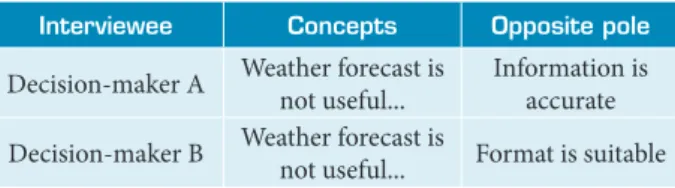
In order to make this feasible, we use the so-called “opposite poles” (bipolar design). hese are statements about certain actions, situations, or observations separated by three dots and followed by another contrasting statement, able to suiciently eliminate ambiguity, subjectivity, or even able to clarify the context of what was analyzed (Georgiou, 2010). An example of this approach is shown in Table 1.
Table 1. Example concepts of respondents.
Interviewee Concepts Opposite pole
Decision-maker A Weather forecast is not useful...
Information is accurate
Decision-maker B Weather forecast is
not useful... Format is suitable
For both decision-makers (A and B), the weather forecast does not appear to be useful. However, by applying the contrast to both of the statements, it is possible to identify the individual (and different) points of view. Therefore, one realizes that the weather forecast may be useful for decision-maker A, if the information presented is accurate. On the other hand, in order to make the weather forecast useful for decision-maker B, the format must be suitable for the intended application.
Henceforth, one may note that the main focus of SODA is to eliminate inherent ambiguities and to provide a clear view of the context under analysis, thus enabling the identiication of potential solutions or courses of action emerging from the diferent perceptions (Georgiou, 2009; Manso et al., 2015). he SODA map is usually employed in the primary stages of approach, when one does not have a clear idea of the context under investigation. However, in some cases, one has veriied that the method used to screen more advanced stages serves as decision support, or as a starting point for methods such as system dynamics.
MAPPING OUT AEROSPACE METEOROLOGY
actors. So, for the systemic mapping of AM in the Brazilian Space Program, several stakeholders, divided into three groups, were interviewed:
• Technical staf (seven interviews): professionals directly related to the provision of weather forecasting and meteorological observation, as meteorologists, engineers and support staf.
• Direct users (ten interviews): actors who use the meteorological information and weather forecasts, directly in their activities during launch missions, and are responsible for the payload, light safety, team assembly and integration etc.
• Top decision-makers (six interviews): considered to be senior managers in the launch missions and/or the BSP, such as chief operating oicer, coordinators and/ or directors of the institutions involved.
Thus, a total of 23 professionals in the BSP, spread over 5 different organizations, were interviewed. Through interviews with different stakeholders, it was possible to identify the perceptions of each group in relation to AM and weather forecasts. Surely, these perceptions are related to their various activities in the rocket launch missions, such as infrastructure, personnel etc. According to the SODA method, individual maps of each stakeholder were made. Subsequently, the individual maps were gathered in each group and validated by the highest ranking member (senior) of each respondent group. As a final step, a map aggregate was made of the three group’s stakeholders, whom we called the “merged map”.
RESULTS AND DISCUSSION
MAPS AND CLUSTER CLASSIFICATION
When all the interviews were finished, the constructs were also classiied according to the focus pointed out by the
interviewees. In other words, the concepts were grouped into thematic clusters, divided into six diferent sets:
• Management: constructs related to aspects of legislation, regulation, budget, political support and institutional support for the space program.
• Infrastructure: related to the infrastructure of the launch centers and meteorological activities such as equipment and instrumentation.
• Operational: constructs directly related to the operational activities of the space center, mission launches or decision-makers/managers.
• Staf: related technical staf and other space program professionals.
• Processes: constructs related to the systems and procedures of launch missions.
• Future vision: related to aspects of long-term vision for the future of the BSP.
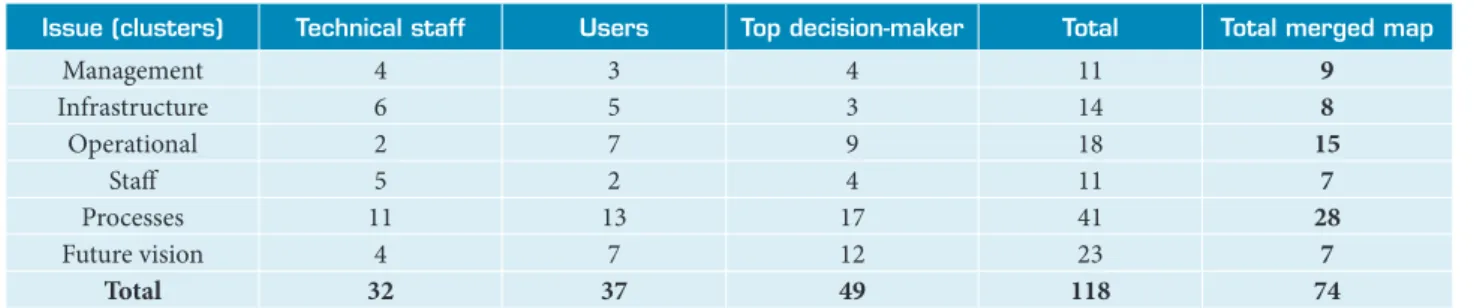
Table 2 shows the amount of each set of constructs indicated by the stakeholders added and the merged map, separated by clusters.
So, the stakeholders mentioned a total of 118 constructs, which were then merged together and validated by the interviewees, reaching a inal total of 74 constructs. he reduction of constructs between the gathered maps from each group and the merged maps is because, quite oten, the concepts of each group are similar and can be grouped together in the inal version of the SODA map. A complete list of the 74 constructs separated by clusters appears in the Appendix of this paper.
HEAD AND TAILS
Given the properties of the SODA map, it is possible perform a number of detailed analysis of a problematic situation. In the supporting merged map (inal version), the “head” may be considered the goal (or goals). hat is, through the respondents’ perceptions of meteorology, it was possible to deine a single objective, which, in this case, is the use of weather as an efective
Issue (clusters) Technical staff Users Top decision-maker Total Total merged map
Management 4 3 4 11 9
Infrastructure 6 5 3 14 8
Operational 2 7 9 18 15
Staf 5 2 4 11 7
Processes 11 13 17 41 28
Future vision 4 7 12 23 7
Total 32 37 49 118 74
Table 4. Construct number of tails, heads, strategic options and dominants in the merged map.
Issue
(cluster) Tails Heads
Strategic options
Dominants (> 4)
Management 1 0 0 4
Infrastructure 5 0 0 1
Operational 3 0 1 3
Staf 0 0 0 1
Processes 0 0 3 15
Future vision 1 1 1 1
Total 10 1 5 25
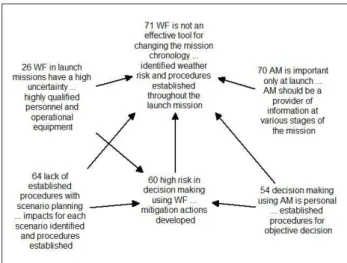
tool for decision support during rocket launch mission (construct 71, Fig. 1). In other words, the weather forecast (WF) does not modify the activities stipulated in the launch chronology.
As mentioned in the methodology section, through the bipolar design of the SODA map, it is possible to diagnose, to “identify weather risk” and to “establish which procedures in the launch mission” should be followed through, so that the objectives are achieved (construct 71). Another important feature of Fig. 1 is that the constructs with immediate links to a “head” are called “strategic options”. hat is, these constructs (26, 54, 60, 64 and 70) are possible strategic options available for achieving the objective.
herefore, in view of the interviewed group, the “strategic options” for the use of weather as a tool for decision support in rocket launch missions in Brazil are presented in Table 3 (in bold).
Grouping by clusters of strategic options, one is in “future vision” (construct 70), three are in “processes” (54, 60 and 64) and one is related to “operational” (26), as demonstrated in the Table 4.
he tails are considered to be the primary cause of the problematic situation. hat is to say, for this study, they are the initial concepts that lead to the inappropriate use of weather forecasts in launch missions. In the SODA map, the tails provide a trace of the origin whose state will inluence the efectiveness of the goal and its strategic options. In Table 5, the list of 10 identiied tails is presented.
It is possible to identify as origin that some concepts are not directly related to AM, for example, the lack of inancial resources (construct 8). his can also be seen in the division of concepts into clusters (Table 4): 1 construct in “management” (8), 5 in “infrastructure” (12, 14, 15, 16 and 17), 3 in “opera-tional” (20, 21 and 22) and one related to “future vision” (72). Interviewees perceived the problems of infrastructure and operations as being the initial causes for not using the weather forecast as an integral tool in launch missions. An example of infrastructure highlighted by one interviewee is: “the absence of a comprehensive system of lightning detection at the launch center increases the weather risk” (construct 16, Table 5). Another example is that there are few launch missions in Brazil per year and consequently this also causes a lack of qualiied technical personnel (construct 22, Table 5).
IMPLOSIONS, EXPLOSIONS, AND DOMINATING CONSTRUCTS
he relationship between the constructs of the SODA map also allows some other interpretations. In the construct with the
Figure 1. Strategic goal (71) and identiied strategic options of the inal SODA map.
Table 3. Strategic options and their bipolar design of the construct.
Strategic options
26 WF in launch missions have a high uncertainty... highly qualiied personnel and operational equipment
54 decision making using AM is personal... established procedures for objective decision
60 high risk in decision making using WF... mitigation actions developed
64 lack of established procedures with scenario planning...
impacts for each scenario identiied and procedures established
70 AM is important only at launch... AM should be a provider of information at various stages of the mission
largest implosion map (construct 60), i.e. the construct that has various constructs leading into it (indegree = 8), it is possible to identify the multiple aspects of the existence of “high risk in decision-making using weather forecasting” (Fig. 2).
Identiied tails
8 low valuation of the space program... suicient inancial resources
12 deicient sotware of AM (weather systems integration)... sotware available and operational
14 poor communication data... dedicated link to weather data 15 deicient reception of satellite image... own system available 16 poor lightning and electrical ield detection system... inancial resources available
17 lack of an observation backup system... multiple observation systems
20 poor training of new staf... replacement staf and continuous training
21 Brazilian rockets are susceptible to weather conditions... rockets with a high protection
22 poor operational team in launching centers... periodic and continuous launch
72 maturation of the importance of “customer”... lack of experience with external payload organizations BSP
Table 5. Tails in the merged map.
Dominant constructs
40 decision making is complex at points of “no return”... risks identiied and established procedures
46 decision using the WF is only for rocket launch (< 2h)...
impacts identiied at all stages of the mission
47 lack of a weather decision support system... system designed in accordance with Brazilian demands
53 WF format is not suitable... procedures established for each type of mission/rocket
56 few operating procedures related to AM... identiied demands
60 high risk in decision making using WF... mitigation actions developed
64 lack of established procedures with scenario planning... impacts for each scenario identiied and procedures established
Table 6. Dominant constructs (degree > 7) in the merged map.
using weather forecasts. hese constructs indicate the need for improvements in the identiication of meteorological impacts (construct 46), the observation of environmental conditions in real time (44), the deinition of the risks and establishment of procedures (40, 54, 55, 64 and 67), as well as keeping qualiied technical staf and equipment operating/ready for use (26).
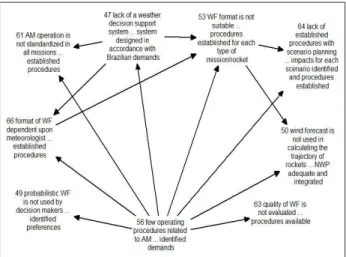
Similarly, the SODA map makes also possible to identify those constructs in which “explosion” occurs, that is, when ideas inluence various constructs. In Fig. 3, it is shown that, in construct 56, “few operating procedures are related to AM” and that number has increased connections (total of 8) in the entire model. In other words, there are few sets of procedures that have a direct bearing on the quality and format of weather information (constructs 49, 50, 53, 61, 63 and 66), on the lack of an integrated decision support system (47) and on the lack of
Figure 3. Construct (56) merged with larger explosion in the map (NWP = numerical weather prediction).
Figure 2. Construct (60) with more implosion on the merged map.
planning utilizing meteorological scenarios (64). he planning scenario related to potential weather events that could negatively impact the launch mission is of great importance for this group of stakeholders.
Figure 4. Dominant construct (56) in the merged map.
also be observed in Fig. 4, which shows the construct 56, that is also the dominant construct in the merged map. In this case, concept 56 has a total of 12 (high total) numbers of constructs connected to it. According to Georgiou (2009), dominants can be interpreted as constructs in a map and indicate focal points in the model where issues or decisions converge to (diverge from) the map.
Naturally, these constructs should be analyzed carefully, as decisions related to the dominant constructs are connected to many other concepts and have a high impact on the model. In Table 6, some dominant constructs (> 7, sum of indegrees and outdegrees) are presented. he actions that should be taken to promote the strategic options are highlighted (in bold).
So, for the most relevant dominant constructs (Table 6), there are three sets of actions that should be taken:
• Identify all demands (construct 56), risks and impacts (40, 46 and 64), as well as mitigation actions related to AM (60).
• Establish operational procedures at various stages of each type of mission and rocket (46 and 53).
• Develop the weather decision support system in accordance with Brazilian demands (47).
FEEDBACK LOOPS
In the SODA map, it is also possible to identify improvement opportunities in a problematic situation (Ackermann and Eden, 2001). his feature is evaluated by feedback loops between the constructs, and can be useful for identifying areas of degenerative or regenerative dynamics. he loops may represent situations of the collapse of a particular decision-makers’ concept. In Fig. 5, we have the main feedback loops of the merged map.
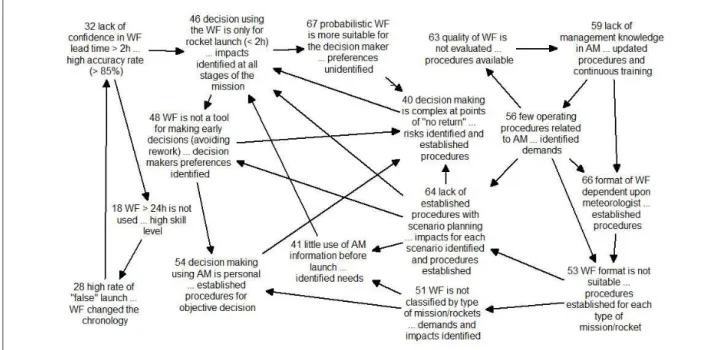
he loop constructs 32, 18 and 28 show a degenerative cycle due to the lack of conidence in the weather forecast
because it is not used for periods > 24h, which causes a high rate of false launches. Note that the false entries occur when the countdown is not halted, even with the bad weather forecast. However, when the launch is canceled or postponed around the litof window, it causes delays in the space mission and technical staf discontent.
According to some interviewed actors, the false launch can be a big issue, since many sounding rockets need to be integrated several hours before litof, and, ater numerous false launches, this unnecessary repetition can impair the safety of the mission.
In another loop, constructs 46, 67 and 40 indicate that decision-making using meteorological information only occurs for weather forecasts of up to 2h before the rocket launch. According to respondents, this happens because the impacts, probabilities of accuracy and weather risks were not previously deined. In other words, if the forecast is for bad weather, the decision to cancel the launch is delayed up to a maximum of 2h before the original schedule. his situation is directly related to the false launch, as shown in the previous loop.
For this group of stakeholders, the probabilistic weather forecast (and not deterministic, as it is currently used) would be more appropriate (construct 67). Another negative efect highlighted by respondents of the current model is that decision-making at the point of no return in the launch chronology. his is an extremely complex and challenging moment of the operation because it depends on an individual subjective decision (construct 40) from the Chief Operating Oicer responsible for the mission. he point of no return is considered when some rocket system is activated in advance (e.g. fuel) and cannot be turned of. hat is, even though at the exact time of litof there is weather with values above the operating limits, the rocket has to be launched and/or destroyed via remote command.
The loop constructs 40, 46, 48 and 54 show that the preferences and values of decision-makers regarding weather forecasts have not been identiied yet, so the decision to use Meteorology information is personal. hat is, even if the launches are similar, the decisions could be distinct because they depend on the proile and experience of the Chief Operating Oicer.
In Fig. 5, it is also possible to observe the looping of the constructs 56, 63 and 59. his loop indicates that the lack of AM-related procedures negatively impacts the quality of the weather forecast, i.e. the hit rate of the forecast is not evaluated. Interviewees perceived this situation as a lack of knowledge between the management and the technical team and also an proper training of new meteorologists.
IMPACTS OF WEATHER INFORMATION FOR ROCKET LAUNCHES
Regarding the constructs identiied by stakeholders, some are directly related to the development of weather forecasting and how it is used in the launch mission. Table 7 presents the features of 5 constructs that deine technical parameters related to weather forecasting and that can be applied in the parametrization of new decision support systems.
So, in the view of respondents, a weather forecast beyond 24h is not used in decision-making (constructs 18 and 32), due to the low rate of success (< 85%). hat is, even if the weather conditions are unfavorable, the decision-makers choose to wait for an updated weather forecast closer to the event, up to 2h before (constructs 32 and 46). In this case, the event can be any chronology activity, where any weather conditions could be a limiting condition (e.g. integration rocket on the launch pad).
However, the most important concept regarding weather forecasts is that the values and proiles of decision-makers are not fully identiied yet. hat is, the interaction with decision-makers showed that it is important to incorporate context in this problem along with the uncertainty of the weather prediction. herefore, it is mentioned (constructs 47 and 48) that the challenge is to develop a new weather decision support system, as well as to identify and quantify the preferences of the decision-makers, concerning the inherent risk in forecast uncertainty. Nevertheless, in order to incorporate the decision-maker’s preferences regarding weather prediction, it would be necessary to develop a new decision support system with a systemic view:
• Identify the demands for weather information throughout the launch mission (construct 46). • Quantify weather risk to the rocket and the launch
center facilities (40).
• Develop a scenario plan (64) for associated weather conditions.
• Develop mitigation actions for each type of scenario, mission and rocket (53 and 60).
CHALLENGES AND OPPORTUNITIES
Opportunities Constructs related
Identify needs for weather information at all stages of the rocket launch mission (not only the litof) 43, 46, 47, 48, 51, 54 and 56 Increase interaction between teams of Meteorology, users and decision-makers to develop
appropriate procedures in AM demands by type of mission and rocket
28, 40, 52, 53, 54, 55, 56, 59, 61, 63, 64, 66 and 71 Develop products with probabilistic weather forecast (e.g. ensemble) 32, 45, 49 and 67 Develop new projects of research and development in areas related to atmospheric science such as
space weather, oceanographic and meteorological instrumentation applied to aerospace 1, 10, 40, 43 and 44 Develop a new weather decision support system, according to the preferences of users and
decision-makers from Brazilian Space Program 18, 45, 48, 49, 54 and 67
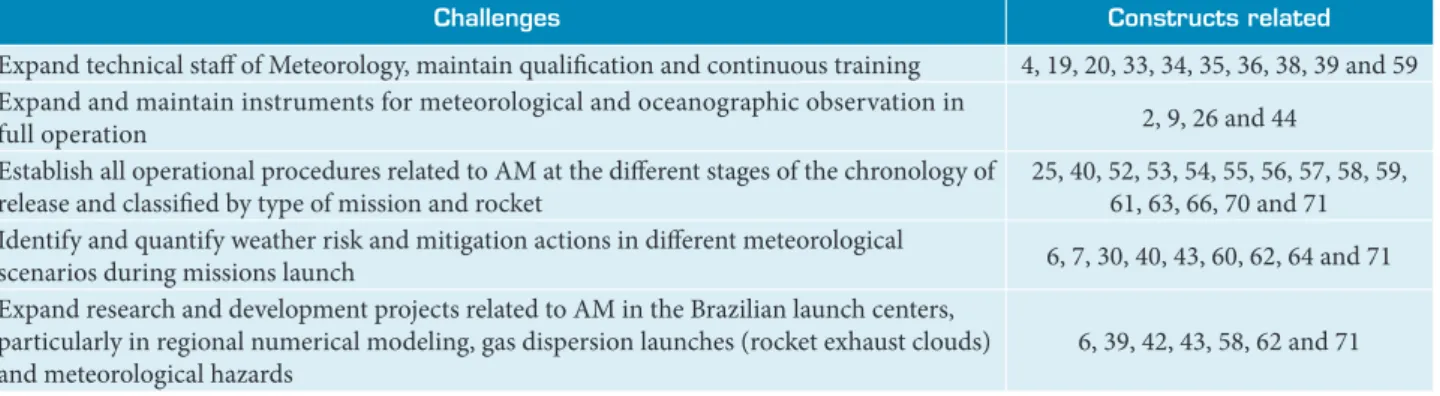
Table 8. List of key challenges identiied.
Challenges Constructs related
Expand technical staf of Meteorology, maintain qualiication and continuous training 4, 19, 20, 33, 34, 35, 36, 38, 39 and 59 Expand and maintain instruments for meteorological and oceanographic observation in
full operation 2, 9, 26 and 44
Establish all operational procedures related to AM at the diferent stages of the chronology of release and classiied by type of mission and rocket
25, 40, 52, 53, 54, 55, 56, 57, 58, 59, 61, 63, 66, 70 and 71 Identify and quantify weather risk and mitigation actions in diferent meteorological
scenarios during missions launch 6, 7, 30, 40, 43, 60, 62, 64 and 71 Expand research and development projects related to AM in the Brazilian launch centers,
particularly in regional numerical modeling, gas dispersion launches (rocket exhaust clouds) and meteorological hazards
6, 39, 42, 43, 58, 62 and 71
Table 9. List of identiied opportunities.
Table 7. Constructs directly related to the operation of the weather forecast.
Features of constructs
18 WF > 24h is not used... high skill level
32 lack of conidence in WF lead time > 2h... high accuracy rate (> 85%)
46 decision using the WF is only launch (< 2h)... impacts identiied at all stages of the mission
47 lack of a weather decision support system... system designed in accordance with the Brazilian demands 48 WF is not a tool for making early decision (avoid rework)... decision-makers’ preferences identiied
concepts of the loops of the constructs 18, 32 and 28 (let side of Fig. 5) and the loop 46, 67 and 40 (on the top of Fig. 5). hat is, the increasing conidence of users and decision-makers in weather forecasting enables early decision-making (before 24 h) thus avoiding false launches.
CONCLUSIONS
his paper aimed to be the irst attempt to map out the systemic view of Aerospace Meteorology at the Brazilian Space Program. he problem structuring methods applied in this study, through interviews with stakeholders, stimulated an overview about the identiication and evaluation of weather information for the launch of aerospace vehicles. he SODA map approach increases the decision-maker’s knowledge to analyze the problem, since it helps clarify the alternatives
and facilitates the understanding of the preferable options needed to apply weather forecasts for the launch mission.
According to the group of Brazilian stakeholders, the constructs related to this problematic situation are divided into 6 clusters (Table 2). By utilizing the SODA method, it was possible to make a set of assessments of decision-makers’ values and perceptions by using the constructs of the merged map. As a highlight, we found that the lack of procedures in Aerospace Meteorology (total of 28 constructs) and operational problems at launch mission (total of 15 constructs) constructs were most oten remembered by respondents (Table 2). In this context, it has been determined that a weather forecast is not merely a tool to be used to modify the chronology of a mission and to fully provide support in decision-making during the rocket launches in Brazil.
for decision support in launch missions. he initial reasons given by respondents for this strategic objective have not been achieved; the problems are concentrated in infrastructure (constructs 12, 14, 15, 16 and 17 of Table 5) and operational problems during launches missions (20, 21 and 22 of Table 5). On the other hand, there are also some reasons indicated by respondents, which had no direct relationship to AM, for example, the lack of resources for the space program (8) or even changes in the customers’ perception of the importance of microgravity research or other payload experiments (72). his also shows that improving Aerospace Meteorology during the launch missions is beyond the activities of the weather forecast. he strategic options identiied by the SODA map (constructs connected to the objective) are clearly concentrated in the absence of processes (constructs 54, 60 and 64 of Fig. 1) during launch mission. As a direct efect, decision-making is personalist (54) and the decision to use the weather forecast is considered highly risky by the decision-maker (60). Furthermore, through the implosions, explosions, dominants and feedback loops, it was possible to identify other highly relevant concepts for the operation of the weather forecast.
We must emphasize this need to develop a weather decision support system, in accordance with the decision-maker’s preferences (47 and 56), classiied by type of mission and weather scenario planning in rocket launching operations (53 and 64). In other words, forecasts are uncertain, and the resulting risk may be interpreted diferently by diferent decision-makers, depending, in part, on their personal experience and risk perception. In this case, to apply a weather forecast as a reliable tool for decision-making, one needs to incorporate three speciic preferences on the demands, procedures, and impacts, which are listed below:
• Value of meteorological variables (wind, rain), according to the boundary conditions of the aerospace vehicle and the launch center facilities (constructs 21, 29 and 53). • Lead time of the weather forecast (hours, days), i.e. the
expiration date of the weather prediction presented to the decision-maker (constructs 18, 32 and 46). • Probability of the weather forecast (%), associated with
each variable and lead time (constructs 32, 45, 49 and 67).
Certainly, the challenges related to Aerospace Meteorology have a strong relationship with the challenges of the BSP. For example, to extend the network of meteorological and oceanographic instruments, it is necessary to have consistent funding for the acquisition and maintenance of equipment. In opposition, identifying weather risks and developing mitigation actions throughout the launch mission require greater interaction between the various BSP’s organizations and the diferent technical teams. hrough this mapping, it was possible to identify the main challenges and opportunities (Tables 8 and 9) for improvement within the AM in the BSP. Surely, this is not an exhausted process and requires constant assessment over the years. We must be constantly developing appropriate meteorological products in accordance with the preferences of users and customers. his is a permanent challenge for the meteorologist and technical team. However, in a space program, where risks and costs are much higher, this approach is crucial to the safety of staf and infrastructure.
As a inal remark, the SODA map has shown itself to be quite useful for this case, facilitating the understanding of the AM’s real situation in the BSP. Furthermore, applying this method in a real case has shown to be a completely appropriate and a reasonable choice for aerospace decision-making problems. In this sense, we can say that the use of problem structuring methods as a irst step for decision-making situations is deinitely the best option for complex decisions to be made in some topics such as space program planning and/or defense sector.
ACKNOWLEDGEMENTS
Study supported by CNPq (grant nº 142212/2011-3) and CAPES Foundation (grant nº 14552/2013-2). he authors also thank all the Brazilian interviewees (from DCTA, IAE, CLBI, ACS, and INPE) for their contributions, and Maria Pirone, John Madura, and KSC Weather Oice Team for comments and suggestions. However, any opinions or conclusions in this paper are those of the authors and do not necessarily relect the views of the Brazilian Space Program institutions.
REFERENCES
Ackermann, F. and Eden, C., 2001, “SODA - Journey Making and Mapping in Practice”, In: Rosenhead, J. and Mingers, J. (Eds.), Rational Analysis for a Problematic World Revisited: Problem Structuring Methods for Complexity, Second Edition, John Wiley & Sons, West Sussex, UK pp. 43-60.
AEB, Agência Espacial Brasileira, 2012, “National Program of Space Activities 2012–2021”. Retrieved in January 29, 2015, from http:// www.aeb.gov.br/wp-content/uploads/2013/01/PNAE-Ingles.pdf
Brasil, Ministério da Ciência, Tecnologia e Inovação, 2012, “Estratégia Nacional de Ciência, Tecnologia e Inovação 2012–2015”, Retrieved in January 31, from http:// www.mct.gov.br/upd_blob/0218/218981.pdf
Brasil, Ministério da Defesa, 2008, “National Strategy of Defense”, Retrieved in September 2, 2012, from http://www.defesa.gov.br/ projetosweb/estrategia/arquivos/estrategia_defesa_nacional_ingles.pdf
Case, J.L., Wheeler, M.M., Manobianco, J., Weems, J.W. and Roeder, W.P., 2005, “A 7-Yr Climatological Study of Land Breezes over the Florida Spaceport”, Journal of Applied Meteorology, Vol. 44, pp. 340-356. doi: 10.1175/JAM-2202.1
Ceballos, D.C., 1995, “The Brazilian Space Program: a Selective Strategy for Space Development and Business”, Space Policy, Vol. 11, No. 3, pp. 202-204. doi: 10.1016/0265-9646(95)92254-B
Dalin, P., Perminov, V., Pertsev, N., Dubietis, A., Zadorozhny, A., Smirnov, A., Mezentsev, A., Frandsen, S., Grønne, J., Hansen, O., Andersen, H., McEachran, I., McEwan, T., Rowlands, J., Meyerdierks, H., Zalcik, M., Connors, M., Schoield, I. and Veselovsky, I., 2013, “Optical Studies of Rocket Exhaust Trails and Artiicial Noctilucent Clouds Produced by Soyuz Rocket Launches”, Journal of Geophysical Research: Atmospheres, Vol. 118, No. 14, pp. 7850-7863. doi:10.1002/jgrd.50549
Devezas, T., de Melo, F.C.L., Gregori, M.L., Salgado, M.C.V., Ribeiro, J.R. and Devezas, C.B.C., 2012, “The Struggle for Space: Past and Future of the Space Race”, Technological Forecasting and Social Change, Vol. 79, No. 5, pp. 963-985. doi:10.1016/j. techfore.2011.12.006
Devyatkin, A.M., Krasnov, V.M., Kuleshov, Y.V., Makov, A.B. and Suvorov, S.S., 2012, “The Use of Information on Atmospheric Conditions for Determining the Impact Areas of Space Rocket Modules”, Russian Meteorology and Hydrology, Vol. 37, No. 2, pp. 98-105. doi: 10.3103/ S1068373912020045
Eden, C., 2004, “Analyzing Cognitive Maps to Help Structure Issues or Problems”, European Journal of Operational Research, Vol. 159, No. 3, pp. 673-686. doi: 10.1016/S0377-2217(03)00431-4
Eden, C. and Ackermann, F., 2001, “SODA - The Principles”, In: Rosenhead, J. and Mingers, J. (Eds.), “Rational Analysis for a Problematic World Revisited: Problem Structuring Methods for Complexity”, Second Edition, John Wiley & Sons, West Sussex, UK, pp. 21-41.
Georgiou, I., 2009, “Mapping Railway Development Prospects in Brazil”, Transport Reviews, Vol. 29, No. 6, pp. 685-714. doi: 10.1080/01441640902752813
Georgiou, I., 2010, “Cognitive Mapping and Strategic Options Development and Analysis (SODA)”, In: Cochran, J.J. (Ed.), Wiley Encyclopedia of Operations Research and Management Science, John Wiley & Sons, West Sussex, UK, pp. 1-10. doi: 10.1002/9780470400531. eorms0974
Joslyn, S. and LeClerc, J., 2013, “Decisions with Uncertainty: the Glass Half Full”, Current Directions in Psychological Science, Vol. 22, No. 4, pp. 308-315. doi: 10.1177/0963721413481473
Kuk, B.J., Kim, H.I., Ha, J.S. and Lee, H.K., 2011, “Intercomparison Study of Cloud-to-Ground Lightning Flashes Observed by KARITLDS and KLDN at South Korea”, Journal of Applied Meteorology and Climatology, Vol. 50, No. 1, pp. 224-232. doi: 10.1175/2010JAMC2493.1
Manso, D.F., Suterio, R., Belderrain, M.C.N., 2015, “Estruturação do problema de gerenciamento de desastres do Estado de São Paulo por intermédio do método Strategic Options Development and Analysis”. Gestão & Produção (article in press).
Marciotto, E.R. and Fisch, G., 2013, “Investigation of Approaching Ocean Flow and its Interaction with Land Internal Boundary Layer”, American Journal of Environmental Engineering, Vol. 3, No. 1, pp. 18-23. doi: 10.5923/j.ajee.20130301.04
Merceret, F.J., O’Brien, T.P., Roeder, W.P., Huddleston, L.L., Bauman-III, W.H., Jedlovec, G.J., 2013. “Transitioning Research to Operations: Transforming the ‘Valley of Death’ Into a ‘Valley of Opportunity.’” Space Weather Vol. 11, No. 11, pp. 637–640. doi:10.1002/swe.20099
Merceret, F.J., Short, D.A. and Ward, J.G., 2006, “Radar Evaluation of Optical Cloud Constraints to Space Launch Operations”, Journal of Spacecraft and Rockets, Vol. 43, No. 1, pp. 248-251. doi: 10.2514/1.17519
Moreira, D.M., Trindade, L.B., Fisch, G., Moraes, M.R., Dorado, R.M. and Guedes, R.L., 2011, “A Multilayer Model to Simulate Rocket Exhaust Clouds”, Journal of Aerospace Technology and Management, Vol. 3, No. 1, pp. 41-52. doi: 10.5028/jatm.2011.03010311
NASA, The Applied Meteorology Unit, 2005, “Severe Weather Forecast Decision Aid (NASA Contractor Report CR-2005-212563)”, Retrieved in March 13, 2011, from http://science.ksc.nasa.gov/amu/inal-reports/severe-tool-inal.pdf
Nascimento, E.G.S., Moreira, D.M., Fisch, G. and Albuquerque, T.T.A., 2014, “Simulation of Rocket Exhaust Clouds at the Centro de Lançamento de Alcântara Using the WRF-CMAQ Modeling System”, Journal of Aerospace Technology and Management, Vol. 6, No. 2, pp. 119-128. doi: 10.5028/jatm.v6i2.277
Rabelo, L., Sepulveda, J., Compton, J., Moraga, R. and Turner, R., 2006, “Disaster and Prevention Management for the NASA Shuttle During Lift-Off”, Disaster Prevention and Management, Vol. 15, No. 2, pp. 262-274. doi: 10.1108/09653560610659810
Rosenhead, J. and Mingers, J., 2001, “Rational Analysis for a Problematic World Revisited: Problem Structuring Methods for Complexity”, Second Edition, John Wiley & Sons, West Sussex, UK.
Uman, M.A. and Krider, E.P., 1989, “Natural and Artiicially Initiated Lightning”, Science, Vol. 246, No. 4929, pp. 457-464. doi: 10.1126/ science.246.4929.457
Vaughan, D., 1996, “The Challenger Launch Decision: Risky Technology, Culture, and Deviance at NASA”, University of Chicago Press, Chicago, USA.
Constructs Cluster Connection
1 delay in deployment of meteorological instruments... awareness of the importance
Management
+13 +53 +40 2 limited inancial resources for equipment and infrastructure for AM... available resources +1 3 low priority by senior management in the AM activities... awareness of the importance +37 +2 +4 -7 4 speciic and ongoing training deicient in AM... awareness of the importance +52 -7 5 deicient development of long-term infrastructure plan... awareness by senior management +13 +1 +2 6 maturation of the importance of AM... low weather risk perception -63 -59 7 risk perception increased ater the VLS accident... low perception of Brazilian decision-makers +9 +6 -1 8 low valuation of the space program... suicient inancial resources +35 +27 +2 +3 +5 9 reliability of equipment/data of AM are important... low weather risk perception -1 10 deicient observation instruments for AM... instruments installed and fully operational
Infrastructure
+13 11 NWP inadequate for the mission launch... regional models and short-term WF +13 12 deicient sotware of AM (Weather Systems Integration)... sotware available and operational +47 +13 13 insuicient general infrastructure for AM... center suitable for all launching operations +44
14 poor communication data... dedicated link to weather data +13 +11
15 deicient reception of satellite image... own system available +10
16 poor lightning and electrical ield detection system... inancial resources available +10 17 lack of an observation backup system... multiple observation systems +10 18 WF >24h is not used... high skill level
Operational
+28 +26 19 limited staf with experience in AM... periodic and continuous launch +26 20 poor training of new staf... replacement staf and continuous training +24 21 Brazilian rockets are susceptible to weather conditions... rockets with a high protection +30 +31 +23 +29 22 poor operational team in launching centers... periodic and continuous launch +24 +25 +19 23 AM is subject to light safety team... implementation of WF at diferent stages of the mission -31 24 lack of a systemic view of the launch missions... interactions identiied and teams prepared +28 +23 25 low weather risk perception... continuous launches and developed operational culture +24 +18 +28 26 WF in launch missions have a high uncertainty... highly qualiied personnel and operational equipment +71 +60 27 lack of interaction between BSP organizations... periodical and continuous launches +24
28 high rate of “false” launch... WF changed the chronology +32 +26
29 AM information is relevant at diferent stages of the mission... low interaction with other sectors -41 +31 30 accuracy of AM is an important safety factor... activities with low weather risk +67 -26 31 WF is important throughout the mission chronology... rocket more resistant to environmental conditions +30 32 lack of conidence in WF lead time > 2h... high accuracy rate (> 85%) +18 +46 +26 33 hard work during mission launch... no need to move outside staf
Staf
+39 34 few forecasters with experience in AM... ongoing training and interaction with more experienced staf +36 35 high staf turnover in the BSP organizations... adequate career progression and challenging conditions +27 +37 36 few forecasters and technical teams... adequate operating staf +38 +39 +33 37 diiculty in keeping meteorologists and technical staf in the launch center... good infrastructure for housing +34 +36 38 need to move technical staf for missions launch... local staf available +39 39 diiculty in conducting research in AM... local and permanent staf available +42 40 decision making is complex at points of “no return”... risks identiied and established procedures
Process
+46 +60
41 little use of AM information before launch... identiied needs +46
42 low interactions between R&D and operation... identiied needs +57 +58 +43 +62 43 nonexistent research in space weather and launching rockets... demands and risks identiied +62 44 risk of loss of the payload in the ocean due to environmental conditions... impacts identiied and oceanographic observation in real time +60 45 little understanding of probabilistic WF... decision-makers’ preferences identiied +56 46 decision using the WF is only for rocket launch (< 2h)... impacts identiied at all stages of the mission +67 +48 +60 47 lack of a weather decision support system... system designed in accordance with Brazilian demands +61 +53 +66 +55 +48 48 WF is not a tool for making early decisions (avoiding rework)... decision-makers’ preferences identiied +40 +54 49 probabilistic WF is not used by decision-makers... identiied preferences +48 +40 +54 +46 50 wind forecast is not used in calculating the trajectory of rockets... NWP adequate and integrated +44 +51 51 WF is not classiied by type of mission/rockets... demands and impacts identiied +41 +54 +61 52 poor interaction between AM and other sectors... well-established procedures and hierarchy +45 +57 +42 53 WF format is not suitable... procedures established for each type of mission/rocket +44 +64 +50 +51 54 decision making using AM is personal... established procedures for objective decision +71 +44 +40 +60 55 external pressure to launch the rockets... established procedures +60
56 few operating procedures related to AM... identiied demands +49 +64 +53 +66 +47 +50 +63 +61 57 poor identiication of limiting environmental criteria... impacts identiied and procedures available +56
58 little research on the gas dispersion launches (rocket exhaust clouds)... high interaction between R&D and operation +62 59 lack of management knowledge in AM... updated procedures and continuous training +66 +65 +56 60 high risk in decision making using WF... mitigation actions developed +71 61 AM operation is not standardized in all missions... established procedures +55 62 few studies on weather risk analysis... impacts and risks identiied +56 +44
63 quality of WF is not evaluated... procedures available +59
64 lack of established procedures with scenario planning... impacts for each scenario identiied and procedures established +71 +48 +60 +41 +55 +40 +46 65 Brazilian standards based on international standards... appropriate standards for Brazilian characteristics +47 66 format of WF dependent upon meteorologist... established procedures +53 67 probabilistic WF is more suitable for the decision-maker... preferences unidentiied -60 -40 68 environmental impact is a concern in commercial launch missions... disinterest in the international market
Strategic