REVISTA
BRASILEIRA
DE
ANESTESIOLOGIA
OfficialPublicationoftheBrazilianSocietyofAnesthesiologywww.sba.com.br
CLINICAL
INFORMATION
Anesthesia
for
EXIT
procedure
(ex
utero
intrapartum
treatment)
in
congenital
cervical
malformation
---
a
challenge
to
the
anesthesiologist
Elsa
Oliveira
∗,
Paula
Pereira,
Carla
Retroz,
Emília
Mártires
DepartmentofAnesthesiology,CentroHospitalareUniversitáriodeCoimbra,Coimbra,Portugal
Received22June2013;accepted22July2013 Availableonline9October2015
KEYWORDS
EXITprocedure; Ex-uterus intrapartum treatment; Congenitalcervical malformation; Anesthesia
Abstract Theexuterointrapartumtreatment(EXIT)procedureconsistsofpartial externaliza-tionofthefetusfromtheuterinecavityduringdelivery,allowingthemaintenanceofplacental circulation.Itisindicatedinthepresenceofcongenitalmalformationwhendifficultyinfetal airwayaccessisanticipated,allowingittobeensuredbydirectlaryngoscopy,bronchoscopy, tracheostomy,orsurgicalintervention.AnesthesiaforEXITprocedurehasseveralspecial fea-tures,such astheappropriateuterinerelaxation, maintenance ofmaternal bloodpressure, fetalairwayestablishment,andmaintenanceofpostpartumuterinecontraction.The anesthe-siologist shouldbe preparedfor theanesthetic particularities ofthisprocedureinorder to contributetoafavorableoutcomeforthemotherandparticularlythefetus.
© 2015SociedadeBrasileirade Anestesiologia.Publishedby ElsevierEditoraLtda.Allrights reserved.
PALAVRAS-CHAVE
ProcedimentoEXIT; Tratamento extraútero intraparto; Malformac¸ão congênitacervical; Anestesia
AnestesiaparaprocedimentoEXIT(tratamentoextraúterointraparto)em malformac¸ãocongênitacervical---umdesafioparaoanestesiologista
Resumo OprocedimentoEXIT(tratamentoextraúterointraparto)consistenaexteriorizac¸ão parcialdofetodacavidadeuterinaduranteopartoparapermitiramanutenc¸ãodacirculac¸ão fetoplacentária.Estáindicadonapresenc¸ademalformac¸õescongênitasemqueseantecipaa dificuldadenoacessodaviaaéreafetalepermitequeessasejaasseguradaporlaringoscopia direta,broncoscopia,traqueostomiaouintervenc¸ãocirúrgica.Aanestesiaparaprocedimento EXIT apresentavárias particularidades. Orelaxamentouterino adequado,amanutenc¸ão da pressãoarterialmaterna,oestabelecimentodeviaaéreafetaleamanutenc¸ãodacontrac¸ão
∗Correspondingauthor.
E-mail:[email protected](E.Oliveira). http://dx.doi.org/10.1016/j.bjane.2013.07.020
ularidadesanestésicasdesseprocedimento,demodoacontribuirparaumdesfechofavorável paraamãeeparticularmenteparaofeto.
©2015SociedadeBrasileiradeAnestesiologia.PublicadoporElsevierEditoraLtda.Todosos direitosreservados.
Background
and
objectives
Recent advances in prenatal diagnosis allow early detec-tionofdefectsresponsibleforfetalairwayobstructionthat benefitfromintrapartumtreatment.1
TheEXITprocedure(exuterointrapartumtreatment)is
indicatedinthepresenceofthesesituations.Itisperformed
during cesarean section and after partial externalization
ofthe fetus from uterinecavity andconsists of the
feto-placentalcirculationmaintenanceuntilthefetalairwayis
secured.2
Itwasoriginallydescribedtoreversethetracheal
occlu-sion performed in utero treatment of severe congenital
diaphragmatic hernia. Currently, it is used in situations
wherethefetus hasairwayobstructionat theendof
ges-tation.The procedure is usuallyscheduled after the35th
week of pregnancy and prematurity is not considered a
contraindication.3
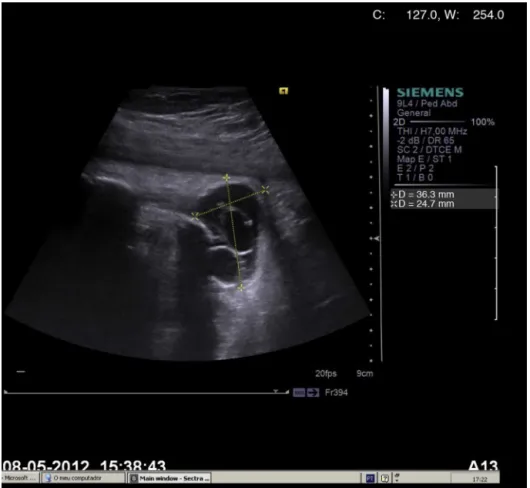
Figure1 Prenatalultrasound.
The anesthetic technique during the EXIT procedure
differsfromanormalcesareansectionandhassome
pecu-liarities.
ThisarticledescribesacaseinwhichtheEXITprocedure
wasperformed successfully infetus withprenatal
diagno-sisofsubmandibularcysticlymphangiomaanddiscussesthe
anesthetictechniqueappliedwithabriefliteraturereview.
Case
report
Afemalepatient,35yearsold,gravida1/to0,with39weeks ofpregnancy,ASAIIduetoallergicrhinitis,presentingwith
fetuswithrightcervicalmassdiagnosedbyprenatal
ultra-soundat31weeksofpregnancy(Fig.1).
At36weeks,amagneticresonanceimaging(MRI)testwas
performedandconfirmedanexpansivelesioninthesoft
tis-suesofhemifaceandproximalportionofthesubmandibular
Figure2 FetalMRI.
associatedwithtongueprotrusion/macroglossiawitha
diag-nosiscompatiblewithcysticlymphangioma(Fig.2).
ElectivecesareansectionwasscheduledwithEXIT
proce-durebyamultidisciplinaryteamofneonatologists,pediatric surgeons,obstetricians,anesthesiologists,andnurses.
The chosen anesthetictechniquewasbalanced general
anesthesiawithepiduralcatheterplacementfor
postopera-tiveanalgesia.
In the operating room,the initial maternal monitoring
wasperformedwithpulseoximetry,ECG, andnoninvasive
bloodpressure,andthe motherwaspositionedintheleft
lateralpositionforepiduralcatheterplacement.
Anesthe-siawasappliedtotheskinwith1%lidocaine(2mL)andthe
identificationof theepiduralwithairwasinitiatedby the
medianapproachinL3---L4.Theepiduralspacewas
identi-fiedat 5.5cm of theskin, andthe epidural catheterwas
insertedupto11cm.Subsequently,atestdosewas
admin-isteredwith2%lidocaine2mL(40mg)andthecatheterwas
fixed. Afterwards, the pregnant woman was placed in a
supineposition withtheuterus displacedtothe leftwith
padandlateralizationofthetable.
Beforeinductionofanesthesia,catheterizationofradial
arteryforinvasivemonitoringofbloodpressureandtwo
18-Gperipheralvenousaccesseswereperformed.
Afterwards,theremainingmonitoringwithinvasiveblood
pressure,capnography,anestheticgasanalyzer,andhourly
dieresiswereperformed.
Face mask oxygenation wasperformed with 100%
oxy-genfor5minandmidazolam(2mg)wasadministered.Rapid
sequence induction was initiated with thiopental 300mg
(4mg/kg),rocuronium40mg(0.6mg/kg),fentanyl0.05mg,
Sellickmaneuver,andtrachealintubationwitha7.5-cuffed
tube.Generalanesthesiawasmaintainedwith2---3%
sevoflu-raneandremifentanil(0.1---0.5g/kg/min).Afterinduction
ofanesthesia,midazolam1mg,fentanyl0.1mg,and
rocuro-nium10mg weregiven. Forthemaintenanceof maternal
systolicbloodpressureabove100---120mmHgitwas
neces-sarytoadministerephedrine5mgandhydroxyethylstarch
500mL.
Figure3 Nasotrachealintubationofthenewborn.
The timeelapsed between the induction of anesthesia
andhysterotomywas15min.
After the hysterectomy, the head, trunk, and upper
limbsofthefetus wereexternalized,preservingthe
uter-inevolumeandfetoplacentalcirculation.Thefetaltracheal
intubationwasachievedunderdirectlaryngoscopy,witha
3.5uncuffed tube, 4min afterhysterectomy. The correct
positioningofthenasotrachealtubewasconfirmed,andwe
proceededtotheclampingandcuttingoftheumbilicalcord
(Figs.3and4).
Duringtheprocedure,uterinerelaxationobtained with
2---3%sevoflurane wassatisfactory and therewasno need
foradditionaltocolyticdrugs.
After cutting the umbilical cord, oxytocin (10U) was
administered at uterine myometrium, sevoflurane was
ued.Therewasadequateuterinecontraction.
Totalvolume of fluidsinfused was1.500mL of
crystal-loid and 500mL of colloids. The estimated bleeding was
approximately800mLandtherewasnoneedfortransfusion
ofblood products. At theend of theprocedure, the
neu-romuscularblockade wasreversed with neostigmine 2mg
andatropine1mg,andthepatientwasextubatedafterfull
reversaloftheblockade.
The newbornwastransferredtothepediatric hospital,
intubated,mechanicallyventilated,andsedatedwith
fen-tanylinfusion.Thenewborntransportwasuneventful.
Conclusions
Prenataldiagnosisof fetalmalformationinthecervical or
oralregionwithobstructionoftheupperairwayisessential toreduceperinatalmorbidityandmortality.3,4Itallowsthe
maternal---fetalmonitoringduringpregnancyanddefinethe
bestapproachtobeundertakenduringdelivery.3
EXITisindicatedinthepresenceofcongenital
malforma-tionsinwhichdifficultyinfetalairwayaccessisanticipated
andallowsitspatencybydirectlaryngoscopyorfiberoptic
andorotrachealintubationortracheostomybefore
fetopla-centalseparation.1,5Itisdefinedasaprocedureperformed
afterpartialexternalization ofthe fetusfromthe uterine
cavity,withuterinevolumemaintenanceandfetoplacental
circulation,andensuresthefetaloxygenationduringairway access.6,7
Anesthesiaforthisprocedurediffersfromaconventional
cesarean-section and general anesthesia is the preferred
technique.1,2 Deep uterine relaxation, uteroplacental
cir-culationpreservation,anesthesia,andfetalimmobilityare
themaingoalsofthisprocedure.1,2,7,8
Uterine relaxation is critical to prevent uterine
con-tractions and placental separation.2 Several authors have
recommendedtheadministrationof inhaledanestheticsin
concentrations not below 2 MAC, which, in addition to
uterinerelaxation,are responsiblefor maternal and fetal
deepanesthesia.Intheeventofpooruterinerelaxation,it
canbeachievedwithtocolyticdrugs,suchasterbutaline,
magnesiumsulfate,ornitroglycerin.Nitroglycerinhasideal
pharmacokineticcharacteristics, suchasitsshorthalf-life
andhighpotency,butitmayhaveadverseeffects,suchas
hypotension.2,6Itisusedinintravenousbolusof50---100 g
orbycontinuousinfusionof10---20g/kg/min.6
Maintenance of the fetoplacental circulation is also
important during EXIT, as it provides adequate fetal
oxygenation.6 Fetal oxygenation may be compromised in
the presence of maternal hypotension, which may occur
upon administration of tocolytic drugs, such as
nitro-glycerin.Aggressive fluid resuscitation and administration
of vasopressors and inotropic drugs, such as
dobut-amine,arecriticaltomaintainthematernalhemodynamic
stability.1,2 Invasive blood pressure monitoring is strongly
recommended for adequate control of hemodynamic
parameters.1,7,8
Fetalanesthesiaandimmobilityareessentialforasafe
and effective airway management, which occurs by the
transplacental passage of anesthetic drugs administered
in the maternal circulation. When ineffective, it can be
opioids or neuromuscular relaxants drugs directly on the
fetus.1,8
Insituationswheregeneralanesthesiaiscontraindicated
(difficult airway or high risk of malignant hyperthermia),
neuraxialanesthesiashouldbe considered.1,9 Inthese
cir-cumstances, uterine relaxation should be obtained with
tocolyticdrugs,asdescribedabove.
Themainintraoperativeandpostoperativecomplication
isbleeding,whichisusuallyassociatedwithuterineatony,
relatedtotheadministrationofhighdosesoftocoliticdrugs orprocedureduration.1,5,8,10
In our case, the chosen anesthetic technique was the
balancedgeneralanesthesiabecauseitispreferableto
neu-raxial anesthesiainthis kind of procedure, andwe opted
for epiduralcatheterplacementforpostoperative
analge-sia.Uterinerelaxationwasachievedwiththeadministration
of 2---3% sevoflurane, and the additional administration
of tocolitic drugs was not required. Systolic blood
pres-sure over 100---120mmHg, essential for proper placental
perfusion, was maintained with ephedrine and
hydrox-yethyl starch, and there was no need to use inotropic
drugs.
The fetalimmobility occurred by thetransfer of
anes-thetic agents administered in the maternal circulation
throughtheplacenta,andit wasnotnecessary to
supple-ment the fetus anesthesia with opioidsor neuromuscular
relaxants.Inourcase,thefetusdidnotreacttothedirect
laryngoscopymaneuvers,whichstronglycontributedtothe
successoftrachealintubation.Aftersecuringthefetal
air-way,weproceededtothefullexternalizationofthefetus,
withumbilicalcordclampinganduterinerelaxation
rever-sal.
Theperiodoftimebetweenhysterectomyandumbilical
cordclamping wasapproximately5min, ashorter timein
relationtoothercasesintheliterature.6Thisseemstobe
afactorofgreatimportanceforfetalwell-beingattheend
oftheEXITprocedure.6,11
To prevent uterine atony, the high inhalational
anes-theticconcentrationsshouldbediscontinuedafterclamping
the umbilical cord and oxytocin should be administered.
Inthecase,uterinecontractionwasachievedafter
reduc-ing the inspiredconcentration of sevoflurane to0.8% and
after administration of oxytocin (10U) at the uterine
myometrium. The estimated bleeding during the
proce-dure was similar to that of a conventional cesarean
section.
Thisinterventionsuccesswasduenotonlytotheearly
diagnosis of malformation responsible for the fetal
air-wayobstruction,butfundamentallytotheplanningofthe
procedure by a multidisciplinary team of neonatologists,
pediatric surgeons, obstetricians, anesthesiologists, and
nurses.
Anesthesiologistsshouldbeawareandpreparedforthe
anestheticparticularitiesofthisprocedureinorderto
con-tributetoafavorableoutcomeforthemotherandespecially
forthefetus.
Conflicts
of
interest
References
1.DeBuck F,Deprest J, Van de Velde M.Anesthesia for fetal surgery.CurrOpinAnaesthesiol.2008;21:293---7.
2.ChangLC,KuczkowskiKM.Theexuterointrapartumtreatment procedure: anesthetic considerations. Arch Gynecol Obstet. 2008;277:83---5.
3.Nascimento GC, SouzaASR, LimaMMS, et al. Estratégia de condutaintraparto no teratomacervical congênito. Procedi-mentoExit(tratamentoextraúterointraparto).ActaMedPort. 2007;20:221---7.
4.DeBackerA,MadernGC,VandeVenCP,etal.Strategyfor man-agementofnewbornswithcervicalteratoma.JPerinat Med. 2004;32:500---8.
5.KuczkowskiT, KrzysztofM.Advancesin obstetricanesthesia: anesthesiaforfetalintrapartumoperations onplacental sup-port.JAnesth.2007;21:243---51.
6.HelferDC,ClivattiJ,YamashitaAM,etal.Anestesiapara trata-mentointrapartoextraútero(Exit) emfetos comdiagnóstico
pré-nataldemalformac¸õescervicaleoral:relatodecasos.Rev BrasAnestesiol.2012;62(3):411---23.
7.BottoHA,BoailchuckID,GarciaC,etal.Exuterointrapartum treatment --- management of neonatal congenital high air-wayobstructionsyndrome.Casereport.ArchArgent Pediatr. 2010;108:E92---5.
8.MarwanA,CrombleholmeTM.Theexitprocedure:principles, pitfalls,andprogress.SeminPediatrSurg.2006;15:107---15. 9.George RB, Melnick AH, Rose EC, et al. Case series:
com-bined spinal epidural anesthesia for cesarean delivery and ex utero intrapartum treatment procedure. Can J Anaesth. 2007;54:218---22.
10.Kunisaki SM, Fauza DO, Barnewolt CE, et al. Ex utero intrapartumtreatmentwithplacementonextracorporeal mem-braneoxygenationfor fetal thoracic masses.JPediatr Surg. 2007;42:420---5.