Brazilian Journal of Physics, vol. 36, no. 3A, September, 2006 619
Wang-Landau Sampling in Three-Dimensional Polymers
A. G. Cunha Netto, C. J. Silva, A. A. Caparica,
Instituto de F´ısica, Universidade Federal de Goi´as, C. P.131, 74.001-970, Goiˆania (GO), Brazil
and R. Dickman
Departamento de F´ısica, Instituto de Ciˆencias Exatas,
Universidade Federal de Minas Gerais, C.P.702, Belo Horizonte (MG), Brazil
Received on 31 October, 2005
Monte Carlo simulations using Wang-Landau sampling are performed to study three-dimensional chains of homopolymers on a lattice. We confirm the accuracy of the method by calculating the thermodynamic properties of this system. Our results are in good agreement with those obtained using Metropolis importance sampling. This algorithm enables one to accurately simulate the usually hardly accessible low-temperature regions since it determines the density of states in a single simulation.
Keywords: Homopolymers; Wang-Landau sampling; Interaction self avoiding walk
I. INTRODUCTION
With the rapid development of computer processors, nu-merical simulations using the Monte Carlo method have be-come a well established tool for the study of proteins, poly-mers and spin-glass models. When a Monte Carlo simulation using Metropolis importance sampling [1] is carried out at a fixed temperature, the quality of the data depends on the dis-tance from criticality, and therefore, multiple computer runs should be performed for each temperature. In order to speed up the simulation several methods have been suggested to overcome problems such as slow dynamics which makes the Metropolis algorithm inefficient, and to study systems with a rough energy landscape with multiple local minima in free en-ergy. Important examples are the cluster-flip Swendsen-Wang algorithm [2], which has been used to reduce critical slow-ing down at second order phase transitions, the multicanon-ical method [3] which was introduced to overcome the bar-rier between coexisting phases at first order phase transitions, the broad histogram method [4] which directly calculates the density of states with only one computer run, and the flat his-togram method [5] which generates a flat hishis-togram in energy space similar to multicanonical simulations. The drawback of the flat histogram method is the slow diffusion of the ran-dom walk which is the same as in the multicanonical method. Nevertheless, no method is more efficient than that recently proposed by Wang and Landau [6–9] which allows one to get around these difficulties even for large systems.
In this work we present results of simulations of three-dimensional lattice polymer chains [10] using Wang-Landau sampling, and calculate thermodynamic properties of the sys-tem. The method is described in Sec. II. Sec. III provides a brief background on the algorithm. The results are given in Sec. IV and we summarize and conclude in Sec. V.
II. THE MODEL
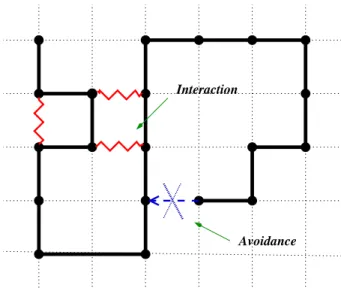
We consider a homopolymer consisting of N monomers which may assume any self avoiding walk (SAW)
config-uration on a three-dimensional lattice. Assuming that the polymer is in a bad solvent, there is an effective monomer-monomer attraction in addition to the self-avoidance con-straint representing excluded volume. For every pair of non-bonded nearest-neighbor monomers the energy of the polymer is reduced byε(See Fig. 1).
Interaction
Avoidance
FIG. 1:Interaction Self Avoiding Walk.
Therefore, the interaction between two nonbonded monomersiand jis given by
ui,j=
∞ r<δ
−ε r=δ
0 r>δ
(1)
whereδis the lattice constant.
The Hamiltonian for the model can be written as
H
=−ε∑
<i,j>
σiσj (2)
620 A. G. Cunha Netto et al.
to exclude pairs of bonded segments along the chain). We are interested in the equilibrium properties at temperatureT. (In the following, temperature is measured in units ofε/kB, where
kBis the Boltzman’s constant.)
In order to generate a Markov process for sampling con-figurations we have first to define a protocol of movements. We used the so-called reptation or “slithering snake”move which consists of randomly adding a monomer to one end of the chain and removing a monomer from the other end, main-taining the size of the polymer constant. We define one Monte Carlo step asN attempted moves. At certain moments, one end of the chain may not be able to move, but successive mo-tions of the other end release it from the trap.
III. THE METHOD
The Wang-Landau algorithm calculates the density of states g(E) by carrying out a random walk in energy space with an acceptance probability proportional to 1/g(E) instead of the usual Boltzmann weighte−E/kBT used in the conventional
Monte Carlo simulation. The probability of energyEchanges therefore fromg(E)e−E/kBT in the Metropolis scheme to an almost constant probability in the Wang-Landau method. As a result the probability minimum which appears at first order phase transitions, for example, practically vanishes. The sim-ulation is performed such that ifE1is the energy of the current configuration andE2is the energy of a possible new configu-ration, the acceptance probability is given by
p(E1→E2) =min
·g(E
1) g(E2)
,1
¸
. (3)
For each accepted configuration we accumulate an energy his-togramH(E). Since the density of states is not knowna pri-ori, Wang and Landau proposed to setg(E) =1 initially, for all energy levels.
To study large systems the energy space is divided into bins and the random walk is carried out independently in each seg-ment. As the random walk in energy space is performed, whenever a move to a configuration with energyEis accepted the density of states is updated by multiplying it by a “modi-fication factor” f>1 that accelerates the diffusion of the ran-dom walk, and an unit is added to the histogramH(E), i.e.
g(E)→g(E)·f; and H(E)→H(E)+1. (4) The initial choice of f is f0=e=2.71828.... The density of states is multiplied by f until the accumulated histogram H(E)is flat. We then reducef by setting
f →pf, (5)
and resettingH(E) =0 for all energy values.
This process is repeated; the simulation converges to the true value ofg(E)when f is approximately 1. In our simu-lations the criterion of flatness was taken as each value of the histogram reaching at least 80% of the mean value hH(E)i. The histograms are generally checked after each 1000 Monte Carlo steps.
0 5 10 15 20 25 30 35 40 45
−60 −50 −40 −30 −20 −10 0
ln g(E)
E
N=50
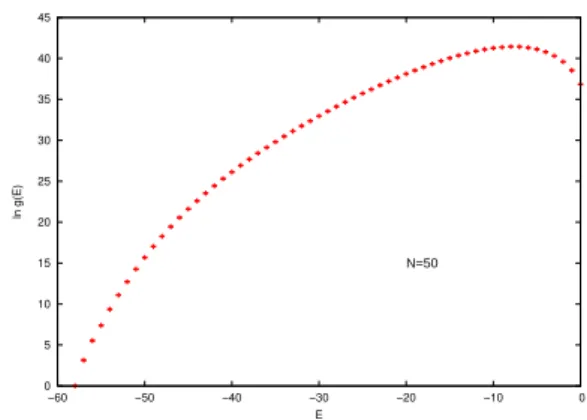
FIG. 2: Density of states for a chain ofN=50 monomers. The
ground state of this chain isEg=−58.
IV. RESULTS
In this section we present results obtained for chains of lattice homopolymers using the Wang-Landau algorithm and compare them with those obtained using Metropolis algorithm importance sampling. In Fig. 2 we show the density of states for a chain of 50 monomers.
The ground state is achieved by shaping a configuration rolled up like a snail (see Fig. 3). The energy of this con-figuration is obtained by counting the number of nonbonded nearest-neighbor pairs. In our simulations the polymer was always set initially in this configuration and, using the algo-rithm described above, the density of states was estimated as a result of a random walk in the energy space.
35 35.5 36 36.5 37 37.5 38 7 7.5
8 8.5 9 9.5 10 33
33.5 34 34.5 35 35.5 36 Z
N=50
X Y
Z
FIG. 3: A ground state configuration forN=50. In this case the energy isEg=−58.
Knowing the density of states, one can calculate any ther-modynamic propertyAof the system through the canonical average
hAiT =∑EhAiEg(E)e
−E/kBT
Z (6)
Brazilian Journal of Physics, vol. 36, no. 3A, September, 2006 621
−60 −55 −50 −45 −40 −35 −30 −25 −20 −15 −10 −5
0 1 2 3 4 5
U
T
Wang−Landau Metropolis
N=50
MT WL
FIG. 4: Temperature dependence of the internal energy for a chain of
N=50 monomers.
each energy levelE, andZis the partition function Z=
∑
E
g(E)e−E/kBT. (7)
In Monte Carlo simulations using Metropolis sampling we fix the temperature and determine the thermodynamic average
hAiT. Therefore a new simulation is needed for each value of temperature. In Wang-Landau sampling we estimate the density of states and then calculate any thermodynamic prop-erty of interest by means of a simple algebraic operation. The computational time in our simulations was about ten times smaller using the Wang-Landau method as compared with the Metropolis algorithm.
In Fig. 4 we show the result for the internal energy via Wang-Landau sampling, evaluated using the relation
U(T) =∑EEg(E)e
−E/kBT
∑Eg(E)e−E/kBT ≡ hEi, (8)
and compare it with that obtained via the Metropolis algo-rithm.
The specific heat can be determined from the fluctuations in the internal energy
Cv(T) =
E2®T− hEi2T
kBT2
. (9)
The temperature dependence of the specific heat is shown in Fig. 5. Much more CPU time would be needed to ob-tain significantly better results using the Metropolis algorithm. One can see clearly from these results that the Wang-Landau method yields a better description in the low-temperature regime.
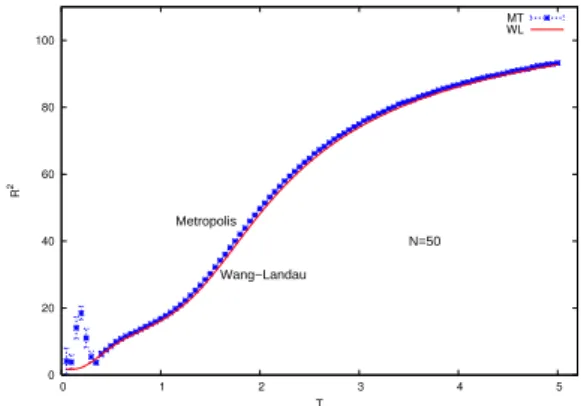
The temperature dependence of the mean square end-to-end distance, given by
R2®
=
[(xN−x0)2+ (yN−y0)2+ (zN−z0)2]® (10) is shown in Fig. 6.
Differentiating expression 6 with regard to temperature us-ing
R2®
as the observableA, we obtain the fluctuation of the mean square end-to-end distance as
d
R2®
T
dT =
ER2®
T− hEiT
R2®
T
T2 . (11)
0 5 10 15 20 25
0 1 2 3 4 5
Cv
T
N=50 Wang−Landau
Metropolis
WL MT
FIG. 5: Specific heat vs. temperature for a chain of N= 50
monomers.
0 20 40 60 80 100
0 1 2 3 4 5
R
2
T Wang−Landau Metropolis
N=50 MT WL
FIG. 6: Mean square end-to-end distancevs.temperature for a chain
ofN=50 monomers.
0 10 20 30 40 50
0 1 2 3 4 5
dR
2/dT
T
N=50 Wang−Landau
Metropolis
WL MT
FIG. 7: Derivative of the mean square end-to-end distancevs. tem-perature. The curve with a peak resembles a second-order phase tran-sition.
The temperature dependence of the derivative of the mean square end-to-end distance is shown in Fig. 7. The coil-globule phase transition is characterized by a peak in the derivative ofR2®similar to the specific heat. We believe that the low-temperature peak corresponds to excitations of the surface of the typically compact, folded configuration. This effect is more pronounced in short chains.
calcu-622 A. G. Cunha Netto et al.
−240 −220 −200 −180 −160 −140 −120 −100 −80 −60 −40
0 1 2 3 4 5
F
T
N=50
FIG. 8: Free energyvs.temperature for a chain ofN=50 monomers.
late the free energy and entropy, quantities that are not directly accessible in conventional Monte Carlo simulations. In terms of the density of states, the free energy can be calculated from the partition function
F(T) =−kBTln(Z) =−kBTln
Ã
∑
E
g(E)e−E/kBT
!
. (12)
0 5 10 15 20 25 30 35 40 45
0 1 2 3 4 5
S
T
N=50
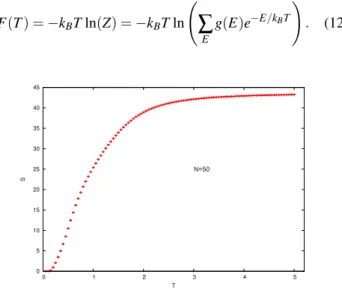
FIG. 9: Entropyvs.temperature for a chain ofN=50 monomers.
The temperature dependence of the free energy obtained
from our simulation is shown in Fig. 8 for a homopolymer withN=50 monomers.
The entropy is a key thermodynamic quantity that cannot be calculated directly by conventional Monte Carlo simula-tion. It can be estimated by integration over other thermody-namic quantities, such as specific heat, but these calculations are somewhat unreliable since the specific heat itself is not easy to estimate accurately. With an accurate density of states estimated by the Wang-Landau method, the entropy can be calculated simply using
S(T) =E(T)−F(T)
T . (13)
In Fig. 9 we show our result for the temperature depen-dence of the entropy for a homopolymer chain of N =50 monomers.
V. CONCLUSIONS
We study the thermodynamic behavior of a three-dimensional homopolymer chain in lattice using the Wang-Landau sampling. We show that the density of states directly obtained by this algorithm enables one to calculate thermody-namic properties even for large systems with only one com-puter run. We also note from the temperature dependence of the specific heat and the mean square end-to-end distance that the low-temperature region is better explored by this method than by standard Monte Carlo simulation. Finally, thermo-dynamic quantities such as the free energy and the entropy, which are not easily accessible by conventional methods, are directly estimated from the density of states.
Acknowledgments
The authors would like to thank the Coordenac¸˜ao de Aperfeic¸oamento de Pessoal de N´ıvel Superior (CAPES), the Conselho Nacional de Desenvolvimento Cient´ıfico e Tec-nol´ogico (CNPq) and the Fundac¸˜ao de Apoio `a Pesquisa (FUNAPE-UFG) for financial support.
[1] N. Metropolis, A. W. Rosenbluth, M. N. Rosenbluth, A. H. Teller, and E. Teller, J. Chem. Phys.211087 (1953).
[2] R. H. Swendsen and J.-S. Wang, Phys. Rev. Lett.58, 86 (1987). [3] B. A. Berg and T. Neuhaus, Phys. Rev. Lett.68, 9 (1992). [4] P. M. C. de Oliveira, Eur. Phys. J. B6, 111 (1998). [5] J.-S. Wang, Eur. Phys. J. B8, 287 (1999).
[6] F. Wang and D. P. Landau, Phys. Rev. Lett.86, 2050 (2001).
[7] F. Wang and D. P. Landau, Phys. Rev. E64, 056101 (2001). [8] D. P. Landau and F. Wang, Braz. J. Phys.34, 354 (2004). [9] D. P. Landau, S.-H. Tsai, and M. Exler, Am. J. Phys.72, 1294
(2004).
[10] P. G. de Gennes, Scaling Concepts in Polymer Physics (Cornell Univ. Press, Ithaca, NY, 1979).