Perolation Transitions and Wetting
Transitions in Stohasti Models
Makoto Katori
Department ofPhysis,Faulty ofSieneandEngineering,
ChuoUniversity,Kasuga, Bunkyo-ku,112-8551 Tokyo, Japan
katoriphys.huo-u.a.jp
Reeived1November1999
Stohasti models with irreversible elementary proesses are introdued, and their marosopi
behaviorsintheinnite-timeandinnite-volumelimitsarestudiedextensively,inordertodisuss
nonequilibrium stationary states and phase transitions. The Domany-Kinzel model is a typial
exampleof suhan irreversible partile system. We rst reviewthis model, and explain that in
aertainparameterregion,thenonequilibriumphasetransitionsitexhibitsanbeidentiedwith
direted perolation transitions on the spatio-temporalplane. Wethen introdue aninterating
partilesystemwithpartileonservationalledfriendlywalkers(FW).Itisshownthatthem=0
limitoftheorrelationfuntionofmfriendlywalkersgivestheorrelationfuntionofthe
Domany-Kinzelmodel,ifwehoosetheparametersappropriately. WeshowthatFWanbeonsideredas
amodelof interfaial wetting transitions,and that thephase transitionsand ritial phenomena
ofFWanbestudiedusingFisher'stheoryofphasetransitionsinlinearsystems. TheFWmodel
may be the keyto onstrutinga unied theory of direted perolation transitions and wetting
transitions. DesriptionsofFWasamodelofinteratingviiouswalkersandasavertexmodelare
alsogiven.
I Introdution
Understanding irreversibility in marosopi systems,
based on reversible proesses of elementary partiles,
is one of the motivations of statistial mehanis. In
theusualequilibriumstatistialmehanis,however,we
onsider statistially stationary states (invariant
mea-sures)in whih detailed balanebetweeneah
elemen-tary proess andthe orrespondingtime-reversed
pro-ess is satised. One way to drive the system outof
equilibrium is to imposean externalfore or eldand
observe the response of the system, or the relaxation
bakto the equilibrium stateafter turning o the
ex-ternal fore. Another way to study irreversibility is
throughoarse-grainedmodeling: Westartat a
meso-sopilevelwithelementaryproesseswhihare
them-selvesirreversible,andonstrutamarosopisystem
from them[1℄.
A typial example of models with irreversible
el-ementary proesses is the ontat proess, whih is
a model of the spread of infetion of a disease. In
this model system, the elementary proesses are (i)
spread ofa disease from aninfeted individual to one
of its healthy neighbors and (ii) reovery from
infe-ane does not hold at all. When an infetion rate is
low,thedisease willbeexterminated, whilewhenit is
high, oexistene of healthy individuals and infeted
ones an be observed if the system is large enough.
Suh a hange of state beomes a sharp transition in
the double limits of innite-time and innite-volume
(thermodynami limit), and denes a nonequilibrium
phasetransitionataertainritialvalueofthe
infe-tionrate. Taking theinnite-timeand innite-volume
limits is neessary to have a mathematially well
de-nedmarosopisystemonstrutedfrommesosopi
levels. The superritial phase in whih healthy and
infeted individuals oexist is a typial example of a
nonequilibrium stationary state. Detaileddesriptions
ofsuhnonequilibriumsystemswillbeoneofthe
start-ingpoints to onstrutageneraltheoryof
nonequilib-riumstatistial mehanis.
In the present paper, we onsider the
disrete-time version of ontat proesses, whih is alled the
Domany-Kinzel model [2℄ and a relatedproess alled
friendly walkers (FW) [3℄, and disuss two kinds of
phasetransitions,diretedperolation (DP)transitions
andinterfaialwettingtransitions. InSetionIIwe
tain parameter region. Using this representation, we
aneasilyunderstandthatnonequilibrium phase
tran-sitionsintheDomany-Kinzelmodel(aswellasthe
on-tatproess)anbeidentied withtheDPtransitions
in two dimensions. Though DP is afamous unsolved
model even in twodimensions,rigorouslowerand
up-perboundsoftheritiallineonaphasediagramhave
beendemonstrated;theyare reviewed there. Thenwe
introdueFWwithtwoparametersinSetionIII.The
Domany-Kinzelmodel involves reationand
annihila-tion of partiles, while the number of walkersis
on-served in FW. We an prove, however, however, the
m = 0 limit of the orrelation funtion of m friendly
walkersgivesthe orrelation funtion of the
Domany-Kinzelmodel,whenweimposeaertainrelationamong
parameters. In Setion IV we show that, if we
iden-tify thespatio-temporalplaneonwhihtrajetoriesof
FW are desribed with two-dimensional spae, the m
FW anberegarded as amodel of interfaial wetting
transitionsinatwo-dimensional(m+1)-phasesystems,
where FW trajetories desribe the ongurations of
interfaes; Fisher'stheory ofphase transitionsin suh
systems [4℄ an be applied. The generating funtions
of two FW anbe evaluated exatlyby a
ombinato-rialmethod. Combiningthis exatresultand Fisher's
theory,theritiallineandritialexponentsare
deter-minedform=2. Two-dimensionalwettingtransitions
are usually modelled byviious walkers [4, 5, 6℄.
Se-tionVis devotedto thepossibledesriptionofFW as
interatingviiouswalkersandasavertexmodelintwo
dimensions.
AttheendofSetionIIIwelaimthatthe
Domany-Kinzel model an be regarded as a\grand-anonial"
ensembleofFWinasense. Thisnewpointofviewlets
us onsider thepossibility ofapplying standard
meth-odsofstatistialmehanis,in theanonialensemble,
to them-FW problem. Usingthe exatlysolvedase,
m =2,wedemonstratein Setion V that the
asymp-totiformofthepartitionfuntionofthevertexmodel,
whihis equivalentto twoFW,an be determinedby
theBetheansatzmethod. Generalizationofthepresent
demonstrationform3isahallengingopenproblem.
II Direted Perolation (DP)
Transitions in Irreversible
Stohasti Models
II.1 The Domany-Kinzel Model
Domany and Kinzel [2,7℄ introdued a lass of
disrete-time proesses on the 1+1 dimensional
spatio-temporalplane
V =f(x;t)2Z 2
:x+t=even; t=0;1;2;g; (1)
where Z =f; 2; 1;0;1;2;g. Their models are
stohasti ellular automata, whih simulate reation
andannihilationproessesofpartilesausedby
short-ranged interations among them [8℄. Eah site x 2V
exists in oneof two states, 0 (vaant) or 1 (oupied
by a partile). Let Z
e
= f; 4; 2;0;2;4;g and
Z
o
=f; 3; 1;1;3;g;the stateat time t=even
(resp. odd) is givenbythe set
t
of sites oupied by
partiles
t Z
e
(resp. Z
o
). The time evolution of
state
t
isgivenbythefollowingstohastirule,
Prob(x2
t+1 j
t
)=f(j
t
\fx 1;x+1gj); (2)
where Prob(!
1 j!
2
)is theonditionalprobabilityof!
1
given!
2
,jAj denotesthenumberofsitesinludedina
set A, andafuntion f isparameterizedbyp
1 andp
2
as
f(N)= 8
<
:
0 N =0
p
1
N =1
p
2
N =2
(3)
with 0 p
1 ;p
2
1. Fig. 1(a) shows the elementary
proesses. Weassume that the initial state is anite
set A Z
e
, jAj < 1, and write the proess starting
from A as A
t
. In partiular, when A is a singleton
fyg;y2Z
e
,wesimplywrite y
t
. Forexample, 0
t isthe
proess starting from only one partile at the origin.
Sine f(0)= 0,the statein whih allsites are vaant
isanabsorbingstateandtheproessisirreversible.
Figure 1. (a) The elementary proesses of the
Domany-Kinzel model
t
. Thefull (resp. open) denote sites
ou-pied by partiles(resp. empty site). (b)Thegadgets for
thediretedperolationrepresentation.
TheDomany-Kinzelmodel anberegardedas the
disrete-time versionof theontatproess. The
lattie(aninteratingpartilesystem)[9-11,1,12℄. The
stateattimetisgivenbytheset
t
2Zoflattiesites
whihareoupiedbypartiles. Thesystemevolvesas
follows:
(i)ifx2
t
,thenx beomesvaantat rate1,
(ii) if x 2=
t
, then x beomes oupied at rate
g(j
t
\fx 1;x+1gj)with
g(N)= 8
<
:
0 N=0
N=1
N=2
(4)
whereandarenon-negativeparameters[13-15℄.Fig.
2illustratesthe aboveelementaryproesses. The
on-tatproessisamodelofspreadofaninfetiousdisease
in onedimension. Anindividualatx2Zisonsidered
infeted if x 2
t
, and healthy ifx 2=
t
. The
param-eter is the infetionrate in the asethat oneof the
neighborsisinfeted. Intheasewherebothneighbors
are infetedthe infetionrateis givenby multiplied
by . The proess with = 2 is usually alled the
basi ontat proess, and wasrst studied by Harris
[16℄. The proess with = 1 is alled the threshold
ontatproessbyLiggett[17℄. Thebasiontat
pro-ess isequivalenttotheReggeon quantum spinmodel
in high-energyphysis[18-20℄. Dikman andBurshka
[21℄studiedanonequilibriumlattiemodelasa
simpli-edversionofthemodelforatalytisurfaesproposed
byZietal[22℄.TheirmodelisalledtheAmodelbut
isequivalenttothethresholdontatproess. Seealso
DikmanandTome[23℄ forotherrelatedmodels.
Figure2. Theelementaryproessesoftheontatproess.
Thefullirlesdenotepartilesandtheopenirlesdenote
vaanies.
Theontatproessexhibitsanonequilibriumphase
transition from the extintion phase to the survival
phase uponinreasing theinfetion rate,for eah .
The formerphase, in whih uniquestationary stateis
the trivial absorbing state, represents the
extermina-tion of disease, while in the latter phase the proess
hasanontrivial,nonequilibriumstationarystate,whih
representstheoexisteneofinfetedandhealthy
indi-viduals. Thephasediagramoftheontatproesswas
nonequilibrium phase transitions whih are similar to
thetransitionsoftheontatproess.
II.2 DP Transitions
Intheparameterregion
p
1 p
2 2p
1
; (5)
we see diret orrespondene betweenthe phase
tran-sitionsof theDomany-Kinzelmodel and direted
per-olationtransitions [2,7,10,25℄. As shown inFig.1 (b),
at eah triangle of three sites (x 1;t);(x+1;t) and
(x;t+1), the following `gadgets' are plaed
indepen-dently: Twoarrowswithprobabilityp,onearrowwith
probability q (to the northeastand to the northwest,
respetively),andnothingwithprobability1 p 2q.
Thearrowmeansthatthedireted bond fromthesite
at the bottom of the arrow to the site at the top of
the arrow is open. If there is a sequene (x
0 ;t) =
(x;t);(x
1
;t+1);;(x
n
;t+n) = (y;t+n) (n 1)
ofsites inV suhthatforeah 0in 1thebond
from(x
i
;t+i)to(x
i+1
;t+i+1)isopen,thissequene
isalled an open pathfrom (x;t) to (y;t+n)and we
write (x;t) ! (y;t+n). Then for aset A Z
e we
deneaset ^ A
t by
^ A
t =
[
x:x2A
fy:(x;0) !(y;t)g: (6)
Itiseasytoonrmthatifandonlyif
p
1
=p+q and p
2
=p+2q; (7)
the proess A
t
that evolves by (2) with (3) from the
initialstateAZ
e
isequalto^ A
t
. Sinewemusthave
0p;q1and 01 p 2q1,thisdireted
per-olation representation oftheproessispossibleifand
onlyif(5)issatised.
In the parameter region (5), the Domany-Kinzel
modelinludesthefollowingperolationmodelsas
spe-ialases.
diretedsiteperolation(DSP)withsite
on-entration
p
1 =p
2
= (p=; q=0) (8)
direted bond perolation (DBP) with bond
onentration
p
1 =; p
2
=(2 ) (p= 2
; q=(1 )) (9)
p
1
=; p
2
=(2 ) (p=
2
; q=(1 ))
(10)
When (5) is satised, we an dene aperolation
transitionfortheDomany-Kinzelmodel. Considerthe
probability t (p 1 ;p 2
)=Prob( 0
t
6=;): (11)
Intheparameterregion(5),sinetheperolation
rep-resentation ensures that it is non-inreasing in t, the
innite-timelimitiswell-dened,
(p
1 ;p
2
)= lim
t!1 t (p 1 ;p 2 ): (12)
(Itiseasyto provethat(p
1 ;p
2
)=0for0p
1 1=2,
0 p
2
1 [10℄. ) For eah 0 p
2 1, (p 1 ;p 2 )
is anon-dereasing funtion of p
1 , ifp
1 p
2
, and we
anuniquely dene theritial valuep
1 (p
2
)by using
(p
1 ;p
2
)asanorderparameteroftheperolation
tran-sitionas
p
1 (p
2
) = supf0p
1
1:(p
1 ;p
2 )=0g
= inff0p
1
1:(p
1 ;p
2
)>0g: (13)
Weall t (p 1 ;p 2
)thet-step perolation probability and
(p
1 ;p
2
) the perolation probability of the
Domany-Kinzelmodelwithparametersp
1 ;p
2
. Intheregion(5),
p 1 =p 1 (p 2
), 0 p
2
1, givesa ritial line on the
(p
1 ;p
2
)-phasediagram.Thep
1
oordinatesofthe
ross-ingpointsofthisritiallinewiththelinesp
2 =p 1 and p 2 =p 1 (2 p 1
)givetheritialonentrations
and
ofDSPandDBP,respetively.
Rigorous lower and upper bounds for the ritial
line (13) were alulated in the region (5) by Katori
and Tsukahara [25℄ and by Liggett [26℄, respetively.
Let B ` (p 1 ;p 2
) = f1 p
1 (p 2 p 1 )gf1 (p 2 p 1 )g
1 f1 (2p
1 p 2 )gp 1 (p 2 p 1 ) 2 (1 p 1 ) b 1 (p 1 ;p 2 ) +fp 2 p 1 (2 p 1 )gp 2 1 (p 2 1)(p 1 1) 2 b 2 (p 1 ;p 2 ) (14) with b 1 (p 1 ;p 2
) = 2p 6 1 (p 2 +2)p 5 1 (p 2 2 2p 2 2)p 4 1 +(3p 2 2 3p 2 1)p 3 1 4p 2 (p 2 1)p 2 1 +(3p 2 1)(p 2 1)p 1 (p 2 1) 2 ; (15) b 2 (p 1 ;p 2
) = (p
2 +1)p 6 1 (3p 2 2 +3p 2 1)p 5 1 +p 2 2 (3p 2 +4)p 4 1 (p 4 2 +3p 3 2 +4p 2 2 p 2 2)p 3 1 +(p 4 2 +4p 3 2 p 2 2 2p 2 +1)p 2 1 (p 2 1)(p 3 2 +p 2 2 +2p 2 +1)p 1 +(p 2 +1)(p 2 1) 2 ; (16) and B u (p 1 ;p 2 )=p
2 4p 1 (1 p 1 ): (17) Dene p 1` (p 2
)=supfp
1 :p
2 =2p
1 p 2 andB ` (p 1 ;p 2 )<0g
p
1u (p
2
)=supfp
1 :p
2 =2p
1 p 2 andB u (p 1 ;p 2
)>0g: (18)
Then[25,26℄ d p 1` (p 2 )p
1 (p
2 )p
1u (p
2
): (19)
FortheDSP(8)and theDBP(9) ases,(19)gives
0:688
3=4; 0:626
2=3; (20)
where the lower bound of
was originally given by
Dhar [27℄. The mostreliablevaluesfor
and
es-timatedsofar aregivenbyJensenand Guttmann[28℄
by the series expansion method as
= 0:705485
0:000005and
=0:64470060:0000010.
Fig. 9in [25℄showsthelowerandupperbounds in
the (p
1 ;p
2
)-plane. We ansee that lim
lim
p2!1 p
1u (p
2
) = 1=2 and then (19) determines
p
1
(1) = 1=2. Exat values of p
1 (p
2
) are not known
exept forthisspeial asep
2
=1. Thoughwedonot
knowtheexatloationoftheritialline,thebounds
(19)ensurethatbothextintionphase(non-perolation
phase) and the survivalphase (perolation phase) are
non-emptyin thephasediagram,and weertainly
ob-servedireted perolationtransitions in theregion(5)
of theDomany-Kinzelmodel.
III Friendly Walkers (FW)
III.1 Denition of FW
Letusonsideranenumerationproblemofweighted
paths of m(1) walkerson Z with disretetime. At
timet=0,allwalkersareattheoriginandtheymove
simultaneouslyin time. At eah time step t ! t+1,
eah walker steps either to the right or left
nearest-neighborsitewithequalprobability. Twoormore
walk-ers anoupy the samesiteon Z and theyan walk
together. We all a set of walkers whih oupy the
samesiteagroup. (Whenthereisonlyonewalkerata
site,thegroupisasingleton.) Welabelthem walkers
byintegers1,2,mandtheloationofthei-thwalker
at time siswritten as x
i
(s). Weimposethefollowing
non-rossingondition.
Non-CrossingCondition: Foranys0,
x
1 (s)x
2
(s)x
m
(s): (21)
Weintroduetwoparametersp0and 0;the
weights of the movement of the m walkers are
deter-minedasfollows.
Weight p s
s
: At eah time 1 s t,
let s
s
be the number of groups (i.e. s
s =
jfx
1 (s);x
2
(s);;x
m
(s)gj). Then weinlude a fator
p ss
in theweight.
Weight `s
: Ateahtime1st,let`
s bethe
number of distint sites at whih two dierent groups
of walkers join together at that time, the two groups
havingbeenseparateattheprevioustime. Weinlude
afator `s
in theweight.
Whentwoormorewalkerswalktogetheralongthe
samepath,s
s
remains small, but iftheytend to walk
separately, then s
s
inreases and the weight p ss
de-reases, sine 0 p 1. This shows that the
walk-ersprefer to work together than walk alone. For this
reason,theyarealledfriendlywalkers(FW)[3,29,30℄.
Fig. 3(a)showsanexampleoftrajetoriesofthethree
(m=3) FWupto t=17.
III.2 Generating Funtions of FW
Itshouldbenotedthatthesetofsites(x;t)onZ 2
,
onwhih walkersanpassupto time t0, denesa
downward-pointingtriangularregionin thelattie
V
t
=f(x;s)2Z 2
:x+s=even; 0stg: (22)
The trajetory of one walker is expressed by a path,
whih is a sequene of suessive bonds, and a set of
trajetoriesofmwalkersisaunionofsuhpaths.
Weonsider aunionof paths,eahof whih starts
from the origin (0;0) and terminates at one of the
sites in f(x
1 ;t);(x
2
;t);;(x
k
;t)g, where x
1 < x
2 <
< x
k
. Suh a union of paths makes a graph g
with gj
0
= f0gand gj
t =fx
1 ;x
2 ;;x
k
g. Wedene
t (0;x
1 ;x
2 ;;x
k
) to be the set of all suh graphs.
Eahgraphg2
t (0;x
1 ;x
2 ;;x
k
)isharaterizedby
thefollowingquantities,
s(g) = thenumberofsites ing ;
b(g) = thenumberofbondsin g;
`(g) = thenumberofloopsin g: (23)
By denition, s(g) = P
t
s=1 s
s
and `(g) = P
t
s=2 `
s ;
wheres
s and`
s
arepowersofweightsp ss
and `s
for
thes-thstepoftheFW.
For a given graph g 2
t (0;x
1 ;x
2 ;;x
k
),
how-ever,theremaybemanydierentrealizationsofmFW,
whih orrespondto thesamegraphg. Let (g;m)be
the number of thedistint realizations of m FW
or-responding to graph g. The (k+1)-point generating
funtionofmfriendlywalkersisdenedas
Z
t
(p;;0;x
1 ;x
2 ;;x
k ;m)=
X
g:g2 t(0;x1;x2;;x
k )
(g;m) `(g)
p s(g) 1
: (24)
Thenwedene thegeneratingfuntion ofmFWas
Z
t
(p;;m)= X
k :k 1
X
fxig:x1<x2<<xk Z
t
(p;;0;x
1 ;x
2 ;;x
k
III.3 Relation between DP and FW
Dene the(k+1)-pointorrelationfuntion
C
t (p
1 ;p
2 ;0;x
1 ;x
2 ;;x
k
)=Prob( 0
t (x
i
)=1for1ik) (26)
fortheDomany-Kinzelmodel,where fx
1 ;x
2 ;;x
k gZ
e
(resp. Z
o
)fort=even(resp. odd), andweassumethat
x
1 <x
2
< <x
k
. Arrowsmith andEssam [31℄ provedthe followingformulafor direted site-bond perolation
(10),
C
t
(;(2 );0;x
1 ;x
2 ;;x
k )=
X
g:g2 t(0;x1;x2;;x
k )
( 1) `(g)
s(g) 1
b(g)
; (27)
whereand arethesiteandbondonentrations,respetively. Thisisalledthelow-densityexpansionformula,
sinetheright-handsideisapowerserieswithrespettotheonentrationsand;ithasbeenusedforalulating
seriesexpansionsforthepair-onnetednessfuntionsfordiretedperolationmodels[32,33℄. Thisformulaanbe
generalizedfortheDomany-Kinzelmodelas
C
t (p
1 ;p
2 ;0;x
1 ;x
2 ;;x
k )=
X
g:g2 t(0;x1;x2;;x
k )
( 1) `(g)
2p
1 p
2
p
1
`(g)
p s(g) 1
1
: (28)
Theproofisgivenin[34℄.
Sofarwehaveassumedthatmisaninteger,butweanallowmbeanyrealnumber,sine(g;m)isapolynomial
inmandthegeneratingfuntionsofthemFWdependonmonlythrough(g;m). CardyandColaiori[29℄proved
lim
m!0
(g;m)=( 1)
k 1+`(g)
; (29)
forg2
t (0;x
1 ;x
2 ;;x
k
). Thenwehave
C
t (p
1 ;p
2 ;0;x
1 ;x
2 ;;x
k
)= lim
m!0 ( 1)
k 1
Z
t (p
1 ;
2p
1 p
2
p
1
;0;x
1 ;x
2 ;;x
k
;m): (30)
Let
t (p
1 ;p
2 )andZ
t
(p;;m)bethet-stepperolationprobabilityoftheDomany-Kinzelmodeldenedby(11)
andthegeneratingfuntionofthemFWdened by(25). Bytheprinipleofinlusionandexlusion
t (p
1 ;p
2 )=
X
k :k 1 ( 1)
k 1
X
fxig:x1<x2<<x
k C
t (p
1 ;p
2 ;0;x
1 ;x
2 ;;x
k
); (31)
weanonludethat
d
t (p
1 ;p
2
)= lim
m!0 Z
t (p
1 ;
2p
1 p
2
p
1
;m): (32)
Bythedenition of (g;m), ifmis xedas a
non-zeroniteinteger,(g;m)=0forgraphshavingm+1
ormore sites ona onstant-timeline (horizontal line)
in V
t
. This means that Z
t
(p;;0;x
1 ;x
2 ;;x
k ;m) is
a partial sum of the graphs g in
t (0;x
1 ;x
2 ;;x
k ).
On the other hand, (29) shows that (g;0) 6= 0 for
anyg andtheformula(28)assertsthat thetotal
sum-mation of all graphs g 2
t (0;x
1 ;x
2 ;;x
k ) gives
the(k+1)-pointorrelationfuntion forthe
Domany-Kinzel model. This is reason why we an obtain the
Domany-Kinzel model, in whih partiles are reated
and annihilated, as a limit of FW, in whih partiles
are onserved. If weonsider the m FW as a
anon-ial system with a xed number of partiles m, then
weansaythattheDomany-Kinzelmodelisa
\grand-anonial"ensembleofFW.
IV Wetting Transitions
IV.1 Fisher's Theory of Phase T
ransi-tions in Linear Systems
Therelations(30)and(32)implythatthe
Domany-Kinzel model an be onsidered as the m = 0 limit
of the m-FW problem. As explained in Setion II,
theDomany-KinzelmodelexhibitsDP-liketransitions.
What are the orresponding phase transitions in
sys-temsofmFW?Sinetheorderparameter(12)ofthe
theasymptoteofZ
t
(p;;m)fort1shouldbestudied
in themFW.
In Fig.3 (a), whih shows an example of a set of
trajetoriesof3-FW,wean lassifythetimeintervals
into twotypes: Theintervalsin whihallwalkerswalk
together (i.e. there is only one group), and those in
whih they areseparated into twoormore groups. If
weignorethedetailsofthewaysofwalkinginthelatter
intervals,the set oftrajetoriesanbe representedby
a simple linearsystem in the form of a \neklae" as
showninFig.3(b).
Figure 3. (a)Anexampleoftrajetories ofthree(m=3)
FW up to t = 17. (b) A linearsystem in the form of a
\neklae".
Fisherdisussedasimplebutgeneralmathematial
mehanismwhihmakessuhlinearsystemstodisplay
phasetransitions[4℄. Inhispaper,manypossible
appli-ationsofhis theoryto physialphenomenaaregiven.
Weseletoneofthemhere,aninterfaialwetting
tran-sitionin atwo-dimensional(m+1)-phasesystem. Fig.
4(a)illustratesthesystem,inwhihtheB
1 ;;B
m 1
phases are onned between the bulk A and bulk C
phases. As a parameter(e.g., thetemperature of the
system) is varied, the interfae AjjC beomes wet by
intermediate phasesB
1 ;;B
m 1
, that is , awetting
transition ours (Fig.4(b)). Now we borrow Fisher's
theory and disuss the phase transitions and ritial
phenomenaofthemFW.
Figure4. Ainterfaialwettingtransitionfromthe(a)
non-wettingphasetothe(b)wettingphase.
The redued free energy per unit (time) length is
denedas
f(p;;m)= lim
t!1 1
t lnZ
t
(p;;m): (33)
Fisherpointedoutthataneetivewayto alulatef
istointroduethegrandgenerating funtion
G(p;;m;z)= 1
X
t=0 z
t
Z
t
(p;;m); (34)
where z is the ativity-like variable. Then if
z
min
(p;;m) is the positive real singularity of
G(p;;m;z)nearesttheoriginz=0,then
f(p;;m)=lnz
min
(p;;m): (35)
Here thesingularity ofG(p;;;m;z) willome from a
simplepole1=(z
min
z),orfromanonanalytipoint,
suhasasquare-rootbranhpoint p
z
min z.
ForourFWsystem,thegrandgeneratingfuntions
areonstrutedasfollows. Firstwedenesetsofgraphs
(k )
t (0)=
[
fxig:x1<x2<<x
k t
(0;x
1 ;x
2 ;;x
k ) (36)
and
t (0)=
[
k :k 1 (k )
t
(0): (37)
Then(25)with(24)isrewrittenas
Z
t
(p;;m)= X
g:g2
t (0)
(g;m) `(g)
p s(g) 1
: (38)
Ingeneralwend asite, exeptthe origin(0;0), in a
the origin(0;0) 2 V
t
is disonneted from any site in
g\f(x;t):x 2Zg. Suh sites arealled nodal points
[35℄.
In termsof theFW, thenodalpoints arethe sites
(exepttheoriginatt=0)atwhihallmwalkersform
asingle group,(i.e., throughwhih thetrajetoriesof
allwalkersmustpass). Dene
N
t
(0;x)= asetofallgraphsin
t
(0) whihhaveonlyone
nodalpointat(x;t)exeptat(0;0), (39)
N(1)
t
(0)= [
x:x2Z N
t
(0;x); (40)
N
t
(0)=asetofallgraphsin
t
(0)whihhavenonodalpoint
pointexeptat(0;0). (41)
ThesupersriptNmeansnon-nodalgraphs. Thenweintrodue,form2,
G
1
(p;;m;z)= 1
X
t=2 z
t X
g:g2 N(1)
t (0)
(g;m) `(g)
p s(g) 1
(42)
and
G
2
(p;;m;z)= 1
X
t=1 z
t X
g:g2 N
t (0)
(g;m) `(g)
p s(g) 1
: (43)
It should be noted that G
1
(p;;m;z) and G
2
(p;;m;z) are the partial generating funtions for \beads" in the
middle and at the end of the \neklae"of Fig.3(b). The partial generating funtion for \string" parts of the
neklaeis
G
0
(p;;z) = 1
X
t=0 z
t
(2p) t
= 1
1 2pz
: (44)
Itiseasytoonrmthat
G(p;;m;z) = G
0 +G
0 G
1 G
0 +G
0 G
1 G
0 G
1 G
0 +
+ G
0 G
2 +G
0 G
1 G
0 G
2 +G
0 G
1 G
0 G
1 G
0 G
2
+ (45)
andforsuÆientlysmallz,
G(p;;m;z)= G
0
(p;;z)(1+G
2
(p;;m;z))
1 G
0
(p;;z)G
1
(p;;m;z)
: (46)
Thepole ofG(p;;m;z)isdetermined by1 G
0
(p;;z)G
1
(p;;m;z)=0,thatis,
G
1
(p;;m;z)=1 2pz: (47)
d
Sine2pz+G
1
(p;;m;z)isbydenitioninreasing
in z (42),theequation(47)hasat mostonereal root.
We an see that the root of (47) is smaller than the
pole of G
0
(p;;z), z
0
=1=(2p). We will assume that
thesingularities ofG
2
(p;;m;z)are equalto those of
G
1
(p;;m;z). (Weanseethisis theaseform=2.)
trated by Fig.4. A loal struture at the end of the
\neklae" desribed by G
2
(p;;m;z) will not aet
the globalstruture of \neklae" at least in the
non-wetting phase. Then the singularity of G(p;;m;z)
may be either a simple pole at the real root of (47),
or the positive real singularity of G
1
problem is todetermine whih is smaller. Iftheorder
of these twopointsonthe realaxisof z is hangedas
theparametershange,thehangeoff(p;;m)maybe
nonanalyti,andmustorrespondtoaphasetransition.
Fisher[4℄onsideredthefollowingpossibleformsof
G
1
(p;;m;z)intheviinityofthesingularityz
1
=1=w.
G
1
(p;;m;z) '
G
1s
(1 wz) 1
for <1 (48)
' G
1s
ln(1 wz) 1
for =1 (49)
' G
1 G
1s
(1 wz) 1
+G
11
(1 wz)+
for >1; (50)
where
d
G
1
= G
1
(p;;m)
G
1
(p;;m;1=w) (51)
and G
1s
istheamplitudeofthe leadingsingularity. It
is onluded[4℄ that when 1, z
min =e
f
is always
given by the real root of (47) and there is no phase
transition. On theotherhand,when >1,there isa
phasetransition. Weshowin thenextsubsetionthat
thelatteris theasefortwofriendlywalkers(m=2),
whenweregarditasamodelofinterfaialwetting
tran-sitions.
IV.2 Wetting Transitions of the m = 2
FW
Itiseasytoalulatethegrandgeneratingfuntions
fortwoFW (m=2) by themethod of images[36, 4℄.
Inpartiular,G
1
(p;;2;z)isdeterminedas
G
1
(p;;2;z) = (p 2
z) 1
X
t=1
2(t 1)
t 1
2(t 1)
t+1
(p 2
z) t 1
(pz)
= pza(p 2
z); (52)
where a(x)isthegeneratingfuntion oftheCatalannumber[37℄
a(x)= 1
2x
1 2x p
1 4x
: (53)
Weanrewrite(52)as,
G
1
(p;;2;z)=
4p
2p (1 4p
2
z) 1=2
+
4p (1 4p
2
z): (54)
Thenthethird ase(50)isrealizedwith
1
z
1
=w=(2p) 2
and =
3
2
: (55)
d
It should be noted that a square-root branh-point
z
1
=1=w=1=(2p) 2
isasingularpointbutG
1
(p;;2;z)
remainsniteasz!z
1 : G
1
(p;;2)==(4p)<1.
Now we determine the wetting transition point of
twoFW (m=2) followingthetheory ofFisher. First
weonsider thespeialaseinwhih =1. Fig. 5(a)
showsy = G (p;1;2;z) and y =1 2pz as funtions
ofzforp=0:6. Therossingpointgivesaroot ofthe
equation(47),whihissmallerthanz
1
=1=(20:6) 2
=
0:694. On the other hand, when p = 0:8, (47)
hasno real root, as shown in Fig.5 (). Figure 5 (b)
shows the ritial ase with p = p
w
= 3=4. In this
ase, aline y = 1 2pz goes througha ritial point
(z
1 ;G
1
(p;1;2)) = (1=(2p
w )
2
;1=(4p
w
Then for the ase =1, when p <3=4, the redued
freeenergy f isgivenbythe root of (47)andthe
sys-tem is non-wetting (the ase of Fig.4 (a)), and when
p>3=4,f =lnz
1
= 2ln(2p)and thesystemis
wet-ting(the aseof Fig.4(b)). Thewetting transition
o-urs at p = 3=4. In the general ase 0, we an
onludethefollowing.
4p <1
1
2p
() wetting
4p >1
1
2p
() non-wetting: (56)
For eah 0, the ritial value of p at whih the
wettingtransition oursisgivenby
p
w ()=
4 +
1
2
: (57)
For p<p
w
therealrootof(47),atwhihG(p;;2;z)
hasasimplepole, isgivenby
z
pole
(p;)= 1
(2 ) 2
p 2
h
(2 )p + p
( 2)p+1 i
:
(58)
Sine
z
pole (p;)
1
(2p) 2
'
16
(+2) 2
2
(p
w
() p) 2
(59)
for0<p
w
() p1,wehavethereduedfreeenergy
in theform
f(p;;2)=f
r
(p;2)+f
s
(p;;2) (60)
witharegularpart
f
r
(p;2)= 2ln(2p) (61)
andasingularpart
f
s
(p;;2)= (
4
2
(p
w
() p) 2
+ forpp
w ()
0 forp>p
w ():
(62)
d
Figure5. Theurvesy=G
1
(p;1;2;z)andlinesy=1 2pz
for(a)p=0:6,(b)p=3=4and()p=0:8.
If we dene the spei-heat ritial exponent
throughf
s (p
w
() p) 2
,wehave
=0: (63)
Fishergaveageneralsalingrelation
= 2 3
1
; (64)
where istheexponentin(48)-(50)[4℄.
The result (30) shows that if we set p = p
1 and
= (2p
1 p
2 )=p
1
, and take the m ! 0 limit, then
FW beomes the Domany-Kinzelmodel. Here we set
p = p
1
; = (2p
1 p
2 )=p
1
for the two FW (m = 2).
Fig. 6 shows the phase diagram of two FW in the
(p
1 ;p
2
)-plane. The ritial line (57) is now given by
p
1 =p
1w (p
2 )with
p
1w (p
2 )=
1
2 +
1
2 p
1 p
2
: (65)
It should be noted that p
1 = p
1w (p
2
) oinides with
the line p
1 = p
1u (p
2
) given by (18) with (17), whih
gives the upper bound for the DP ritial line of the
Figure 6. Thephase diagram ofthe two FW (m=2) on
the (p
1 ;p
2
)-phasediagram. Thehathedregion,p
2 >2p
1 ,
shouldbeignored,sine <0there.
To lose this setion, we give an interpretation of
theresultsfortwoFWagainfromtheviewpointofthe
wettingtransition. When m=2,thesystemisa
two-dimensional,three-phasesystemomposedofA;Band
C phases (seeFig.4). Ifwewrite thesurfaetensions
of the AjB and BjC interfaes at temperature T as
AB
(T) and
BC
(T),respetively,the regularpartof
thereduedfreeenergymaybewritten as
f
r
(p;2)=(
AB
(T)+
BC (T))=k
B
T: (66)
Comparing this with (61), we an put
AB (T) =
BC
(T)= k
B
Tln(2p)or
2p=e
AB (T)=k
B T
=e
BC (T)=k
B T
: (67)
Therefore, hanging the parameter p orresponds to
hanging the temperature T of the system. On the
other hand, the parameter an be regarded as an
ativity assoiated with the end of the \beads" of B
phase. LetT
w
()be theritial temperature of
wet-tingtransitionorrespondingtop
w
()and
AC (T)be
thesurfaetensionbetweenthebulkA and Cphases.
Then(60)-(62)gives
AC (T)
=
AB
(T)+
BC
(T) A
0 (T
w
() T) 2
+ forT T
w ()
AB
(T)+
BC
(T) forT >T
w ()
(68)
d
withaonstantA
0
. Thisdesriptionofinterfaial
wet-ting transitions in two-dimensional uids is found in
[4℄.
V FW as an Interating Viious
Walkers and Vertex Model
V.1 Interating Viious Walkers
Inthis setion,weonsiderthe mFW witha
on-dition
=p; (69)
whih orresponds to DBP when we put p = p
1 ,
= (2p
1 p
2 )=p
1
and m = 0. Using Euler's law
`(g)=b(g) s(g)+1,(38)beomes
Z
t
(p;p;m)= X
g:g2
t (0)
(g;m)p b(g)
: (70)
As shown in Fig. 7(a), we onsider m FW, in whih
all walkersstart from theorigin and the non-rossing
ondition (21)has been imposed. Foreahset of
tra-jetories of m FW, we an make a set of trajetories
by shifting the i-th trajetory to the right by (i 1)
lattie-units as shown in Fig. 7(b). Suh a graph is
alledapolymer brushwithm branhes [6℄.
Figure7. ConstrutionofthevertexmodelfromthemFW.
Thenon-rossingonditionismappedtothe
ondi-tionwithstritinequalities,
Walkerssubjetto theondition(71)aredesribedas
viious walkers [4, 5, 6, 38, 39℄, sine they anbe
re-garded asthe survivingwalkerswhoshoot eah other
dead (i.e., pair annihilation) when wheyarriveat the
samesite (x
i (s)=x
i+1
(s) forsomei). If p=1, (70)
is the total number of ways of m viious walkers to
walksuhthattheyallsurviveforatleastt time-steps
startingfromthesitesx
i
=i 1(i=1;;m).
Let h(g) be the number of pairs of bonds whih
run parallel to eah other, maintaining a distane of
one lattie unit (h(g) = 6 for Fig. 7(b)). Then
p b(g)
= p mt
p h(g)
for m walkers up to time t. It
meansthat the mFW model is aninterating viious
walkermodel,in whih ifapairofnearest-neighboring
walkerswalkparalleltoeahotherforonetimestep,the
walkisweightedbyp 1
. (Ifthreeneighbors walk
par-alleltooneanother,theyareregardedastwopairsand
theweightarriesafatorof p 2
.) Sinep 1
>1,the
walkersprefertowalkparalleltooneanother. Thuswe
an saythatthese viiouswalkersarefriendlytotheir
neighbors,aslongas theydon'tgettoolose!
V.2 Ten-Vertex Model
Interating viious walkers an be desribed by a
kindofvertexmodel. Foreah trajetoryofthe
inter-atingviiouswalkers,drawarightontourasshownin
Fig. 7(). Thenerasethetrajetoriesoftheinterating
viiouswalkersand identify aset of ontours asaline
of ongurations of avertex model (Fig. 7(d)). Note
that alllines havediretions whih arerepresented by
arrowsateahbond(segmentsoflines).
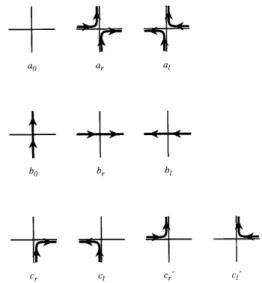
Weintrodueaten-vertexmodel. Thetenloal
di-retedlineongurationsat avertexareshownin Fig.
8. Eahbondisinoneofthefourstatesrepresentedby
anupwardarrow,aleftwardarrow,arightwardarrow,
or nothing. Down arrows are forbidden and the
non-rossing ondition is imposed. We assign the weights
a
0 ;a
r ;a
` ;b
0 ;b
r ;b
` ;
r ;
` ;
0
r ;
0
`
forthetenongurations,
asshowninFig.8. Weassumetheinitialonguration
(the boundary ondition at the bottom on a
spatio-temporalplaneV
t
),suhthattherearemupwardlines
atx=0;1;2;;m 1,andsumupallongurations
of direted lines with appropriate weightsin whih m
direted lines are onserved upto time t. There is no
restritionontheongurationsatthenaltimet. The
partitionfuntion oftheten-vertexmodelisdenedas
Z 10v
t (a
0 ;a
r ;a
` ;b
0 ;b
r ;b
` ;
r ;
` ;
0
r ;
0
` ;m)=
X
allowedong : Y
(weights): (72)
d
The onstrution of the vertex model for m FW
shownin Fig.7yieldstheidentity
Z
t
(p;p;m)=p mt
Z 10v
t (1;
1
p ;
1
p
;0;0;0;1;1;1;1;m):
(73)
Sine all straight lines aross a vertex are forbidden,
b
0 =b
r =b
`
=0,andtheleft-rightsymmetryrelations,
a
r = a
`
(= 1=p),
r =
`
(= 1), and 0
r =
0
`
(= 1), are
satised,weansaythat them FWwith (69)anbe
mappedtoasymmetriseven-vertex model.
Ifweonsiderthetotallyasymmetriasesuhthat
a
` =b
` =
` =
0
`
=0,whereallleftwardlines are
for-bidden,thearrowsputonbondsanbeerasedandthe
ongurationsare represented by undireted lines. In
this ase the system is identied with the six-vertex
model[40℄,
Z 10v
t
(a;a;0;b;b;0;;0;;0;m)=Z 6v
t
(a;b;;m): (74)
Asshownin[40℄,thesix-vertexmodelanbemapped
to the ritial q-state Potts model. We have the
fa-mousresultbyKasteleynandFortuin[41,42℄,thatfor
problem an be formulated using the q ! 1 limit of
the q-state Pottsmodels. Then wean onludethat
theundireted perolationproblem anbe formulated
in termsofthetotallyasymmetri(six-)vertexmodel.
Figure 8. Theten kinds of direted-lineongurations in
(69), whose m = 0 limit gives the DBP system, is
mapped to thesymmetri (seven-)vertex model. The
followingorrespondeneisnowlaried.
Perolation VertexModel
undireted () asymmetri
direted () symmetri (75)
It isinterestingtoseethatdireted perolation, whih
an be dened as a proess with time-irreversibility,
(that is, totally asymmetri in time diretion)
orre-spondstothesymmetriaseofthevertexmodel.
V.3 Bethe Ansatz and Exat Solvability
Thesix-vertexmodelanbesolvedexatlyby the
Bethe ansatz[40℄. Weansee thatthe total
asymme-try of the six-vertex model is essentialto allow us to
use the Bethe ansatz to solve the problem. We will
show here, however, an attempt to apply the Bethe
ansatz method to the symmetri vertex model. First
weonsider anite squarelattie witht rows(t steps
in the time diretion) and L olumns (L sites in the
spatialdiretion)andassumeperiodiboundary
ondi-tionsinthespatialdiretion. ThestateX oneahrow
is speiedby theloationsof m lines onthe L sites,
X =fx
1 ;x
2 ;;x
m
g. LetT betherow-to-row
trans-fer matrixofourten-vertexmodel, aneigenvalueof
T,andg theorrespondingeigenfuntion,then
g(X)= X
Y
T(X;Y)g(Y): (76)
Whentislarge,Z 10v t t max ,where max
isthe
max-imumeigenvalueofT.
The m= 1ase is trivial. For m =2, we assume
theformof theBetheansatzforg(X),
g(x
1 ;x
2 )=A
12 x 1 1 x 2 2 +A 21 x 2 1 x 1 2 ; (77) where A 12 ;A 21 ; 1 ; 2
are omplex numbers. We
nd for the symmetri seven-vertex model,
(a 0 ;a r ;a ` ;b 0 ;b r ;b ` ; r ; ` ; 0 r ; 0 `
) =(1, 1=p, 1=p, 0, 0, 0,
1,1,1,1), thatiftheYang-Baxterrelations
N 1 = A 12 A 21 ; N 2 = A 21 A 12 ; A 12 A 21 = 2 [(1 p)( 2 1 +1= 2 2 ) p℄ 1 [(1 p)( 2 2 +1= 2 1 ) p℄ (78)
aresatised,then
( 1 ; 2 )= 1 + 1 1 2 + 1 2 : (79)
Themaximumeigenvalue
max
willbeobtainedby
setting =1andthesolutionof(78)determines,in
theL!1limit,
max (p)= (p 2) 2 2p(1 p) : (80)
Then(73)gives
Z
t
(p;p;2) t
max
for t1 (81)
with
max
(p) = p 2 max (p) = p(p 2) 2 2(1 p) : (82)
Itshouldbenotedthattherelation
max (p)= 1 z pole (p;p) (83)
holds, where z
min
(p;p) is given by (58) with = p.
That is, in the ase of m = 2 with (69), the Bethe
ansatz method determines the loation of the pole of
G(p;;2;z).
As shown in Setion IV, to disuss wetting
tran-sitions we have to know not only the loation of the
polebut alsothesingularpointofG
1
(p;;2;z). When
m = 2, the trajetories of the two FW whih
on-tributeto G
1
(p;;2;z) are representedbylines of the
ten-vertex model with (a
0 ;a r ;a ` ;b 0 ;b r ;b ` ; r ; ` ; 0 r ; 0 ` )
= (1;0;0;0;0;0;1;1;1;1). If two lines run
sepa-rately, they seem to be the trajetories of two
in-dependent random walkers, who step either to the
right or left at random, but if two lines meet at a
vertex, they are pair-annihilated. We expet that
Z 10v
t
(1;0;0;0;0;0;1;1;1;1;2) 2 2t
=t with an
expo-nent (the number of trajetories 2 2t
is redued by
a fator 1=t due to pair-annihilation) [4℄. It follows
thatG
1
(p;;2;z)= P t z t p 2t Z 10v t P t ((2p) 2 z) t =t (1 (2p) 2 z) 1
. Then thesingularpointG
1
(p;;2;z)
anbedeterminedasz
1
(p)=1=(2p) 2
. Usingtheresult
(82)oftheBetheansatz,wehave
1 max (p) z 1 (p) = 9 4p 2 (p 2) 2 2 3 p 2 ' 3 6 2 8 2 3 p 2 (84)
for0<2=3 p1. If weput =pin(57)and(59),
we obtain the same result as (84) from them. This
means that (84) determines p
w
= 2=3 and = 2=3
(i.e. =0) inthease(69).
In the present paper we have shown two ways to
solvethetwoFWmodel(m=2): byaombinatorial
method in Setion IV.B and by the Bethe ansatz via
therearenoexatresultsform3. Asfarasweknow,
therearenoexatresultsform3. Asweanimagine
whenwelook atFig.4, theB
i
'sphaseswill have
om-plexstruturesinsidethemifmislarge,andweexpet
arihphysisofwettingtransitionsinFWmodelswith
m3.
Aknowledgments
TheauthorwouldliketothankNorioInuiforuseful
disussionsonthefriendlywalkerproblemandwetting
transitions. A part of this work was supported by a
Grant-in-AidforSientiResearhfromtheMinistry
ofEduation,SieneandCulture,Japan.
Referenes
[1℄ J.MarroandR.Dikman,NonequilibriumPhase
Tran-sitionsinLattieModels,(CambridgeUniversityPress,
Cambridge,1999).
[2℄ E.DomanyandW.Kinzel, Phys.Rev.Lett.53,311
(1984).
[3℄ T. Tsuhiya and M. Katori, J. Phys. So. Jpn. 67,
1655(1998).
[4℄ M.E.Fisher, J.Stat.Phys.34,667(1984).
[5℄ D.K.Arrowsmith,P.MasonandJ.W.Essam,
Phys-ia A177,267(1991).
[6℄ J.W.EssamandA. J.Guttmann, Phys.Rev.E 52,
5849(1995).
[7℄ W.Kinzel, Z.Phys.B58,229(1985).
[8℄ B. Chopard and M. Droz, Cellular Automata
Model-ingof PhysialSystems,(CambridgeUniversityPress,
Cambridge,1998).
[9℄ T.M.Liggett,Interating PartileSystems(Springer,
NewYork,1985).
[10℄ R.Durrett,LetureNotesonPartileSystemsand
Per-olation(Wadsworth andBrooks/Cole, PaiGrove,
CA,1988)Setion5b.
[11℄ N. Konno, Phase Transitions of Interating Partile
Systems(WorldSienti,Singapore,1994).
[12℄ T. M. Liggett, Stohasti Interating Systems:
Con-tat, Voter and Exlusion Proesses, (Springer, New
York,1999).
[13℄ R. Durrett and D. Grieath, Ann. Probab. 11, 1
(1983).
[14℄ M.KatoriandN.Konno, J.Phys.A:Math.Gen. 26,
6597(1993).
[15℄ I.JensenandR.Dikman, PhysiaA203,175(1994).
[16℄ T.E.Harris, Ann.Probab.2,969(1974).
[17℄ T.M.Liggett,Theperiodithresholdontatproess,
in Random Walks, Brownian Motion and Interating
Partile Systems, edited R. Durrett and H. Kesten
(Birkhauser,Boston,1991)pp.339-358.
[18℄ R. C. Brower, M. A. Furman and M. Moshe, Phys.
Lett.B76,213(1978).
[19℄ P. Grassberger andA. dela Torre, Ann.Phys.122,
373(1979).
[20℄ J.L.CardyandR.L.Sugar, J.Phys.A:Math.Gen.
13,L423(1980).
[21℄ R.DikmanandM. A.Burshka, Phys.Lett.A 127,
132(1988).
[22℄ R.M.Zi,E.GulariandY.Barshad, Phys.Rev.Lett.
56,2553(1986).
[23℄ R. Dikman and T. Tome, Phys. Rev. A 44, 4833
(1991).
[24℄ M.Katori, J.Phys.A:Math.Gen.27,3191 (1994).
[25℄ M.KatoriandH.Tsukahara, J.Phys.A:Math.Gen.
28,3935(1995).
[26℄ T.M.Liggett, Ann.Appl.Probab.5,613(1995).
[27℄ D.Dhar, J.Phys.A:Math.Gen.15,1849(1982).
[28℄ I.JensenandA.J.Guttmann, J.Phys.A:Math.Gen.
28,4813(1995).
[29℄ J. Cardyand F. Colaiori, Phys.Rev.Lett. 82, 2232
(1999).
[30℄ M. Katori,T.Tsuhiya,N.InuiandH.Kakuno,
An-nalsofCombinatoris3,337(1999).
[31℄ D. K.Arrowsmith andJ.W. Essam, J.Math. Phys.
18,235(1977).
[32℄ J. W. Essam, Perolation and luster size, in Phase
Transitions and CritialPhenomena, vol.2, C. Domb
andM.S.Green,eds.,(AademiPress,London,1972)
pp.197-270.
[33℄ J.W.Essam, Rep.Prog.Phys.43,833(1980).
[34℄ N.Konno,inpreparation.
[35℄ F.M.BhattiandJ.W.Essam, J.Phys.A:Math.Gen.
17,L67(1984).
[36℄ D.A.Huse, A.M.SzpilkaandM. E.Fisher, Physia
A121,363(1983).
[37℄ N. Inuiand M. Katori, J. Phys. A: Math. Gen. 29,
4347(1996).
[38℄ A. J.Guttmann,A. L. Owzarekand X.G.Viennot,
J.Phys.A:Math. Gen.31,8123(1998).
[39℄ A. J.GuttmannandM. Voge,Lattie paths: Viious
walkersandfriendlywalkers,submittedtoJ.Stat.
In-ferene andPlanning(1999).
[40℄ R.J.Baxter,ExatlySolved ModelsinStatistial
Me-hanis(AademiPress,London,1982).
[41℄ P.W.KasteleynandC.M.Fortuin, J.Phys.So.Jpn.
Suppl.26,11(1969).
[42℄ C.M. FortuinandP.W.Kasteleyn, Physia 57,536