Exat Solution of Asymmetri Diusion With
Seond-Class Partiles of Arbitrary Size
F. C. Alaraz 1
R.Z. Bariev 1;2
1
Departamentode Fsia,
UniversidadeFederaldeS~aoCarlos,13565-905, S~aoCarlos,SPBrazil
2
TheKazanPhysio-TehnialInstituteof theRussianAademyof Sienes,Kazan420029, Russia
Reeived15November1999
The exat solution of the asymmetri exlusion problem with rst- and sond-lass partiles is
presented. In this model the partiles (size1) of both lasses are loated at lattie points, and
diusewithequalasymmetrirates,butpartilesintherstlassdonotdistinguishthoseinthe
seondlassfrom holes(emptysites). Wegeneralize andsolve exatlythis modelbyonsidering
moleulesintherstand seondlasswithsizess
1 ands
2 (s
1 ;s
2
=0;1;2;:::),inunits oflattie
spaing, respetively. Thesolutionisderivedby aBetheansatzofnestedtype. Wegiveasimple
pedagogialpresentationoftheBetheansatzsolutionoftheproblemwhihaneasilybefollowed
byareadernotspeializedinexatlyintegrablemodels.
I Introdution
Thesimilaritybetweenthemaster equationdesribing
time utuationsin nonequilibrium problems and the
Shrodinger equation desribing the quantum
utua-tionsofquantumspinhainsturnsouttobefruitfulfor
bothareasof researh[1℄- [15℄. Sinemanyquantum
hainsareknownto beexatlyintegrablethroughthe
Bethe ansatz, this provides exat information on the
related stohasti model. At the same time the
las-sial physial intuitionand probabilisti methods
su-essfully applied to nonequilibrium systems give new
insightsinto theunderstandingof thephysial and
al-gebraipropertiesofquantumhains.
Anexampleofthisfruitfulinterhangeisthe
prob-lem of asymmetri diusion of hard-ore partiles on
the one dimensional lattie. This model is related to
theexatlyintegrableanisotropiHeisenberghain[16℄
(XXZ model). However if we demand this quantum
haintobeinvariantunderaquantumgroupsymmetry
U
q
(SU(2)), we have to introdue, for the equilibrium
statistial system, unphysial surfaeterms, whih on
the other hand have a nie and simple interpretation
fortherelatednonequilibriumstohastisystem[3, 4℄.
In the area of exatly integrable models it is well
knownthat oneof thepossible extensionsof the
spin-1
2
XXZhainto higherspins, istheanisotropispin-1
Sutherland model(grading
1 =
2 =
3
=1)[17℄. On
theotherhandintheareaofdiusionlimitedreations
lem is the problem of diusion with rst and seond
lasspartiles[18℄- [20℄. Inthisproblem amixture of
twolassesofhard-orepartilesdiusesonthelattie.
Partiles belonging to the rst lass ignore the
pres-ene of those in theseond lass, i. e., they see them
in the same way as they see the holes (empty sites).
In[3℄itwasshownthat foropen boundaryonditions
the anisotropispin-1 Sutherland model and this last
stohasti model are exatly related, the Hamiltonian
governing the quantum or time utuations of both
models being given in terms of generatorsof a Heke
algebra,invariantunderthe quantum groupU
q SU(3).
Inthispaperwearegoingtoderivetheexatsolutionof
theassoiatedquantum hain, in alosed lattie.
Re-ently[15℄ (see also [14℄)wehaveshown that without
losingitsexatintegrability,weanonsiderthe
prob-lemofasymmetri diusionwith anarbitrarymixture
of moleules with dierent sizes (even zero), as long
theydonotinterhangepositions, thatis,thereareno
reations. Motivated by these results we are going to
extendtheasymmetridiusionproblemwithaseond
lassofpartiles,totheasewherethepartilesineah
lasshaveanarbitrarysize,inunitsofthelattie
spa-ing. Unlike theaseof asymmetri diusion problem,
wehavein thisaseanestedBetheansatz[21℄.
Thepaperis organizedasfollows. Inthe next
se-tion we introdue the generalized asymmetri model
with seond-lass partiles and derive the assoiated
solu-ontainedway,whihshould besimpletofollowbyan
audiene notspeialized in exatlyintegrable models.
Finallyin setionIVwepresent ouronlusions,with
somepossiblegeneralizationsofthestohastiproblem
onsideredin this paper,andsomeperspetiveson
fu-turework.
II The generalized asymmetri
diusion model with
rst-and seond-lass of partiles
Asimpleextensionoftheasymmetriexlusionmodel,
where hard-ore partiles diuse onthe lattie, is the
problem whereamixtureofpartiles belonging to
dif-ferent lasses (rst and seond lass) diuses on the
lattie. Thisproblemwasusedtodesribeshoks[18℄
-[20℄outofequilibriumandalsohasastationary
proba-bilitydistributionthatanbeexpressedviathe
matrix-produt ansatz[22℄. In thismodelwehaven
1 andn
2
moleules belonging to the rst and seond lass,
re-spetively. Both lassesofmoleules diuse
asymmet-rially,butwiththesameasymmetrialrates,whenever
theyenounteremptysites (holes)atnearest-neighbor
sites. However,when moleulesof dierentlassesare
attheirminimumseparation,themoleulesoftherst
lassexhangeposition withthesamerateasthey
dif-fuse, and onsequently therst-lass moleules see no
dierene between moleules belonging to the seond
lassandholes.
We now introdue a generalization of the above
model,whereinsteadofhavingunitsize,themoleules
in the rst and seond lass have in general distint
sizess
1 ands
2 (s
1 ;s
2
=1;2;:::),respetively,in units
oflattiespaing. InFig. 1weshowsomeexamplesof
moleulesofdierentsizes. Wemaythinkofamoleule
ofsizesasformedbysmonomers(size1),andfor
sim-pliity, we dene the position of the moleule as the
enter of its leftmost monomer. The moleules have
a hard-ore repulsion: the minimum distane d
, in
units of the lattie spaing, between moleules and
, with in the left, is givenby d
= s
. In order
to desribe the oupany of a given onguration of
moleules wedene, at eah site i ofa lattiewith N
sites,a variable
i
(i =1;2;:::;N), takingthe values
i
=0;1and2,representingsite iempty(sizes
0 =1),
oupiedbyamoleuleoflass1(sizes
1
)oramoleule
oflass2(sizes
2
),respetively. Thentheallowed
on-gurations are given by the set f
i
g (i = 1;:::;N),
where for eahpair (
i ;
j
)6=0with j >i weshould
havej is
i .
Figure1. Exampleofongurationsofmoleuleswith
dis-tint sizess inalattie ofsize N =6. Theoordinatesof
themoleulesaredenotedbytheblaksquares.
The time evolution of the probability distribution
P(fg;t),of agivenonguration fgis givenby the
masterequation
P(fg;t)
t
= (fg!f
0
g)P(fg;t)+ (f 0
g!fg)P(f 0
g;t); (1)
d
where (fg!f 0
g)isthetransitionratefor
ongu-rationfgto hangetof 0
g. Inthepresentmodelwe
onlyallow,wheneveritispossible,thepartilesto
dif-fusetonearest-neighborsites,ortoexhangepositions.
Thepossiblemotionsarediusion totheright
1
i ;
i+s
1
! ;
i 1
i+1
; (rate
R )
2
i ;
i+s
2
! ;
i 2
i+1
; (rate
R
); (2)
diusiontotheleft
;
i 1
i+1
! 1
i ;
i+s1
; (rate
L )
;
i 2
i+1
! 2
i ;
i+s
2
; (rate
L
); (3)
andinterhangeofpartiles
1
i 2
i+s
1
! 2
i 1
i+s
2
; (rate
R )
2
i 1
i+s
2
! 1
i 2
i+s
1
; (rate
L
): (4)
As we see from (4), partiles in the rst lass
inter-hange positions with those of the seond lass with
thesamerateastheyinterhangepositionswithempty
the seond lass partiles have unit size (s
2
=1), the
net eet of the seond lass partiles in those of the
rst lass is distint from the eet produed by the
holes,sineastheresultoftheexhangetherstlass
ofpartileswillmovebys
2
lattiesizeunits,
aelerat-ingitsdiusion.
The master equation (1) an be written as a
Shrodinger equation in Eulidean time (see Ref. [3℄
forgeneralappliationfortwobodyproesses)
jP >
t
= HjP >; (5)
if we interpret jP > P(fg;t) as the assoiated
wavefuntion. If we represent
i
asj >
i
the vetor
j >
1
j >
2
j >
N
will give us the
assoi-ated Hilbert spae. The proess (2)-(4) gives us the
Hamiltonian(seeRef. [3℄forgeneralappliations)
H = D
X
j H
j
H
j
= Pf
2
X
=1
+ (E
0
j E
0
j+1 E
j E
00
j+1
)+ (E 0
j E
0
j+1 E
00
j E
j+1 )
+
+ (E
21
j E
10
j+s2 E
02
j+s1 E
11
j E
00
j+s2 E
22
j+s1
)+ (E 12
j E
20
j+s1 E
01
j+s2 E
22
j E
00
j+s1 E
11
j+s2
)gP (6)
with
D=
R +
L ;
+ =
R
R +
L
; =
L
R +
L (
+
+ =1); (7)
d
and periodi boundaryonditions. ThematriesE ;
are 3 3 matries with a single nonzero element
(E ;
)
i;j =Æ
;i Æ
;j
(;;i;j 2Z). TheprojetorP in
(6), projetsoutfromtheassoiatedHilbert spaethe
vetorsjfg >whih represent forbidden positions of
themoleulesduetotheirnitesize,whih
mathemat-iallymeansthat foralli;j with
i ;
j
6=0; ji jj
s
i
(j >i). TheonstantD in (6) xes thetime sale
and for simpliity wehose D =1. A partiular
sim-pliationof(6)ourswhenmoleulesoftherstand
seond lass have the samesize s
1 = s
2
= s. Inthis
asetheHamiltoniananbeexpressedasananisotropi
nearest-neighborinterationspin-1SU(3)hain.
More-overin theasewheretheirsizesareunity(s=1) the
modelmayberelated tothe SU(3)Sutherland model
withtwistedboundaryonditions[17℄.
III The Bethe ansatz equations
Wepresentinthissetiontheexatsolutionofthe
gen-eralquantumhain (6). Sinethepresentpaperis
go-ingtoappearinaspeialissuewherethemainsubjet
is nonequilibrium physis, we are going to present a
pedagogialand self-ontainedderivation of theexat
solution,that aneasily befollowedbyanonexpertin
thearena ofexatly solvablemodelsin statistial
me-hanis.
Duetotheonservationofpartilesinthediusion
andinterhangeproessesthetotalnumbersofpartiles
n
1 andn
2
ofpartilesoflass1and2aregoodquantum
numbers andonsequently weansplit the assoiated
Hilbertspaeinto blokdisjointsetorslabeledbythe
numbersn
1 andn
2 (n
1
=0;1;:::;n; n
2
=n n
1 ; n=
n
1 +n
2
). Wethereforeonsidertheeigenvalueequation
Hjn
1 ;n
2
>=Ejn
1 ;n
2
>; (8)
where
jn
1 ;n
2 >=
X
fQg X
fxg f(x
1 ;Q
1 ;:::;x
n ;Q
n )jx
1 ;Q
1 ;:::;x
n ;Q
n
Here jx
1 ;Q
1 ;:::;x
n ;Q
n
> means the onguration
whereapartileoflassQ
i (Q
i
=1;2)isat position x
i
(x
i
=1;:::;N). The summationfQg=fQ
1 ;:::;Q
n g
extendsoverallpermutationsofnnumbersinwhihn
1
terms are1 andn
2
termsare 2, whilethe summation
fxg=fx
1 ;:::;x
n
gruns,foreahpermutationfQg,in
thesetofthennondereasingintegerssatisfying
x i+1 x i +s Q i
; i=1;:::;n 1; s
Q 1 x n x 1 N s Q n : (10)
Beforegettingtheresultsforgeneralvaluesofnletusonsider initiallytheaseswherewehave1or2partiles.
n= 1. Foronepartile onthehain (lass1or2), asaonsequeneofthetranslationalinvarianeof(6)itis
simpletoverifydiretlythattheeigenfuntionsarethemomentum-k eigenfuntions
j1;0>= N
X
x=1
f(x;1)jx;1>; or j0;1>= N
X
x=1
f(x;2)jx;2>; (11)
with
f(x;1)=f(x;2)=e ik x
; k= 2l
N
;l=0;1;:::;N 1; (12)
andenergygivenby
E=e(k) ( e ik + + e ik 1): (13)
n =2. FortwopartilesoflassesQ
1 and Q 2 (Q 1 ;Q 2
=1;2)onthe lattie,theeigenvalueequation(8) gives
us twodistintrelations depending onthe relativeloationof thepartiles. Therstrelation appliesto the ase
in whih apartile of lass Q
1 (size s
Q
1
) is at position x
1
and a partile Q
2 (size s
Q
2
) is at position x
2 , where x 2 >x 1 +s Q1
. Weobtaininthisasetherelation
Ef(x 1 ;Q 1 ;x 2 ;Q 2 )= + f(x 1 1;Q 1 ;x 2 ;Q 2
) f(x
1 ;Q
1 ;x
2 +1;Q
2 )
f(x
1 +1;Q
1 ;x 2 ;Q 2 ) + f(x 1 ;Q 1 ;x 2 1;Q 2 ) + 2f(x 1 ;Q 1 ;x 2 ;Q 2 ); (14)
wherewehaveusedtherelation
+
+ =1. Thislastequationanbesolvedpromptlybytheansatz
f(x 1 ;Q 1 ;x 2 ;Q 2 )=e
ik 1 x 1 e ik 2 x 2 ; (15) withenergy
E=e(k
1 )+e(k
2
): (16)
Sinethisrelationissymmetriundertheinterhangeofk
1 andk
2
,weanwriteamoregeneralsolutionof(14)as
f(x 1 ;Q 1 ;x 2 ;Q 2 ) = X P A Q 1 ;Q 2 P1;P2 e i(k P 1 x 1 +k P 2 x 2 ) = A Q1;Q2 1;2 e i(k1x1+k2x2) +A Q1;Q2 2;1 e i(k2x1+k1x2) (17)
withthesameenergy asin (16). In(17) thesummationis overthepermutations P =P
1 ;P
2
of(1,2). Theseond
relationapplieswhenx
2 =x 1 +s Q 1
. Inthisaseinsteadof(14)wehave
Ef(x 1 ;Q 1 ;x 1 +s Q1 ;Q 2 )= + f(x 1 1;Q 1 ;x 1 +s Q2 ;Q 2
) f(x
1 ;Q 1 ;x 1 +s Q1 +1;Q
2 ) ~ Q 1 ;Q 2 f(x 1 ;Q 2 ;x 1 +s Q 2 ;Q 1
)+(1+~
Q 1 ;Q 2 )f(x 1 ;Q 1 ;x 1 +s Q 1 ;Q 2 ); (18) where ~ 1;1 =~ 2;2
=0; ~
1;2 =
+
and ~
2;1
= : (19)
If we nowsubstitute the ansatz (17) with the energy (16), theonstants A Q1;Q2
12
and A Q1;Q2
21
, initially arbitrary,
shouldnowsatisfy
X f D P 1 ;P 2 +e ik P 2 (1 ~ Q 1 ;Q 2 ) e ik P 2 (s Q 1 1) A Q 1 ;Q 2 P1;P2 +~ Q 1 ;Q 2 e ik P 2 s Q 2 A Q 2 ;Q 1 P1;P2
where
D
i;j
= (
+ + e
i(ki+kj)
): (21)
At this point it is onvenient to onsider separately the ase where Q
1 = Q
2
from those where Q
1 6= Q 2 . If Q 1 =Q 2
=Q(Q=1;2)eq. (20)gives
X P D P1;P2 +e ikP 2 e ikP 2 (sQ 1) A Q1;Q2 P 1 ;P 2
=0 (22)
andtheasesQ
1 6=Q
2
giveus theequations
X P D P 1 ;P 2 +e ikP 2 + e ikP 2 e ikP 2 D P 1 ;P 2 + + e ikP 2 " e ikP 2 (s1 1) A 1;2 P 1 ;P 2 e ikP 2 (s2 1) A 2;1 P1;P2 # =0:
Performingtheabovesummationweobtain,afterlengthybutstraightforwardalgebra,thefollowingrelationamong
theamplitudes " A 1;2 1;2 e ik2(s1 1) A 2;1 1;2 e ik2(s2 1) # = D 1;2 +e ik 1 D 1;2 +e ik2 1 (k 1 ;k 2 ) + + A 12 2;1 e ik1(s1 1) A 21 2;1 e ik1(s2 1) ; where (k 1 ;k 2 )= e ik 1 e ik 2 D 1;2 +e ik 1 : (23)
Equations(22)and(23)anbewritteninaompatform
A Q1;Q2 P 1 ;P 2 = P 1 ;P 2 2 X Q 0 1 ;Q 0 2 =1 S Q1;Q2 Q 0 1 ;Q 0 2 (k P 1 ;k P 2 )A Q 0 2 ;Q 0 1 P 2 ;P 1 ; (Q 1 ;Q 2
=1;2) (24)
with l;j = D l;j +e ikl D l;j +e ikj = + + e
i(kl+kj)
e ikl
+ + e
i(k l +k j ) e ik j ; (25)
where wehaveintroduedtheS matrix. From22and(23),theonlynonzeroelementsofS Q1;Q2 Q 0 1 ;Q 0 2 are: S 1;1 1;1 (k 1 ;k 2
) = e i(k 1 k 2 )(s 1 1) ; s 2;2 2;2 (k 1 ;k 2 )=e
i(k 1 k 2 )(s 2 1) ; S 1;2 2;1 (k 1 ;k 2
) = [1
+ (k 1 ;k 2 )℄e i(k 1 k 2 )(s 1 1) ; S 2;1 1;2 (k 1 ;k 2
) = [1 (k
1 ;k 2 )℄e i(k 1 k 2 )(s 2 1) ; S 1;2 1;2 (k 1 ;k 2 ) = + (k 1 ;k 2 )e ik 1 (s 2 1) e ik 2 (s 1 1) ; S 2;1 2;1 (k 1 ;k 2
) = (k
1 ;k 2 )e ik 1 (s 1 1) e ik 2 (s 2 1) : (26)
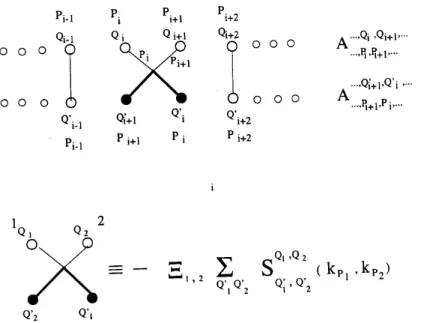
A graphialrepresentationoftheS matrixisshown inFig. 2a. Equations(24)donotx the\wavenumbers"k
1
andk
2
. Ingeneral,thesenumbersareomplex,andarexeddue totheyliboundaryondition
f(x 1 ;Q 1 ;x 2 ;Q 2 )=f(x
2 ;Q
2 ;x
1
+N;Q
1
); (27)
whihfrom (17)givestherelation
A Q 1 Q 2 1;2 =e ik1N A Q 2 ;Q 1 2;1 ; A Q 1 ;Q 2 2;1 =e ik2N A Q 2 ;Q 1 2;1 : (28)
Thislastequation,whensolvedbyexploiting(24)-(26),givesusthepossiblevaluesofk
1 andk
2
,andfrom(16)the
Figure2. Graphialrepresentationsof: a)theSmatrix(26)andb)theYang-Baxterequations(34).
Generaln. Theabovealulationanbegeneralizedforarbitraryvaluesofn
1 andn
2
ofpartilesoflasses1
and2,respetively(n
1 +n
2
=n). Theansatzforthewavefuntion (9)beomes
f(x
1 ;Q
1 ;:::;x
n ;Q
n )=
X
P A
Q
1 ;;Q
n
P1;:::;Pn e
i(k
P
1 x
1 ++k
Pn x
n )
; (29)
wherethesumextendsoverallpermutationsP oftheintegers1;2;:::;n. Fortheomponentsjx
1 ;Q
1 ;:::;x
n ;Q
n >
wherex
i+1 x
i >s
Qi
fori=1;2;:::;n,itissimpletoseethattheeigenvalueequation(8)issatisedbytheansatz
(29)withenergy
E= n
X
j=1 e(k
j
): (30)
Ontheother handifapairofpartilesoflass Q
i ;Q
i+1
is atpositionsx
i ; x
i+1
,wherex
i+1 =x
i +s
Qi
,equation
(8)withtheansatz(29)andtherelation(30)giveusthegeneralizationofrelation(24),namely
A
;Qi;Qi+1;
:::;Pi;Pi+1;:::
=
Pi;Pi+1 2
X
Q 0
1 ;Q
0
2 S
Qi;Qi+1
Q 0
1 ;Q
0
2 (k
Pi ;k
Pi+1 )A
;Q 0
2 ;Q
0
1 ;
:::;Pi+1;Pi;::: Q
i ;Q
i+1
=1;2; (31)
withS givenbyeq. (26). Insertingtheansatz(29)in theboundaryondition
f(x
1 ;Q
1 ;:::;x
n ;Q
n )=f(x
2 ;Q
2 ;:::;x
n ;Q
n ;x
1 +N;Q
1
) (32)
weobtaintheadditionalrelation
A Q1;;Qn
P
1 ;:::;P
n =e
ikP
1 N
A
Q2;;Qn;Q1
P
2 ;:::;P
n ;P
1
; (33)
whihtogetherwith(31)should giveustheenergies.
Suessive appliations of (31) give us in general distint relations between the amplitudes. For example
A
:::;;;;:::
:::;k
1 ;k
2 ;k
3 ;:::
relate to A
:::;;;;:::
:::;k
3 ;k
2 ;k
1 ;:::
by performing the permutations ! ! ! or !
!!,andonsequentlytheS-matrixshouldsatisfytheYang-Baxter[16,23℄equation
2
X
; 0
; 00
=1 S
; 0
; 0
(k
1 k
2 )S
; 00
; 00
(k
1 k
3 )S
0
; 00
0
; 00
(k
2 k
3 )=
2
X
; 0
; 00
=1 S
0
; 00
0
; 00
(k
2 k
3 )S
; 00
; 00
(k
1 k
3 )S
; 0
; 0
(k
1 k
2
); (34)
for; 0
; 00
;; 0
; 00
=1;2andSgivenby(26). InFig. 2bweshowgraphiallythisequation. Atuallytherelation
(34)isaneessaryandsuÆientondition[16,23℄toobtainanon-trivialsolutionfortheamplitudesin Eq. (31).
Wean verify by a longand straightforwardalulation that for arbitraryvalues of s
1 and s
2
, the S matrix
relationbetweentheamplitudeswith thesamemomenta. Usingthegraphialrepresentationin Fig. 2afor theS
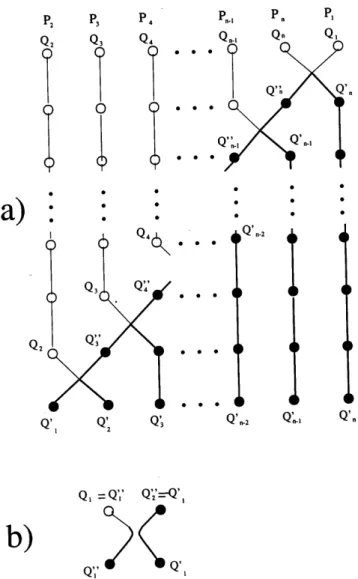
matrix,weillustratein Fig. 4theresultofsuhappliations. Wethenobtain
A Q1;:::;Qn
P1;:::;Pn =e
ik
P
1 N
A
Q2;:::;Qn;Q1
P2;:::;Pn;P1 =
n
Y
i=2
P
i ;P
1 !
e ik
P
1 N
X
Q 0
1 ;:::;Q
0
n X
Q 00
1 ;:::;Q
00
n
S Q
1 ;Q
00
2
Q 0
1 ;Q
00
1 (k
P1 ;k
P1 )S
Q
2 ;Q
00
3
Q 0
2 ;Q
00
2 (k
P2 ;k
P1 )S
Q
n 1 ;Q
00
n
Q 0
n 1 ;Q
00
n 1 (k
Pn
1 ;k
P1 )S
Q
n ;Q
00
1
Q 0
n ;Q
00
n (k
Pn ;k
P1 )A
Q 0
1 ;:::;Q
0
n
P1;:::;Pn
; (35)
where wehaveintroduedtheharmlessextrasum
1= 2
X
Q 00
1 ;Q
00
2 =1
Æ
Q 00
2 ;Q
0
1 Æ
Q 00
1 ;Q1
= 2
X
Q 00
1 ;Q
00
2 =1
S Q
1 ;Q
00
2
Q 0
1 ;Q
00
1 (k
P
1 k
P
1
): (36)
Inordertox thevaluesoffk
j
gweshouldsolve(35),i.e.,weshouldndtheeigenvalues(k)ofthematrix
T(k) fQg
fQ 0
g =
2
X
Q 00
1 ;:::;Q
00
n =1
(
n 1
Y
l=1 S
Q
l ;Q
00
l+1
Q 0
l ;Q
00
l (k
Pl k)
!
S Q
n ;Q
00
1
Q 0
n ;Q
00
n (k
Pn ;k)
)
; (37)
andtheBethe-ansatzequationswhihx theset fk
l
gwillbegivenfrom (35)by
e ik
j N
=( 1) n 1
n
Y
l=1
l;j !
(k
j
); j=1;:::;n: (38)
UsingthegraphialrepresentationforS givenin Fig.2athematrixT in (37)anberepresentedgraphiallyasin
Fig.5,andweidentify T(k)asthetransfermatrixofaninhomogeneous6-vertexmodel,onaperiodilattie,with
BoltzmannweightsS Q
1 ;Q
2
Q 0
1 ;Q
0
2 (k
P
l
;k)(l=1;:::;n). Consequently,inordertoobtaintheeigenenergiesofthequantum
hain(6)weshoulddiagonalizetheabovetransfermatrixT(k).
Figure3. Graphialrepresentationoftherelation(31). Theirlesrepresentsthepartile's indiesfQgandfQ 0
g,and the
Figure 4. a) Graphial representation of the result of n iterations of relation (31) on the right of equation (33). The
diagramatirepresentationofFig. 3wasused. b)Agraphialrepresentationofequation(36).
Diagonalizationof T(k)
The simplest way to diagonalizeT is through the introdution of the monodromymatrix M(k) [21℄, whih is a
transfermatrixoftheinhomogeneousvertexmodel underonsideration,where,insteadofbeingperiodi,therst
andlastlink inthehorizontaldiretionarexed tothevalues
1 and
n+1 (
1 ;
n+1
=1;2),thatis
M fQg;
n+1
fQ 0
g;
1 (k)=
X
2 ;:::;
n S
Q1;2
Q 0
1 ;1
(k
P
1 ;k)S
Q2;3
Q 0
2 ;2
(k
P
2
;k)S Q
n 1 ;
n
Q 0
n 1 ;n
1 (k
P
n 1 ;k)S
Q
n ;
n+1
Q 0
n ;
n (k
P
n
;k): (39)
ThemonodromymatrixM fQg;
n+1
fQ 0
g;
1
(k)isrepresentedinFig. 6aandhasoordinatesfQg;fQ 0
ginthevertialspae
(2 n
dimensions)andoordinates
1 ;
n+1
inthehorizontalspae(4dimensions).Thismatrixsatisesthefollowing
importantrelations
S
0
1 ;
0
1
1;1 (k
0
;k)M f
l g;n+1
flg; 0
1
(k)M f
l g;n+1
flg; 0
1 (k
0
)=M f
l g;
0
n+1
flg;1 (k
0
)M f
l g;
0
n+1
flg;1 (k)S
n+1;n+1
0
n+1 ;
0
n+1 (k
0
;k): (40)
Thisrelationisshowngraphiallyin Fig. 6b;itsvalidityfollowsdiretly fromsuessiveappliationsofthe
Yang-Baxterequations(34)(seeFig. 2b).
Inordertoexploitrelation(40)letusdenotetheomponentsofthemonodromymatrixinthehorizontalspae
by
A(k) = A(k) f
l g
flg =M
f
l g;1
flg;1
(k); B(k)=B(k) f
l g
flg =M
f
l g;2
flg;1 (k);
C(k) = C(k) f
l g
fg =M
f
l g;1
fg;2
(k); D(k)=D(k) f
l g
fg =M
f
l g;2
fg;2
andlearlythetransfermatrixT(k)oftheperiodiinhomogeneouslattie,wewanttodiagonalize,isgivenby
T(k)=A(k)+D(k): (42)
As a onsequene of (40) the matries A, B, C and D in (41) obey some algebrai relations. The elements
(
1 ;
1 ;
n+1 ;
n+1
)=(1;1;2;2),(1;1;1;2)and(1;2;2;2)giveustherelations
[B(k);B(k 0
)℄=0; (43)
A(k)B(k 0
)= S
1;1
1;1 (k;k
0
)
S 1;2
1;2 (k;k
0
) B(k
0
)A(k) S
1;2
2;1 (k;k
0
)
S 1;2
1;2 (k;k
0
)
B(k)A(k 0
); (44)
D(k)B(k 0
)= S
2;2
2;2 (k
0
;k)
S 1;2
1;2 (k
0
;k) B(k
0
)D(k) S
2;1
1;2 (k
0
;k)
S 1;2
1;2 (k
0
;k)
B(k)D(k 0
); (45)
respetively. The diagonalization of T(k)in (42) will bedone by exploiting the aboverelations. This proedure
is known in the literature as the algebrai Bethe ansatz [21℄. The rst step in this method follows from the
identiation ofareferenestatej>,whihshould beaneigenstateof A(k)andD(k),and heneT(k), butnot
of B(k). In our problem it is simple to see that a possible referene state is j >= jf
l
= 1g >
l=1;:::;n , whih
orrespondsto astatewithrst-lasspartilesonly. Itissimpletoalulate
A(k)j> = a(k)j>; D(k)j>=d(k)j>;
C(k)j> = 0; B(k)j>= n
X
i=1 b
i
(k)j>; (46)
where
a(k) = n
Y
i=1 S
1;1
1;1 (k
Pi
;k); d(k)= n
Y
i=1 S
1;2
2;1 (k
Pi ;k);
b
i (k) =
i 1
Y
l=1 S
1;1
1;1 (k
P
l ;k)
n
Y
l=j S
1;2
1;2 (k
P
l
;k): (47)
InFig. 7weshowagraphialrepresentationoftheaboverelation. Theideain thealgebraiBetheansatzisthat
B(k)atsasareationoperatorinthereferene(\vauum")state,i.e.,itreatespartilesofseondlassinaseaof
partilesofrstlassj>,anditisexpetedthatageneraleigenvetorofT(k)inthesetorwithn
2
seond-lass
partileswill begivenbytheansatz
(k (1)
1 ;k
(1)
2
;:::;k (1)
n2
)=B(k (1)
1 )B(k
(1)
2
)B(k (1)
n2
)j>: (48)
Thenumbersfk (1)
i
g;i=1;:::;n
2
hereplaytheroleofthe\wavenumber"fk
i
gintheoordinateBetheansatz(29),
andaregoingto bexedbytheeigenvalueequation
T(k) (k (1)
1
;:::;k (1)
n
2
)=(A(k)+D(k)) (k (1)
1
;:::;k (1)
n
2
)=(k) (k (1)
1
;:::;k (1)
n
2
): (49)
Beforederivingtherelationforgeneralvaluesofn
2
,letusonsiderinitiallytheaseswheren
2
=1andn
2 =2.
Figure6. Graphialrepresentationoftherelation(40)betweentheS matrixandthemonodromymatrixM.
n
2
=1. Usingrelation(44)and(45)in (49)weobtain
T(k) (k (1)
1 ) =
"
S 1;1
1;1 (k;k
(1)
1 )
S 1;2
1;2 (k;k
(1)
1 )
+d(k) S
2;2
2;2 (k
(1)
1 ;k)
S 1;2
1;2 (k
(1)
1 ;k)
#
(k (1)
1 )
"
S 1;2
2;1 (k;k
(1)
1 )
S 1;2
1;2 (k;k
(1)
1 )
+d(k (1)
1 )
S 2;1
1;2 (k
(1)
1 ;k)
S 1;2
1;2 (k
(1)
1 ;k)
#
B(k)j>=(k) (k (1)
1
); (50)
whihislearlysatisediftheoeÆientof B(k)j>(unwantedterm)vanishes. Thisondition,whihxesk (1)
1 ,
isgivenby
n
Y
j=1 S
1;2
1;2 (k
Pj ;k
(1)
1
)=1; (51)
whereweusedtherelation
S 1;2
2;1 (k;k
0
)
S 1;2
1;2 (k;k
0
) =
S 2;1
1;2 (k
0
;k)
S 1;2
1;2 (k
0
;k)
; (52)
validfortheS matrix(26). Theeigenvalueisgivenby
(k)= S
1;1
1;1 (k;k
(1)
1 )
S 1;2
1;2 (k;k
(1)
1 )
+ S
2;2
2;2 (k
(1)
1 ;k)
S 1;2
1;2 (k
(1)
1 ;k)
n
Y
j=1 S
1;2
1;2 (k
Pj
;k); (53)
n
2
=2. InthisasetheappliationofA(k)andD(k)intheansatz(48)giveus
A(k) (k (1) 1 ;k (1) 2 ) = S 1;1 1;1 (k;k (1) 1 )S 1;1 1;1 (k;k (1) 2 ) S 1;2 1;2 (k;k (1) 1 )S 1;2 1;2 (k;k (1) 2 ) a(k) (k (1) 1 ;k (1) 2 ) S 1;2 2;1 (k;k (1) 1 )S 1;1 1;1 (k (1) 1 ;k (1) 2 ) S 1;2 1;2 (k;k (1) 1 )S 1;2 1;2 (k (1) 1 ;k (1) 2 ) a(k (1) 1 )B(k)B(k (1) 2 )j> S 1;2 2;1 (k;k (1) 2 )S 1;1 1;1 (k (1) 2 ;k (1) 1 ) S 1;2 1;2 (k;k (1) 2 )S 1;2 1;2 (k (1) 2 ;k (1) 1 ) a(k (1) 2 )B(k)B(k (1) 1
)j>; (54)
and D(k) (k (1) 1 ;k (1) 2 ) = S 2;2 2;2 (k (1) 1 ;k)S 2;2 2;2 (k (1) 2 ;k) S 1;2 1;2 (k (1) 1 ;k)S 1;2 1;2 (k (1) 2 ;k) d(k) (k (1) 1 ;k (1) 2 ) S 2;1 1;2 (k (1) 1 ;k)S 2;2 2;2 (k (1) 2 ;k (1) 1 ) S 1;2 1;2 (k (1) 1 ;k)S 1;2 1;2 (k (1) 2 ;k (1) 1 ) d(k (1) 1 )B(k)B(k (1) 2 )j> S 2;1 1;2 (k (1) 2 ;k)S 2;2 2;2 (k (1) 1 ;k (1) 2 ) S 1;2 1;2 (k (1) 2 ;k)S 1;2 1;2 (k (1) 1 ;k (1) 2 ) d(k (1) 2 )B(k)B(k (1) 1
)j>; (55)
where besidesrelations(44)and(45)wehaveused(43),whihimplies (k (1)
1 ;k
(1)
2
)= (k (1)
2 ;k
(1)
1
). From(54)and
(55)theondition(49)givesus
(k)= n Y i=1 S 1;1 1;1 (k Pi ;k) 2 Y j=1 S 1;1 1;1 (k;k (1) j ) S 1;2 1;2 (k;k (1) j ) + n Y i=1 S 1;2 1;2 (k Pi ;k) 2 Y j=1 S 2;2 2;2 (k (1) j ;k) S 1;2 1;2 (k (1) j ;k) ; (56)
under theondition,whihxesk (1) 1 andk (1) 2 , n Y i=1 S 1;2 1;2 (k P i ;k (1) )= 2 Y =1(6=) S 1;1 1;1 (k (1) ;k (1) )S 1;2 1;2 (k (1) ;k (1) ) S 1;2 1;2 (k (1) ;k (1) )S 2;2 2;2 (k (1) ;k (1) ) n Y j=1 S 1;1 1;1 (k P j ;k (1)
) =1;2: (57)
Inderivingthislastexpressiontherelation(52)wasalsoused.
General n
2
. Theprevious proedure an be iteratedstraightforwadlyfor arbitrary numbers n
2
of seond-lass
partiles,whihgives
A(k) (k (1)
1
;:::;k (1) n2 ) = (A) (k) (k (1) 1
;:::;k (1) n2 ) n X i=1 (A) i
(k) (k;k (1)
1
;:::;k (1)
i 1 ;k
(1)
i+1 ;:::;k
(1) n2 ); D(k) (k (1) 1
;:::;k (1) n2 ) = (D) (k) (k (1) 1
;:::;k (1) n2 ) n X i=1 (D) i
(k) (k;k (1)
1
;:::;k (1)
i 1 ;k
(1)
i+1 ;:::;k
(D) j (k) = S 2;1 1;2 (k (1) j ;k) S 1;2 1;2 (k (1) j ;k) d(k (1) j ) n 2 Y l=1(6=j) S 2;2 2;2 (k (1) l ;k (1) j ) S 1;2 1;2 (k (1) l ;k (1) j ) : (59)
Then (k (1)
1
;:::;k (1)
n2
)isaneigenvetorof T witheigenvalue(k)= (A)
(k)+ (D)
(k),i. e.,
(k)= n Y i=1 S 1;1 1;1 (k Pi ;k) n2 Y =1 S 1;1 1;1 (k;k (1) ) S 1;2 1;2 (k;k (1) ) + n Y i=1 S 1;2 1;2 (k Pi ;k℄ n2 Y =1 S 2;2 2;2 (k (1) ;k) S 1;2 1;2 (k (1) ;k) ; (60)
ifthefollowingonditions,whihxfk (1)
1
;:::;k
n2
garesatised:
(A) i (k)+ (D) i
(k)=0; i=1;:::;n
2
: (61)
Usingtherelations(52),thislast onditionanbewrittenas
n Y j=1 S 1;2 1;2 (k P j ;k (1) ) S 1;1 1;1 (k Pj ;k (1) ) = n 2 Y =1(6=) S 1;1 1;1 (k (1) ;k (1) )S 1;2 1;2 (k (1) ;k (1) ) S 1;2 1;2 (k (1) ;k (1) )S 2;2 2;2 (k (1) ;k (1) )
; =1;:::;n
2
; (62)
whihonludesthediagonalizationofT(k).
Nowletus returntoouroriginal problemofndingtheeigenvaluesoftheHamiltonian(6). TheBethe-ansatz
equationswillbeobtainedbyinsertingin(38)theeigenvaluesevaluatedatk
j
, i. e.,(k
j
),givenin (60),withthe
ondition(62). Taking intoaountthat S 1;2
1;2
(k;k)=0,weobtain
e ik j N =( ) n 1 n Y l=1 l;j S 1;1 1;1 (k l ;k j ) n2 Y =1 S 1;1 1;1 (k j ;k (1) ) S 1;2 1;2 (k j ;k (1) )
; j=1;:::;n; (63)
withtheondition
n Y j=1 S 1;2 1;2 (k j ;k (1) ) S 1;1 1;1 (k j ;k (1) ) = n 2 Y =1(6=) S 1;1 1;1 (k (1) ;k (1) )S 1;2 1;2 (k (1) ;k (1) ) S 1;2 1;2 (k (1) ;k (1) )S 2;2 2;2 (k (1) ;k (1) )
; =1;:::;n
2
: (64)
WritingexpliitlytheS-matrixelements(26)in (63)and(64)weanstatethattheenergies,inthesetorwithn
1
rst-lasspartilesandn
2
seond-lasspartilesaregivenby
E= n X j=1 ( e ikj + + e ikj 1); (65) wherefk j
;j =1;:::;ngaregivenbythesolutionsof
e
ikj(N n2(s2 s1))
= ( ) n1 1 n Y l=1 " e ik j e ikl s1 1 + + e
i(k l +k j ) e ik j + + e
i(k l +kj) e ik l # n 2 Y =1 + (e ik j e ik (1) ) + + e
i(k j +k (1) ) e ik (1)
(j=1;:::;n); (66)
e ikj(s2 s1)n ( + ) n n Y i=1 e ik j e ik (1) + + e
i(k j +k (1) ) e ik j = ( ) n1 1 n 2 Y =1 + + e
i(k (1) +k (1) ) e ik (1) + + e
i(k (1) +k (1) ) e ik (1)
(=1;:::;n
2
Itisinterestingtoobservethatinthepartiularase
wheren
2
=0weobtaintheBethe-ansatzequations,
re-entlyderived[15℄, for theasymmetri diusion
prob-lemwithpartilesofsizes
1
. Alsotheases
1 =s
2 =1
give us the orresponding Bethe ansatz equations for
the standard problem of seond lass partiles. The
Bethe-ansatzequations forthefully asymmetri
prob-lem isobtainedbysetting
+
=1and =0.
IV Conlusions and
generaliza-tions
WeobtainedthroughtheBetheansatztheexat
solu-tion of theproblem ofrst- and seond-lasspartiles
diusingandinterhangingpositionsonthelattie. We
showthatthesolutionanbederivedinthegeneralase
where thepartileshavearbitrarysizes.
Someextensionsofourresultsanbemade. Arst
generalizationistheproblemwhereM>2hierarhial
ordered lassesof partiles (1st, 2nd, ...,Mth lasses),
withsizess
i
(i=1;:::;M),besidesdiusingonthe
lat-tie,interhangepositionsinsuhwaythatpartilesof
higherhierarhiallassesseetheloweronesinthesame
way asthey see the holes(0 lass). The allowed
pro-essesandtheHamiltoniansaresimplegeneralizations
of relations (2)-(4) and (6), respetively. The
Hamil-tonian obtained in a open lattie will be U
q
(SU(M))
symmetri and in theases
1 =s
2
=:::=s
M =1 it
is relatedwiththespinS = M
2
Sutherland model[17℄.
The model is ertainly integrableand itseigenspetra
will begivenin termsofM-nestedBetheansatz
equa-tionswhih aregeneralizationsof(66)-(67).
A further quite interesting generalization of our
model happens when we onsider moleules in one or
both lasses with size s = 0. Moleules of size zero
do not oupy spae on the lattie, having no
hard-oreexlusioneet. Consequentlywemayhave,at a
givenlattiepoint,an arbitrarynumberof them. The
Bethe-ansatzsolutionpresentedintheprevioussetion
is extendeddiretlyin thisase(theequations arethe
same)andtheeigenenergiesaregivenbyxingin
(65)-(67)theappropriatesizesof themoleules. Itis
inter-estingtoremarkthatpartilesofseondlasswithsize
s
2
= 0, ontrary to the ase s
2
> 1, where they
\a-elerate" the diusion of the rst lass partiles, now
they \retard" the diusive motion of these partiles.
Thequantum Hamiltonianintheaseswherethe
par-tileshavesizezeroarewrittenintermsofspins=1
quantum hains.
TheBethe-ansatzequationsintheaseofthe
asym-metri diusion, withpartiles ofunit size[10,11℄, or
size orretions ofthe mass gap G
N
of the assoiated
quantumhain. Therealpartofthesenite-size
orre-tionsare governedby thedynamial ritialexponent
z,i. e.,
Re(G
N )N
z
: (68)
The alulation of the exponent z for the model
pre-sentedinthispaper,withpartilesofarbitrarysizes,is
presentlyinprogress[24℄.
Aknowledgements
This work wassupported in part byConselho
Na-ional de Desenvolvimento Ciento e Tenologio
-CNPq-BrazilandbytheRussianFoundationofF
un-damental Investigation(Grant99-02-17646).
Referenes
[1℄ A.A.Lushinikov,Zh.
Eksp.Teor.Fiz.91,1376(1986)
[Sov.Phys.JETP64,811(1986)℄,Phys.Lett.A120,
135(1987).
[2℄ G.M.Shultz,J.Stat.Phys.71,471(1993).
[3℄ F.C.Alaraz,M.Droz,M.Henkel,andV.Rittenberg,
Ann.Phys.(N.Y.)230,250(1994).
[4℄ F.C. Alarazand V.Rittenberg, Phys.Lett. B324,
377(1993).
[5℄ F.C.Alaraz,Int.J.Mod.Phys.Bbf8,3449(1994).
[6℄ M. D. Grynberg and R. B.Stinhombe, Phys.Rev.
Lett.74,1242(1995).
[7℄ K. Krebs, M. P. Pfannmuller, B. Wehefritz, and H.
Henrihsen,J.Stat.Phys.78,1429(1995).
[8℄ J.E.Santos, G.M.Shutz,andR.B.Stinhombe,J.
Chem.Phys.105,2399(1996).
[9℄ M. J. de Oliveira, T. Tome, and R. Dikman, Phys.
Rev.A46,6294(1992).
[10℄ L. H. Gwa and H. Spohn, Phys. Rev. Lett. 68, 725
(1992),Phys.Rev.A46,844(1992).
[11℄ D.Kim,Phys.Rev.E52,3512(1995).
[12℄ D.Kim,J.Phys.A30,3817(1997).
[13℄ F.C.Alaraz,S.DasmahapatraandV.Rittenberg,J.
Phys.A.31,845(1998);PhysiaA257,1(1998).
[14℄ T. Sasamoto and M. Wadati, J. Phys. A 31, 6057
(1998).
[15℄ F.C.Alarazand R.Z. Bariev, Phys.Rev.E 60,79
(1999).
[16℄ C.N.Yang,Phys.Rev.Lett.19,1312 (1967).
[17℄ B.Sutherland,Phys.Rev.B12,3795(1975).
[18℄ C.Boldrighini,G.Cosimi, S.Frigio, andNu~nes G,J.
Stat.Phys.55,611(1989).
[19℄ P.A.Ferrari,C.KipnisandE.Saada,Ann.Prob.19,
[21℄ L.A.TakhtajanandL.D.Faddeev,Russ.Math.Surv.
34,11 (1979); V. E.Korepin, I. G.Izerginand N. M.
Bogoliubov,QuantumInverseSatteringMethod,
Cor-relationFuntions andAlgebraiBethe Ansatz
(Cam-bridgeUniversityPress,Cambridge,1992).
[22℄ B.Derrida,M. R.Evans,V.Hakim,andV.Pasquier,
J.Phys.A26,1493(1993).
[23℄ R.J.Baxter,ExatlySolved ModelsinStatistial
Me-hanis(AademiPress,NewYork,1982).