Diusive-Like Minibands in Finite Superlatties of
Disordered Quantum Wells
R.R.Rey-Gonzalez 1
,E. Mahado 1
, and P.A.Shulz 2
(1) Departamento deFsia,UniversidadNaionaldeColombia
Bogota, Colombia
(2)InstitutodeFsiaGlebWataghin,Uniamp,
13.081-970 Campinas,SP,Brazil
Reeivedon23April,2001
The existene of quantized levels, as a onsequene of spatial onnement, does not neessarily
implyinformationofsuperlattiesminibandsduetotheouplingbetweenthesequantumwells.The
presentworkdisussaframeworktoanalyzetheanalogetominibandsinperiodisuperlattiesmade
ofdisorderedquantumwells. Theinterquantumwellouplingleadstodiusive-likeminibands.
I Introdution
A model for a disorderedquantum well (dQW) made
of ashort repulsive binary alloy (RBA) embedded by
ordered barriershasreentlybeendisussed [1℄. Sine
in RBAs an eetive deloalization window appears,
theproblemofdeloalizationinonedimensionalhains
[2,3℄ouldbeaddressedfromthepointofviewof
spa-tial onnement eets in suh systems. These eets
poseanewquestiononerningtheouplingofdQWs
innitesuperlatties(SLs). Althoughwelldened,the
quantum well statesshowaninhomogeneous
broaden-ingduetotheunderlyingdisorder. Consideringinitially
twooupledquantumwells,itisimportanttoompare
the energy sale of the inhomogeneous broadeningto
the tunnelingsplitting ofthe levels. Ifthebroadening
is of the order of (or larger than) this splitting, then
theoupling ofthequantumwellsannotberesolved
in thealulatedenergyspetra.
Here,weshowthat the ouplingof quantum wells
an bedesribed by appropriatenearest levelspaing
statistisforan ensemble ofSLs[4℄. Furthermore,the
levelspaingstatistisevolvetoPoissonorWigner
sur-mise distributions in nite SLs, as a funtion of the
loalizationlentgh,whihdependsontheSLminiband
index. For sakeof learness, wewill name asa
mini-band thelevellustering aroundtheaverage energyof
astateinanisolateddQW.Whileoneofthelevel
lus-tersshowssignaturesofatrueminiband,theothersare
haraterizedbyeithereetivelyextendedorstrongly
loalizedstates. Theminibandsofeetivelyextended
states have level spaing properties of a diusive-like
II Model
Our Hamiltonian is a one-dimensional tight-binding
hain of s-like orbitals, with nearest-neighbor
intera-tionsonly,[1℄
H = X
n "
n
jn><nj+V
n;n+1
jn><n+1j+h:: (1)
TheSLhainisonstrutedinawaythatshortRBAs,
40 atomi sites long, representing the quantum wells
are separated by sets of L
b
= 2; 3 or 5 sites for the
barriers.Inordertominimizesurfaeeets,thehain
ends are wide barriers. The tight-binding parameters
usedthroughoutthisworkarethesameasinprevious
work [1℄. Thenumberof quantumwellsin anite SL
variesintherange2N
w 50.
In a RBA the bond between one of the atomi
speies is inhibited, introduing short range order: in
a hain of A and B sites, only A-A and A-B nearest
neighbors bonds are allowed. The well layeris
there-foreharaterizedbythisorrelationindisorderandthe
onentration ofB-likesites,whih istaken
B 0:3.
DisorderisintroduedbyrandomlyassigningAandB
sites,aording to aboveonstraintson onentration
and bonding. Sine weare simulating disordered
sys-tems, averages over 5000 ongurations for the same
parametersareundertaken.
III Results and disussion
a)Energyspetraandtransmissionprobabilities
The analysis of the formation and the properties
studyingminibandsislost. However,thismaybedone
withusualtools,namelytheenergyspetraand
trans-missionprobabilities.
In Fig.1 we show the energy spetra as a
fun-tion of the onguration, for single, double quantum
wells and 5dQWs, with L
b
=2. Only the spetra in
therange around theenergy ofmaximumloalization
lengthofaninniteRBA,
max
0:7eV [1℄isshown.
Aording to the parametersand the well width, the
bonadequantum wellstatesorrespondtotheindex
n =11; n= 12(indiated by anarrow)and n =13.
Forawidetight-bindingparametersrangeandbarriers
widths down to L
b
=2sites, weare dealing withthe
interestinglimitwheretheaveragelevelrepulsionturns
upto beof theorder oftheinhomogeneusbroadening
ofQWlevels.
Theselevellusters,minibands,arerelatedtostates
that are still well dened quantum wells states and
shouldrepealeahotherduetoquantumwelloupling.
Ifthese levellusters havefeatures ofatrueminiband
like in ordered systems, will depend on whether it is
possibletodeterminealevelrepulsionduetoquantum
well oupling. However, suh level splitting is not
re-solved in the average energy spetra, even in thease
ofadouble-wellwithverythinbarriers.
−0.77
−0.72
−0.67
−0.62
Energy (ev)
a)
b)
c)
Figure1.Energyspetrafor50dierentongurations: (a)
foraone;(b)two;and,()vedisorder quantumwell.
Resonanesinthetransmissionprobability,through
quantum well systems are spetrosopi probes of
their quasi-bond states. The transmission probability
through nite disordered SLs an be obtained within
the given model, using the transfer matrix approah
[1℄. Fig. 2 shows the average transmission
probabil-ity versus energy for some nite SLs: (a) for 3, (b)
5 and () 15 oupled quantum wells. The resonane
marked by an arrow orresponds to the n =12
mini-band. Welearlyobserveresonanttransmissionbands
inthese disorderedsystems.
lear that neither internal struture of the minibands
anberesolvednortheminibands beomewiderwith
inreasing thenumberof QWs in theSL, as expeted
fororderedsystems.Thisisharateristiofasituation
where theinhomogeneusbroadeningislargerthan the
levelrepulsionduetotheQWsoupling. Theredution
in the utuations, on the transmission probabilities,
with inreasing the SL lengthmay be attributed to a
better ensemble average for large systems. The
exis-teneornotofouplingbetweentheQWsanonlybe
veriedbylevelspaing distribution.
-0.95
-0.85
-0.75
-0.65
-0.55
Energy (eV)
(c)
(b)
(a)
Transmission Probability
Figure 2. Average transmission probability through nite
disorderedSLs. a),3;b),5;and)15quantumwells.
b) Levelspaing distributions
Thelevelspaingstatistiswithinagivenminiband
isawelldenedproblem,sinetheeigenvalueslusters
deliversetsof equalnumberof levelswith omparable
loalization lengths and these sets are well separated
in energy from eah other. In other words, a nite
SL overomes the problem of arbitrarily dening
en-ergy intervals where to evaluate the level spaing
dis-tributions,inoppositiontolongone-dimensionalhains
with orrelateddisorder[5℄showinganalmost
ontin-uous spetrum of stateswith loalization lengthsthat
arestronglyenergydependent[6℄.
Nearest neighbor level spaing distributions for 6
oupled dQWs are shown in Fig. 3. Weonsider two
dierentbarrierwidths, L
b
=2,leftpanel,and L
b =3
sites, rightpanel for then=13, (a), n =12, (b)and
n = 11, (), minibands. Histograms obtained
numer-ially are ompared to analytial Poisson and Wigner
distributions. The later are evaluated with the
orre-spondingnumerialaveragelevelspaing,D.
Thenearestneighborlevelspaing distributionfor
thin barriersapproahesaWignerdistribution,as an
be seenin theleft panel of Fig. 3, whih is expeted
for orrelated levels. By inreasing the barrier
thik-ness, the minimal level splitting diminishes
exponen-tially beoming negligiblewhen it is ompared to the
average level spaing. In this limit, atually seen for
L
b
bution, whih is expeted for unorrelated states, i.e.
loalizedin onlyoneofthewells.
On theother hand, in the right partof Fig. 3(b),
for then=12 states,there are struturesin the level
spaing distribution. Here no denitive answer,
on-erningtheorrelationoflevels,anbedeliveredfrom
omparisonswitheitherWignersurmiseorPoisson
dis-tributions. Inthisminibandthelevelbroadeningisthe
smallestone,sineitsenergyisalmostperfetlytuned
totheenergyofmaximumloalizationlengthofan
in-niteRBA,
max
0:7eV. Therefore,somememoryof
theorrespondingorderedsystem,withenhanedlevel
repulsion,shouldbetheoriginoftheseleardeviations
ofaWignersurmise.
0.0
2.0
S=(E
n
-E
n-1
)/D
0.0
2.0
4.0
S=(E
n
-E
n-1
)/D
P(s) a.u.
(a)
(b)
(c)
(a)
(b)
(c)
Figure3.Nearestlevelspaingdistributionforentrallevels
atn=13,(a),n=12,(b),andn=11,(),minibandsofnite
SLswith6dQWs. Poissondistributions(dottedlines)and
Wigner (dashedlines) surmises, for the respetive average
nearest levelspaings,are also shown. Left (Right)panel:
Lb=2(Lb=3).
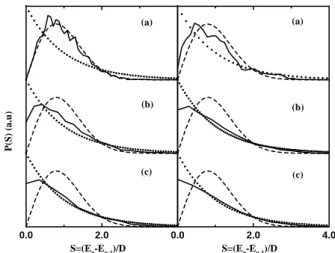
A transition to loalization with inreasingthe SL
lengthanbeseeninthelevelspaingdistributionsfor
then=12miniband. InFig. 4,resultsforSLswith10
(a),30(b),and50()dQWsaredisplayed: left(rigth)
panel for levels at the enter (edge) of the miniband.
Inthe bothases, thelevelspaing distributionshows
a transition from Wignerto Poisson distribution. For
small spaings,this transition is slowerthan for large
ones. Is is expeted that foreven longerSLsthe level
spaing distribution would approah a Poisson
distri-bution, irrespetiveofthelevelspaing.
The present results show minibands whose level
spaingdistributionsarelosetoWignersurmise. This
impliesthattherelatedloalizationlength,,islarger
than system length, L. On the other hand, in
one-dimensional systems, the elasti mean free path l is
of the order of the lattie parameter a. Therefore,
Furthermore, not all the states in a miniband are
ef-fetivelly extended. For these reasons we all it as
diusive-likeminibands. A whole miniband is neither
intheloalized regime(purePoisson distribution)nor
intheballistiregime(trueminibands).
0.0
2.0
S=(E
n
-E
n-1
)/D
0.0
2.0
4.0
S=(E
n
-E
n-1
)/D
P(S) (a.u)
(a)
(b)
(c)
(a)
(b)
(c)
Figure4. Nearestlevelspaingdistributionforentral(left
panel)andedges(rightpanel)levelsofn=12minibandsfor
niteSLs10,(a),30,(b),and50,(),dQWs. Poisson
distri-butions(dottedlines)andWigner(dashedlines)surmises.
IV Conlusions
Thepresentmodelonstitutesapotentiallyinteresting
tool foranalyzing regular superlattiesmade of
disor-dered materials, where a mobility edge may play an
important role, like in amorphous semiondutor
su-perlatties [7℄. The mobility edge is emulated by the
deloalizationwindowin theenergyspetraofRBAas
hasbeendisusssed.
This work was partially supported by DIB
(Uni-versidad Naional) and Colienias, Colombia, and
FAPESPandCNPq,Brazil.
Referenes
[1℄ R.Rey-Gonzalez andP.A. Shulz, Phys. Rev.B57,
14766(1998).
[2℄ J.C.Flores,J.Phys.: Condens.Matter1,8471(1989).
[3℄ D.H.Dunlap,H-L.Wu,andP.W.Phillips,Phys.Rev.
Lett.65,88(1990).
[4℄ F.M.Izrailev,Phys.Rep.196,299(1990).
[5℄ S.Russ,J.W.Kantelhardt,A.Bunde,S.Havlin, and
I.Webman,PhysiaA266,492(1999).
[6℄ F.M.Izrailev,T.Kottos,andG.P.Tsironis,J.Phys.:
Condens.Matter8,2823 (1996).
[7℄ D.J.Lokwood,Z. H.LuandJ.-M.Baribeau, Phys.