1756 Brazilian Journal of Physics, vol. 34, no. 4B, December, 2004
Detection of Water by Neutron Scattering Using
a Small Plasma Focus
A. Tartaglione
(1), R. Ramos
(2), J. Gonz´alez
(2), A. Clausse
(3), and C. Moreno
(1)Interinstitutional Program of Dense Magnetized Plasmas
PLADEMA Argentina
(1) Departamento de F´ısica, FCEyN – UBA, INFIP – CONICET
(2) Instituto Balseiro, Centro At´omico Bariloche, CNEA
(3) Departamento de Computaci´on y Sistemas, FCE – UNC, CNEA, CONICET
Received on 9 February, 2004; revised version received on 30 April, 2004
A compact Plasma Focus operated in deuterium which produces 2 108 neutrons per pulse, has been used as a radiation source for water detection by neutron scattering. The detecting system is composed by two silver activation sensors operated simultaneously on every shot. These detectors have quite different responses depen-ding on whether the incoming neutrons are energetic or thermalised. Energetic neutrons come from the Plasma Focus itself, whereas those thermalized come, scattered, from the substance to be detected. The comparison between the readouts of each detector allows to reveal the presence of the blanket. The shot to shot variation of the Plasma Focus neutron yield does not preclude the detection. In practice shots with yields belonging to the 2 107
– 2 108
range, can be conveniently used. The obtained results indicate that the method is able to detect water contents of few percents in volume placed about 8.5 cm away from the Plasma Focus chamber. The presented method admits side-on as well as directional detection.
1
Introduction
Among other non-conventional applications [1], neutrons produced by DD reactions can be used as probe radiation to detect the presence of hydrogenated substances, water, for instance [2, 3]. Conceptually, the detection mechanism is similar to that of echography: a pulse of energetic neu-trons (2.45 MeV) is sent to the region of interest, and then, using an adequated sensor, the medium response is registe-red, which consist in the dispersion (and thermalisation) of the incident neutrons.
Due to the high effective cross section of hydrogen for neutron dispersion, as compared with the rest of the ele-ments, the experimental analysis of what happens to a neu-tronic flux used as probe radiation, gives valuable informa-tion to reveal the presence of hydrogenated substances. Ap-plication examples are: soil humidity studies [2], water con-tent in oil, and detection of hidden dangerous substances.
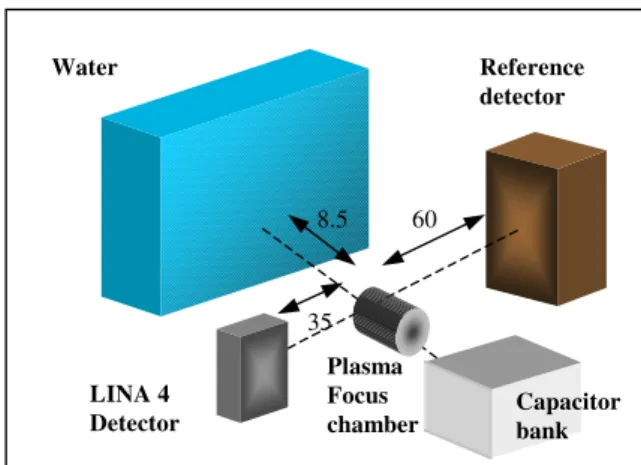
Recently, the feasibility of water detection using a small Plasma Focus as a pulsed neutron source was demonstra-ted [3, 4]. Two silver activation detectors [5] were used: one to register the number of emitted neutrons, and the other one to detect the scattered neutrons. The experimental set up is shown in Fig. 1. The comparison between both readouts al-lows to determine whether the water is present or not.
In this paper, a directional detector of scattered neutrons is proposed and experimentally tested. Its sensibility to dif-ferent water quantities is also studied.
Figure 1. Basic set up for water detection by neutron
Water Reference detector
LINA 4 Detector
Plasma Focus chamber
8.5
35
60
Capacitor bank
Figure 1. Basic set up for water detection by neutron scattering. Dimensions are in cm.
2
Experimental method
A small 10.5 uF, 30 kV (4.7 kJ) Plasma Focus, called GN1, was used as neutron source. This device is detailed el-sewere [6, 7]. The optimum average neutron yield,∼108 n/shot, is attained when operating at 3 – 4 mbar of deute-rium. The measured neutron anisotropy for this device, de-fined as the neutron flux ratio emitted in the electrode axis forward direction respect to the flux emitted 90 ˚ appart is 1.4.
A. Tartaglioneet al. 1757
thick silver foil. Silver has a resonance peak for neutron capture, with a beta decay, at 5 eV. The reference detector is a 28 x 34 x 14 cm3
box containing paraffin to moderate fast neutrons. The scattered neutron detector does not con-tain paraffin for it to be sensitive to neutrons scattered by the substance and, at the same time, to be insensitive to the direct Plasma Focus neutron radiation. The reference detec-tor has a background of 66±8 counts in a time interval of 20 sec, whereas the scattered neutrons detector reads 60±
8 counts in the same conditions.
2.1
LINA 4 detector
Directionality in scattered neutrons detection requires shiel-ding against neutrons moderated in the Plasma Focus sour-roundings. Laboratory walls, floor and other structures, ap-part from the Plasma Focus itself, specially its capacitor bank, are sources of unwanted thermalized neutrons.
The10
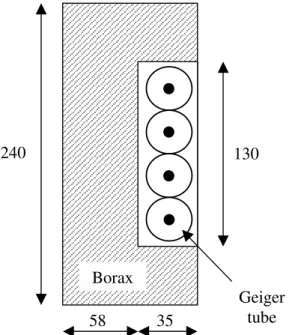
B has a high cross section for thermal neutrons capture. Therefore a substance containing a high proporti-ons of boron, placed as a shield arround the Geigers, can be used to diminish the neutron flux coming from undesired di-rections. A common substance rich in boron is the sodium tetraborate (Na2B4O7)usually known as borax. In Fig. 2 a drawing of LINA 4 detector using borax powder is shown. It consists of a metallic box containing the four Geigers at-tached to one of its faces. The rest of the box is filled with borax. There are about 5 cm of borax sourrounding the Gei-gers except on one side, which acts as a collecting window. The borax thickness used is about 5 times the free mean path of 5 eV neutrons in this substance.
240
130
58 35
Geiger
tube
Borax
Figure 2. Drawing of the scattered neutrons detector LINA 4. Bo-rax encasing allows for detection directionality. Dimensions are in mm.
To verify the detector’s directionality a water wall was used as scattering substance, as shown in Fig. 1. The LINA 4 detector was placed 35 cm away from the chamber and
at 8.5 cm from the 33.6 dm3
water wall. Two extreme ori-entations were tested: one (A) with the window facing the water wall, and the other one (B) with the window oriented in the oposite direction. In this last orientation, the window can collect neutrons coming from the capacitor bank, which contains substantial amounts of plastic and insulating oil.
The readouts of both detectors were registered for each orientation with and without the water wall. Between 10 and 15 shots were performed for each one of the four resulting configurations. The obtained results are shown in Fig. 3, where the LINA 4 counts are ploted against those from the reference detector. According to its calibration, a readout of 1000 counts from the reference detector correspond to a total of 108
emitted neutrons.
Orientation A
Orientation B LINA 4
LINA 4 Water
Water
Figure 3. Plot of detected scattered neutrons versus emitted ones, with and without water present, for orientations A and B of LINA 4 detector. Dashed lines correspond to 95%confidence bands.
Firstly, cases A-1 and A-0 (corresponding to the orien-tation A with and without water, respectively) can be dis-tinguished, where a substantial difference in slopes is evi-dent (0.348±0.013 and 0.0856±0.0078). The uncertainty bands correspond to 95 % confidence interval. Since the me-asured data exhibits errors of the same order of magnitude in both coordinates, the method of reference [8] was used to obtain the slopes and their uncertainties.
Secondly, when the orientation is B, the presence of wa-ter does not produce significative difference on the LINA 4 response (slopes are 0.162±0.010 and 0.143 ±0.013 for the cases with and without water, respectively). This illus-trates the low sensitivity of LINA 4 detector to neutrons not coming through its window.
Additionally, since the slopes corresponding to cases B are significantly higher than that of case A-0, it can be con-cluded that the capacitor bank has a sensible effect on the moderated neutrons field in the Plasma Focus head sour-roundings. Therefore, the borax shielding effectively con-tributes to the detection efficiency.
3
Aplication and sensibility
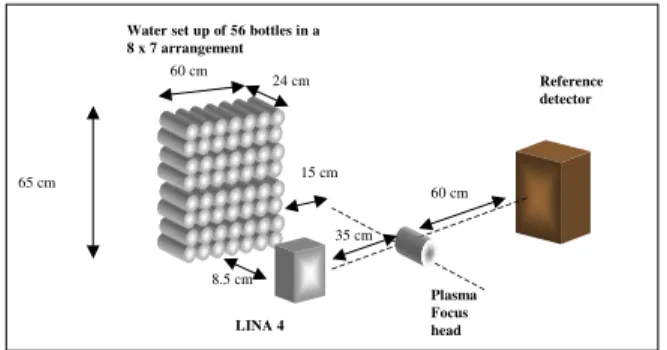
As an application example of water detection and to illus-trate the method sensibility, a configuration like that of Fig. 1 was set up, where the water distribution was implemented using 56 plastic bottles of 600 cm3
1758 Brazilian Journal of Physics, vol. 34, no. 4B, December, 2004
Reference detector
LINA 4
Plasma Focus head
60 cm 15 cm
8.5 cm 24 cm 60 cm
65 cm
Water set up of 56 bottles in a 8 x 7 arrangement
35 cm
Figure 4. Experimental set up used to study the sensibility to dif-ferent water quantities.
56
32
16
Figure 5. Experimental results of detected scattered neutrons ver-sus emitted ones for the configurations depicted on the right.
Filling either all or some of them, different water con-centrations can be obtained.
Four configurations were considered, one with all bot-tles empty, and the other three, filling 56, 32 y 16 of them (see the sketch of Fig. 5). LINA 4 detector was placed in orientation A. The obtained results are ploted in Fig. 5.
It is observed that the method permits to distinguish between configurations, since the corresponding slopes of the linear fits are different (0.348±0.013, 0.2838±0.0092, 0.208±0.011 and 0.162±0.011).
According to these results, the minimum detectable wa-ter volume is∼16 filled bottles, that is,∼9.6 dm3
, for the geometric configuration depicted in Fig. 5. Since the con-sidered distribution of water in volume is discrete, the re-lationship between the water volume and the corresponding slope is not expected to be simple. Nevertheless, a calibra-tion conducted to distinguish between different situacalibra-tions, is always possible.
4
Conclusion
In the hydrogenated substances detection by neutron scatte-ring framework, a scattered neutrons detector that uses bo-rax to block neutrons coming from unwanted directions was proposed and experimentally checked.
From the obtained results, it can be seen that
∼1×10⁸
(∼1000 counts on the reference detector) is, in practice, the lowest number of neutrons per shot needed to detect water quantities of about 10 dm3
in configurations
like those considered in this communication. For a less in-tense neutron source, more sensitive neutron detectors must be used.
In general cases of practical interest, related for instance, to different amounts and/or concentrations of the prospected substance, or different geometrical configurations, or even different substances; adequated calibrations must be con-ducted to discriminate between specific situations. It is also suitable to mention that due to the scattered nature of the prospection neutrons, the presented method admits side-on substance interrogation, i.e., the interrogated substance does not need to be placed in the Plasma Focus-to-detector line of sight. This fact can be conveniently used to widen the applicability field of the discussed technique.
Acknowledgements
Dr. Roberto Vieytes is kindly acknowledged by the criti-cal reading of the manuscript and valuable suggestions. This work was supported by Fundaci´on Antorchas (Proj. 14068-24), IAEA (TC Proj. ARG1026-11099L), PLADEMA-CNEA and UBA (X074).
References
[1] F. Beg, K. Krushelnick, C. Gower, S. Torn, A. Dangor, A. Howard, T. Sumner, A. Bewick, V. Lebedenko, J. Dawson, D. Davidge, M. Joshi, and J. Gillespie. Appl. Phys. Lett.80
(16), 3009 (2002).
[2] J. Pouzo, M. Milanese, and R. Moroso, AIP Conf. Proc.669
(1), 277 (2003).
[3] R. Ramos, C. Moreno, J. Gonz´alez, A. Clausse, and P. Flo-rido. Feasibility of a water detection system based in Plasma Focus technology. American Nuclear Society, Nuclear Odys-sey 2001, CD Proceedings Nuclear OdysOdys-sey 2001, Next Ge-neration TechnologiesI, 23-27, Texas, March 28 - April 4, (2001).
[4] C. Moreno, A. Clausse, J. Mart´ınez, R. Llovera, A. Tarta-glione, M. V´enere, R. Barbuzza, and M. del Fresno. Using a 4.7 kJ Plasma Focus for introspective imaging of metallic ob-jects and for neutronic detection of water.IX Latin American
Workshop on Plasma Physics, La Serena, Chile, AIP
Confe-rence Proc563, H. Chuaqui and M. Favre Eds, 300-305, Nov (2000).
[5] A. Gentilini, J. Rager, K. Steinmetz, M. Tacchi, D. Antonini, B. Arcipiani, P. Moioli, E. Pedretti, and R. Scafe. Nuclear Instrum. and Meth.172(3), 541 (1980).
[6] C. Moreno, M. V´enere, R Barbuzza, M. Del Fresno, R. Ra-mos, H. Bruzzone, P. Florido, J. Gonz´alez, and A. Clausse, Brazilian J. of Phys.32, 20 (2002).
[7] C. Moreno, A. Clausse, H. Bruzzone, J. Mart´ınez, R. Llovera, A. Tartaglione. Small-chamber 4.7 kJ Plasma Focus for appli-cations.IX Latin American Workshop on Plasma Physics, La Serena, Chile, AIP Conference Proc563, H. Chuaqui and M. Favre Eds, 276-281, Nov (2000).