Influence of the stiffness of beam-column connections on
the structural analysis of reinforced concrete buildings
Influência da rigidez das ligações viga-pilar na
análise estrutural de edifícios em concreto armado
a Instituto Federal de Goiás, Departamento de Áreas Acadêmicas, Uruaçu, GO, Brasil; b Universidade Federal de Uberlândia, Faculdade de Engenharia Civil, Uberlândia, MG, Brasil.
Received: 24 Dec 2016 • Accepted: 25 Aug 2017 • Available Online:
J. B. SANTOS a
T. J. DA SILVA b
G. M. S. ALVA b
Abstract
Resumo
Conventional structural analysis of buildings in reinforced concrete is performed considering beam-column connections as rigid. However, experi-mental results prove the existence of relative rotations in beam-column connections of reinforced concrete structures, showing the partial transfer of bending moment. In this study the influence of the stiffness of beam-column connections on the global stability and in the column bending moments of buildings in reinforced concrete was investigated. A building was designed with rigid connections and deformable connections to identify the importance of considering the influence of the stiffness of the beam-column connections in the overall stability of monolithic and in the redistribution efforts in reinforced concrete structures. In order to determine the stiffness rotation of deformable connections, two analytical models available in literature were used, and a comparison between the results obtained by each analytical model was also performed. Based on the results, it is concluded that neglecting the influence of the stiffness of the beam-column connections on the analysis of monolithic reinforced concrete structures may result in different solutions compared to the real behavior of the structure. The stiffness values obtained with the analytical models usually differ from the condition of rigid connections, suggesting an adjustment on the standard consideration of rigid connections adopted by the computer programs of structural calculation.
Keywords: reinforced concrete structures, beam-column connection, stiffness rotation, partially rigid conections, monolithic connections.
A análise estrutural convencional de edifícios em concreto armado é realizada considerando as ligações viga-pilar como rígidas. Entretanto, resultados experimentais comprovam a existência de rotações relativas nas ligações viga-pilar de estruturas de concreto armado, evidenciando a transmissão parcial de momento fletor. Neste trabalho foi investigada a influência da rigidez das ligações viga-pilar na estabilidade global de edifícios em concreto armado, e também, nos esforços dos pilares. Com o auxílio do programa comercial TQS, uma edificação foi calculada considerando ligações rígidas e ligações deformáveis, visando identificar a importância da consideração da influência da rigidez das ligações viga-pilar na estabilidade global e na redistribuição de esforços de estruturas monolíticas de concreto armado. Para determinação da restrição à rotação das ligações deformáveis, utilizaram-se dois modelos analíticos disponíveis na literatura, realizando-se, também, uma comparação entre os resultados obtidos pelos modelos. Com base nos resultados, conclui-se que negligenciar a influência da rigidez das ligações viga-pilar na análise de estruturas monolíticas em concreto armado pode gerar soluções muito diferentes do comportamento real da estrutura na prática. Os valores de rigidez obtidos pelos modelos analíticos utilizados diferem de forma não negligenciável da condição de ligações rígidas, sugerindo-se a adequação na consideração padrão de ligações rígidas adotada pelos programas computacionais de cálculo estrutural.
1. Introduction
In terms of the technological advance and development of structural analysis programs, it is possible to design slenderer buildings. How-ever, these structures may exhibit high lateral displacement, in addition to significant second-order effects. Thus, the global stability evaluation of multi-story buildings takes on a great importance in structural design. In recent years, several researches have been carried out to ana-lyze the stiffness of beam-column connections influence on the global stability of precast concrete structures performed by Brazilian researchers. Among these researches, it can be highlighted Ferreira
et al. [1], Ferreira et al. [2], Araújo et al. [3] and El Debs et al. [4]. Due to the absence of monolithism observed in these structures, the stiff-ness of connections is an essential factor regarding the influence of the structural behavior of buildings subjected to lateral loads. At the international level, several experimental investigations are found in the specialized bibliography on monolithic beam-column connections, emphasizing their behavior when subjected to seismic loads. Among these studies, some of them considered the slippage of flexural reinforcement bars effects on the relative rotations between beam and column and on the global behavior of the connection [5-9]. Although there are several international studies dealing with the numerical simulation of beam- column joints via Finite Elements Method using 2D or 3D finite elements, models which apply springs in order to represent flexibility of the connections are still more at-tractive due to simplicity. In this context, there are models with rota-tional springs that simulate the effects of slippage of reinforcement bars [10-12] and models that use additional springs to represent the effect of joint distortion [13-15]. Even though they are more attractive due to the simplicity and low computational effort, these models still present difficulties with regard to the calibration of the parameters used by them and obstacles in being used in commercial software for analysis and design of reinforced concrete structures.
Simple analytical models which use only well known parameters and currently applied in the design of reinforced concrete struc-tures are certainly more attractive for structural analysis. Among these, the model of Paultre et al. [8] and, more recently, the models presented in Sezen and Moehle [16], Sezen and Setzler [17], and Kwak and Kim [18] can be cited.
Despite many experimentally and analytically studies on beam-column connections in monolithic reinforced concrete structures, known as beam-column joints, there are few published studies on the influence of stiffness of these connections regarding the analy-sis of global stability of entire structures.
Connections in cast-in-situ concrete structures are usually stiffer compared to those ones in precast concrete, due to the existence of continuity between the structural elements which provides monolithism to the structure. In spite of this, experimental tests on reinforced concrete beam-column joints show the existence of rel-ative rotations between beams and columns, according to Ferreira [19] and Alva [20]. These connections are theoretically treated as fully rigid, but in practice, the existence of these relative rotations causes a stiffness reduction in the connection.
Alva and El Debs [21] presented an analytical model in order to determine the relative rotations in beam-column connections of monolithic reinforced concrete structures. In the experimental
vali-dation of the model, the authors compared the model results with experimental values and with results obtained by considering the connections as fully rigid. It can be seen in Figure 1 that the consid-eration of fully rigid connections may differ considerably from the actual behavior, even in monolithic connections.
Experimental investigation conducted by Lacerda [30] can be cited among the most recent national researches on precast connec-tions. In this investigation, the influence of continuity reinforce-ment positioning on precast connections were analyzed. The re-sults allowed to conclude that the specimens with reinforcement steel bars crossing the column presented higher stiffness than the specimens with reinforcement steel bars only in slab. In addition, a comparison was performed between the experimental results and those obtained by Ferreira etal. [1] analytical model. Recently, the Brazilian Code for design of precast concrete structures [24] has provided analytical expressions for the calculation of the secant bending stiffness for six typologies of connections.
Besides the local impacts derived from the stiffness reduction of the structure joints, changes in the global behavior of the building can be noticed. A modification in the connections stiffness alters the structural behavior under lateral loads. Consequently, it af-fects the lateral displacements and the second order efaf-fects on the building structure, modifying the design of the structural members. However, the influence of connections stiffness is not always veri-fied in the structural analysis, neglecting the possible impacts on the behavior of the structure. This can be explained by the lack of more in-depth studies on the stiffness of monolithic reinforced con-crete connections and, especially, its influence on overall structural behavior. In addition, the usual consideration that the monolithic connections are rigid does not arouse in engineers a concern about the influence of the connections stiffness in structural analysis. An increase in the number of storeys in the structure leads to lateral displacements and second order effects become larger. Therefore, in multi-story structures, the influence of beam-column stiffness can be crucial on global stability (second-order effects).
Figure 1
A better understanding upon the influence of beam-column stiff-ness on structural behavior may contribute to the development of structural projects closer to the reality of buildings behavior. Such methods may contribute to more safety in the design of reinforced concrete structures, especially of multi-floor buildings. In addition, the use of the available computational programs requires a better understanding of the impacts of the beam- column connections stiffness modification on the structural behavior of buildings.
2. Beam-column connections
in structural analysis
2.1 Initial considerations
Structural analysis is a primordial procedure in the structural design of a building in reinforced concrete. It consists in obtaining the behavior of the structure subjected to dead and live loads and lateral forces (wind and earthquakes), determining the distribu-tions of internal forces, strains and displacements in the structure, checking ultimate and serviceability limit states.
The behavior of beam-column connections influences the internal
forces redistribution of the 3D frame structure, as well as in the design of all structural members. Thus, in the structural analysis, the influence of the connections stiffness must be treated with its proper importance, in order to be able to obtain internal forces and the design of the structural members in a manner that is compat-ible with the real structure.
The beam- column connections, also called beam-column joints, are regions of very complex structural behavior, where stress con-centrations occur (normal stress and shear stress). According to Alva [20], there is the influence of many variables interacting on the joint strength capacity such as the reinforcement detailing, ge-ometry of connected structural members, intensity of the internal forces, and finally strength of the materials (concrete and steel). According to experimental results obtained by Ferreira [19] and Alva [20], it is possible to observe the existence of relative rotations in the monolithic reinforced concrete beam-column connections. These rotations are caused by the slippage of flexural reinforce-ment of the beams inside the beam-column joints and by the crack-ing of concrete in these regions, as shown in Figure 2.
From the experimental and analytical results of some researches, highlighting Alva et al. [22], Ferreira [19], Ferreira et al. [1], Alva and
Figure 2
Cracking and slippage of reinforcement in beam-column joints
Figure 3
El Debs [21], it can be concluded that the actual behavior of mono-lithic beam-column connections is not fully rigid, but partially re-strained. As a result, considering the connections as rigid ends up overestimating the connections stiffness and, as a consequence, underestimating the lateral displacements of the structure.
2.2 End-fixity factor
The end-fixity factor (for bending moments) was initially presented by Monforton and Wu [23]. The authors developed a mathemati-cal model to consider the effects of semi-rigid connections on the global behavior of plane frames. Subsequently, ABNT NBR 9062 [24] included the semi-rigid behavior of precast connections using the end-fixity factor αR.
The end-fixity factor is defined as the ratio of the chord rotation of the structural member (θ1) to the sum of the chord rotation of the structural member (θ1) and the rotation of the connection (θ2),
according to Figure 4. ABNT NBR 9062 [24] presents Equation 1 to determine the αR value. This expression associates the bend-ing stiffness of the beam-column connection (Rsec) with the beam
bending stiffness.
(1)
where:
(EI)sec: secant bending stiffness of the beam according to ABNT NBR 6118 [25];
Lef: effective span between supports (or the distance between rota-tion centers of the supports);
Rsec: secant bending stiffness of the beam-column connection. The bending stiffness of the beam-column connection is obtained by its moment-rotation curve.
Nonlinear behavior of the connections can be considered by sim-plified linear analysis using the secant stiffness (Rsec), as shown in
the Figure 5. The relative rotation should be measured at the rota-tion center of the support. In order to determine the secant stiffness
of the connections, the analytical models found in the literature for beam- column connections can be used.
Table 1 shows the classification of precast connections according to ANBT NBR 9062 [24] as function of the element ends flexural rigidities. A very large gap is observed for the connections stiffness consideration. In this context, Ferreira et al. [2] proposed a con-nection classification system subdivided in five different zones, as indicated in Table 2. In this table, ME is the moment mobilized by the connection and MR is the fixed end moment.
2.3 Analytical models
Two analytical models were used to determine the beam-column connections stiffness in this paper: i) Ferreira et al. [1] model; ii) Alva and El Debs [21] model.
Ferreira et al. [1] model was originally developed for precast beam-column connections with continuity reinforcement. In this model, the relative rotation in the beam-column connection is induced by two deformation mechanisms: the elongation of continuity reinforcement bars and the occurrence of bending cracks in the connection region (as shown in Figure 3). The comparison of the theoretical values
Figure 4
End-fixity factor – ABNT NBR 9062 [24]
Figure 5
Moment-rotation relationship of precast concrete
beam-column connections – Brazilian Code [24]
Table 2
Classification system of connections for precast structures – adapted de [2]
Zone End-fixity factor
(αR)
Partially restrained
coefficient (ME/MR) Classification of connection
I 0 ≤ αR < 0,14 0 ≤ ME/MR < 0,2 Pinned
II 0,14 ≤ αR < 0,4 0,2 ≤ ME/MR < 0,5 Semi-rigid low-strength
III 0,4 ≤ αR < 0,67 0,5 ≤ ME/MR < 0,75 Semi-rigid medium-strength
IV 0,67 ≤ αR < 0,86 0,75 ≤ ME/MR < 0,9 Semi-rigid high-strength
V 0,86 ≤ αR < 1 0,9 ≤ ME/MR < 1 Fully rigid
Table 1
Classification of connections for precast structures
– adapted from [24]
Connection type End-fixity factor (αR)
Pinned αR < 0,15
Semi-rigid 0,15 ≤ αR ≤ 0,85
with experimental results proved that the model can also be used in monolithic connections, presenting good values correlations, as presented in Alva et al. [22]. Equation 2 allows the determination of the moment-rotation curve until the yielding moment:
(2)
where
θ is the relative rotation between beam and column; M is the bending moment at the beam end;
Ecs is the secant modulus of elasticity of the concrete;
Ieq is the effective moment of inertia of the beam (Branson´s formula); Lp is the connection region length, approximately equal to effective depth of the beam in monolithic beam-column connections;
σs is the stress on the tensioned reinforcement of the beam
(bend-ing reinforcement);
Es is the elasticity modulus of the steel; d is the effective depth of the beam;
Le is the embedded length of bending reinforcement of the beam in the column;
My is the flexural strength of the connection, related to the yielding moment.
Material nonlinearity is considered in a simplified linear analysis using the secant bending stiffness of the connection, which can be deducted from Equation 2:
(3)
where
Rsec is the secant bending stiffness of the connection;
III is the moment of inertia of the cracked transformed section of the beam;
As is the area of longitudinal bending reinforcement of the beam. The model proposed by Alva and El Debs [21] has the same con-ceptual basis of Ferreira et al. [1] model, but considers the bond-slip behavior of beam reinforcement bars inside the column and properties that interfere in the total slip caused by cracking of the beam, which are not contemplated in the Ferreira et al. [1] model.
The moment-rotation curve applicable until the end of the elastic range (M ≤ My) is given by Equation 4:
(4)
where
φ is the bar diameter of the longitudinal reinforcement of the beam;
τby is the bond stress in the elastic range [16-17], equal to , with
fc in MPa;
fc is the column concrete compressive strength; x is the neutral axis depth (cracked section);
z is the lever arm between the tension and compression forces in the section beam:
sr is the crack spacing in the connection region, which can be ob-tained by expressions found in specialized literature, presented in Borosnyói and Balázs [26], or by expressions of codes for design, such as Eurocode 2 [27].
1/r is the curvature at the beam end is the curvature of beam section calculated from the average reinforcement strain in the elastic range (with tension stiffening) or from the usual design calculations for rein-forced concrete sections (with equilibrium and compatibility equations). The yielding moment My can be evaluated by My = 0,9.d.As.fy or by My = As.fy.z, where fy is the yield strength of the steel of bending reinforcement of the beam.
The expression to calculate the crack spacing presented by Euro-code 2 [27] is given by the Equation 5:
(5)
where
sR is the crack spacing;
φ is the diameter of longitudinal bending reinforcement of the beam; k1 is a coefficient which considers bond properties of the reinforce-ment steel bars (equal to 0,8 for high-bond bars and equal 1,6 for plane surface bars);
k2 = 0,5; k3 = 3,4; k4 = 0,425;
c is the concrete cover;
Ac,eff is the effective tension area of concrete (see Figure 6). From Equation 4, the secant bending stiffness of the connection obtained by Alva and El Debs [21] model is:
(6)
3. Numerical simulations
3.1 Initial informations
Numerical simulations of a building structure were carried out
Figure 6
considering the beam-column connections as fully rigid and partially restrained. In order to determine the secant stiffness and the end-fixity factor (αR) of the connections, Ferreira El Debs et al. [1] and
Alva and El Debs [21] models were used. The results of the global stability analysis (second-order global effects) and internal forces in the columns are compared for the both types of connections (fully rigid and partially restrained), aiming to emphasize the impor-tance of considering the flexibility of the beam-column connections
in structural analysis of monolithic reinforced concrete structures. Numerical simulations of a nineteen and five storey building were carried out, trying to identify differences in the influence of the con-nections flexibility on tall and low buildings (symmetric-plan build-ings). Figures 7 and 8 contain the typical floor plan for 19-storey and 05-storey buildings. In order to determine the dimensions of the cross-section columns, a preliminary estimate was performed according to the vertical loads acting on these structural members.
Figure 7
Typical floor plan of five-storey building (dimensions in cm)
Figure 8
These numerical simulations were performed in the software CAD/ TQS® (version 18), which considers the influence of the beam-col-umn connections stiffness by the end-fixity factor values which mod-ify the stiffness matrix of 3D frame element in the structural analysis. It is worth emphasizing that the computational program performs nu-merous load combinations and uses the envelopes of internal forces for the design of the structural members. Thus, it has not been indi-cated in this paper which envelope was critical for the design of each structural member. Only the final results were presented.
The procedure used to consider this flexibility of the connections is de -scribed as follows. First, the numerical simulation of the building with fully rigid connections (αR = 1.0) is performed. Then, based on the re-inforcement areas obtained from this structural analysis, the αR value
was determined for each connection. By performing a new simulation considering connections as partially restrained in the structural analy-sis, there will be a redistribution of internal forces in the structure, with changes in the reinforcement of beam-column connections, leading to different values of αR for the connections. Therefore, it is an iterative
process, which was repeated until the percentage difference between the αR values of the current iteration in relation to the previous itera-tion is less than 10% as shown in Figure 7. The iterative process was performed manually (without automation).
3.2 Input data
The building structures were designed considering the concrete
compressive strength equal to 25 MPa and environmental ag-gression level II. Dead loads on the typical floor slabs was derived from the self-weigth added to a load of 1,0 kN/m² in order to con-sider additional permanent loads (floor covering). The dead load-ing of roof slabs was adopted equal to 1.0 kN/m² to consider the existence of a roof with fiber cement sheet. According to ABNT NBR 6120 [28], the live load assumed for typical floor slabs was 2.0 kN/m² (offices) and for roof slabs was 0.5 kN/m².
The load used for the typical floor beams and foundation was the self-weight plus the weight of wall of 2.50 m in height, composed of clay blocks (thickness: 15 cm). For the roof beams, it was con-sidered a small wall of 0.5 m in height composed of clay blocks (thickness: 15 cm). For typical and roof floors beams, there is still the loading portion from concrete slabs.
The critical direction of global stability was for wind acting at 90°. For the evaluation of global second order effects, the approximated procedure proposed by NBR 6118 was used, which applies the coefficient γz. The lateral displacement at the top of the structure for this critical wind direction was analyzed, as well as the values of the coefficient γz. Results for other wind directions were not ana-lyzed in this paper.
Alva and El Debs [21] model was proposed for reinforced concrete monolithic beam-column connections. The relative rotations in the beam-column connection result from two deformation mechanisms: slippage of flexural reinforcement of the beams inside the column and the formation of bending cracks in the connection region. A good cor-relation between the theoretical values provided by the model pro-posed by Alva and El Debs [21] with experimental results was found. More information on these two analytical models are available in [1,21].
In this paper, the influence of beam-column connections stiffness on lateral displacements of the structure, on second-order global effects (with the coefficient γz) and also on longitudinal
reinforce-ment of the columns was verified. Clearly, beam-column connec-tions stiffness also have impact on other structural elements (such as beams) and on other internal forces (such as shear forces). However, the choice of the analyzed results was made considering the importance of the impact of connection stiffness values on the global stability of the structure, as well as its consequent influence upon the amount of longitudinal reinforcement of the columns due to internal forces redistribution.
4. Results and discussions
4.1 Ferreira et al. [1] model
For the 19-storey building, concerning the roof floor connections, values for αR ranging from 0,41 to 0,50 were obtained. According to Ferreira
et al. [2] classification, these connections are semi-rigid with
medium-strength. In connections of the typical floor, αR values ranging from 0.64
to 0.80 were achieved. Thus, these connections are classified as semi-rigid connections with medium-strength and high-strength.
For the 05-storey building, in roof floor connections, values of αR
varying from 0,49 to 0,52 were obtained, which are classified as semi-rigid with medium-strength, according to the classification of Ferreira et al. [2]. For the connections of the typical floor, αR val-ues ranging from 0.49 to 0.72 were attained, which classifies these
Figure 9
Algorithm used to determine the end-fixity fator
α
Rof the connections
Figure 10
Ferreira
et al.
[1] model: lateral displacements for
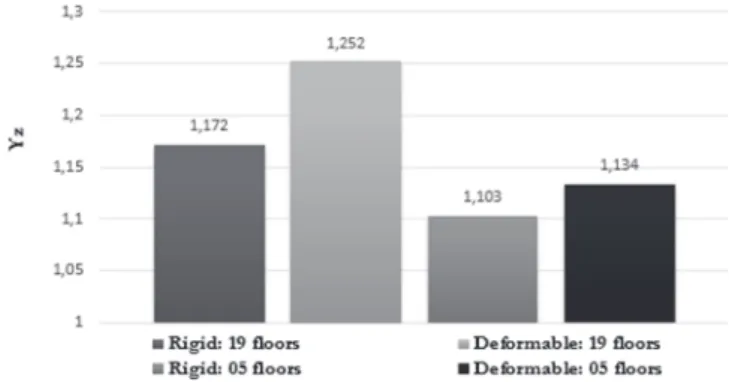
connections as semi-rigid with medium-strength and high-strength. Subsequently, a comparison of the global stability results obtained for the structure with rigid connections and for the structure with deformable connections using Ferreira et al. [1] model was present-ed (for the 19-storey building, and also for the 05-storey building). Figure 10 shows the lateral displacement at the top of the 19-sto-rey structure. It can be noticed had a 38% increase from rigid con-nections to the deformable concon-nections situation. For the 05-storey structure, there was a 31% increase in the displacements value. Figure 11 presents the coefficient γz values for the 19-storey
struc-ture, which exhibited a variation from 1,172 to 1,252 considering deformable connections. For 05-storey structure, the increase was from 1,103 to 1,134.
It is possible to notice that, in the case of 19-storey building, lateral displacements and the coefficient γz percentage increases were
higher in comparison with 05-storey building, as expected. In build-ings higher than those analyzed in this paper, the influence on con-nections stiffness reducing may result in more critical situations for global stability (second-order effects).
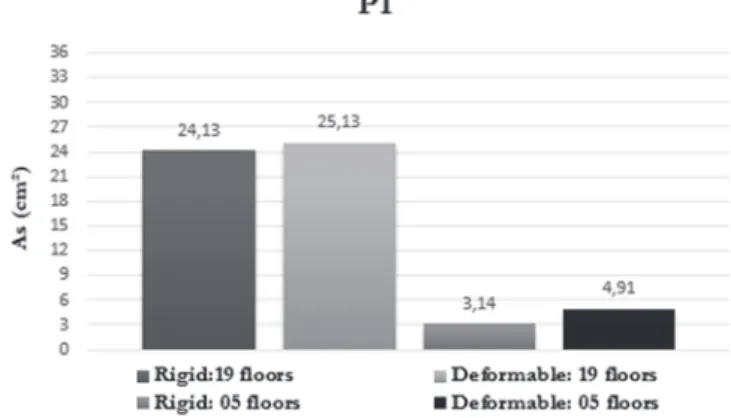
Figures 12, 13 and 14 show comparative graphs related to the area of longitudinal reinforcement in columns P1, P2 and P6 respective-ly. For the 19-storey structure, in all the columns, there was a 30% increase in the amount of reinforcement when the connections de-formability was considered. For the 05-storey structure, there was an increase of 256% reinforcement for the P1 column, 24% for the P6 column, and there was no change for the P2 column.
4.2 Alva and El Debs [21] model
For the 19-storey building, concerning the roof floor connections, values for αR ranging from 0,57 to 0,65 were obtained. According to Ferreira et al. [2] classification, these connections are semi-rigid
with medium-strength. In connections of the typical floor, αR values
ranging from 0.73 to 0.85 were achieved, which classifies these connections as semi-rigid with high-strength.
For the 05-storey building, in the roof floor connections, values
Figure 11
Ferreira
et al.
[1] model: coefficient
γ
z
for for
nineteen-storey and five-nineteen-storey buildings, considering perfectly
rigid and partially restrained connections
Figure 12
Ferreira
et al.
[1] model: longitudinal reinforcement
of column P1 for nineteen-storey and five-storey
buildings, considering perfectly rigid and partially
restrained connections
Figure 13
Ferreira
et al.
[1] model: longitudinal reinforcement
of column P2 for nineteen-storey and five-storey
buildings, considering perfectly rigid and partially
restrained connections
Figure 14
Ferreira
et al.
[1] model: longitudinal reinforcement
of αR varying from 0,55 to 0,71 were obtained, which, according to the classification of Ferreira et al. [2], classifies these
connec-tions as semi-rigid with medium-strength and high-strength. For connections of the typical floor, αR values ranging from 0.57 to 0.78
were attained. In this case, these connections are classified as semi-rigid with medium-strength and high-strength.
Figure 15 shows the lateral displacement at the top of the 19-storey building. It can be notice in this figure that the displacements for de-formable connections situation are 27% larger than for rigid connec-tions situation. For the 05-storey building, this increase was about 23%. In Figure 16 the values of coefficient γz are presented. For the
19-storey building, the value of 1,172 was obtained in the case of rigid connections and 1,227 referring to deformable connections. For the 05-storey building, the coefficient γz ranges from 1.103
(rigid connections) to 1,134 (deformable connections).
Figure 17, 18 19 show comparative graphs related to the longitudi-nal reinforcement area of the columns P1, P2 and P6, respectively. For the 19-storey building, in the P1 and P4 columns there was
an increase of only 4% in reinforcement when the deformability of connections was considered. For the P2 column, this increase was 29%. For the 05-storey structure, when the deformability of connections was considered, there was an increase in longitudinal reinforcement area only for the P1 column, which was 56%.
4.3 Comments about analytical models
Observing the results obtained from the numerical simulations that consider the deformability of the connections in the structural analysis, some observations can be made on the analytical models discussed. The αR values obtained by Alva and El Debs [21] model are larger than those obtained by Ferreira et al. [1] model, reaching 59% of differences. It was observed that the rotations obtained by Ferreira
et al. [1] model are larger when compared to the Alva and El Debs [21] model. The differences between the models can be visualized in Equations 2 and 4.
Figure 15
Alva and El Debs [21] model: lateral displacements
for nineteen-storey and five-storey buildings,
considering perfectly rigid and partially restrained
connections
Figure 16
Alva and El Debs [21] model: coefficient
γ
zfor
nineteen-storey and five-storey buildings, considering
perfectly rigid and partially restrained connections
Figure 17
Alva and El Debs [21] model: longitudinal
reinforcement of column P1 for nineteen-storey and
five-storey buildings, considering perfectly rigid and
partially restrained connections
Figure 18
Alva and El Debs [21] model: longitudinal
Alva and El Debs [21] model considers important properties in bond-slip behavior of flexural reinforcement of the beam inside the column, differing from Ferreira et al. [1] model, in which the relative rotation corresponding to this deformation mechanism is exclusively attributed to the elongation of beam steel bars inside the column in embedded length.
5. Conclusions
According to the results obtained by the analytical models discussed in this paper, it was observed that the consideration of connections deformability can diverge in a relevant way with the rigid connections conventional hypothesis. In numerical simulations, αR values lower
than 50% were obtained in some connections. It was also verified that the roof floor connections have inferior stiffness when compared to the connections of the typical floor. This fact is attributed to the lower reinforcement ratios obtained for roof beams.
The existence of less stiff connections results in more critical situ-ations for global stability of the structure and also for the reinforce-ment of the columns. In general, increases in the global stability parameters (second-order effects) due the consideration of par-tially rigid connections can lead to different solutions in the struc-tural design when compared to solutions obtained by assuming the hypothesis of fully rigid connections.
Regarding the analytical models used in this paper, it was ob-served that Alva and El Debs [21] model results in stiffer values of the connections when compared to Ferreira et al. [1] model. The analytical models used to determine the stiffness of beam-column connections in monolithic structures of reinforced concrete were developed for connections without the presence of slabs. The existence of slab may cause an increase in stiffness in the beam-column connection, besides reducing cracking in the beam, which is not considered in the models used in this paper.
Although monolithic beam-column connections are commonly treated as fully rigid, experimental results have already shown that there are relative rotations in these connections. The existence of a lower stiffness in the partially restrained beam-column connections
causes a redistribution of internal forces in the structure, result-ing in higher values for global stability parameters (second-order effects), for positive bending moments in the span of beams and for longitudinal reinforcement area of the columns. In addition, there are tools in the commercial computational programs for the calcu-lation of concrete structures that consider such influence. It is up to the structural engineer to use this option with good judgment when considering the stiffness of connections in the structural analysis. Considering the results obtained in this research, it is recommend-ed that the stiffness of the beam-column connections be taken into account even in cast-in-situ concrete structures design (monolithic structures). Structural analysis more realistic by taking into account the deformability of the connections, as well as providing greater structural safety.
6. Acknowledgments
To CAPES for financial support and to the engineer Rodrigo Nurn-berg of TQS company, for the thoughtful support on the computa-tional program.
7. References
[1] FERREIRA, M.A.; EL DEBS, M.K.; ELLIOT, K.S. Determina-ção teórico-experimental da relaDetermina-ção momento-rotaDetermina-ção em ligações viga-pilar de estruturas pré-moldadas de concreto. V Simpósio EPUSP sobre estruturas de concreto. São Pau-lo: EPUSP, 2003.
[2] FERREIRA, M. A.; ARAÚJO, D. L.; JEREMIAS Jr, A. C.; CA-TOIA, B.; KATAOKA, M. N. Estabilidade global de estrutu-ras pré-moldadas: efeito das ligações semi-rígidas. In: 1o Encontro Nacional de Pesquisa-Projeto-Produção em Con-creto Pré-Moldado. São Carlos, 2005.
[3] ARAÚJO, D.L.; FERREIRA, M.A.; EL DEBS, M.K. Estabili-dade global de estruturas reticuladas em concreto pré-molda-do: influência da plastificação da ligação. Revista Sul-Ameri-cana de Engenharia Estrutural, v. 3, n.2, p. 85-102, 2006. [4] EL DEBS, M. K.; MIOTTO, A. M.; EL DEBS, A. L. H. C.
Anal-ysis of a semi-rigid connection for precast concrete. Build-ings and Structures, p. 41-51, 2010.
[5] HANSON, N.W. Seismic resistance of concrete frames with grade 60 reinforcement. Journal of the Structural Division, 97(6): 1685-700, 1971.
[6] PAULAY, T.; SCARPAS, A. The behaviour of exterior beam-column joints. Bulletin of the New Zealand National Soci-ety for Earthquake Engineering, 14(3): 131-44, 1981. [7] FILIPPOU, F.C.; POPOV, E.P.; BERTERO, V.V. Effects of
bond deterioration on hysteretic behavior of reinforced con-crete joints. Report No. UCB/EERC-83/19. Earthquake En-gineering Research Center. 1983.
[8] PAULTRE, P.; CASTELE, D.; RATTRAY, S.; MITCHELL, D. Seismic response of reinforced concrete frame subassem-blages – a Canadian code perspective. Canadian Journal of Civil Engineering, 16: 627-49, 1989.
[9] ALAMEDDINE, F.; EHSANI, M.R. High strength RC connec-tions subjected to inelastic cyclic loading. Journal of Struc-tural Engineering, 117(3): 829-50, 1991.
Figure 19
Alva and El Debs [21] model: longitudinal
[10] FILIPPOU, F.C; ISSA, A. Nonlinear analysis of reinforced concrete frames under cyclic load reversals. Report No. UCB/EERC-88/12. Earthquake Engineering Research Cen-ter. 1988.
[11] FILIPPOU, F.C; D’AMBRISI, A.; ISSA, A. Nonlinear static and dynamic analysis of reinforced concrete subassemblag-es. Report No. UCB/EERC-92/08. Earthquake Engineering Research Center. 1992.
[12] MERGOS, P.E.; KAPPOS, A.J. A gradual spread inelasticity model for R/C beam-columns, accounting for flexure, shear and anchorage slip. Engineering Structures, 44: 94-106, 2012. [13] GHOBARAH, A.; BIDDAH, A. Dynamic analysis of reinforced
concrete frames including joint shear deformation. Engineer-ing Structures, 21: 971-87, 1999.
[14] LOWES, L.N.; ALTOONTASH, A. Modeling reinforced-con-crete beam-column joints subjected to cyclic load. Journal of Structural Engineering, 129(12): 1686-97, 2003.
[15] BIRELY, A.C; LOWES, L.N.; LEHMAN, D.E. A model for the practical nonlinear analysis of reinforced-concrete frames in-cluding joint flexibility. Engineering Structures, 34: 455-65, 2012.
[16] SEZEN, H.; MOEHLE, J.P. Bond-slip behavior of reinforced concrete members. In: fib-Symposium (CEB-FIP) – Con-crete Structures in Seismic Regions. Athens, Greece, 2003. [17] SEZEN, H.; SETZLER, E.J. Reinforcement slip in reinforced
concrete columns. ACI Structural Journal, 105(3): 280-9, 2008.
[18] KWAK, H.G.; KIM, S.P. Simplified monotonic moment-cur-vature relation considering fixed-end rotation and axial force effect. Engineering Structures, 32: 69-79, 2010.
[19] FERREIRA, M. A. Deformabilidade de ligações viga-pilar de concreto pré-moldado. 1999. 231p. Tese (Doutorado) – Escola de Engenharia de São Carlos, Universidade de São Paulo, São Carlos, 1999.
[20] ALVA, G. M. S. Estudo teórico-experimental do comporta-mento de nós de pórtico de concreto armado submetidos a ações cíclicas. 2004. 218p. Tese (Doutorado) – Escola de Engenharia de São Carlos, Universidade de São Pau-lo, 2004.
[21] ALVA, G. M. S.; EL DEBS, A. L. H. C. Moment-rotation re-lationship of RC beam-column connections: Experimental tests and analytical model. Engineering Structures, v. 56, p. 1427-1438, 2013.
[22] ALVA, G. M. S.; FERREIRA, M. A.; EL DEBS, A. L. H. C. Engastamento parcial de ligações viga-pilar em estruturas de concreto armado. Revista IBRACON de Estruturas e Ma-teriais, v. 2, n. 4, p.356-379, 2009.
[23] MONFORTON, G.R; WU, T.S. Matrix analysis of semi-rig-idly connected frames. Journal of the Structural Division, (ASCE), v.89, p.13-42, dezembro de 1963.
[24] ASSOCIAÇÃO BRASILEIRA DE NORMAS TÉCNICAS. NBR 9062: Projeto e execução de estrururas de concreto pré-moldado. Rio de Janeiro: ABNT, 2017.
[25] ASSOCIAÇÃO BRASILEIRA DE NORMAS TÉCNICAS. NBR 6118: Projeto de estruturas de concreto - Procedimen-to. Rio de Janeiro: ABNT, 2014.
[26] BOROSNYOÍ, A; BALÁZS, G.L. Models for flexural cracking
in concrete: the state of the art. Structural Concrete 2005; 6(2): 53-62.
[27] EUROPEAN COMMITTEE FOR STANDARDIZATION. EU-ROCODE 2: Design of Concrete Structures – Part 1: Gen-eral Rules and Rules for Building. Brussels, 2004.
[28] ASSOCIAÇÃO BRASILEIRA DE NORMAS TÉCNICAS. NBR 6120: Cargas para o cálculo de estruturas de edifica-ções. Rio de Janeiro: ABNT, 1980.
[29] LEE, L.N.; WIGHT, J.K.; HANSON, R.D. RC beam-column joints under large load reversals. Journal of the Structural Division 1977; 103(12): 2337-50.
![Table 1 shows the classification of precast connections according to ANBT NBR 9062 [24] as function of the element ends flexural rigidities](https://thumb-eu.123doks.com/thumbv2/123dok_br/16323978.719518/4.892.68.432.72.280/classification-precast-connections-according-function-element-flexural-rigidities.webp)