JOURNAL OF NANO- AND ELECTRONIC PHYSICS Р А А - А Р
Vol. 6 No 4, 04009(3pp) (2014) Том 6 № 4, 04009(3cc) (2014)
2077-6772/2014/6(4)04009(3) 04009-1 2014 Sumy State University Effect of Metal on Characteristics of MPc Organic Diodes
M. Benhaliliba1,*, Y.S. Ocak2, C.E. Benouis1
1 Physics Department, Science Faculty, Oran University of Sciences and Technology USTO-MB, BP1505 Oran, Algeria 2 Department of Science, Faculty of Education, University of Dicle, Diyarbakir, Turkey
(Received 11 August 2014; revised manuscript received 27 November 2014; published online 29 November 2014)
The fabrication and electrical characterization of metal phthalocyanine MPc organic diodes have been investigated. The Au / MPc / Si Schottky diodes are fabricated via a spin coating route. Based on the elec-trical measurement of the current versus bias voltage in dark conditions we extract the parameters such as ideality factor, saturation current, series resistance and rectifying factor. Role of metal M Cu, Al, Zn, Mg on the electronic parameters is emphasized. The obtained values of n, 1.85, 2.22 and 4.40, show a non-ideal behavior. Using a derivate dV / dlnI and H(I) functions, we determine the ideality factor and series re-sistance and found to be 2 and 17 Ω for the CuPc device.
Keywords: Organic layers, Spin coating, Current-voltage characteristics, Ideality factor, Barrier height.
PACS numbers: 85.30.Hi, 85.30.Kk
*[email protected] 1. INTRODUCTION
Since 2001 organic materials attracted the attention of many researchers in order to fabricate a device with suitable electronic parameters and important efficiency. Metal phthalocyanine (MPc) where M Cu, Al, Mg, Ni has been used as layers in the device fabrication [1-4]. Junctions and Schottky diodes are fabricated by many processes like thermal evaporation and spin coating [4-5]. Among the organic device materials, metal phthalocya-nine is the typical one as mentioned by Yunfen [6]. In the current work, the synthesis and the diode formation of semiconductors from the reaction of metal phthalocya-nine MPc(M Cu, Mg, Al) are achieved. Many electronic parameters such as ideality factor, saturation current, rectification factor, series resistance and barrier height are then extracted for the Schottky barrier height (SBH) based on MPc material in dark conditions. Functions, like dV / dlnI and H versus current, are plotted and some electronic magnitudes are determined.
2. EXPERIMENTAL DETAILS
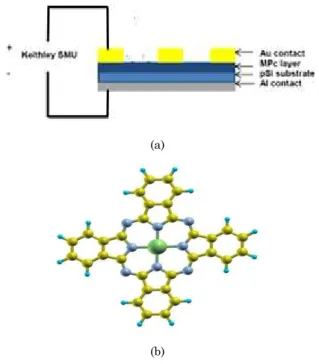
The Au/CuPc/pSi/Al, Au/MgPc/pSi/Al and Au/AlPc/pSi/Al diodes are fabricated by spin coating route @ 2000 rpm. Metallic contacts are made by ther-mal evaporation process in vacuum at pressure of 10– 6 T. The metallic (Au) contacts have a diameter of 1.5 mm. The cross section of Au/MPc/pSi/Al structures is sketched in figure 1. Experimental system for the diode fabrication and electrical characterization system are composed by a source meter unit SMU Keithley Model 2400. All the measurements are carried out at room temperature in dark conditions.
3. RESULTS AND DISCUSSION
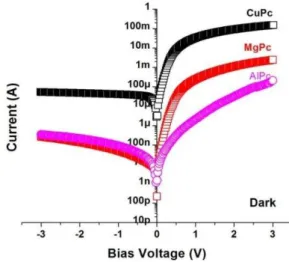
The molecular structure of MPc has a square-planar arrangement with a metal ion in its center as displayed in figure 1A. Figure 2 depicts the semilog plotting versus bias voltage which varies within (– 3, + 3) V for the MPc / pSi diodes. The measurements are achieved in dark and at room temperature. From these characteris-tics, we extract the microelectronic parameters like
ide-ality factor, saturation current, rectifying factor and series resistance. Table 1 summarized all obtained pa-rameters of the current-voltage characteristics. As shown in figure 2, the characteristics reveal a non-ideal behavior, a big discrepancy in current values is observed between CuPc, MgPc and AlPc in particular for the for-ward bias. At high voltage + 3 V, the current is found to be 152, 2 and 0.21 mA respectively for CuPc, MgPc and AlPc diodes. In the reverse bias region, 53.7, 0.26 and 0.34 A are the found current values at – 3 V for the organic diodes cited above in the same order. At 0 V, the diode based on MPc shows roughly a current of 2.9 A, 0.24 nA and 1.6 nA respectively for M Cu, Mg and Al.
(a)
(b)
M. BENHALILIBA,Y.S. OCAK,C.E.BENOUIS J.NANO-ELECTRON.PHYS. 6, 04009 (2014)
04009-2 Fig. 2 – The semilog-plotting of I-V characteristics (under dark)of Al/MPc/p-Si diode, where M Cu, Mg and Al
Fig. 3 – dV / dlnI vs. current profile (under dark) of Al/MPc/p-Si diode, where M Cu (a), Mg (b) and Al (c)
If the bias value is 3kT / q then the ideality factor is calculated from the linear region of the current-voltage characteristics as follows [4];
ln( ) q dV n
kT d I
(1)
Where k is Boltzmann constant (1.38 10– 23 J/K), T is the absolute temperature (300 K) and q is the elec-tron charge. The parameter n is equal to unity in the ideal diode case but for our Au/MPc/Si device it is greater than 1 due to interface density and series re-sistance. It is equal to 2.22, 1.85 and 4.40 respectively for M Cu, Mg and Al. A rectifying behavior is then observed and rectifying factor R is calculated from ratio of current calculated at 3 V to that at – 3 V, R I (3 V) / I(– 3) as listed in table 1.
According to the thermo-ionic emission mechanism, the current versus voltage depending on I0 is expressed as follows [6],
0
( )
exp q V IRs
I I
nkT (2)
The saturation current, depends on metallic ion M as indicated in table1, decreases strongly from 12 A to 7 nA when copper ion is substituted by magnesium or aluminum. As reported above, the non-ideal behavior of as fabricated diodes is revealed and rectification factor is higher for the Cu and Mg-Pc and lower for the AlPc as calculated in table 1 and shown in fig. 2.
When the effect of resistance is important, then the equation 1 will be modified as follows [4];
ln s
dV kT
R I n
d I q (3)
Here, the resistance due to the interface presence is dominated.
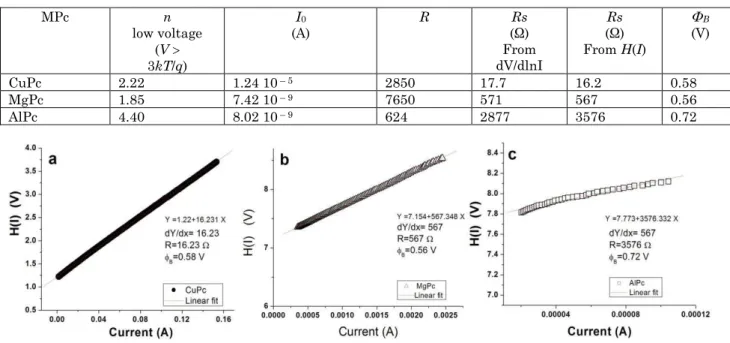
The derivate dV / dlnI versus current is displayed in figure 3 a, b and c. From these curves, using a linear fit as (nkT / q) + RsI, we determine the values of series
resistance and idealty factor. n takes the values of 2.08, 12.7 and 10.74 and Rs of 17.7, 571 and 2877 Ω
respec-tively for CuPc, MgPc and AlPc devices.
In contrast, when the resistance effect dominates, the two parameters ΦB and Rs are determined from the
function H(I) expressed as [7];
( ) ( ) ln( )
* ²
nkT I
H I V
q AA T
(4)
A* is of 32 A/cm²K² for p type Si. The metallic co n-tacts have an area of 0.0176 cm² and T is of 300 K and kT / q is found to be 0,025875 V.
( ) B s
H I n R I (5)
The H curves exhibit a linear variation as function of current as seen in figure 4. From the linear fit, Y + Rs X, displayed in figure 4 and according to eq. 5 the parameters Rs and ΦB are determined as
listed in table 1.
The series resistance Rs(Ω) determined by the eq. 3,
EFFECT OF METAL ON CHARACTERISTICS OF MPC ORGANIC DIODES J.NANO-ELECTRON.PHYS.6, 04009 (2014)
04009-3
Table 1 – Ideality factor, saturation current, rectification factor, series resistance and barrier height
MPc n
low voltage (V 3kT/q)
I0 (A)
R Rs
(Ω) From dV/dlnI
Rs (Ω) From H(I)
ΦB
(V)
CuPc 2.22 1.24 10– 5 2850 17.7 16.2 0.58
MgPc 1.85 7.42 10– 9 7650 571 567 0.56
AlPc 4.40 8.02 10– 9 624 2877 3576 0.72
Fig. 4 – Plotting of H(I) vs. current (under dark)of Al/MPc/p-Si diode, where M Cu (a), Mg (b) and Al (c)
CuPc device and greater than 3500 Ω for the AlPc d e-vice. Consequently the resistance decreases as a result of metal ion insertion. While the barrier height, is close for the MPc M Cu, Mg, and 0.72 V for AlPc diodes.
4. CONCLUSION
The Au/MPc/Si diodes are successfully fabricated and investigated. The non-ideal behavior, metal ion dependence are revealed. A rectifying behavior of MPC diodes is confirmed 8000 R 600, and n is greater than 2. This fact is due in particular to series resistance of CuPc device and greater than 3500 Ω for the AlPc d e-vice. Consequently the resistance decreases as a result of metal ion insertion. While the barrier height, is close for the MPc, M Cu, Mg, and 0.72 V for AlPc diodes,
and Rs varied within the range 17-3500 Ω. A barrier
height of Au/MPc/Si is around 0.6 V and increases up to 0.7 V for the AlPc diode case.
ACKNOWLEDGMENTS
This study is included in the CNEPRU project un-der contract number D01920120039, supported by Ministry of High Teaching and Scientific Research MESRS http://www.mesrs.dz, and UST0-MB
www.univ-usto.dz. The authors would like to express
their sincere thanks to the head of renewable energy laboratory DUBTAM, for his help in performing the spin coating route.
REFERENCES
1. Sawanta S. Malia, Hyungjin Kim, Jin Hyeok Kim, Pramod S. Patila, Chang Kook Hong, Ceramics Int. 40, 643 (2014).
2. M.E. Sánchez-Vergara, M. Rivera, J. Phys. Chem. Solids
75, 599 (2014).
3. S. Riad, Thin Solid Films370, 253 (2000).
4. Mutabar Shah, M.H. Sayyad, Kh.S. Karimov, M. Maroof Tahir, Physica B405, 1188 (2010).
5. A.A.M. Farag, W.A. Farooq, F. Yakuphanoglu,
Microelec-tron. Eng.88, 2894 (2011).
6. Shi Yunfen, Zhou Yang, Xu Ying, Energ. Procedia17, 1550 (2012).
7. Ö.TüzünÖzmen, E.Yağlıoğlu, Mater. Sci. Semiconductor