
Abstract— THz continuum spectral photometry has new and unique applications in different civil and military areas presenting a number of distinctive advantages on the well known microwaves or mid- to near-infrared technologies. THz sensing is essential to investigate the emission mechanisms by high energy particle acceleration processes. Technical challenges appear to diagnose radiation produced by solar flare burst emissions measured from space as well as radiation produced by high energy electrons in laboratory accelerators. THz filters and detectors have been investigated for the construction of solar flare high cadence radiometers to operate outside the terrestrial atmosphere. Experimental setups have been assembled for testing THz continuum radiation response from distinct detectors: adapted commercial microbolometer array, pyroelectric module, and opto-acoustic (Golay cell). The results permitted the final design of a THz double radiometer using Golay cells to be flown in stratosphere balloon missions.
Index Terms—Far IR continuum spectral photometry,THz radiometers, THz sensors, Solar THz radiation
I. INTRODUCTION
Technologies for photometry and imaging in the THz range (arbitrarily 0.1 – 30 THz) are in full
expansion for a variety of new and unique applications in different civil and military areas presenting
a number of distinctive advantages on the well known microwaves or mid- to near-infrared
technologies. THz radiation propagates well through cloth, dust and fog [1,2,3]. Sensing in this range
Uncooled Detectors of Continuum Terahertz
Radiation
P. Kaufmann
Universidade Presbiteriana Mackenzie, CRAAM – Escola de Engenharia, São Paulo, SP, Brazil, and Universidade Estadual de Campinas, CCS – Centro de Componentes Semicondutores, Campinas, SP, Brazil,
R. Marcon
Universidade Estadual de Campinas, IFGW, Campinas, SP, Brazil and Observatório Solar ”Bernard Lyot”, Campinas, SP, Brazil, [email protected]
A.S. Kudaka, M. M. Cassiano, L.O.T. Fernandes
Universidade Presbiteriana Mackenzie, CRAAM – Escola de Engenharia, São Paulo, SP, Brazil, [email protected]
A. Marun, P. Pereyra, R. Godoy
Complejo Astronomico El Leoncito, CONICET San Juan, Argentina, [email protected]
E. Bortolucci, M. Beny Zakia, J.A. Diniz, A.M. Pereira Alves da Silva
Universidade Estadual de Campinas, CCS – Centro de Componentes Semicondutores, Campinas, SP, Brazil, [email protected]
A.V. Timofeevsky, V.A. Nikolaev
[10]. The radiometry of temperature enhancements above a pre-existent bright level - as it is the case
of flare radiation excess over the solar disk intense emission - requires the effective suppression of the
incoming visible and near-infrared (NIR) radiation. This has been accomplished with the use of a
number of THz low-pass filters [11], consisting in a combination of rough surface mirrors [12,13,14]
and commercially available membranes [15,16]. We present the performance of distinct uncooled
sensors in response to black body THz radiation for different sensors: microbolometer array,
pyroelectric module, and Golay cell.
II. TEST OF UNCOOLED THZ DETECTORS
A. Adapted microbolometer array
A custom-made detector consisted in a room-temperature vanadium oxide micro-bolometer focal
plane array (FPA) camera IRM 160A with HRFZ-Si THz window provided by INO Company,
Quebec, Canada [17]. The camera total-power response for black body temperatures ranging
300-1000 K was measured at El Leoncito laboratory. A nichrome resistor, assumed as close to an ideal
black body radiator, was placed at the focus of 150 mm concave reflector to produce an image
occupying nearly 70 % of the FPA. We selected the Region Of Interest (ROI) over the area in the
frame filled by the heated resistor image. All pixels readings on the ROI were added and averaged for
every frame reading, quoted in camera reading units. Several sets of measurements were taken, for
temperatures ranging from ambient (about 290 K) to about 900 K, without any low-pass filter, and
using the two membrane low-pass filters described elsewhere [11,15,16]. One set of measurements is
summarized in Fig. 1 (a). Figure 1(b) shows another expanded set of data showing the camera
response using the Zitex G110 [15] and the TydexBlack [16] low-pass membranes.
The fluctuation of data points can be attributed to measurement uncertainties (of about ± 1 reading
unit), since they were taken with high cadence (30 frames/s). It can be noted that the camera readings
with Zitex G110 low pass filter interposed is about 20-40 reading units above the TydexBlack
readings, for the whole range of temperatures. This effect was repeatedly observed for all series of
measurements. It might correspond to the fraction of power in the visible-NIR transmitted by Zitex
(a) (b)
Fig. 1 - The response of INO IRM 160A camera FPA with HRFZ-Si window to black body radiation: (a) for the whole
spectrum and through the low-pass membranes filters for the THz spectral contribution. (b) Independent expanded plot for
TydexBlack low-pass filter. The output ordinates are in ADC camera reading units.
The substantial reduction in the camera response to black body temperature changes when
interposing the low-pass membranes proves their effectiveness in the readings increase suppressing
the visible and NIR radiation. Indeed the predicted ratio of power increase for a black body heated
about 100 K, at the 700 K level, for the whole main spectrum (λ > 0.5 µm) in comparison to the THz
part of the spectrum (λ > 15 µm ) is close to 60. This might be compared to ratio of about 40 between
the camera ROI readings increase in that range compared to with the membrane low-pass filters.
The camera scale of about 25 K per reading unit (± 1 reading unit) was too large to allow any
measurable differences when adding one resonant metal mesh band-pass filter [18].
B. Pyroelectric detector module
The pyroelectric modular detector made by Spectrum Detector Inc. [19], model SPH65-THz, was
tested at the laboratory of the Center for Semiconductor Components (CCS), State University of
Campinas. The setup utilised a standard laboratory Newport model 67030 black body source with a
build-in wheel chopper, set at 20 Hz. The detector response to black body temperatures is shown in
Fig. 2 for open conditions (responding to the visible – THz range) and for low-pass membranes
interposed.
performed by adding a 2 THz metal mesh band-pass filter [18]. For higher temperatures there were
indications on power reduction, qualitatively consistent with the expected band-pass. The measured
output, however, was close to the output reading fluctuations, preventing the reliable reading of
several data points, for different temperatures.
Fig. 3 - Expanded scale peak-to-peak mV response for the Spectrum Detector SPH65-THz pyroelectric module to black
body temperatures with low-pass membrane filters interposed: Zitex G110 and TydexBlack.
C. The opto-acoustic detector (Golay cell)
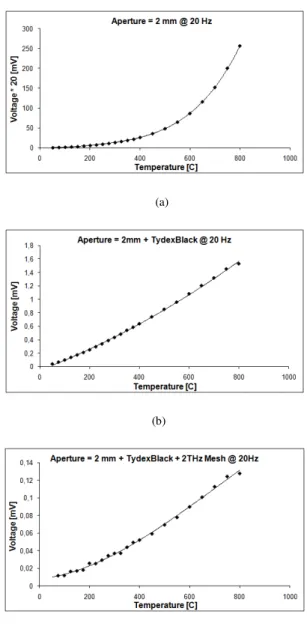
The performance of the Tydex model GC-1P Golay cell sensor [20] was investigated on similar
conditions. The first set of measurements was carried out at Tydex Company, using a standard black
body, 2 mm diameter diaphragm in front of the extended black body source and a wheel chopper.
Filters and diaphragm were interposed in front of the Golay cell. We report here the measurements
taken with the diaphragm close to the detector, chopper frequency of 20 Hz.
A 2 THz band-pass resonant metal mesh filter, fabricated separately [18], was added to the
low-pass membrane filter, producing the nearly linear response shown in Fig. 4. The reduction in detector
outputs for low-pass filter (frequencies < 15 THz) and for band-pass filter added (2 ± 0.2 THz) to the
low-pass filter are consistent with the spectral power reduction in the respective band. The sensitivity
of the Golay cell can be further increased with the use of the input photon collecting cone and/or by
(a)
(b)
(c)
Fig. 4 - The Tydex GC-1P opto-acoustic detector (Golay cell) response to black body temperature variations through a 2 mm
aperture. (a) No filter interposed. (b) TydexBlack low-pass filter interposed and (c) with low-pass filter TydexBlack and 2
THz metal mesh band-pass filter interposed.
III. CONCLUDING REMARKS
The detection of black body THz radiation has been tested for microbolometer focal plane array,
pyroelectric module, and opto-acoustic detector (Golay cell). The Golay cell exhibited superior
sensitivity for the detection of weak power fraction enhancement as a function of temperature
variations as measured with a band-pass of ± 10% centered at the THz frequency. The results obtained
in this study provided the necessary parameters needed for the design of a THz radiometer intended
for solar flare observations from a space platform.
Fig. 5 – Concept design of the double 3 and 7 THz solar radiometer system, provisionally called SOLAR-T [21] to be flown
in three stratosphere balloon long duration flights over USA, Antarctica and Russia. The left panel shows the two
Cassegrain telescopes (70 mm in diameter) with roughened primary mirrors. The two Golay cells and electronics box are
seen from the top. The right panel shown the input filters sandwich made of the band-pass resonant metal mesh filter
(centered at 3 and 7 THz) plus the low-pass membrane filter plus the THz TPX window [21]
The THz radiometers’ SOLAR-T system is planned to be flown in long duration flights over Russia
(about one week) sometime between 2013-2016[21], in a cooperation with Moscow Lebedev Physics
Institute, and on USA and Antarctica (about two weeks circumnavigation), in 2012 and 2013,
respectively, in cooperation with University of California, Berkeley, together with their GRIPS
gamma-ray experiment [22].
ACKNOWLEDGMENTS
This research was partially supported by Brazilian agencies FAPESP, CNPq,
CNPq-FAPESP/INCT-NAMITEC, Mackpesquisa and Argentina agency CONICET.
REFERENCES
[1] Harris, D.C., “Materials for infrared windows and domes”, SPIE Optical Engineering Press, Washington, USA,1999. [2] Siegel, P.H., “THz Technology: An Overview”, International Journal of High Speed Electronics and Systems, 13, nº2,
2003, 1-44.
[4] Sherwin M. S., Schmuttenmaer C. A., Bucksbaum P. H., Proceedings of DOE-NSF-NIH Workshop on Opportunities in THz Science, Arlington, VA , 2004.
[5] Kinch, M.A., “Infrared detector materials”, SPIE Optical Engineering Press, TT76, Washington, USA, DC, 2007. [6] Strabala K. I., Ackerman S. A. and Menzel W. P., “Cloud Properties inferred from 8–12-µm Data”, Journal of Applied
Meteorology, 33, 1994, 212.
[7] Williams, G. P., “FAR-IR/THz radiation from the Jefferson Laboratory, energy recovered linac, free electron laser”,
Rev. Sci. Instrum. 73, 2002, 1461-1463.
[8] Kaufmann, P. and Raulin, J.-P., “Can microbunch instability on solar flare accelerated electron beams account for bright broadband coherent synchrotron microwaves?”, Phys. Plasmas13, 2006, 070701-070701-4.
[9] Klopf, J. M., in 1st SMESE Workshop, 10-12 March, Paris, France, 2008. [10] Kaufmann, P. et al., Astrophys. J.,603, 2004, L121.
[11] Kaufmann, P. et al., “Continuum Terahertz Radiation Detection Using Membrane Filters”, International Microwave and Optoelectronics Conference, SBMO & IEEE-MTT, Nov. 3-6 2009, Belem, Pará, Brazil, 2009, 262-266.
[12] Bennett, H.E. and Porteus, J. O. “Relation between surface roughness and specular reflectance at normal incidence“, J. Opt. Soc. Am.51, 1961, 123-129.
[13] Kostiuk.T. and Deming, D., “A solar infrared photometer for space flight application”, Infrared Physics32, 1991, 225-233.
[14] Kornberg, M. et al., “Rough Mirrors for the THz Frequency Range”, Proc. MOMAG 2008 - 13th SBMO and 8th CBMAG, Florianópolis, SC, Brazil, 7-10 September, 2008, 365-367.
[15] Benford, D.J., Gaidis, M.C., and Kooi, J.W., “Optical properties of Zitex in the infrared to submillimeter”, Applied Optics42, 2003, 5118-5122.
[16] www.tydex.ru, Tydex JSCo, St. Petersburg, Russia, Technical Note on THz materials and components, 2008. [17] http://www.ino.ca/en-CA
[18] Melo, A.M. et al., "Metal mesh resonant filters for terahertz frequencies", Applied Optics 47,2008, 6064-6069. [19] http://www.spectrumdetector.com, 2009.
[20] http://www.tydexoptics.com/products1/thz_optics/golay_cell/, 2009.
[21] Kaufmann, P. et al., “Search for Continuum Solar Flare Radiation in the Terahertz Range”, in Proc. of IRMMW-THz 2010 Conference, Rome, Italy, 5-10 September, 2010.


![Fig. 5 – Concept design of the double 3 and 7 THz solar radiometer system, provisionally called SOLAR-T [21] to be flown in three stratosphere balloon long duration flights over USA, Antarctica and Russia](https://thumb-eu.123doks.com/thumbv2/123dok_br/18887590.424191/6.892.108.789.368.614/concept-radiometer-provisionally-stratosphere-balloon-duration-flights-antarctica.webp)
