Surfae Instability and Disloation Nuleation in
Strained Epitaxial Layers
O. Trushin,
Institute ofMiroeletronisandInformatis,AademyofSienesof Russia, Yaroslavl 150007,Russia
E. Granato,
LAS,InstitutoNaionaldePesquisas Espaiais 12201-190S~aoJosedosCampos,SPBrasil
S.C. Ying,J.M. Kosterlitz
DepartmentofPhysis, BrownUniversity,, Providene,RI02912USA
T. Ala-Nissila,and P. Salo
HITandLaboratory ofPhysis,HelsinkiUniversityofTehnology, FIN-02015HUT,Espoo,Finland
Reeivedon23April,2001
Wehavestudiednumeriallythestabilityand defetnuleation inepitaxiallayersonasubstrate
withlattie mismath. Stress relaxation and energybarriers for mistdisloationnuleation are
estimated using modern methods for saddle point searh based on a ombination of ativation
withloal repulsive potentialand the Nudged ElastiBand method. Stress relaxation proesses
orrespond to dierent transition pathsfrom oherent toinoherentstates of theepitaxial layer.
Usingatwo-dimensionalatomistimodelwithLennard-Jonesinteratingpotential,wenddierent
equilibriumritialthiknessandativationenergybehavior fordisloationnuleationofepitaxial
lmsunder tensile and ompressive strain. For tensile strain, the energybarrier dereases with
thiknesswhileitreahesaonstant valueforompressivestrain.
Standardonsiderationsoftheompetitionbetween
strainenergybuild upandstrainreliefdueto
disloa-tionnuleationinmismathedepitaxiallmsleadtoan
equilibrium ritial thiknessabovewhihdisloations
an appear spontaneously [1℄. The predited ritial
valuehowever,bothfromontinuouselastimodels[2℄
and from models inorporating layer disreteness [3℄,
is muh smallerthan theobserved experimental value
suggesting that the defet-free (oherent) state above
theequilibriumritialthiknessshouldbemetastable.
Physially,nuleationofdisloationsininitially
defet-free lms must then proeed by an ativation proess
thatoveromestheenergybarrierbetweentheoherent
and inoherentstates. Thenature ofthe instabilityof
theoherentstatehoweverisstillunderurrent
investi-gation[4,5,6℄butdetailedunderstandingofthe
orre-spondingatomistimehanismshouldbeimportant,for
example, in the fabriation of semiondutingdevies
[1, 2℄. The idea of strain relaxation as an ativated
proessis supportedbyreentexperimentalresultsfor
the temperature dependene of the ritial thikness
[7℄andhasalsobeenaddressedin akineti
semiempir-ialmodel[8℄. With reentdevelopmentsin omputer
simulationmethods,itbeamepossibletoaddressthis
problemwithatomistisimulationsusingsemiempirial
potentials[9, 10℄, suh as Embedded Atom potentials
and Stillinger-Weberpotential. Muh simplermodels,
usingLennard-Jones(LJ)interatingpotentialsintwo
andthreedimensions,havealsobeenusedas,for
exam-ple,inthemoleulardynamis(MD)studyofthe
spon-taneousrelaxationinasystemwithlargelm-substrate
mismath [11, 12, 13℄. Theimportane of kineti
fa-tors in real experiments has also been emphasized in
MD simulations of the growth proess [6℄. However,
there are important questions that have not been
ad-dressed satisfatorily, suh as: the estimation of the
energybarrier for mist disloation nuleation;
atom-istimehanismsofstruturaltransformationalongthe
transition path; possible struture of disloation ore
andthe dierenein kinetis of disloationnuleation
for ompressive and tensile strain. In this work, we
studythemehanismofdisloationnuleationby
on-sideringtherelaxationproessesasdierenttransition
pathsfrom oherenttoinoherentstatesofthe
epitax-ialsystemanddeterminetheassoiatedenergybarrier
usingimprovedmethodsforsaddlepointsearhin
mul-tidimensionalspae.
We onsider a two-dimensional model of the
epi-taxial lm and substrate where the atomi layers are
onnedto aplane. Interationsbetweenatomsinthe
systemweremodeledbyageneralizedLJpairpotential
[14℄
U(r)="
n
m n
r
0
r
m
m
m n
r
0
r
n
energy and r
0
the equilibrium distane between the
atoms. This potential wasinitially developed for
sim-ulationofmetalli systemsbutitisalsoonvenientfor
othersystemswhentheparametersarehosen
aord-ingly. In the alulations, the values of these
param-eters were hosen to mimi the properties of opper.
In this ase we set m = 5, n = 8 and used a
ut-o radius for the interatomi potential of 12
A. The
energy sale was set to " = 3401:1K to allow
real-isti estimates for the strength of interatomi
bond-ings. r
0
was set to dierent values to represent the
substrate, epitaxial lm and the substrate-lm
inter-fae. For the substrate r
0 = r
ss
= 2:5487
A and for
theepitaxial lm r
0 =r
ff
wasvariedto givea mist
f =(r
ff r
ss )=r
ss
. For thelm-substrateinteration
we set r
0 = r
fs = (r
ff +r
ss
)=2. Positive mismath
orrespondstoompressivestrainandnegativeto
ten-silestrainwhenthelmisoherentwiththesubstrate.
Periodiboundaryonditionsareimposedinthe
dire-tion parallel tothe lm-substrate interfae. Most
al-ulationswereperformedonasubstrateonsistingof5
layerswhere thebottom 2 layersare hold xed while
the top 3 layers and all layers of the lm are free to
move.
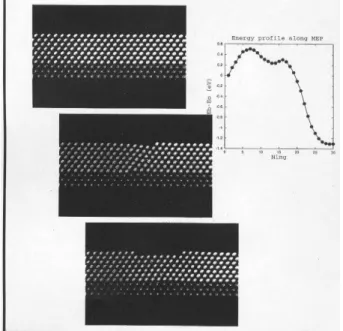
Figure1.Partile ongurations(left)intheinitial
epitax-ial stateandat dierent statesalongtheminimumenergy
path (right), for tensile (f = 8%) strain. E
b E
0
de-notes the energy hange from the initial state and Nimg
suessivehainongurationsintheNudgedElastiBand
method[15℄.
Tostudythenuleationofdefetsandritial
thik-nessofthismodelweuseanumerialtehniquewhih
allowsthe determination of the energyprole along a
transition pathfrom theinitial oherentstateto a
re-laxed state of the epitaxial lm. The tehnique
on-sistsofthreesteps. First,theinitial(oherent)stateis
preparedbyminimizingthetotalenergyofthesystem
throughstandardMDooling[15℄. (Inthismethod,the
V =0wheneverV andtheforeF onapartilesatisfy
the ondition ~
V ~
F < 0). Next, the systemis moved
fromtheinitialminimumtoanothernearestminimum
energy state [16℄. This is aomplished through the
introdution of additional loal repulsive potential of
the form U
tot
(r) = U(r)+Aexpf (r r
0
)g, where
r
0
is the oordinates of the initial state at the
mini-mum. [16,17℄. Thesystemisrandomlydisplaedfrom
theinitialstateinthepreseneofthisrepulsive
poten-tial to esape from the harmoni basin and arrive at
thenewminimumongurationagainviaMDooling.
Finally, with theknowledgeof boththe initial and
-nalstates,the minimumenergypathonnetingthem
is determined with the Nudged Elasti Band method
[15℄. The minimum energy path ontainsinformation
fortheatomiongurationatasaddlepointaswellas
the energy barrier to esape from the initial epitaxial
state. A typial resultfor the aseof tensile strainis
shownin Fig.1.
For epitaxial lms above the equilibrium ritial
thikness,therelaxedstateisexpetedtohavealower
energy and a nonzero density of mist disloations
whih partially relieves the strain energy in the lm.
However,ifthisongurationisseparatedfromthe
o-herentstatebyaniteenergybarrierthelmremains
oherentunlessdefets arenuleated allowingthe
sys-temtooveromethisenergybarrier. Thisbarrierould
beniteevenwhentherelaxedstatewithdisloations
has an energy already lower than the epitaxial state.
Thustheritialthiknessanbemuhlargerthanthe
equilibrium value depending on the kinetis of defet
nuleation. Preliminary results for amist jfj = 8%
showed a large variety of relaxationproesses
inlud-ing,singledisloationnuleation,multipledisloations,
disloationswithdierentorestrutures,disloations
nuleatingondierentdepthin thelm,whih anbe
haraterizedbytheirdierentativation energiesand
energies ofthe nal inoherentstates. To addressthe
problemofritialthiknesswehadtorestritour
on-siderationsto asmall groupof relaxationproesses,in
partiulartosingledisloationnuleation,withthe
low-estnalstateenergy. Wehaveperformedasystemati
omparisonoftheparametersforsingledisloation
nu-leationproessesin systemswith dierent lm
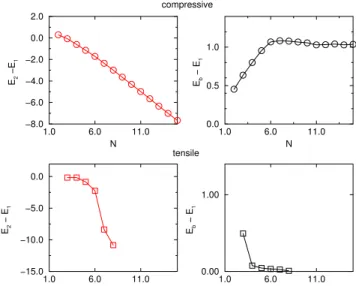
thik-ness. Wendthatthereisasharpdiereneinthe
be-haviorofthe ativation barrierasfuntion of thelm
thikness(number of layers) for lms under
ompres-siveandtensilestrainasshowninFig. 2. Intheaseof
ompressivestrain,theativationbarrierinreasesand
thensaturatestosomeonstantvaluewhereasitdeays
rapidly for inreasing number of layers for the tensile
strain. Inaddition,theenergyhangeE
2 E
1
fromthe
oherent(E
1
)to theinoherent state(E
2
)also shows
dierent behavior. The lm thikness where this
en-ergyvanishesdenes theequilibrium ritialthikness
whih results smaller for ompressive strain in
agree-ment with other alulations for a similar model [6℄.
strain disloation nuleation an in fat be ativated
even at the lowest temperature. Spontaneous
nule-ation of disloation ours after a short time heating
(100 time steps) up to 70 K(a negligible valueof the
ativation energy). The dierene in behavior of the
energybarrierfortensileandompressivestrainanbe
explained as resulting from the dierene in the
sti-nessoftherepulsiveandattrativepartsofinteratomi
Lennard-Jones potential. Forompressive strain,
dis-plaement of the partiles near the free surfae ost
higherenergysinetheinteratomi potentialinreases
sharplyforseparationsr<r
o
whereasitdeaysslowly
forr>r
o .
1.0
6.0
11.0
N
−15.0
−10.0
−5.0
0.0
E
2
− E
1
1.0
6.0
11.0
N
−8.0
−6.0
−4.0
−2.0
0.0
2.0
E
2
−E
1
1.0
6.0
11.0
N
0.00
1.00
E
b
− E
1
1.0
6.0
11.0
N
0.0
0.5
1.0
E
b
− E
1
compressive
tensile
Figure2. RelaxationenergyE2 E1 (left)andenergy
bar-rier E
b
E1 (right) as a funtionof numberof layers for
an epitaxial lmunder ompressive (f =8%) and tensile
(f = 8%)strain.
Thepresentmethodanalsobeextendedto
three-dimensional modelswith morerealistiinteration
po-tentials. Preliminary alulations for the Pd/Cu and
Cu/Pd systems with the Embedded Atom Model
po-tentials [18℄ demonstrate eetiveness of the method
forsystematistudiesinthisaseaswellandonrms
theasymmetryofthenuleationenergywithrespetto
themistasfoundforthesimplerLennard-Jonestype
potential. However,thedetailsofthedisloation
nule-ation mehanismandthedependeneofthebarrieron
the thikness in three-dimensional systems are rather
dierentfromthetwo-dimensionalmodelstudiedhere.
In summary, we have shown that by ombining
theNudged ElastiBand[15℄andSpherialRepulsion
methods [16℄ it is possible to investigate in a
system-ati waythetransition pathsformistdisloation
nu-leationin epitaxiallms. Alargevarietyofproesses
areobserved(edgedisloations,disloationswith
inter-mixingonthelm-substrateinterfae,disloationswith
nuleationisaetedbythestinessofinteratomi
po-tentialandsize ofsystem. IntheaseofLJ potential,
theproessissensitivetosmallpotentialut-oradius.
Anonzeroativationbarrierfordisloationnuleation,
asfound in the present model, may explain the large
ritialthikness and thetemperature dependene
of-tenobservedinexperiments.
Aknowledgments
This work was supported by a joint NSF-CNPq
grant, bythe Russian Ministery of Siene and
Teh-nologyandtheAademyofFinlandthroughitsCenter
ofExelleneProgram.
Referenes
[1℄ J.C.Bean,Siene230,127(1985).
[2℄ C.A.B.Ball and J.H.vander Merwe, inDisloationin
Solids, F.R.N. Nabarro, Ed. (North-Holland,
Amster-dam,1983).
[3℄ E.Granato,J.M.Kosterlitz,andS.C.Ying,Phys.Rev.
B39,3185 (1989).
[4℄ B.J. Spener, P.W. Woorhees, S.H. Davis, Phys.Rev.
Lett.67,3696(1991).
[5℄ A.G. Cullis, A.J. Pidduk, M.T. Emeny, Phys. Rev.
Lett.75,2368(1995).
[6℄ L.Dong,J.Shnitker,R.W.Smith,andD.J.Srolovitz,
J.Appl.Phys.83,217(1998).
[7℄ J.Zou and D.J.H. Cokayne, B.F. Usher, Appl. Phys.
Lett.68673(1996).
[8℄ D.C.Houghton,J.Appl.Phys.702136(1991).
[9℄ C.M.Gilmore,Phys.Rev.B426899 (1990).
[10℄ M. Ihimura and J. Narayan, Phil. Mag. A, 72 281
(1995).
[11℄ B.W.DodsonandP.A.Taylor, Appl.Phys.Lett. 49,
643(1986).
[12℄ P.A.TaylorandB.W.Dodson,Phys.Rev.B36,1355
(1987).
[13℄ A.S. Nandedkar, G.R. Srinivasan, and C.S. Murthy,
Phys.Rev.B43,7308 (1991).
[14℄ S.Zhen and G.J. Davies, Phys.Stat. Sol. A 78, 595
(1983).
[15℄ H.Jonsson,G.Mills andK.W.Jaobsen,inClassial
and Quantum Dynamis in Condensed Phase
Simula-tions,ed.byB. J.Berneetal(WorldSienti,
Singa-pore,1998).
[16℄ O.Trushin,unpublished.
[17℄ N.MousseauandG.T.Barkema,Phys.Rev.B61,1898
(2000).
[18℄ S.M.Foiles,M.I.Bakes, andM.S.Daw,Phys.Rev.B