Brazilian Journal of Physics, vol. 36, no. 3A, September, 2006 717
Ground State Energy of Charged Particles Clusters by
Quantum Monte Carlo Method
N. L. Moreira1, J. N. Teixeira Rabelo2, and L. Cˆandido2
(1) Departamento de F´ısica, Universidade Federal de S˜ao Carlos, C.P. 676, 13.565-905, S˜ao Carlos, SP, Brazil and (2) Instituto de F´ısica, Universidade Federal de Goi´as Campus Samambaia, 74001-970 Goiˆania, GO, Brazil
Received on 7 November, 2005
Using variational and diffusion Monte Carlo methods, we have calculated the ground state energy of spinless charged particles (forN≤10) interacting through a repulsive Coulomb potential, moving in two-dimensions and kept together by an external parabolic potential. Using a very simple trial wave function, we obtain results comparable to those of a sophisticated model of a quantum dot.
Keywords: Quantum Monte Carlo; Quantum dot; Ground state
I. INTRODUCTION AND MODEL
With technological advances in the preparation and in the fabrication of microstructures it is now possible to confine electrons and atoms in restricted regions. The principal exem-ples of experimental progress in this area are semiconductor quantum dots [1] and laser trapping of cold atoms [2]. Semi-conductor quantum dots constitute a quasi ideal system for the study of the physical properties of a two-dimensional system of strongly interacting electrons, laterally confined by an ex-ternal potential. From the theoretical point of view, computer simulation [3, 4] has achieved the greatest success inusmuch as approximate analytical methods [5] have encountered difi-culties, since both the many body effects and the individual behavior of each electron have a crucial role in these systems. The major difficulty in the theoretical methods is due to the fact that the electrons in the quantum dots are confined in a very small area and hence they cannot be treated as part of a continuous distribution of charges. These systems, consisit-ing of a finite number of electrons confined to a small region in semiconductor structures are known as quantum dots and more recently as artificial atoms.
In this paper we report an application of Variational Monte Carlo and Diffusion Monte Carlo method (VMC-DMC) to calculate the ground state energy of a two-dimensional system used as a model for quantum dots. The simulations are per-formed with a confinement frequency~ω=0.28 Hartree (H). We consider a system consisting of a small number of spinless charged particles interacting through a repulsive Coulomb po-tential, moving in two dimensions and an external parabolic potential well. The Hamiltonian is given by
H=
N
∑
i=1
−~2 2m∗
− →∇2
i+ N
∑
i=1 m∗ω2r2
i
2 +
e2 4πεε0
N
∑
i<j 1
|~ri−~rj| (1)
Here,~riis the position of theith particle relative to the cen-ter of the confinement; m∗is the effective mass andεis the dielectric constant of the semiconductor. In effective atomic units, defined by~=e2
ε =m∗=1, the energy and length units
areRy∗=m∗e2/2~2(4πεε0)2anda∗B=~2(4πεε0)/m∗e2[6]. The average densityn0 of electrons in the dot may be rep-resented by a parameterrs defined byn0=N/πr2=1/πrs2.
Thus, because the external parabolic confinement is responsi-ble for the average density of electrons, the confinement fre-quency isω2=e2/4πε ε0m∗r3
s
√
N.
II. NUMERICAL SIMULATION
In this work most of the VMC-DMC calculations were per-formed for clusters with the electron number varying between N=1 and 10. The simulations were performed in two steps: first we perform a calculation using the VMC method. In this method the main idea is to assume a trial wave functionΨT, which can be optimized with respect to a set of variational pa-rametersα, in order to minimize the expectation value of the energy. In this step use variance minimization of the local en-ergy to improve the trial wave function [7]. Next, we improve the variational estimate by using the DMC method. In this method one propagates the trial wave function in imaginary timet using the operatore−tHin the long time limit to elim-inate higher excited states and project out the ground state. For more details of the VMC and DMC method see ref.[8]. We use a simplified algorithm as suggested in Ref.[8]. In our work we use a simple trial wave function given by a single particle Gaussian times a correlation Jastrow factor product
ΨT=e−∑iαr 2
ie∑i<j βri j
1+γri j. (2)
718 N. L. Moreira et al.
III. RESULTS AND DISCUSSION
Table I shows the results of DMC for a system of charged spinless particles (column 3) and the results by Pederivaet al. [9] (column 2) for a circular quantum dot in a semiconductor structure using the Quantum Monte Carlo method. We origi-nally intended to compare our results (column 3) to those of Bedanovet al.[3], for a system of classical particles confined by a parabolic potential, in order to get a first estimate of quan-tum effects for such system. The direct comparison to those results is however puzzling due to the differences in the defin-ition of the system of units, a problem that has been noted by several authors. For this reason we decided to make a com-parison with the results of Pederiva [9] for a semiconductor quantum dot. We do not expect excelent agreement since we consider a system of spinless particles. In spite of the differ-ences mentioned above, our results show an overall qualitative agreement and a reasonable quantitative behavior as is shown in Table I. The quantitative differences in the results come ba-sically from the contribution of the exchange interaction to the total energy. The qualitative behavior is brought about by the Coulombic interaction and the parabolic type of confinement. We can see that the values by Pederivaet al.are always above ours. This is expected, since the inclusion of spins will allow for smaller typical distances between electrons, thus augment-ing the potential energy and consequently the total energy.
TABLE I: Ground state energy inH, for circular quantum dots with confinement frequency~ω=0.28H.
N E(Ref. [9]) E(This work) 2 1.02165(1) 1.021602(1)
3 2.2339(1) 2.141503(5)
4 3.7145(1) 3.586869(1)
5 5.5338(1) 5.346638(4)
6 7.6001(1) 7.379415(5)
7 10.0342(1) 9.691703(6) 8 12.6900(1) 12.262552(7) 9 15.5801(1) 15.062426(8) 10 18.7232(1) 18.107263(6)
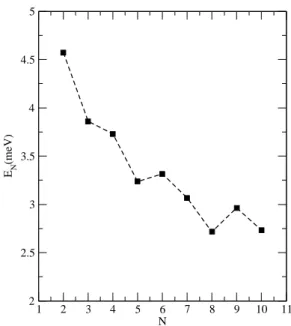
In Fig.1 we plot the change in the electrochemical potential EN as a function ofN. This change is due to the addition of an extra electronEN =µ(N+1)−µ(N), where N is the number of electrons in the cluster,µ(N) =E(N)−E(N−1) is the electrochemical potential of the system. As one can see, the electrochemical potential decreases as a function of the number of electrons, and seems to show valleys and peaks in electron numbers 2,6 and 9 that are related to changes in the structure of the cluster in agreement with experiment [10]. The most remarkable change observable in the Figure occurs
when the number of particles is equal to six. For this particular number of particles one electron lies in an internal shell and the other five in the external shell. For the configurations with five or less electrons the changes are not so drastic since all the electrons form a single shell.
1 2 3 4 5 6 7 8 9 10 11
N 2
2.5 3 3.5 4 4.5 5
EN
(meV)
FIG. 1: Change of the eletrochemical potential forω=0.28.
IV. CONCLUSION
A combination of the variational and diffusion Monte Carlo methods using a very simple wave function provides a good description of a system of spinless charged particles. In spite of this simplicity, our results are in good agreement with more sophisticated models of quantum dots. Because of this, we believe our results could be of interest as a first estimate of quantum corrections to classical approaches.
Acknowledgments
This research was partially sponsored by Conselho Na-cional de Desenvolvimento Cient´ıfico e Tecnol´ogico (CNPq) and Fundac¸˜ao Nacional de Apoio a Pesquisa (FUNAPE-UFG). N.L.M is supported by Fundac¸˜ao Coordenac˜ao de Aperfeic¸oamento de Pessoal de N´ıvel Superior (CAPES).
[1]Nanostructure Physics and Fabrication(edited by M. A. Reed and W. P. Kirk) (Academic Press, Boston, 1989).
[2]New Trends in Atomic Physics, Les Houches, Session 38, (edited by G. Grynberg and R. Stora) (North-Holland,
Ams-terdam, 1984), Vol. 1, p. 383.
[3] V. M. Bedanov, and F. M. Peeters, Phys. Rev. B 49, 2667 (1994).
Brazilian Journal of Physics, vol. 36, no. 3A, September, 2006 719
Condens. Matter.10, 11627 (1998).
[5] P. F. Farinas, G. E. Marques, and N. Studart, J. Appl. Phys.79, 8475 (1996).
[6] M. Koskinen, M. Manninen, and S. M. Reimann. Phys. Rev. Let.79, 1389, (1997).
[7] C. J. Umrigar, M. P. Nightingale, and K. J. Runge. J. Chem. Phys.99(4), 2865, (1993).
[8] B. L. Hammond, W. A. Lester, Jr., and P. J. Reynolds.Monte
Carlo Methods in Ab Initio Quantum Chemistry. World Scien-tific lecture and course note in chemistry; vol. 1, ADDRESS, (1994).
[9] F. Pederiva, C. J. Umrigar, and E. Lipparini, Phys. Rev. B62, 8120 (2000).