Carbon Doping of InAlAs Layers Grown by
Metalorgani Vapor Phase Epitaxy
M.L. P.Ribeiro,B. Yavih
, C. V. B. Tribuzy, and P. L. Souza
Laboratoriode Semiondutores,CentrodeEstudos emTeleomunia~oes,
PontifiaUniversidadeCatolia doRio deJaneiro,
RuaMarqu^esde S~aoViente225,RiodeJaneiro,22453-900 RJ,Brazil
Reeivedon23April,2001
CarbondopedAlInAs layers grown by low pressure metalorgani vapor phaseepitaxyare
inves-tigated as a funtionofgrowth temperature. Photoluminesenespetra showasigniant drop
inpeak intensityas thegrowthtemperatureis redued,duetothe inorporationofnon-radiative
defets. ItisshownthattheCdopingisnotrelatedtothedeteriorationoftheoptialpropertiesof
thelayers. Ontheotherhand,boththenetholeonentrationandtheondutivityinreaseasthe
growth temperatureis redueddueto amoreeÆient Cinorporationand alowerinorporation
ofthepassivatingHatoms.
I Introdution
InAlAs doped with aeptors has many appliations
in eletroni and optoeletroni devies. The p-type
layerofapinamplitudemodulatorstruture,when
In-GaAs/InAlAsmultiplequantumwell(MQW)formthe
intrinsiregion,isap-typeInAlAslayer.Normally,Zn
is used as the p-type dopant and gives rise to
exel-lentquality layersand high ontrollable dopinglevels.
Thedisadvantageof thisimpurityis its large
diusiv-ity[1℄. LargediusionoeÆientsimplyininludinga
thikintrinsiundopedInAlAslayerbetweentheMQW
region and the doped layerto avoid Zn diusion into
theMQW region. This leadsto athikertotal
intrin-siregionandthereforelargerappliedreversevoltages.
Moreover,ifoneintendstousep-typedelta-doped
lay-ersintheMQWstrutures[2℄oneshould avoidZn
be-ausetheatomidiusionwillgiverisetobroaddoping
proles. ThealternativewouldbetouseC,whihisan
aeptorbysubstitutingAsatoms.
Carbon hasreently reeived muh of attention as
anintentionalp-typedopantforInAlAsgrownby
met-alorganivaporphaseepitaxy(MOVPE)duetoitslow
diusionoeÆient[3℄andhighahievabledopinglevel
(over10 19
m 3
), whih is attrativefor fabriating a
rangeofhigh-speedeletroniandoptoeletronidevies
[4℄. However, to obtainhigh doping levelsone should
uselowgrowthtemperatures(T
g
),whih,ontheother
hand,are undesirablebeausethey favordefet
inor-poration. Therefore,knowledgeofthelimitationsofC
dopingofInAlAsisfundamental fordevie design.
Inthisworkwepresentresultsofasystemati
inves-tigationoftransportandoptialpropertiesofCdoped
InAlAs layers grown at dierent temperatures. It is
shownthatforgrowthtemperaturesatwhihthe
trans-port properties of thelayersare adequate, theoptial
harateristisareunappropriate.
II Experimental details
Thelattie-mathedInAlAsepitaxiallayersweregrown
in a horizontal MOVPE Aixtron 200 reator at 100
mbar at temperatures between 530 o
C and 650 o
C.
Hydrogen was used as the arrier gas. The
pre-ursors are trimethylgallium (TMGa),
trimethylalu-minium (TMAl), arsine(AsH
3
), tetrabromide (CBr
4 )
for Ga,Al, As andC respetively. Hallmeasurements
werearried outusing aBio-Rad HL5500 xed
mag-neti eld system in the standard Van der Pauw
ge-ometryat300K.X-raymeasurementsweremadewith
a Bede Sienti QC2a x-ray diratometer to
deter-mine thealloyomposition. Seondaryionmass
spe-trometry (SIMS) was used to evaluate the C atomi
onentration,[C℄. The photoluminesene(PL)
mea-surementswere performed with the514nm line of an
Ar +
laser for exitation. Thesignal wasdispersed by
a250mmmonohromatoranddetetedbyanitrogen
ooledGe photodetetor.
III Results and disussion
CdopedInAlAslayersweregrownwithTg varying
be-tween530 o
Cand650 o
C.Thegrowthtemperature
nor-mally used for InAlAs is around 630C.However, we
ndthatifsuhhightemperaturesareused,nomatter
howhigh the IV/V ux ratiois, the layersare n-type
andnotp-type. Threedierentfatorsmayontribute
to thiseet. First,Cisanamphoteridopantandits
probability of oupying a siteIII orV is most likely
temperaturedependent. However,suhaneetshould
beveryweak[5℄ Seond,it is well known that low T
g
leadstoasigniantinorporationofdefets,whihan
at as hole traps or ompensating speies. Finally, H
atoms are inorporatedwith theC atoms, passivating
them. Heat-treatments an be used to removethe H
atomsandre-establish theCeletrialativity.
Fig. 1 shows the twodimensional net free harge
onentration,[℄asafuntionofT
g
forsamplesgrown
using thesame CBr
4
ux. It is lear that the p
dop-ing levelinreases as T
g
is redued. One analso see
in Fig. 1that forT
g > 575
o
C,thesamples aren-type.
After growththeyweresubjetedto aheat-treatment
for15minutesunderforminggasow. Inallases,the
freeholeonentration,[p℄, inreasedwiththe
anneal-ingtemperature,asshowninFigs2aand2bforsamples
grownat 650 o
Cand 530 o
C,respetively, in agreement
withresultspublishedbyotherauthors[6,7℄.
Figure 1. Net free arrier onentration as a funtionof
growthtemperature. Theirlesreferdopedmaterial,while
thediamondsorrespondtoundopedlayers.
Figure2.Netfreearrieronentrationasafuntionof
an-nelingtemperaturefor samples grownat a) 650 o
C andat
b)530 o
C.
SIMSmeasurementswereperformedinorderto
de-termine[C℄and toompareit with[℄. Table1shows
theresultsof[C℄,[℄andtheeletrialativityeÆieny
of the C atoms for samples grown at three dierent
temperatures. As Tg is redued, not onlythe
eletri-alativityinreasesbut alsothe Catomi
inorpora-tionprobabilitydoes. Theeletrial ativityeÆieny
is dened as the ratio of [℄ and [C℄. The improved
stikingoeÆientforCatlowTg is attributedtothe
fatthatAsH
3
isonlypartiallyrakedatlow
temper-aturesfavoringtheinorporationofotherspeiesinthe
Vsub-lattie. Infat,atlowtemperaturesalsooxygen
is more eetively inorporatedas a donor oupying
sitesintheVsub-lattie. [8℄
Table1Resultsof[C℄, [℄andtheeletrial ativityeÆieny oftheCatomsforsamplesgrownatthree dierent
temperatures.
Sample T
g
(C) [C℄ (m 3
) [℄(m 3
) Eletrialativity
eÆieny(%)
#365 530 5x10
18
1.3x10 18
26
#363 575 1.3x10
18
2x10 17
15
Fig.3showsaninreaseintheondutivityasT
g is
redueddueto theinreasein[p℄. Oneonludes that
despitethemoreimportantinorporationofdefets at
low T
g
, in partiular ofoxygen [8℄,the ondutivityis
improved. Thus,CdopedInAlAslayersgrownat
tem-peraturesoftheorderof550 o
Candsubjetedtoa
post-growthannealareadequate,intermsoftheirtransport
properties, forappliationin eletronideviessuhas
highspeedtransistors,ashasalreadybeendisussedby
otherauthors[4,9℄. However,foroptialand
optoele-troni devies itis ruial that goodoptial qualityis
alsoahieved.
Figure3. Condutivityasafuntionofgrowth
temperature.
Weobserve that as Tg dereases theoptial
qual-ityofthelayersgraduallydeteriorates. Thenear-edge
optial transition dereases its intensity as T
g is
re-duedfrom650 o
Canditisnolongerobservedwhenthe
growthtemperaturereahes575 o
C.Thiseet is
inde-pendentofthepreseneofCimpurities,sinethesame
result is observed for the undoped referene samples.
AsshowninFig. 1,onlywhenTg isloweredto575 o
C
theas-grownsamplesarep-type. Inordertobetter
un-derstandthiseet,oneanthink thatloweringTg,is
theequivalentofdereasingthe V/III ratio[10℄. This
is beause at lower temperatures the raking of the
AsH
3
is less eÆient, as mentioned before. Hene, at
lowTg,moredefets areinorporated,aswellasmore
CatomsandlesspassivatingHatoms. Asobserved,the
moreeÆientinorporationofCoritsimproved
eletri-alativityarenotrelatedtothereduedPLintensity.
Therefore,oneonludesthatsomeoftheinorporated
defetsareveryeÆientnon-radiativeenters. The
na-tureof suhenter isstillunderinvestigation.
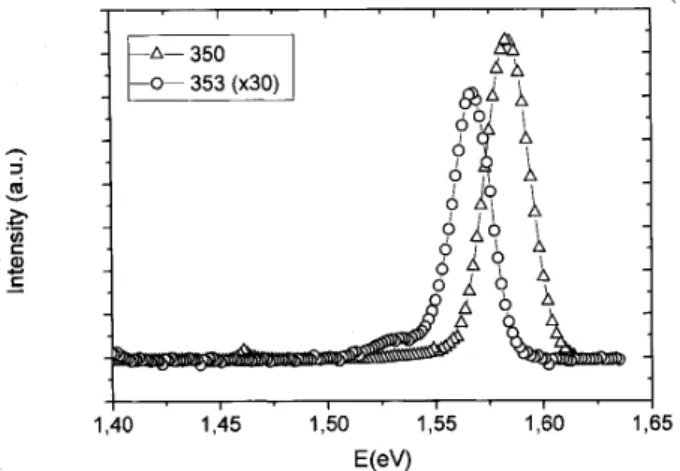
The eet of the doping in the near-edgeemission
anbeobservedinFig. 4,wherethe30KPLspetrafor
anundopedandadopedsample,bothgrownat650 o
C,
are shown. In the ase of the doped sample, the PL
peakenergyis15 meVbelowthatof theundoped
ref-erenesample. PLmeasurementsasafuntionof
exi-asP inreasesforthedopedsample,asexpetedfroma
donor-aeptor(D-A) typetransition. Sine this does
not our for the referene sample, one an onlude
that the D-A transition is limited by the presene of
C aeptors. The unintentionally inorporateddonors
ompensatethe aeptors. Oneshould rememberthat
these samples are n-type. Thedonorsare most likely
oxygenwhihareusuallyinorporatedinAlontaining
material.
Figure4. 30Kphotoluminesenespetraofadoped
(ir-les)andanundoped(triangles)sample.
IV Conlusion
CdopedInAlAslayershavebeenstudiedasafuntion
of Tg. It was shown that the [p℄ and the
ondutiv-ity inreaseasTg dereases due to amoreeÆient C
inorporationaswellasalowerinorporationof
passi-vating H atoms. Annealing the samples inreases the
eletrial ativity due to the removal of H atoms. It
has been also observed that as Tg dereases, the
in-tensityofthenear-edgePLemissionisreduedandfor
Tg < 575 o
C,it isnolonger observed. This eet is
at-tributed to the inorporation of non-radiative defets
at low Tg. It is suggested that TBAs, as As soure,
ouldbeanalternativeforAsH
3
toobtaingoodoptial
qualityCdopedAlInAs,sineitsrakingtemperature
is lower that that of AsH
3
[11℄, and onsequently the
lowTg wouldnotleadtoasigniantinorporationof
defets.
Referenes
[1℄ K.TaenoandC.Amano,J.CrystalGrowth220,393
(2000).
[2℄ P.L.Souza,C.V.-B.Tribuzy,S.M.Landi,M.P.Pires,
R.Butendeih,A.C.Bittenourt, G.E. Marquesand
A.B.Henriques,PhysiaEtobepublished.
[3℄ T.H.ChiuandJ.E.Cunningham,J.A.Dilzenberger,
[4℄ Hiroshi Ito and Tadao Ishibashi, Jpn. J. Appl. Phys
30,944(1991).
[5℄ C. R.Abernathy, S.J.Pearton, M. O. Manasreh, D.
W. Fisher and D. N. Talwar, Appl. Phys.Lett. 57,
294(1990).
[6℄ Abdallah Ougazzaden, Jay Holavanahalli, Mihael
GevaandLawrene E.Smith,J.CrystalGrowth221,
66(2000).
[7℄ Hiroshi Ito andHarukiYokoyama,J.Crystal Growth
173,315(1997).
[8℄ S. Lea, F. Fohnsdorf, W. Stolz, R. Beker, A.
Salz-mann,A.Greiling,J.CrystalGrowth195,98(1998).
[9℄ T.Yamada,E.Tokumitsu,K.Saito, T.Akatsuka,M.
Miyauhi, M. Konagai and K. Takahashi, J. Crystal
Growth95,145(1989).
[10℄ S.A.Stokman, A.W.HomsomandG.E.Stillmom,
Appl.Phys.Lett. 60,2903(1992).
[11℄ P.Velling,ProgressinCrystalGrowthand