Landau Levels in Two and Three-Dimensional Eletron
Gases in a Wide Paraboli Quantum Well
C.S. Sergio,G.M. Gusev, J.R.Leite,
InstitutodeFsiadaUniversidadedeS~aoPaulo,SP,Brazil
E.B. Olshanetskii, A.A. Bykov, N.T. Moshegov, A.K.Bakarov, A.I. Toropov,
Instituteof SemiondutorPhysis,Novosibirsk,Russia
D.K. Maude, O.Estibals, and J.C. Portal
GHMF,MPI-FKF/CNRS,BP-166,F-38042, Grenoble,Cedex9, Frane
Reeivedon23April,2001
Shubnikov-deHaasosillations are measured ina wideparaboliquantumwell with6 subbands
inatiltedmagnetield. Wendtwotypesofosillations. Theosillationsatlowmagnetield
are shiftedtowardshighereldswithtilted angles,and anbeattributedtothe two-dimensional
Landaustateatthebottomsubband.Thepositionoftheseondtypeosillationsdonotshiftwith
tilted anglesindiating athree-dimensional haraterof the Landaustate formedbythe highest
subbands. Thebottomlevelinthequantumwellisnotoverlappedwiththehighestsubbandsdue
totheenhanedquantumsatteringtimeofthelowestsubbands.
I. Introdution
Whenamagnetieldisappliedinabulk
semion-dutor,thefreeeletronswhih arrytheeletriharge
perform an orbital motion in the plane perpendiular
to themagneti eld diretion. This motion beomes
quantized, and equallyspaed levels(the Landau
lev-els)separatedinenergyby~!
areformed. Theenergy
ofthesystemisgivenby
E
i =
i 1
2
~!
+
~ 2
k 2
z
2m
(1)
where i=1;2;3;:::istheLandauquantumnumber,m
istheeetivemassoftheeletron,and!
=eB=mis
theylotronfrequeny.
TheeletronswithinoneLandauleavelmaybe
on-sideredtobehaveasiftheywereone-dimensional. The
densityofstates(DOS),%(E),whihintheabstaneof
amagnetildisaparabolagivenby%(E)/E 1=2
dE,
nowbeomesthesumofasetofone-dimensional
densi-tiesofstates,where%(E)/E 1=2
dE,eah startingat
thebottomofaLandaulevel. Theverysharp
singular-itiesatthebottomofeahLandaulevelistheoriginof
the Shubnikov-de Haas(SdH) eet. Inpratiethese
sharpfeaturesaresmeared outbysattering.
Whenfreepartilesareonnedtoasmallregionof
spae, eitherbyapotentialbarrier formedbyphysial
boundariesofthesample,theenergylevelsofthe
par-tiles beome quantizeddue to the wave-likebehavior
of thepartiles. Areofthesimplest exampleofthisis
asquare wellpotential. For asquare wellof widthw
the energy of the bound states are given by (innite
potentialbarrier)
E
n =
n 2
(h=w
e )
2
8m
(2)
wheren=1;2;3;:::isthesubbandindex. Weseethat
theenergyseparationinreasesfromthebottomtotop
levelswith subbandnumber.
If a magneti eld is applied perpendiular to the
two-dimensional(2D)eletrongas,thenatotal
quanti-zationoftheeletronlevelstakesplae. Theresulting
DOSonsists ofaset ofÆ-funtions separatedby~!
,
intheabseneofsattering. Whensatteringispresent
eahÆ-funtion broadensintopeakswithwidth .
Inpresenttheworkwestudyremotelydoped4000
A
paraboliquantumwell(PQW)withintermediary
den-sity, whih allow us to obtain 6 oupied subbands
(forfull ase we have8subbands oupied). In order
to haraterizethe wide paraboliwell and determine
thesubband struture wemeasure SdH osillationsin
a tilted magneti eld. The osillations ontain two
frequenies, one depends on the tilt angle, and other
does not. We attribute suh behaviour to the
three-dimensional(3D)Landaustatesformedbythe5higher
subbandand2DLandaustatesoriginatedfromthe
low-estsubband.
II. Experiment and Disussion
ThesamplesusedaretheGaAs/Al
x Ga
1 x
AsPQW
grownonundoped(100)GaAssubstrateby
10;000
A GaAsbuerlayerwith20periodsofAlAs(5
ML)GaAs(10 ML) superlattie, followed by 5000
A
Al
x Ga
1 x
As with x varying from 0:07 to 0:27. The
struture onsists of a 4000
A-wide Al
x Ga
1 x As well
in whih x was quadratially varied between x = 0,
at the enter of the well, and x = 0:19, at the edges
of the well. On eah side, the well is bounded by
Si-doped(5:010 11
m 2
)Al
0:3 Ga
0:7
Aslayers,grown
nextto spaerlayers. Thethiknessesof theundoped
Al
0:3 Ga
0:7
Asspaelayersare100
A.A100
AGaAsap
layerwasgrownas nallayeroftheestruture.
0.10
0.15
0.20
0.25
25
Ω
R
X X
(
Ω
)
B (T)
Figure 1. Low eld part of the magnetoresistane
osilla-tionsasafuntionofthemagnetield,fordierentangles
{top(=0),botton(=50){,T = 50mK.
Aftergrowth,arephotolithographiallydenedHall
barwith dimensions100X 200m. Four-terminal
re-sistane and Hall measurements were made down to
50mK in magneti eld up to 17T. The
measure-mentswereperformedwithanaurrentnotexeeding
10 8
A. Resistanewasmeasuredfordierentangles
betweentheeldandsubstrateplaneinmagnetield
usinganinsiturotationofthesample.
The mobility of the eletron gas in the well is
H
=21010 3
m 2
=Vs, and theeletron
onentra-tionisn
H
=2:510 11
m 2
{fromtheHalleet at
loweld.
Three dimensional pseudoharge is N
+
= 0:9
10 16
m 3
whih orresponds to the lassial width
of the 3D eletron gas w
e = n
H =N
+
= 2900
A. We
perform the numerial self-onsistent alulations for
PQW of width W = 4000
A, whih yields the
fol-lowing energies for the rst 6 eletri subbands (in
meV): E
1
= 0:05; E
2
= 0:21; E
3
=0:46; E
4
= 0:80;
E
5
= 1:22; E
6
= 1:73; and E
F
= 2:03meV (for
m=0:075m ).
Fig. 1 shows the low eld dependene of the SdH
osillations fordierentangles . The osillationsare
periodiin1=Bandontainonlysinglefrequeny. The
position of the osillations are shifted, as expeted or
2Deletrongas,whenmagnetieldistiltedfrom the
normal to the substrate. The magnetoresistane are
verywelldesribedbytheonventionalformulaforthe
SdHosillationsinthe2Dase: [1℄
R
xx R
0
R
0
= 4 A
T
sinhA
T exp
!
os
2E
F(2D)
~!
(3)
where A
T
= (2 2
k
B
T)=(~!
) , is a quantum
life-time, E
F(2D)
is the Fermi energyof the 2Dlevel,and
R
0
represents the lassial resistane in zero applied
eld.
0.0
0.5
1.0
1.5
2.0
50
Ω
0
0
90
0
R
x x
(
Ω
)
B (T)
Figure 2. The magnetoresistane osillations as a
fun-tion ofthe magneti eld upto 3T for dierent angles ,
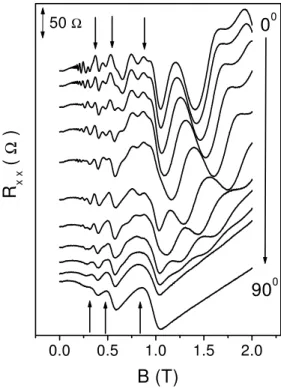
T = 50mK. Arrows: positionofthe3D Landaustates.
From the omparison of the experimental SdH
os-illations(Fig. 1,=0) andEq.3weextratthe
ar-rierdensityn
s1
=0:710 11
m 2
,whihisoinident
with2Deletrondensityobtainedfromthealulation
forthelowest subband. Surprisingly,wedon't seeany
ontributionatthismagnetieldfromtheseond
sub-band.
Fig.2showsR
xx
(B)extendedtothemagnetield
up to 3T. We an see 3 osillations indiated by
ar-rows. Surprisingly, the position of these osillations
does notdepend on the tilt angle. Weattribute suh
Inrealsystemstheenergylevelswillhavenitewidths
beause of the disorder, therefore orresponding
ele-trisubbandsanoverlap. Naively,itis expetedthat
the lowest subbandswill overlaprst, whenthewidth
ofthewellinreases,beausethedistanebetween
lev-els
ij =E
j E
i
growsupasthesquareoftheindex
number. However, if the broadening of the levels
j
inreases faster than Æ
ij
=
ij
=2 the highest eletri
subbands are ollapsed to the bulk Landau states
be-fore the lowest one. Therefore thespei features of
theinvestigatedwidePQWisaoexistene3Dand2D
eletronstatesinsideofthewell. Inthetiltedeld 2D
SdHosillationsareshiftedtothehighermagnetield,
andanross3DSdHpeaks,whihdoesnotdependon
thetiltangle.
Thetheoretial expression for theSdH osillations
in 3Daseisslightlydierentfromthe2Dase: [2℄
R
xx
R
0 =
2
5
~!
2E
F(3D)
1=2
A
T
sinhA
T
(4)
exp
!
os
2E
F(3D)
~!
4
Fitstheexperimentalurvefor3DSdHosillations
to theEq. 4givethevalueE
F(3D)
=1:88meV. From
this value we nd the bulk onentration for highest
subbandsN
(3D)
=0:710 16
m 3
.
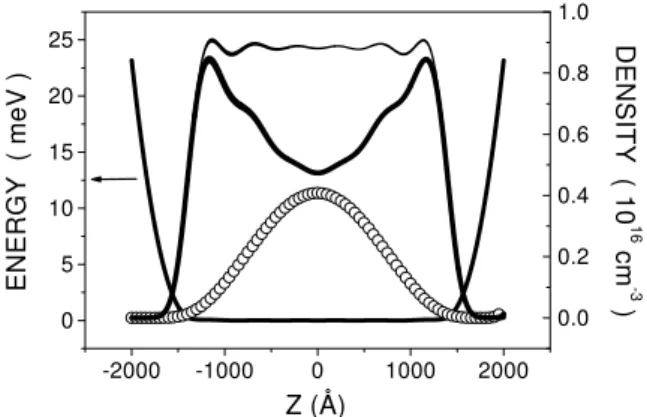
Thedensityproleforthe5highersubbandsisnot
aonstantandhasadeepminimumintheenteraswe
ansee in Fig.3. Therefore thesheet densityannot
berealulatedfromtheequationn
s =w
e N
(3D) . The
widthoftheself-onsistenteletrondensityprolesan
bedenedas:
(w
eff )
2
= 12
n
s Z
W
0
z W
2
2
n(z)dz (5)
where n(z) = P
n
si j
i (z)j
2
, and
i
is the envelope
funtion oftheeletronsintheith subband.
Thesheet density ofthe eletronsin the 5highest
subband is (n
H n
s1
) = 1:810 11
m 2
. We
ob-tain the self-onsistent value w
eff
= 2600
A and nd
bulk density for the quasi-three-dimensional subband
N
(3D) =(n
H n
s1 )=w
eff
=0:710 16
m 3
, whihis
equalthanthebulkdensitydetermined fromthe
mea-surementsofthe3DSdHosillations.
Furthermore, we alulate following the
formal-ismof the Andoand Goldtaking into aountthe
in-uene of the intersubband oupling on the sreening
and orrelation orretions. [3℄ We onsider only two
majorsatteringmehanisms{remoteandbakground
impurity sattering. The results of thelevel
broaden-ing = ~=2 are, in meV: = 0:06; = 0:08; 3
=0:18;
4
=0:21;
5
=0:25; and
6
=0:40. Our
empirialnding is that
2 <Æ
12
for 2Donnement
eetstobeobservableinbottonsubband. Weobtain
2 Æ
12
. Forhighstsubbands
j >Æ
ij
{therefore
the-sessubbandsareoverlappedandform the3Dsystem.
-2000
-1000
0
1000
2000
0
5
10
15
20
25
DE
NS
IT
Y
(
1
0
16
cm
-3
)
EN
ER
G
Y
( m
eV )
Z (Å)
0.0
0.2
0.4
0.6
0.8
1.0
Figure3.Eletrondensityproleasafuntionofpositionin
thewellfor5topsubbands(solidline)andbottomsubband
(irle). Thethikline: totaldensityprole.
III. Conlusions
Inthe presentworkwerealizethesystemwith 2D
andquasi-3Deletrongasoexistinginthesame
quan-tumwell. WeusestandardanalysisofSdHosillations
inthetiltedmagnetieldandexplorethefatthat2D
Landaustatesare sensitiveto theperpendiular
mag-neti eld. We evaluate the broadening of the levels
due to remoteand bakgroundimpurity sattering in
the presene of the intersubband sattering and nd
that the bottom subband is not overlapped with the
highestsubbands. Therefore, the2D state belongs to
the lowest subband and the 3D state, to the highest
subband.
It is known that 2D and 3D systems obey several
properties, whih areradially dierent,suh as
loal-izationinrandompotential.Webelievethatoursystem
anbeusedforomparingsuheets.
Aknowledgments
WewouldliketothankFAPESPfornanialsupport.
Referenes
[1℄T.Ando,J.Phys.So.Jpn,37,1233(1974).
[2℄ Landau Level Spetrosopy, Modern Problems in
Con-densed Matter Sienes, edited by G. Landwehr and E.I.
Rashba,NORTH-HOLLAND,Volume27.2(1991).
[3℄A Gold,Phys. Rev. B,35,723(1987);P.T.Coleridge ,
Phys. Rev. B,44,3793(1991);E.Zaremba,Phys. Rev. B,