RevistaBrasileiradeFarmacognosia27(2017)384–387
w ww.e l s e v i e r . c o m / l o c a t e / b j p
Original
Article
Ecuadorian
honey
types
described
by
Kichwa
community
in
Rio
Chico,
Pastaza
province,
Ecuador
using
Free-Choice
Profiling
Patricia
Vit
a,b,
Silvia
R.M.
Pedro
c,
Carlos
Vergara
d,
Rosires
Deliza
e,∗aFoodScienceDepartment,FacultyofPharmacyandBioanalysis,UniversidaddeLosAndes,Mérida,Venezuela
bCancerResearchGroup,SydneyMedicalSchool,TheUniversityofSydney,Sydney,Australia
cDepartamentodeBiologia,FaculdadedeFilosofia,CiênciaseLetras,UniversidadedeSãoPaulo,RibeirãoPreto,SP,Brazil
dDepartmentofChemicalandBiologicalScience,SchoolofScience,UniversidaddelasAméricasPuebla,Puebla,Mexico
eEmbrapaAgroindústriadeAlimentos,RiodeJaneiro,RJ,Brazil
a
r
t
i
c
l
e
i
n
f
o
Articlehistory:
Received11July2016 Accepted22January2017 Availableonline9March2017
Keywords:
Apismellifera
Kichwa Ecuador Honey
Free-ChoiceProfile Meliponini
a
b
s
t
r
a
c
t
PastazaisthelargestandleastpopulatedprovinceinEcuador,withsevennativeindigenousnationalities.
TheKichwasfromtheRioChicocommunityliveneartothecapitalcityPuyo,arerecognizedfortheir
knowledgeonstinglesshoneybees.Fromthe400speciesofNeotropicalMeliponinithatmakehoneyin
cerumenpots,almost100thriveinSouthernEcuador,andconfersuchbiodiversitytopot-honey.Inthis
studysensorycharacteristicsofEcuadorianfalseandgenuinehoneyswithdiverseentomologicalorigin:
Apismellifera–lightamberandamber,Geotrigonaleucogastra,MeliponagrandisandScaptotrigonasp.(S. ederinpSchwarz)wereinvestigatedwithKichwaassessors(fourfemaleandfourmale,aged18–62years
old).Thepanelwasaskedtotasteandtoidentifysensoryattributesofhoney(appearance,taste,smell,
aroma,mouthfeel,othertactilesensations),andtoscoretheirintensitiesin10cmunstructuredlinescales
anchoredwiththewordsweakandstrong,usingtheFree-ChoiceProfilemethodologyTheGeneralized
ProcrustesAnalysiswasusedonthedata.Thefirstandseconddimensionsaccountedforby61.1%ofthe
variance.Inthedescriptivesensoryevaluation,darkerhoneys(amberA.mellifera,falseandGeotrigona)
wereseparatedfrom(lightamberA.mellifera,MeliponaandScaptotrigona)bythefirstdimension;whereas
thickerhoneys(A.melliferaandfalse)werediscriminatedfromthinnerhoneys(Geotrigona,Meliponaand
Scaptotrigona)bytheseconddimension.Theassessorswereabletoevaluateanddifferentiatehoney
typeswithoutprevioussensorytraining.Remarkably,twoKichwaladiesimmediatelyspitoutthefalse
honey,incontrasttoanacceptancestudyon18-honeys,wherethefalsehoneywasscoredamongthe
preferredonesby58participantsoftheFirstCongressonApicultureandMeliponicultureinEcuador.
Therefore,resultssuggestthatEcuadoriannativeKichwaskeepasensorylegacyofancestralknowledge
withforestproductssuchashoney.
©2017SociedadeBrasileiradeFarmacognosia.PublishedbyElsevierEditoraLtda.Thisisanopen
accessarticleundertheCCBY-NC-NDlicense(http://creativecommons.org/licenses/by-nc-nd/4.0/).
Introduction
Ecuadorianindigenouspopulationkeepsalegacyofavast Pre-columbianentomologicalknowledge,presentintheirmythology, art,gastronomy(Barragánetal.,2009)andmedicine.Inparticular, thestinglessbeeMeliponabeecheiiwasconsideredareincarnation ofdivineforcesbytheMayas,andstilltoday thisMelipona bee isknownwiththegoddessnameXunankab,frommaya“Xunan” principalladyand“kab”honey(OcampoRosales,2013).
Forest experiences of meliponiculture or honey hunting are
reportedintheAmazonforestwithKayapó(PoseyandCamargo,
∗ Correspondingauthor.
E-mail:[email protected](R.Deliza).
1985;CamargoandPosey,1990)andPankararé(Costa-Neto,2002) inBrazil,andHuottujainVenezuela.
Pollination is the greatest service of the bees for the
envi-ronment, and the benefits of pollination for agriculture are
more profitable than the honey and pollen harvested (
López-Palacios,1986;Heard,1999;Cruzetal.,2005).Pot-honey(Guerrini etal.,2009),pot-pollen(Cruzetal.,2005)andpropolis(Campos et al., 2014) produced by Meliponiniare studied with increas-inginterestbyinternationalscientificteams.Theinteractionsof Meliponiniwithmicrorganisms(Moraisetal.,2013),besidesthe vegetal–animal nature of this medicinalfood, originates active principleswithmedicinalpropertiesattributedtotraditional heal-ing,awaitingforscientificdemonstration.
Thestudyofpot-honeyrequiresthedisciplinetoreferthebees producing honey in a collection,identified by an entomologist.
http://dx.doi.org/10.1016/j.bjp.2017.01.005
P.Vitetal./RevistaBrasileiradeFarmacognosia27(2017)384–387 385
Table1
DescriptionofEcuadorianhoneysamplesevaluatedinthestudy.
No. Code Beespecies Ethnicnames Provinceoforigin Stinglessbeevouchers
1 105 Apismellifera(lightamber) “abeja” LosRíos –
2 291 Scaptotrigonaederi “catiana” ElOro 17044-17046RPSP
3 376 Meliponagrandis “bunganegra” Pastaza 171037-171045RPSP
4 442 Apismellifera(amber) “abeja” Pichincha –
5 551 fakehoney “artificial” MoronaSantiago –
6 686 Geotrigonaleucogastra “abejadetierra” Manabí 0238-0239UPSE
The great Neotropical biodiversity hasbeen carefully reviewed
by Camargo and Pedro (2007), reporting 391species-group of Meliponini,upto417validspecies(Camargoand Pedro,2013). Ramírezet al.(2013)inform89 speciesofstinglessbeesinthe SouthernregionNo.7ofEcuadorthatcomprisesthreeprovinces: ElOro,LojaandZamoraChinchipe.
HoneysproducedinpotsbyMeliponinihavebeenappreciated
fortheirtropicalfeatures(Schwarz,1948).Pot-honeysaremore sourandthinnerthanhoneysproducedincombsbyApismellifera (GonnetandVache,1984)–wherefermentationisconsidereda
defect–andvarymuchmoreduetotheenormousentomological
biodiversity.Vitetal.(2011)initiatedaresearchonperceptionsof
honeytypesbyHuottujafromtheAmazoneforestinVenezuela.
PastazaisthelargestandleastpopulatedprovinceinEcuadorian Amazone,withsevennativeindigenousnationalities.TheKichwas fromtheRioChicocommunityliveneartothecapitalcityPuyo, andwerechosentotakepartinthisstudyfortheirknowledgeon stinglesshoneybees.Fromthenearly400speciesofNeotropical Meliponini(CamargoandPedro,2007),thatmakehoneyin ceru-menpots,almost100thriveinSouthernEcuador(Ramírezetal., 2013),andconfersuchbiodiversitytopot-honey.However, Pre-columbianpot-honeysarenotregulated(Vit,2008),andonlythe honeyproducedbyA.melliferaisincludedintheEcuadorianHoney Norm(NTEINEN,1988).Aparadoxbetweenkeepinggentlebeesto protectforest(Vit,2000)andprotectingMeliponinifrom conspic-uouspopulationdecrease(Villanueva-Gutiérrezetal.,2013).
Thisstudyaimedatcharacterizingfalseandgenuine Ecuador-ianhoneyswithdiverseentomologicalorigin(A.mellifera–light amberand amber, Geotrigona leucogastra,Melipona grandis and Scaptotrigonasp.)interms oftheirsensorycharacteristicsusing Kichwaassessors.
Materialsandmethods
Stinglessbees
Entomologicalsamplesofthestinglessbeeswerecollectedin alcohol,driedandsentforentomologicalidentificationtothe Biol-ogyDepartmentattheUniversidadedeSãoPauloinRibeirãoPreto,
Brazil(VouchersNo.17044-17046RPSPand171037-171045RPSP
intheCamargoCollectionRPSP,housedattheUniversidadedeSão Paulo,RibeirãoPreto,Brazil),andtheDepartmentofChemicaland BiologicalScienceatUniversidaddeLasAméricasPueblainMexico (VouchersNo.0238-UPSEand0239-UPSEdepositedinthe Entomo-logicalCollectionatUniversidadEstatalPenínsuladeSantaElena, Ecuador)(seeTable1).
Honey
SixEcuadorianhoneysampleswerepurchasedatthelocal mar-kets(lightamberandamberA.melliferahoneynamedas“abeja”, andonefakehoney)orharvestedfromstinglessbeenests,named as“abejadetierra”,“bunganegra”and“catiana”,whicharethe eth-nicnamesgiventoG.leucogastra,M.grandisandScaptotrigonasp. Honey,respectively.ThesixhoneysamplesaredescribedinTable1.
Assessors
Agroupofeighthoneyconsumers,fourfemalesandfourmales,
agedbetween18and62yearsold,fromanativeKichwa
commu-nitylocatedinRioChico,Pastazaprovince,Ecuador,tookpartin thisstudy.Theywereselectedbasedontheirknowledgeon sting-lessbees,nutritionalandmedicinalinterestonhoney,commitment andavailabilityforthesensorytest.Noneoftheassessorshad pre-viousexperiencewithsensoryanalysis,butallwerefamiliarwith EcuadorianpothoneyfromPastazaprovince.Theirsenseofsmell wasnotalteredbysmoking,allergies,flues,orinsomnia.Thefirst, secondandthirdsessionstookplaceinthemorning,2–3hafter breakfast.Theirparticipationwasvoluntary.
Sensoryevaluation
Threesensorysessionswereperformedafteraninformed con-sentformwasfilledforthesensorytest.TheFree-ChoiceProfile methodology(WilliamsandLangron,1984)wasusedinthisstudy.
In the first session, the Free-Choice Profile procedure was
explained andthen thesensorycharacteristics wereelicitedby participants.Theywereasked tolisthoney’ssensoryattributes usingtheirownwordstodescribetheappearance(colorandvisual consistency),odor,flavor(aromaandtaste)andothersensations
in theirmouth and throat. Instructionswere given to prevent
comparativeandhedonicterms.Eachofthesixhoneysshowed
in Table1werepresentedin cappedplastic bottlescoded with three-digitnumbers,inadaylightilluminatedroom,and partici-pantswereaskedtolistthesensorycharacteristicstheyperceived aftertastingeachhoney.Appearancewasevaluatedfirst,thenthe odor,andfinallyhalfspoonofhoneywastakentoevaluatetaste,
aroma, mouthfeel andanyothersensation. Mineralwater was
servedtorinse themouthbetweenhoneysamples,toreset the
palate.
Forthesecondandthirdsessions,individualscorecardswere prepared based onthe attributes they elicited during the first sessiontoevaluatetheintensitiesofeachsensoryattribute.The honeysamplesweremonadicallyevaluatedbyusingunstructured 10cmlinescalesanchoredwiththewords“weak”or“absent”at theleftend,and“strong”attherightend.Eachassessorcrossed theintensityonthelinescaleinthepositionthatbestdescribed his/herperception.Helpwasindividuallyprovidedduringthetest tofacilitatetheevaluationprocesswithoutanyinduction.
Statisticalanalysis
The Generalized Procrustes Analysis was used on the
Free-ChoiceProfiledata,togenerateanoptimizedconsensusmatrixby mathematicaltransformations, toreacha minimaloverall
devi-ation, which wasabletosummarize theinformationabout the
386 P.Vitetal./RevistaBrasileiradeFarmacognosia27(2017)384–387
Resultsanddiscussion
Stinglessbeeidentification
M.grandisGuérin,1834andG.leucogastra(Cockerell1914)were thetwostinglessbeesidentifiedinthisresearch.Thebeenamed Scaptotrigonasp.wasidentifiedasScaptotrigonaederi (Schwarz, unpublished).Howeverduetothefactthatthisspecieswas rec-ognizedbySchwarz,butneverdescribedandpublished,thename mustnotbeused,followingtherecommendationsofthe Interna-tionalCodeofZoologicalNomenclature.SeeTable1withtheethnic nameofthesebees.
Elicitedsensoryattributes
Alistof28termswaselicitedbyparticipantsinthefirstsession. Thenumber ofattributesvariedamongassessors.Ferreiraetal. (2009) pointed out that the vocabulary developed to describe stinglessbeehoneybyFree-ChoiceProfile,wassimilarto descrip-torsof appearance,odor,flavor,and trigeminalsensationsused todescribeA.melliferahoneybyQuantitativeDescriptive Analy-sis(Vit,1993;Anupamaetal.,2003;PersanoOddoandPiro,2004; Galán-Soldevillaetal.,2005).
Honeys
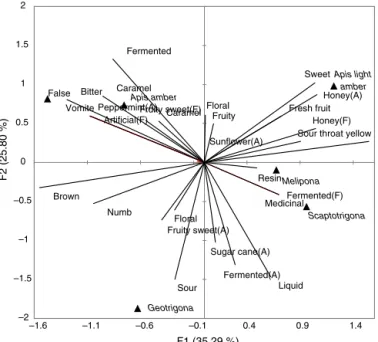
Thefirstandseconddimensionsaccountedforby61.1%ofthe variance.Itispossibletoseethatdarkerhoneys(amberA. mellif-era,falseandGeotrigona)wereseparatedfromlightercoloredby thefirstdimension;whereasthickerhoneys(lightamberA. mellif-era,amberA.melliferaandfake)werediscriminatedfromthinner honeys (Geotrigona, Melipona and Scaptotrigona) by the second dimensioninFig.1.
The consensus configuration of the six Ecuadorian honeys
in Fig.1,shows theposition of the samplesand their sensory attributes.Thefirstdimensionexplained35.29%ofthevariance, andseparateddarkerhoneys(amberA.mellifera,fake,and Geotrig-ona) to the left, from lighter honeys (light amber A. mellifera,
Apis light amber
Scaptotrigona Melipona Apis amber
False
Geotrigona
Brown
Liquid Fermented
Fermented(A) Floral
Fruity
Fruity sweet(A)
Sugar cane(A) Caramel
Sunflower(A)
Honey(A)
Medicinal Peppermint(A)
Sweet
Sour Bitter
Artificial(F) Caramel
Floral
Fresh fruit Fruity sweet(F)
Fermented(F) Resin
Honey(F)
Numb Vomite
Sour throat yellow
–2 –1.5
–1 –0.5
0 0.5
1 1.5
2
–1.6 –1.1 –0.6 –0.1 0.4 0.9 1.4
F2 (25.80 %)
F1 (35.29 %)
Fig.1.ThesixEcuadorianhoneysdefinedbythefirsttwodimensionsofthe con-sensusconfiguration,showingthesensoryattributesusedtodescribethem.Aroma (A)andflavor(F)attributesareindicated.SeeTable1fortheidentificationofhoney samples.
Melipona and Scaptotrigona). The second dimension explained 25.8%ofthevariability,andseparatedthickergenuinelightamber A.melliferaandamberA.mellifera,andfakehoneyinthetop,from thethinnerpothoneysamples(Scaptotrigona,Melipona, Geotrig-ona)inthebottom.
Falsehoneywasdescribedbythefollowingattributes:vomit, peppermint,caramel,bitter, artificial. Assessorsused theterms caramel,fermented,sweet,whenevaluatingamberA.mellifera.The lightamberA.melliferawasperceivedasfloral,fruity,sunflower, freshfruit,sourthroat,yellow,honey.TheMeliponaandthe Scap-totrigonaweredescribedasresin,fermented,medicinal,sugarcane, liquidhoneys.TheGeotrigonahoneywascharacterizedasbrown, numb,sour,floral,fruity,sweet,fermented,liquid.
Assessors
TheKichwaassessorswereabletodescribeandtodifferentiate honeytypeswithoutprevioussensorytraining.Remarkably,two Kichwaladiesimmediatelyspitoutthefalsehoney,incontrasttoan acceptancestudyon18-honeys,wherethefalsehoneywasscored amongthethreemostlikedhoneysby58participantsoftheFirst CongressonApicultureandMeliponicultureinEcuador(Vitetal., 2015).Therefore,resultsoftheperceptionsoftheeightassessors suggestthatEcuadoriannativeKichwaskeepasensorylegacyof ancestralknowledge,andaremorefamiliarwithnaturalproducts.
Conclusions
Thesensoryprofilingmethodusedinthestudydemonstrated
tobeadequatetodescribethesamplesoffalseandgenuinehoneys. Theydifferedintheirsensoryattributes,whichwereidentifiedby theassessors,despitetheirlackoffamiliaritywiththetask.
How-ever,theKichwasconsumerswerefamiliarwiththehoneysand
thischaracteristicallowedthemtousespecifictermstodescribe anddifferentiatethehoneys.Practicalimplicationsofthisstudy canbesuggested,andoneofthemreferstotheCodex.
TheCodex AlimentariusCommission couldbenefit fromthe
resultsof this research onnative Kichwas from Ecuador using
current wordsto recognize sensorydifferences and similarities
betweenfake and genuine honey produced byA. mellifera and
Meliponini.Besidesthechemical standardsfor honey, key sen-soryattributesplayaroleasananalyticalsupporttoconfirmits entomologicaloriginandauthenticity.
Ethicaldisclosures
Protectionofhumanandanimalsubjects. Theauthorsdeclare
thatnoexperimentswereperformedonhumansoranimalsfor
thisinvestigation.
Confidentialityofdata. Theauthorsdeclarethatnopatientdata appearsinthisarticle.
Righttoprivacyandinformedconsent. Theauthorsdeclarethat nopatientdataappearsinthisarticle.
Authors’contributions
PV collected the Ecuadorian honeys and the stinglessbees,
P.Vitetal./RevistaBrasileiradeFarmacognosia27(2017)384–387 387
Conflictsofinterest
Theauthorsdeclarenoconflictsofinterest.
Acknowledgements
To Prometeo-Senescyt for the scholarship given to
Profes-sorPatriciaVit(2014–2015).ToConsejodeDesarrolloCientífico, Humanístico,TecnológicoyArtísticoatUniversidaddeLosAndes forthesupporttoattendthe11thPangbornSensoryScience
Sym-posiuminGotteborg,Sweden,23–27August2015,SE-FA-01-2015
wheretheseresultswerepresented.ToMr.GuillermoFeijóofrom
Moromoro, ElOroProvincefor the“catiana” pot-honey,andto
Mr.Henry MoralesfromPuyo, PastazaProvince forthe“bunga
negra”pot-honey.TotheKichwaCommunityinRioChico,Pastaza Provincefortheirreceptiveattitudeandinteresttoparticipatein thissensoryresearch.ToSchulloProductsforthepaymentofBJP processingfees.
References
Anupama, D., Bhat, K.K., Sapna, V.K., 2003. Sensory and physicochemi-cal properties of commercial samples of honey. Food Res. Int. 36, 183–191.
Barragán,A.R.,Dangles,O.,Cárdenas,R.E.,Onore,G.,2009.Thehistoryofentomology inEcuador.Ann.Soc.Entomol.Fr.45,410–423.
Camargo,J.M.F.,Pedro,S.R.M.,2007.MeliponiniLepeletier,1836.In:Moure,J.S., Urban,D.,Melo,G.A.R.(Eds.),CatalogueofBees(Hymenoptera,Apoidea)inthe NeotropicalRegion.SociedadeBrasileiradeEntomologia,Curitiba,Brazil,pp. 272–578.
Camargo,J.M.F.,Pedro,S.R.M.,2013.MeliponiniLepeletier,1836.In:Moure,J.S., Urban,D.,Melo,G.A.R.(Eds.),CatalogueofBees(Hymenoptera,Apoidea)in theNeotropicalRegion.SociedadeBrasileiradeEntomologia,Curitiba,Brazil, Availableat:www.moure.cria.org.br/catalogue.
Camargo,J.M.F.,Posey,D.A.,1990.OconhecimentodosKayapósobreasabelhas sociaissemferrão(Meliponidae,Apidae,Hymenoptera):notasadicionais.Bol. Mus.Para.EmílioGoeldisérZool.6,17–42.
Campos, J.F., dos Santos, U.P., Macorini, L.F., de Melo, A.M., Balestieri, J.B., Paredes-Gamero, E.J., Cardoso, C.A., de Picoli Souza, K., dos Santos, E.L., 2014. Antimicrobial, antioxidant and cytotoxic activities of propolis from Melipona orbignyi (Hymenoptera, Apidae). Food Chem. Toxicol. 65, 374–380.
Costa-Neto,E.M.,2002.TheuseofinsectsinfolkmedicineintheStateofBahia, NortheasternBrazil,withnotesoninsectsreportedelsewhereinBrazilianfolk medicine.Hum.Ecol.30,245–263.
Cruz,D.O.,Freitas,B.M.,Silva,L.A.,SarmentoSilva,E.M.,Bomfim,I.G.A.,2005. Pol-linationefficiencyofthestinglessbeeMeliponasubnitidaongreenhousesweet pepper.Pesq.Agropec.Bras.40,1197–1201.
Ferreira,E.L.,Lencioni,C.,Benassi,M.T.,Barth,M.O.,Bastos,D.H.M.,2009.Descriptive sensoryanalysisandacceptanceofstinglessbeehoney.FoodSci.Technol.Int. 15,251–258.
Galán-Soldevilla,H.,Ruíz-Pérez-Cacho,M.P.,SerranoJiménez,S.,JodralVillarejo,M., BentabolManzanarez,A.,2005.Developmentofapreliminarysensorylexicon forfloralhoneys.FoodQual.Prefer.16,71–77.
Gonnet,M.,Vache,G.,1984.L’AnalisiSensorialedeiMieli.Comedegustaree individ-uarelequalitáorganolettichediunmiele.FederazioneApicoltoriItaliani,Roma, Italia.
Guerrini,A.,Bruni,R.,Maietti,S.,Poli,F.,Rossi,D.,Paganetto,G.,Muzzoli,M., Scal-venzi,L.,Sacchetti,G.,2009.Ecuadorianstinglessbee(Meliponinae)honey:a chemicalandfunctionalprofileofanancienthealthproduct.FoodChem.114, 1413–1420.
Heard,T.,1999.Theroleofstinglessbeesincroppollination.Ann.Rev.Entomol.44, 183–206.
López-Palacios,S.,1986. Catálogoparauna FloraApícolaVenezolana.Consejo deDesarrolloCientíficoyHumanístico,UniversidaddeLosAndes,Mérida, Venezuela.
Morais,P.B.,SãoThiagoCalac¸a,P.S.,Rosa,C.A.,2013.Microorganismsassociatedwith stinglessbees.In:Vit,P.,Pedro,S.R.M.,Roubik,D.W.(Eds.),Pot-Honey.ALegacy ofStinglessBees.Springer,NewYork,USA,pp.173–186.
NTEINEN,1988.NormaTécnicaEcuatorianaObligatoria.MieldeAbejas,Requisitos. NormaTécnicaEcuatoriana,InstitutoEcuatorianodeNormalizaciónNTEINEN 1572,Quito,Ecuador,pp.1–4.
OcampoRosales,G.R.,2013.MedicinalusesofMeliponabeecheiihoney,bythe ancientMaya.In:Vit,P.,Pedro,S.R.M.,Roubik,D.W.(Eds.),Pot-Honey.ALegacy ofStinglessBees.Springer,NewYork,USA,pp.229–240.
PersanoOddo,L.,Piro,R.,2004.MainEuropeanunifloralhoneys:descriptivesheets. Apidologie35,S38–S81.
Posey,D.A.,Camargo,J.M.F.,1985.Additionalnotesontheclassificationand knowl-edgeofstinglessbees(Meliponinae,Apidae,Hymenoptera)bytheKayapó IndiansofGorotire,Pará,Brazil.Ann.CarnegieMus.54,247–274.
Ramírez,J.A.,Ure ˜na,J.,Camacho,A.,2013.LasabejassinaguijóndelaRegiónSurdel Ecuador.ConsejoNacionaldeEducaciónSuperior,Loja,Ecuador.
Schwarz,H.F.,1948.Stinglessbees(Meliponidae)ofthewesternhemisphere.Bull. Am.Mus.Nat.Hist.90,i-xvii+1-546.
Villanueva-Gutiérrez,R.,Roubik,D.W.,Colli-Ucán,W.,Güemez-Ricalde,F.J., Buch-mann, S.L., 2013. A critical view of colony losses in managed Mayan honey-makingbees(Apidae:Meliponini)intheheartofZonaMaya.J.Kansas Entomol.Soc.86,352–362.
Vit,P.,1993.MieldeAbejas.Mérida:ConsejodePublicaciones.UniversidaddeLos Andes,Mérida,Venezuela.
Vit,P.,2000.Unaideaparavalorizarlameliponiculturalatinoamericana.Tacayá10, 3–6.
Vit,P.,2008.Lamielprecolombinadeabejassinaguijón(Meliponini)aúnnotiene normasdecalidad.Rev.Bol.Cen.Invest.Biol.42,415–423.
Vit,P.,Deliza,R.,Pérez,A.,2011.HowaHuottuja(Piaroa)communityperceives genuineandfalsehoneyfromtheVenezuelanAmazon,byfree-choiceprofile sensorymethod.Rev.Bras.Farmacogn.21,786–792.
Vit,P.,Isitua,C.,Deliza,R.,2015.SensoryevaluationofEcuadorianhoneysinabee congress.FHTTfromhivetotable2015.In:InternationalCongressonSafetyand AuthenticityofBeeProducts,21–22May,Istanbul,Turkey.