1Instituto Oceanográico, Universidade de São Paulo – USP, São Paulo (SP), Brazil. E-mails: [email protected], [email protected], [email protected], [email protected], [email protected]
2Instituto de Energia e Meio Ambiente, Universidade de São Paulo – USP, São Paulo (SP), Brazil. E-mail: [email protected]
*Corresponding author
Manuscript ID: 20170057. Received in: 04/19/2017. Approved in: 09/01/2017. ABSTRACT: In this paper, we present new evidence regarding a Marine Isotope Stage 3 (MIS3) transgression on the south-eastern Brazilian coast (Baixada Santista coastal plain). Data collected from a Standard Penetration Test (SPT) drilling reveal the occurrence of myxohaline sediments between cal BP 45,000 and 41,000. A de-eper sequence, which shows a clear transition from terrestrial to a myxohaline environment, was associated with MIS5e. Organic and inorganic proxies have been used to recognize the variations on the terrestrial/myxohaline/marine deposits, as well as to infer about cli-mate and energy of the depositional environment. Environmental change, which could correspond to a sea-level peak or the occurrence of drier conditions, was recognized between 43,000 and 42,000 cal BP. he results reinforce the need for future works on MIS3 variabi-lity on the South American Atlantic coast.
KEYWORDS: Marine Isotope Stage 3; Late Pleistocene; sea-level.
RESUMO:Neste artigo, apresentamos novas evidências sobre a trans-gressão ocorrida Estágio Isotópico 3 (MIS3) na costa do sudeste do Brasil (Baixada Santista). Dados coletados por meio de um ensaio de pene-tração em solo (SPT) revelam a ocorrência de sedimentos mixohalinos entre 45.000 e 41.000 anos a.P. Uma sequência mais profunda, que mostra clara transição de ambiente continental para um mixohalino, foi associada ao Estágio Isotópico 5e (MIS5e). Marcadores orgânicos e in-orgânicos foram usados para reconhecer as variações dos ambientes ter-restre/mixohalino/marinho, bem como inferir sobre o clima e a energia do ambiente deposicional. Uma mudança ambiental, que poderia cor-responder a um pico do nível do mar ou à ocorrência de condições mais secas, foi reconhecida entre 43.000 e 42.000 anos a.P. Os resultados re-forçam a necessidade de futuros trabalhos sobre a variabilidade do MIS3 na costa atlântica sul-americana.
PALAVRAS-CHAVE: MIS3; Pleistoceno superior; nível do mar.
Evidence of an Marine Isotope Stage 3
transgression at the Baixada Santista,
south-eastern Brazilian coast
Evidência de uma transgressão na Baixada
Santista durante o Estágio Isotópico 3
André da Silva Salvaterra1, Rosangela Felício dos Santos1, Alexandre Barbosa
Salaroli1, Rubens Cesar Lopes Figueira1, Michel Michaelovitch de Mahiques1,2*
INTRODUCTION
he Marine Isotope Stage 3 (MIS3) corresponds to the time interval between 60 and 25 ka (Siddall et al. 2008) and is marked by a series of abrupt oscillations, corresponding to in the form of warming periods (Chappell 2002, Van Meerbeeck et al. 2009). Estimates based on δ18O
chronol-ogies and U/h dating of coral reefs indicate that during this time interval sea level oscillated between 80 and 30 m below present sea level (mbsl) (Chappell & Shackleton 1986, Lambeck and Bard 2000, Chappell 2002, Pahnke et al. 2003, Rabineau et al. 2006). Short-term oscillations in time inter-vals between 6,000–7,000 years followed by 10–15 m sea-level rise events, corresponding to Heinrich events, occurred in this time interval (Chappell 2002).
On the other side, there are several papers that report the occurrence of MIS3 highstands at levels considerably shallower than those ones reported by the traditional sea level curves (Cann et al. 1993, Murray-Wallace et al. 1993, Rodriguez et al. 2000, Murray-Wallace 2002, Hanebuth
et al. 2006, Simms et al. 2009, Doğan et al. 2012). In South America, other examples of MIS3 highstands have been described both in the Atlantic and Paciic coasts (Isla 1990, Isla & Schnack 2016), but part of these data have been disproved by Schellmann and Radtke (1997), who compared radiocarbon data with Electron Spin Resonance (ESR) information. In the Brazilian coast, Silva et al. (2014) recognized a lagoonal environment, dated from 47,000 to 36,000 BP, in the Maricá coastal plain (state of Rio de Janeiro).
Additionally, a complete set of coherent (no age rever-sal) radiocarbon ages in both organic matter and foramin-ifera, ranging from 39,000 to about 24,000 BP, marks the transition of myxohaline to freshwater conditions in a shal-low-water (6 mbsl) deposit in the São Sebastião Channel (state of São Paulo) (Mahiques et al. 2011). Other unpub-lished (thesis) data, from the Paraná state, also report MIS3 high levels in the shelf and adjacent coastal plain (Souza 2005, Veiga 2005).
he main criticism of the papers dealing with MIS3 high-stands is associated with the limitations of the radiocarbon as a geochronological tool. Indeed, a signiicant part of the MIS3 interval cannot be dated with conidence beyond cal BP 45,000, and contamination of older materials with young carbon can result in apparent MIS3 ages (Murray-Wallace
et al. 1993, Yim 1999, Hanebuth et al. 2006). On the other hand, the introduction of the Accelerator Mass Spectrometry (AMS) technique to radiocarbon dating (Dorn et al. 1989) brought another perspective to the original chronology lim-itation of cal BP 30,000 years. hus, it is possible that sev-eral Pleistocene samples dated in the original studies of the
Brazilian coast might need to be reviewed due to the possi-ble occurrence of an MIS3 highstand.
In this paper we analyze a new set of sedimentolog-ical and geochemsedimentolog-ical data, coming from a drilling per-formed in the Baixada Santista coastal plain (southeast Brazil), with evidence of two transgressive events, one of them with evidence of an MIS3 transgression. Data will be compared with other evidence of an MIS3 sea-level rise, reported in the SW Atlantic as well as in other coastal areas.
STUDY AREA
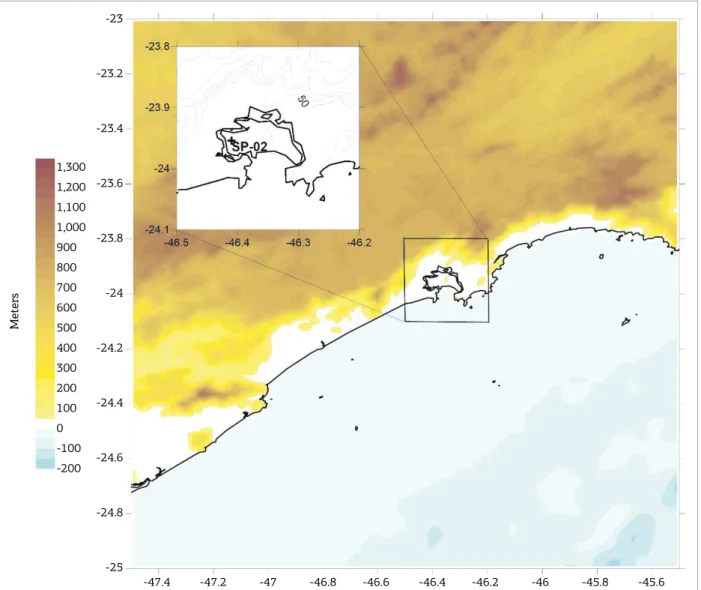
he study site (Fig. 1) is located in the so-called Baixada Santista coastal plain, an area covered by Late Pleistocene / Holocene coastal and marine muddy to sandy deposits, originally associated with two main transgressive events: Cananeia (MIS 5e) and Santos (Mid-Holocene) (Suguio & Martin 1978b).
Towards the continent the coastal plain is limited by the Serra do Mar mountain range, exhibiting a width, variable from a few to almost 20 km. he Quaternary sediments are locally interrupted by Pre-Cambrian massifs, forming groups of hills that are aligned according to SW-NE (Almeida & Carneiro 1998).
According to Suguio and Martin (1978a), the Cananeia Transgression is associated with a sea level rise that reached about 8 m above present sea level (mapsl), while the Santos Transgression reached 4.5 mapsl. Aspects of the evolution of the deposits were studied by Suguio and Martin (1978a) and Coelho et al. (2010). Angulo et al. (2006) reviewed the Mid- to Late Holocene sea-level changes and deined an envelope in which the maximum sea-level of 5.6 cal yr BP ranged from 2 to about 4 mapsl.
On the other hand, there is almost no information about the position of the sea-level of the eastern to south-ern Brazilian between the climatic optimum of the MIS5e and the early Holocene. Corrêa (1996) proposed a sea-level curve between the Last Glacial Maximum and the early Holocene, based on the position of abrasion terraces on the southern Brazilian continental shelf and comparing them with global sea-level curves. Vicalvi et al. (1978) rec-ognized a paleo-lagoon at the Abrolhos Depression (Eastern Brazilian shelf ), dating them at 10,600 yr BP (uncalibrated). Finally, Mahiques et al. (2011), presented four datings on diferent material from a beach-rock located at 13 mbsl São Sebastião (southeastern Brazil), which gave calibrated ages around 8,200 yr BP.
recognizing continental sediments, marine and sand dunes of Late Pleistocene age, transitional sediments and Holocene lagoonal deposits, in addition to modern alluvium deposits located at the base of the Serra do Mar range.
he lower terrains lead to the establishment of a com-plex of estuarine channels, bordered by mangrove vegeta-tion. On the other side, the sandy deposits and a signiicant part of the hills are presently occupied by urban, industrial and port infrastructure, which makes the Baixada Santista one of the most developed areas of Brazil.
METHODS
In this paper, we analyzed a 58.45 m long Standard Penetration Test (SPT) drilling, located at the coordinates
23º57.2512’S and 46º24.6018’W, at the altitude of 8 mbsl (Fig. 1). From the SPT drilling, a cylinder of 15 cm was recovered at each 1 meter. Samples were then air-dried and kept in polyethylene vials until laboratory analysis.
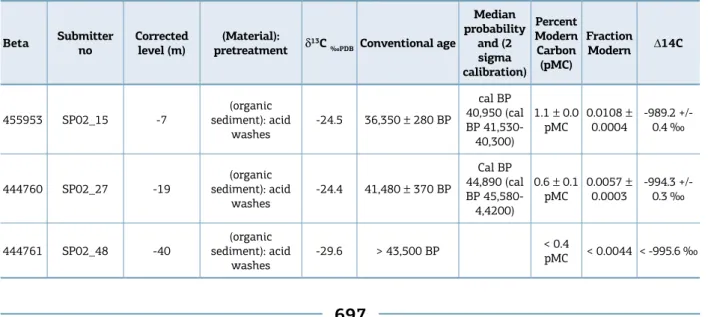
Radiocarbon dating was performed on the organic fraction of sediment samples by the Accelerator Mass Spectrometry (AMS) at Beta Analytic Laboratories (Miami, United States). Calibrated ages have been calculated according to the SH13 Southern Hemisphere Calibration (Hogg et al. 2016).
Grain size was performed in a Malvern Mastersizer 2000 laser difraction system. Approximately 4 g of dry sediment were leached with H2O2 until the complete removal of the organic matter. Finally, 20 mL of a solution of 25% sodium hexamet-aphosphate was added as a dispersant. Results were obtained in intervals of 1/4φ, and statistical parameters were calculated with the aid of the Gradistat macro (Blott & Pye 2001).
-23
-23.2
-23.4
-23.6
-23.8
-24
-24.2
-24.4
-24.6
-24.8
-25
-47.4 -47.2 -47 -46.8 -46.6 -46.4 -46.2 -46 -45.8 -45.6 1,300
1,200
1,100
1,000
900
800
700
600
500
400
300
200
100
0
-100
-200
Meters
CaCO3 content was determined by the weight diference of the sediments before and after acidiication with 10% HCl. Organic Carbon (Corg) and total Nitrogen (Ntot), as well as the isotope ratios δ13C
PDB and δ 15N
AIR, were
deter-mined by using a Finnigan Delta V Plus mass spectrome-ter coupled with a Costech Elemental Analyser. he IAEA 600, USGS40, Leco™ Soil and a secondary marine sed-iment standard from Ubatuba (SE Brazil) were used as reference materials.
Metals (Al, Ba, Ca, Fe, K, Mg, Sc, Sr, Ti, and V) were analyzed with a Varian 710 ICP-OES, following the proce-dures of total digestion established in the US Environmental Protection Agency 3052 Method. he methodology for metal determination is fully described in Mahiques et al.
(2017). Metal/metal ratios in their logarithmic forms have been used to help the interpretation of the marine/terres-trial character, source rock and climate (Govin et al. 2012, Razik et al. 2015, Mahiques et al. 2017).
Values of d13C
PDB, N/C and ln(Ti/Ca) (Govin et al.
2012), have been used to evaluate the marine versus ter-restrial contribution. he values of ln(Fe/K) (Govin et al. 2012) have been used as a proxy of weathering of source rocks. he values of ln(Ti/Al) have been used as proxies of changes in energy of the environment (Govin et al. 2012, Chen et al. 2013).
For both inorganic and bulk organic contents, we present only the results that reached values higher than the Limit of Quantiication (LQ), deined as ive times the Limit of Detection (LD) for each parameter.
For grain size data, a Correspondence Factor Analysis, with the aid of the software Past version 3.15 (Hammer et al.
2001) was performed. For the metal content, an R-mode cluster analysis, using the Correlation matrix and Unweighted Pair Group Method with Arithmetic (UPGMA) clustering technique was used.
All of the altitude/depth results are reported in meters relative to the present sea level, and samples are named according to their position (i.e., sample -12 refers to a sam-ple collected at 12 mbsl).
RESULTS AND DISCUSSION
All of the results are presented as Supplementary Material of this paper.
A ield macroscopic description is presented in Figure 3A. Concerning chronology, a sample, located at 40 mbsl, provided an age beyond the limit of the radiocarbon dating (MIS5e?). The δ13C
PDB of this sample (-29.6‰)
indicates a terrestrial organic matter. Another sample, located at 19 mbsl, was dated at Cal BP 44,890 (2s: 45,580–44,200) (MIS3) and provided a δ13C
PDB value
of -24.4‰, indicative of a mixture of marine and terres-trial organic matter. Finally, a third sample, collected at 7 mbsl, provided a cal age of 40,950 (2s: 41,530–40,300) (MIS3) and a δ13C
PDB value of -24.5‰, also indicative
of mixed organic matter.
SPT values (Fig. 3B) vary signiicantly along the drill-ing. Higher values correspond to its base, which has been described as weathered rock. he lowest values of SPT cor-respond to the interval between 12 and 18 mbsl.
Values of mean diameter (Fig. 3C) are roughly cor-related with values of SPT (R = -0.26, p = 0.04), with vari-ations between 1.93 φ (medium sand) to 5.39 φ (medium silt). Sorting varies from very poor sorted, at the base, to well sorted, associated with ine and very ine sands (see Supplementary Material, Tab. 1).
he lack of an expected high correlation between Mean Diameter with SPT should be associated to the increasing compaction of the sediments, towards deeper strata.
Crystalline Pre-Cambrian basement
Ocean Holocene Marine LagoonalHolocene Marine Pleistocene with sand dunes
Lagoonal Holocene
Modern Alluvium
Modern Alluvium
Serra do Mar
30 20 10 0 -10 -20 -30 -40 -50 km
4 3 2 1
Modern alluvium
Lagoonal deposits
Marine and aeolian dunes
Transitional clays
Continental deposits
he CaCO3 contents are always low, varying from less than 0.5% to about 9.4%. his parameter correlates sig-niicantly with both SPT (R = -0.49, p = 0.00) and Mean Diameter (R = 0.76, p = 0.00).
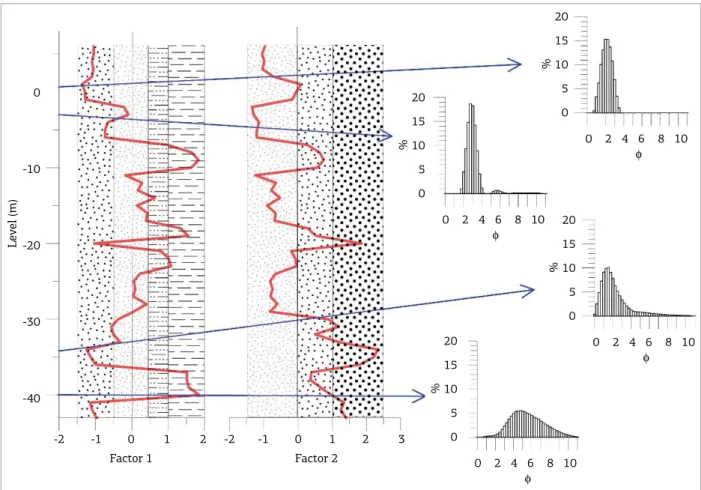
he Correspondence Factor Analysis (Fig. 4) allowed rec-ognizing four main types of grain size distributions. he irst one is represented by a poorly sorted coarse to medium silt, platykurtic and positively skewed distribution, represented by sample -40. It corresponds to the muddy sequences dated as MIS3 and beyond the limit of radiocarbon dating (MIS5e?).
The second group, represented by sample -3, has a bimodal distribution. he main mode is centered at 3 φ, with a leptokurtic symmetric distribution. he second-ary mode is centered at 5.75 φ and shows a much lesser
expression. It expresses the sandy sediments associated to the MIS3 muds.
he third group is expressed by sample 1. It corresponds to a leptokurtic symmetric distribution, centered at 2 φ, and represents the topmost sediments of the drilling.
Finally, the fourth group, expressed by sample -34, con-sists of a strongly asymmetric distribution, meso- to platykur-tic, with the main mode at 1.75 φ, and progressively small amounts of silts and clay. his group is mainly related with the sandy sediments associated with the MIS5e muds.
Concerning the proxies of sediment provenance and energy (Figs. 5A to 5F), there is a clear evidence of a terres-trial environment in samples -39 and -40, both in organic (Figs. 5A and 5B) and inorganic (Fig. 5C) parameters.
0 2 4 6 8 10
Lev
el (m)
0
-10
-20
-30
-40
-50
Cal BP 40950 MIS3 Cal BP 44890
> 43500 BP MIS 5e
0 10 20 30 40 SPT (n)
A B C D
Mean diameter (ϕ) 1 2 3 4 5 6
%CaCO³
Figure 3. (A) General macroscopic description: (1) Variegated light grey to yellow micaceous sandy-clayey silt, with rock fragments; (2) Variegated micaceous yellow to grey sandy-clayey silt; (3) Variegated grey sandy-clayey silt; (4) Grey ine to coarse sand, with silt; (5) Dark grey sandy-clayey silt; (6) Dark grey silty ine sand; (7) Dark grey sandy-clayey silt; (8) Yellowish grey ine to medium sand, with silt; (9) Landill; (B) Standard Penetration Test (SPT) values; (C) Grain size diameter; (D) Content in CaCO3 of the drilling.
Table 1. Radiocarbon datings of the samples collected in the drilling
Beta Submitter no
Corrected level (m)
(Material): pretreatment δ
13C
‰PDB Conventional age
Median probability
and (2 sigma calibration)
Percent Modern Carbon
(pMC)
Fraction
Modern Δ14C
455953 SP02_15 -7
(organic sediment): acid
washes
-24.5 36,350 ± 280 BP
cal BP 40,950 (cal BP
41,530-40,300)
1.1 ± 0.0 pMC
0.0108 ± 0.0004
-989.2 +/- 0.4 ‰
444760 SP02_27 -19
(organic sediment): acid
washes
-24.4 41,480 ± 370 BP
Cal BP 44,890 (cal BP
45,580-4,4200)
0.6 ± 0.1 pMC
0.0057 ± 0.0003
-994.3 +/- 0.3 ‰
444761 SP02_48 -40
(organic sediment): acid
washes
-29.6 > 43,500 BP < 0.4
Lev
el (m)
0
-10
-20
-30
-40
-2 -1 0 1 2
Factor 1
-2 -1 0 1 2 3
Factor 2
%
20
15
10
5
0
ϕ 0 2 4 6 8 10
%
20
15
10
5
0
ϕ 0 2 4 6 8 10
%
20
15
10
5
0
ϕ 0 2 4 6 8 10
%
20
15
10
5
0
ϕ 0 2 4 6 8 10
Figure 4. Vertical variations of factors 1 (53.0% of explained variance) and 2 (34.2% of explained variance) of the grain size data. Extreme grain size distributions are also shown as histograms.
his condition changed in the sample -38, and myxoha-line sediments are recognized in all of the analyzed sam-ples. A single sample (-14) shows an indication of an inner shelf environment, presenting the more positive values of both δ13C and N/C.
he variations of ln(Fe/K) indicate oscillations in the input of illite or kaolinite to the depositional environment and can be used as proxies for changes in local and regional weathering (Ziegler et al. 2013, Nace et al. 2014, Simon
et al. 2015). A higher level in K is found in samples -12 and -13 (Fig. 5D).
Ti/Al ratios are used as indicators of energy variations due to changes in hydraulic equivalence of these elements (Schmitz 1987, Chen et al. 2013). As a rule, except few samples, located in the basal layers, most of the sediments deposited reveal conditions of low energy (Fig. 5E).
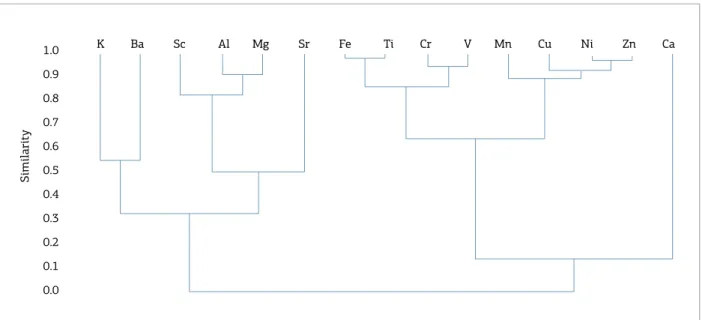
he cluster analysis of the distribution of metals (Fig. 6) reveals the existence of two main groups, which can be asso-ciated to the dominant mineralogy. he irst group involves K, Ba, Sc, Al, Mg, and Sr, and can be associated with the dominance of clay minerals. he second group encompasses Fe, Ti, Cr, V, Mn, Cu, Ni and Zn, and corresponds to the
elements associated with oxides. Calcium remains isolated since it presents an exclusive biogenic origin. Based on this difer-entiation, a Metal Ratio (MR) was applied (Fig. 5F)(Eq. 1):
Σ +
+ + + + + + +
+ + + +
= Σ
( )
( )
K Ma Sc Al Mg Sr MR
Fe Ti Cr V Mn Cu Ni Zn (1)
he distribution of the MR along the sedimentary sequence shows a distinct pattern when comparing to the two muddy sequences (Fig. 5F). he basal sequence is richer in metals associated oxides, such as Fe and Ti. On the other hand, elements characteristics of clay min-erals (silicates), such as Al, K, and Sc, are more conspicu-ous in the intermediate muddy sequence. Worth to note that the “oxide-like” sediments correspond to the terres-trial facies, while the “silicate-like” sediments are associ-ated with the myxohaline environment. It points to the possibility of distinct source rocks or climatic conditions between MIS5e and MIS3.
-1 0 1
Lev
el (m)
0
-10
-20
-30
-40
-50
Lev
el (m)
0
-10
-20
-30
-40
-50
-24 -26 -28 -30 Cal BP 40950
Cal BP 44890 MIS 3
> 43500 BP MIS 5e Myxohaline Terrestrial
δ13C
PDB N/C
Terrestrial Myxohaline Marine
0.04 0.08 0.12 0.16 -1 0 1
In (Ti/Ca)
Myxohaline Terrestrial
A B C
D E F
-1 0 1 2 In (Fe/K)
Illite-rich Cal BP 40950
CAL BP 44890
> 43500 BP
Kaollinite rich
MIS 3
MIS 5e
Lower energy
Higher energy
-3 -2 -1 0 In (Ti/Al)
Silicates
Oxides
In (Metal ratio)
Figure 5. Variations in (A) d13C; (B) N/C ratio; (C) ln(Ti/Ca) along the drilling; (D) ln(Fe/K); (E) ln(Ti/Al); (F) ln(Metal
ratio) along the drilling.
1.0
0.9
0.8
0.7
0.6
0.5
0.4
0.3
0.2
0.1
0.0
K Ba Sc Al Mg Sr Fe Ti Cr V Mn Cu Ni Zn Ca
Similarity
existence of transitional clays on top of the Late Pleistocene sediments and below the Holocene deposits (layer marked with question marks in Fig. 2), located at depths varying from 5 to 20 mbsl. hese deposits apparently occupy the distal areas of the plain, in a position that could be associ-ated with the location of the SPT drilling. herefore, even without recognizing the possibility of an MIS3 transgression, the authors pointed to the occurrence of myxohaline sedi-ments positioned between the MIS5e and Holocene deposits. In the drilling analyzed here, sediments from the MIS5e lie down directly over weathered rocks of the crystalline basement. he basal sequence corresponds to terrestrial sediments that give place to myxohaline muds, whose age is beyond the limit of the radiocarbon method. herefore, a ine to very ine sand sequence is deposited, correspond-ing to the regressive sediments deposited under low sea level. A second muddy layer yielded ages between cal BP 45,000 and 40,000 (MIS3), and all sedimentological and geochemical characteristics point to a myxohaline envi-ronment. Between cal BP 43,000 and 42,000 a change in environmental conditions, as indicated by the ln(Fe/K) as well as the higher values of δ13C and N/C ratios, points to
a rise in the sea level or to a climatic change, which led to a decrease terrigenous sediment input from the adjacent continental area.
he occurrence of transgressive deposits, associated with the MIS3, at positions above the predicted by the oxygen isotope curves (Chappell & Shackleton 1986), is reported in several coastal areas. Rodriguez et al. (2000) identiied a 15 mbsl deposit, associated with MIS3, on the Texas conti-nental shelf. Also in the United States, Doar III and Kendall (2017) reported MIS3 ages for the 3 mabsl of the Silver Bluf formation, in South Carolina.
In Turkey, a shoreline located at 39–40 mbsl has been dated at 53,000 yr BP, but, in this case, a strong tectonic component cannot be discarded, since the area is located between the African-Arabian and Eurasian plates (Doğan
et al. 2012).
In Southeast Asia, coastal deposits, dated between 40,000 and 49,000 yr BP, located around 20 mbsl, also indicate the occurrence of a possible transgressive event during MIS3 (Zhao et al. 2008). A diferential tectonic regime was pro-posed to explain the occurrence of shallow MIS3 deposits in the Changjiang Delta (China). Nevertheless, the MIS3 deposits would remain at depths of about 10 mbsl if the efect of tectonic is removed (Zhao et al. 2008).
Also in Southeast Asia, Hanebuth et al. (2006) recog-nized the possibility of occurrence of an MIS3 highstand in the region of the River Delta, Vietnam.
In Southeast Brazil, the papers by Mahiques et al. (2011) and Silva et al. (2014) are the irst published references that
point to the occurrence of MIS3 transgression, represented by myxohaline/lagoonal deposits, located close to the pres-ent sea-level.
Close to the area of study, Mahiques et al. (2011) describes a full transition from myxohaline to terrestrial environments, based on radiocarbon datings of foraminifera and organic matter, from ca 39,000 to 24,000 yr BP in a core collected in the São Sebastião Channel, state of São Paulo.
Silva et al. (2014) describe the formation of a sandy bar-rier, dated on 45,000 yr BP, deposited over lagoonal sedi-ments, presenting ages from 48,000 and 45,000 yr BP, at Maricá region, Rio de Janeiro.
When gathering the information obtained by Mahiques
et al. (2011), Silva et al. (2014) and this work, a picture emerges (Fig. 7). It does not correspond to a sea-level curve for the period between cal BP 50,000 and 40,000, but to the position, relative to present sea level, of myxohaline envi-ronments, suggesting a trend of sea-level rise in the period. It is important to note that other geological events, such as Late Quaternary crustal movements (Riccomini et al. 1989, Riccomini & Assumpção 1999, Walker et al. 2016), should be considered in the case of an evaluation of the sea-level curves for the region.
Our indings are in agreement with the conclusions of short-term climatic oscillations which occurred in the irst half of the MIS3 (Siddall et al. 2008, Frigola et al. 2012). he transgression here reported can be associated with a sea-level rise phase recorded between events Heinrich HE4 and HE5 (Arz et al. 2007, González & Dupont 2009).
Figure 7. Scatter plot of datings of myxohaline sediments along depths. Data source are Mahiques et al. (2011) (green); Silva et al. (2014) (blue); and this
work (red).
-50,000 -48,000 -46,000 -44,000 -42,000 -40,000 MIS 3 sea lev
el rise
P
osition (m) relativ
e to present sea lev
el
0
-4
-8
-12
-16
-20
CONCLUSIONS
Radiocarbon ages, as well as organic and inorganic prox-ies, have been used to discriminate the MIS3 transgression of the Baixada Santista (SE Brazil) coastal plain, from an older (MIS5e) transgressive event.
he data indicate that, between cal BP 45,600 and 40,300, a myxohaline environment developed at levels between 7 and 19 m below the present sea level. Also, geochemical proxies suggest a marine transgression (or a climatic change) between cal BP 43,000 and 42,000.
Diferent metal ratios between the two muddy sequences point to distinct characteristics of the terrestrial versus myx-ohaline environments, associated with source rocks or cli-matic conditions.
Previous works, performed on the northern coast of the state of São Paulo as well as on the Rio de Janeiro coastal
region (southeast Brazil), corroborate our results and point to the need for a revision of the Late Quaternary sea-level curves in the SW Atlantic coast, as well as of the southeast-ern Brazilian coastal plains.
Our indings agree with one of the short-term climatic oscillations that occurred in the irst half of MIS3.
ACKNOWLEDGMENTS
he authors are indebted to the Oceanographic Institute of the University of São Paulo, for the infrastructure. Michel M. de Mahiques acknowledges the Conselho Nacional de Desenvolvimento Cientíico e Tecnológico (CNPq), for the research grant no. 303132/2014-0.
his paper is a contribution to the NAP-Geosedex Project, funded by the University of São Paulo.
Almeida F.F.M. & Carneiro C.D.R. 1998. Origem e evolução da Serra do Mar. Revista Brasileira de Geociências, 28(2):135-150.
Angulo R.J., Lessa G.C., Souza M.C. 2006. A critical review of mid- to late-Holocene sea-level luctuations on the eastern Brazilian coastline. Quaternary Science Reviews, 25(5-6):486-506. doi: 10.1016/j.quascirev.2005.03.008.
Arz H.W., Lamy F., Ganopolski A., Nowaczyk N., Pätzold J. 2007. Dominant Northern Hemisphere climate control over millennial-scale glacial sea-level variability. Quaternary Science Reviews, 26 (3-4):312-321. doi:10.1016/j.quascirev.2006.07.016
Blott S.J. & Pye K. 2001. GRADISTAT: A grain size distribution and statistics package for the analysis of unconsolidated sediments.
Earth Surface Processes and Landforms, 26(11):1237-1248. doi:
10.1002/esp.261.
Cann J.H., Belperio A.P., Gostin V.A., Rice R.L. 1993. Contemporary benthic foraminifera in Gulf St Vincent, South Australia, and a reined Late Pleistocene sea-level history. Australian Journal of
Earth Sciences, 40(2):197-211. doi: 10.1080/08120099308728074.
Chappell J. 2002. Sea level changes forced ice breakouts in the Last Glacial cycle: New results from coral terraces. Quaternary Science Reviews, 21(10):1229-1240. doi: 10.1016/s0277-3791(01)00141-x.
Chappell J. & Shackleton N.J. 1986. Oxygen isotopes and sea level.
Nature, 324:137-140. doi: 10.1038/324137a0.
Chen H-F., Yeh P-Y., Song S-R., Hsu S-C., Yang T-N., Wang Y., Chi Z., Lee T-Q., Chen M-T., Cheng C-L., Zou J., Chang Y-P. 2013. The Ti/Al molar ratio as a new proxy for tracing sediment transportation processes and its application in aeolian events and sea level change in East Asia. Journal of Asian Earth Sciences, 73:31-38. doi: 10.1016/j.jseaes.2013.04.017. Coelho M.R., Martins V.M., Vidal-Torrado P., Souza C.R.G, Perez X.L.O., Vásquez F.M. 2010. Relação solo-relevo-substrato geológico nas restingas da planície costeira do estado de São Paulo. Revista Brasileira de Ciências do Solo, 34(3):833-846.
Corrêa I.C.S. 1996. Les variations du niveau de la mer durant les derniers 17.500 ans BP: l’exemple de la plate-forme continentale du Rio Grande do Sul-Brésil. Marine Geology, 130(1-2):163-178. doi: 10.1016/0025-3227(95)00126-3.
REFERENCES
Mahiques M.M., Hanebuth T.J.J., Nagai R.H., Bícego M.C., Figueira R.C.L., Sousa S.H.M., Burone L., Franco-Fraguas P., Taniguchi S., Salaroli A.B., Dias G.P., Prates D.M., Freitas M.E.F. 2017. Inorganic and organic geochemical ingerprinting of sediment sources and ocean circulation on a complex continental margin (São Paulo Bight, Brazil). Ocean Science, 13:209-222. doi: 10.5194/os-13-209-2017. Mahiques M.M., Sousa S.H.M., Burone L., Nagai R.H., Silveira I.C.A., Figueira R.C.L, Soutelino R.G., Ponsoni L., Klein D.A. 2011. Radiocarbon geochronology of the sediments of the São Paulo Bight (southern Brazilian upper margin). Anais da Academia Brasileira de Ciências, 83(3):817-834. doi: 10.1590/S0001-37652011005000028. Doar III W.R., Kendall C.G.S.C. 2017. An analysis and comparison of observed Pleistocene South Carolina (USA) shoreline elevations with predicted elevations derived from Marine Oxygen Isotope Stages.
Quaternary Research, 82(1):164-174. doi: 10.1016/j.yqres.2014.04.005.
Doğan U., Koçyiğit A., Varol B., Özer İ., Molodkov A., Zöhra E. 2012. MIS 5a and MIS 3 relatively high sea-level stands on the Hatay– Samandağ Coast, Eastern Mediterranean, Turkey. Quaternary International, 262:65-79. doi: 10.1016/j.quaint.2011.12.020. Dorn R.I., Jull A.J.T., Donahue D.J., Linick T.W., Toolin L.J. 1989. Accelerator mass spectrometry radiocarbon dating of rock varnish.
Geological Society of America Bulletin, 101(11):1363-1372. doi:
10.1130/0016-7606(1989)101<1363:amsrdo>2.3.co;2.
Frigola J., Canals M., Cacho I., Moreno A., Sierro F.J., Flores J.A., Berné S., Jouet G., Dennielou B., Herrera G., Pasqual C., Grimalt J.O., Galavazi M., Schneider R. 2012. A 500 kyr record of global sea-level oscillations in the Gulf of Lion, Mediterranean Sea: New insights into MIS 3 sea-level variability. Climate of the Past, 8:1067-1077. doi: 10.5194/cp-8-1067-2012.
González C. & Dupont L.M. 2009. Tropical salt marsh succession as sea-level indicator during Heinrich events. Quaternary Science Reviews,28(9-10):939-946. doi: 10.1016/j.quascirev.2008.12.023. Govin A., Holzwarth U., Heslop D., Keeling L.F., Zabel M., Mulitza S., Collins J.A., Chiessi C.M. 2012. Distribution of major elements in Atlantic surface sediments (36°N-49°S): Imprint of terrigenous input and continental weathering. Geochemistry, Geophysics, Geosystems,
Hammer Ø, Harper D.A.T., Ryan P.D. 2001. PAST: Paleontological statistics sotware package for education and data analysis.
Palaeontological Association. Available at: http://palaeo-electronica.
org/2001_2001/past/issue2001_2001.htm [cited at Nov. 2016]. Hanebuth T.J.J., Saito Y., Tanabe S., Vu Q.L., Ngo Q.T. 2006. Sea levels during late marine isotope stage 3 (or older?) reported from the Red River delta (northern Vietnam) and adjacent regions. Quaternary International, 145-146:119-134. doi: 10.1016/j.quaint.2005.07.008. Hogg A.G., Hua Q., Blackwell P.G., Niu M., Buck C.E., Guilderson T.P., Heaton T.J., Palmer J.G., Reimer P.J., Reimer R.W., Turney C.S.M., Zimmerman S.R.H. 2016. SHCal13 Southern Hemisphere Calibration, 0–50,000 Years cal BP. Radiocarbon, 55(4):1889-1903. doi: 10.2458/azu_js_rc.55.16783. Isla F.I. 1990. Where was the sea-level 30-50,000 years ago’? The Patagonian point of view. Quaternary of South America and
Antarctic Peninsula,6:33-64.
Isla F.I. & Schnack E.J. 2016. Sea level changes during Marine Isotopic Stage 3 (MIS 3) in Argentina. In: Gasparini G.M., Rabassa J., Deschamps C., Tonni E.P. (eds.) Marine Isotope Stage 3 in Southern
South America, 60 KA B.P.-30 KA B.P. Switzerland, Springer
International Publishing, p. 147-154.
Lambeck K. & Bard E. 2000. Sea-level change along the French Mediterranean coast for the past 30000 years. Earth and Planetary Science Letters, 175:203-222.
Murray-Wallace C.V. 2002. Pleistocene coastal stratigraphy, sea-level highstands and neotectonism of the southern Australian passive continental margin – a review. Journal of Quaternary Science, 17 (5-6):469-489. doi: 10.1002/jqs.717.
Murray-Wallace C.V., Belperio A.P., Gostin V.A., Cann J.H. 1993. Amino acid racemization and radiocarbon dating of interstadial marine strata (oxygen isotope stage 3), Gulf St. Vincent, South Australia.
Marine Geology, 110(1-2):83-92.
Nace T.E., Baker P.A., Dwyer G.S., Silva C.G., Rigsby C.A., Burns S.J., Giosan L., Otto-Bliesner B., Liu Z., Zhu J. 2014. The role of North Brazil Current transport in the paleoclimate of the Brazilian Nordeste margin and paleoceanography of the western tropical Atlantic during the late Quaternary. Palaeogeography, Palaeoclimatology,
Palaeoecology,415:3-13. doi: 10.1016/j.palaeo.2014.05.030.
NOAA. Bathymetry and global relief. Available at: https://www.ngdc. noaa.gov/mgg/bathymetry/relief.html. [Cited at Oct. 2016]. Pahnke K., Zahn R., Elderield H., Schulz M. 2003. 340,000-year centennial-scale marine record of Southern Hemisphere climatic oscillation. Science, 301(5635):948-952. doi: 10.1126/science.1084451. Rabineau M., Berné S., Olivet J-L., Aslanian D., Guillocheau F., Joseph P. 2006. Paleo sea levels reconsidered from direct observation of paleoshoreline position during Glacial Maxima (for the last 500,000 yr). Earth and Planetary Science Letters, 252(1-2):119-137. doi: 10.1016/j.epsl.2006.09.033.
Razik S., Govin A., Chiessi C.M., von Dobeneck T. 2015. Depositional provinces, dispersal, and origin of terrigenous sediments along the SE South American continental margin. Marine Geology, 363 :261-272. doi: 10.1016/j.margeo.2015.03.001.
Riccomini C. & Assumpção M. 1999. Quaternary tectonics in Brazil.
Episodes, 22:221-225.
Riccomini C., Peloggia A.U.G., Saloni J.C.L., Kohnke M.W., Figueira R.M. 1989. Neotectonic activity in the Serra do Mar rit system (southeastern Brazil). Journal of South American Earth Sciences,
2(2):191-197. doi: 10.1016/0895-9811(89)90046-1.
Rodriguez A.B., Anderson J.B., Banield L.A., Taviani M., Abdulah K., Snow J.N. 2000. Identiication of a −15 m Wisconsin shoreline on the Texas inner continental shelf. Palaeogeography, Palaeoclimatology,
Palaeoecology, 158(1-2):25-43. doi: 10.1016/s0031-0182(00)00027-4.
Schellmann G. & Radtke U. 1997. Electron spin resonance (ESR) techniques applied to mollusc shells from South America (Chile, Argentina) and implications for palaeo sea-level curve.
Quaternary Science Reviews, 16(3-5):465-475. doi: 10.1016/ s0277-3791(96)00104-7.
Schmitz B. 1987. The TiO2Al2O3 ratio in the Cenozoic Bengal Abyssal Fan sediments and its use as a paleostream energy indicator. Marine Geology, 76:195-206. doi: 10.1016/0025-3227(87)90029-6. Siddall M., Rohling E.J., Thompson W.G., Waelbroeck C. 2008. Marine isotope stage 3 sea level luctuations: Data synthesis and new outlook. Reviews of Geophysics, 46(4). doi: 10.1029/2007rg000226.
Silva A.L.C., Silva M.A.M., Gambôa L.A.P., Rodrigues A.R. 2014. Sedimentary architecture and depositional evolution of the Quaternary coastal plain of Maricá, Rio de Janeiro, Brazil.
Brazilian Journal of Geology, 44(2):191-206. doi: 10.5327/
z2317-4889201400020002.
Simms A.R., DeWitt R., Rodriguez A.B., Lambeck K., Anderson J.B. 2009. Revisiting marine isotope stage 3 and 5a (MIS3–5a) sea levels within the northwestern Gulf of Mexico. Global and Planetary
Change, 66(1-2):100-111. doi: 10.1016/j.gloplacha.2008.03.014.
Simon M.H., Ziegler M., Bosmans J., Barker S., Reason C.J., Hall I.R. 2015. Eastern South African hydroclimate over the past 270,000 years. Scientiic Reports, 5:18153. doi: 10.1038/srep18153.
Souza M.C. 2005. Estratigraia e evolução das barreiras holocênicas paranaenses, sul do Brasil. In: Curitiba, Federal University of
Paraná, p. 95.
Suguio K. & Martin L. 1978a. Formações quaternárias marinhas do
litoral paulista e sul-luminense. São Paulo, Instituto de Geociências
USP, Sociedade Brasileira de Geologia.
Suguio K. & Martin L. 1978b. Quaternary marine formations of the State of São Paulo and southern Rio de Janeiro. In: Geologia SBd (ed.) International Symposium on Coastal Evolution in the Quaternary, São Paulo. Sociedade Brasileira de Geologia, p. 1-55.
Van Meerbeeck C.J., Renssen H., Roche D.M. 2009. How did Marine Isotope Stage 3 and last Glacial Maximum climates differ? – Perspectives from equilibrium simulations. Climate of the Past, 5:33-51.
Veiga F.A. 2005. Processos morfodinâmicos e sedimentológicosna plataforma continental rasa paranaense. In: Curitiba, Federal University of Paraná, p. 193.
Vicalvi M.A., Costa M.P.A., Kowsmann R. 1978. Depressão de Abrolhos: uma paleolaguna holocênica na plataforma continental brasileira. Boletim Técnico da Petrobrás, 21:279-286.
Walker R.T., Telfer M., Kahle R.L., Dee M.W., Kahle B., Schwenninger J.L., Sloan R.A., Watts A.B. 2016. Rapid mantle-driven uplit along the Angolan margin in the late Quaternary. Nature Geoscience,
9:909-914. doi: 10.1038/ngeo2835.
Yim W.W.S. 1999. Radiocarbon dating and the reconstruction of late Quaternary sea-level changes in Hong Kong. Quaternary International, 55(1):77-91. doi: 10.1016/s1040-6182(98)00029-9. Zhao B., Wang Z., Chen J., Chen Z. 2008. Marine sediment records and relative sea level change during late Pleistocene in the Changjiang delta area and adjacent continental shelf. Quaternary International,
186(1):164-172. doi: 10.1016/j.quaint.2007.08.006.
Ziegler M., Simon M.H., Hall I.R., Barker S., Stringer C., Zahn R. 2013. Development of Middle Stone Age innovation linked to rapid climate change. Nature Communications, 4(1905). doi: 10.1038/
ncomms2897.