Eet of DX Centers in the Vertial Transport
Properties of Semiondutor Superlatties
F. Aristone y
,B. Goutiers z
,J. L. GauÆer z
, and L.Dmowski {
y
DFI-CCET/UFMS,C.P.549, 79070-900CampoGrande -MSBrazil
z
INSA-ComplexeSientiquedeRangueil,31077 Toulouse,Frane
{High Pressure ResearhCenter,01-142Warsaw,Poland
Reeived27September,1999
DXentershavebeendetetedinvertial transportexperimentsofGaAs-AlAssuperlatties. We
studiedminibandondutionpropertiesofsuhsemiondutorstruturesinpreseneofhigh
hydro-statipressuresandontrolledtemperature.Hystheresiseetintheurrent-voltageharateristis
wasobserved. Weshowthatminibandtransportpropertiesaredependentonthepathofthe
pres-sureyleimposedto the sample. It islear from ourresults thatDX entersare present inthe
ativesuperlattieregion. Wepropose that the energyassoiated with DXstatesinsuperlattie
resultsfroma\hybridization"ofDXentersofbothGaAsandAlAsbulkmaterials.
Semiondutor superlatties are very attrative
strutures for use in the design of eletroni
de-vies, partiularlyinhigh frequenyosillators usedin
teleommuniationsystems[1℄. Bulk-likenegative
dif-ferentialondutanehas beendemonstrated in
verti-al transport ofsuperlatties. Eletronsmovingalong
growthaxisdiretionaresubjettohighminiband
non-paraboliity and onsequently undergo negative
ee-tivemassatsuÆientlyhighbiasvoltage[2℄.
Band struture of superlatties is more omplex
than band struture of bulk materials due to the
additional periodiity introdued when growing
dif-ferent semiondutors alternately. It is known that
Al
x Ga
1 x
As materials present two minima along the
[001℄ diretion, the and X point usually alled
and X valleys [3℄. GaAs has the lowest minimum at
the valley, whih denotes a diret band-gap
mate-rial. AlAs is an indiret band-gap material beause
itslowest minimumisloated atX. Valley mixingon
theGaAs AlAssuperlattieinterfaeswasstudiedby
Ando[4℄.
Condution (mini)band struture of superlatties
and bulk materials present analogies, sine the
peri-odi prolesof and X valleys produe the so-alled
\diret"and \indiret"minibands, respetively [5℄. A
superlattie issaidto be\diret"whenthehigher
en-ergyvaluefor minibandis lowerthanthelowest
en-ergy for any X miniband. Relative position of and
ters. Symmetri\indiret"GaAs AlAssuperlatties
are obtainedwhen well and barrier thikness are less
than 13 mono-layers [6℄. There are two dierent X
minibands assoiatedwith longitudinaland transverse
(two-folddegenerate)eetivemasses.
Shallowanddeeplevelsarealsopresentintheband
struture of Al
x Ga
1 x
As materials when the whole
struture isdoped,e.g.,withsilion. Suh statesarise
from the same donor enter and are separated by an
energy barrier. Shallow levels are explained in terms
of eetive mass state and deep levels are assoiated
with relaxed donors. Deep donorlevels arealled DX
statesandhavebeenobservedinIII-Vsemiondutors.
Inthis paperwedemonstratethepreseneofDX
en-tersinsuperlattiestruturesusingavertialtransport
experiment.
Hydrostati pressure is frequently used as a very
funtional tool to explore band struture in
semion-dutors. Pressure eets in superlatties are more
ompliated to analyze than they are in bulk
materi-als. Leburton and Kahen studied the pressure
oef-ient dierene of band energy for both bulk
mate-rials and superlatties [7℄. Warburton et al.
inves-tigated the pressure oeÆient of eetive mass for
GaAs Al
x Ga
1 x
As heterojuntions and found the
samevalueasfoundin bulkmaterials,with no
depen-dene on theeletron onentrationn [8℄. Austing et
X eletroni intervalley transfer in GaAs
Al
x Ga
1 x
As superlatties hasbeendisussed by
vari-ousauthors,eitherinvertialorparalleltransport
on-guration. Dutisseuil et al. analyzed intra-miniband
heatingandintervalleysatteringapplying
hydrostati-pressureonsuperlatties[10℄. Nunnenkamp etal.
per-formed time-resolved optial measurements to study
transitionoftype-Itotype-IIGaAs AlAssuperlattie
underpressure[11℄. X mixinginGaAs AlAshas
also beenstudied withthe help ofamagneti eld by
Pulsford et al.[12℄. Sellito et al. reentlypresenteda
study of DX statesin planardopedGaAs AlAs
su-perlatties [13℄. Measuring Hall and photo-Hall eet
of uniformand delta-doped superlatties, theyshowed
two main eets of suh eletroni struture behavior
under hydrostati pressure: 1) miniband rosses over
thedeeplevelwhenhighenoughpressureisapplied;2)
shallowlevelsarelinkedtotheminiband.
Eetsofhydrostatipressureonvertialtransport
propertiesfor\diret"and\indiret"GaAs AlAs
su-perlattieshavealsobeenstudied. Appliationofhigh
pressureallowsexpliitseparationofGaAs AlAs
su-perlattie eletroni transport. Transition from
\di-ret" to \indiret" superlattie strutures has been
demonstrated when suÆiently high hydrostati
pres-sure is applied to the sample [14℄. In this paper we
presenttherstevideneto ourknowledgeofDX
en-ter eetonperpendiulartransportofsuperlatties.
Oursamplesweregrownbymoleularbeamepitaxy
onan +
-doped[001℄orientedGaAssubstrate. The
pe-riod of sample1wasequalto 74
A; of whih 54
A was
thewelland20
Athebarrier.First miniband
ondu-tionforthisstruturewas9meV wideandseparatedby
102meV from the bottom of GaAs ondution band.
It is a diret struture (type-I) for whih the rst X
miniband was62meV above miniband. Theperiod
of sample 2 wasequal to 34
A; of whih 20
A wasthe
welland14
A thebarrier. An indiretstruture
(type-II), itsrstX minibandwas6meV wideseparatedby
80meV from the bottom of GaAs ondution band.
A grading average of theomposition wasarried out
betweensuperlattie ativeregion anddoped layersin
ordertoavoidabruptheterojuntionsinthepassageof
thethree-dimensionaleletrongasfromontatstothe
miniband.
Conventional lithographiproesseswereemployed
toobtainmesa-areatypiallyintherangefrom100m 2
to 2800m 2
. AuGeNi was deposited and diused on
bothtopandbottomn +
-dopedlayers,thusgiving
per-fetOhmiontatsforoursamples. Theativeregions
were lightly doped, with a Si onentration of n
210 16
m 3
forsample1andn 110 16
m 3
for
Ourresultswereobtainedusingstandardtransport
tehnique. All measurementswere performed in total
abseneoflight. Hydrostatipressurewasappliedusing
either aliquidlampelloraHelium gasompressor.
Pressureinsidetheellwasmeasuredwithaalibrated
InSb resistane.
Typial urrent-voltage I(V) harateristis were
obtainedasafuntionofappliedpressureatroom
tem-peratureandatT =77K,forourtwosamples. These
resultsaninarstapproximationbeexplainedasthe
intervalley eletroni transfer, sine hydrostati
pres-sure produes a relative movement of minibands, as
disussedbyGassot etal.[15℄
However, rigorousobservation of I(V)
harateris-tis,inpartiular for\indiret"sample, indiatesthat
more preise arguments are neessary to explain our
data. We plot in Fig. 1 I(V) harateristis for
dierent temperatures, obtained at onstant pressure
P=12kbar. Theurrentintensitydereases
monoton-iallyasthetemperaturedereases. Suhadereasein
urrentannotbeexplainedasintervalleytransfer,
be-ausethis sampleisalready \indiret"at atmospheri
pressure. Therefore itis evidentthat no eletronsare
present in the miniband at high pressure, even at
roomtemperature.
Figure 1. I(V) harateristis at onstant pressure P =
12 kbars for \indiret" sample 2. Two dierent
temper-atures are shown. Dashed urve has been multiplied by
fator50, toappearinthesamesale. Dereaseinurrent
intensityisexplainedaseletrontrappingbyDX enters.
Toexplainthis eetweneedto onsiderthe
pres-eneofreombinationentersinthesuperlattie
stru-ture. Currentintensitydereasesbeauseeletrons
re-main onned to trapping states when temperature
goes down. We an also infer that the pressure
oef-ientofthis reombinationenterisverylosetothe
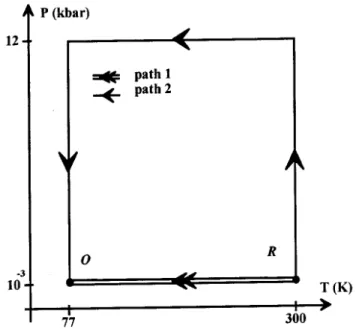
our struture, we performed a \yle of pressure"
ex-periment, whih is divided in two parts as desribed
below:
First Part SeondPart
i) I
1
(V) harateristi is measured at room
tem-peratureT
r
=300K;
I) I
4
(V) harateristi is measured at room
tem-peratureT
r
=300K;
ii)sampleisooledtoT
n
=77K;I
2
(V)
harater-istiismeasured;
II) Pressureisapplied uptoP
m
=12kbars,while
temperature T
r
= 300K is kept onstant; I
5 (V)
harateristiismeasured;
iii) sampleisheated toT
r
=300K; I
3
(V)
hara-teristiismeasured.
III) temperatureis ooledto T
n
=77K and
pres-sureP
m
= 12kbars is maintenedonstant; I
6 (V)
harateristiismeasured;
IV) pressureis ompletely relaxed with
tempera-ture T
n
= 77K onstant; I
7
(V) harateristi is
measured;
V)sampleis heatedto T
r
=300K; I
8
(V)
hara-teristiismeasured.
Suh ayleisshematiallyrepresentedonP T
diagramofFig. 2. I
1 (V),I
3 (V),I
4
(V)andI
8
(V)
har-ateristis were measured (on position R of Fig. 2)
todeterminewhetherirreversibledeformationourred
in the sampleornot. No variationhas been observed
among all these harateristis, insuringthat intrinsi
eletronipropertiesofsuperlattiewerepreserved
dur-ingtheproess.
Figure2. Shematirepresentationofthe\pressure yle"
experiment. Vertial transport properties of GaAs-AlAs
superlatties weremeasured duringthe yle. Results
ob-tained at position R ertify that hydrostati pressure did
notdamagethesample. WeomparedI(V)harateristis
atpointO fortwodierentpathsandhystheresisbehavior
wasobserved.
point O dueto preseneofDX entersin superlattie
struture. We ompare I
2
(V) and I
7
(V)
harateris-tis that were obtained both at atmospheri pressure
andat T =77K,but measuredattheendofdierent
pathsonthe\yleofpressure". Hystheresisbehavior
observedforsample1isexhibitedinFig.3. Thiseet
is also diret evidene for thepresene of DX enters
in thesuperlattiestruture.
Figure3. I(V)harateristisobtainedforsample1atpoint
O ofthe\pressureyle" experiment,whihis represented
inFig. 2anddesribedinthetext. Hystheresisbehavioris
duetotrapping of eletronsduetoDX enters present in
theativeregionofsuperlattie.
Hydrostatipressurewasappliedatroom
tempera-tureanddue to highthermalenergyeletronsare
dis-tributed among and X minibands anddeep enters.
Whentemperaturedereasesatonstantpressure,less
eletronshaveenergytoaessthehigh miniband. At
T =77K nomoreeletronsarepresentin miniband.
re-moreeletronshaveaesseither to X miniband orto
DXstates. Someeletrons,however,remainedtrapped
in DX states due to lowthermal energy. Hystheresis
eetisobservedbetweenthesetwopartiular
measure-mentsofI(V)harateristis. PreseneofDX enters
in thesuperlattie strutureisthereforemadeevident.
We estimate the energy position, entropy fator
and pressure oeÆient of this energy trapping level,
based on the Theis [16℄ and Adahi [17℄ desription
of DX enter. We onluded for sample 2 that: 1)
a DX-type reombination enter is loated
approxi-mately 100meV below the miniband X; 2) the
en-tropyfator is S 0:2meV=K; 3) its pressure
o-eÆientislose to pressureoeÆientof miniband X,
roughlyequalto10meV=kbar. Wealsoalulated
dop-ingonentrationintheativestrutureand wefound
N
d
0:810 16
m 3
,whihisinsubstantialagreement
with growthparameters. Results forsample 1leadto
equalentropyfatorand pressureoeÆient. We
esti-mateinthisasethataDXlevelisloatedat120meV
belowtheX miniband.
We have haraterized, therefore, a reombination
state in our strutures for whih the pressure
oeÆ-ient, entropy fatorand energy position areidential
to bulkDX 0
\relaxation level" values. The \yleof
pressure"expressesthissamebehavior,i.e.,hystheresis
observedidentiesalattierelaxationlevel.
Inonlusion,wedemonstratedthepreseneofdeep
levelsinGaAs=AlAssuperlattiesusingvertial
trans-port experimentsin preseneof highhydrostati
pres-sure. Twoprinipaleets wereobserved: dereaseof
urrent intensity as a funtion of temperature for
in-diret samplesand hystheresis behavior signifying the
presene ofaDX level. Afterdetermination ofenergy
position,pressureoeÆientandentropyfatorwe
as-soiated suh astate with aDX 0
level. We proposed
thepreseneofreombinationlevelinsuperlattiesdue
to \hybridization" of DX enters of both GaAs and
AlAs materials.
Aknowledgments
WeexpressspeialgratitudetoJ.F.PalmierandJ.-C.
Portalforaritialreadingofthispaper. We
aknowl-for tehnial support. One of us (F. A.) is
partiu-larlygratefultoCNPq-Brasilfornanialsupport. We
arefullyaknowledgethesamplesprovidedby
Frane-Teleom/CNET.
Referenes
[1℄ M.Hadjazi,J.F.Palmier,A.Sibille,H.Wang,E.Paris
andF.Mollot.EletronisLetters29,8:684 (1993).
[2℄ A.Sibille,J.F.Palmier,H.WangandF.Mollot. Phys.
Rev.Lett.64,52(1990).
[3℄ M.GuzziandJ.L.Staehli. SolidStatePhenomena10,
25(1989).
[4℄ T.Ando. Phys.Rev.B47,9621 (1993).
[5℄ O.E.Raihev. Sov.Phys.Semiond.25,740(1991).
[6℄ K.Reimann. Jpn.J.ofAppl.Phys.32,64(1993).
[7℄ J.P.Leburtonand K.Kahen. Superlatt.Mirostrut.
1,49(1985).
[8℄ R.J.Warburton,M.Watts,R.J.Niholas,J.J.Harris
andC.T.Foxon. Semiond.Si.Tehnol.7,787(1992).
[9℄ D. G. Austing, P. C. Klipstein, A. W. Higgs, H. J.
Huthinson, G. W. Smith, J. S. Roberts and G. Hill.
Phys.Rev.B47,1419 (1993).
[10℄ E.Dutisseuil,A.Sibille, J.F.Palmier,F.Aristone,F.
Mollot and V. Thierry-Mieg. Phys. Rev.B 49, 5093
(1994).
[11℄ J.Nunnenkamp, K.Reimann,J. Kuhland K.Ploog.
SurfaeSiene263,553(1992).
[12℄ N.J.Pulsford,R.J.Niholas,P.Dawson,K.J.Moore,
G.Duggan, and C.T.B.Foxon. Phys.Rev.Lett. 63,
2284(1989).
[13℄ P.Sellito,J.Siart,J.L.RobertandR.Planel. Phys.
Rev. B 51, 16778 (1995). More reently: Miwa and
Shmidt, AppliedPhysisLetters 74,1999 (1999).
[14℄ F.Aristone, A. Sibille, J. F.Palmier, B.Goutiers, J.
C.Portal and F.Mollot. Jpn.J. Appl. Phys. 32,144
(1993).
[15℄ P.Gassot, D.K.Maude,M. Eremets,F.Aristone,B.
Goutiers, J.L.GauÆer, J.F.Palmier, J.C.Portal, J.
C.HarmandandF.Mollot. SolidStateEletronis40,
185(1996).
[16℄ Theis,MooneyandParker. Phys.Rev.Lett. 60,361
(1988). E. Calleja, A. Gomez and E. Mu~noz. Appl.
Phys.Lett. 52,383(1988).