doi: 10.1590/0101-7438.2015.035.03.0523
THE MULTIPLE CHOICE PROBLEM WITH INTERACTIONS BETWEEN CRITERIA
Luiz Flavio Autran Monteiro Gomes
1*,
Maria Augusta Soares Machado
1and Luis Alberto Duncan Rangel
2Received May 14, 2014 / Accepted August 12, 2015
ABSTRACT.An important problem in Multi-Criteria Decision Analysis arises when one must select at least two alternatives at the same time. This can be denoted as a multiple choice problem. In other words, instead of evaluating each of the alternatives separately, they must be combined into groups ofn alterna-tives, wheren =2. When the multiple choice problem must be solved under multiple criteria, the result is a multi-criteria, multiple choice problem. In this paper, it is shown through examples how this problem can be tackled on a bipolar scale. The Choquet integral is used in this paper to take care of interactions between criteria. A numerical application example is conducted using data from SEBRAE-RJ, a non-profit private organization that has the mission of promoting competitiveness, sustainable development and entrepreneurship in the state of Rio de Janeiro, Brazil. The paper closes with suggestions for future research.
Keywords: Multi-Criteria Decision Analysis, bipolar Choquet integral, multiple choice problem, formation of portfolios, fuzzy logic.
1 INTRODUCTION
The project portfolio management process involves different stages of decision making. At the end of those stages, projects that add value to organizations are selected and prioritized. Com-panies that work with multiple projects require a vision or integrated form of management that encompasses all of the projects from their portfolios. The methods that are used to form a port-folio of projects tend to emphasize the importance of uncertainty as a process variable. The term uncertainty usually refers to both the resources and the results that must be achieved (He & Zhou, 2011; Yu et al., 2012). This statement is especially true in a multiple interacting criteria context.
*Corresponding author.
1Ibmec/RJ, Av. Presidente Wilson, 118, sala 1110, 20030-020 Rio de Janeiro, RJ, Brasil. Tel: +55 21 4503-4053 – E-mails: [email protected]; [email protected]
The issue of dependency between criteria has been approached by different authors in Multi-Criteria Decision Analysis ( ˇCanˇcer, 2010; Dalalah et al., 2012; ¨Ozt¨urk, 2006; Roy, 2009). However, that issue has been virtually untouched within the context of portfolio selection un-der multiple criteria.
Selecting a portfolio of projects is a problem that has been approached using Multi-Criteria Decision Analysis (Vetschera & Almeida, 2012; Anagnostopoulos & Mamanis, 2010; Carazo et al., 2010). However, in many cases when portfolios must be selected under multiple criteria, the interactions among the criteria are not considered as much as they should be, and additive aggregation procedures are used. A mathematical model that has been quite useful for modeling the interactions between criteria is the Choquet integral (Choquet, 1953). The objective of this paper is to show how the bipolar Choquet integral can be used for determining two or three combinations of choices for projects to be performed at the same time under multiple criteria, given that there are interactions between criteria. Ordering the two or three project combinations is indeed a multiple choice problem. A numerical application example is conducted using the data from Gomes et al. (2009).
2 THE CHOQUET INTEGRAL AS A MULTICRITERIA RANKING MODEL IN THE
UNIPOLAR SCALE
The Choquet integral makes use of fuzzy measures. Those measures are very important for problems that require reliability (in a sense that an element belongs to a set) and plausibility which is dual to reliability. The fuzzy measures also assign different degrees of importance to preferences and verify whether the criteria are met.
Following Grabisch & Labreuche (2010), consider the set X = X1×X2. . .×Xnof feasible alternatives. The decision maker has preferences with respect toX that are expressed by a binary relation of the type.
Now consider the function that is given byx ≥ y→ F(µ1(x1), . . . , µn(xn))≥ F(µ1(y1), . . . ,
µn(yn)), where F is the Choquet integral and µi: Xi → S,i = 1, . . . ,n are aggregation functions.S⊂R+is a scale that represents the decision maker’s preferences.
There are two types of scales: the first scale, the limited unipolar scale, applies when S = [0;1], where zero means the absence of a property and 1 means the total certainty about the existence of such a property. In modeling, one can affirm the existence in Xi of two elements that have the notationsUi and Pi, whereUi is an element of Xi that represents the complete dissatisfaction of the decision maker andPirepresents his complete satisfaction, thenµi(Ui)=0 andµi(Pi) = 1. The second scale, the unlimited unipolar scale, applies when S = R+. This scale serves to represent the priorities and relative importance. For convenience, we use the notationµi(Si)=1.
disjoint setsA,B ⊆N, one hasµ(A
B)=µ(A)+µ(B). It is symmetrical if, for all subsets
A,B, we have|A| = |B| ⇒µ(A)=µ(B).
The formal definition of the discrete Choquet integral in a unipolar scale can be defined as fol-lows: Let f: N→ R+to be the Choquet integral f in relation to a capacityµgiven by:
Cµ(f)= fσ (i)− fσ (i−1)µ{σ1, . . . , σn}
whereσ is a permutation inN such that fσ1 ≤. . .≤ fσn and fσ0 =0.
To construct an example, assume that the scores of 4 students in 3 subjects are as shown in Table 1.
Table 1– Students’ evaluations in 3 subjects.
Criterion Alternative
Student A Student B Student C Student D
Subject 1 4 3 1 2
Subject 2 6 5 6 5
Subject 3 3 5 3 2
The dean of the school wants to give a full scholarship to a student by sticking to the following rule: every chosen student must be good in subjects 1, 2 and 3 (exactly in this order, that is subject 1 is more important than subject 2 and subject 2 is more important than subject 3) (i.e.
Subject1≻Subject2≻Subject3).
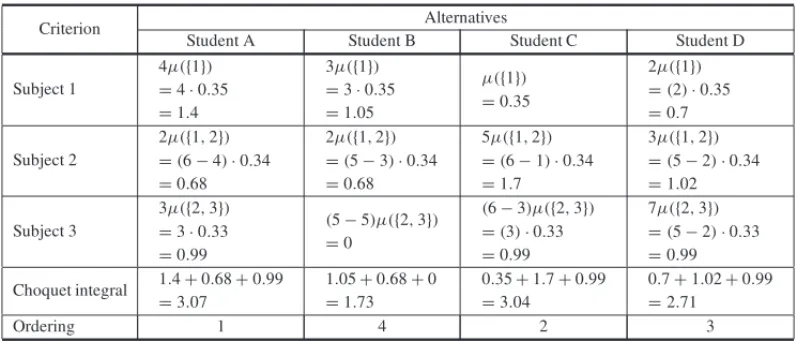
The ordering of these 4 students can be determined by using the Choquet integral as shown in Table 2. The steps below are then followed.
Step 1 – Determining the fuzzy measures
A fuzzy measure indicates the degree of evidence that an element belongs to a set. It was used a 2-additive model and Shapley-Schubik index to determine the fuzzy measures.
For example, considering three subjects in this orderSubject1 ≻ Subject2 ≻ Subject3. The fuzzy measures used in this example were:
µ({1,2,3})=1, µ(φ)=0, µ({1})=0.35, µ({2})=0, µ({3})=0, µ({1,2})=0.34, µ({1,3})=0, µ({2,3})=0.33.
Step 2: Calculating the Choquet integral
These calculations are performed by summing the values along each column. This sum gives the values of the Choquet integral. The ranking of the alternatives that are provided by the Choquet integral is then obtained by ordering these alternatives from the highest to the lowest values. The results are presented in Table 2.
Table 2– Ranking obtained by using the Choquet integral in the unipolar scale.
Criterion Alternatives
Student A Student B Student C Student D
Subject 1
4µ({1})
=4·0.35 =1.4
3µ({1})
=3·0.35 =1.05
µ({1})
=0.35
2µ({1})
=(2)·0.35 =0.7
Subject 2
2µ({1,2})
=(6−4)·0.34 =0.68
2µ({1,2})
=(5−3)·0.34 =0.68
5µ({1,2})
=(6−1)·0.34 =1.7
3µ({1,2})
=(5−2)·0.34 =1.02
Subject 3
3µ({2,3})
=3·0.33 =0.99
(5−5)µ({2,3})
=0
(6−3)µ({2,3})
=(3)·0.33 =0.99
7µ({2,3})
=(5−2)·0.33 =0.99
Choquet integral 1.4+0.68+0.99 =3.07
1.05+0.68+0 =1.73
0.35+1.7+0.99 =3.04
0.7+1.02+0.99 =2.71
Ordering 1 4 2 3
3 THE CHOQUET INTEGRAL IN THE BIPOLAR SCALE
Using the same notation as in the previous section, for the bipolar Choquet we have the following (Grabisch & Labreuche, 2005):
Let f: N → Rn,A⊆Rnbe the Choquet integral of f with respect to the capacityµgiven by
Cµ(f)=
n
i=1
f(σ (i))− f(σ (i−1))
µ(Aσi),
whereσis a permutation inNsuch that fσ (1)≤. . .≤ fσ (n)and fσ (0)=0.
According to Greco & Figueira (2003), given a finite set J = {1,2, . . . ,n}, a fuzzy measureµ is a function of the form:µ: 2J → [0,1]such thatµ(φ)=0,µ(J)=1 (boundary conditions) andµ(C)=µ(D)ifD⊆C,∀C,D⊆J (monotonicity condition).
LetP(J)be a set of pairs of subsets of
J: P(J)=
(C,D),C,D⊆J,C D=φ
.
A bi-capacity µin J is a functionµ: P(J) → [0,1]X[0,1]such thatµ(C, φ) = (c,0)and µ(φ,D)=(0,d),c,d ∈ [0,1];µ(J, φ)=(1,0)andµ(φ,J)=(0,1)(boundary conditions). For each (C,D), (E,F) ∈ P(J)such that E ⊆ C,D ⊆ F, we have µ(C,D) = (c,d)and µ(E,F) = (e, f), e,f ∈ [0,1]withc ≥ eandd ≥ f (monotonicity condition). We use the following notation: µ+(C,D) = c, µ−(C,D) = d. A bi-capacity µˆ on the set J is a functionµˆ: P(J)→ [−1,1]such thatµ(φ, φ)ˆ =0;µ(ˆ J, φ)=1 andµ(φ,ˆ J)= −1 (boundary conditions). If E ⊆ C,D ⊆ F, then µ(ˆ C,D) ≥ ˆµ(E,F) (monotonicity condition). From each bi-polar capacityµ in J, we can obtain a bi-capacityµˆ in J: ˆµ(C,D) = µ+(C,D)−
µ−(C,D),∀C,D ∈ P(J)(Greco & Figueira, 2003).
For eachx ∈ Rn: x+=max{x,0}is the positive part ofx; for eachx∈ R: x− =max{−x,0}
x(x1,x2, . . . ,xn)∈ Rn; andx−=(x1−,x − 2, . . . ,x
−
n)is the negative part ofx(x1,x2, . . . ,xn)∈ Rn. Givenx∈Rn, we consider a permutation(·)of the elements ofJsuch that|x(1)| ≤ |x(2)| ≤ · · · ≤ |x(j)| ≤ |x(n)|. For each element j ∈ J, we have two subsets,C(j)= {i ∈ J: xi ≥ |x(j)|}
andD(j)= {i ∈ J: −xi ≥ |x(j)|}. Considering a bi-capacityµinJ and a vectorx ∈ Rn, we
can define the positive part of the bipolar Choquet integral as follows:
Ch+(x, µ)=
j∈J>
|x(j)| − |x(j−1)|µ+(C(j),D(j)),
where J ≥ {j ∈ J/|xj| >0}. In the same way, we can write the negative part of the bipolar Choquet integral as follows:Ch−(x, µ)=
j∈J>|x(j)| − |x(j−1)|µ−(C(j),D(j)). Therefore,
the bipolar Choquet integral isChB(x, µ)=C+(x, µ)+Ch−(x, µ).
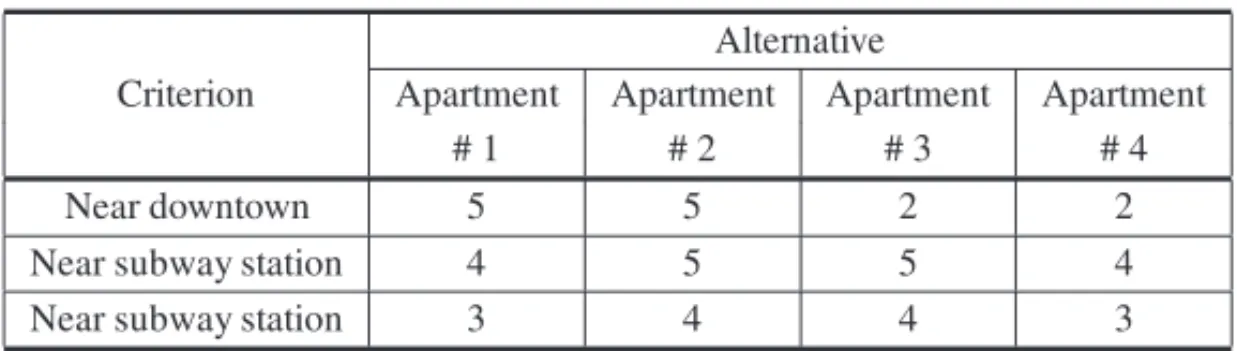
To illustrate the use of the bipolar Choquet integral, we now consider an example of the evalu-ation of apartments for rent based on three alternatives: near downtown, near a subway stevalu-ation and low cost, which are given in Table 3. In this example, we have used a Likert scale, with which the opinions of experts varying from 1 (worst value) to 5 (best value). To select the best apartment, the client expresses his preferences as follows:(i)for an apartment near downtown, a low price is more important than being near the subway; therefore, apartment #1 is better than apartment #2; and(ii) for an apartment far from downtown, being near the subway station is more important than a low price; therefore, apartment #3 is better than apartment #4.
Table 3– Decision matrix for a bipolar example.
Criterion
Alternative
Apartment Apartment Apartment Apartment
# 1 # 2 # 3 # 4
Near downtown 5 5 2 2
Near subway station 4 5 5 4
Near subway station 3 4 4 3
Step 1 – Determining the fuzzy measures
Consider the following ordering of criteria: (i) low price≻ near subway station for an apart-ment near downtown; and (ii) near subway station≻low price for an apartment far from down-town. This arrangement allows us to establish a relation between the fuzzy measures using a 2-additive model and the Shapley-Chubik index [Grabisch & Labreuche (2010)]. Those measures are presented below:
µ({1,2,3})=1, µ(φ)=0, µ({1})=0.39, µ({2})=0, µ({3})=0, µ({1,2})=0.33, µ({1,3})=0, µ({2,3})=0.31
Step 2 – Calculating the Choquet integral
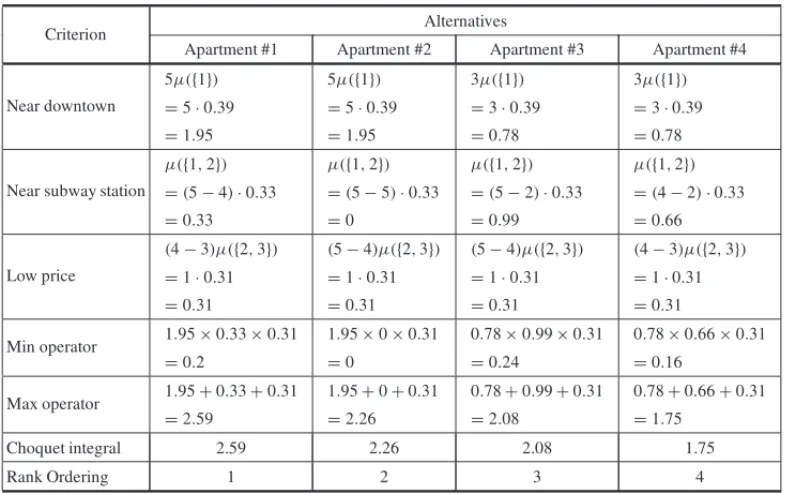
Computations are performed by determining the Min and Max values along each column. The MaxMin operator gives the values of the Choquet integral. The ranking of the alternatives that are provided by the Choquet integral is then obtained by ordering these alternatives from the highest to the lowest values. The results are presented in Table 4.
Table 4– Rank ordering for a bipolar example.
Criterion Alternatives
Apartment #1 Apartment #2 Apartment #3 Apartment #4
Near downtown
5µ({1})
=5·0.39
=1.95
5µ({1})
=5·0.39
=1.95
3µ({1})
=3·0.39
=0.78
3µ({1})
=3·0.39
=0.78
Near subway station
µ({1,2})
=(5−4)·0.33
=0.33
µ({1,2})
=(5−5)·0.33
=0
µ({1,2})
=(5−2)·0.33
=0.99
µ({1,2})
=(4−2)·0.33
=0.66
Low price
(4−3)µ({2,3})
=1·0.31
=0.31
(5−4)µ({2,3})
=1·0.31
=0.31
(5−4)µ({2,3})
=1·0.31
=0.31
(4−3)µ({2,3})
=1·0.31
=0.31
Min operator 1.95×0.33×0.31 =0.2
1.95×0×0.31
=0
0.78×0.99×0.31
=0.24
0.78×0.66×0.31
=0.16
Max operator 1.95+0.33+0.31 =2.59
1.95+0+0.31
=2.26
0.78+0.99+0.31
=2.08
0.78+0.66+0.31
=1.75
Choquet integral 2.59 2.26 2.08 1.75
Rank Ordering 1 2 3 4
By using the bipolar Choquet integral the logic and desired solution is obtained. This solution is the following: Apartment #1≻Apartment #2 and Apartment #3≻Apartment #4.
4 THE SEBRAE-RJ CASE STUDY
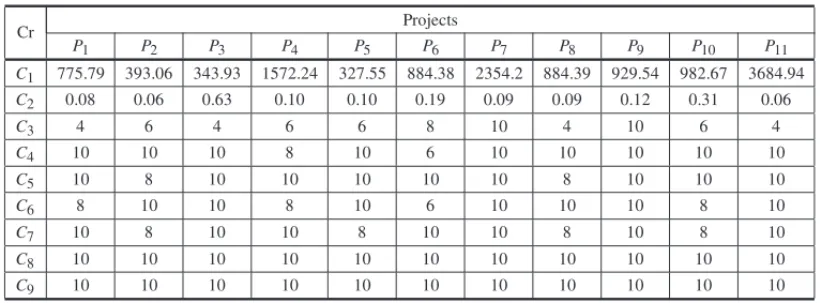
A numerical application example is conducted using data from Gomes et al. (2009). SEBRAE-RJ is a non-profit private organization that has the mission of promoting competitiveness and sustainable development and encouraging entrepreneurship in the state of Rio de Janeiro, Brazil. In conjunction with the Strategies and Guidelines area of that organization, nine criteria were defined to evaluate different development projects. These criteria were C1 = cost of project; C2 =generated revenue/total cost of project;C3 =degree of synergy in the use of
SEBRAE-RJ’s products in the project;C4 =capacity to contribute to the sustainable development of the
region;C5 =capacity to interact with other sectors of the economy;C6=capacity to generate
employment and income;C7 =degree of adherence of the partnerships in the management as
well as governance of the project; C8 =chance of success; andC9 =degree of visibility that
Table 5– Decision matrix for the SEBRAE-RJ Case Study.
Cr Projects
P1 P2 P3 P4 P5 P6 P7 P8 P9 P10 P11
C1 775.79 393.06 343.93 1572.24 327.55 884.38 2354.2 884.39 929.54 982.67 3684.94
C2 0.08 0.06 0.63 0.10 0.10 0.19 0.09 0.09 0.12 0.31 0.06
C3 4 6 4 6 6 8 10 4 10 6 4
C4 10 10 10 8 10 6 10 10 10 10 10
C5 10 8 10 10 10 10 10 8 10 10 10
C6 8 10 10 8 10 6 10 10 10 8 10
C7 10 8 10 10 8 10 10 8 10 8 10
C8 10 10 10 10 10 10 10 10 10 10 10
C9 10 10 10 10 10 10 10 10 10 10 10
By using the mean and standard deviation of each line of the decision matrix a Gaussian mem-bership function can be utilized in order to minimize the spreading of the data (Oliveira et al., 2007). This approach is illustrated in Figure 1 for line 1 of the decision matrix.
0 2000 4000 6000 8000 10000 12000 14000 16000 18000
0 0.1 0.2 0.3
0.4 0.5 0.6 0.7 0.8
0.9
1
Figure 1– Membership function adjusted to the data of line 1 of decision matrix.
The membership values for line 1 of the decision matrix are presented in Table 6.
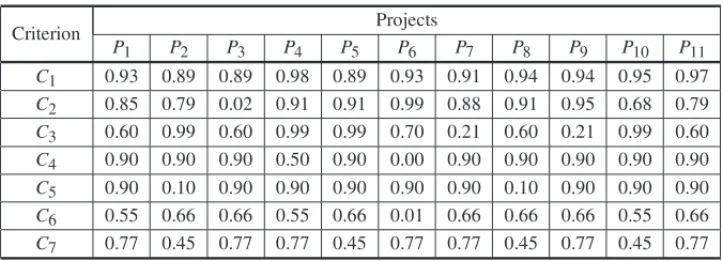
This task is accomplished for the whole decision matrix, as shown in Table 7. In this last table
mi is the membership value for lineiof the decision matrix(i =1, . . . ,7).
The Choquet integral was calculated for all two portfolio combinations and for all possible two criteria combinations. The MinMax operator was used for each two of them. Similarly, all three portfolio combinations for all possible three criteria combinations were taken. Since criteria 8 and 9 are irrelevant for the analysis as they lead to the same figures they were removed from Table 8.
Table 6– Membership values for of the decision matrix.
Project Membership values
P1 0.93
P2 0.89
P3 0.89
P4 0.98
P5 0.89
P6 0.93
P7 0.01
P8 0.94
P9 0.94
P10 0.95
P11 0.97
Table 7– Membership values for all data of decision matrix.
Project m1 m2 m3 m4 m5 m6 m7
P1 0.93 0.85 0.60 0.90 0.90 0.55 0.91 P2 0.89 0.79 0.99 0.90 0.10 0.66 0.45
P3 0.89 0.02 0.60 0.90 0.90 0.66 0.77 P4 0.98 0.91 0.99 0.50 0.90 0.55 0.77
P5 0.89 0.91 0.99 0.90 0.90 0.66 0.45 P6 0.93 0.99 0.70 0.02 0.90 0.01 0.77 P7 0.91 0.88 0.21 0.90 0.90 0.66 0.77 P8 0.94 0.91 0.60 0.90 0.10 0.66 0.45
P9 0.94 0.95 0.21 0.90 0.90 0.66 0.77 P10 0.95 0.68 0.99 0.90 0.90 0.55 0.45 P11 0.97 0.79 0.60 0.90 0.90 0.66 0.77
Table 8– Fuzzified decision matrix for the SEBRAE-RJ case study.
Criterion Projects
P1 P2 P3 P4 P5 P6 P7 P8 P9 P10 P11
C1 0.93 0.89 0.89 0.98 0.89 0.93 0.91 0.94 0.94 0.95 0.97 C2 0.85 0.79 0.02 0.91 0.91 0.99 0.88 0.91 0.95 0.68 0.79
Step 1 – Determining the fuzzy measures
As fuzzy measures indicate the degree of evidence that an element belongs to a set, considering a 2-aditive model and the Shapley-Schubik index, the fuzzy measures used in this paper were:
µ({1,2,3,4,5,6,7,8,9})=1, µ(φ)=0, µ({1})=0.56, µ({2})=0, µ({3})=0, µ({4})=0, µ({5})=0, µ({6})=0, µ({7})=0, µ({8})=0, µ({9})=0, µ({1,2})=0.54, µ({1,3})=0, µ({2,3})=0.53, µ({3,4})=0.49, µ({4,5})=0.48, µ({5,6})=0.45, µ({6,7})=0.44.
We then consider the following order of criteria:C1≻C2≻C3≻C4≻C5≻C6≻C7.
Step 2 – Choquet integral calculations
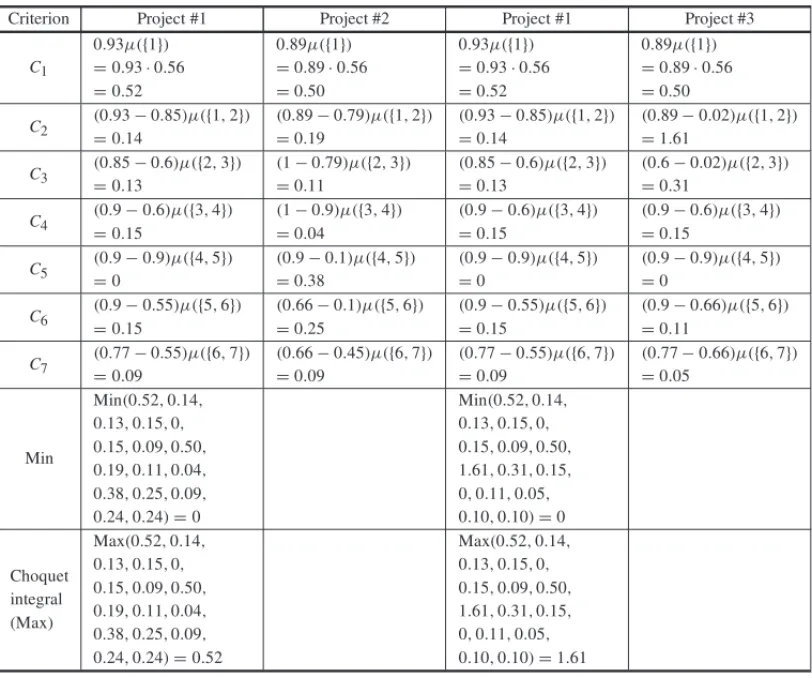
In Table 9, we present some calculations obtained by using the bipolar Choquet integral for projects 1 and 2 and for projects 1 and 3. The same has been done for all combinations of two projects.
Table 9– Some calculations for a two project selection of SEBRAE-RJ case study.
Criterion Project #1 Project #2 Project #1 Project #3
C1
0.93µ({1})
=0.93·0.56 =0.52
0.89µ({1})
=0.89·0.56 =0.50
0.93µ({1})
=0.93·0.56 =0.52
0.89µ({1})
=0.89·0.56 =0.50
C2
(0.93−0.85)µ({1,2})
=0.14
(0.89−0.79)µ({1,2})
=0.19
(0.93−0.85)µ({1,2})
=0.14
(0.89−0.02)µ({1,2})
=1.61
C3
(0.85−0.6)µ({2,3})
=0.13
(1−0.79)µ({2,3})
=0.11
(0.85−0.6)µ({2,3})
=0.13
(0.6−0.02)µ({2,3})
=0.31
C4
(0.9−0.6)µ({3,4})
=0.15
(1−0.9)µ({3,4})
=0.04
(0.9−0.6)µ({3,4})
=0.15
(0.9−0.6)µ({3,4})
=0.15
C5 (0.9
−0.9)µ({4,5})
=0
(0.9−0.1)µ({4,5})
=0.38
(0.9−0.9)µ({4,5})
=0
(0.9−0.9)µ({4,5})
=0
C6
(0.9−0.55)µ({5,6})
=0.15
(0.66−0.1)µ({5,6})
=0.25
(0.9−0.55)µ({5,6})
=0.15
(0.9−0.66)µ({5,6})
=0.11
C7 (
0.77−0.55)µ({6,7})
=0.09
(0.66−0.45)µ({6,7})
=0.09
(0.77−0.55)µ({6,7})
=0.09
(0.77−0.66)µ({6,7})
=0.05
Min
Min(0.52,0.14, 0.13,0.15,0, 0.15,0.09,0.50, 0.19,0.11,0.04, 0.38,0.25,0.09, 0.24,0.24)=0
Min(0.52,0.14, 0.13,0.15,0, 0.15,0.09,0.50, 1.61,0.31,0.15, 0,0.11,0.05, 0.10,0.10)=0
Choquet integral (Max)
Max(0.52,0.14, 0.13,0.15,0, 0.15,0.09,0.50, 0.19,0.11,0.04, 0.38,0.25,0.09, 0.24,0.24)=0.52
These calculations are performed by using the Min and Max operators along considering the respective two columns projects. The MaxMin operator has been used to calculate the Choquet integral. The ranking of the alternatives that are provided by the Choquet integral is then obtained by ordering these alternatives from the highest to the lowest values.
The results are presented in Table 9.
A two-combination choice
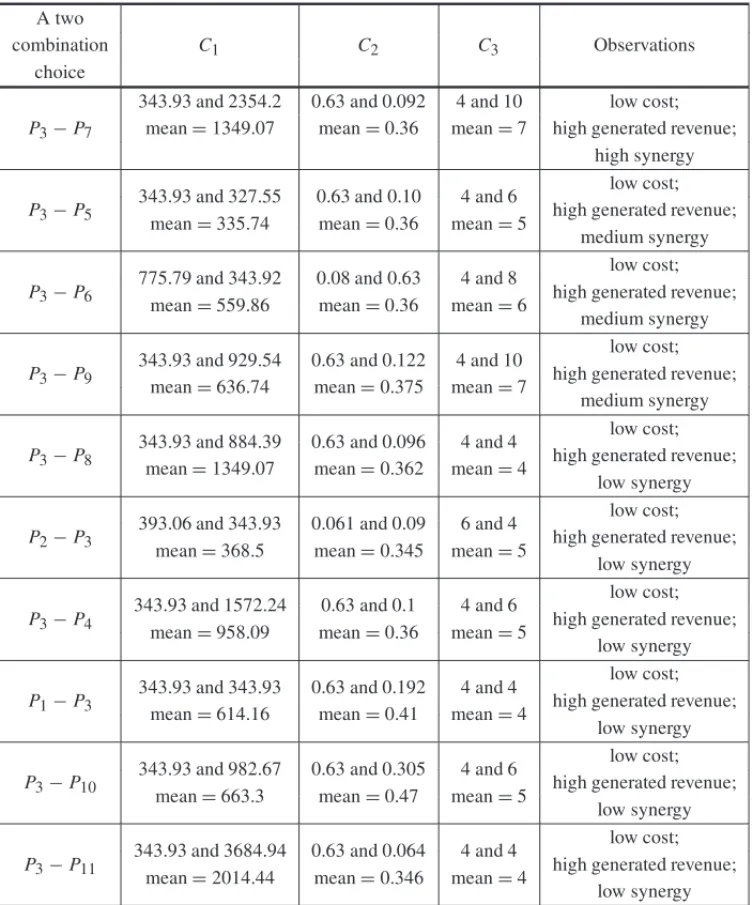
The Choquet integral was calculated for all two portfolios combinations and all two criteria combinations that is, the MinMax operator was used for each two of them.
In Table 10 the ordering for two project combination portfolios is shown for the three most important criteria,C1(cost of project with mean 1193.88),C2 (generated revenue/total cost of
project with mean 0.17) andC3(degree of synergy in the use of SEBRAE-RJ’s products in the
project with mean 6.18).
In this paper values higher that mean values are considered as high; values near mean values are considered as mean; and values lower that mean values are considered as low. This holds for Tables 10, 11 and 12.
It can be observed that project P3is present in all combinations for criteria that are related with
minimum cost. high generated revenue and high synergy.
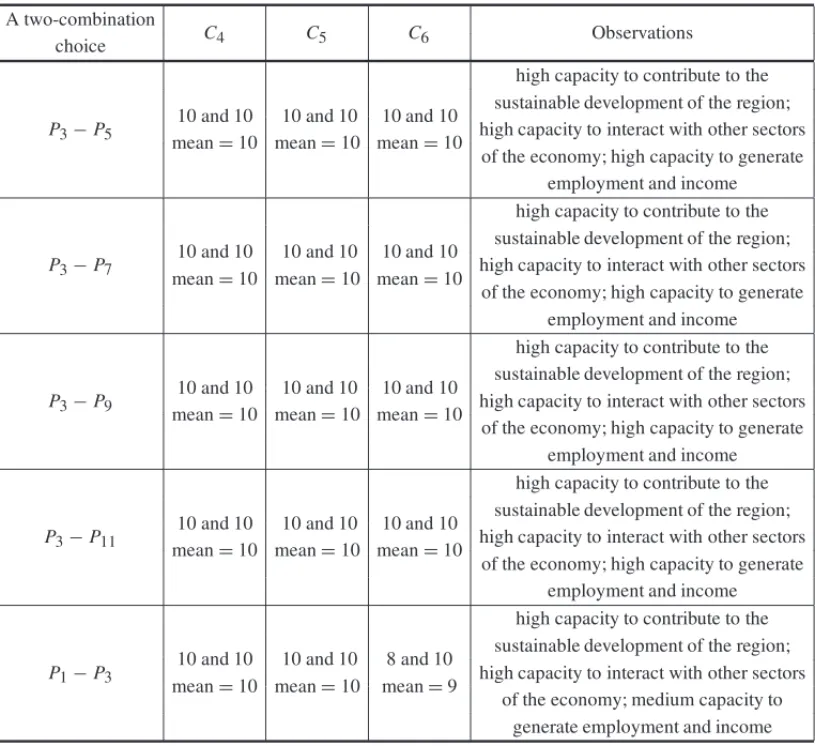
Table 11 presents a two combination choice for the criteria C4 (capacity to contribute to the
sustainable development of the region with mean 9.45),C5(capacity to interact with other sectors
of the economy with mean 9.64) and C6 (capacity to generate employment and income with
mean 9.1).
It can be observed that most of combinations have high capacity to contribute to the sustainable development of the region, high capacity to interact with other sectors of the economy and high capacity to generate employment and income. It also can be seen that project P3is present in
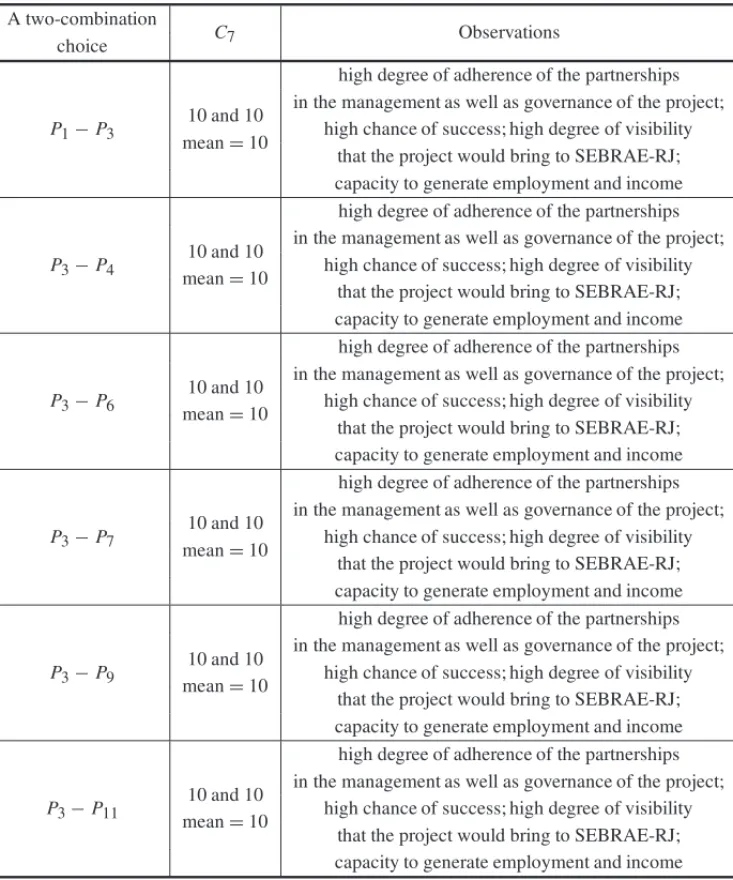
all of them. Table 12 presents a two combination choice for the criteriaC7(degree of adherence
of the partnerships) in the management as well as governance of the project with mean 9.3. In Table 12 criteria 8 and 9 were not considered since they were found to be redundant.
It can be observed that all combinations have high degree of adherence of the partnerships in the management as well as governance of the project, high chance of success and high degree of visibility that the project would bring to SEBRAE-RJ.
It also can be seen that project P3is present in all of them. In conclusion, we now reach the
or-dering by the bipolar Choquet integral for alternative two-project portfolios, as shown Table 13 presents the results obtained by using the bipolar Choquet integral for two-combination portfo-lios. Table 14 presents the results obtained by using the bipolar Choquet integral for three-project portfolio alternatives with similar calculations.
Table 10– A two combination choice based on the first three most important criteriaC1,C2andC3.
A two
combination C1 C2 C3 Observations
choice
P3−P7
343.93 and 2354.2 0.63 and 0.092 4 and 10 low cost; mean=1349.07 mean=0.36 mean=7 high generated revenue;
high synergy
P3−P5
343.93 and 327.55 0.63 and 0.10 4 and 6 low cost; mean=335.74 mean=0.36 mean=5 high generated revenue;
medium synergy
P3−P6
775.79 and 343.92 0.08 and 0.63 4 and 8 low cost; mean=559.86 mean=0.36 mean=6 high generated revenue;
medium synergy
P3−P9
343.93 and 929.54 0.63 and 0.122 4 and 10 low cost; mean=636.74 mean=0.375 mean=7 high generated revenue;
medium synergy
P3−P8
343.93 and 884.39 0.63 and 0.096 4 and 4 low cost; mean=1349.07 mean=0.362 mean=4 high generated revenue;
low synergy
P2−P3 393.06 and 343.93 0.061 and 0.09 6 and 4
low cost;
mean=368.5 mean=0.345 mean=5 high generated revenue; low synergy
P3−P4
343.93 and 1572.24 0.63 and 0.1 4 and 6 low cost; mean=958.09 mean=0.36 mean=5 high generated revenue;
low synergy
P1−P3
343.93 and 343.93 0.63 and 0.192 4 and 4 low cost; mean=614.16 mean=0.41 mean=4 high generated revenue;
low synergy
P3−P10 343.93 and 982.67 0.63 and 0.305 4 and 6
low cost;
mean=663.3 mean=0.47 mean=5 high generated revenue; low synergy
P3−P11
343.93 and 3684.94 0.63 and 0.064 4 and 4 low cost; mean=2014.44 mean=0.346 mean=4 high generated revenue;
low synergy
It can be observed that all projects are selected to compose a three-combination choice of portfolio for all nine criteria and the projectP3is present in all.
5 CONCLUSIONS
Table 11– A two combination choice based on criteriaC4,C5andC6.
A two-combination
C4 C5 C6 Observations
choice
P3−P5
10 and 10 10 and 10 10 and 10
high capacity to contribute to the
mean=10 mean=10 mean=10
sustainable development of the region; high capacity to interact with other sectors
of the economy; high capacity to generate employment and income
P3−P7
10 and 10 10 and 10 10 and 10
high capacity to contribute to the
mean=10 mean=10 mean=10
sustainable development of the region; high capacity to interact with other sectors
of the economy; high capacity to generate employment and income
P3−P9
10 and 10 10 and 10 10 and 10
high capacity to contribute to the
mean=10 mean=10 mean=10
sustainable development of the region; high capacity to interact with other sectors
of the economy; high capacity to generate employment and income
P3−P11
10 and 10 10 and 10 10 and 10
high capacity to contribute to the
mean=10 mean=10 mean=10
sustainable development of the region; high capacity to interact with other sectors
of the economy; high capacity to generate employment and income
P1−P3
10 and 10 10 and 10 8 and 10
high capacity to contribute to the
mean=10 mean=10 mean=9
sustainable development of the region; high capacity to interact with other sectors
of the economy; medium capacity to generate employment and income
All of the selected two- and three-project combination portfolios do not cost too much and lead to high generated revenues/total project cost, high capacity to contribute to the sustainable de-velopment of the region and high capacity to create employment and income. For a two-choice problem, projects P2, P4, P5, P8 and P10 are not selected, and for a three-choice problem, all
projects are selected. In essence, we have shown that the use of the bipolar Choquet integral could allow forming a portfolio of projects by considering the measures of interactions among criteria. However, one must keep in mind the limitations that are related to the use of the Cho-quet integral, such as the requirement to have the aggregation (e.g., utility) functions fixed a priori (Bouyssou et al., 2012). Nevertheless, when the bipolar Choquet integral can be used, the approach presented in this paper can be extended forn =3 by induction.
Table 12– A two combination choice based on criteriaC7.
A two-combination
C7 Observations
choice
P1−P3 10 and 10
high degree of adherence of the partnerships
mean=10
in the management as well as governance of the project; high chance of success; high degree of visibility
that the project would bring to SEBRAE-RJ; capacity to generate employment and income
P3−P4
10 and 10
high degree of adherence of the partnerships
mean=10
in the management as well as governance of the project; high chance of success; high degree of visibility
that the project would bring to SEBRAE-RJ; capacity to generate employment and income
P3−P6
10 and 10
high degree of adherence of the partnerships
mean=10
in the management as well as governance of the project; high chance of success; high degree of visibility
that the project would bring to SEBRAE-RJ; capacity to generate employment and income
P3−P7
10 and 10
high degree of adherence of the partnerships
mean=10
in the management as well as governance of the project; high chance of success; high degree of visibility
that the project would bring to SEBRAE-RJ; capacity to generate employment and income
P3−P9
10 and 10
high degree of adherence of the partnerships
mean=10
in the management as well as governance of the project; high chance of success; high degree of visibility
that the project would bring to SEBRAE-RJ; capacity to generate employment and income
P3−P11 10 and 10
high degree of adherence of the partnerships
mean=10
in the management as well as governance of the project; high chance of success; high degree of visibility
that the project would bring to SEBRAE-RJ; capacity to generate employment and income
Table 13– Ordering by the Choquet bipolar Integral for two-choice projects 2.
Two-combination Results obtained using Portfolios the bipolar Choquet Integral
P3−P7 1
P3−P9 2
P3−P6 3
P3−P9 4
P3−P11 5
Table 14– Ordering obtained using the bipolar Choquet Integral for three-combination portfolios.
Three-combination Results obtained using Portfolios the bipolar Choquet Integral
P1−P2−P3 1
P1−P3−P6 2
P1−P3−P8 3
P1−P3−P9 4
P1−P3−P10 5
P1−P3−P11 6
P2−P3−P4 7
P2−P3−P7 8
For future research, it is recommended to design and run detailed sensitivity analyses on using other types of membership functions and alternative values for the parameters.
ACKNOWLEDGMENTS
The research leading to this article was partially supported by CNPq through projects 305732/2012-9 and 303363/2014-2.
REFERENCES
[1] ANAGNOSTOPOULOSKP & MAMANISG. 2010. A portfolio optimization model with three objec-tives and discrete variables.Computers & Operations Research,37: 1285–1297.
[2] BOUYSSOUD, COUCEIROM, LABREUCHEC, MARICHALJL & MAYAGB. 2012. Using
Cho-quet integral in Machine Learning: what can MCDA bring? DA2PL November 2012. LAMSADE, Universit´e Paris.
[3] CˇANCERˇ V. 2010. Considering interactions among multiple criteria for the server selection.Journal of Information and Organizational Sciences,34(1): 55–65.
[4] CARAZOAF, GOMEZT, MOLINAJ, HERNANDEZ-DIAZAG, GUERREROFM & CABALLEROR.
[5] CHOQUETG. 1953. Theory of Capacities.Annales de l’Institut Fourier,5: 131–295.
[6] DALALAHD, AL-TAHATM & BATAINEHK. 2012. Mutually dependendt multi-criteria decision making.Fuzzy Information Engineering,2: 195–216.
[7] DUBOISD, FARGIERH & PRADEHM. 1996. Refinements of the maximin approach to decision-making in a fuzzy environment.Fuzzy Sets and Systems,81(1): 103–122.
[8] GOMESLFAM, RANGELLAD & MOREIRARA. 2009. Using ELECTRE IV in the promotion of social and economic development: A case study in Rio de Janeiro.Foundations of Computing and Decision Sciences,34(3).
[9] GRABISCH M & LABREUCHE C. 2005. Bi-capacities: The Choquet integral. Fuzzy Sets and Systems,151(2): 237–259.
[10] GRABISCHM & LABREUCHEC. 2010. A Decade of the Choquet ans Sugeno integrals in Multicri-teriA Decision Aid.Annals of Operations Research,175: 247–290.
[11] GRECOS & FIGUEIRAJ. 2003. Dealing with interaction between bi-polar multiple criteria prefer-ences in outranking methods.Research Report 11-2003: 1–73. INESC – Coimbra, Portugal.
[12] HEXD & ZHOUXY. 2011. Portfolio choice under cumulative prospect theory: An analytical treat-ment.Management Science,57(2): 315–331.
[13] O¨ZTURK¨ ZK. 2006. A review of multi criteria decision making with dependency between criteria.
MCDM 2006, Chania, Greece, June 19–23.
[14] ROYB. 2009. `A propos de la signification des d´ependences entre crit`eres: quelle place et quels modes de prise em compte pour l’aide `a la d´ecision?RAIRO-Oper. Res.,43: 255–275.
[15] SUGENOM. 1974.Theory of fuzzy Integrals and its applications. PhD thesis. Tokyo Institute of Technology.
[16] VETSCHERAR & ALMEIDAATDE. 2012. A PROM ´ETH ´EE-based approach to portfolio selection problems.Computers & Operations Research,39: 1010–1020.