Brazilian Journal of Physics, vol. 33, no. 3, September, 2003 591
Polydisperse Packings
H.J. Herrmann, R. Mahmoodi Baram, and M. Wackenhut
Institute for Computer Applications 1, University of Stuttgart, Pfaffenwaldring 27, D-70569 Stuttgart
Received on 23 April, 2003
The manufacture of high resistance concrete or hard ceramics needs extremely dense granular packings. They can only be realised when the size distribution of grains is strongly polydisperse. Typically powerlaw dis-tributions give the best results. We present a simple packing model for polydisperse disdis-tributions, namely a generalized reversible parking lot model. We also discuss the perfectly dense limit, namely Apollonian pack-ings in three dimensions and show in particular the existence of space filling bearpack-ings rotating without slip and without torsion.
I
Introduction
The search for the perfect packing has a long history [1] and although much is known about monodisperse or bidisperse systems, the real challenge lies in polydispersity. Materials of very high resistance made of an originally granular mix-ture as it is the case for high performance concrete (HPC) [2] and for hard ceramics are manufactured by trying to reach the highest possible densities. From the fracture mechanics point of view, higher densities imply less and smaller micro-cracks and therefore higher resistance and reliability. This goal can be reached as shown clearly for the case of HPC by mixing grains of very different sizes (gravel, sand, ordi-nary cement, limestone filler, silica fume), where the size distribution of the mixture follows as closely as possible a powerlaw distribution. In fact it is known that configura-tions of density one are obtained for spherical particles in so-called Apollonian packings (albeit not yet physically re-alisable) and constitute the idealized final goal of a com-pletely space filling packing having absolutely no defects.
In the studies presented here, on the one hand we gen-eralize a toy model for granular compaction, namely the re-versible parking lot model to size distributions following a powerlaw. On the other hand we will discuss possible dif-ferent realisations and self similar packings in three dimen-sions.
II
A reversible parking lot model for
polydisperse size distributions
Parking lot models have served as simple representations of compaction phenomena. Ben-Naim and Krapivski [3] intro-duced a reversible parking lot model to describe the com-paction dynamics of monodisperse packings. They found an asymptotically logarithmic approach to a final density which was confirmed experimentally by Knight et al. [4]. The model is defined within a one-dimensional interval on
which particles of fixed size are randomly absorbed with a ratek+
and desorbed with a ratek−. The density reached
af-ter an infinite time depends on the ratiok−/k+
and is unity when this ratio vanishes.
For strongly polydisperse size distributions, this model must be considerably modified in order to still make sense [5].
• A finite reservoir of particles must be considered in
order to keep the distributions the same and this reser-voir must be essentially not larger than the actual par-ticles one would need to fill the interval.
• The system must be initialized very carefully by
putting first the large particles, otherwise small par-ticles will create huge voids.
• A size dependent desorption probability must be
con-sidered, otherwise the large particles will easily leave the system without being able to be reinserted.
Our model is defined in the following way: Letribe the
diameter of the ith-particle. Then the reservoir is filled with
Kparticles following a distribution proportional tor−b i for
ri ∈ [rmin, rmax]and fulfilling the constraint
PK i ri = l
wherelis the length of the interval. The system is initial-ized by inserting the particles according to their size, starting with the largest one. Each particle getsIattempts to find a free space in the interval and when it does, it will be left there. IfI is large enough, most particles will actually al-ready be placed in this initial state. Once this procedure is finished, i.e. all particles in the reservoir have had theirI
attempts, the real compaction dynamics is switched on by choosing randomly one of the remaining particles from the reservoir and attempting to absorb it and then choosing ran-domly a particle in the interval with probabilityp(r)in order to desorb it. Each such step is called a time unit and typically we performt = 109
592 H.J. Herrmann, R. Mahmoodi Baram, and M. Wackenhut
is defined through
p(r) =
K1
X
i=1
′(h
i−r)/l (1)
whereK1is the number of particles on the interval,hi the
size of the ith-hole and the prime at the sum denotes that the sum only goes over positive terms and the negative ones are discarded.
0.55 0.6 0.65 0.7 0.75 0.8 0.85 0.9 0.95 1
1 10 100 1000 10000
ρinit
I (density as function of time) rmin=0.001
Figure 1. Density as function of time.
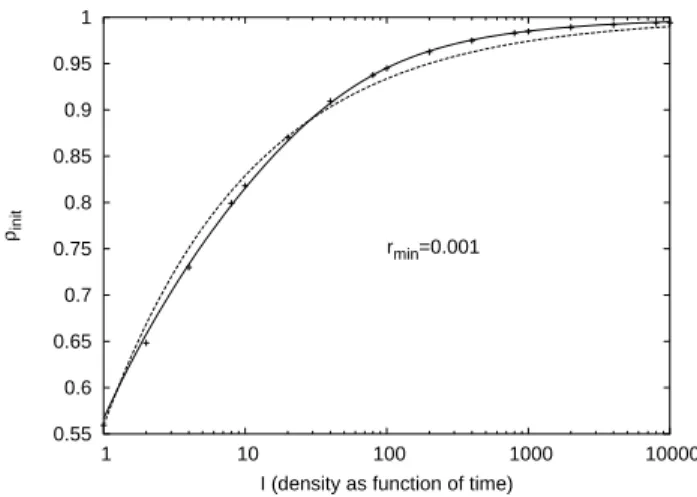
In Fig. 1 we see an example for the evolution of the den-sity as function of time. The first part with the steepest in-crease corresponds to the initialization (up tot = 107) and the density reached at this point is calledρinit. From there we continue using the dynamics with desorption plotting the data along the same time scale untilt= 109. The full line is a fit using the equation
ρinit(I) =ρmax−
∆ρ
1 +B·ln(1 +I/τ)I
−fn (2)
while the dotted line is obtained when the quotient in Eq. (2) is removed,∆ρ, B, τ andfnare essentially fit parameters.
One sees that on a logarithmic time scale eventually den-sities close to unity can be obtained. A particularly inter-esting result of this model is presented in Fig. 2 where the finally reached density at fixedIis shown as a function of the exponent of the powerlaw size distribution. We see that there exists an optimal value forbaround 1.6. Generalising the above model to higher dimensions should therefore be a way to help designers of stronger materials optimizing the size distribution of the grain mixture.
III
Space filling packings
One ultimately wants to reach a packing of density one. Well known configurations are so-called Apollonian packings in which a sphere is always placed inside an existing pore such as to have maximum volume. The new smaller pores created by this procedure are then again filled with even smaller
0.944 0.946 0.948 0.95
1.3 1.35 1.4 1.45 1.5 1.55 1.6 1.65 1.7 1.75 1.8 1.85
ρinit
b (final density as function of the exponent $b$ of the size distribution) I=100
Figure 2. Density after the initialization as function of the exponent
bof the size distribution.
spheres of maximum volume and so on. If one starts with mutually touching spheres on the vertices of a tetrahedron, one obtains the classical Apollonian packing [6, 7] which is known to be self-similar, its size distribution is a perfect power law with exponent 3.47 and from there results that the pore volume and the overall surface are fractal with a fractal dimension of 2.47.
We found four more such self-similar configurations with different topologies and therefore possibly different ex-ponents, one based on the cube, two on the octahedron and one on the dodecahedron and at this point no further self-similar packings are known [8].
The biggest surprise however is that one of those config-urations, namely one based on the octahedronal symmetry is bi-chromatic, this means that two colours suffice to as-sure that spheres having the same colour never touch. This is shown in Fig. 3. Its fractal dimension is about 2.54, i.e. larger than the classical Apollonian one. That means that a blue sphere only has red neighbours and vice-versa. Fur-thermore we can prove [9] that if one chooses any axis and rotates one sphere around it, all the other spheres will roll without slip at their contacts. The rotation axis of the dif-ferent spheres are then in general difdif-ferent. If the blue ones rotate clockwise, the red ones rotate counterclockwise. One can also show that except for a set of points of measure0, the contacts have no torsion friction, i.e. that the two spheres in contact will have equal angle of velocities of opposite sign in the axis perpendicular to the tangent plane. Therefore one has essentially only rolling friction which typically is very small so that this packing is a realisation for a three-dimensional space filling bearing, actually to our knowledge the first one ever described.
IV
Conclusion
Brazilian Journal of Physics, vol. 33, no. 3, September, 2003 593
Figure 3. Bi-chromatic packing of fractal dimensions 2.59.
slowly attain densities above 95 % and that one can optimize this number by tuning the exponent of the distribution. We have also seen that the idealized completely dense case can be self-similar in five topologically different configurations, only one of them having the property of being a bearing, i.e. allowing for slipless rotations around an arbitrary axis.
A full three-dimensional model or simulation of a sys-tem is still far from being realised because of the difficulties to deal with the large amount of very small particles. Our contributions are just a small step in this direction. From the
theoretical point of view one has also to consider non-self-similar perfect packings and non spherical particles, under-stand the settling and demixing dynamics and calculate for each size the corresponding mobilities. From a numerical point of view, one has to organize the data hierarchically, eventually using quad-trees for a generalized linked cell al-gorithm and consider size classes in representative volume elements. We think that in the future much progress can still be achieved.
References
[1] T. Aste and D. Weaire,The pursuit of perfect packing, Insti-tute of Physics Publishing, Bristol and Philadelphia 2000. [2] F. de Larrard,Concrete Mixture Proportioning,Eds. E & FN
Spon, London, New York 1999.
[3] E.R. Nowak, J.B. Knight, E. Ben-Naim, H.M. J¨ager, and S.R. Nagel, Physical Review E,57(2), 1971 (1998).
[4] J.B. Knight, C.G. Frandich, Chun Ning Lau, H.M. J¨ager, and S.R. Nagel, Physical Review E,51(1), 3957 (1995). [5] M. Wackenhut and H.J. Herrmann, Searching for the perfect
packing. Preprint, 2003.
[6] D.W. Boyd, Math. Comp.27(122), 369 (1973).
[7] M. Borkovec, W. de Paris, and R. Peikert, Fractals2(4), 521 (1994).
[8] R. Mahmoodi Baram and H.J. Herrmann, Self-similar pack-ings in three dimensions. Preprint, 2003.