
Brazilian Journal of Physics, vol. 35, no. 3B, September, 2005 793
The Chlorine Reference Value in Whole Blood using ANAA
Laura Cristina Oliveira, Cibele Bugno Zamboni,
Instituto de Pesquisas Energ´eticas e Nucleares, Caixa Postal 11049, 05422-970, S ˜ao Paulo, SP, Brazil
Patricia da Silva Lins, and Maria Regina Andrade de Azevedo e Oliveira Universidade de Santo Amaro - UNISA, S˜ao Paulo, SP, Brazil
Received on 1 August, 2005
The Absolute Neutron Activation Analysis (ANAA) technique was used to estimate the reference value for Cl in whole blood of healthy group, selected from blood banks at S˜ao Paulo city, to provide information which can help in diagnosis of patients. The results show that the indicative interval obtained for Cl in serum from the nuclear analysis (3.41 - 3.69µg·µl−1) is in agreement with the reference value adopted (3.44 - 3.76µg·µl−1) in addition, an indicative interval for Cl (2.75 - 2.95µg·µl−1) could be proposed for whole blood. The advantages
and limitations of using this nuclear methodology were discussed.
I. INTRODUCTION
The reference values for trace elements in human clinical specimens can facilitate the interpretation of data deriving from clinical practice because they reflect the findings in a select group of individuals [1]. Several clinical hematological examinations, some of them involving the elements’ concen-tration such as Cl (Cloremia), K (Calemia), Na (Natremia), Fe (Serum Iron, Ferritin, and TIBC - Total Iron Binding Capa-city), for example, are very important to identify anomalies in human being body organs. But, to perform these conventional analysis the procedure needs the separation of serum-plasma, which demands time and it is expensive because different ap-paratus must be used [2, 3]. In this work, our purpose is to investigate the performance of the nuclear methodology, spe-cifically the Absolute Neutron Activation Analysis (ANAA), to perform hematological examinations in human being using whole blood.
This study is part of a larger project,Determination of re-ference values for concentrations of trace elements in human blood using nuclear methodology, at the present in develop-ment at IPEN in collaboration with Blood Banks and Hemato-logical Laboratories from different regions of Brazil. Firstly, this nuclear methodology was applied with success to inves-tigated elements concentration in whole blood, urine and also in several body organs of small and medium-sized animals resulting in an agile and economic way to perform clinical in-vestigations [4–10]. Now, we intend to use this nuclear tool to perform hematological analyses in human beings.
The necessity to obtain the reference value is related to the fact that the conventional clinical analyses are performed using serum or plasma, consequently there are no reference value established for whole blood. To perform these measure-ments a group (male and female blood donators), age between 25 and 60 years at 50 and 85 kg, were selected from blood banks. In this study we choose the element Cl to be first analy-zed because it takes part in the human being metabolism and its important for preservation of the osmotic and acid - base equilibrium of human fluids, for that reason its variations are generally related to several pathological processes. Besides, their nuclear properties such as thermal cross section, half live
and isotopic fraction are very favorable to perform neutron ac-tivation.
For the development of this investigation the Chlorine con-centration in serum was first analyzed, by using ANAA, for comparing the nuclear results with the reference value adopted [2] and for checking the accuracy and precision of this metho-dology. After that, this methodology was applied to analyze Cl in whole blood for the proposition of an indicative interval for its reference value.
II. EXPERIMENTAL PROCEDURE
In this study the samples came from Blood Bank Paulista at S˜ao Paulo city. About 2ml of whole blood was collec-ted in a vacuum plastic tubing (15mm long and diameter at about 1.0mm) attached to the donator’s arm. Immediately af-ter the collection, before its coagulation, a small quantity (50 to 100µl) was transferred to the filter paper using a calibrated micropipette and dried for few minutes using an infrared lamp. The biological material yet in the plastic tubing was then cen-trifuged for the serum sample preparation following the same procedure. It is important to emphasize that the amount of biological material draw up in the filter paper is less than∼
2cm2, and that the samples can be storage without any refri-geration.
794 Laura Cristina Oliveira et al.
FIG. 1: Partialγ-ray spectrum of whole blood sample, taken at 5 minutes of irradiation time. Bg indicates peaks occurring in natural background.
the IDEFIX computer software [12] and the calculation of the concentration for each element was obtained from software developed by Medeiros [13]. In this investigation a total of 26 samples for serum and whole blood, respectively, were col-lected in replicate. The irradiation time of 5 minutes, coun-ting time of 1 minutes for the Gold activation detector and 10 minutes for the biological sample and background radia-tion (Bg) allowed us to conclude the analysis of each sample (whole blood or serum) in about half hour.
III. RESULTS
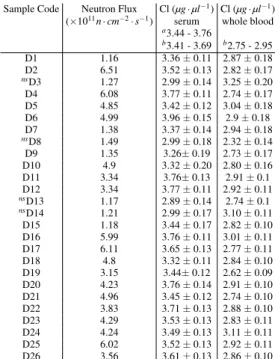
The Cl concentration in serum and whole blood are shown in Table I and the gamma ray spectrum of whole blood in Figs. 1 and 2. All the results were obtained by analyzing replicate samples and the indicative interval for the reference values by using the median value considering one SD. Although the concentration of D3, D8, D13 and D14 samples have been de-termined these results were not considered in our calculation because, according to the selection performed by the blood bank, these donators were not completely healthy. In the fi-gure 3 the Chlorine’s concentration results in serum are shown together with the reference values [2], included for compari-son. In this figure we can also notice that the concentration’s results of the samples not selected (D3, D8, D13 and D14) do not belong to the reference value showing the sensibility of the method. In figure 4 the Chlorine’s concentration results in whole blood are shown where the indicative interval, obtained in this study, was included.
According to figures 1 and 2, besides Cl (T1/2∼37min), some other elements are also activated in whole blood, such as 28Al (T
1/2∼3min),80Br (T1/2∼18min),49Ca (T1/2∼9min), 42K (T
1/2∼12h),27Mg (T1/2∼9.5min),56Mn (T1/2∼2.5h) and24Na (T1/2∼15h), suggesting that these elements’ con-centrations can also be measured using the same irradiation
Sample Code Neutron Flux Cl (µg·µl−1) Cl (µg·µl−1)
(×1011n·cm−2·s−1) serum whole blood
a3.44 - 3.76
b3.41 - 3.69 b2.75 - 2.95
D1 1.16 3.36±0.11 2.87±0.18 D2 6.51 3.52±0.13 2.82±0.17
nsD3 1.27 2.99±0.14 3.25±0.20
D4 6.08 3.77±0.11 2.74±0.17 D5 4.85 3.42±0.12 3.04±0.18 D6 4.99 3.96±0.15 2.9±0.18 D7 1.38 3.37±0.14 2.94±0.18
nsD8 1.49 2.99±0.18 2.32±0.14
D9 1.35 3.26±0.19 2.73±0.17 D10 4.9 3.32±0.20 2.80±0.16 D11 3.34 3.76±0.13 2.91±0.1 D12 3.34 3.77±0.11 2.92±0.11
nsD13 1.17 2.89±0.14 2.74±0.1
nsD14 1.21 2.99±0.17 3.10±0.11
D15 1.18 3.44±0.17 2.82±0.10 D16 5.99 3.76±0.11 3.01±0.11 D17 6.11 3.65±0.13 2.77±0.11 D18 4.8 3.32±0.11 2.84±0.10 D19 3.15 3.44±0.12 2.62±0.09 D20 4.23 3.76±0.14 2.91±0.10 D21 4.96 3.45±0.12 2.74±0.10 D22 3.83 3.71±0.13 2.88±0.10 D23 4.29 3.53±0.13 2.83±0.11 D24 4.24 3.49±0.13 3.11±0.11 D25 6.02 3.52±0.13 2.92±0.11 D26 3.56 3.61±0.13 2.86±0.10
TABLE I: The Cl concentration in serum and whole blood by using the ANAA.
* associated uncertainly<4%;
areference value [2];
bindicative interval proposed in this work; nssamples not selected.
FIG. 2: Partialγ-ray spectrum of whole blood sample, taken at 5 mi-nutes time irradiation. Bg indicates peaks occurring in natural back-ground.
Brazilian Journal of Physics, vol. 35, no. 3B, September, 2005 795
FIG. 3: Chlorine concentration results in serum samples; the hori-zontal lines represent the reference interval from [2].
FIG. 4: Chlorine concentration results in whole blood samples; the horizontal lines represent the indicative interval proposed in this work.
IV. DISCUSSION
In this study the ANAA technique was applied to analyze Cl in whole blood of a selected group of individuals, for the proposition of an indicative interval for its reference value, to provide information which can help in diagnosis of patients. Although the statistical treatment of reference values a reaso-nably estimate must be obtained [14], these preliminary re-sults show that the indicative interval obtained for Cl in serum from the nuclear analysis (3.41 - 3.69µg·µl−1) is in agree-ment with the reference value adopted (3.44 - 3.76µg·µl−1) [2] suggesting that this nuclear methodology can be used to analyze other elements in serum and blood. Of course, more systematic and large scale studies are needed to establish refe-rence values using ANAA aiming its application, in the future, for studying in more details reference values of common
defi-ciencies in Brazilian population helping their diagnostics.
Relating to the use of this nuclear methodology to perfor-med hematological examinations some advantages could be appointed: it is not necessary to performed the serum-plasma separation; it permits the simultaneous determination of seve-ral elements concentrations; it allows the sample storage for future reexamination, for long periods, without the need of re-frigeration and due the short time irradiation and the use of small amounts of biological material low activity is induced, so any specific shielding is necessary after a few days. When ANAA is compared with another nuclear technique, the Ins-trumental Neutron Activation Analysis (INAA) [15], there are also advantages because the absolute method does not require standards which are imported and expensive besides the com-parative method demand much more time, mainly when ele-ments of short half-life are involved due to the necessity to analyze the standards and the sample separately and as some of them can decay before being gamma counted, several ir-radiation usually must be done. Considering the advantages appointed it is possible to perform clinical analysis in whole blood in an agile, fast and economic way using ANAA.
Other techniques such as PIXE (Particle Induced X-ray Emission), ETAAS (Electrothermal Atomic Absorption Spectrometry), Q-ICP-MS (Quadrupole Inductively Coupled Plasma Mass Spectrometry) and TXRF (Total Reflection X-ray Fluorescence), for example, have been extensively used for reference value determination, in whole blood, mainly for elements which present the highest potential risk for health, such as, Cd, Hg, Pb (pollutants) as well as As, Cr and Ni (car-cinogenic metals) [16], however no reference value for Ch-lorine or other elements in whole blood have been measured for medical diagnosis studies, particularly from inhabitants of the Brazil. Nowadays, measurements of Iron in whole blood are in progress [17], using this methodology, aiming to stan-dardize the nuclear procedure for Iron determination in whole blood, for diagnosis and prediction of Iron deficiency (ane-mia), that have high prevalence in Brazilian population (60%) [18].
V. CONCLUSIONS
796 Laura Cristina Oliveira et al.
Acknowledgments
The authors would like to thank the staff for the technical assistance during the blood collection at Paulista Blood Bank.
This works has been supported by CNPq and FAPESP.
[1] O. Vesterberg, et al.International project reference values for concentrations of trace elements in blood and urine - TRACY. Scand Work Environ Health vol.19 (1993).
[2] J. P. Fr´ejaville, and P. Kamoun (eds).Guide des examens de laboratoire,Paris, Flammarion (1981).
[3] S. S. Raphael (ed). Lynch’s medical laboratory technology, 4.ed., Philadelphia: Saunders (1983).
[4] C. B. Zamboni, I. M. M. A. Medeiros, F. A. Genezini, A. C. Cestari, and J. T. Arruda-Neto, Proceedings of the V ENAN (RJ, Brasil, 2000).
[5] L. C. Oliveira, C. B. Zamboni, A. M. G. Figueiredo, A. C. Ces-tari, and J. T. Arruda-Neto, Proceedings of the III ENBN (Gra-mado, Brasil, 2001).
[6] L. C. Oliveira, C. B. Zamboni, A. C. Cestari, L. Dalaqua Jr., M. V. G. Manso, A. M. G. Figueiredo, and J. T. Arruda-Neto, Rev. Bras. Pesq. Des.4, 1035 (2002).
[7] L. C. Oliveira, C. B. Zamboni, F. A. Genezini, A. M. G. Figuei-redo, and G. S. Zahn, Proceedings of the MARC VI (HI, USA, 2003).
[8] L. C. Oliveira, C. B. Zamboni, G. S. Zahn, M. P. Raele, and M. A. Maschio, Brazilian Journal of Physics34, 811 (2004). [9] L. C. Oliveira, C. B. Zamboni, L. Dalaqua Jr., and M. Saiki,
Proceedings of the 11th MTAA (Guildford, England, 2004).
[10] C. B. Zamboni, L. C. Oliveira, and L. Dalaqua Jr., Proceedings of the ANES (Miami Beach, EUA, 2004).
[11] U. D. Bitelli, M.Sc. Thesis, (Instituto de Pesquisas Energ´eticas e Nucleares, S˜ao Paulo, 1988).
[12] P. Gouffon,Manual do programa IDeFix.(Instituto de F´ısica da Universidade de S˜ao Paulo, Laborat´orio do Acelerador Linear, S˜ao Paulo, 1987).
[13] J. A. G. MEDEIROS, Private communication, (Instituto de Pes-quisas Energ´eticas e Nucleares - IPEN, S˜ao Paulo, 2002). [14] A. H. Reed, R. Henry, and W. B. Mason, Clinical Chemistry17,
275 (1971).
[15] M. D. Glascok, In: Electronic Annals: http://www.missouri.edu/∼glascok/naa over.htm. (Acces-sed on Mar 2004).
[16] International Federation of Clinical Chemistry, Clinica Chimica Acta,137, 97F (1984).
[17] P. S. Lins, M.Sc. Thesis (Universidade de Santo Amaro, S˜ao Paulo, 2004).
[18] S. S. Queiroz, et al., Jornal de Pediatria76, s298 (2000). [19] K. Shtejer-Diaz, C. B. Zamboni, G. S. Zahn, and J. Y.
![FIG. 3: Chlorine concentration results in serum samples; the hori- hori-zontal lines represent the reference interval from [2].](https://thumb-eu.123doks.com/thumbv2/123dok_br/18981324.457130/3.892.107.415.92.326/chlorine-concentration-results-samples-zontal-represent-reference-interval.webp)
