rev bras hematol hemoter. 2017;39(1):86–88
w w w . r b h h . o r g
Revista
Brasileira
de
Hematologia
e
Hemoterapia
Brazilian
Journal
of
Hematology
and
Hemotherapy
Letter
to
the
Editor
Administration
of
all-trans
retinoic
acid
through
enteral
tubes
in
acute
promyelocytic
leukemia:
the
handling
of
cytotoxic
agents
and
clinical
benefits
DearEditor,
Acutepromyelocyticleukemia(APL)isoneofthemost inci-denthematologicneoplasmsintheacutecaresetting.1
Treatment ofAPL consistsoforalall-transretinoic acid (ATRA),whichhasbeenextensivelystudiedsince1990.1The pharmacologicaltargetofATRAistheRetinoicAcid Receptor-Alfa(RAR-␣)inmalignantpromyelocyteswhereitpromotes
theirdifferentiationintomaturemyeloidlineages.Nowadays, 90%ofpatientsachievecompleteremissionstatusinoneto threemonths.Dependingonriskclassification,ATRAcanbe usedasoralmonotherapy,orcombinedwitharsenictrioxide oranthracyclines.2
Despitethehighratesofdiseaseremission,APLisa med-ical emergency, as it causes a life-threatening coagulation disorder and respiratory insufficiency. Thelatter may be a resultofdifferentiationsyndrome(DS),whichcomprises30% ofallcausesofdeathsintheAPLpopulation.3
WhenpatientsarediagnosedwithDS,theyareoften intu-batedtorestoreventilationparameters.Theyalsorequirethe placementofanenteraltubetoreceivenutrientsand medica-tions.
So,howcanwekeepadministeringATRAtothesepatients? Inotherwords,theriskofoccupationalexposuretoATRAdoes notallowthenursingstafftomanipulatesuchdrugsby punc-turingthecapsule.Moreover,extractingtheoilycontentfrom thehard-coatedjellycapsulesmayleadtosignificantATRA losses.4
Inour institution, wehave been admittingfrom two to eightpatientsperyearwithAPL/DStotheemergencyroom and intensive care units. Because of the aforementioned ATRAhandlingproblems,wehaveseendoseadministration delays, unaware nursing technicians trying to manipulate ATRA(some ofthem inthe fertileage)andpharmacystaff recurrentlyasking howtoprepare thisdrugwithout losses andunnecessaryoccupationalexposure.Unfortunately,there is not enough published information to support any kind ofinitiative, possiblydue tothe quickclinical evolution of APL and relatively low incidence in comparison to other neoplasms.5
In one of the most recent cases that we accompanied, we standardized a protocol to administer ATRA to intu-bated patients. A 22-year-old woman was admitted to the emergency room with dyspnea, dry cough and 85% oxy-gen saturation.Shewasdiagnosedwithhigh-risk PMLand induction chemotherapy was promptly initiated: 50mg/m2
daunorubicin plusATRA 45mg/m2/day.Two dayslater,her
ventilatory parameters worsened due to DS, so she was intubated and an enteral tube was inserted. As DS is an ATRA-related life-threatening condition, the retinoid was suspended for two days until her respiratory parameters improved.
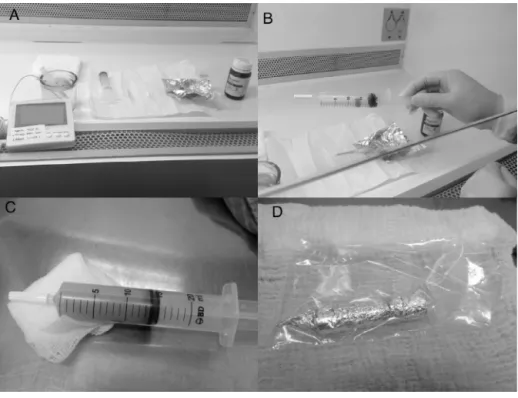
WhenATRAwasreintroduced,theproblemof administer-ingitbyenteraltubearose,asheroralaccesswasnolonger available.Afterconductingaliteraturereview,wesuggestthe followingprocedure(Figure1):
• ATRAwasdissolvedin10mLofdistilledwater(45◦C),and
5mLofmineraloilwasaddedtoworkasalipophiliccarrier. A5-mLdeadspacewasleftinsidea20-mLsyringe; ◦ WefoundthatATRAcouldbedissolvedathigher
tem-peratures without affecting its molecular structure.6–8 Mineraloilwaschosenbecausethepatientwasalready receiving it due to constipationsecondary tonarcotic agents;
• Themixturewasthoroughlyshakenuntiltheentirecoat dissolved;
◦ Other authors have suggested that vigorous shaking shouldbeappliedtodissolveATRA insidethe syringe, whichwasobservedbyourpharmacystaff.9Ittookmore than5minofshakingtodissolvetheintactcapsules com-pletely;
◦ Wealsoobservedthatcoldtemperaturesdidnotremodel the carbohydrate polymer-based coat, so the solution maintaineditscolloidalphysico-chemicalproperties; • All procedureswere performedina classII-B2biological
revbrashematolhemoter.2017;39(1):86–88
87
Figure1–Processtomanipulateall-transretinoicacid(ATRA).(A)Materials:gown,gloves,classII-B2biologicalsafety cabinet,thermometer,20-mLsyringe,luerlockorotheravailablesyringe/locksystem,lightprotection(e.g.:aluminumfoil orothereffectivesystem),distilledwaterheatedto40◦CandATRA.(B)Syringefilledwith5–10mLofheateddistilledwater withATRAandairspaceforeffectivemixing.(C)Finalproductaftervigorousshaking.(D)ATRAprotectedfromthelight.
• Weprovidedwrittenandverbalinstructionstonursesand physiciansforclinicalmonitoring(liverenzymesandblood cell count,respectivelyfortoxicityandefficacy)andsafe ATRAhandling(useofpersonalprotectionequipmentand correctdiscard).
Afterseven daysin the intensive careunit, the patient hadimprovedclinicallyandshewasweanedfrom mechani-calventilationandsedatives.Sheprogressedtoconsolidation therapy,whichconsistedinmitoxantroneandoralATRA,and wasdischargedfromtheoncologyward.
Duetotheclinicalbenefits1–3,5andphysicalandchemical stability,6thereweremanyadvantageswiththe administra-tionofATRAdissolvedinwaterthroughanenteraltube.
AJapanesegroupreportedthatafewpatientswhoreceived ATRAbyenteraltubeshadsignificantlylowerplasmatic lev-elsofretinoicacidderivatives.10 However,twocasereports discussedATRAdilutedinamannersimilartothatdescribed hereinwherepatientsachievedcompleteremissionanditwas suggestedthatthedrugwasabsorbedinthegastrointestinal tract.9
Itisworthrememberingthat,asacytotoxicagent, nurs-ingstaff mustnotmanipulateit without properprotection and materials and that uncoated ATRA is photosensitive.8 Thus,thedisparitiesbetweenthetwoaforementionedreports might be due to lack of protection against light, which explainswhyauthorsobservedonlyphysiologicalretinoid lev-els in their patients.6,9,10 The oral administrationof ATRA asa single 80mg dose (∼45mg/m2 usual dosage)provides
347±266ng/mLofpeakconcentrationinonetotwohours.4,8 Bylookingatthepharmacokineticsgraphoftheauthors,ifan
ATRAdosewasentirelyadministered,weshouldobserveat leastaminimalpeakconcentrationneardrugadministration, andlogarithmiceliminationofATRA.10
Lastly,ourexperienceisnotabsentoflimitationsand suc-cessfulcasesofATRAadministrationthroughenteraltubes shouldbemonitoredregardingsafety(controlofthe hyperco-agulationstateinAPL,riskofbleedingandhepatotoxicity)and dosing requirements asdifferentpharmacokinetic parame-tersmayinfluenceclinicalresponse.9
ATRAisthemainstayoftreatingAPLpatients. Consider-ing the benefits ofmaintaining retinoic-based therapy, the dissolving ofcoatedcapsulesremainsavaluableoptionfor patientswithoutoralaccess.
Conflicts
of
interest
Therearenoconflictsofinterest.
Acknowledgements
On behalfofall IntensiveCareUnitstaff,wewould liketo thankDr.HipólitoCarraroJr.forhisknowledgeand outstand-ingclinicalsupporttopharmacists,residentsandpatients.
r
e
f
e
r
e
n
c
e
s
1.DegosL.All-transretinoicacid(ATRA)therapeuticaleffectin
acutepromyelocyticleukemia.BiomedPharmacother.
88
revbrashematolhemoter.2017;39(1):86–882. AdesL,SanzMA,ChevretS,MontesinosP,ChevallierP,
RaffouxE,etal.Treatmentofnewlydiagnosedacute
promyelocyticleukemia(APL):acomparisonof
French-Belgian-SwissandPETHEMAresults.Blood.
2008;111(3):1078–84.
3. RogersJE,YangD.Differentiationsyndromeinpatientswith
acutepromyelocyticleukemia.JOncolPharmPract.
2012;18(1):109–14.
4. Vesanoid®(all-transretinoicacid)capsulesprescribing information.ProdutosRocheQuímicoseFarmacêuticosS.A., Inc(2013)[cited29.12.15].Availablefrom:http://www.
anvisa.gov.br/datavisa/filabula/frmVisualizarBula.asp?
pNuTransacao=10239652013&pIdAnexo=1891818.
5. MontesinosP,BerguaJM,VellengaE,RayónC,ParodyR,dela
SernaJ,etal.Differentiationsyndromeinpatientswithacute
promyelocyticleukemiatreatedwithall-transretinoicacid
andanthracyclinechemotherapy:characteristics,outcome,
andprognosticfactors.Blood.2009;113(4):775–83.
6. TanX,MeltzerN,LindenbaumS.Determinationofthe
kineticsofdegradationof13-cis-retinoicacidand
all-trans-retinoicacidinsolution.JPharmBiomedAnal.
1993;11(9):81722.
7. GattiR,GioiaMG,CavriniV.Analysisandstabilitystudyof
retinoidsinpharmaceuticalsbyLCwithfluorescence
detection.JPharmBiomedAnal.2000;23(1):147–59.
8. MuindiJRF,FrankelSR,HuseltonC,DeGraziaF,GarlandWA,
YoungCW,etal.Clinicalpharmacologyoforalall-trans
retinoicacidinpatientswithacutepromyelocyticleukemia.
CancerRes.1992;52(8):2138–42.
9. BargetziMJ,TichelliA,GratwohlA,SpeckB.Oral
all-transretinoicacidadministrationinintubatedpatients
withacutepromyelocyticleukemia.SchweizMed
Wochenschr.1996;126(November(45)):1944–5.
10.TakitaniK,NakaoY,KosakaY,InoueA,KawakamiC,KunoT,
etal.Lowplasmalevelofall-transretinoicacidafterfeeding
tubeadministrationforacutepromyelocyticleukemia.AmJ
Hematol.2004;76(1):97–8.
LucasMiyakeOkumura∗,PatríciaCarvalhoBaruelOkumura, CleniVeroneze
HospitaldeClínicasdePortoAlegre(HCPA),PortoAlegre,RS,Brazil
∗Correspondingauthorat:ClinicalPharmacyDivision,Hospital
deClínicas dePortoAlegre(HCPA),RRamiroBarcelos2350, Bonfim,90035-903PortoAlegre,RS,Brazil.
E-mailaddress:[email protected](L.M.Okumura).
Received27May2016 Accepted4November2016 Availableonline23December2016
1516-8484/
©2016Associac¸ ˜aoBrasileiradeHematologia,Hemoterapiae TerapiaCelular.PublishedbyElsevierEditoraLtda.Thisisan openaccessarticleundertheCCBY-NC-NDlicense(http://
creativecommons.org/licenses/by-nc-nd/4.0/).