Cooper Pairing and Superondutivity in a Spin
Flutuation Model for High-T
Cuprate Superondutors
Eduardo C. Marino and Marello B. SilvaNeto
InstitutodeFsia,UniversidadeFederaldoRiode Janeiro,
CaixaPostal68528,RiodeJaneiro-RJ,21945-970, Brazil
Reeivedon28February,2002
WestudytheformationofCooperpairsinhigh-T
upratesuperondutorswithinaspinutuation
modelfor dopedquantumHeisenbergantiferromagnets. The harge ofthe dopants (hargons) is
assoiated toquantumskyrmionexitationsoftheCu ++
antiferromagnetispinbakground. We
thenompute the quantum skyrmioneetive interation potential as a funtion of doping and
temperature in order to study harge pairing. It beomes lear that Cooper pair formation is
determinedbythe ompetition betweenthespinutuationsofthe Cu ++
magnetiionsand the
spinsoftheO dopedholes(spinons). Thesuperondutingtransitionourswhentheeetive
potential allows for skyrmionbound states. Our theoretial preditions for the superonduting
phasediagramofLa2 xSrxCuO4 andYBa2Cu3O6+x areingoodagreementwithexperiment.
I Introdution
Stronglyorrelatedeletronsystemshavebeenthe
ob-jet of intense studies, both theoretial and
experi-mental,after numerousindiationsthat the high
tem-peraturesuperondutivity, disoveredin uprate
per-ovskites[1℄,arisesfromthedopingofaMott-Hubbard
antiferromagnetiinsulator. Thestrongorrelating
sys-tem deviates signiantly from the usual Fermi liquid
andanumberofanomaliesareobservedinthesoalled
underdopedregime. Among themost interestingones
are: Neelandmetal-insulatortransitions,linear
depen-deneoftheresistivitywithtemperature[2℄,the
redu-tionofthedensityofstatespreviousto
superondutiv-ity(pseudogap) [3℄, dierentresponses forthe optial
probesofthespinandhargedegreesoffreedom
(spin-hargeseparation)[4℄,et.,whihhaveinspiredalarge
amountoftheoretialandexperimentalworkforabout
fteen years. In spite of that, even the nature of the
groundstateandofitselementaryexitationshavenot
yet been fullydetermined and manydierent pitures
are available,ranging from a resonatingliquid ofspin
singlets(Anderson'sRVB)[4℄untilthereentproposed
staggereduxphase(SF-phase)ofWenandLee[5℄.
Oneof themost fundamental points yet to be
un-derstood is the mehanismof harge pairing. It is by
nowwellestablishedthatantiferromagnetispin
orre-lations play animportant role in thedynamis of the
system,evenafterthedestrutionoftheNeelstate.
In-deed, dierentspin-utuation models havebeen
su-essfullyusedtoexplaintheobservedspetralweightin
ARPESdata ofhigh-T materials[6℄, aswellasother
anomalies [7℄. Moreover, the idea of spin-utuation
induedhargepairingandsuperondutivityhasbeen
usedreurrently[8℄.
In this work we propose a theory for high-T
uprates that takes into aountthe spin utuations
oftheCu ++
magnetiionsandoftheO dopedholes
asindependent degreesoffreedom. Thehargeof the
dopants(hargons)isassoiatedtoskyrmionquantum
spinexitationsoftheCu ++
bakground,whihin the
Neel phase are nite energy defets losely related to
theirlassiounterpartswhereasinthequantum
disor-deredphasearenontrivialzeroenergypurelyquantum
mehanial exitations. The spin of the doped holes
(spinons),ontheotherhand,isrepresentedby
harge-less, massless Dira fermion elds [9℄. We alulate
theeetiveinteration potentialbetweenthese
quan-tumskyrmiontopologialexitationsinordertostudy
harge pairing. It beomes lear that Cooper pairing
isontrolled bytheompetition betweenthespin
u-tuations ofCu ++
magnetiions andthoseoftheO
dopedholes. OurpreditionsfortheT
lineareingood
agreement with experiment for both La
2 x Sr
x CuO
4
andYBa
2 Cu
3 O
6+x .
II The model
Itisgenerallyaeptedthattherelevanteletroni
de-greesoffreedomintheperovskitesareonnedtotwo
dimensionsandresideinCopper-Oxideplanes[10℄,like
theone shownin Fig. 1. Our startingpointwill then
squarelattieHamiltonian
H = t
p X
hi;ji ; (
y
i;
j;
+h::)+U
p X
i; n
i; n
i;
+ J
K X
i;; ~
S
i
y
i; ~
i; +J
X
hi;ji ~
S
i
~
S
j ; (1)
whiharisesfromthestrongouplinglimitofthethree
band Hubbard Model (3BHM)[11℄. In the above
ex-pression, ~
S
i
represent the loalized spins of Copper
ions,whihinteratthroughthesuperexhangeJ, y
i; ,
=1::N = 2, isthe hole reationoperator, t
p is the
hopping term for holes, J
K
is a Kondo like oupling
betweenthespinsofCu ++
ionsand thespinsof O
holes, and we have retained the usually ignored
on-site Coulomb repulsion between O holes, U
p 6= 0
with n
i; =
y
i;
i;
. Sine realistiestimatesfrom the
3BHMsuggestthatU
p =t
p
10[12℄,beingratherlarge,
and thus we an perform a t
p =U
p
expansion. Seond
order perturbation theory in t
p =U
p
will give rise to a
superexhangeJ
p =2t
2
p =U
p
betweenoxygenspinsand
weend upwithat J modelfortheholes.
tp, Up
J
k
J
Cu
Cu
Cu
Cu
O
O
O
O
O
O
O
O
O
O
Figure1. UnitelloftheCuO2 plane.
Themeaneld(largeN)solutionsofthet Jmodel
arewellknownandithasbeenestablishedthata-ux
phasehasminimumenergy,atleastatthesaddle-point
level(N !1)[9℄. Weanwritetheeletroninterms
ofahargedspinless boson
i
(hargon)anda
harge-lessspin-1=2fermionf
i;
(spinon),
y
i; =
y
i f
y
i;
; (2)
in suh a way that the above objet has exatly the
same quantum numbersas the eletron. Wedeouple
thefourpartileinterationsbyintroduingthed-wave
auxiliaryelds
ij =
D
f y
i; f
j; E
= hf f f f i; (3)
whihaquireanonzeroexpetation valueforT <T
,
whereT
is thesoalledpseudogaptemperature.
Intermsofthenewdegreesoffreedom,
i andf
i; ,
weseethattheHilbertspaeistwieaslargeasinthe
original t J Hamiltonian. Furthermore, the
result-ingHamiltonianhasanextraZ
2
(Ising)symmetry[13℄
sinenoweahpieeisinvariantunderahangeofsign
inboththehargonandspinonelds
i
!
i
f
i;
! f
i;
: (4)
Weshallthen impose aonstraintin order toaount
fortheabovedisussedfats. Weanwrite
X
i h
f y
i; f
i; +
y
i
i i
=N; (5)
whereN 0isanevennumber. With thisonstraint
the only possible states in the Hilbert spae are: a)
N=0,nohargonsandnospinons(ahole);b)N =2,
onehargonandonespinon(oneeletron),ortwo
har-gonsandnospinons(oneCooperpair),ornohargons
andtwospinons(aspinsinglet);) N >2,Nhargons
andnospinons(N=2Cooperpairs),ortwospinonsand
N 2hargons(onespinsingletand(N 2)=2Cooper
pairs). It is learhowthe extra Z
2
symmetry forbids
states with a single hargon and no spinon, and vie
versa,sineallphysialstatesmustbeZ
2
invariant.
If we then neglet harge utuations, D
i
y
j E
'
j
i j
2
=onst:,andifwereallthattheorderparameter
ij
hasd-wavesymmetry,thusvanishinglinearlyalong
the four Dira points (=2;=2), we nd that the
lowestlyingexitationsofthe-uxphasearemassless,
hargeless, spin arrying Dira Fermi elds [9℄ whose
dynamisisdesribedbytheLagrangian
L= X
; i
;
0
v
F ~
~
r
;
; (6)
where = 1;2 label the only two inequivalent Fermi
points at (=2;=2) (see Fig. 2),
= (
;
~
r),
= (
0
;~) = (i
z ;
x ;
y ), v
F
= 2a is the dopant
Fermi veloity(witha beingthelattiespaing and
theonstantamplitudeofj
ij j)and
; =
f e
;
f o
;
; (7)
k
kx
y
π
π
−π
−π
Figure 2. Fermi surfae for the low energy exitations of
the t J modelat low doping in the -ux phase. The
smallpoketsare loated at (=2;=2) and symmetry
re-latedpointsintheBrillouimzone.
The long wavelength utuations of the loalized
Cu ++
spins, on the other hand, are desribed by the
CP N 1
Lagrangian[14,15℄
L
CP N 1 =
1
2g
0 j (
iA
)z
i j
2
; (8)
where ~
S = z y
i ~
ij z
j
, with z y
i ;z
i
, i = 1::N = 2,
be-ing Shwinger boson elds suh that z y
i z
i
= 1, A
=
iz
i
z
i ,g
0
isabareouplingonstant,andweare
us-ingunitswhere =1. Itisnowonvenientto perform
theloalanonialtransformation !U ,where
U =exp
q
z
1 z
2
z
2 z
1
(9)
isaSU(2)matrix,and qisarbitrary. NowtheKondo
oupling term in (1) redues to a hemial potential
term, sine U y
~
S ~U =
z
. Also, sine U y
U =
iq
z A
+negligiblenondiagonalterms,weendupwith
theeetivetheory
Z= Z
DzDzD D DA
Æ[zz 1℄e S
; (10)
where
S =
Z
~
0 d
Z
d 2
x (
X
i=1::N 1
2g
0 j(
iA
)z
i j
2
+
X
=1::N;=1;2 ;
(i
q
z A
)
; 9
=
; ; (11)
where =1=k T andwehaveset,fornow,v =1.
III Chargons as quantum
skyrmions
In previous works [16℄, we have proposed a model
fordopingquantumHeisenbergantiferromagnets,that
suessfullydesribedthemagnetizationurvesandthe
AF part of the phase diagrams of both LSCO and
YBCO. One of the important onsequenes of that
modelwastheobservationthateahholeaddedtothe
CuO
2
planesreates askyrmion topologial defet on
the Cu ++
spin bakground, in agreementwith earlier
proposals[17℄. The dopant harge, in partiular, was
foundtobeattahedtotheskyrmionhargeand
onse-quentlyitsdynamisbeomestotallydeterminedbythe
quantum skyrmion orrelation funtions. Despite the
fatthatthemodelproposedin[16℄isrestritedtothe
antiferromagnetipartof thephase diagram, weshall
neverthelesspursuethepitureinwhihskyrmionsare
in generalthehargearriersof thedopedholes. This
willallowustotreatthebosonivariable
i
introdued
aboveas aquantum skyrmionoperator. Inpartiular,
we shall exploit this idea in the quantum disordered
phase,ÆÆ
AF
, wheretheskyrmionsarepurely
quan-tummehanialandhavezeroenergy(Æisthein-plane
dopingparameter).
Thefulltreatmentofthequantumskyrmionsofthe
theorydesribedby(11)hasbeenarriedoutin[18℄. In
therenormalizedlassialregime,g
0 <g
(g
=8=),
wehave
h(x) y
(y)i= e
2sjx yj
jx yj q
2
=2
; (12)
where
s = 1=g
0 1=g
and q is the spinon oupling.
Conversely, for the theory studied in [16℄ the
orre-spondingorrelatorwasfoundtobe
h(x) y
(y)i= e
2s(Æ)jx yj
jx yj (Æ)
; (13)
wheretheexpressionsfor
s
(Æ)and(Æ)havebeen
are-fullydeterminedin [16℄. Inpartiular,
(Æ)=
64
2
+16 +
EM
4 2
(nÆ) 2
; (14)
with n = 1 for YBCO and n = 4 forLSCO, the
fa-toroffourbeingaonsequeneoftheexisteneoffour
branhes in the Fermi surfae for this ompound, as
disussed in [16℄. Inthe aboveexpression
EM is the
eletromagnetinestrutureonstantandweseethat
the ontribution from the eletromagneti oupling is
negligible. In this sense,weshall assume
EM =0in
allthesubsequentalulations.
The
s
(Æ) funtion is given by
s
(Æ) =
s (0)[1
AÆ 2
℄, for YBCO and
s
(Æ) =
s
(0)[1 BÆ CÆ 2
℄ 1=2
,
for LSCO, and again the dierent behavior being
as-ribed to the form of the Fermi surfae in eah ase
from rstpriniples in [16℄. In order to obtain the
Æ-dependene of the spin stiness
s
and of the spinon
oupling q in our model (11), we now math the two
orrelationfuntions in (12)and(13)(orderedphase),
obtaining
s =
s (Æ)and
q= r
128
2
+16
(nÆ): (15)
Thesublattie magnetization in theordered phase
is given byM(Æ)= p
(Æ),and onsequentlyÆ
AF an
beobtainedfrom(Æ
AF
)=0,bothin good agreement
with experiment, see [16℄. ForÆ >Æ
AF
, on theother
hand, where
s
=0, we shallassume that the
expres-sion forq(Æ) still holds. This is quitereasonablesine
q was introdued bya loal anonial transformation,
andat leastloallytherestillisshort rangeAForder.
IV Cooper pair formation
Letus nowinvestigatetheonditionsforCooper
pair-ing. We shall rstintrodue in the partition funtion
(10)theskyrmionurrent,J
= 1
2
A
,through
theidentity
1= Z
DJ
Æ[J
1
2
A
℄: (16)
Integratingoverz y
i ;z
i and
a ;
a
,weobtain,atleading
order,theeetiveLagrangian
L
eff [A
℄=
N
2 A
(x;)
(x y ; 0
)A
(y ;
0
);
(17)
where
(x y ; 0
) has Fourier transformgiven
by
(p;i
m ) =
B (p;i
m )+
F (p;i
m
), whih
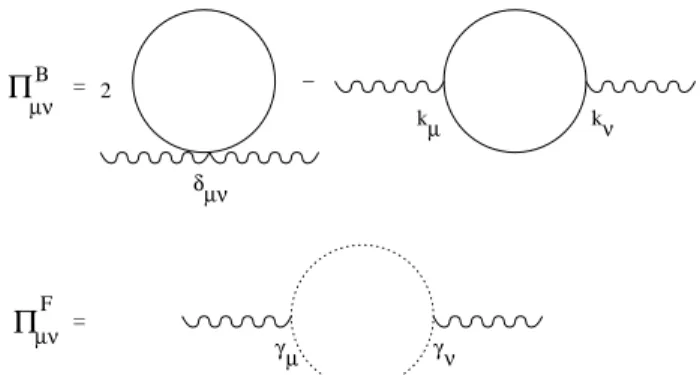
arerespetivelytheontributionstothenite
temper-ature vauum polarization oming from the omplex
salarelds z
i
(Shwinger bosons) and fermions
;
(spinons),seeFig. 3.
k
µ
k
ν
Π
=
µν
Π
µν
F
B
=
γµ
γν
−
δµν
2
Figure3. Leadingordergraphsforthe polarization tensor
=
B
+
F
.
Inordertoobtaintheeetiveurrent-urrent
inter-ationbetween skyrmions,weuse anexponential
rep-resentationfortheÆ-funtionin(16)andintegrateover
A
and the orresponding Lagrange multiplier eld.
Theresultis
Z= Z
DJ
e
2 2
R
d 3
x R
d 3
yJ(x)
(x y)J(y)
;
(18)
where
(p)=
(p)=p 2
,x=(;x)andp=(i
m ;p).
Therealtimeeetiveinterationenergybetweenstati
skyrmions(
m
=0) isthen
H
I =2
2 Z
d 2
x Z
d 2
y(x) 00
(x y ;0)(y ); (19)
where (x) =J
0
(x) is thedopanthargedensity and
00
(x y ;0)hasFouriertransformgivenby 00
(p)=
B
(p)+
F
(p)with
B (p)=
2 +
1
2 Z
1
0 dx
p
jpj 2
x(1 x)+m 2
oth p
jpj 2
x(1 x)+m 2
2k
B T
!
; (20)
and
F (p)=
q 2
Z
1
0 dx
p
jpj 2
x(1 x)tanh p
jpj 2
x(1 x)
2k
B T
!
: (21)
d
In the above expressions, m is the inverse orrelation
lengthofthequantumdisorderedphaseoftheCP N 1
model,where
=8
1
g 1
g
(22)
and
s
=0. Atorder N,itisgivenexatlyby[15℄
1
(T)=m(T)=+2k
B Te
=kBT
: (23)
For two harges at positions x
1 and x
2
, we have
(x) = Æ (2)
(x x
1 )+Æ
(2)
(x x
2
self-interations,weobtain(r=x
1 x
2 )
V(r)= Z
d 2
p 00
(p)e ipr
+V
l
(r); (24)
where we havealso introdued the entrifugal barrier
potentialbetweenthetwohargesthatformtheCooper
pair,
V
l (r)=
l(l+1)~ 2
2M
r 2
; (25)
withlspeifyingtherelativeorbitalangularmomentum
ofthepairand M
theeetivemassoftheharges.
IV.1 DeterminationofÆ
SC
It is well known that in high-T
uprates, Cooper
pairs form at relatively short distanes. In this limit,
largejpj,wehave,atT =0
V(r)! Z
d 2
p
1
8jpj 2q
2
8jpj
e ipr
+V
l
(r): (26)
Theabove expression learlyshowsaompetition
be-tween the spin utuations of the Cu ++
spins (rst
term)andoftheO dopedspins(seondterm). For
smallenoughdoping,q 2
<1=2,thepotentialisalways
repulsiveand thereisnohargepairing. Forq 2
>1=2,
on the other hand, the potential hasa minimum and
harge(skyrmion)pairingours.Weonludethatthe
ritialdopingfortheonsetofsuperondutivityis
de-termined by theonditionq 2
(Æ
SC
)=1=2. Weobserve
thatwithouttheCu ++
bakground,theinteration
po-tential (26) would always have bound states for any
q6=0,atzerotemperature,andÆ
SC
=0. Thisiswhat
happensinthemeaneldphasediagramofKotliarand
Liu[19℄. WeseethattheeetoftheCu ++
bakground
istoshiftthevalueofÆ
SC
toitsorretpositioninthe
phasediagram.
From expression (15) we see that Æ
SC
is only
de-termined by thegeometry of the Fermi surfaeof the
ompound. Usingthatq 2
(Æ
SC
)=1=2wegetÆ YBCO
SC =
0:318 and Æ LSCO
SC
= 0:079, whih have a fairly good
agreementwithexperiment. Inpartiular,wesee that
Æ YBCO
SC
= 4Æ LSCO
SC
, aresult that is veried by
experi-ments,ifwetakeinaounttherelationbetweenÆand
the stoihiometridoping parameterx, namely Æ = x
forLSCOandÆ=x 0:20forYBCO.Another
predi-tionofourmodelisthatompoundswithsimilarFermi
surfaesshould havethesamesuperondutingritial
dopingÆ
SC .
IV.2 Disorder
Weanimproveevenfurtherouragreementwith
ex-perimentaldataforÆ
SC
byonsideringdisorderin the
bonds of the Cu ++
antiferromagnetilattie. In fat,
disorder may be modelled in the ordered Neel phase
of a doped antiferromagnet by onsidering a
ontinu-ousrandomdistributionofspinstinesses[20℄. The
ef-fetofintroduingaGaussianj
s j
1
distribution,
withexponentiallysuppressedmagnetidilution,inthe
original model [16℄, is a orretion for (Æ), namely
(Æ) ! 0
(Æ) = (Æ)+ [20℄, and onsequently we
endupwith
q(Æ)= r
128
2
+16 (nÆ)
2
+2; (27)
Choosing = 1
8
for both ompounds, we get Æ
SC =
1
n q
2
+16
512
, or equivalently x YBCO
SC
= 0:425 and
x LSCO
SC
=0:056,in goodagreementwithexperiment.
IV.3 The superonduting transition lineT
SC
The omputations at nite temperature are a bit
more involved. Sine the integralsover the Feynman
parametersin(20)and(21)annotbesolvedexatly,
weshallmakeuseofsometemperatureexpansions.For
B
we shall expand in k
B
T=m, sine it is lear that
m(T)>k
B
T;8T.
B
will thenbesimplygivenbyits
zerotemperaturelimit,where m=. For
F
, onthe
other hand,suh alow T expansionisnot neessarily
valid even for jpj k
B
T. We will then have to split
theintegralovertheFeynmanparameterxin(21)into
three parts. For 0 x x
and 1 x
x 1,
x
=(k
B T=jpj)
2
, weuseahigh T expansion,whilefor
x
x1 x
weusethelowT expression. Weobtain
00
(p)= (1 2q
2
)
8jpj
m
jpj 2
+ m
2
2jpj 3
+ 16q
2
T 3
4m 3
3jpj 4
:
(28)
Inserting this in (24), we get V(r), and from the
thresholdonditionsfortheformationofboundstates,
namelyV 0
(r
0
)=0andV 00
(r
0
)=0,weobtainthe
rela-tion
(k
B T
SC )
3
=
(1 2q 2
) 3
512q 2
+ m
2
32q 2
3m 2
128q 2
+ m
3
4q 2
3 2
l(l+1) 4
q 2
M
v 2
F
; (29)
where =~v
F =r
0
,m=,andr
0
istheminimumof
the potential(it also measures the size of the Cooper
pair).
V Comparison with experiment
In order to make ontat with experimental data we
need thedopingdependene of. ForYBCO,weuse
(Æ)=
0 [(Æ=Æ
AF )
2
1℄,inagreementwiththeresults
of [16℄, with
0
= 8:0 meV. ForLSCO, weshall use
an expression that ts the experimental data of [21℄,
namely (Æ) =
0 [(Æ=Æ
AF )
2
1℄ 1=2
, with
0
= 0:87
meV. Forthe T = 0 AF quantum ritial point Æ
AF ,
weknowfromexperimentsthatÆ
AF
=0:22forYBCO
and Æ
AF
=0:02forLSCO.Insertingin (29)thevalues
ofÆ
SC
atT =0,obtainedpreviously,wegetarelation
that xesM
v 2
F
with respet to r
0
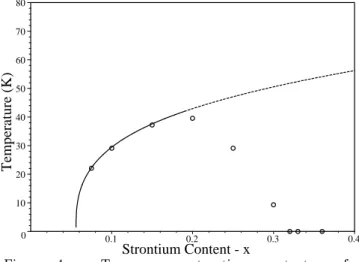
. InFigs. 4and 5
we plot the urve (29) for LSCO and YBCO,
respe-tively, withr
0 =38
A,~v
F
=0:1eV
A forLSCOand
~v
F
=1:15eV
AforYBCO,andl=2(d-vavepairing).
0
10
20
30
40
50
60
70
80
Temperature (K)
0.1
0.2
0.3
0.4
Strontium Content - x
Figure 4. T
SC
versus strontium ontent x for
La
2 x Sr
x CuO
4
.Thelinesorrespondtothetheoretial
pre-dition(Eq. 29). Experimentaldatafrom[21 ℄.
0
20
40
60
80
100
120
140
160
Temperature (K)
0.2
0.4
0.6
0.8
1
Oxygen Content - x
Figure5. TSC versusoxygen ontentxforYBa2Cu3O6+x.
Thelinesorrespondtothetheoretialpredition(Eq.29).
InFig. 4(LSCO),the dashedpartis in theregion
where T > T
and we should move to a new
saddle-point. In Fig. 5 (YBCO) we have shifted the urve
(dashedpart) totherightintheregionsx=[0:52;0:7℄
andx =[0:8;1℄ in order to omplywith the eets of
theout-of-planeO-Cu-Ohains,whihproduethe
ob-served60Kand90Kplateaus,wheretheextraholesdo
notenterintheCuO
2
planes. Furthermore,forYBCO,
T
ishigherthan T
max
(x =1) andtherefore imposes
norestritionstoourresults.
VI Final remarks
Wewouldliketoremarkthatourtheory(11)alsogives
asimple interpretationfor thepseudogap phenomena.
Indeed, for T
SC
< T < T
spinons are paired into
d-wave singlets but hargons (skyrmions) repel eah
otherand there isno superonduting state. Only for
T<T
SC
wedohaveCooperpairformationand
super-ondutivity.
Aknowledgements
Theauthorswould liketoaknowledgeE. Miranda
forusefulomments. This workhasbeensupportedin
partbyFAPERJ and PRONEX - 66.2002/1998-9. E.
C.M.waspartiallysupportedbyCNPq and M.B.S.
N.byFAPERJ.
Referenes
[1℄ J. G. Bednorz and K. A. Muller, Z. Phys. B 64, 189
(1986).
[2℄ B.Batlogg,H.Takagi,H.L.Kao,andJ.Kwo,in
Ele-troniPropertiesofHigh-TSuperondutors.The
Nor-malState andThe Superonduting State,Kuzmanyet
al., eds., (Springer-Verlag, Berlin/Vienna/New York)
1992.
[3℄ T.M.Rie,inPhysisandChemistryofOxide
Superon-dutors,Y. IyeandH.Yasuoka,eds.,(Springer-Verlag,
Berlin/NewYork)1992.
[4℄ P.W.Anderson,inTheTheory ofSuperondutivity in
the High-T Cuprate Superondutors, Prineton
Uni-versityPress(1997).
[5℄ X-G. Wen and P. A. Lee, Phys. Rev. Lett. 76, 503
(1996).
[6℄ W. Ranter and X-G.Wen, Phys. Rev.Lett. 83, 3871
(2001); M. Franz and Z. Tesanovi, Phys. Rev.B 63,
064516(2001).
[7℄ A. V. Chubukov and J. Shmalian, Phys. Rev. B 57,
R11085 (1998); J. Shmalian, D. Pines and B.P.
Sto-jkovi,Phys.Rev.Lett.80,3839 (1998).
[8℄ T. Moriya, K.Ueda, and Y. Takahashi, J. Pro. So.
Jpn. 49, 2905 (1990); P.Monthoux, A. Balatsky, and
D.Pines,Phys.Rev.Lett.67,3448(1991);T.S.
[9℄ J. B.Marston and I. Aek, Phys. Rev.B 39, 11538
(1989); X-G.Wenand P.A.Lee,Phys.Rev.Lett. 76,
503(1996).
[10℄ Y.Iye,inPhysialPropertiesofHighTemperature
Su-perondutors III,D. M. Ginsberg, eds.,(World
Sien-ti,Singapore),p.285,1989.
[11℄ V.J.Emery,Phys.Rev.Lett.58,2794(1987).
[12℄ A.P.Kampf,Phys.Rep.249,219(1994).
[13℄ T.SenthilandM.P.A.Fisher,Phys.Rev.B62,7850
(2000).
[14℄ A.V.Chubukov,S.Sahdev,andJ.Ye,Phys.Rev.B
49,11919 (1994).
[15℄ O.Starykh,Phys.Rev.B50,16428(1994).
[16℄ E. C. Marino, Phys. Lett. A 263, 446 (1999); E. C.
MarinoandM.B.SilvaNeto,Phys.Rev.B64,092511
(2001).
[17℄ P.B.Wiegmann,Phys.Rev.Lett. 60,821(1988); B.
I. Shraiman and E. Siggia, Phys. Rev. Lett. 61, 467
(1990);R.J.Gooding,Phys.Rev.Lett.66,2266(1991).
[18℄ E.C.Marino,Phys.Rev.B61,1588(2000).
[19℄ G.KotliarandJ.Liu,Phys.Rev.B38,5142(1988).
[20℄ E.C.Marino,Phys.Rev.B65,054418(2002).
[21℄ B.Keimeretal.,Phys.Rev.B46,14034(1992).
[22℄ P.Burlet,etal.,DynamisofMagnetiFlutuationsin
High-T Superondutors, NATO, ASI Series, Plenum,